
// ROAD TRIP
         TO
  INNO
VATION
HOW I CAME TO UNDERSTAND FUTURE THINKING


            Delia Dumitrescu

                          POWERED BY TRENDONE
Road Trip to Innovation – How I came to
understand Future Thinking is an investigative
tale about a friendly and curious mind that
sets-off on a road trip to find out what inno-
vation is truly made of. Highlighting expert
interviews and companies that are heralded for
their know-how in the fields of future studies,
innovation and trend research, the book offers
an introduction to the theory and methodology
behind these complicated notions in easy and
refreshing language.
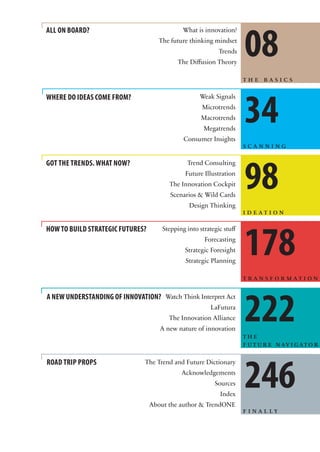
08
ALL ON BOARD?                                 What is innovation?
                                     The future thinking mindset
                                                            Trends
                                            The Diffusion Theory

                                                                      the basics


                                                                      34
WHERE DO IDEAS COME FROM?                           Weak Signals
                                                     Microtrends
                                                     Macrotrends
                                                      Megatrends
                                              Consumer Insights
                                                                      scanning


                                                                      98
GOT THE TRENDS. WHAT NOW?                      Trend Consulting
                                               Future Illustration
                                        The Innovation Cockpit
                                         Scenarios & Wild Cards
                                                Design Thinking
                                                                      ideation


                                                                      178
HOW TO BUILD STRATEGIC FUTURES?       Stepping into strategic stuff
                                                      Forecasting
                                               Strategic Foresight
                                               Strategic Planning

                                                                      transformation


                                                                      222
A NEW UNDERSTANDING OF INNOVATION? Watch Think Interpret Act
                                                         LaFutura
                                        The Innovation Alliance
                                     A new nature of innovation
                                                                      the
                                                                      f u t u r e n av i g at o r


                                                                      246
ROAD TRIP PROPS                The Trend and Future Dictionary
                                             Acknowledgements
                                                          Sources
                                                            Index
                                  About the author & TrendONE
                                                                      f i n a l ly
4


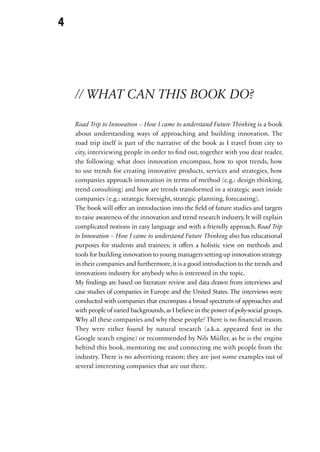
    // WHAT CAN THIS BOOK DO?

    Road Trip to Innovation – How I came to understand Future Thinking is a book
    about understanding ways of approaching and building innovation. The
    road trip itself is part of the narrative of the book as I travel from city to
    city, interviewing people in order to find out, together with you dear reader,
    the following: what does innovation encompass, how to spot trends, how
    to use trends for creating innovative products, services and strategies, how
    companies approach innovation in terms of method (e.g.: design thinking,
    trend consulting) and how are trends transformed in a strategic asset inside
    companies (e.g.: strategic foresight, strategic planning, forecasting).
    The book will offer an introduction into the field of future studies and targets
    to raise awareness of the innovation and trend research industry. It will explain
    complicated notions in easy language and with a friendly approach. Road Trip
    to Innovation – How I came to understand Future Thinking also has educational
    purposes for students and trainees; it offers a holistic view on methods and
    tools for building innovation to young managers setting up innovation strategy
    in their companies and furthermore, it is a good introduction to the trends and
    innovations industry for anybody who is interested in the topic.
    My findings are based on literature review and data drawn from interviews and
    case studies of companies in Europe and the United States. The interviews were
    conducted with companies that encompass a broad spectrum of approaches and
    with people of varied backgrounds, as I believe in the power of poly-social groups.
    Why all these companies and why these people? There is no financial reason.
    They were either found by natural research (a.k.a. appeared first in the
    Google search engine) or recommended by Nils Müller, as he is the engine
    behind this book, mentoring me and connecting me with people from the
    industry. There is no advertising reason; they are just some examples out of
    several interesting companies that are out there.
No.01                                                                             5

                                                         creative
                                                                  idea


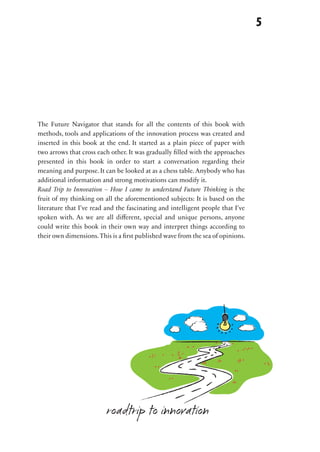
 The Future Navigator that stands for all the contents of this book with
 methods, tools and applications of the innovation process was created and
 inserted in this book at the end. It started as a plain piece of paper with

No.02
 two arrows that cross each other. It was gradually filled with the approaches
 presented in this book in order to start a conversation regarding their
 meaning and purpose. It can be looked at as a chess table. Anybody who has
 additional information and strong motivations can modify it.
 Road Trip to Innovation – How I came to understand Future Thinking is the
 fruit of my thinking on all the aforementioned subjects: It is based on the
                                                             innovation
 literature that I’ve read and the fascinating and intelligent people that I’ve
 spoken with. As we are all different, special and unique persons, anyone
 could write this book in their own way and interpret things according to
 their own dimensions. This is a first published wave from the sea of opinions.


No.03


No.04                     roadtrip to innovation
all on board?


                                     The Basics
                                             What is innovation? 12

                                     The future thinking mindset 16

                                                         Trends 22

                                           The Diffusion Theory 29


Tensta Konsthall by frontdesign.se
12   the basics


     // WHAT IS INNOVATION?

     [ĭn’ -vā’sh n]
         e       e
     1 the introduction of something new;
     2 a n e w i d e a , m e t h o d , o r d e v i c e : n ov e lt y.

     Innovation is a change; it is “new stuff that is made useful” as Max McKeon
     writes in his book The Truth About Innovation. Therefore, the innovation
     process, in this book, refers to the journey one has to make in order to obtain
     a new, cool, innovative idea and how to manage it. In a nutshell, it is about
     how to get the idea and what you can do with it to make it valuable.
     The Organization for Economic Cooperation and Development (OECD)
     report on the New Nature of Innovation states that a new nature of innovation
     is emerging. How? “Innovation is no longer mainly about science and
     technology. Firms can innovate in other ways. Co-creation, user involvement,
     environmental and societal challenges increasingly drive innovation today.
     Collaborative, global networking and new public private partnerships are
     becoming crucial elements in companies’ innovation process.”
     In the early 1990s innovation equaled product development; this approach
     was actually much too narrow. But the modern approach is also problematic
     because the plasticity of this term turned the meaning of innovation into
     a catch phrase.
     Nowadays, everything that is providing value for a company is being
     referred to as an innovation. For some companies it may be as simple as
     gathering around for a pizza on a Friday night at the office in order to create
     a better organizational climate thus internally providing a better basis for
     innovation and creativity. As for others, it cannot be called innovation until
     the brilliant idea that provides value is marketed – like creating an app that
     tells you the ingredients of the pizza just by scanning the barcode of the box.
     So, it all depends on how deep you go into the term of innovation, if just
     about anything can be interpreted as an innovation. But it shouldn’t be this
     way. In my opinion, the prior example dilutes its powers.
the basics
                                                                                         13


THE FIRST AIRPLANE
These days it seems that innovation as a noun has been thrown into so many
contexts that it has become hype. This makes it difficult for its meaning
to be securely locked in a box. For this reason, it becomes subjective and
highly interpretative. The good thing is the popularity of the word can
only do well to the world. Innovation turns out to be the source and, in the
same time, the target for more and more strategies. Martin Kruse, futurist
at the Copenhagen Institute for Future Studies (CIFS), states that “research
into innovation offers insights that can benefit everyone working with
organizational development, management, finance or product development.”
Defining what innovation means was giving me a hard time. Every answer
I got was competing in being more poetic than the one before. Here is one
particularly poetic definition coming from the Future Driven Innovation
paper from CIFS: “Shakespeare calls Man the ‘paragon of animals’ the            ,
greatest work in the history of evolution. This is because we have a brain
with 100 billion cells and so the ability to change the world around us to
give ourselves a better chance of survival. We develop ourselves through
creative production, a process that, since the dawn of financial markets, has
been known as innovation.”
From the same source, here comes the practical definition: “Innovation has
historically been regarded as inventing a new product, producing it and putting it
on the market. It is the result of a creative process with emphasis on value creation.
Today, innovation can happen anywhere in the company. The value created can
be internal, as is the case with human resources, or directed out to the customer as
a product on the shelf. The point is that value is created and reaches the customer
in some way.  ”
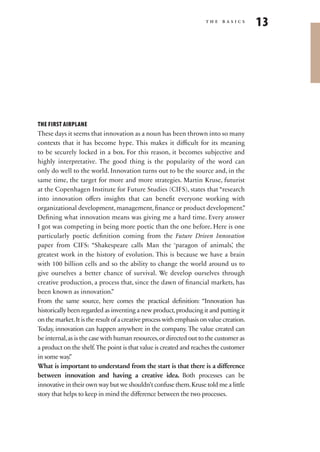
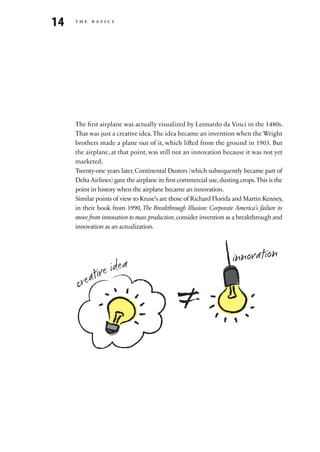
What is important to understand from the start is that there is a difference
between innovation and having a creative idea. Both processes can be
innovative in their own way but we shouldn’t confuse them. Kruse told me a little
story that helps to keep in mind the difference between the two processes.
14   the basics


     The first airplane was actually visualized by Leonardo da Vinci in the 1480s.
     That was just a creative idea. The idea became an invention when the Wright
     brothers made a plane out of it, which lifted from the ground in 1903. But
     the airplane, at that point, was still not an innovation because it was not yet
     marketed.
     Twenty-one years later, Continental Dusters (which subsequently became part of
     Delta Airlines) gave the airplane its first commercial use, dusting crops. This is the
     point in history when the airplane became an innovation.
     Similar points of view to Kruse’s are those of Richard Florida and Martin Kenney,
     in their book from 1990, The Breakthrough Illusion: Corporate America’s failure to
     move from innovation to mass production, consider invention as a breakthrough and
     innovation as an actualization.


                  a                                                   innovation
           ive ide

                                                ≠
      creat
the basics
                                                                                             29


                 // THE DIFFUSION THEORY

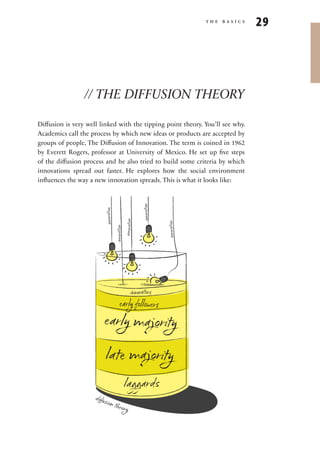
Diffusion is very well linked with the tipping point theory. You’ll see why.
Academics call the process by which new ideas or products are accepted by
groups of people, The Diffusion of Innovation. The term is coined in 1962
by Everett Rogers, professor at University of Mexico. He set up five steps
of the diffusion process and he also tried to build some criteria by which
innovations spread out faster. He explores how the social environment
influences the way a new innovation spreads. This is what it looks like:
                                                      innovation
                        innovation


                                    in n o va tio n


                                                                   innovation
                                 innovation


                                               i n novators
                                     early followers
                         early majority

                         late majority
                                         laggards
                     diffus
                          ion th
                                eory
36       scanning


WEAK SIGNALS
                 HOW TO BOIL A FROG
                 If you drop a frog into a kettle of boiling water it will definitely try to escape.
                 The reason being the temperature difference is too extreme (20°-100°). However,
                 if you put a frog in a kettle of water at room temperature and then start to
                 slowly warm the water, the frog will hardly even notice when the water starts
                 to boil.
                 The moral of this story: we easily adapt to changes; we may not even
                 notice them if they happen gradually. With this funny and insightful tale
                 I began my morning discussion with Elina Hiltunen in Helsinki.
                 Elina Hiltunen, founder of What’s Next Consulting, carried out her doctoral
Elina Hiltunen
                 thesis about using weak signals in organisational environment and has been
                 interested in this subject since 1998. She is now Finland’s leading expert on
                 weak signals and focuses on issues like anticipating and innovating future
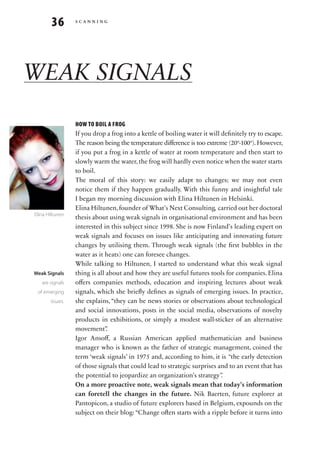
                 changes by utilising them. Through weak signals (the first bubbles in the
                 water as it heats) one can foresee changes.
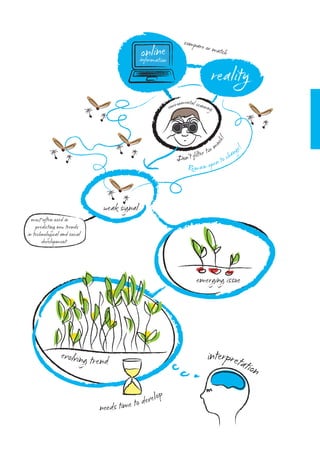
                 While talking to Hiltunen, I started to understand what this weak signal
Weak Signals     thing is all about and how they are useful futures tools for companies. Elina
   are signals   offers companies methods, education and inspiring lectures about weak
 of emerging     signals, which she briefly defines as signals of emerging issues. In practice,
       issues.   she explains, “they can be news stories or observations about technological
                 and social innovations, posts in the social media, observations of novelty
                 products in exhibitions, or simply a modest wall-sticker of an alternative
                 movement”    .
                 Igor Ansoff, a Russian American applied mathematician and business
                 manager who is known as the father of strategic management, coined the
                 term ‘weak signals’ in 1975 and, according to him, it is “the early detection
                 of those signals that could lead to strategic surprises and to an event that has
                 the potential to jeopardize an organization’s strategy”.
                 On a more proactive note, weak signals mean that today’s information
                 can foretell the changes in the future. Nik Baerten, future explorer at
                 Pantopicon, a studio of future explorers based in Belgium, expounds on the
                 subject on their blog: “Change often starts with a ripple before it turns into
compar
                                                  online
                                                                             e or ma
                                                                                            tch
                                                  information

                                                                                       reality
                                                                     onmental scann
                                                                envir              ing


                                                                                         !
                                                                                      uch
                                                                                       oo m            e!
                                                                            i lt e r t             ang
                                                                    Don‘t f                 to c
                                                                                                 h
                                                                       R e m ain       open


                                    weak signal
 most often used in
most often used in predicting
    predicting new trends
  new trends in technological
in technological and social
   and social development
       development


                                                                               emerging issue


                 e v olvi n g
                                tren d                                               interpreta
                                                                                               tion

                                                 deve   lo p
                                   needs time to
248   the trend & future dictionary


THE TREND&FUTURE
DICTIONARY
       A collection of definitions picked up from interviews, articles, books
       and blogs discovered and used during the road trip.


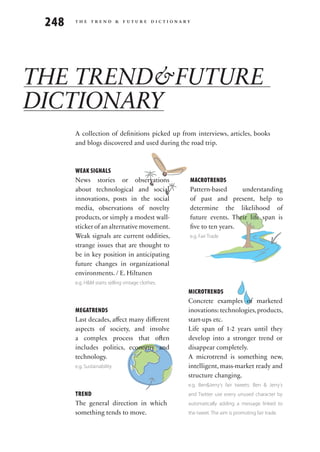
       WEAK SIGNALS
       News stories or observations               MACROTRENDS
       about technological and social             Pattern-based      understanding
       innovations, posts in the social           of past and present, help to
       media, observations of novelty             determine the likelihood of
       products, or simply a modest wall-         future events. Their life span is
       sticker of an alternative movement.        five to ten years.                     macrotrend
       Weak signals are current oddities,         e.g. Fair Trade
       strange issues that are thought to
       be in key position in anticipating
       future changes in organizational
       environments. / E. Hiltunen
       e.g. H&M starts selling vintage clothes.
                                                  MICROTRENDS
                                                                                microtrend
                                                  Concrete examples of marketed
       MEGATRENDS                                 inovations: technologies, products,
       Last decades, affect many different        start-ups etc.
       aspects of society, and involve            Life span of 1-2 years until they
       a complex process that often               develop into a stronger trend or
       includes politics, economy and             disappear completely.
       technology.                                A microtrend is something new,
       e.g. Sustainability                        intelligent, mass-market ready and
                                                  structure changing.
                         dnertag                  e.g. Ben&Jerry‘s fair tweets: Ben & Jerry‘s
       TREND
                                 e   m            and Twitter use every unused character by
       The general direction in which             automatically adding a message linked to
       something tends to move.                   the tweet. The aim is promoting fair trade.
the trend & future dictionary
                                                                                     249


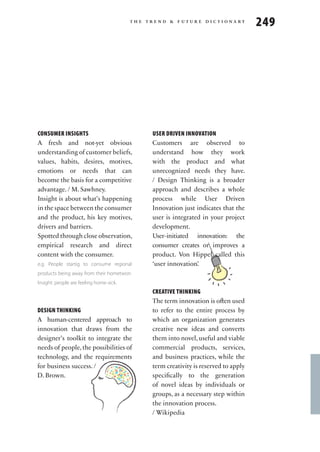
CONSUMER INSIGHTS                             USER DRIVEN INNOVATION
A fresh and not-yet obvious                   Customers are observed to
understanding of customer beliefs,            understand how they work
values, habits, desires, motives,             with the product and what
emotions or needs that can                    unrecognized needs they have.
become the basis for a competitive            / Design Thinking is a broader
advantage. / M. Sawhney.                      approach and describes a whole
Insight is about what’s happening             process while User Driven
in the space between the consumer             Innovation just indicates that the
and the product, his key motives,             user is integrated in your project
drivers and barriers.                         development.
Spotted through close observation,            User-initiated innovation: the
                                                                             tion
empirical research and direct
                                                                      innova
                                              consumer creates or improves a
content with the consumer.                    product. Von Hippel called this
e.g. People startig to consume regional       ‘user innovation’.
products being away from their hometwon.
Insight: people are feeling home-sick.
                                              CREATIVE THINKING
                                              The term innovation is often used
DESIGN THINKING                               to refer to the entire process by
A human-centered approach to                  which an organization generates
innovation that draws from the                creative new ideas and converts
designer’s toolkit to integrate the           them into novel, useful and viable
needs of people, the possibilities of         commercial products, services,
technology, and the requirements              and business practices, while the
for business success. /                       term creativity is reserved to apply
D. Brown.                                     specifically to the generation
                                              of novel ideas by individuals or
         gnikniht                             groups, as a necessary step within
                    ngised                    the innovation process.
                                              / Wikipedia
If there is one single book I recommend to get a joyful taste of what the work in
the fields of innovation and trends is like, then it is this impressive work by Delia
Dumitrescu. She tells the story of her mental and physical learning trip and easily
manages to shed light on and give answers to most of the pivital questions an
outsider would ask.
Dr. Pero Mićić, CEO FutureManagementGroup


‘Road Trip to Innovation’ is a fun to read, non-pretentious exploration into
the world of innovation told through a refreshing and honest voice.
It’s not about making grandiose statements, it simply gathers and compiles
information from the movers and shakers of innovation into one comprehensive
look; and more often than not, that’s all you want and need – simple, honest, and
comprehensive.
Susan M. Choi, Director of Strategy + Innovation, CScout Inc.


As a ‘Trend Passionionate’ person I love to work with insights and trends as
inspiration for idea and concept development.
The term ‘trends’ covers a broad variety of definitions. This is both chance and
confusion simultaneously.
For my daily innovation work I aspired a kind of navigation tool. ‘Road Trip to
Innovation’ is the perfect synergy of this type of tool: educational and beneficial
concerning the various perspectives of future research and it is fun to read – be
inspired!
Jens Bode, International Foresight Manager at Henkel AG & Co. KGaA


ISBN 978-3-00-035736-7

Roadtrip To Innovation

  • 1.
    // ROAD TRIP TO INNO VATION HOW I CAME TO UNDERSTAND FUTURE THINKING Delia Dumitrescu POWERED BY TRENDONE
  • 2.
    Road Trip toInnovation – How I came to understand Future Thinking is an investigative tale about a friendly and curious mind that sets-off on a road trip to find out what inno- vation is truly made of. Highlighting expert interviews and companies that are heralded for their know-how in the fields of future studies, innovation and trend research, the book offers an introduction to the theory and methodology behind these complicated notions in easy and refreshing language.
  • 3.
    08 ALL ON BOARD? What is innovation? The future thinking mindset Trends The Diffusion Theory the basics 34 WHERE DO IDEAS COME FROM? Weak Signals Microtrends Macrotrends Megatrends Consumer Insights scanning 98 GOT THE TRENDS. WHAT NOW? Trend Consulting Future Illustration The Innovation Cockpit Scenarios & Wild Cards Design Thinking ideation 178 HOW TO BUILD STRATEGIC FUTURES? Stepping into strategic stuff Forecasting Strategic Foresight Strategic Planning transformation 222 A NEW UNDERSTANDING OF INNOVATION? Watch Think Interpret Act LaFutura The Innovation Alliance A new nature of innovation the f u t u r e n av i g at o r 246 ROAD TRIP PROPS The Trend and Future Dictionary Acknowledgements Sources Index About the author & TrendONE f i n a l ly
  • 4.
    4 // WHAT CAN THIS BOOK DO? Road Trip to Innovation – How I came to understand Future Thinking is a book about understanding ways of approaching and building innovation. The road trip itself is part of the narrative of the book as I travel from city to city, interviewing people in order to find out, together with you dear reader, the following: what does innovation encompass, how to spot trends, how to use trends for creating innovative products, services and strategies, how companies approach innovation in terms of method (e.g.: design thinking, trend consulting) and how are trends transformed in a strategic asset inside companies (e.g.: strategic foresight, strategic planning, forecasting). The book will offer an introduction into the field of future studies and targets to raise awareness of the innovation and trend research industry. It will explain complicated notions in easy language and with a friendly approach. Road Trip to Innovation – How I came to understand Future Thinking also has educational purposes for students and trainees; it offers a holistic view on methods and tools for building innovation to young managers setting up innovation strategy in their companies and furthermore, it is a good introduction to the trends and innovations industry for anybody who is interested in the topic. My findings are based on literature review and data drawn from interviews and case studies of companies in Europe and the United States. The interviews were conducted with companies that encompass a broad spectrum of approaches and with people of varied backgrounds, as I believe in the power of poly-social groups. Why all these companies and why these people? There is no financial reason. They were either found by natural research (a.k.a. appeared first in the Google search engine) or recommended by Nils Müller, as he is the engine behind this book, mentoring me and connecting me with people from the industry. There is no advertising reason; they are just some examples out of several interesting companies that are out there.
  • 5.
    No.01 5 creative idea The Future Navigator that stands for all the contents of this book with methods, tools and applications of the innovation process was created and inserted in this book at the end. It started as a plain piece of paper with No.02 two arrows that cross each other. It was gradually filled with the approaches presented in this book in order to start a conversation regarding their meaning and purpose. It can be looked at as a chess table. Anybody who has additional information and strong motivations can modify it. Road Trip to Innovation – How I came to understand Future Thinking is the fruit of my thinking on all the aforementioned subjects: It is based on the innovation literature that I’ve read and the fascinating and intelligent people that I’ve spoken with. As we are all different, special and unique persons, anyone could write this book in their own way and interpret things according to their own dimensions. This is a first published wave from the sea of opinions. No.03 No.04 roadtrip to innovation
  • 7.
    all on board? The Basics What is innovation? 12 The future thinking mindset 16 Trends 22 The Diffusion Theory 29 Tensta Konsthall by frontdesign.se
  • 8.
    12 the basics // WHAT IS INNOVATION? [ĭn’ -vā’sh n] e e 1 the introduction of something new; 2 a n e w i d e a , m e t h o d , o r d e v i c e : n ov e lt y. Innovation is a change; it is “new stuff that is made useful” as Max McKeon writes in his book The Truth About Innovation. Therefore, the innovation process, in this book, refers to the journey one has to make in order to obtain a new, cool, innovative idea and how to manage it. In a nutshell, it is about how to get the idea and what you can do with it to make it valuable. The Organization for Economic Cooperation and Development (OECD) report on the New Nature of Innovation states that a new nature of innovation is emerging. How? “Innovation is no longer mainly about science and technology. Firms can innovate in other ways. Co-creation, user involvement, environmental and societal challenges increasingly drive innovation today. Collaborative, global networking and new public private partnerships are becoming crucial elements in companies’ innovation process.” In the early 1990s innovation equaled product development; this approach was actually much too narrow. But the modern approach is also problematic because the plasticity of this term turned the meaning of innovation into a catch phrase. Nowadays, everything that is providing value for a company is being referred to as an innovation. For some companies it may be as simple as gathering around for a pizza on a Friday night at the office in order to create a better organizational climate thus internally providing a better basis for innovation and creativity. As for others, it cannot be called innovation until the brilliant idea that provides value is marketed – like creating an app that tells you the ingredients of the pizza just by scanning the barcode of the box. So, it all depends on how deep you go into the term of innovation, if just about anything can be interpreted as an innovation. But it shouldn’t be this way. In my opinion, the prior example dilutes its powers.
  • 9.
    the basics 13 THE FIRST AIRPLANE These days it seems that innovation as a noun has been thrown into so many contexts that it has become hype. This makes it difficult for its meaning to be securely locked in a box. For this reason, it becomes subjective and highly interpretative. The good thing is the popularity of the word can only do well to the world. Innovation turns out to be the source and, in the same time, the target for more and more strategies. Martin Kruse, futurist at the Copenhagen Institute for Future Studies (CIFS), states that “research into innovation offers insights that can benefit everyone working with organizational development, management, finance or product development.” Defining what innovation means was giving me a hard time. Every answer I got was competing in being more poetic than the one before. Here is one particularly poetic definition coming from the Future Driven Innovation paper from CIFS: “Shakespeare calls Man the ‘paragon of animals’ the , greatest work in the history of evolution. This is because we have a brain with 100 billion cells and so the ability to change the world around us to give ourselves a better chance of survival. We develop ourselves through creative production, a process that, since the dawn of financial markets, has been known as innovation.” From the same source, here comes the practical definition: “Innovation has historically been regarded as inventing a new product, producing it and putting it on the market. It is the result of a creative process with emphasis on value creation. Today, innovation can happen anywhere in the company. The value created can be internal, as is the case with human resources, or directed out to the customer as a product on the shelf. The point is that value is created and reaches the customer in some way. ” What is important to understand from the start is that there is a difference between innovation and having a creative idea. Both processes can be innovative in their own way but we shouldn’t confuse them. Kruse told me a little story that helps to keep in mind the difference between the two processes.
  • 10.
    14 the basics The first airplane was actually visualized by Leonardo da Vinci in the 1480s. That was just a creative idea. The idea became an invention when the Wright brothers made a plane out of it, which lifted from the ground in 1903. But the airplane, at that point, was still not an innovation because it was not yet marketed. Twenty-one years later, Continental Dusters (which subsequently became part of Delta Airlines) gave the airplane its first commercial use, dusting crops. This is the point in history when the airplane became an innovation. Similar points of view to Kruse’s are those of Richard Florida and Martin Kenney, in their book from 1990, The Breakthrough Illusion: Corporate America’s failure to move from innovation to mass production, consider invention as a breakthrough and innovation as an actualization. a innovation ive ide ≠ creat
  • 11.
    the basics 29 // THE DIFFUSION THEORY Diffusion is very well linked with the tipping point theory. You’ll see why. Academics call the process by which new ideas or products are accepted by groups of people, The Diffusion of Innovation. The term is coined in 1962 by Everett Rogers, professor at University of Mexico. He set up five steps of the diffusion process and he also tried to build some criteria by which innovations spread out faster. He explores how the social environment influences the way a new innovation spreads. This is what it looks like: innovation innovation in n o va tio n innovation innovation i n novators early followers early majority late majority laggards diffus ion th eory
  • 12.
    36 scanning WEAK SIGNALS HOW TO BOIL A FROG If you drop a frog into a kettle of boiling water it will definitely try to escape. The reason being the temperature difference is too extreme (20°-100°). However, if you put a frog in a kettle of water at room temperature and then start to slowly warm the water, the frog will hardly even notice when the water starts to boil. The moral of this story: we easily adapt to changes; we may not even notice them if they happen gradually. With this funny and insightful tale I began my morning discussion with Elina Hiltunen in Helsinki. Elina Hiltunen, founder of What’s Next Consulting, carried out her doctoral Elina Hiltunen thesis about using weak signals in organisational environment and has been interested in this subject since 1998. She is now Finland’s leading expert on weak signals and focuses on issues like anticipating and innovating future changes by utilising them. Through weak signals (the first bubbles in the water as it heats) one can foresee changes. While talking to Hiltunen, I started to understand what this weak signal Weak Signals thing is all about and how they are useful futures tools for companies. Elina are signals offers companies methods, education and inspiring lectures about weak of emerging signals, which she briefly defines as signals of emerging issues. In practice, issues. she explains, “they can be news stories or observations about technological and social innovations, posts in the social media, observations of novelty products in exhibitions, or simply a modest wall-sticker of an alternative movement” . Igor Ansoff, a Russian American applied mathematician and business manager who is known as the father of strategic management, coined the term ‘weak signals’ in 1975 and, according to him, it is “the early detection of those signals that could lead to strategic surprises and to an event that has the potential to jeopardize an organization’s strategy”. On a more proactive note, weak signals mean that today’s information can foretell the changes in the future. Nik Baerten, future explorer at Pantopicon, a studio of future explorers based in Belgium, expounds on the subject on their blog: “Change often starts with a ripple before it turns into
  • 13.
    compar online e or ma tch information reality onmental scann envir ing ! uch oo m e! i lt e r t ang Don‘t f to c h R e m ain open weak signal most often used in most often used in predicting predicting new trends new trends in technological in technological and social and social development development emerging issue e v olvi n g tren d interpreta tion deve lo p needs time to
  • 14.
    248 the trend & future dictionary THE TREND&FUTURE DICTIONARY A collection of definitions picked up from interviews, articles, books and blogs discovered and used during the road trip. WEAK SIGNALS News stories or observations MACROTRENDS about technological and social Pattern-based understanding innovations, posts in the social of past and present, help to media, observations of novelty determine the likelihood of products, or simply a modest wall- future events. Their life span is sticker of an alternative movement. five to ten years. macrotrend Weak signals are current oddities, e.g. Fair Trade strange issues that are thought to be in key position in anticipating future changes in organizational environments. / E. Hiltunen e.g. H&M starts selling vintage clothes. MICROTRENDS microtrend Concrete examples of marketed MEGATRENDS inovations: technologies, products, Last decades, affect many different start-ups etc. aspects of society, and involve Life span of 1-2 years until they a complex process that often develop into a stronger trend or includes politics, economy and disappear completely. technology. A microtrend is something new, e.g. Sustainability intelligent, mass-market ready and structure changing. dnertag e.g. Ben&Jerry‘s fair tweets: Ben & Jerry‘s TREND e m and Twitter use every unused character by The general direction in which automatically adding a message linked to something tends to move. the tweet. The aim is promoting fair trade.
  • 15.
    the trend &future dictionary 249 CONSUMER INSIGHTS USER DRIVEN INNOVATION A fresh and not-yet obvious Customers are observed to understanding of customer beliefs, understand how they work values, habits, desires, motives, with the product and what emotions or needs that can unrecognized needs they have. become the basis for a competitive / Design Thinking is a broader advantage. / M. Sawhney. approach and describes a whole Insight is about what’s happening process while User Driven in the space between the consumer Innovation just indicates that the and the product, his key motives, user is integrated in your project drivers and barriers. development. Spotted through close observation, User-initiated innovation: the tion empirical research and direct innova consumer creates or improves a content with the consumer. product. Von Hippel called this e.g. People startig to consume regional ‘user innovation’. products being away from their hometwon. Insight: people are feeling home-sick. CREATIVE THINKING The term innovation is often used DESIGN THINKING to refer to the entire process by A human-centered approach to which an organization generates innovation that draws from the creative new ideas and converts designer’s toolkit to integrate the them into novel, useful and viable needs of people, the possibilities of commercial products, services, technology, and the requirements and business practices, while the for business success. / term creativity is reserved to apply D. Brown. specifically to the generation of novel ideas by individuals or gnikniht groups, as a necessary step within ngised the innovation process. / Wikipedia
  • 16.
    If there isone single book I recommend to get a joyful taste of what the work in the fields of innovation and trends is like, then it is this impressive work by Delia Dumitrescu. She tells the story of her mental and physical learning trip and easily manages to shed light on and give answers to most of the pivital questions an outsider would ask. Dr. Pero Mićić, CEO FutureManagementGroup ‘Road Trip to Innovation’ is a fun to read, non-pretentious exploration into the world of innovation told through a refreshing and honest voice. It’s not about making grandiose statements, it simply gathers and compiles information from the movers and shakers of innovation into one comprehensive look; and more often than not, that’s all you want and need – simple, honest, and comprehensive. Susan M. Choi, Director of Strategy + Innovation, CScout Inc. As a ‘Trend Passionionate’ person I love to work with insights and trends as inspiration for idea and concept development. The term ‘trends’ covers a broad variety of definitions. This is both chance and confusion simultaneously. For my daily innovation work I aspired a kind of navigation tool. ‘Road Trip to Innovation’ is the perfect synergy of this type of tool: educational and beneficial concerning the various perspectives of future research and it is fun to read – be inspired! Jens Bode, International Foresight Manager at Henkel AG & Co. KGaA ISBN 978-3-00-035736-7