Προσυμπτωματικός
Έλεγχος
Υγείας
Ευάγγελος Α. Φραγκούλης, MD, MSc
Γενικός Οικογενειακός Ιατρός
Αν. Αρχίατρος ΕΔΟΕΑΠ
Council Member European Primary Care Cardiovascular Society
Delivering
Preventive Care
Earlier
in Lower Cost Settings
is the key for the success of
Value Based Care.
Providers must focus on improving
individual and population health,
reducing the number of avoidable
emergency room visits, hospitalizations
and readmissions and significantly
improving the patients outcomes at an
earlier point across their patient
population.
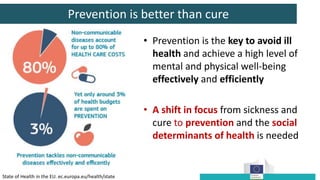
Prevention is better than cure
• Prevention is the key to avoid ill
health and achieve a high level of
mental and physical well-being
effectively and efficiently
• A shift in focus from sickness and
cure to prevention and the social
determinants of health is needed
State of Health in the EU. ec.europa.eu/health/state
Preventive Care
• people without specific complaints
• undergo interventions to identify and modify risk factors to avoid the
onset of disease or
• to find disease early in its course so that early treatment prevents
illness.
Risks associated with the highest number of deaths worldwide
for both sexes combined, all ages, in 2019
0 2 4 6 8 10 12
Number of deaths (millions)
Alcohol use Child and maternal malnutrition Kidney dysfunction High LDL
High body-mass index High fasting plasma glucose Air pollution Dietary risks
Tobacco High systolic blood pressure
http://www.healthdata.org/gbd/2019
Παράγοντες κινδύνου για χρόνια νοσήματα
Preventing Chronic diseases. A vital investment. WHO 2005
Chronic Diseases can be prevented and controlled
Preventing Chronic diseases. A vital investment. WHO 2005
Η παρέμβαση πρέπει να ξεκινά από την ενδομήτρια ζωή
Breaking the vicious cycle of ill health and poverty
Χρόνια Νοσήματα & Φτώχεια
• Φαύλος κύκλος
• Οι φτωχοί είναι περισσότερο ευάλωτοι
• Αυξημένο κίνδυνο έκθεσης σε παράγοντες
κινδύνου
• Ελαττωμένη πρόσβαση σε υπηρεσίες υγείας
Preventing Chronic diseases. A vital investment. WHO 2005
“If a patient asks a medical practitioner for help, the doctor does the
best he can. He is not responsible for defects in medical
knowledge.
If, however, the practitioner initiates screening procedures, he
is in a very different situation.
He should have conclusive evidence that screening can alter
the natural history of disease in a significant proportion of
those screened.”
Archie Cochrane and Walter Holland, 1971
Annual Wellness Visit (AWV)
• Visit to develop or update a Personalized
Prevention Plan (PPP) and
perform a Health Risk Assessment (HRA)
• ✔ Covered once every 12 months
• ✔ Patient pays nothing
Perform
Health
Risk
Assessment
(HRA)
Establish patient’s medical and family history
Establish list of current providers and suppliers
Measure
Detect any cognitive impairment patients may have
Review patient’s potential depression risk factors,
including current or past experiences with depression
or other mood disorders
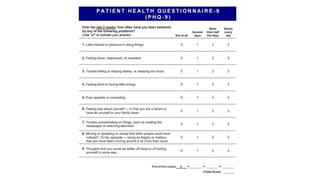
Geriatric Depression Scale - Greek version
K.N. Fountoulakis, M Tsolaki, A. Iacovides, J. Yesavage, R O'Hara, A Kazis and Ch Ierodiakonou.:
The Validation of the Short Form of Geriatric Depression Scale (GDS) in Greece
published in "Aging:Clinical and Experimental Research, 1999;11:367-372"
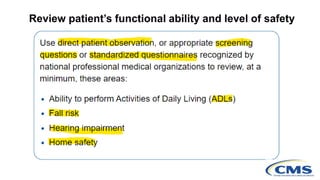
Review patient’s functional ability and level of safety
Establish an appropriate written screening schedule for
patients, such as a checklist for next 5–10 years
Establish list of patient risk factors and conditions
where primary, secondary, or tertiary interventions are
recommended or underway
Provide patient’s personalized health advice and
appropriate referrals to health education or preventive counseling
services or programs
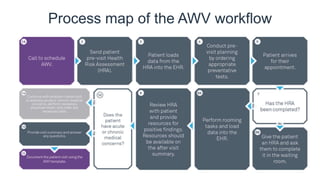
Process map of the AWV workflow
• CMS now recognizes the important work done by primary care physicians
that is different from the traditional “sick visit” model.
• Emphasized the health care provider's (HCP) role in helping patients
understand the importance of prevention
• By focusing the AWV on preventive screening, safety issues (eg, falls),
and social needs (eg, food insecurity, transportation), patients' qualities
of life can be enhanced.
• Setting up a system within your practice that involves contributions from
all members of the care team will maximize both patient benefit and
practice reimbursement for this important work.
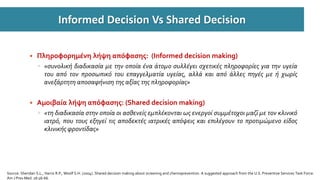
Informed Decision Vs Shared Decision
 Πληροφορηµένη λήψη απόφασης: (Informed decision making)
◦ «συνολική διαδικασία µε την οποία ένα άτοµο συλλέγει σχετικές πληροφορίες για την υγεία
του από τον προσωπικό του επαγγελματία υγείας, αλλά και από άλλες πηγές µε ή χωρίς
ανεξάρτητη αποσαφήνιση της αξίας της πληροφορίας»
 Aµοιβαία λήψη απόφασης: (Shared decision making)
◦ «τη διαδικασία στην οποία οι ασθενείς εµπλέκονται ως ενεργοί συμμέτοχοι µαζί µε τον κλινικό
ιατρό, που τους εξηγεί τις αποδεκτές ιατρικές απόψεις και επιλέγουν το προτιμώμενο είδος
κλινικής φροντίδας»
Source: Sheridan S.L., Harris R.P., Woolf S.H. (2004). Shared decision making about screening and chemoprevention. A suggested approach from the U.S. Preventive Services Task Force.
Am J Prev Med. 26:56-66.
Informed decision
The benefits of breast cancer
screening on important
outcomes,
including
preventing death from breast
cancer,
reducing rates of advanced breast
cancer,
less aggressive surgery
(lumpectomy vs mastectomy),
less aggressive adjuvant therapy
and
improving quality of life.
The potential harms of breast
cancer screening, such as
overdiagnosis and
resulting overtreatment,
false-positive and false-negative test
results, and
adverse effects related to
breast cancer treatment
Benefit vs Harm
 In a meta-analysis of 11 randomized trials, the relative risk of breast cancer mortality for
women invited to screening compared with controls was 0·80 (95% CI 0·73—0·89), which is
a relative risk reduction of 20%.
 for every 10 000 UK women aged 50 years invited to screening for the next 20 years, 43
deaths from breast cancer would be prevented and 129 cases of breast cancer, invasive and
non-invasive, would be overdiagnosed
 ΟΝΕ breast cancer death prevented for about every THREE overdiagnosed cases
identified and treated.’
The Lancet 2012, 380; 9855:1778 - 1786
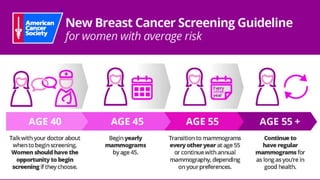
The Breast Cancer Screening Debate
• When to start screening
mammography?
• How often to have a mammogram?
• At what age woman should stop
getting mammograms?
Trends in Colorectal Cancer
Incidence Rates
• by Age and Year of Birth
• by Age and Year of Diagnosis
United States, 1975 to 2014
Data source: Surveillance, Epidemiology, and End Results
(SEER) program, SEER 9 registries, delayed adjusted rates,
1975-2014, National Cancer Institute.
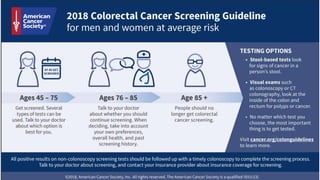
Options for CRC screening
Stool-based tests
• Fecal immunochemical test every y
• High-sensitivity, guaiac-based fecal occult blood test every y
• Multitarget stool DNA test every 3 y
Structural examinations
• Colonoscopy every 10 y
• CT colonography every 5 y
• Flexible sigmoidoscopy every 5 y
• Men should have a chance to make an informed decision with their health
care provider about whether to be screened for prostate cancer.
• The decision should be made after getting information about
the uncertainties, risks, and potential benefits of prostate cancer
screening.
• Men should not be screened unless they have received this information.
Prostate Cancer Screening- When to start?
• Age 50 for men who are at average risk of prostate cancer and
are expected to live at least 10 more years.
• Age 45 for men at high risk of developing prostate cancer
(African Americans, first-degree relative (father or brother)
with prostate cancer at an early age (<65y).
• Age 40 for men at even higher risk (≥ 1 first-degree relative
who had prostate cancer at an early age).
Men who want to be screened should get PSA +/- DRE
Factors that might raise PSA levels
• An enlarged prostate: Conditions such as benign prostatic hyperplasia (BPH), a non-cancerous enlargement
of the prostate that affects many men as they grow older, can raise PSA levels.
• Older age: PSA levels normally go up slowly as you get older, even if you have no prostate abnormality.
• Prostatitis: This is an infection or inflammation of the prostate gland, which can raise PSA levels.
• Ejaculation: This can make the PSA go up for a short time.This is why some doctors suggest that men abstain
from ejaculation for a day or two before testing.
• Riding a bicycle: Some studies have suggested that cycling may raise PSA levels for a short time (possibly
because the seat puts pressure on the prostate), although not all studies have found this.
• Certain urologic procedures: Some procedures done in a doctor’s office that affect the prostate, such as a
prostate biopsy or cystoscopy, can raise PSA levels for a short time. Some studies have suggested that a digital
rectal exam (DRE) might raise PSA levels slightly, although other studies have not found this. Still, if both a PSA
test and a DRE are being done during a doctor visit, some doctors advise having the blood drawn for the PSA
before having the DRE, just in case.
• Certain medicines: Taking male hormones like testosterone (or other medicines that raise testosterone levels)
may cause a rise in PSA.
• 5-alpha reductase inhibitors: Certain drugs used to treat BPH or urinary symptoms, such as finasteride or
dutasteride, can lower PSA levels.
Frequency of screening
the time between future screenings depends on the results of the
PSA blood test:
• PSA < 2.5 ng/mL - may only need to be retested every 2 years.
The most important thing to remember is to get
screened regularly, no matter which test you
get!
Those
• >65y
• had regular screening in the past 10 years with normal results
• no history of CIN2 or more serious diagnosis within the past 25 years
SHOULD STOP cervical cancer screening.
• People who have had a total hysterectomy (removal of the uterus and cervix) should
stop screening (such as Pap tests and HPV tests), unless the hysterectomy was done
as a treatment for cervical cancer or serious pre-cancer.
• People who have had a hysterectomy without removal of the cervix (called a supra-
cervical hysterectomy) should continue cervical cancer screening according to the
guidelines above.
• People who have been vaccinated against HPV should still follow these guidelines
for their age groups.
The ACS recommends annual screening for lung cancer with LDCT in adults aged 55
to 74 years in relatively good health who:
Πότε πρέπει να υποβάλλονται οι ασθενείς σε
Μέτρηση Οστικής Πυκνότητας;
Clinician’s guide to prevention and treatment of osteoporosis
International Osteoporosis Foundation and National Osteoporosis Foundation 2015
Osteoporosis to Prevent Fractures: Screening
June 26, 2018
Risk estimation: key messages
Recommendations for cardiovascular disease risk estimation
Systematic Coronary Risk Estimation chart
for
European populations
at
low cardiovascular disease risk
Calibrated country-specific versions are available for many
European countries and can be found at
www.heartscore.org
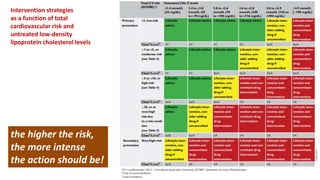
Intervention strategies
as a function of total
cardiovascular risk and
untreated low-density
lipoprotein cholesterol levels
the higher the risk,
the more intense
the action should be!
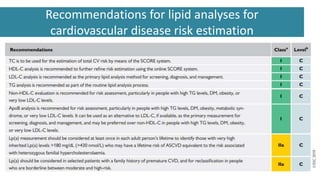
Recommendations for lipid analyses for
cardiovascular disease risk estimation
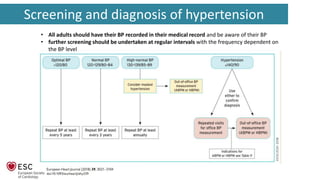
Screening and diagnosis of hypertension
• All adults should have their BP recorded in their medical record and be aware of their BP
• further screening should be undertaken at regular intervals with the frequency dependent on
the BP level
| 69
Standards of Medical Care in Diabetes - 2021. Diabetes Care 2021;44(Suppl. 1):S15-S33
| 70
CLASSIFICATION AND DIAGNOSIS OF DIABETES
Classification and Diagnosis of Diabetes:
Standards of Medical Care in Diabetes - 2021. Diabetes Care 2021;44(Suppl. 1):S15-S33
| 71
CLASSIFICATION AND DIAGNOSIS OF DIABETES
Classification and Diagnosis of Diabetes:
Standards of Medical Care in Diabetes - 2021. Diabetes Care 2021;44(Suppl. 1):S15-S33
| 72
CLASSIFICATION AND DIAGNOSIS OF DIABETES
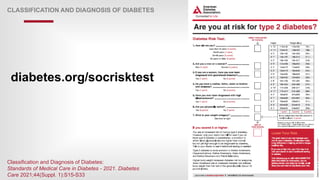
diabetes.org/socrisktest
Classification and Diagnosis of Diabetes:
Standards of Medical Care in Diabetes - 2021. Diabetes
Care 2021;44(Suppl. 1):S15-S33
Abdominal Aortic Aneurysm: Screening
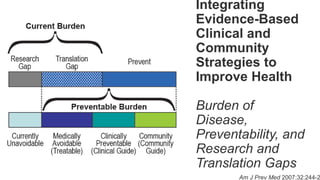
Integrating
Evidence-Based
Clinical and
Community
Strategies to
Improve Health
Burden of
Disease,
Preventability, and
Research and
Translation Gaps
Am J Prev Med 2007;32:244-2
Greater care complexity
• Studies estimate that it would take 7.4 hours to deliver all recommended preventive
services and 10.6 hours per working day to deliver all evidence-based care for chronic
conditions to a primary care panel.
• “These excessive demands contribute to long waiting times and inadequate quality of
care for patients.”
• Concern about one’s ability to manage complex, chronically ill patients may contribute to
driving career choice away from primary care.
Kimberly et al, Am J Public Health. 2003 3
Østbye et al, Ann Fam Med. 2005
Bodenheimer T. N Engl J Med. 2006
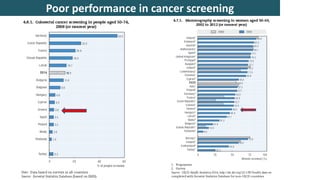
Poor performance in cancer screening
Cancer Doesn't Stop for COVID-19 and Neither Should
You
JAMA Netw Open. 2020;3(8):e2017267
Cancer Doesn't Stop for COVID-19 and Neither Should
You
• Concerns that the pandemic would delay the diagnosis and
treatment of some cancers with potentially serious
consequences.
• Delays in screening could mean that the “missed” cancers
might be larger and more advanced when they were
ultimately detected.
• The impact of the pandemic on overall cancer deaths will not
be clear for many years
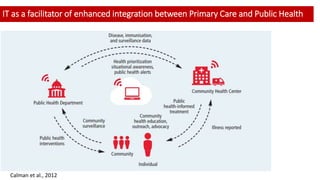
IT as a facilitator of enhanced integration between Primary Care and Public Health
Calman et al., 2012
Ψηφιακή ώθηση στο Εθνικό Πρόγραμμα Πρόληψης «Σπύρος Δοξιάδης»
• Δοκιμασμένα ψηφιακά εργαλεία – που αναδείχτηκαν
στο υπό εξέλιξη εμβολιαστικό πρόγραμμα «Ελευθερία»
• Οι γονείς θα λαμβάνουν προσωποποιημένα sms –
αντίστοιχα με αυτά που λαμβάνουν σήμερα μέσω της
πλατφόρμας emvolio.gov.gr – που θα τους υπενθυμίζουν
πότε πρέπει να κλείσουν το επόμενο ραντεβού με τον
παιδίατρο, ώστε να υποβληθούν τα παιδιά τους στον
τακτικό εμβολιασμό που προβλέπεται από το Εθνικό
Πρόγραμμα Εμβολιασμών
• Αντίστοιχο σύστημα υπενθύμισης και για τον κρίσιμο
αντιγριπικό εμβολιασμό που ξεκινά κάθε φθινόπωρο,
ενώ οι πολίτες θα λαμβάνουν επίσης υπενθύμιση για
κρίσιμες προληπτικές εξετάσεις, όπως αυτές που
αφορούν σε καρδιαγγειακά νοσήματα ή τα τεστ ΠΑΠ
κ.ο.κ.
Pay for Performance (P4P)
• financial incentives for reaching targets on predefined
performance measures
• providers are responsive to financial incentives
• commonest payment methods not designed to stimulate good
performance and separately creates incentives for undesired
behavior
• The main goal of P4P is to improve patient outcomes while
mitigating unintended consequences
• Contributing to better prevention and disease management/
including efficiency measures, could also mitigate cost growth
alexandre.lourenco@icloud.com
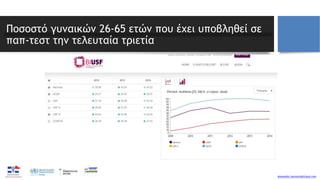
1,8x
Ποσοστό γυναικών 26-65 ετών που έχει υποβληθεί σε
παπ-τεστ την τελευταία τριετία
alexandre.lourenco@icloud.com
1,8x
Ποσοστό γυναικών 50-70 ετών που έχει υποβληθεί
σε μαστογραφία τα τελευταία 2 έτη

Προσυμπτωματικός Έλεγχος Υγείας

  • 1.
    Προσυμπτωματικός Έλεγχος Υγείας Ευάγγελος Α. Φραγκούλης,MD, MSc Γενικός Οικογενειακός Ιατρός Αν. Αρχίατρος ΕΔΟΕΑΠ Council Member European Primary Care Cardiovascular Society
  • 2.
    Delivering Preventive Care Earlier in LowerCost Settings is the key for the success of Value Based Care. Providers must focus on improving individual and population health, reducing the number of avoidable emergency room visits, hospitalizations and readmissions and significantly improving the patients outcomes at an earlier point across their patient population.
  • 3.
    Prevention is betterthan cure • Prevention is the key to avoid ill health and achieve a high level of mental and physical well-being effectively and efficiently • A shift in focus from sickness and cure to prevention and the social determinants of health is needed State of Health in the EU. ec.europa.eu/health/state
  • 4.
    Preventive Care • peoplewithout specific complaints • undergo interventions to identify and modify risk factors to avoid the onset of disease or • to find disease early in its course so that early treatment prevents illness.
  • 6.
    Risks associated withthe highest number of deaths worldwide for both sexes combined, all ages, in 2019 0 2 4 6 8 10 12 Number of deaths (millions) Alcohol use Child and maternal malnutrition Kidney dysfunction High LDL High body-mass index High fasting plasma glucose Air pollution Dietary risks Tobacco High systolic blood pressure http://www.healthdata.org/gbd/2019
  • 7.
    Παράγοντες κινδύνου γιαχρόνια νοσήματα Preventing Chronic diseases. A vital investment. WHO 2005
  • 9.
    Chronic Diseases canbe prevented and controlled Preventing Chronic diseases. A vital investment. WHO 2005
  • 10.
    Η παρέμβαση πρέπεινα ξεκινά από την ενδομήτρια ζωή
  • 12.
    Breaking the viciouscycle of ill health and poverty
  • 13.
    Χρόνια Νοσήματα &Φτώχεια • Φαύλος κύκλος • Οι φτωχοί είναι περισσότερο ευάλωτοι • Αυξημένο κίνδυνο έκθεσης σε παράγοντες κινδύνου • Ελαττωμένη πρόσβαση σε υπηρεσίες υγείας Preventing Chronic diseases. A vital investment. WHO 2005
  • 14.
    “If a patientasks a medical practitioner for help, the doctor does the best he can. He is not responsible for defects in medical knowledge. If, however, the practitioner initiates screening procedures, he is in a very different situation. He should have conclusive evidence that screening can alter the natural history of disease in a significant proportion of those screened.” Archie Cochrane and Walter Holland, 1971
  • 20.
    Annual Wellness Visit(AWV) • Visit to develop or update a Personalized Prevention Plan (PPP) and perform a Health Risk Assessment (HRA) • ✔ Covered once every 12 months • ✔ Patient pays nothing
  • 22.
  • 23.
  • 24.
    Establish list ofcurrent providers and suppliers
  • 25.
  • 26.
    Detect any cognitiveimpairment patients may have
  • 28.
    Review patient’s potentialdepression risk factors, including current or past experiences with depression or other mood disorders
  • 31.
    Geriatric Depression Scale- Greek version K.N. Fountoulakis, M Tsolaki, A. Iacovides, J. Yesavage, R O'Hara, A Kazis and Ch Ierodiakonou.: The Validation of the Short Form of Geriatric Depression Scale (GDS) in Greece published in "Aging:Clinical and Experimental Research, 1999;11:367-372"
  • 32.
    Review patient’s functionalability and level of safety
  • 33.
    Establish an appropriatewritten screening schedule for patients, such as a checklist for next 5–10 years
  • 34.
    Establish list ofpatient risk factors and conditions where primary, secondary, or tertiary interventions are recommended or underway
  • 35.
    Provide patient’s personalizedhealth advice and appropriate referrals to health education or preventive counseling services or programs
  • 36.
    Process map ofthe AWV workflow
  • 37.
    • CMS nowrecognizes the important work done by primary care physicians that is different from the traditional “sick visit” model. • Emphasized the health care provider's (HCP) role in helping patients understand the importance of prevention • By focusing the AWV on preventive screening, safety issues (eg, falls), and social needs (eg, food insecurity, transportation), patients' qualities of life can be enhanced. • Setting up a system within your practice that involves contributions from all members of the care team will maximize both patient benefit and practice reimbursement for this important work.
  • 38.
    Informed Decision VsShared Decision  Πληροφορηµένη λήψη απόφασης: (Informed decision making) ◦ «συνολική διαδικασία µε την οποία ένα άτοµο συλλέγει σχετικές πληροφορίες για την υγεία του από τον προσωπικό του επαγγελματία υγείας, αλλά και από άλλες πηγές µε ή χωρίς ανεξάρτητη αποσαφήνιση της αξίας της πληροφορίας»  Aµοιβαία λήψη απόφασης: (Shared decision making) ◦ «τη διαδικασία στην οποία οι ασθενείς εµπλέκονται ως ενεργοί συμμέτοχοι µαζί µε τον κλινικό ιατρό, που τους εξηγεί τις αποδεκτές ιατρικές απόψεις και επιλέγουν το προτιμώμενο είδος κλινικής φροντίδας» Source: Sheridan S.L., Harris R.P., Woolf S.H. (2004). Shared decision making about screening and chemoprevention. A suggested approach from the U.S. Preventive Services Task Force. Am J Prev Med. 26:56-66.
  • 39.
  • 40.
    The benefits ofbreast cancer screening on important outcomes, including preventing death from breast cancer, reducing rates of advanced breast cancer, less aggressive surgery (lumpectomy vs mastectomy), less aggressive adjuvant therapy and improving quality of life. The potential harms of breast cancer screening, such as overdiagnosis and resulting overtreatment, false-positive and false-negative test results, and adverse effects related to breast cancer treatment
  • 41.
    Benefit vs Harm In a meta-analysis of 11 randomized trials, the relative risk of breast cancer mortality for women invited to screening compared with controls was 0·80 (95% CI 0·73—0·89), which is a relative risk reduction of 20%.  for every 10 000 UK women aged 50 years invited to screening for the next 20 years, 43 deaths from breast cancer would be prevented and 129 cases of breast cancer, invasive and non-invasive, would be overdiagnosed  ΟΝΕ breast cancer death prevented for about every THREE overdiagnosed cases identified and treated.’ The Lancet 2012, 380; 9855:1778 - 1786
  • 42.
    The Breast CancerScreening Debate • When to start screening mammography? • How often to have a mammogram? • At what age woman should stop getting mammograms?
  • 46.
    Trends in ColorectalCancer Incidence Rates • by Age and Year of Birth • by Age and Year of Diagnosis United States, 1975 to 2014 Data source: Surveillance, Epidemiology, and End Results (SEER) program, SEER 9 registries, delayed adjusted rates, 1975-2014, National Cancer Institute.
  • 47.
    Options for CRCscreening Stool-based tests • Fecal immunochemical test every y • High-sensitivity, guaiac-based fecal occult blood test every y • Multitarget stool DNA test every 3 y Structural examinations • Colonoscopy every 10 y • CT colonography every 5 y • Flexible sigmoidoscopy every 5 y
  • 48.
    • Men shouldhave a chance to make an informed decision with their health care provider about whether to be screened for prostate cancer. • The decision should be made after getting information about the uncertainties, risks, and potential benefits of prostate cancer screening. • Men should not be screened unless they have received this information.
  • 50.
    Prostate Cancer Screening-When to start? • Age 50 for men who are at average risk of prostate cancer and are expected to live at least 10 more years. • Age 45 for men at high risk of developing prostate cancer (African Americans, first-degree relative (father or brother) with prostate cancer at an early age (<65y). • Age 40 for men at even higher risk (≥ 1 first-degree relative who had prostate cancer at an early age). Men who want to be screened should get PSA +/- DRE
  • 51.
    Factors that mightraise PSA levels • An enlarged prostate: Conditions such as benign prostatic hyperplasia (BPH), a non-cancerous enlargement of the prostate that affects many men as they grow older, can raise PSA levels. • Older age: PSA levels normally go up slowly as you get older, even if you have no prostate abnormality. • Prostatitis: This is an infection or inflammation of the prostate gland, which can raise PSA levels. • Ejaculation: This can make the PSA go up for a short time.This is why some doctors suggest that men abstain from ejaculation for a day or two before testing. • Riding a bicycle: Some studies have suggested that cycling may raise PSA levels for a short time (possibly because the seat puts pressure on the prostate), although not all studies have found this. • Certain urologic procedures: Some procedures done in a doctor’s office that affect the prostate, such as a prostate biopsy or cystoscopy, can raise PSA levels for a short time. Some studies have suggested that a digital rectal exam (DRE) might raise PSA levels slightly, although other studies have not found this. Still, if both a PSA test and a DRE are being done during a doctor visit, some doctors advise having the blood drawn for the PSA before having the DRE, just in case. • Certain medicines: Taking male hormones like testosterone (or other medicines that raise testosterone levels) may cause a rise in PSA. • 5-alpha reductase inhibitors: Certain drugs used to treat BPH or urinary symptoms, such as finasteride or dutasteride, can lower PSA levels.
  • 52.
    Frequency of screening thetime between future screenings depends on the results of the PSA blood test: • PSA < 2.5 ng/mL - may only need to be retested every 2 years.
  • 55.
    The most importantthing to remember is to get screened regularly, no matter which test you get! Those • >65y • had regular screening in the past 10 years with normal results • no history of CIN2 or more serious diagnosis within the past 25 years SHOULD STOP cervical cancer screening. • People who have had a total hysterectomy (removal of the uterus and cervix) should stop screening (such as Pap tests and HPV tests), unless the hysterectomy was done as a treatment for cervical cancer or serious pre-cancer. • People who have had a hysterectomy without removal of the cervix (called a supra- cervical hysterectomy) should continue cervical cancer screening according to the guidelines above. • People who have been vaccinated against HPV should still follow these guidelines for their age groups.
  • 57.
    The ACS recommendsannual screening for lung cancer with LDCT in adults aged 55 to 74 years in relatively good health who:
  • 58.
    Πότε πρέπει ναυποβάλλονται οι ασθενείς σε Μέτρηση Οστικής Πυκνότητας;
  • 59.
    Clinician’s guide toprevention and treatment of osteoporosis International Osteoporosis Foundation and National Osteoporosis Foundation 2015
  • 60.
    Osteoporosis to PreventFractures: Screening June 26, 2018
  • 63.
  • 64.
    Recommendations for cardiovasculardisease risk estimation
  • 65.
    Systematic Coronary RiskEstimation chart for European populations at low cardiovascular disease risk Calibrated country-specific versions are available for many European countries and can be found at www.heartscore.org
  • 66.
    Intervention strategies as afunction of total cardiovascular risk and untreated low-density lipoprotein cholesterol levels the higher the risk, the more intense the action should be!
  • 67.
    Recommendations for lipidanalyses for cardiovascular disease risk estimation
  • 68.
    Screening and diagnosisof hypertension • All adults should have their BP recorded in their medical record and be aware of their BP • further screening should be undertaken at regular intervals with the frequency dependent on the BP level
  • 69.
    | 69 Standards ofMedical Care in Diabetes - 2021. Diabetes Care 2021;44(Suppl. 1):S15-S33
  • 70.
    | 70 CLASSIFICATION ANDDIAGNOSIS OF DIABETES Classification and Diagnosis of Diabetes: Standards of Medical Care in Diabetes - 2021. Diabetes Care 2021;44(Suppl. 1):S15-S33
  • 71.
    | 71 CLASSIFICATION ANDDIAGNOSIS OF DIABETES Classification and Diagnosis of Diabetes: Standards of Medical Care in Diabetes - 2021. Diabetes Care 2021;44(Suppl. 1):S15-S33
  • 72.
    | 72 CLASSIFICATION ANDDIAGNOSIS OF DIABETES diabetes.org/socrisktest Classification and Diagnosis of Diabetes: Standards of Medical Care in Diabetes - 2021. Diabetes Care 2021;44(Suppl. 1):S15-S33
  • 73.
  • 74.
    Integrating Evidence-Based Clinical and Community Strategies to ImproveHealth Burden of Disease, Preventability, and Research and Translation Gaps Am J Prev Med 2007;32:244-2
  • 75.
    Greater care complexity •Studies estimate that it would take 7.4 hours to deliver all recommended preventive services and 10.6 hours per working day to deliver all evidence-based care for chronic conditions to a primary care panel. • “These excessive demands contribute to long waiting times and inadequate quality of care for patients.” • Concern about one’s ability to manage complex, chronically ill patients may contribute to driving career choice away from primary care. Kimberly et al, Am J Public Health. 2003 3 Østbye et al, Ann Fam Med. 2005 Bodenheimer T. N Engl J Med. 2006
  • 77.
    Poor performance incancer screening
  • 80.
    Cancer Doesn't Stopfor COVID-19 and Neither Should You JAMA Netw Open. 2020;3(8):e2017267
  • 81.
    Cancer Doesn't Stopfor COVID-19 and Neither Should You • Concerns that the pandemic would delay the diagnosis and treatment of some cancers with potentially serious consequences. • Delays in screening could mean that the “missed” cancers might be larger and more advanced when they were ultimately detected. • The impact of the pandemic on overall cancer deaths will not be clear for many years
  • 83.
    IT as afacilitator of enhanced integration between Primary Care and Public Health Calman et al., 2012
  • 84.
    Ψηφιακή ώθηση στοΕθνικό Πρόγραμμα Πρόληψης «Σπύρος Δοξιάδης» • Δοκιμασμένα ψηφιακά εργαλεία – που αναδείχτηκαν στο υπό εξέλιξη εμβολιαστικό πρόγραμμα «Ελευθερία» • Οι γονείς θα λαμβάνουν προσωποποιημένα sms – αντίστοιχα με αυτά που λαμβάνουν σήμερα μέσω της πλατφόρμας emvolio.gov.gr – που θα τους υπενθυμίζουν πότε πρέπει να κλείσουν το επόμενο ραντεβού με τον παιδίατρο, ώστε να υποβληθούν τα παιδιά τους στον τακτικό εμβολιασμό που προβλέπεται από το Εθνικό Πρόγραμμα Εμβολιασμών • Αντίστοιχο σύστημα υπενθύμισης και για τον κρίσιμο αντιγριπικό εμβολιασμό που ξεκινά κάθε φθινόπωρο, ενώ οι πολίτες θα λαμβάνουν επίσης υπενθύμιση για κρίσιμες προληπτικές εξετάσεις, όπως αυτές που αφορούν σε καρδιαγγειακά νοσήματα ή τα τεστ ΠΑΠ κ.ο.κ.
  • 85.
    Pay for Performance(P4P) • financial incentives for reaching targets on predefined performance measures • providers are responsive to financial incentives • commonest payment methods not designed to stimulate good performance and separately creates incentives for undesired behavior • The main goal of P4P is to improve patient outcomes while mitigating unintended consequences • Contributing to better prevention and disease management/ including efficiency measures, could also mitigate cost growth
  • 86.
    alexandre.lourenco@icloud.com 1,8x Ποσοστό γυναικών 26-65ετών που έχει υποβληθεί σε παπ-τεστ την τελευταία τριετία
  • 87.
    alexandre.lourenco@icloud.com 1,8x Ποσοστό γυναικών 50-70ετών που έχει υποβληθεί σε μαστογραφία τα τελευταία 2 έτη

Editor's Notes

  • #3 Η πρόληψη και έγκαιρη διάγνωση δυνατόν να γλιτώσει περισσότερο πολύπλοκες και ακριβές θεραπείες στο μέλλον, να φέρει ταχύτερη ανάρρωση, λιγότερες επιπλοκές
  • #78 Πτωχή απόδοση στην πρόληψη, όπως στον προσυμπτωματικό έλεγχο για καρκίνο
  • #87 Υπάρχουν δυο ειδη κέντρων υγείας που τρέχουν παράλληλα, τα uscp τα παραδοσιακά με μισθωτούς γιατρούς και τα usf, τα σύγχρονα με χρήση αποζημίωσης βάση απόδοσης, τα αποτελέσματα τους στους δείκτες απόδοσης διαφέρουν παρασάγγας, όπως στο ποσοστό γυναικών που έχουν υποβληθεί σε τεστ παπ 31% με 62%
  • #88 Σε μαστογραφία – 41% με 59%