DEPARTMENT OF PHYSICAL MEDICINE &
RAHABILITATION
SCHOOL OF HEALTH SCIENCE - NIU
PULMONARY RESECTION
By : Dr Hafiz mukhtar
B.P.T.H final year
5/5/2017
indications
 The commonest indication is bronchial carcinoma which accounts
for around 90 percent of all resections
 1-MALIGNANCY : primary brochial carcinnoma, bronchial carnoid,
isolated secondaries arising from kidney or larg intestine
 2-INFLAMMATORY: lung resection is occasionally required for the
fpllonwing conditions lung abscess,tuberculosis,bronchiectesis
 3-TRAUMA : stab wound.gunshot wounds
 4-DEGENRATIVE: large lung bullae in selected patients where there
is compression of normal lung
 5-CONGENITAL: Arterio-venous fistula,sequestrated lobe,lobar
emphysema
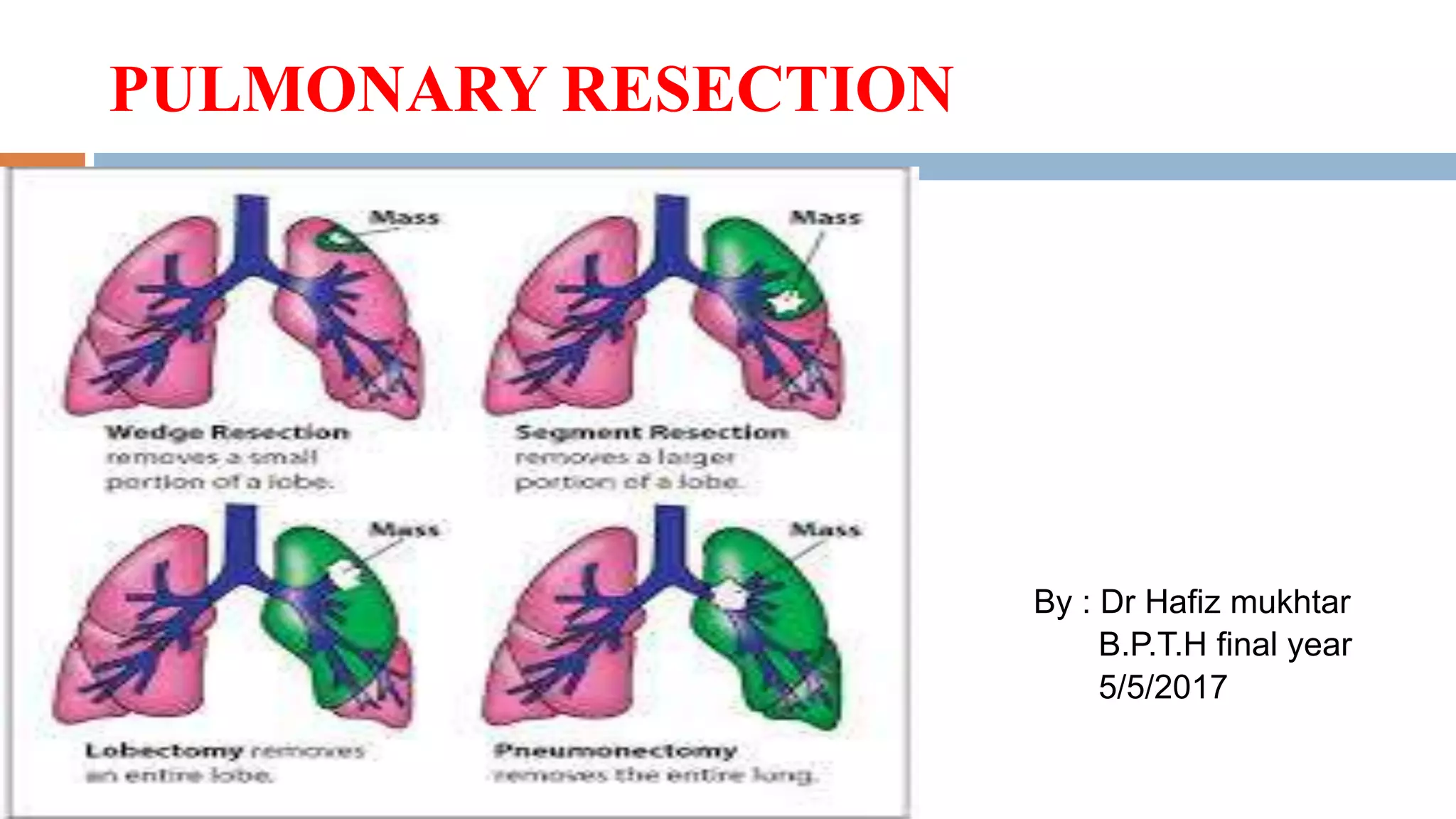
Types of pulmonary resection
 pneumonectomy
 Segmental resection
 lobectomy
 Wedge resection
pneumonecto
my
This is the surgical removal of the
entire lung, a radical pneumonectomy
includes excision of the mediastinal
glands with dissection from the chest
wall or pericardium.part of the chest
wall may have to be removed
Indications-
carcinoma,bronchiectesis,tuberculosis
Incisions-usually is ;posterior lateral
thoracotomy
lobectomy
In lobectomy any of the five lobes may be removed;
on the right side the middle and lower lobes are often
removed together because of their common lymphstic
drainage. If a tumor in an upper lobe protrudes into
the main bronchus a cuff of main bronchus can be
removed with the lobe and remianing lung and
bronchus is joined to the trachea,this is term as
sleeve lobectomy
Indications
1-bronchiectasis
2-tuberculosis
3-lung abscess
4-carcinoma
Incisions : may be posterolateral or aterolateral
thoracotomy st the level of the 5th or 7th rib
Lobectomy
Segmental
resection
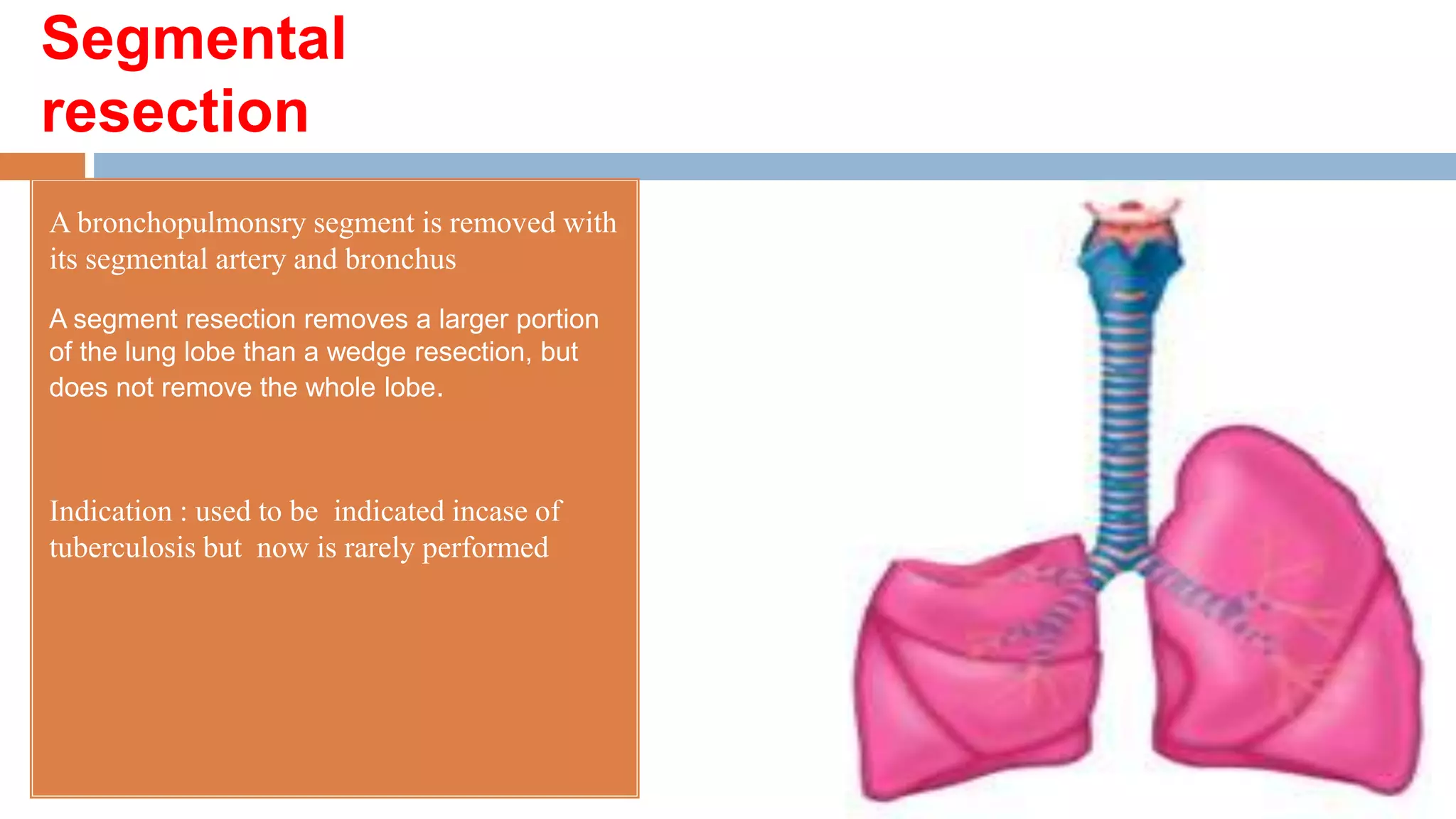
A bronchopulmonsry segment is removed with
its segmental artery and bronchus
A segment resection removes a larger portion
of the lung lobe than a wedge resection, but
does not remove the whole lobe.
Indication : used to be indicated incase of
tuberculosis but now is rarely performed
Wedge
resection
A wedge resection is a surgical procedure during which
the surgeon removes a small, wedge-shaped portion of
the lung containing the cancerous cells along with healthy
tissue that surrounds the area.
The surgery is performed to remove a small tumor or to
diagnose lung cancer.
A wedge resection is performed instead of a lobectomy
(removing a complete lung lobe) when there is a danger of
decreased lung function if too much of the lung is
removed.
A wedge resection can be performed by minimally-
invasive video-assisted thoracoscopic surgery (VATS) or a
thoracotomy (open chest surgery).
Wedge resection
Pre operative investigations
 These investigations are designed to anwer two questions
 1-can the carcinoma be removed ?
 2-is the patients fit for thoracotomy
BRONCHOSCOPY
This is carried out by two separate technique
A-via flexible fibre-optic instrument in a conscious patients
this technique allows the operator to see further into subsegmental bronchi
B-via a rigid instrument in a patients under genearal anaesthesia
allows a better assessment of operability in central lesions
 LUNG FUNCTION ; if the FEV1/FVC ratio is lessthan 40 percent of
the predicted value or the PaCO2 is greater than 5kpa(40mmhg)
then operation is definitely contraindicated
 Ventilation perfusion scans may also be helpful particularly where
abnormal lung is perfused but unventilated and therfore shunting
deoxygenated blood from right to left,under these conditions
removal of the abnormal lung ca be expected to improved overall
lung function
Pre operative physiotherapy
 This should be given as soon as possible after the patients is admitted,the
main aims are to
 1-Gain the patients confidence
 2-clear the lungs fields
 3-Teach respiratory control and inspiratory holding
 4-Teach posture awareness
 5-Teach arm, trunk and leg exercises
 6-teach mobility about the bed
 7-incase of lobectomy the breathing exercise wil be taught to expand the
lung tissue o the affected isde which wil stil be present after the operation
 PATIENTS CONFIDENCE : this involve explanation of the aims of
physiotherapy and teaching the patients exercise to be undertaken post operatively
 CLEARING LUNG FIELDS : the patiets must be discouraged from smoking
,shaking ,clapping and vibration with postural drainage if necessary must be used
to clear secreations from the lung
 TEACHING RESPIRATORY CONTROL : inspiratory exercises are taught fro
the sound lung together with inspiratory holding means that the patients is asked
to take adeep breath in ,hold then breath in a little further hold then breathe out
breathing control has to be practised after secrations have been cleared
Post operative physiotherapy
 It is important to note whether the patient is on oxygen therapy and
whether there is drain in the thorax
 The aims of physiotherapy are to :
 1-clear secretions from the remaining lung
 2-retain full expansion of the remaining lung tissue
 3-prevent circulatory complications
 4-Regain arm and spinal movements
 5-maitain good posture
 6-restore exercise tolerance
Suitable programme may be as follows
 Day of operation
patients in half lying with pillows arranged behind the neck and back and
possibly both forearms on a pillow on the lap
 Day 1
Half lying-segmental expansion exercises,shaking or vibrations are
necessary,huffing and expectoration with wound support from physiotherapist
Foot and ankle exercises
Correction of posture should be emphasized to prevent scoliosis on the scar sifde
 Day 2
Treament is continued as above plus
Sitting on the edge of the bed ;trunk turning,bending side to side and stretching
backwards
Sitting in chair-bilateral breathing exercises
Walk around the bed with trunk erect and arms swinging
 Day 3
Breathing exercise and huffing are continued as necessary other activities contnue twice a
day, the patient may join in group therapy
 Day 4 post operation to discharge
The patient continued with group therapy , gets dressed,walks further and after 7th day
practices going up and down stairs with breathig control
Bilateral breathing,trunk and arm exercises are essential
Two weeks after the operation the patient is discharge home with strict guidelines
 Incentive spirometry
 LONG TERM MANAGEMENT
Regular chekup after every 3 month
Physiotherapist should check the exercise tolerance,posture ,trunk and
shoulder mobility
The patients should continue thoraxix mobilty exercise on a regular basis
Complications of pulmonary resection
 Early (30 days complications):
 Acute postoperative respiratory failure, due to
 Pain (postoperative analgesia; local + general, is mandatory).
 Atelectasis & Pneumonia (chest physiotherapy, IV antibiotics, ? bronchoscopy).
 Pulmonary oedema (restriction of IV fluids, diuretics, chest physiotherapy).
 ARDS .
 Cardiac arrhythmia (AF in patients > 60 ys).
 Bleeding.
 DVT, pulmonary embolism,
 Infections: empyema, wound infection and dehiscence.
 persistent air leak (visceral, disruption of bronchial stump causing bronchopleural fistula),
Complications of pulmonary resection
Late:
 chronic pain,
 chronic respiratory failure,
 post-pneumonectomy syndrome
References
 Tidys physiotherapy page no 212 to 220 12th edition
 Cash textbook of chest,heart and vascular disoders fror
physiotherapists chapter 15 page no 365 4th edition
 See this video on youtube for more operative details about
VATS
https://youtu.be/aegWclsbJvk
THANK YOU !!!

Pulmonary Resection by Dr hafeez mukhtar

  • 1.
    DEPARTMENT OF PHYSICALMEDICINE & RAHABILITATION SCHOOL OF HEALTH SCIENCE - NIU
  • 2.
    PULMONARY RESECTION By :Dr Hafiz mukhtar B.P.T.H final year 5/5/2017
  • 3.
    indications  The commonestindication is bronchial carcinoma which accounts for around 90 percent of all resections  1-MALIGNANCY : primary brochial carcinnoma, bronchial carnoid, isolated secondaries arising from kidney or larg intestine  2-INFLAMMATORY: lung resection is occasionally required for the fpllonwing conditions lung abscess,tuberculosis,bronchiectesis  3-TRAUMA : stab wound.gunshot wounds  4-DEGENRATIVE: large lung bullae in selected patients where there is compression of normal lung  5-CONGENITAL: Arterio-venous fistula,sequestrated lobe,lobar emphysema
  • 4.
    Types of pulmonaryresection  pneumonectomy  Segmental resection  lobectomy  Wedge resection
  • 5.
    pneumonecto my This is thesurgical removal of the entire lung, a radical pneumonectomy includes excision of the mediastinal glands with dissection from the chest wall or pericardium.part of the chest wall may have to be removed Indications- carcinoma,bronchiectesis,tuberculosis Incisions-usually is ;posterior lateral thoracotomy
  • 6.
    lobectomy In lobectomy anyof the five lobes may be removed; on the right side the middle and lower lobes are often removed together because of their common lymphstic drainage. If a tumor in an upper lobe protrudes into the main bronchus a cuff of main bronchus can be removed with the lobe and remianing lung and bronchus is joined to the trachea,this is term as sleeve lobectomy Indications 1-bronchiectasis 2-tuberculosis 3-lung abscess 4-carcinoma Incisions : may be posterolateral or aterolateral thoracotomy st the level of the 5th or 7th rib
  • 7.
  • 8.
    Segmental resection A bronchopulmonsry segmentis removed with its segmental artery and bronchus A segment resection removes a larger portion of the lung lobe than a wedge resection, but does not remove the whole lobe. Indication : used to be indicated incase of tuberculosis but now is rarely performed
  • 9.
    Wedge resection A wedge resectionis a surgical procedure during which the surgeon removes a small, wedge-shaped portion of the lung containing the cancerous cells along with healthy tissue that surrounds the area. The surgery is performed to remove a small tumor or to diagnose lung cancer. A wedge resection is performed instead of a lobectomy (removing a complete lung lobe) when there is a danger of decreased lung function if too much of the lung is removed. A wedge resection can be performed by minimally- invasive video-assisted thoracoscopic surgery (VATS) or a thoracotomy (open chest surgery).
  • 10.
  • 11.
    Pre operative investigations These investigations are designed to anwer two questions  1-can the carcinoma be removed ?  2-is the patients fit for thoracotomy BRONCHOSCOPY This is carried out by two separate technique A-via flexible fibre-optic instrument in a conscious patients this technique allows the operator to see further into subsegmental bronchi B-via a rigid instrument in a patients under genearal anaesthesia allows a better assessment of operability in central lesions
  • 12.
     LUNG FUNCTION; if the FEV1/FVC ratio is lessthan 40 percent of the predicted value or the PaCO2 is greater than 5kpa(40mmhg) then operation is definitely contraindicated  Ventilation perfusion scans may also be helpful particularly where abnormal lung is perfused but unventilated and therfore shunting deoxygenated blood from right to left,under these conditions removal of the abnormal lung ca be expected to improved overall lung function
  • 13.
    Pre operative physiotherapy This should be given as soon as possible after the patients is admitted,the main aims are to  1-Gain the patients confidence  2-clear the lungs fields  3-Teach respiratory control and inspiratory holding  4-Teach posture awareness  5-Teach arm, trunk and leg exercises  6-teach mobility about the bed  7-incase of lobectomy the breathing exercise wil be taught to expand the lung tissue o the affected isde which wil stil be present after the operation
  • 14.
     PATIENTS CONFIDENCE: this involve explanation of the aims of physiotherapy and teaching the patients exercise to be undertaken post operatively  CLEARING LUNG FIELDS : the patiets must be discouraged from smoking ,shaking ,clapping and vibration with postural drainage if necessary must be used to clear secreations from the lung  TEACHING RESPIRATORY CONTROL : inspiratory exercises are taught fro the sound lung together with inspiratory holding means that the patients is asked to take adeep breath in ,hold then breath in a little further hold then breathe out breathing control has to be practised after secrations have been cleared
  • 15.
    Post operative physiotherapy It is important to note whether the patient is on oxygen therapy and whether there is drain in the thorax  The aims of physiotherapy are to :  1-clear secretions from the remaining lung  2-retain full expansion of the remaining lung tissue  3-prevent circulatory complications  4-Regain arm and spinal movements  5-maitain good posture  6-restore exercise tolerance
  • 16.
    Suitable programme maybe as follows  Day of operation patients in half lying with pillows arranged behind the neck and back and possibly both forearms on a pillow on the lap  Day 1 Half lying-segmental expansion exercises,shaking or vibrations are necessary,huffing and expectoration with wound support from physiotherapist Foot and ankle exercises Correction of posture should be emphasized to prevent scoliosis on the scar sifde  Day 2 Treament is continued as above plus Sitting on the edge of the bed ;trunk turning,bending side to side and stretching backwards
  • 17.
    Sitting in chair-bilateralbreathing exercises Walk around the bed with trunk erect and arms swinging  Day 3 Breathing exercise and huffing are continued as necessary other activities contnue twice a day, the patient may join in group therapy  Day 4 post operation to discharge The patient continued with group therapy , gets dressed,walks further and after 7th day practices going up and down stairs with breathig control Bilateral breathing,trunk and arm exercises are essential Two weeks after the operation the patient is discharge home with strict guidelines
  • 18.
     Incentive spirometry LONG TERM MANAGEMENT Regular chekup after every 3 month Physiotherapist should check the exercise tolerance,posture ,trunk and shoulder mobility The patients should continue thoraxix mobilty exercise on a regular basis
  • 19.
    Complications of pulmonaryresection  Early (30 days complications):  Acute postoperative respiratory failure, due to  Pain (postoperative analgesia; local + general, is mandatory).  Atelectasis & Pneumonia (chest physiotherapy, IV antibiotics, ? bronchoscopy).  Pulmonary oedema (restriction of IV fluids, diuretics, chest physiotherapy).  ARDS .  Cardiac arrhythmia (AF in patients > 60 ys).  Bleeding.  DVT, pulmonary embolism,  Infections: empyema, wound infection and dehiscence.  persistent air leak (visceral, disruption of bronchial stump causing bronchopleural fistula),
  • 20.
    Complications of pulmonaryresection Late:  chronic pain,  chronic respiratory failure,  post-pneumonectomy syndrome
  • 21.
    References  Tidys physiotherapypage no 212 to 220 12th edition  Cash textbook of chest,heart and vascular disoders fror physiotherapists chapter 15 page no 365 4th edition  See this video on youtube for more operative details about VATS https://youtu.be/aegWclsbJvk
  • 22.