Steam Power Plant
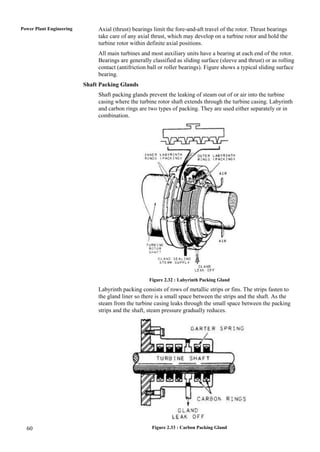
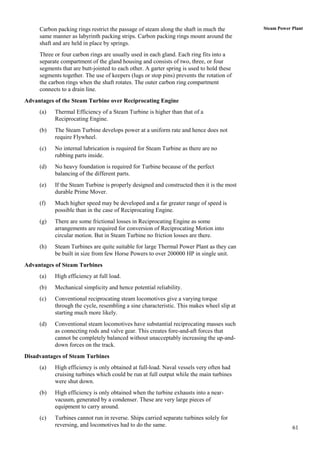
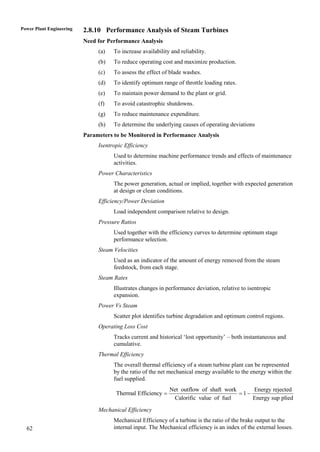
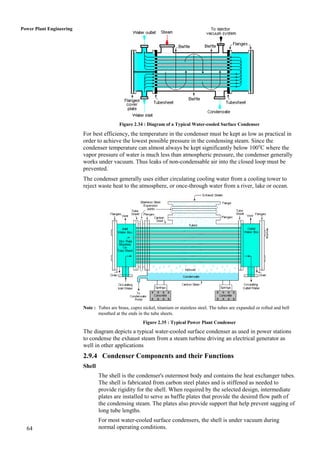
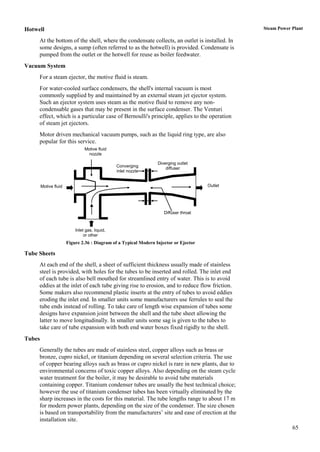
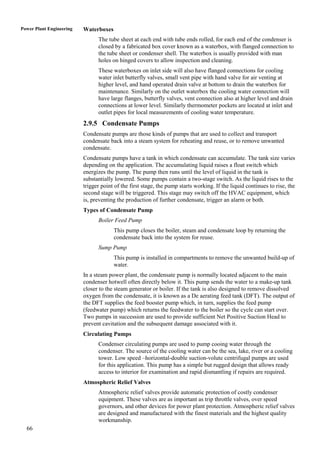
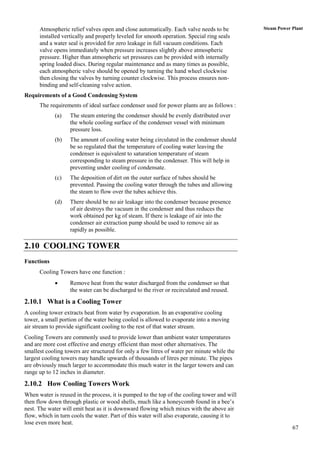
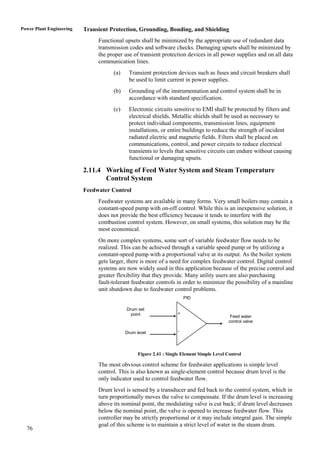
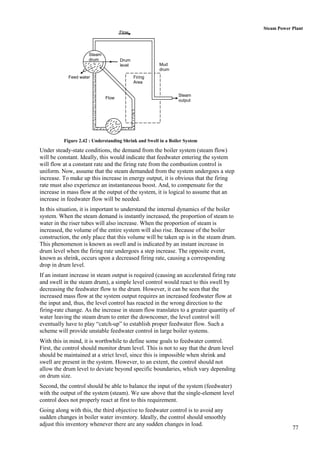
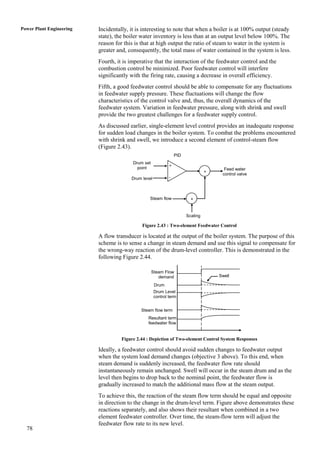
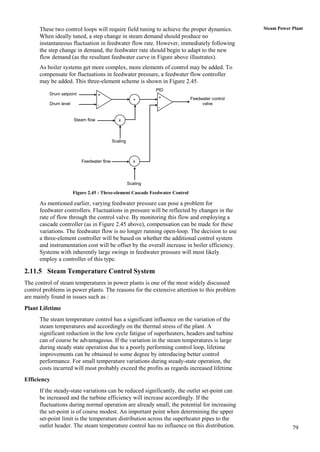
UNIT 2 STEAM POWER PLANT
Structure
      2.1   Introduction
            Objectives

      2.2   Basic Consideration in the Analysis of Power Cycles
      2.3   Steam Generator
      2.4   Super Heater
      2.5   Feed Water Heater
      2.6   Furnaces
      2.7   Energy Performance Assessment of Boilers
      2.8   Steam Turbines
      2.9   Condenser
      2.10 Cooling Tower
      2.11 Steam Power Station Control
      2.12 Summary
      2.13 Key Words
      2.14 Answers to SAQs


2.1 INTRODUCTION
Two important area of application of thermodynamics are power generation and
refrigeration.
Both power generation and refrigeration are usually accomplished by a system that
operates on a thermodynamics cycle.
Thermodynamics cycles can be divided into two generation categories :
      (a)   Power Cycles
      (b)   Refrigeration Cycles
The devices or systems used to produce a net power output are often called engines and
the thermodynamics cycles they operate on are called power cycle.
The devices or systems use to produce refrigeration are called refrigerator, air
conditioners or heat pumps and the cycles they operates on are called refrigeration
cycles.
Thermodynamic cycles can be categorized as :
      (a)   Power cycles or Refrigeration cycles.
      (b)   Gas Cycles or Vapor Cycles : In gas cycles, the working fluid remains in
            the gaseous phase throughout the entire cycle, where as in vapor cycles the
            working fluid exists in the vapor phase during one part of the cycle and in
            the liquid phase during another part.
      (c)   Closed Cycles or Open Cycles : In closed cycles, the working fluid is
            returned to the initial state at the end of the cycle and is re-circulated. In
            open cycle, the working fluid is renewed at the end of each cycle instead of
            being re-circulated.                                                                         21
Power Plant Engineering   Objectives
                          After studying this unit, you should be able to
                                       know steam generator, steam turbine, and
                                       describe cooling towers and condensers.

                          2.2 BASIC CONSIDERATION IN THE ANALYSIS OF
                              POWER CYCLES
                          Actual Cycle
                                The cycles encountered in actual devices are difficult to analyze because of the
                                presence of complicating effects, such as friction and the absence of sufficient
                                time for establishment of the equilibrium conditions during the cycle.
                          Ideal Cycle
                                When the actual cycle is stripped of all the internal irreversibilities and
                                complexities, we end up with a cycle that resembles the actual cycle closely but is
                                made up totally of internally reversible processes. Such a cycle is called an Ideal
                                cycle.
                                Heat Engines
                                        Heat engines are designed for the purpose of converting other form of
                                        energy to work and their performance is expressed as thermal efficiency.
                                                             Wnet
                                                     th 
                                                             Qin

                                The Idealization and Simplification
                                        (a)   The cycle does not involve any friction.
                                        (b)   All expansion and compression process take place in a quasi-
                                              equilibrium manner.
                                        (c)   The pipe connecting the various component of a system are well
                                              insulated and heat transfer and pressure drop through them are
                                              negligible.
                          Carnot Cycle
                                The Carnot cycle is composed of 4 totally reversible processes :
                                        (a)   Isothermal heat addition at high temperature (TH).
                                        (b)   Isentropic expansion from high temperature to low temperature.
                                        (c)   Isothermal heat rejection at low temperature (TL).
                                        (d)   Isentropic compression from low temperature to high temperature.
                                                                                                       TL
                                              Thermal efficiency of Carnot cycle = th, carnot  1 
                                                                                                       TH

                          The Carnot Vapor Cycle
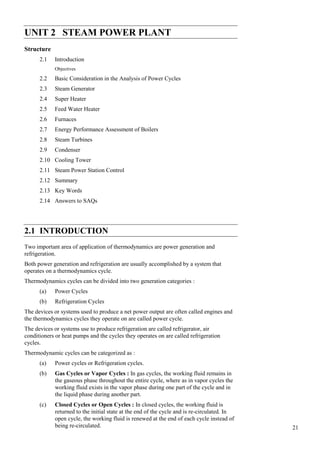
                                (a)     A steady-flow Carnot cycle executed with the saturation dome of a pure
                                        substance is shown in Figures 2.1(a) and (b). The fluid is heated reversibly
                                        and isothermally in a boiler (process 1-2), expanded isentropically in a
                                        turbine (process 2-3), condensed reversibly and isothermally in a condenser
                                        (process 3-4) and compressed isentropically by a compressor to the initial
                                        state (process 4-1).
  22
(b)   The Carnot cycle is not a suitable model for vapor power cycle because it                   Steam Power Plant
           cannot be approximated in practice.
                             T


                                                                         2
                                              1


                                              4                          3


                                                                                               s
                                                             (a)
                       T                                                 2
                                                  1


                                              4                              3


                                                                                              s
                                                              (b)
                                          Figure 2.1 : Carnot Cycle

Rankine Cycle : The Ideal Cycle for Vapor Power Cycle
     (a)   The impracticalities associated with Carnot cycle can be eliminated by
           superheating the steam in the boiler and condensing it completely in the
           condenser. This cycle that results is the Rankine cycle, which is the ideal
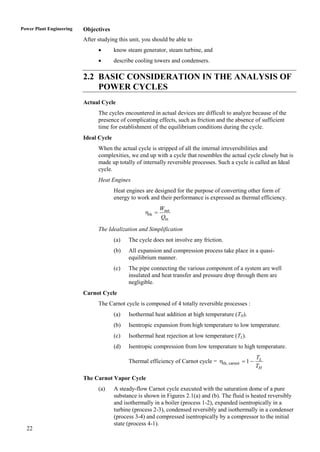
           cycle for vapor power plants. The construct of power plant and T-s diagram
           is shown in Figures 2.2(a) and (b).
                                              qin


                                                    Boiler
                                                                             3
                                 2                                                        W turb,out

                                                                                 Turbi
                  wpump,in                                                       ne
                                                  Pump                                   4 qout

                             1                                 Condenser


                                                             (a)
                             T


                                                                         3
                                     qin
                                                                             W turb,out

                                     2


                                          1                         4’
                                                      qout
                                         wpunp,in

                                                                                    s
                                                             (b)
                                         Figure 2.2 : Rankine Cycle                                                23
Power Plant Engineering        (b)   The ideal Rankine cycle dose not involve any internal irreversibilities
                               (c)   The Rankine cycle consists of the following four processes :
                                             1-2 : Isentropic compression in pump (compressors)
                                             2-3 : Constant pressure heat addition in boiler
                                             3-4 : Isentropic expansion in turbine
                                             4-1 : Constant pressure heat rejection in a condenser
                               Process 1-2
                                     Water enters the pump at state 1 as saturated liquid and is compressed
                                     isentropically to the operating pressure of the boiler. The water temperature
                                     increases somewhat during this isentropic compression process due to slight
                                     decrease in the specific volume of the water. The vertical distance between
                                     state 1 and 2 on the T-s diagram is greatly exaggerated for clarity.
                               Process 2-3
                                     Water enters the boiler as a compressed liquid at state 2 and leaves as a
                                     superheated vapor at state 3. The boiler is basically a large heat exchanger
                                     where the heat originating from combustion gases, is transferred to the
                                     water essentially at constant pressure. The boiler together with the section
                                     where the steam is superheated (the superheater), is often called the steam
                                     generator.
                               Process 3-4
                                     The superheated vapor at state 3 enters the turbine, where it expands
                                     isentropically and produces work by rotating the shaft connected to an
                                     electric generator. The pressure and the temperature of the steam drops
                                     during this process to the values at state 4, where steam enters the
                                     condenser
                               Process 4-1
                                     At this state, the steam is usually a saturated liquid-vapor mixture with a
                                     high quality. Steam is condensed at constant pressure in the condenser
                                     which is basically a large heat exchanger, by rejecting heat to a cooling
                                     medium from a lake, or a river. Steam leaves the condenser as saturated
                                     liquid and enters the pump, completing the cycle.
                          Energy Analysis of the Ideal Rankine Cycle
                               All four components associated with the Rankine cycle (the pump, boiler, turbine
                               and condenser) are steady-flow devices, and thus all four processes that make up
                               the Rankine cycle can be analyzed as steady-flow process.
                               The steady flow equation per unit mass of steam reduces to
                                             (qin  qout )  (win  wout )  he  hi (kJ/kg)

                               Pump (q = 0) :
                                             wpump, in  (h2  h1 )  v ( P2  P )
                                                                                1

                               where h1  h f @ p1 and v  v1  v f @ p1

                               Boiler (w = 0) :
                                             qin  h3  h2

                               Turbine (q = 0) :
                                                    wturbine, out  (h3  h4 )
  24
Condenser (w = 0)                                                                         Steam Power Plant

                  qout  h4  h1

     The thermal efficiency of the Rankine cycle is determine from
                          wnet      q
                  th          1  out
                          qin        qin

     where        wnet  qin  qout  wturbine, out  wpump, in

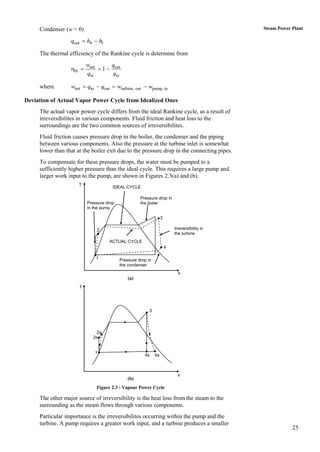
Deviation of Actual Vapor Power Cycle from Idealized Ones
     The actual vapor power cycle differs from the ideal Rankine cycle, as a result of
     irreversibilites in various components. Fluid friction and heat loss to the
     surroundings are the two common sources of irreversibilites.
     Fluid friction causes pressure drop in the boiler, the condenser and the piping
     between various components. Also the pressure at the turbine inlet is somewhat
     lower than that at the boiler exit due to the pressure drop in the connecting pipes.
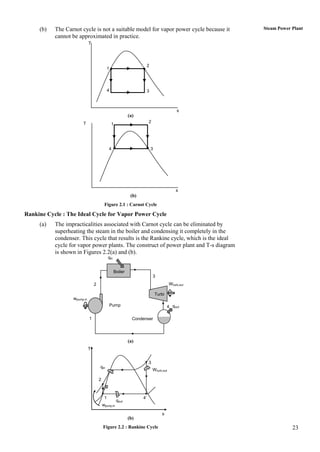
     To compensate for these pressure drops, the water must be pumped to a
     sufficiently higher pressure than the ideal cycle. This requires a large pump and
     larger work input to the pump, are shown in Figures 2.3(a) and (b).
                      T
                                      IDEAL CYCLE

                                                    Pressure drop in
                          Pressure drop             the boiler
                          in the pump

                                                                  3

                              2                                           Irreversibility in
                                                                          the turbine
                                    ACTUAL CYCLE
                                                                      4

                              1           Pressure drop in
                                          the condenser
                                                                            s
                                              (a)
                      T


                                                         3


                              2a
                            2s


                             1
                                                      4s     4a


                                                                            s
                                              (b)
                              Figure 2.3 : Vapour Power Cycle

     The other major source of irreversibility is the heat loss from the steam to the
     surrounding as the steam flows through various components.
     Particular importance is the irreversibilites occurring within the pump and the
     turbine. A pump requires a greater work input, and a turbine produces a smaller
                                                                                                           25
Power Plant Engineering        work output as a result of irreversibilties. Under the ideal condition the flow
                               through these devices is isentropic.
                               The deviation of actual pumps and turbine from the isentropic ones can be
                               accurately accounted by isentropic efficiencies, define as :
                                                   ws h2 s  h1
                                            p      
                                                   wa h2a  h1

                                                   wa h3  h4a
                                            T      
                                                   ws h3  h4 s

                          How can We Increase the Efficiency of the Rankine cycle?
                               Than Rankine cycle efficiency can be increased by increasing average temperature
                               at which heat is transferred to the working fluid in the boiler or decreasing the
                               average temperature at which heat is rejected from the working fluid in the
                               condenser. That is, the average fluid temperature should be as high as possible
                               during heat addition and as low as possible during heat rejection.
                               The three ways by which efficiency of the Rankine cycle can be increased are :
                                     (a)    Lowering the condenser pressure (Lowers Tlow, av).
                                     (b)    Superheating the steam to high temperatures (Increases Thigh, av).
                                     (c)    Increasing the boiler pressure (Increases Thigh, av).
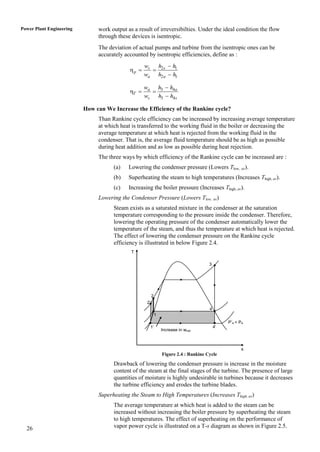
                               Lowering the Condenser Pressure (Lowers Tlow, av)
                                     Steam exists as a saturated mixture in the condenser at the saturation
                                     temperature corresponding to the pressure inside the condenser. Therefore,
                                     lowering the operating pressure of the condenser automatically lower the
                                     temperature of the steam, and thus the temperature at which heat is rejected.
                                     The effect of lowering the condenser pressure on the Rankine cycle
                                     efficiency is illustrated in below Figure 2.4.
                                             T

                                                                                       3


                                                         2
                                                    2’
                                                                                       4
                                                             1
                                                                                                P’4 < P4
                                                     1’                                    4’
                                                                 Increase in wnet


                                                                                                       s
                                                                 Figure 2.4 : Rankine Cycle

                                     Drawback of lowering the condenser pressure is increase in the moisture
                                     content of the steam at the final stages of the turbine. The presence of large
                                     quantities of moisture is highly undesirable in turbines because it decreases
                                     the turbine efficiency and erodes the turbine blades.
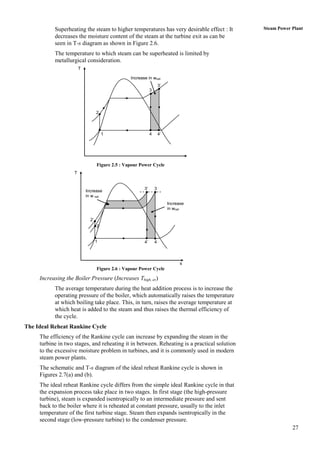
                               Superheating the Steam to High Temperatures (Increases Thigh, av)
                                     The average temperature at which heat is added to the steam can be
                                     increased without increasing the boiler pressure by superheating the steam
                                     to high temperatures. The effect of superheating on the performance of
  26                                 vapor power cycle is illustrated on a T-s diagram as shown in Figure 2.5.
Superheating the steam to higher temperatures has very desirable effect : It      Steam Power Plant
           decreases the moisture content of the steam at the turbine exit as can be
           seen in T-s diagram as shown in Figure 2.6.
           The temperature to which steam can be superheated is limited by
           metallurgical consideration.
                        T

                                                  Increase in wnet
                                                                      3’
                                                              3


                                   2


                                       1                      4       4’


                                   Figure 2.5 : Vapour Power Cycle
                    T


                                                         3’       3
                            Increase
                            in w net
                                                                           Increase
                                                                           in wnet

                              2’
                                   2


                                   1                     4’       4


                                                                                 s
                                   Figure 2.6 : Vapour Power Cycle

     Increasing the Boiler Pressure (Increases Thigh, av)
           The average temperature during the heat addition process is to increase the
           operating pressure of the boiler, which automatically raises the temperature
           at which boiling take place. This, in turn, raises the average temperature at
           which heat is added to the steam and thus raises the thermal efficiency of
           the cycle.
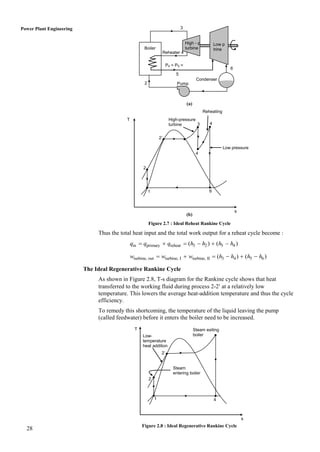
The Ideal Reheat Rankine Cycle
     The efficiency of the Rankine cycle can increase by expanding the steam in the
     turbine in two stages, and reheating it in between. Reheating is a practical solution
     to the excessive moisture problem in turbines, and it is commonly used in modern
     steam power plants.
     The schematic and T-s diagram of the ideal reheat Rankine cycle is shown in
     Figures 2.7(a) and (b).
     The ideal reheat Rankine cycle differs from the simple ideal Rankine cycle in that
     the expansion process take place in two stages. In first stage (the high-pressure
     turbine), steam is expanded isentropically to an intermediate pressure and sent
     back to the boiler where it is reheated at constant pressure, usually to the inlet
     temperature of the first turbine stage. Steam then expands isentropically in the
     second stage (low-pressure turbine) to the condenser pressure.
                                                                                                         27
Power Plant Engineering                                                         3


                                                                                     High - p          Low p
                                                      Boiler                         turbine           trine
                                                                       Reheater 4

                                                                        P 4 = P5 =
                                                                        Preheat                                6
                                                                              5
                                                                                            Condenser
                                                      2                       Pump


                                                                                     (a)
                                                                                                Reheating
                                           T                             High-pressure
                                                                         turbine       3           4


                                                                  2’

                                                                                                            Low pressure
                                                                                            4


                                                     2


                                                          1                                        6


                                                                                                                   s
                                                                                     (b)
                                                          Figure 2.7 : Ideal Reheat Rankine Cycle

                               Thus the total heat input and the total work output for a reheat cycle become :
                                               qin  qprimary  qreheat  (h3  h2 )  (h5  h4 )

                                               wturbine, out  wturbine, I  wturbine, II  (h3  h4 )  (h5  h6 )

                          The Ideal Regenerative Rankine Cycle
                               As shown in Figure 2.8, T-s diagram for the Rankine cycle shows that heat
                               transferred to the working fluid during process 2-2 at a relatively low
                               temperature. This lowers the average heat-addition temperature and thus the cycle
                               efficiency.
                               To remedy this shortcoming, the temperature of the liquid leaving the pump
                               (called feedwater) before it enters the boiler need to be increased.
                                                 T                                         Steam exiting
                                                     Low-                                  boiler
                                                     temperature
                                                     heat addition
                                                                   2’


                                                                            Steam
                                                                            entering boiler
                                                          2


                                                              1                                        4


                                                                                                                       s
                                                     Figure 2.8 : Ideal Regenerative Rankine Cycle
  28
Another way of increasing the thermal efficiency of the Rankine cycle is by           Steam Power Plant
regeneration. During a regeneration process, liquid water (feedwater) leaving the
pump is heated by steam bled off the turbine at some intermediate pressure in
devices called feedwater heaters.
There are two type of feedwater Heaters :
      (a)     Open Feedwater Heater
      (b)     Closed Feedwater Heater
Open Feedwater Heater
      An open (or direct-contact) feedwater heater is basically a mixing chamber,
      where the steam extracted from the turbine mixes with the feedwater exiting
      the pump. Ideally, the mixture leaves the heater as a saturated liquid at the
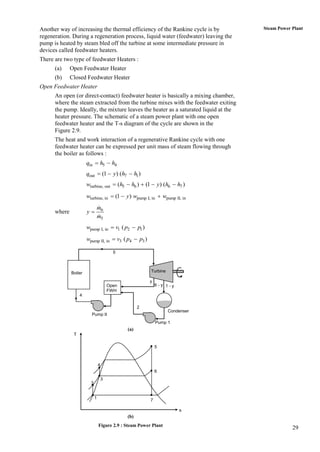
      heater pressure. The schematic of a steam power plant with one open
      feedwater heater and the T-s diagram of the cycle are shown in the
      Figure 2.9.
      The heat and work interaction of a regenerative Rankine cycle with one
      feedwater heater can be expressed per unit mass of steam flowing through
      the boiler as follows :
                       qin  h5  h4
                       qout  (1  y) (h7  h1 )
                       wturbine, out  (h5  h6 )  (1  y) (h6  h7 )
                       wturbine, in  (1  y) wpump I, in  wpump II, in
                                 m6
      where            y
                                 m5
                       wpump I, in  v1 ( p2  p1 )
                       wpump II, in  v3 ( p4  p3 )

                                           5


              Boiler                                      Turbine

                                                          y
                                         Open                 6-y 1-y
                                         FWH
                   4

                                                      2
                                                                    Condenser
                         Pump II
                                                              Pump 1
                                                (a)
               T

                                                              5


                                 4
                                                              6
                                     3
                         3


                             1
                                                          7

                                                                        s
                                                (b)
                                 Figure 2.9 : Steam Power Plant
                                                                                                  29
Power Plant Engineering                       The thermal efficiency of the Rankine cycle increases as a result of
                                              regeneration. This is because regeneration raises the average
                                              temperature at which heat is transferred to the steam in the boiler by
                                              raising the temperature of the water before it enters the boiler.
                                Closed Feedwater Heaters
                                      Another type of feedwater heater used is steam power plants is the closed
                                      feedwater heater in which heat is transferred from the extracted steam to the
                                      feedwater without any mixing taking place. The two streams now can be at
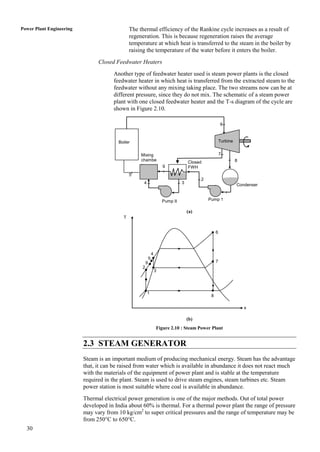
                                      different pressure, since they do not mix. The schematic of a steam power
                                      plant with one closed feedwater heater and the T-s diagram of the cycle are
                                      shown in Figure 2.10.

                                                                                                        6


                                        Boiler                                                          Turbine


                                                   Mixing                                               7
                                                   chambe                                                         8
                                                                                     Closed
                                                   r                   9             FWH
                                              5
                                                                                           2
                                                    4                            3                                Condenser


                                                                       Pump II                 Pump 1

                                                                                     (a)
                                          T


                                                                                                    6


                                                               4
                                                           5
                                                       9                                            7
                                                   2
                                                                   3


                                                        1
                                                                                                8

                                                                                                                      s

                                                                                     (b)
                                                                   Figure 2.10 : Steam Power Plant


                          2.3 STEAM GENERATOR
                          Steam is an important medium of producing mechanical energy. Steam has the advantage
                          that, it can be raised from water which is available in abundance it does not react much
                          with the materials of the equipment of power plant and is stable at the temperature
                          required in the plant. Steam is used to drive steam engines, steam turbines etc. Steam
                          power station is most suitable where coal is available in abundance.
                          Thermal electrical power generation is one of the major methods. Out of total power
                          developed in India about 60% is thermal. For a thermal power plant the range of pressure
                          may vary from 10 kg/cm2 to super critical pressures and the range of temperature may be
                          from 250°C to 650°C.
  30
2.3.1 Essentials of Steam Power Plant Equipment                                                 Steam Power Plant

A steam power plant must have following equipment :
      (a)    A furnace to burn the fuel.
      (b)    Steam generator or boiler containing water. Heat generated in the furnace is
             utilized to convert water into steam.
      (c)    Main power unit such as an engine or turbine to use the heat energy of
             steam and perform work.
      (d)    Piping system to convey steam and water.
In addition to the above equipment the plant requires various auxiliaries and accessories
depending upon the availability of water, fuel and the service for which the plant is
intended.
The flow sheet of a thermal power plant consists of the following four main circuits :
      (a)    Feed water and steam flow circuit.
      (b)    Coal and ash circuit.
      (c)    Air and gas circuit.
      (d)    Cooling water circuit.
A steam power plant using steam as working substance works basically on Rankine
cycle.
Steam is generated in a boiler, expanded in the prime mover and condensed in the
condenser and fed into the boiler again.
The different types of systems and components used in steam power plant are as
follows :
      (a)    High pressure boiler
      (b)    Prime mover
      (c)    Condensers and cooling towers
      (d)    Coal handling system
      (e)    Ash and dust handling system
      (f)    Draught system
      (g)    Feed water purification plant
      (h)    Pumping system
      (i)    Air preheater, economizer, super heater, feed heaters.
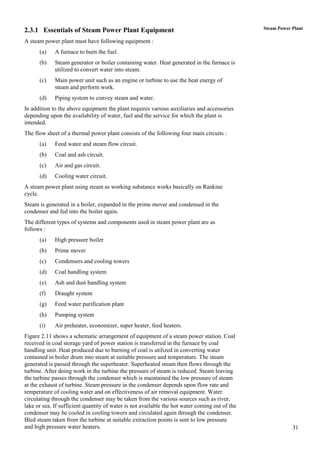
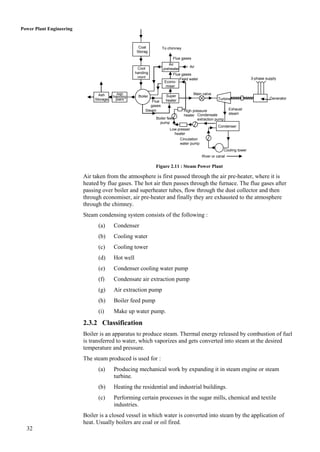
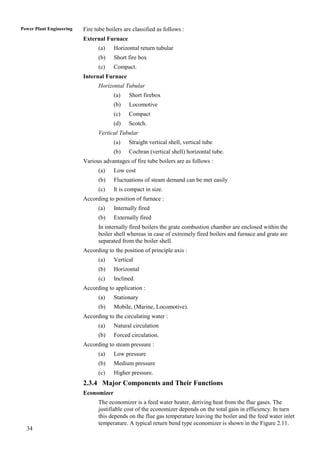
Figure 2.11 shows a schematic arrangement of equipment of a steam power station. Coal
received in coal storage yard of power station is transferred in the furnace by coal
handling unit. Heat produced due to burning of coal is utilized in converting water
contained in boiler drum into steam at suitable pressure and temperature. The steam
generated is passed through the superheater. Superheated steam then flows through the
turbine. After doing work in the turbine the pressure of steam is reduced. Steam leaving
the turbine passes through the condenser which is maintained the low pressure of steam
at the exhaust of turbine. Steam pressure in the condenser depends upon flow rate and
temperature of cooling water and on effectiveness of air removal equipment. Water
circulating through the condenser may be taken from the various sources such as river,
lake or sea. If sufficient quantity of water is not available the hot water coming out of the
condenser may be cooled in cooling towers and circulated again through the condenser.
Bled steam taken from the turbine at suitable extraction points is sent to low pressure
and high pressure water heaters.                                                                            31
Power Plant Engineering


                                                     Coal           To chimney
                                                    Storag
                                                      e
                                                                         Flue gases
                                                                       Air
                                                     Cool                           Air
                                                                    preheater
                                                    handing              Flue gases
                                                     plant                                                              3-phase supply
                                                                             Feed water
                                                                     Econo-
                                                                      miser

                                 Ash       Ash                                        Main valve
                                         handing     Boiler          Super
                               Storage    plant                                                     Turbine                       Generator
                                                             Flue    heater
                                                            gases
                                                         Steam                   High pressure              Exhaust
                                                                                 heater Condensate          steam
                                                              Boiler feed                extraction pump
                                                                pump
                                                                                                    Condenser
                                                                        Low presser
                                                                          heater
                                                                             Circulation
                                                                             water pump
                                                                                                        Cooling tower
                                                                                           River or canal

                                                              Figure 2.11 : Steam Power Plant

                          Air taken from the atmosphere is first passed through the air pre-heater, where it is
                          heated by flue gases. The hot air then passes through the furnace. The flue gases after
                          passing over boiler and superheater tubes, flow through the dust collector and then
                          through economiser, air pre-heater and finally they are exhausted to the atmosphere
                          through the chimney.
                          Steam condensing system consists of the following :
                                (a)      Condenser
                                (b)      Cooling water
                                (c)      Cooling tower
                                (d)      Hot well
                                (e)      Condenser cooling water pump
                                (f)      Condensate air extraction pump
                                (g)      Air extraction pump
                                (h)      Boiler feed pump
                                (i)      Make up water pump.

                          2.3.2 Classification
                          Boiler is an apparatus to produce steam. Thermal energy released by combustion of fuel
                          is transferred to water, which vaporizes and gets converted into steam at the desired
                          temperature and pressure.
                          The steam produced is used for :
                                (a)      Producing mechanical work by expanding it in steam engine or steam
                                         turbine.
                                (b)      Heating the residential and industrial buildings.
                                (c)      Performing certain processes in the sugar mills, chemical and textile
                                         industries.
                          Boiler is a closed vessel in which water is converted into steam by the application of
                          heat. Usually boilers are coal or oil fired.
  32
A boiler should fulfill the following requirements :                                           Steam Power Plant

      (a)    Safety : The boiler should be safe under operating conditions.
      (b)    Accessibility : The various parts of the boiler should be accessible for
             repair and maintenance.
      (c)    Capacity : The boiler should be capable of supplying steam according to
             the requirements.
      (d)    Efficiency : To permit efficient operation, the boiler should be able to
             absorb a maximum amount of heat produced due to burning of fuel in the
             furnace.
      (e)    It should be simple in construction and its maintenance cost should be low.
      (f)    Its initial cost should be low.
      (g)    The boiler should have no joints exposed to flames.
      (h)    The boiler should be capable of quick starting and loading.
2.3.3 Types of Boilers
The boilers can be classified according to the following criteria.
According to flow of water and hot gases :
      (a)    Water tube
      (b)    Fire tube.
In water tube boilers, water circulates through the tubes and hot products of combustion
flow over these tubes. In fire tube boiler the hot products of combustion pass through the
tubes, which are surrounded, by water. Fire tube boilers have low initial cost, and are
more compacts. But they are more likely to explosion, water volume is large and due to
poor circulation they cannot meet quickly the change in steam demand. For the same
output the outer shell of fire tube boilers is much larger than the shell of water-tube
boiler. Water tube boilers require less weight of metal for a given size, are less liable to
explosion, produce higher pressure, are accessible and can respond quickly to change in
steam demand. Tubes and drums of water-tube boilers are smaller than that of fire-tube
boilers and due to smaller size of drum higher pressure can be used easily. Water-tube
boilers require lesser floor space. The efficiency of water-tube boilers is more.
Water tube boilers are classified as follows :
Horizontal Straight Tube Boilers
      (a)    Longitudinal drum
      (b)    Cross-drum.
Bent Tube Boilers
      (a)    Two drum
      (b)    Three drum
      (c)    Low head three drum
      (d)    Four drum.
Cyclone Fired Boilers
Various advantages of water tube boilers are as follows :
      (a)    High pressure can be obtained.
      (b)    Heating surface is large. Therefore steam can be generated easily.
      (c)    Large heating surface can be obtained by use of large number of tubes.
      (d)    Because of high movement of water in the tubes the rate of heat transfer
             becomes large resulting into a greater efficiency.
                                                                                                           33
Power Plant Engineering   Fire tube boilers are classified as follows :
                          External Furnace
                                (a)    Horizontal return tubular
                                (b)    Short fire box
                                (c)    Compact.
                          Internal Furnace
                                Horizontal Tubular
                                       (a)    Short firebox
                                       (b)    Locomotive
                                       (c)    Compact
                                       (d)    Scotch.
                                Vertical Tubular
                                       (a)    Straight vertical shell, vertical tube
                                       (b)    Cochran (vertical shell) horizontal tube.
                          Various advantages of fire tube boilers are as follows :
                                (a)    Low cost
                                (b)    Fluctuations of steam demand can be met easily
                                (c)    It is compact in size.
                          According to position of furnace :
                                (a)    Internally fired
                                (b)    Externally fired
                                In internally fired boilers the grate combustion chamber are enclosed within the
                                boiler shell whereas in case of extremely fired boilers and furnace and grate are
                                separated from the boiler shell.
                          According to the position of principle axis :
                                (a)    Vertical
                                (b)    Horizontal
                                (c)    Inclined.
                          According to application :
                                (a)    Stationary
                                (b)    Mobile, (Marine, Locomotive).
                          According to the circulating water :
                                (a)    Natural circulation
                                (b)    Forced circulation.
                          According to steam pressure :
                                (a)    Low pressure
                                (b)    Medium pressure
                                (c)    Higher pressure.
                          2.3.4 Major Components and Their Functions
                          Economizer
                                The economizer is a feed water heater, deriving heat from the flue gases. The
                                justifiable cost of the economizer depends on the total gain in efficiency. In turn
                                this depends on the flue gas temperature leaving the boiler and the feed water inlet
                                temperature. A typical return bend type economizer is shown in the Figure 2.11.
  34
Air Pre-heater                                                                               Steam Power Plant

      The flue gases coming out of the economizer is used to preheat the air before
      supplying it to the combustion chamber. An increase in air temperature of
      20 degrees can be achieved by this method. The pre heated air is used for
      combustion and also to dry the crushed coal before pulverizing.
Soot Blowers
      The fuel used in thermal power plants causes soot and this is deposited on the
      boiler tubes, economizer tubes, air pre heaters, etc. This drastically reduces the
      amount of heat transfer of the heat exchangers. Soot blowers control the formation
      of soot and reduce its corrosive effects. The types of soot blowers are fixed type,
      which may be further classified into lane type and mass type depending upon the
      type of spray and nozzle used. The other type of soot blower is the retractable soot
      blower. The advantages are that they are placed far away from the high
      temperature zone, they concentrate the cleaning through a single large nozzle
      rather than many small nozzles and there is no concern of nozzle arrangement with
      respect to the boiler tubes.
Condenser
      The use of a condenser in a power plant is to improve the efficiency of the power
      plant by decreasing the exhaust pressure of the steam below atmosphere. Another
      advantage of the condenser is that the steam condensed may be recovered to
      provide a source of good pure feed water to the boiler and reduce the water
      softening capacity to a considerable extent. A condenser is one of the essential
      components of a power plant.
Cooling Tower
     The importance of the cooling tower is felt when the cooling water from the
     condenser has to be cooled. The cooling water after condensing the steam
     becomes hot and it has to be cooled as it belongs to a closed system. The Cooling
     towers do the job of decreasing the temperature of the cooling water after
     condensing the steam in the condenser.
     The type of cooling tower used in the Columbia Power Plant was an Inline
     Induced Draft Cross Flow Tower. This tower provides a horizontal air flow as the
     water falls down the tower in the form of small droplets. The fan centered at the
     top of units draws air through two cells that are paired to a suction chamber
     partitioned beneath the fan. The outstanding feature of this tower is lower air
     static pressure loss as there is less resistance to air flow. The evaporation and
     effective cooling of air is greater when the air outside is warmer and dryer than
     when it is cold and already saturated.
Superheater
     The superheater consists of a superheater header and superheater elements. Steam
     from the main steam pipe arrives at the saturated steam chamber of the superheater
     header and is fed into the superheater elements. Superheated steam arrives back at
     the superheated steam chamber of the superheater header and is fed into the steam
     pipe to the cylinders. Superheated steam is more expansive.
Reheater
     The reheater functions similar to the superheater in that it serves to elevate the
     steam temperature. Primary steam is supplied to the high pressure turbine. After
     passing through the high pressure turbine, the steam is returned to the steam
     generator for reheating (in a reheater) after which it is sent to the low pressure
     turbine. A second reheat cycle may also be provided.
SAQ 1
      (a)   Describe the various types of power cycles.
      (b)   What is steam generator? Describe the components of steam power plant.
      (c)   What is a boiler? Discuss about different types of boilers, its components
            and functions.                                                                               35
Power Plant Engineering
                          2.4 SUPER HEATER
                          One of the most important accessories of a boiler is a super heater. It effects
                          improvement and economy in the following ways :
                                      The super heater increases the capacity of the plant.
                                      Eliminates corrosion of the steam turbine.
                                      Reduces steam consumption of the steam turbine.
                          Types of Super Heater
                                      Plate Super heaters.
                                      Pendant Super heaters.
                                      Radiant Super heaters.
                                      Final Super heaters.

                          2.4.1 Steam Temperature Control
                          The nominal control of reheat steam temperature is by tilting the burners. The super
                          heater steam temperature is controlled by spraying water.
                          Other control methods that are according to the need and design are :
                                (a)    Excess Air Control
                                (b)    Flue Gas Recirculation
                                (c)    Gas by-pass Control
                                (d)    Control of Combination Superheaters
                                (e)    Adjustable Burner Control
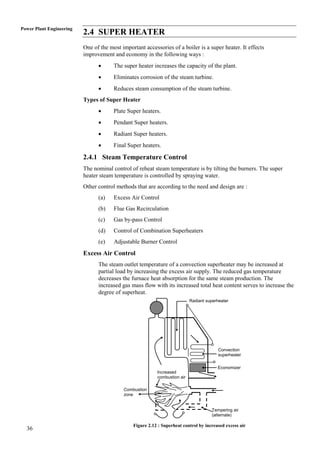
                          Excess Air Control
                                The steam outlet temperature of a convection superheater may be increased at
                                partial load by increasing the excess air supply. The reduced gas temperature
                                decreases the furnace heat absorption for the same steam production. The
                                increased gas mass flow with its increased total heat content serves to increase the
                                degree of superheat.
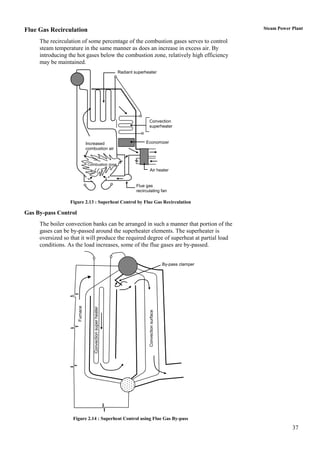
                                                                           Radiant superheater


                                                                                         Convection
                                                                                         superheater

                                                                                        Economizer
                                                          Increased
                                                          combustion air

                                           Combustion
                                           zone


                                                                                     Tempering air
                                                                                     (alternate)

                                               Figure 2.12 : Superheat control by increased excess air
  36
Flue Gas Recirculation                                                                                               Steam Power Plant

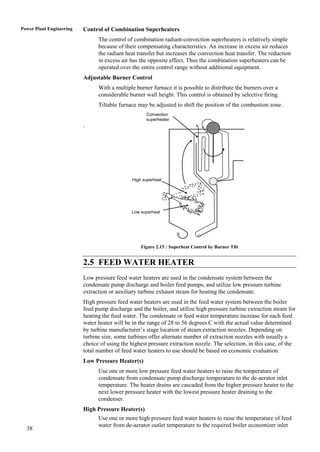
     The recirculation of some percentage of the combustion gases serves to control
     steam temperature in the same manner as does an increase in excess air. By
     introducing the hot gases below the combustion zone, relatively high efficiency
     may be maintained.
                                                              Radiant superheater


                                                                              Convection
                                                                              superheater


                                Increased                                   Economizer
                                combustion air


                                Combustion zone
                                                                              Air heater


                                                                       Flue gas
                                                                       recirculating fan

                  Figure 2.13 : Superheat Control by Flue Gas Recirculation

Gas By-pass Control
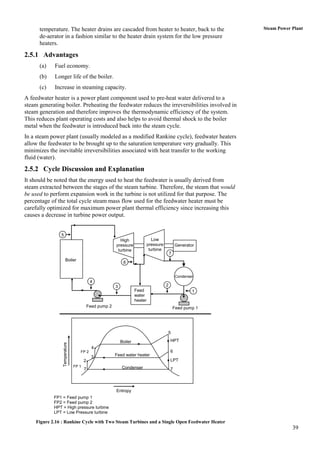
     The boiler convection banks can be arranged in such a manner that portion of the
     gases can be by-passed around the superheater elements. The superheater is
     oversized so that it will produce the required degree of superheat at partial load
     conditions. As the load increases, some of the flue gases are by-passed.


                                                                                                   By-pass clamper
                      Furnace


                                    Convection super heater


                                                                              Convection surface


                   Figure 2.14 : Superheat Control using Flue Gas By-pass
                                                                                                                                 37
Power Plant Engineering   Control of Combination Superheaters
                                The control of combination radiant-convection superheaters is relatively simple
                                because of their compensating characteristics. An increase in excess air reduces
                                the radiant heat transfer but increases the convection heat transfer. The reduction
                                in excess air has the opposite effect. Thus the combination superheaters can be
                                operated over the entire control range without additional equipment.
                          Adjustable Burner Control
                                With a multiple burner furnace it is possible to distribute the burners over a
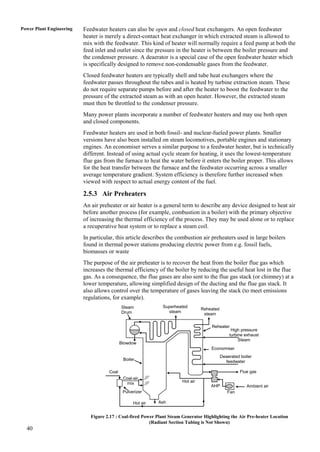
                                considerable burner wall height. This control is obtained by selective firing.
                                Tiltable furnace may be adjusted to shift the position of the combustion zone.
                                                     Convection
                                                     superheater
                          .


                                               High superheat


                                              Low superheat


                                                   Figure 2.15 : Superheat Control by Burner Tilt


                          2.5 FEED WATER HEATER
                          Low pressure feed water heaters are used in the condensate system between the
                          condensate pump discharge and boiler feed pumps, and utilize low pressure turbine
                          extraction or auxiliary turbine exhaust steam for heating the condensate.
                          High pressure feed water heaters are used in the feed water system between the boiler
                          feed pump discharge and the boiler, and utilize high pressure turbine extraction steam for
                          heating the feed water. The condensate or feed water temperature increase for each feed
                          water heater will be in the range of 28 to 56 degrees C with the actual value determined
                          by turbine manufacturer‟s stage location of steam extraction nozzles. Depending on
                          turbine size, some turbines offer alternate number of extraction nozzles with usually a
                          choice of using the highest pressure extraction nozzle. The selection, in this case, of the
                          total number of feed water heaters to use should be based on economic evaluation.
                          Low Pressure Heater(s)
                                Use one or more low pressure feed water heaters to raise the temperature of
                                condensate from condensate pump discharge temperature to the de-aerator inlet
                                temperature. The heater drains are cascaded from the higher pressure heater to the
                                next lower pressure heater with the lowest pressure heater draining to the
                                condenser.
                          High Pressure Heater(s)
                                Use one or more high pressure feed water heaters to raise the temperature of feed
                                water from de-aerator outlet temperature to the required boiler economizer inlet
  38
temperature. The heater drains are cascaded from heater to heater, back to the                          Steam Power Plant
      de-aerator in a fashion similar to the heater drain system for the low pressure
      heaters.
2.5.1 Advantages
      (a)    Fuel economy.
      (b)    Longer life of the boiler.
      (c)    Increase in steaming capacity.
A feedwater heater is a power plant component used to pre-heat water delivered to a
steam generating boiler. Preheating the feedwater reduces the irreversibilities involved in
steam generation and therefore improves the thermodynamic efficiency of the system.
This reduces plant operating costs and also helps to avoid thermal shock to the boiler
metal when the feedwater is introduced back into the steam cycle.
In a steam power plant (usually modeled as a modified Rankine cycle), feedwater heaters
allow the feedwater to be brought up to the saturation temperature very gradually. This
minimizes the inevitable irreversibilities associated with heat transfer to the working
fluid (water).

2.5.2 Cycle Discussion and Explanation
It should be noted that the energy used to heat the feedwater is usually derived from
steam extracted between the stages of the steam turbine. Therefore, the steam that would
be used to perform expansion work in the turbine is not utilized for that purpose. The
percentage of the total cycle steam mass flow used for the feedwater heater must be
carefully optimized for maximum power plant thermal efficiency since increasing this
causes a decrease in turbine power output.


               5
                                                         High                   Low
                                                       pressure              pressure           Generator
                                                        turbine               turbine
                                                                                            7
                     Boiler
                                                            6


                                                                                                 Condenser
                                          4
                                                       3                                2
                                                                    Feed                                 1
                                                                    water
                                                                    heater
                                         Feed pump 2                                            Feed pump 1


                                                                                        5

                                                           Boiler                           HPT
                Temperature


                                           4
                                 FP 2                                                       6
                                           3           Feed water heater
                                     2                                                      LPT
                              FP 1                         Condenser
                                     7                                                      7


                                                       Entropy
            FP1 = Feed pump 1
            FP2 = Feed pump 2
            HPT = High pressure turbine
            LPT = Low Pressure turbine

    Figure 2.16 : Rankine Cycle with Two Steam Turbines and a Single Open Feedwater Heater
                                                                                                                          39
Power Plant Engineering   Feedwater heaters can also be open and closed heat exchangers. An open feedwater
                          heater is merely a direct-contact heat exchanger in which extracted steam is allowed to
                          mix with the feedwater. This kind of heater will normally require a feed pump at both the
                          feed inlet and outlet since the pressure in the heater is between the boiler pressure and
                          the condenser pressure. A deaerator is a special case of the open feedwater heater which
                          is specifically designed to remove non-condensable gases from the feedwater.
                          Closed feedwater heaters are typically shell and tube heat exchangers where the
                          feedwater passes throughout the tubes and is heated by turbine extraction steam. These
                          do not require separate pumps before and after the heater to boost the feedwater to the
                          pressure of the extracted steam as with an open heater. However, the extracted steam
                          must then be throttled to the condenser pressure.
                          Many power plants incorporate a number of feedwater heaters and may use both open
                          and closed components.
                          Feedwater heaters are used in both fossil- and nuclear-fueled power plants. Smaller
                          versions have also been installed on steam locomotives, portable engines and stationary
                          engines. An economiser serves a similar purpose to a feedwater heater, but is technically
                          different. Instead of using actual cycle steam for heating, it uses the lowest-temperature
                          flue gas from the furnace to heat the water before it enters the boiler proper. This allows
                          for the heat transfer between the furnace and the feedwater occurring across a smaller
                          average temperature gradient. System efficiency is therefore further increased when
                          viewed with respect to actual energy content of the fuel.

                          2.5.3 Air Preheaters
                          An air preheater or air heater is a general term to describe any device designed to heat air
                          before another process (for example, combustion in a boiler) with the primary objective
                          of increasing the thermal efficiency of the process. They may be used alone or to replace
                          a recuperative heat system or to replace a steam coil.
                          In particular, this article describes the combustion air preheaters used in large boilers
                          found in thermal power stations producing electric power from e.g. fossil fuels,
                          biomasses or waste
                          The purpose of the air preheater is to recover the heat from the boiler flue gas which
                          increases the thermal efficiency of the boiler by reducing the useful heat lost in the flue
                          gas. As a consequence, the flue gases are also sent to the flue gas stack (or chimney) at a
                          lower temperature, allowing simplified design of the ducting and the flue gas stack. It
                          also allows control over the temperature of gases leaving the stack (to meet emissions
                          regulations, for example).
                                            Steam             Superheated
                                                                                  Reheated
                                            Drum                steam
                                                                                   steam

                                                                                      Reheater
                                                                                                  High pressure
                                                                                                 turbine exhaust
                                                                                                      Steam
                                            Blowdow
                                            n                                         Economiser
                                                                                             Deaerated boiler
                                             Boiler                                            feedwater

                                     Coal                                                              Flue gas
                                             Coal-air
                                              mix                       Hot air
                                                                                      AHP                 Ambient air
                                             Pulverizer                                         Fan

                                                  Hot air   Ash


                             Figure 2.17 : Coal-fired Power Plant Steam Generator Highlighting the Air Pre-heater Location
                                                         (Radiant Section Tubing is Not Shown)
  40
Types                                                                                          Steam Power Plant

      There are two types of air preheaters for use in steam generators in thermal power
      stations : One is a tubular type built into the boiler flue gas ducting, and the other
      is a regenerative air preheater. These may be arranged so the gas flows
      horizontally or vertically across the axis of rotation.
Tubular Type
      Construction Features
             Tubular preheaters consist of straight tube bundles which pass through the
             outlet ducting of the boiler and open at each end outside of the ducting.
             Inside the ducting, the hot furnace gases pass around the preheater tubes,
             transferring heat from the exhaust gas to the air inside the preheater.
             Ambient air is forced by a fan through ducting at one end of the preheater
             tubes and at other end the heated air from inside of the tubes emerges into
             another set of ducting, which carries it to the boiler furnace for combustion.
Problems
      The tubular preheater ductings for cold and hot air require more space and
      structural supports than a rotating preheater design. Further, due to dust-laden
      abrasive flue gases, the tubes outside the ducting wear out faster on the side facing
      the gas current. Many advances have been made to eliminate this problem such as
      the use of ceramic and hardened steel.
      Many new circulating fluidized bed (CFB) and bubbling fluidized bed (BFB)
      steam generators are currently incorporating tubular air heaters offering an
      advantage with regards to the moving parts of a rotary type.
Dew Point Corrosion
      Dew point corrosion occurs for a variety of reasons. The type of fuel used, its
      sulfur content and moisture content are contributing factors. However, by far the
      most significant cause of dew point corrosion is the metal temperature of the
      tubes. If the metal temperature within the tubes drops below the acid saturation
      temperature, usually at between 88°C and 110°C, but sometimes at temperatures
      as high as 127°C, then the risk of dew point corrosion damage becomes
      considerable.
Regenerative Air Pre-heaters
      There are two types of regenerative air pre-heaters: the rotating-plate regenerative
      air preheaters and the stationary-plate regenerative air preheaters.
Rotating-plate Regenerative Air Pre-heater
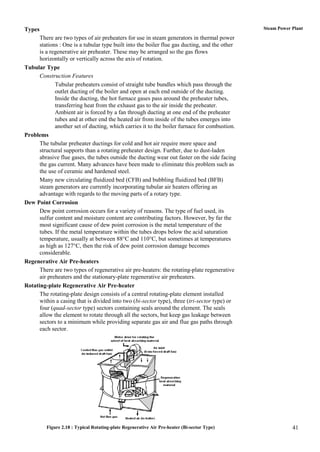
      The rotating-plate design consists of a central rotating-plate element installed
      within a casing that is divided into two (bi-sector type), three (tri-sector type) or
      four (quad-sector type) sectors containing seals around the element. The seals
      allow the element to rotate through all the sectors, but keep gas leakage between
      sectors to a minimum while providing separate gas air and flue gas paths through
      each sector.


         Figure 2.18 : Typical Rotating-plate Regenerative Air Pre-heater (Bi-sector Type)                 41
Power Plant Engineering         Tri-sector types are the most common in modern power generation facilities. In
                                the tri-sector design, the largest sector is connected to the boiler hot gas outlet.
                                The hot exhaust gas flows over the central element, transferring some of its heat to
                                the element, and is then ducted away for further treatment in dust collectors and
                                other equipment before being expelled from the flue gas stack. The second,
                                smaller sector, is fed with ambient air by a fan, which passes over the heated
                                element as it rotates into the sector, and is heated before being carried to the boiler
                                furnace for combustion. The third sector is the smallest one and it heats air which
                                is routed into the pulverizers and used to carry the coal-air mixture to coal boiler
                                burners. Thus, the total air heated in the air preheater provides: heating air to
                                remove the moisture from the pulverised coal dust, carrier air for transporting the
                                pulverised coal to the boiler burners and the primary air for combustion.
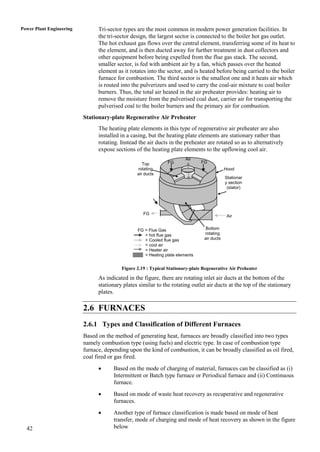
                          Stationary-plate Regenerative Air Preheater
                                The heating plate elements in this type of regenerative air preheater are also
                                installed in a casing, but the heating plate elements are stationary rather than
                                rotating. Instead the air ducts in the preheater are rotated so as to alternatively
                                expose sections of the heating plate elements to the upflowing cool air.
                                                                        Air
                                                    Top         FG              FG
                                                 rotating                                    Hood
                                                 air ducts
                                                                                             Stationar
                                                                                             y section
                                                                                              (stator)


                                                    FG
                                                                                              Air


                                                 FG = Flue Gas                    Bottom
                                                    = hot flue gas               rotating
                                                    = Cooled flue gas            air ducts
                                                    = cool air
                                                    = Heater air
                                                    = Heating plate elements


                                          Figure 2.19 : Typical Stationary-plate Regenerative Air Preheater

                                As indicated in the figure, there are rotating inlet air ducts at the bottom of the
                                stationary plates similar to the rotating outlet air ducts at the top of the stationary
                                plates.

                          2.6 FURNACES
                          2.6.1 Types and Classification of Different Furnaces
                          Based on the method of generating heat, furnaces are broadly classified into two types
                          namely combustion type (using fuels) and electric type. In case of combustion type
                          furnace, depending upon the kind of combustion, it can be broadly classified as oil fired,
                          coal fired or gas fired.
                                      Based on the mode of charging of material, furnaces can be classified as (i)
                                       Intermittent or Batch type furnace or Periodical furnace and (ii) Continuous
                                       furnace.
                                      Based on mode of waste heat recovery as recuperative and regenerative
                                       furnaces.
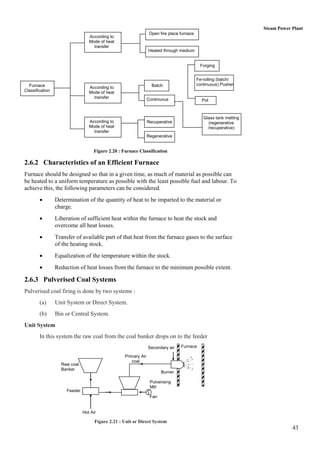
                                      Another type of furnace classification is made based on mode of heat
                                       transfer, mode of charging and mode of heat recovery as shown in the figure
  42                                   below
Steam Power Plant
                                                                  Open fire place furnace
                                  According to
                                  Mode of heat
                                    transfer
                                                                 Heated through medium


                                                                                             Forging


                                                                                            Fe-rolling (batch/
  Furnace                                                          Batch                    continuous) Pusher
                                  According to
Classification                    Mode of heat
                                    transfer                     Continuous                   Pot


                                                                                               Glass tank melting
                                  According to                   Recuperative                    (regenerative
                                  Mode of heat                                                   /recuperative)
                                    transfer
                                                                 Regenerative


                                    Figure 2.20 : Furnace Classification

2.6.2 Characteristics of an Efficient Furnace
Furnace should be designed so that in a given time, as much of material as possible can
be heated to a uniform temperature as possible with the least possible fuel and labour. To
achieve this, the following parameters can be considered.
                Determination of the quantity of heat to be imparted to the material or
                 charge.
                Liberation of sufficient heat within the furnace to heat the stock and
                 overcome all heat losses.
                Transfer of available part of that heat from the furnace gases to the surface
                 of the heating stock.
                Equalization of the temperature within the stock.
                Reduction of heat losses from the furnace to the minimum possible extent.

2.6.3 Pulverised Coal Systems
Pulverised coal firing is done by two systems :
        (a)      Unit System or Direct System.
        (b)      Bin or Central System.
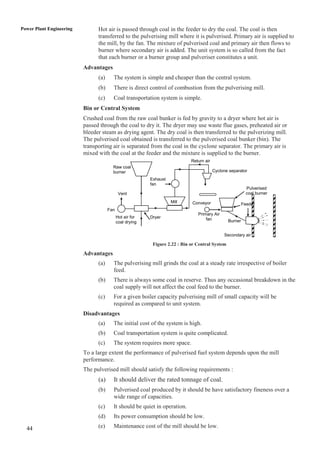
Unit System
        In this system the raw coal from the coal bunker drops on to the feeder
                                                                 Secondary air    Furnace

                                                   Primary Air
                                                      coal
                   Raw coal
                   Banker
                                                                        Burner

                                                                  Pulverising
                                                                  Mill
                      Feeder
                                                                  Fan


                               Hot Air

                                     Figure 2.21 : Unit or Direct System
                                                                                                                                43
Power Plant Engineering         Hot air is passed through coal in the feeder to dry the coal. The coal is then
                                transferred to the pulverising mill where it is pulverised. Primary air is supplied to
                                the mill, by the fan. The mixture of pulverised coal and primary air then flows to
                                burner where secondary air is added. The unit system is so called from the fact
                                that each burner or a burner group and pulveriser constitutes a unit.
                          Advantages
                                (a)     The system is simple and cheaper than the central system.
                                (b)     There is direct control of combustion from the pulverising mill.
                                (c)     Coal transportation system is simple.
                          Bin or Central System
                          Crushed coal from the raw coal bunker is fed by gravity to a dryer where hot air is
                          passed through the coal to dry it. The dryer may use waste flue gases, preheated air or
                          bleeder steam as drying agent. The dry coal is then transferred to the pulverizing mill.
                          The pulverised coal obtained is transferred to the pulverised coal bunker (bin). The
                          transporting air is separated from the coal in the cyclone separator. The primary air is
                          mixed with the coal at the feeder and the mixture is supplied to the burner.
                                                                             Return air
                                        Raw coal
                                        burner                                            Cyclone separator
                                                          Exhaust
                                                          fan
                                                                                                            Pulverised
                                             Vent                                                           coal burner
                                                                    Mill     Conveyor                     Feeder
                                      Fan
                                                                                Primary Air
                                            Hot air for   Dryer                     fan
                                            coal drying                                          Burner


                                                                                               Secondary air

                                                           Figure 2.22 : Bin or Central System
                          Advantages
                                (a)     The pulverising mill grinds the coal at a steady rate irrespective of boiler
                                        feed.
                                (b)     There is always some coal in reserve. Thus any occasional breakdown in the
                                        coal supply will not affect the coal feed to the burner.
                                (c)     For a given boiler capacity pulverising mill of small capacity will be
                                        required as compared to unit system.
                          Disadvantages
                                (a)     The initial cost of the system is high.
                                (b)     Coal transportation system is quite complicated.
                                (c)     The system requires more space.
                          To a large extent the performance of pulverised fuel system depends upon the mill
                          performance.
                          The pulverised mill should satisfy the following requirements :
                                (a)     It should deliver the rated tonnage of coal.
                                (b)     Pulverised coal produced by it should be have satisfactory fineness over a
                                        wide range of capacities.
                                (c)     It should be quiet in operation.
                                (d)     Its power consumption should be low.

  44                            (e)     Maintenance cost of the mill should be low.
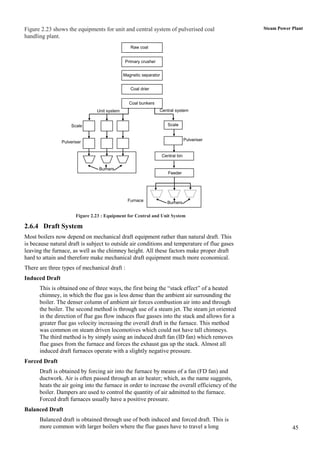
Figure 2.23 shows the equipments for unit and central system of pulverised coal                 Steam Power Plant
handling plant.
                                                 Raw coal


                                              Primary crusher


                                              Magnetic separator


                                                 Coal drier


                                                Coal bunkers
                                Unit system                     Central system


                     Scale                                            Scale


                                                                                 Pulveriser
                Pulveriser


                                                                   Central bin


                                 Burners
                                                                      Feeder


                                                Furnace              Burners


                       Figure 2.23 : Equipment for Central and Unit System

2.6.4 Draft System
Most boilers now depend on mechanical draft equipment rather than natural draft. This
is because natural draft is subject to outside air conditions and temperature of flue gases
leaving the furnace, as well as the chimney height. All these factors make proper draft
hard to attain and therefore make mechanical draft equipment much more economical.
There are three types of mechanical draft :
Induced Draft
      This is obtained one of three ways, the first being the “stack effect” of a heated
      chimney, in which the flue gas is less dense than the ambient air surrounding the
      boiler. The denser column of ambient air forces combustion air into and through
      the boiler. The second method is through use of a steam jet. The steam jet oriented
      in the direction of flue gas flow induces flue gasses into the stack and allows for a
      greater flue gas velocity increasing the overall draft in the furnace. This method
      was common on steam driven locomotives which could not have tall chimneys.
      The third method is by simply using an induced draft fan (ID fan) which removes
      flue gases from the furnace and forces the exhaust gas up the stack. Almost all
      induced draft furnaces operate with a slightly negative pressure.
Forced Draft
      Draft is obtained by forcing air into the furnace by means of a fan (FD fan) and
      ductwork. Air is often passed through an air heater; which, as the name suggests,
      heats the air going into the furnace in order to increase the overall efficiency of the
      boiler. Dampers are used to control the quantity of air admitted to the furnace.
      Forced draft furnaces usually have a positive pressure.
Balanced Draft
      Balanced draft is obtained through use of both induced and forced draft. This is
      more common with larger boilers where the flue gases have to travel a long                            45
Power Plant Engineering         distance through many boiler passes. The induced draft fan works in conjunction
                                with the forced draft fan allowing the furnace pressure to be maintained slightly
                                below atmospheric.

                          2.6.5 High Pressure Boilers
                          In all modern power plants, high pressure boilers (> 100 bar) are universally used as they
                          offer the following advantages. In order to obtain efficient operation and high capacity,
                          forced circulation of water through boiler tubes is found helpful. Some special types of
                          boilers operating at super critical pressures and using forced circulations are described in
                          this chapter.
                                (a)    The efficiency and the capacity of the plant can be increased as reduced
                                       quantity of steam is required for the same power generation if high pressure
                                       steam is used.
                                (b)    The forced circulation of water through boiler tubes provides freedom in the
                                       arrangement of furnace and water walls, in addition to the reduction in the
                                       heat exchange area.
                                (c)    The tendency of scale formation is reduced due to high velocity of water.
                                (d)    The danger of overheating is reduced as all the parts are uniformly heated.
                                (e)    The differential expansion is reduced due to uniform temperature and this
                                       reduces the possibility of gas and air leakages.
                                (f)    Some special types of high pressure supercritical boilers are described in
                                       this chapter.

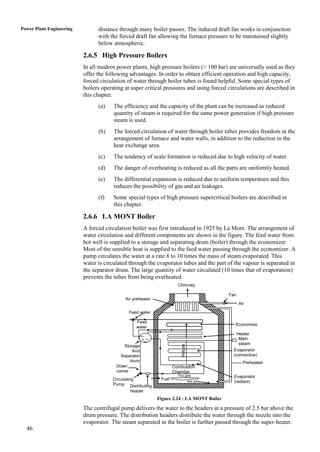
                          2.6.6 LA MONT Boiler
                          A forced circulation boiler was first introduced in 1925 by La Mont. The arrangement of
                          water circulation and different components are shown in the figure. The feed water from
                          hot well is supplied to a storage and separating drum (boiler) through the economizer.
                          Most of the sensible heat is supplied to the feed water passing through the economizer. A
                          pump circulates the water at a rate 8 to 10 times the mass of steam evaporated. This
                          water is circulated through the evaporator tubes and the part of the vapour is separated in
                          the separator drum. The large quantity of water circulated (10 times that of evaporation)
                          prevents the tubes from being overheated.
                                                                      Chimney

                                                                                           Fan
                                            Air preheater
                                                                                                 Air

                                             Feed water

                                                 Feed
                                                                                              Economise
                                                 water
                                                                                              r
                                                                                              Heater
                                                                                                Main
                                                                                                steam
                                                                        Hotgas


                                           Storage
                                               And                                           Evaporator
                                          Separator                                          (convective)
                                              drum                                                 Preheated
                                        Down                        Combustion
                                        comer                       Chamber
                                                                      Fire gate              Evaporator
                                      Circulating            Fuel                Ash pan     (radiant)
                                      Pump Distributing
                                              header
                                                            Figure 2.24 : LA MONT Boiler

                          The centrifugal pump delivers the water to the headers at a pressure of 2.5 bar above the
                          drum pressure. The distribution headers distribute the water through the nozzle into the
                          evaporator. The steam separated in the boiler is further passed through the super-heater.
  46
Secure a uniform flow of feed water through each of the parallel boiler circuits a choke       Steam Power Plant
is fitted entrance to each circuit. These boilers have been built to generate 45 to
50 tonnes of superheated steam at a pressure of 120 bars and temperature of 500°C.
Recently forced circulation has been introduced in large capacity power
2.6.7 Benson Boiler
The main difficulty experienced in the La Mont boiler is the formation and attachment of
bubbles on the inner surfaces of the heating tubes. The attached bubbles reduce the heat
flow and steam generation as it offers higher thermal resistance compared to water film :
      (a)    If the boiler pressure was raised to critical pressure (225 atm), the steam and
             water would have the same density and therefore the danger of bubble
             formation can be completely avoided.
      (b)    Natural circulation boilers require expansion joints but these are not
             required for Benson as the pipes are welded. The erection of Benson boiler
             is easier and quicker as all the parts are welded at site and workshop job of
             tube expansion is altogether avoided.
      (c)    The transport of Benson boiler parts is easy as no drums are required and
             majority of the parts are carried to the site without pre-assembly.
      (d)    The Benson boiler can be erected in a comparatively smaller floor area. The
             space problem does not control the size of Benson boiler used.
      (e)    The furnace walls of the boiler can be more efficiently protected by using
             small diameter and close pitched tubes.
      (f)    The superheater in the Benson boiler is an integral part of forced circulation
             system, therefore no special starting arrangement for superheater is
             required.
      (g)    The Benson boiler can be started very quickly because of welded joints.
      (h)    The Benson boiler can be operated most economically by varying the
             temperature and pres- sure at partial loads and overloads. The desired
             temperature can also be maintained constant at any pressure.
      (i)    Sudden fall of demand creates circulation problems due to bubble formation
             in the natural circulation boiler which never occurs in Benson boiler. This
             feature of insensitiveness to load fluctuations makes it more suitable for
             grid power station as it has better adaptive capacity to meet sudden load
             fluctuations.
      (j)    The blow-down losses of Benson boiler are hardly 4% of natural circulation
             boilers of same capacity.
      (k)    Explosion hazards are not at all severe as it consists of only tubes of small
             diameter and has very little storage capacity compared to drum type boiler.
During starting, the water is passed through the economiser, evaporator, superheater and
back to the feed line via starting valve.
During starting, first circulating pumps are started and then the burners are started to
avoid the overheating of evaporator and superheater tubes.
2.6.8 Loeffler Boiler
The major difficulty experienced in Benson boiler is the deposition of salt and sediment
on the inner surfaces of the water tubes. The deposition reduced the heat transfer and
ultimately the generating capacity. This further increased the danger of overheating the
tubes due to salt deposition as it has high thermal resistance. The difficulty was solved in
Loffler boiler by preventing the flow of water into the boiler tubes. Most of the steam is
generated outside from the feed water using part of the superheated steam coming-out
from the boiler.
                                                                                                           47
Power Plant Engineering   The pressure feed pump draws the water through the economizer and delivers it into the
                          evaporator drum. About 65% of the steam coming out of super heater is passed through
                          the evaporator drum in order to evaporate the feed water coming from economizer.
                          The steam circulating pump draws the saturated steam from the evaporator drum and is
                          passed through the radiant superheater and then convective superheater. About 35% of
                          the steam coming out from the superheater is supplied to the H.P. steam turbine. The
                          steam coming out from H.P. turbine is passed through reheater before supplying to L.P.
                          turbine. The amount of steam generated in the evaporator drum is equal to the steam
                          tapped (65%) from the superheater. The nozzles which distribute the superheated steam
                          through the water into the evaporator drum are of special design to avoid priming and
                          noise.
                          This boiler can carry higher salt concentration than any other type and is more compact
                          than indirectly heated boilers having natural circulation. These qualities fit it for land or
                          sea transport power generation. Loffler boilers with generating capacity of 94.5 tones/hr
                          and operating at 140 bar have already been commissioned.

                          2.6.9 SCHMIDT-HARTMANN Boiler
                          The operation of the boiler is similar to an electric transformer. Two pressures are used
                          to affect an interchange of energy. In the primary circuit, the steam at 100 bar is
                          produced from distilled water. This steam is passed through a submerged heating coil
                          which is located in an evaporator drum. The high pressure steam in this coil possesses
                          sufficient thermal potential and steam at 60 bars with a heat transfer rate of
                          2.5 kW/m2-°C is generated in the evaporator drum. The steam produced in the evporator
                          drums from impure water is further passed through the superheater and then supplied to
                          the prime-mover. The high pressure condensate formed in the sub- merged heating coil is
                          circulated through a low pressure feed heater on its way to raise the feed water
                          temperature to its saturation temperature. Therefore, only latent heat is supplied in the
                          evaporator drum. Natural circulation is used in the primary circuit and this is sufficient
                          to effect the desired rate of heat transfer and to overcome the thermo-siphon head of
                          about 2 m to 10 m. In normal circumstances, the replenishment of distilled water in the
                          primary circuit is not required as every care is taken in design and construction to
                          prevent leakage. But as a safeguard against leakage, a pressure gauge and safety valve
                          are fitted in the circuit.

                          2.6.10 VELOX-Boiler
                          When the gas velocity exceeds the sound-velocity, the heat is transferred from the gas at
                          a much higher rate than rates achieved with sub-sonic flow. The advantages of this
                          theory are taken to obtain the large heat transfer from a smaller surface area in this
                          boiler. Air is compressed to 2.5 bars with the help of a compressor run by gas turbine
                          before supplying to the combustion chamber to get the supersonic velocity of the gases
                          passing through the combustion chamber and gas tubes and high heat release rates. The
                          burned gases in the combustion chamber are passed through the annulus of the tubes.
                          The heat is transferred from gases to water while passing through the annulus to generate
                          the steam. The mixture of water and steam thus formed then passes into a separator
                          which is so designed that the mixture enters with a spiral flow. The centrifugal force thus
                          produced causes the heavier water particles to be thrown outward on the walls. This
                          effect separates the steam from water. The separated steam is further passed to
                          superheater and then supplied to the prime-mover. The water removed from steam in the
                          separator is again passed into the water tubes with the help of a pump.
                          The gases coming out from the annulus at the top are further passed over the superheater
                          where its heat is used-for superheating the steam. The gases coming out of superheater
                          are used to run a gas turbine as they carry sufficient kinetic energy. The power output of
                          the gas turbine is used to run the air-compressor. The exhaust gases coming out from the
                          gas turbine are passed through the economiser to utilize the remaining heat of the gases.
                          The extra power required to run the compressor is supplied with the help of electric
  48
motor. Feed water of 10 to 20 times the weight of steam generated is circulated through        Steam Power Plant
the tubes with the help of water circulating pump. This prevents the overheating of metal
walls.

2.7 ENERGY PERFORMANCE ASSESSMENT
    OF BOILERS
Performance of the boiler, like efficiency and evaporation ratio reduces with time, due to
poor combustion, heat transfer fouling and poor operation and maintenance.
Deterioration of fuel quality and water quality also leads to poor performance of boiler.
Efficiency testing helps us to find out how far the boiler efficiency drifts away from the
best efficiency. Any observed abnormal deviations could therefore be investigated to
pinpoint the problem area for necessary corrective action. Hence it is necessary to find
out the current level of efficiency for performance evaluation, which is a pre requisite for
energy conservation action in industry.
Purpose of the Performance Test
            To find out the efficiency of the boiler
            To find out the Evaporation ratio
      The purpose of the performance test is to determine actual performance and
      efficiency of the boiler and compare it with design values or norms. It is an
      indicator for tracking day-to-day and season-to-season variations in boiler
      efficiency and energy efficiency improvements
Performance Terms and Definitions
                                       Heat output
      (a)    Boiler Efficiency,                   100
                                       Heat input

                                       Heat in steam output (kCals)
                                                                    100
                                        Heat in fuel input (kCals)

                                   Quantity of steam generation
      (b)    Evaporation Ratio 
                                   Quantity of fuel consumption

Scope
      The procedure describes routine test for both oil fired and solid fuel fired boilers
      using coal, agro residues etc. Only those observations and measurements need to
      be made which can be readily applied and is necessary to attain the purpose of the
      test.
2.7.1 Reference Standards
British standards, BS845 : 1987
      The British Standard BS845: 1987 describes the methods and conditions under
      which a boiler should be tested to determine its efficiency. For the testing to be
      done, the boiler should be operated under steady load conditions (generally full
      load) for a period of one hour after which readings would be taken during the next
      hour of steady operation to enable the efficiency to be calculated.
      The efficiency of a boiler is quoted as the % of useful heat available, expressed as
      a percentage of the total energy potentially available by burning the fuel. This is
      expressed on the basis of gross calorific value (GCV).
      This deals with the complete heat balance and it has two parts :
             (a)   Part one deals with standard boilers, where the indirect method is
                   specified.
                                                                                                           49
Power Plant Engineering                 (b)   Part two deals with complex plant where there are many channels of
                                              heat flow. In this case, both the direct and indirect methods are
                                              applicable, in whole or in part.
                          ASME Standard : PTC-4-1 Power Test Code for Steam Generating Units
                               This consists of
                                        (c)   Part One : Direct method (also called as Input -output method).
                                        (d)   Part Two : Indirect method (also called as Heat loss method)
                          IS 8753 : Indian Standard for Boiler Efficiency Testing
                               Most standards for computation of boiler efficiency, including IS 8753 and BS845
                               are designed for spot measurement of boiler efficiency. Invariably, all these
                               standards do not include blow down as a loss in the efficiency determination
                               process.
                               Basically Boiler efficiency can be tested by the following methods :
                               The Direct Method
                                        Where the energy gain of the working fluid (water and steam) is compared
                                        with the energy content of the boiler fuel.
                               The Indirect Method
                                        Where the efficiency is the difference between the losses and the energy
                                        input.
                          2.7.2 The Direct Method Testing
                          Description
                               This is also known as „input-output method‟ due to the fact that it needs only the
                               useful output (steam) and the heat input (i.e. fuel) for evaluating the efficiency.
                               This efficiency can be evaluated using the formula :
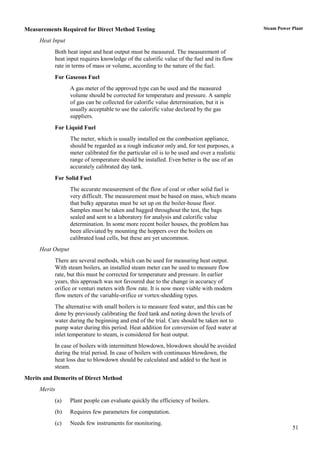
                                                                    Heat output
                                              Boiler Efficiency                 100
                                                                    Heat input

                                                             Heat addition to steam
                                              Efficiency                            100
                                                              Gross heat in fuel

                                                    Steam flow rate  (steam enthalpy  feed water enthalpy)
                              Boiler Efficiency                                                              100
                                                             Fuel firing rate  Gross calorific value


  50                                                    Figure 2.25 : Direct Method Testing
Measurements Required for Direct Method Testing                                                 Steam Power Plant

     Heat Input
           Both heat input and heat output must be measured. The measurement of
           heat input requires knowledge of the calorific value of the fuel and its flow
           rate in terms of mass or volume, according to the nature of the fuel.
           For Gaseous Fuel
                   A gas meter of the approved type can be used and the measured
                   volume should be corrected for temperature and pressure. A sample
                   of gas can be collected for calorific value determination, but it is
                   usually acceptable to use the calorific value declared by the gas
                   suppliers.
           For Liquid Fuel
                   The meter, which is usually installed on the combustion appliance,
                   should be regarded as a rough indicator only and, for test purposes, a
                   meter calibrated for the particular oil is to be used and over a realistic
                   range of temperature should be installed. Even better is the use of an
                   accurately calibrated day tank.
           For Solid Fuel
                   The accurate measurement of the flow of coal or other solid fuel is
                   very difficult. The measurement must be based on mass, which means
                   that bulky apparatus must be set up on the boiler-house floor.
                   Samples must be taken and bagged throughout the test, the bags
                   sealed and sent to a laboratory for analysis and calorific value
                   determination. In some more recent boiler houses, the problem has
                   been alleviated by mounting the hoppers over the boilers on
                   calibrated load cells, but these are yet uncommon.
     Heat Output
           There are several methods, which can be used for measuring heat output.
           With steam boilers, an installed steam meter can be used to measure flow
           rate, but this must be corrected for temperature and pressure. In earlier
           years, this approach was not favoured due to the change in accuracy of
           orifice or venturi meters with flow rate. It is now more viable with modern
           flow meters of the variable-orifice or vortex-shedding types.
           The alternative with small boilers is to measure feed water, and this can be
           done by previously calibrating the feed tank and noting down the levels of
           water during the beginning and end of the trial. Care should be taken not to
           pump water during this period. Heat addition for conversion of feed water at
           inlet temperature to steam, is considered for heat output.
           In case of boilers with intermittent blowdown, blowdown should be avoided
           during the trial period. In case of boilers with continuous blowdown, the
           heat loss due to blowdown should be calculated and added to the heat in
           steam.
Merits and Demerits of Direct Method
     Merits
           (a)     Plant people can evaluate quickly the efficiency of boilers.
           (b)     Requires few parameters for computation.
           (c)     Needs few instruments for monitoring.
                                                                                                            51
Power Plant Engineering         Demerits
                                        (a)   Does not give clues to the operator as to why efficiency of system is
                                              lower.
                                        (b)   Does not calculate various losses accountable for various efficiency
                                              levels.
                                        (c)   Evaporation ratio and efficiency may mislead, if the steam is highly
                                              wet due to water carryover
                          2.7.3 The Indirect Method Testing
                          Description
                                The efficiency can be measured easily by measuring all the losses occurring in the
                                boilers using the principles to be described. The disadvantages of the direct
                                method can be overcome by this method, which calculates the various heat losses
                                associated with boiler. The efficiency can be arrived at, by subtracting the heat
                                loss fractions from 100. An important advantage of this method is that the errors
                                in measurement do not make significant change in efficiency.
                                Thus if boiler efficiency is 90%, an error of 1% in direct method will result in
                                significant change in efficiency, i.e. 90  0.9 = 89.1 to 90.9. In indirect method,
                                1% error in measurement of losses will result in
                                        Efficiency = 100 – (10  0.1) = 90  0.1 = 89.9 to 90.1
                                The various heat losses occurring in the boiler are
                                        Efficiency = 100 – (1 + 2 + 3 + 4 + 5 + 6 + 7 + 8) (by indirect method)


                                                       Figure 2.26 : Indirect Method Testing
                          The following losses are applicable to liquid, gas and solid fired boiler :
                                L1 – Loss due to dry flue gas (sensible heat)
                                L2 – Loss due to hydrogen in fuel (H2)
                                L3 – Loss due to moisture in fuel (H2O)
                                L4 – Loss due to moisture in air (H2O)
                                L5 – Loss due to carbon monoxide (CO)
                                L6 – Loss due to surface radiation, convection and other unaccounted*.
                                *Losses which are insignificant and are difficult to measure.
                          The following losses are applicable to solid fuel fired boiler in addition to above :
                                L7 – Unburnt losses in fly ash (Carbon)
                                L8 – Unburnt losses in bottom ash (Carbon)

  52                      Boiler Efficiency by indirect method = 100 – (L1 + L2 + L3 + L4 + L5 + L6 + L7 + L8)
Energy Balance                                                                              Steam Power Plant

      Having established the magnitude of all the losses mentioned above, a simple
      energy balance would give the efficiency of the boiler. The efficiency is the
      difference between the energy input to the boiler and the heat losses calculated.
   Boiler energy Balance :                 kCal / kg of fuel             %
   Input/Output Parameter
   Heat Input in fuel                              =                     100
   Various Heat losses in boiler
   1. Dry flue gas loss                            =
   2. Loss due to hydrogen in fuel                 =
   3. Loss due to moisture in fuel                 =
   4. Loss due to moisture in air                  =
   5. Partial combustion of C to CO                =
   6. Surface heat losses                          =
   7. Loss due to Unburnt in fly ash               =
   8. Loss due to Unburnt in bottom ash            =
   Total Losses                                    =
   Boiler efficiency = 100 – (1 + 2 + 3 + 4 + 5 + 6 + 7 + 8)

2.7.4 Combustion Rate
Combustion rate is determined by the rate at which parcels of unburned gas are broken
down into smaller ones (create sufficient interfacial area between unburned mixture &
hot gases to enable reaction)
Factors Affecting Boiler Performance
      The various factors influencing the boiler performance are listed below :
              (a)    Periodical cleaning of boilers
              (b)    Periodical soot blowing
              (c)    Proper water treatment programme and blow down control
              (d)    Draft control
              (e)    Excess air control
              (f)    Percentage loading of boiler
              (g)    Steam generation pressure and temperature
              (h)    Boiler insulation
              (i)    Quality of fuel
      All these factors individually/combined, contribute to the performance of the
      boiler and reflected either in boiler efficiency or evaporation ratio. Based on the
      results obtained from the testing further improvements have to be carried out for
      maximizing the performance. The test can be repeated after modification or
      rectification of the problems and compared with standard norms. Energy auditor
      should carry out this test as a routine manner once in six months and report to the
      management for necessary action.
Boiler Terminology
      MCR: Steam boilers rated output is also usually defined as MCR (Maximum
      Continuous Rating). This is the maximum evaporation rate that can be sustained
      for 24 hours and may be less than a shorter duration maximum rating.
                                                                                                        53
Power Plant Engineering   Boiler Rating
                                  Conventionally, boilers are specified by their capacity to hold water and the steam
                                  generation rate. Often, the capacity to generate steam is specified in terms of
                                  equivalent evaporation (kg of steam/hour at 100oC).
                                  The equivalent of the evaporation of 1 kg of water at 100oC to steam at 100oC.
                          Efficiency
                                  In the boiler industry there are four common definitions of efficiency :
                                  Combustion Efficiency
                                        Combustion efficiency is the effectiveness of the burner only and relates to
                                        its ability to completely burn the fuel. The boiler has little bearing on
                                        combustion efficiency. A well-designed burner will operate with as little as
                                        15 to 20% excess air, while converting all combustibles in the fuel to useful
                                        energy.
                                  Thermal Efficiency
                                        Thermal efficiency is the effectiveness of the heat transfer in a boiler. It
                                        does not take into account boiler radiation and convection losses.
                                  Boiler Efficiency
                                        The term boiler efficiency is often substituted for combustion or thermal
                                        efficiency. True boiler efficiency is the measure of fuel to steam efficiency.
                                  Fuel to Steam Efficiency
                                        Fuel to steam efficiency is calculated using either of the two methods as
                                        prescribed by the ASME (American Society for Mechanical Engineers)
                                        power test code, PTC 4.1. The first method is input output method. The
                                        second method is heat loss method.

                          2.8 STEAM TURBINES
                          A steam turbine is a mechanical device that extracts thermal energy from pressurized
                          steam, and converts it into rotary motion. It has almost completely replaced the
                          reciprocating piston steam engine primarily because of its greater thermal efficiency and
                          higher power-to-weight ratio. Because the turbine generates rotary motion, it is
                          particularly suited to be used to drive an electrical generator – about 80% of all
                          electricity generation in the world is by use of steam turbines. The steam turbine is a
                          form of heat engine that derives much of its improvement in thermodynamic efficiency
                          through the use of multiple stages in the expansion of the steam, which results in a closer
                          approach to the ideal reversible process.
                          Types
                                  Steam turbines are made in a variety of sizes ranging from small 0.75 kW units
                                  (rare) used as mechanical drives for pumps, compressors and other shaft driven
                                  equipment, to 1,500,000 kW turbines used to generate electricity. There are
                                  several classifications for modern steam turbines.

                          2.8.1 Steam Turbine Classification
                          Steam Turbines have been classified by :
                                  (a)   Details of stage design as
                                        (i)    impulse
                                        (ii)   reaction
  54
(b)   Steam supply and exhaust conditions as                                           Steam Power Plant

      (i)     Condensing
      (ii)    Back Pressure (Non Condensing)
      (iii)   Mixed Pressure
      (iv)    Reheat
      (v)     Extraction type (Auto or Controlled)
      Condensing turbines are most commonly found in electrical power plants.
      These turbines exhaust steam in a partially condensed state, typically of a
      quality near 90%, at a pressure well below atmospheric to a condenser.
      Non-condensing or backpressure turbines are most widely used for process
      steam applications. The exhaust pressure is controlled by a regulating valve
      to suit the needs of the process steam pressure. These are commonly found
      at refineries, district heating units, pulp and paper plants, and desalination
      facilities where large amounts of low pressure process steam are available.
      Reheat turbines are also used almost exclusively in electrical power plants.
      In a reheat turbine, steam flow exits from a high pressure section of the
      turbine and is returned to the boiler where additional superheat is added.
      The steam then goes back into an intermediate pressure section of the
      turbine and continues its expansion.
      Extracting type turbines are common in all applications. In an extracting
      type turbine, steam is released from various stages of the turbine, and used
      for industrial process needs or sent to boiler feedwater heaters to improve
      overall cycle efficiency. Extraction flows may be controlled with a valve, or
      left uncontrolled.
      Induction turbines introduce low pressure steam at an intermediate stage to
      produce additional power.
(c)   Casing or shaft arrangement as
      (i)     Single Casing
      (ii)    Tandem compound
      (iii)   Cross Compound
      Single casing units are the most basic style where a single casing and shaft
      are coupled to a generator. Tandem compound are used where two or more
      casings are directly coupled together to drive a single generator. A cross
      compound turbine arrangement features two or more shafts not in line
      driving two or more generators that often operate at different speeds. A
      cross compound turbine is typically used for many large applications.


                       Figure 2.27 : Impulse Main Propulsion Turbine                               55
Power Plant Engineering         (d)    Number of Exhaust Stages in Parallel
                                (e)    Direction of steam flow
                                (f)    Steam supply – Superheated or saturated.

                          2.8.2 Principle of Operation and Design
                          An ideal steam turbine is considered to be an isentropic process, or constant entropy
                          process, in which the entropy of the steam entering the turbine is equal to the entropy of
                          the steam leaving the turbine. No steam turbine is truly “isentropic”, however, with
                          typical isentropic efficiencies ranging from 20%-90% based on the application of the
                          turbine. The interior of a turbine comprises several sets of blades, or “buckets” as they
                          are more commonly referred to. One set of stationary blades is connected to the casing
                          and one set of rotating blades is connected to the shaft. The sets intermesh with certain
                          minimum clearances, with the size and configuration of sets varying to efficiently exploit
                          the expansion of steam at each stage.

                          2.8.3 Turbine Efficiency
                          To maximize turbine efficiency the steam is expanded, generating work, in a number of
                          stages. These stages are characterized by how the energy is extracted from them and are
                          known as either impulse or reaction turbines. Most steam turbines use a mixture of the
                          reaction and impulse designs : each stage behaves as either one or the other, but the
                          overall turbine uses both. Typically, higher pressure sections are impulse type and lower
                          pressure stages are reaction type.


                                          Figure 2.28 : Schematic Diagram Outlining the difference between
                                                          an Impulse and a Reaction Turbine

                          2.8.4 Impulse Turbines
                          An impulse turbine has fixed nozzles that orient the steam flow into high speed jets.
                          These jets contain significant kinetic energy, which the rotor blades, shaped like buckets,
                          convert into shaft rotation as the steam jet changes direction. A pressure drop occurs
                          across only the stationary blades, with a net increase in steam velocity across the stage.
  56
As the steam flows through the nozzle its pressure falls from inlet pressure to the exit           Steam Power Plant
pressure (atmospheric pressure, or more usually, the condenser vacuum). Due to this
higher ratio of expansion of steam in the nozzle the steam leaves the nozzle with a very
high velocity. The steam leaving the moving blades is a large portion of the maximum
velocity of the steam when leaving the nozzle. The loss of energy due to this higher exit
velocity is commonly called the “carry over velocity” or “leaving loss”.

2.8.5 Reaction Turbines
In the reaction turbine, the rotor blades themselves are arranged to form convergent
nozzles. This type of turbine makes use of the reaction force produced as the steam
accelerates through the nozzles formed by the rotor. Steam is directed onto the rotor by
the fixed vanes of the stator. It leaves the stator as a jet that fills the entire circumference
of the rotor. The steam then changes direction and increases its speed relative to the
speed of the blades. A pressure drop occurs across both the stator and the rotor, with
steam accelerating through the stator and decelerating through the rotor, with no net
change in steam velocity across the stage but with a decrease in both pressure and
temperature, reflecting the work performed in the driving of the rotor.

2.8.6 Steam Turbine Start up
When warming up a steam turbine for use, the main steam stop valves (after the boiler)
have a bypass line to allow superheated steam to slowly bypass the valve and proceed to
heat up the lines in the system along with the steam turbine. Also a turning gear is
engaged when there is no steam to the turbine to slowly rotate the turbine to ensure even
heating to prevent uneven expansion. After first rotating the turbine by the turning gear,
allowing time for the rotor to assume a straight plane (no bowing), then the turning gear
is disengaged and steam is admitted to the turbine, first to the astern blades then to the
ahead blades slowly rotating the turbine at 10 to 15 RPM to slowly warm the turbine.

2.8.7 Precautions during Running
Problems with turbines are now rare and maintenance requirements are relatively small.
Any imbalance of the rotor can lead to vibration, which in extreme cases can lead to a
blade letting go and punching straight through the casing. It is, however, essential that
the turbine be turned with dry steam. If water gets into the steam and is blasted onto the
blades (moisture carryover) rapid impingement and erosion of the blades can occur,
possibly leading to imbalance and catastrophic failure. Also, water entering the blades
will likely result in the destruction of the thrust bearing for the turbine shaft. To prevent
this, along with controls and baffles in the boilers to ensure high quality steam,
condensate drains are installed in the steam piping leading to the turbine.

2.8.8 Speed Regulation
The control of a turbine with a governor is essential, as turbines need to be run up
slowly, to prevent damage while some applications (such as the generation of alternating
current electricity) require precise speed control. Uncontrolled acceleration of the
turbine rotor can lead to an overspeed trip, which causes the nozzle valves that control
the flow of steam to the turbine to close. If this fails then the turbine may continue
accelerating until it breaks apart, often spectacularly. Turbines are expensive to make,
requiring precision manufacture and special quality materials. During normal operation
in synchronization with the electricity net power plants are governed with a five percent
speed droop. This means the full load speed is 100% and the no load speed is 105%.
This is required for the stable operation of the net without hunting and dropouts of
power plants. Normally the changes in speed are minor. Adjustments in power output are
made by slowly raising the droop curve by increasing the spring pressure on a centrifugal
governor. Generally this is a basic system requirement for all power plants because the
older and newer plants have to be compatible in response to the instantaneous changes in
frequency without depending on outside communication.
                                                                                                               57
Power Plant Engineering   2.8.9 The Governor
                          The speed of the machine is controlled by the automatic opening and closing of the
                          admission valves under the control of a governor, of the spring-weighted type
                          (Figure 2.29) attached directly to the top end of the turbine shaft. The action of the
                          governor depends on the balance of force exerted by the spring, and the centrifugal effort
                          of the rectangular-shaped weights at the lower end; the moving weights acting through
                          the knife-edge suspension tend to pull down the lever against the resistance of the heavy
                          helical spring. The governor is provided with an auxiliary spring on the outside of the
                          governor dome for varying the speed while synchronizing. The tension of the auxiliary
                          spring is regulated by a small motor wired to the switchboard. This spring should be
                          used only to correct slight changes in speed. Any marked change should be corrected by
                          the use of the large hexagonal nut in the upper plate of the governor frame. This nut is
                          screwed down to increase the speed, and upward to decrease it.


                                                           Figure 2.29 : The Governor

                          Elements of Turbines and their Functions
                                Other than the operating and controlling equipment, similarity exists in both the
                                impulse and reaction turbines. These include foundations, casings, nozzles, rotors,
                                bearings, and shaft glands.
                          Foundations
                                Turbine foundations are built up from a structural foundation in the hull to provide
                                a rigid supporting base. All turbines are subjected to varying degrees of
                                temperature-from that existing during a secured condition to that existing during
                                full-power operation. Therefore, means are provided to allow for expansion and
                                contraction.
                                At the forward end of the turbine, there are various ways to give freedom of
                                movement. Elongated bolt holes or grooved sliding seats are used so that the
                                forward end of the turbine can move fore and aft as either expansion or
                                contraction takes place. The forward end of the turbine may also be mounted with
                                a flexible I-beam that will flex either fore or aft.
  58
Casings                                                                                     Steam Power Plant

     The materials used to construct turbines will vary somewhat depending on the
     steam and power conditions for which the turbine is designed. Turbine casings are
     made of cast carbon steel for non superheated steam applications. Superheated
     applications use casings made of carbon molybdenum steel. For turbine casings
     used on submarines, a percentage of chrome stainless steel is used, which is more
     resistant to steam erosion than carbon steel. Each casing has a steam chest to
     receive the incoming high-pressure steam. This steam chest delivers the steam to
     the first set of nozzles or blades.


                     Figure 2.30 : Turbine Assembly in a Machine Shop

Nozzles
     The primary function of the nozzles is to convert the thermal energy of steam into
     kinetic energy. The secondary function of the nozzles is to direct the steam against
     the blades.
Rotors
     Rotors (forged wheels and shaft) are manufactured from steel alloys. The primary
     purpose of a turbine rotor is to carry the moving blades that convert the steam's
     kinetic energy to rotating mechanical energy.
Bearings
     The rotor of every turbine must be positioned radially and axially by bearings.
     Radial bearings carry and support the weight of the rotor and maintain the correct
     radial clearance between the rotor and casing.


                           Figure 2.31 : Sliding Surface Bearing                                        59
Power Plant Engineering        Axial (thrust) bearings limit the fore-and-aft travel of the rotor. Thrust bearings
                               take care of any axial thrust, which may develop on a turbine rotor and hold the
                               turbine rotor within definite axial positions.
                               All main turbines and most auxiliary units have a bearing at each end of the rotor.
                               Bearings are generally classified as sliding surface (sleeve and thrust) or as rolling
                               contact (antifriction ball or roller bearings). Figure shows a typical sliding surface
                               bearing.
                          Shaft Packing Glands
                               Shaft packing glands prevent the leaking of steam out of or air into the turbine
                               casing where the turbine rotor shaft extends through the turbine casing. Labyrinth
                               and carbon rings are two types of packing. They are used either separately or in
                               combination.


                                                     Figure 2.32 : Labyrinth Packing Gland

                               Labyrinth packing consists of rows of metallic strips or fins. The strips fasten to
                               the gland liner so there is a small space between the strips and the shaft. As the
                               steam from the turbine casing leaks through the small space between the packing
                               strips and the shaft, steam pressure gradually reduces.


  60                                                  Figure 2.33 : Carbon Packing Gland
Carbon packing rings restrict the passage of steam along the shaft in much the        Steam Power Plant
     same manner as labyrinth packing strips. Carbon packing rings mount around the
     shaft and are held in place by springs.
     Three or four carbon rings are usually used in each gland. Each ring fits into a
     separate compartment of the gland housing and consists of two, three, or four
     segments that are butt-jointed to each other. A garter spring is used to hold these
     segments together. The use of keepers (lugs or stop pins) prevents the rotation of
     the carbon rings when the shaft rotates. The outer carbon ring compartment
     connects to a drain line.
Advantages of the Steam Turbine over Reciprocating Engine
     (a)   Thermal Efficiency of a Steam Turbine is higher than that of a
           Reciprocating Engine.
     (b)   The Steam Turbine develops power at a uniform rate and hence does not
           require Flywheel.
     (c)   No internal lubrication is required for Steam Turbine as there are no
           rubbing parts inside.
     (d)   No heavy foundation is required for Turbine because of the perfect
           balancing of the different parts.
     (e)   If the Steam Turbine is properly designed and constructed then it is the most
           durable Prime Mover.
     (f)   Much higher speed may be developed and a far greater range of speed is
           possible than in the case of Reciprocating Engine.
     (g)   There are some frictional losses in Reciprocating Engine as some
           arrangements are required for conversion of Reciprocating Motion into
           circular motion. But in Steam Turbine no friction losses are there.
     (h)   Steam Turbines are quite suitable for large Thermal Power Plant as they can
           be built in size from few Horse Powers to over 200000 HP in single unit.
Advantages of Steam Turbines
     (a)   High efficiency at full load.
     (b)   Mechanical simplicity and hence potential reliability.
     (c)   Conventional reciprocating steam locomotives give a varying torque
           through the cycle, resembling a sine characteristic. This makes wheel slip at
           starting much more likely.
     (d)   Conventional steam locomotives have substantial reciprocating masses such
           as connecting rods and valve gear. This creates fore-and-aft forces that
           cannot be completely balanced without unacceptably increasing the up-and-
           down forces on the track.
Disadvantages of Steam Turbines
     (a)   High efficiency is only obtained at full-load. Naval vessels very often had
           cruising turbines which could be run at full output while the main turbines
           were shut down.
     (b)   High efficiency is only obtained when the turbine exhausts into a near-
           vacuum, generated by a condenser. These are very large pieces of
           equipment to carry around.
     (c)   Turbines cannot run in reverse. Ships carried separate turbines solely for
           reversing, and locomotives had to do the same.                                              61
Power Plant Engineering   2.8.10 Performance Analysis of Steam Turbines
                          Need for Performance Analysis
                               (a)   To increase availability and reliability.
                               (b)   To reduce operating cost and maximize production.
                               (c)   To assess the effect of blade washes.
                               (d)   To identify optimum range of throttle loading rates.
                               (e)   To maintain power demand to the plant or grid.
                               (f)   To avoid catastrophic shutdowns.
                               (g)   To reduce maintenance expenditure.
                               (h)   To determine the underlying causes of operating deviations
                          Parameters to be Monitored in Performance Analysis
                               Isentropic Efficiency
                                     Used to determine machine performance trends and effects of maintenance
                                     activities.
                               Power Characteristics
                                     The power generation, actual or implied, together with expected generation
                                     at design or clean conditions.
                               Efficiency/Power Deviation
                                     Load independent comparison relative to design.
                               Pressure Ratios
                                     Used together with the efficiency curves to determine optimum stage
                                     performance selection.
                               Steam Velocities
                                     Used as an indicator of the amount of energy removed from the steam
                                     feedstock, from each stage.
                               Steam Rates
                                     Illustrates changes in performance deviation, relative to isentropic
                                     expansion.
                               Power Vs Steam
                                     Scatter plot identifies turbine degradation and optimum control regions.
                               Operating Loss Cost
                                     Tracks current and historical „lost opportunity‟ – both instantaneous and
                                     cumulative.
                               Thermal Efficiency
                                     The overall thermal efficiency of a steam turbine plant can be represented
                                     by the ratio of the net mechanical energy available to the energy within the
                                     fuel supplied.
                                                             Net outflow of shaft work     Energy rejected
                                      Thermal Efficiency                              1
                                                              Calorific value of fuel      Energy sup plied

                               Mechanical Efficiency
                                     Mechanical Efficiency of a turbine is the ratio of the brake output to the
  62                                 internal input. The Mechanical efficiency is an index of the external losses.
Steam Rate                                                                               Steam Power Plant

             Heat Rate Units and Definitions
                   The economy or efficiency of a steam power plant cycle is expressed
                   in terms of heat rate, which is total thermal input to the cycle divided
                   by the electrical output of the units.
             Actual Steam Rate
                   The actual steam rate of a turbine can be determined by dividing the
                   actual throttle steam flow rate by the actual corresponding kilowatts,
                   at the generator terminals, produced by that amount of steam. The
                   actual steam rate can also be determined by dividing the theoretical
                   steam rate by the engine efficiency of the turbine generator.

2.9 CONDENSER
2.9.1 Functions of Condensers
The main purposes of the condenser are to condense the exhaust steam from the turbine
for reuse in the cycle and to maximize turbine efficiency by maintaining proper vacuum.
As the operating pressure of the condenser is lowered (vacuum is increased), the
enthalpy drop of the expanding steam in the turbine will also increase. This will increase
the amount of available work from the turbine (electrical output). By lowering the
condenser operating pressure, the following will occur :
      (a)    Increased turbine output
      (b)    Increased plant efficiency
      (c)    Reduced steam flow (for a given plant output)
It is therefore very advantageous to operate the condenser at the lowest possible pressure
(highest vacuum).

2.9.2 Condenser Types
There are two primary types of condensers that can be used in a power plant :
      (a)    Direct Contact
      (b)    Surface
Direct contact condensers condense the turbine exhaust steam by mixing it directly with
cooling water. The older type Barometric and Jet-Type condensers operate on similar
principles.
Steam surface condensers are the most commonly used condensers in modern power
plants. The exhaust steam from the turbine flows on the shell side (under vacuum) of the
condenser, while the plant‟s circulating water flows in the tube side. The source of the
circulating water can be either a closed-loop (i.e. cooling tower, spray pond, etc.) or once
through (i.e. from a lake, ocean, or river). The condensed steam from the turbine, called
condensate, is collected in the bottom of the condenser, which is called a hotwell. The
condensate is then pumped back to the steam generator to repeat the cycle.

2.9.3 Surface Condenser
The surface condenser is a shell and tube heat exchanger in which cooling water is
circulated through the tubes. The exhaust steam from the low pressure turbine enters the
shell where it is cooled and converted to condensate (water) by flowing over the tubes as
shown in the diagram. Such condensers use steam ejectors or rotary motor-driven
exhausters for continuous removal of air and gases from the steam side to maintain
vacuum.                                                                                                    63
Power Plant Engineering


                                            Figure 2.34 : Diagram of a Typical Water-cooled Surface Condenser

                          For best efficiency, the temperature in the condenser must be kept as low as practical in
                          order to achieve the lowest possible pressure in the condensing steam. Since the
                          condenser temperature can almost always be kept significantly below 100oC where the
                          vapor pressure of water is much less than atmospheric pressure, the condenser generally
                          works under vacuum. Thus leaks of non-condensable air into the closed loop must be
                          prevented.
                          The condenser generally uses either circulating cooling water from a cooling tower to
                          reject waste heat to the atmosphere, or once-through water from a river, lake or ocean.


                          Note : Tubes are brass, cupro nickel, titanium or stainless steel. The tubes are expanded or rolled and bell
                                 mouthed at the ends in the tube sheets.
                                                         Figure 2.35 : Typical Power Plant Condenser
                          The diagram depicts a typical water-cooled surface condenser as used in power stations
                          to condense the exhaust steam from a steam turbine driving an electrical generator as
                          well in other applications
                          2.9.4 Condenser Components and their Functions
                          Shell
                                  The shell is the condenser's outermost body and contains the heat exchanger tubes.
                                  The shell is fabricated from carbon steel plates and is stiffened as needed to
                                  provide rigidity for the shell. When required by the selected design, intermediate
                                  plates are installed to serve as baffle plates that provide the desired flow path of
                                  the condensing steam. The plates also provide support that help prevent sagging of
                                  long tube lengths.
                                  For most water-cooled surface condensers, the shell is under vacuum during
  64                              normal operating conditions.
Hotwell                                                                                         Steam Power Plant

     At the bottom of the shell, where the condensate collects, an outlet is installed. In
     some designs, a sump (often referred to as the hotwell) is provided. Condensate is
     pumped from the outlet or the hotwell for reuse as boiler feedwater.
Vacuum System
     For a steam ejector, the motive fluid is steam.
     For water-cooled surface condensers, the shell's internal vacuum is most
     commonly supplied by and maintained by an external steam jet ejector system.
     Such an ejector system uses steam as the motive fluid to remove any non-
     condensable gases that may be present in the surface condenser. The Venturi
     effect, which is a particular case of Bernoulli's principle, applies to the operation
     of steam jet ejectors.
     Motor driven mechanical vacuum pumps, such as the liquid ring type, are also
     popular for this service.
                                Motive fluid
                                 nozzle

                                                                  Diverging outlet
                                                Converging
                                                                      diffuser
                                                inlet nozzle


        Motive fluid                                                                   Outlet


                                                                     Diffuser throat


                           Inlet gas, liquid,
                                or other
                       Figure 2.36 : Diagram of a Typical Modern Injector or Ejector

Tube Sheets
     At each end of the shell, a sheet of sufficient thickness usually made of stainless
     steel is provided, with holes for the tubes to be inserted and rolled. The inlet end
     of each tube is also bell mouthed for streamlined entry of water. This is to avoid
     eddies at the inlet of each tube giving rise to erosion, and to reduce flow friction.
     Some makers also recommend plastic inserts at the entry of tubes to avoid eddies
     eroding the inlet end. In smaller units some manufacturers use ferrules to seal the
     tube ends instead of rolling. To take care of length wise expansion of tubes some
     designs have expansion joint between the shell and the tube sheet allowing the
     latter to move longitudinally. In smaller units some sag is given to the tubes to
     take care of tube expansion with both end water boxes fixed rigidly to the shell.
Tubes
     Generally the tubes are made of stainless steel, copper alloys such as brass or
     bronze, cupro nickel, or titanium depending on several selection criteria. The use
     of copper bearing alloys such as brass or cupro nickel is rare in new plants, due to
     environmental concerns of toxic copper alloys. Also depending on the steam cycle
     water treatment for the boiler, it may be desirable to avoid tube materials
     containing copper. Titanium condenser tubes are usually the best technical choice;
     however the use of titanium condenser tubes has been virtually eliminated by the
     sharp increases in the costs for this material. The tube lengths range to about 17 m
     for modern power plants, depending on the size of the condenser. The size chosen
     is based on transportability from the manufacturers‟ site and ease of erection at the
     installation site.
                                                                                                            65
Power Plant Engineering   Waterboxes
                                The tube sheet at each end with tube ends rolled, for each end of the condenser is
                                closed by a fabricated box cover known as a waterbox, with flanged connection to
                                the tube sheet or condenser shell. The waterbox is usually provided with man
                                holes on hinged covers to allow inspection and cleaning.
                                These waterboxes on inlet side will also have flanged connections for cooling
                                water inlet butterfly valves, small vent pipe with hand valve for air venting at
                                higher level, and hand operated drain valve at bottom to drain the waterbox for
                                maintenance. Similarly on the outlet waterbox the cooling water connection will
                                have large flanges, butterfly valves, vent connection also at higher level and drain
                                connections at lower level. Similarly thermometer pockets are located at inlet and
                                outlet pipes for local measurements of cooling water temperature.
                          2.9.5 Condensate Pumps
                          Condensate pumps are those kinds of pumps that are used to collect and transport
                          condensate back into a steam system for reheating and reuse, or to remove unwanted
                          condensate.
                          Condensate pumps have a tank in which condensate can accumulate. The tank size varies
                          depending on the application. The accumulating liquid raises a float switch which
                          energizes the pump. The pump then runs until the level of liquid in the tank is
                          substantially lowered. Some pumps contain a two-stage switch. As the liquid rises to the
                          trigger point of the first stage, the pump starts working. If the liquid continues to rise, the
                          second stage will be triggered. This stage may switch off the HVAC equipment, which
                          is, preventing the production of further condensate, trigger an alarm or both.
                          Types of Condensate Pump
                                Boiler Feed Pump
                                       This pump closes the boiler, steam and condensate loop by returning the
                                       condensate back into the system for reuse.
                                Sump Pump
                                       This pump is installed in compartments to remove the unwanted build-up of
                                       water.
                          In a steam power plant, the condensate pump is normally located adjacent to the main
                          condenser hotwell often directly below it. This pump sends the water to a make-up tank
                          closer to the steam generator or boiler. If the tank is also designed to remove dissolved
                          oxygen from the condensate, it is known as a De aerating feed tank (DFT). The output of
                          the DFT supplies the feed booster pump which, in turn, supplies the feed pump
                          (feedwater pump) which returns the feedwater to the boiler so the cycle can start over.
                          Two pumps in succession are used to provide sufficient Net Positive Suction Head to
                          prevent cavitation and the subsequent damage associated with it.
                          Circulating Pumps
                                Condenser circulating pumps are used to pump cooing water through the
                                condenser. The source of the cooling water can be the sea, lake, river or a cooling
                                tower. Low speed –horizontal-double suction-volute centrifugal pumps are used
                                for this application. This pump has a simple but rugged design that allows ready
                                access to interior for examination and rapid dismantling if repairs are required.
                          Atmospheric Relief Valves
                                Atmospheric relief valves provide automatic protection of costly condenser
                                equipment. These valves are as important as trip throttle valves, over speed
                                governors, and other devices for power plant protection. Atmospheric relief valves
                                are designed and manufactured with the finest materials and the highest quality
                                workmanship.
  66
Atmospheric relief valves open and close automatically. Each valve needs to be         Steam Power Plant
      installed vertically and properly leveled for smooth operation. Special ring seals
      and a water seal is provided for zero leakage in full vacuum conditions. Each
      valve opens immediately when pressure increases slightly above atmospheric
      pressure. Higher than atmospheric set pressures can be provided with internally
      spring loaded discs. During regular maintenance and as many times as possible,
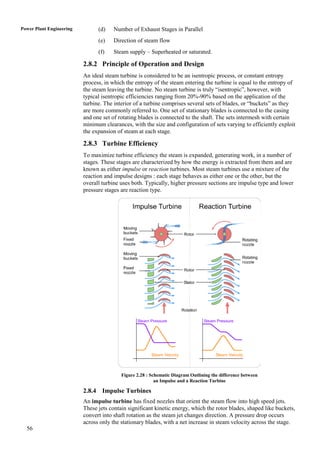
      each atmospheric valve should be opened by turning the hand wheel clockwise
      then closing the valves by turning counter clockwise. This process ensures non-
      binding and self-cleaning valve action.
Requirements of a Good Condensing System
      The requirements of ideal surface condenser used for power plants are as follows :
             (a)   The steam entering the condenser should be evenly distributed over
                   the whole cooling surface of the condenser vessel with minimum
                   pressure loss.
             (b)   The amount of cooling water being circulated in the condenser should
                   be so regulated that the temperature of cooling water leaving the
                   condenser is equivalent to saturation temperature of steam
                   corresponding to steam pressure in the condenser. This will help in
                   preventing under cooling of condensate.
             (c)   The deposition of dirt on the outer surface of tubes should be
                   prevented. Passing the cooling water through the tubes and allowing
                   the steam to flow over the tubes achieve this.
             (d)   There should be no air leakage into the condenser because presence
                   of air destroys the vacuum in the condenser and thus reduces the
                   work obtained per kg of steam. If there is leakage of air into the
                   condenser air extraction pump should be used to remove air as
                   rapidly as possible.

2.10 COOLING TOWER
Functions
      Cooling Towers have one function :
                  Remove heat from the water discharged from the condenser so that
                   the water can be discharged to the river or recirculated and reused.

2.10.1 What is a Cooling Tower
A cooling tower extracts heat from water by evaporation. In an evaporative cooling
tower, a small portion of the water being cooled is allowed to evaporate into a moving
air stream to provide significant cooling to the rest of that water stream.
Cooling Towers are commonly used to provide lower than ambient water temperatures
and are more cost effective and energy efficient than most other alternatives. The
smallest cooling towers are structured for only a few litres of water per minute while the
largest cooling towers may handle upwards of thousands of litres per minute. The pipes
are obviously much larger to accommodate this much water in the larger towers and can
range up to 12 inches in diameter.

2.10.2 How Cooling Towers Work
When water is reused in the process, it is pumped to the top of the cooling tower and will
then flow down through plastic or wood shells, much like a honeycomb found in a bee‟s
nest. The water will emit heat as it is downward flowing which mixes with the above air
flow, which in turn cools the water. Part of this water will also evaporate, causing it to
lose even more heat.
                                                                                                         67
Power Plant Engineering   2.10.3 Types of Cooling Towers
                          One way to distinguish between cooling towers is how the air and water interact, open
                          cooling towers or closed cooling towers. Open cooling towers, also called direct cooling
                          towers, allow the water to come into contact with outside air. If cooled water is returned
                          from the cooling tower to be used again, some water must be added to replace the water
                          that has been lost. Pollutants are able to enter into the water used in these processes and
                          must be filtered out. Another method of combating the excess minerals and pollutants is
                          some means of a dissolved solid control, such as a blow down. With this, a small
                          percentage of the flow is drained off to aid in the removal of these contaminants. This is
                          fairly effective, but not as efficient as filtration.
                          Closed loop (or closed circuit) cooling tower systems, also called indirect cooling tower
                          systems, do not allow the water to come into contact with any outside substance,
                          therefore keeping the water more pure due to the lack of foreign particles introduced.
                          Another classification of cooling towers is made between field assembled towers and
                          factory assembled towers. Field assembled towers are shipped in pieces and assembled
                          on site by a highly qualified and certified installation team. Factory assembled towers
                          typically only require the fan motor to be mounted.
                          2.10.4 Natural Draft Towers
                          Natural draft towers are typically about 120 m high, depending on the differential
                          pressure between the cold outside air and the hot humid air on the inside of the tower as
                          the driving force. No fans are used.
                          Whether the natural or mechanical draft towers are used depends on climatic and
                          operating requirement conditions.
                          The green flow paths show how the warm water leaves the plant proper, is pumped to the
                          natural draft cooling tower and is distributed. The cooled water, including makeup from
                          the lake to account for evaporation losses to the atmosphere, is returned to the
                          condenser.
                          Mechanical Draft
                                Mechanical draft towers uses fans (one or more) to move large quantities of air
                                through the tower. They are two different classes :
                                       (a)   Forced draft cooling towers
                                       (b)   Induced draft cooling towers
                                The air flow in either class may be cross flow or counter flow with respect to the
                                falling water. Cross flow indicates that the airflow is horizontal in the filled
                                portion of the tower while counter flow means the air flow is in the opposite
                                direction of the falling water.
                                The counter flow tower occupies less floor space than a cross flow tower but is
                                taller for a given capacity. The principle advantages of the cross flow tower are
                                the low pressure drop in relation to its capacity and lower fan power requirement
                                leading to lower energy costs.
                                All mechanical towers must be located so that the discharge air diffuses freely
                                without recirculation through the tower, and so that air intakes are not restricted.
                                Cooling towers should be located as near as possible to the refrigeration systems
                                they serve, but should never be located below them so as to allow the condenser
                                water to drain out of the system through the tower basin when the system is shut
                                down.
                                Forced Draft
                                       The forced draft tower, has the fan, basin, and piping located within the
                                       tower structure. In this model, the fan is located at the base. There are no
                                       louvered exterior walls. Instead, the structural steel or wood framing is
                                       covered with paneling made of aluminum, galvanized steel, or asbestos
  68                                   cement boards.
Steam Power Plant


                       Figure 2.37 : Mechanical Draft

     During operation, the fan forces air at a low velocity horizontally through
     the packing and then vertically against the downward flow of the water that
     occurs on either side of the fan. The drift eliminators located at the top of
     the tower remove water entrained in the air. Vibration and noise are
     minimal since the rotating equipment is built on a solid foundation. The
     fans handle mostly dry air, greatly reducing erosion and water condensation
     problems.
Induced Draft
     The induced draft tower show in the following picture has one or more fans,
     located at the top of the tower, that draw air upwards against the downward
     flow of water passing around the wooden decking or packing. Since the
     airflow is counter to the water flow, the coolest water at the bottom is in
     contact with the driest air while the warmest water at the top is in contact
     with the moist air, resulting in increased heat transfer efficiency.


                         Figure 2.38 : Induced Draft                                             69
Power Plant Engineering   Hybrid Draft
                                They are equipped with mechanical draft fans to augment airflow. Consequently,
                                they are also referred to as fan-assisted natural draft towers. The intent of their
                                design is to minimize the power required for the air movement, but to do so with
                                the least possible stack cost impact. Properly designed fans may need to be
                                operated only during periods of high ambient and peak loads.
                                                                            Air out


                                                     Water in


                                         Air in


                                           Outflow


                                                                Figure 2.39 : Hybrid Draft


                          2.11 STEAM POWER STATION CONTROL
                          2.11.1 Basic Components of a Control System
                          Most control functions are implemented by means of a computer-based system, so we
                          shall now briefly look at a typical configuration known as DCS.
                          DCS stands for „distributed control system‟. The term „distributed‟ means that several
                          processors are operating together. This is usually achieved by dedicating tasks to
                          different machines. It does not necessarily mean that the separate computers are
                          physically located in different areas of the plant.
                          Figure 2.40 shows how a typical system may be arranged. The following notes relate to
                          individual parts of that system.


  70                                                    Figure 2.40 : The Central System Cabinets
Located near the centre are the cabinets which house the processors that execute the           Steam Power Plant
control functions. These cubicles also contain the attendant interface and input/output
(I/O) cards and the necessary power supply units (PSUs). The latter will usually be
duplicated or triplicated, with automatic changeover from one to another in the event of
the first failing. This automatic changeover is often referred to as 'diode auctioneering'
because silicon diodes are used to feed power from each unit onto a common bus-main.
In the event of the operational power-supply unit failing, its diode prevents a power
reversal while the back-up power unit takes over. At this time it is important that the
system should raise an alarm to warn that a PSU failure has occurred. Otherwise the
DCS will continue to operate with a diminished power-supply reserve and any further
failure could have serious consequences.
The I/O cards consist of analogue and digital input and output channels. Analogue
inputs convert the incoming signals to a form which can be read by the system. The
printed-circuit cards for analogue inputs may or may not provide „galvanic isolation‟.
With a galvanically isolated device the signal circuit is electrically isolated from others,
from the system earth and from the power-supply common rail.
Termination and Marshalling
      It is important to understand that the grouping of inputs and outputs on the I/O
      cards does not always correspond with the grouping of signals into multipair
      cables, which is dictated by the physical arrangement of equipment on the plant.
      While it is sensible to avoid mixing different control systems (e.g. feed water
      control and combustion control) onto a single card, the signals associated with a
      single system will not necessarily all be carried in the same cable. The result is
      that a certain degree of cross connection or 'marshalling' is always required.
Operator Workstations
      The operator workstations consist of screens on which plant information can be
      observed, plus keyboards, trackballs or „mouse‟ devices allowing the operator to
      send commands to the system. They also comprise printers for operational records,
      logging of events (such as start-up of a pump), or alarms. Some systems also
      provide plotters
2.11.2 Compressed Air Control Systems
Compressed air system controls match the compressed air supply with system demand
(although not always in real-time) and are one of the most important determinants of
overall system energy efficiency. Proper control is essential to efficient system operation
and high performance. The objective of any control strategy is also to shut off unneeded
compressors or delay bringing on additional compressors until needed. All units which
are on should be run at full-load, except for one unit for trimming.
Individual Compressor Control Strategies
      Controls such as start/stop and load/unload respond to reductions in air demand,
      increasing compressor discharge pressure by turning the compressor off or
      unloading it so that it does not deliver air for periods of time. Modulating inlet and
      multi-step controls allow the compressor to operate at part load and deliver a
      reduced amount of air during periods of reduced demand.
Start/Stop
      Start/stop is the simplest control available and can be applied to either
      reciprocating or rotary screw compressors. The motor driving the compressor is
      turned on or off in response to the discharge pressure of the machine. Typically, a
      simple pressure switch provides the motor start/stop signal.
Load/Unload
      Load/unload control, also known as constant speed control, allows the motor to
      run continuously, but unloads the compressor when the discharge pressure is
      inadequate, but in most cases, an unloaded compressor will consume 15-35% of
      full load power while delivering no useful work.                                                     71
Power Plant Engineering   Modulating Controls
                               Modulating inlet control allows the output of a compressor to be varied to meet
                               flow requirements. Throttling is usually accomplished by closing down the inlet
                               valve, thereby restricting inlet air to the compressor. With the use of inlet guide
                               vanes which direct the air in the same direction as the impeller inlet, centrifugal
                               compressors yield more efficient results.

                          Multi-Step Controls
                               Some compressors are designed to operate in two or more partially loaded
                               conditions. With such a control schemes, output pressure can be closely controlled
                               without requiring the compressor to start/stop or load/unload.

                          2.11.3 Controls and Instruments in a Modern Central Station
                                 Control Room
                          General Instrumentation and Control Design
                               Redundant systems and equipment shall be used in the instrumentation and control
                               systems. Automated control data processing/display shall be considered in order to
                               enhance operability. The logic system shall contain redundant central control
                               units: one active and the second one in a hot standby mode.
                               An automatic shutdown override capability shall be designed into the control
                               system to permit the operator to bypass controls that normally initiate automatic
                               shutdown. Control systems and instruments may be pneumatic, ac or dc electrical,
                               electronic digital, combination pneumatic and electronic, or hydraulic.
                               Mechanical-hydraulic and electro-hydraulic systems shall be used in conjunction
                               with governor speed control systems. Pneumatic controls shall not be used on
                               power systems.

                          Supervisory Control and Data Acquisition System
                               The control system shall consist of a Programmable Logic Controller (PLC) based
                               Supervisory Control and Data Acquisition (SCADA) system. Input/output (I/O)
                               modules located in Remote Terminal Units (RTUs) shall provide the interface
                               between the central control unit and other system hardware such as circuit breaker
                               position indication and control, generator paralleling switchgear, automatic
                               transfer switches, UPS units, etc. Man-machine interface (MMI) software shall
                               run on a Windows based PC and interface with the central control unit.

                          Power Loss and Restoration
                               When the facility is operating solely on commercial power, loss of commercial
                               power shall cause automatic disconnect of all loads from the utility bus and
                               initiation of the sequence to bring generator sets up to their full capabilities. Then
                               loads shall be incrementally added to the power plant bus. The sequence and
                               restoration priority for feeders serving technical loads, as well as consideration of
                               the maximum time to restore the service, shall be determined by the using an
                               agency.
                               The central plant operator shall have an option for manually initiating the start
                               sequence, bringing additional generators on-line, or reconnecting the power plant
                               bus to commercial power and returning the generator sets to the condition existing
                               prior to the loss of commercial power. Manual startup and shutdown control shall
                               be provided locally in each generator area for use by an
                               operator-maintainer. Visual and audible alarms shall indicate out-of-tolerance
                               conditions, and critical information shall be printed out or otherwise recorded.
                               This requirement includes minor discrepancies which, if left uncorrected or
                               allowed to degrade further, could result in shutdown of the power-generating unit.
  72
Table 2.1 : Automatic Control Functions                                 Steam Power Plant

                                 Module or Unit Functions
   1    Generator set startup sequence                                                A, M1
   2    Synchronizing generator to main bus                                           A, M1
   3    Generator set normal shutdown sequence                                         M
   4    Generator set emergency shutdown (except when in run-to-destruct mode)          A
   5    Generator voltage regulation                                                    C
   6    Engine speed regulation                                                         C
   7    Motor-generator set starting sequence                                          M
                                   Power Plant Functions
   1    Real load division between generator sets                                      C
   2    Reactive load divisions between generators                                     C
   3    Bus voltage regulation                                                         C
   4    Bus frequency regulation                                                       C
   5    Bus frequency time-error correction                                            C
                            Cooling Equipment Area Functions
   1    Shift to backup pump upon failure of any manually or automatically            A, M
        selected pump
   2    Control makeup water feed pump by liquid level                                A, M
                                 Station Service Functions
  1a    Air-conditioning system shutdown upon high temperature signal from             A
        critical components
  1b    Air-conditioning system shutdown upon loss of refrigerant                      A
  1c    Air-conditioning system thermostatic control of each system                    A
   2    Compressed air system – maintain station service receiver at rated pressure    A
   3    Sump pumps                                                                     A
   4    Direct current supply – maintain rectifier at rated output                     A
 A – Automatic initiation, M – Manual initiation, C – Continuous signal

       Table lists required automatic control functions and their initiation mode(s). These
       functions are the minimum required, and others may be added as needed. Those
       functions requiring manual initiation are noted as (M), those initiated by automatic
       signal are noted as (A), and those operating on a continuous signal are noted as
       (C). Manual control shall be provided on automatic control functions, as required,
       for maintenance and testing.
Control Room (CR) Instrumentation
       For installations with a large central power plant, on-site instrumentation and
       controls shall be provided in the CR to centralize operation of the on-site utilities.
       Instrumentation in the CR shall be microprocessor-based systems and shall permit
       the power plant operator to monitor the operating status of all equipment, operate
       the equipment, and evaluate system conditions affecting delivery of electric power
       and coolant to the site equipment and the facility. Additionally, monitoring and
       control of auxiliary equipment and of all equipment required to regulate the
       environment of the site shall be performed in the CR. Operators shall be able to
       measure operating conditions, which shall permit analysis of the thermodynamic
       and mechanical performance of the power plant on a continuous basis. Abnormal
       incipient failures and failure conditions shall be annunciated in the CR. Mimic
       status boards and/or CRT color graphic displays shall indicate, by color coded
       groups arranged graphically, the status of all power generation equipment,
       commercial power primary substation medium-voltage switchgear, coolant pumps,
       and other critical items. Printout on a periodic basis and under alarm conditions
       shall be provided for all critical equipment and plant conditions. Remote CRTs
       and printouts shall be provided for operation officers or the facility engineer.

                                                                                                            73
Power Plant Engineering         (a)   A master frequency control system shall be provided for the primary
                                      switchgear main bus. Provisions shall be made for sensing and controlling
                                      any or all of the buses when they are electrically connected to each other,
                                      when they are in service but electrically separated, or when only one is in
                                      service. The system shall be capable of being switched in or out of service,
                                      to either side of the primary double bus, or to split bus operation without
                                      causing system frequency deviation beyond the requirements specified. The
                                      system shall include the following :
                                      (i)     Frequency recorders
                                      (ii)    Frequency deviation transducers
                                      (iii)   Master frequency standard
                                      (iv)    Governor actuator devices
                                (b)   A master voltmeter recorder system shall be furnished to indicate and
                                      record the line-to-line voltages on the main buses and on each medium-
                                      voltage power supply bus. The voltmeter shall measure the true RMS
                                      voltage. A multi-channel recorder shall be used to precisely record all bus
                                      voltages.
                                (c)   Recording watt-hour meters and demand meters shall be installed for the
                                      commercial power connection. The installation shall meet the requirements
                                      of the serving utility and local regulating agencies, and shall provide with
                                      data needed to confirm billing by the utility company. Voltage and current
                                      measurements shall be true RMS.
                                (d)   Table lists the minimum requirement for the CR control panel instruments
                                      and controls for prime movers. These instruments and controls are the
                                      minimum required, and others may be added as needed.
                               Table 2.2 : Minimum CR Control Panel Instrumentation for Prime Movers

                          1      Pressure indicator, fuel oil, supply to engine
                          2      Pressure indicator, fuel, from main storage tank
                          3      Level indicator, fuel, main storage tank
                          4      Level indicator, fuel, day storage tank
                          5      Pressure indicator, lube oil, supply to engine
                          6      Pressure indicator, lube oil, supply to turbocharger
                          7      Level indicator, lube oil, sump tank
                          8      Pressure indicator, combustion air, turbocharger
                          9      Pressure indicator, combustion air, filter downstream
                          10     Temperature indicator, each cylinder and combined exhaust (selector switch)
                          11     Pressure indicator, starting air, air receiver
                          12     Pressure indicator, cooling water, pump discharge
                          13     Temperature indicator, cooling water, supply to engine
                          14     Temperature indicator, cooling water, return from engine
                          15     Level indicator, jacket water, surge tank
                          16     Motor control switches, jacket water pumps, cooling tower fans, fuel oil transfer pumps,
                                 centrifuges and related auxiliaries
                          17     High engine oil temperature
                          18     Annunciator alarms, low lube oil pressure, high lube oil temperature, low jacket water
                                 pressure, high jacket water temperature, high and low day tank levels
  74
Instruments and Controls for Power Generation Equipment                                                          Steam Power Plant

           The prime mover control panel shall be located in the unit control compartment or
           other suitable space in accordance with the manufacturer‟s standard design.
           Table 2.3 lists the minimum monitoring and control functions required of the
           prime mover control panel. These monitoring and control functions are the
           minimum required, and others may be added as needed.
           Table 2.3 : Monitoring and Control Functions of Engine Control Panel
                                                 Control Switches
       1      Master operation selector (remote-auto-crank-fire-oil)
       2      Load selector (base-peak)
       3      Master control (stop-start)
       4      Fuel selector switch
       5      Emergency trip push button (to shut down engine and open generator breaker)
                                              Motors and Indicators
       1      Tachometer
       2      Exhaust temperature
       3      Set point
       4      Control system voltage
       5      Digital temperature indicator with selector switch (or recorder) (12 points minimum)
       6      Base operating hours
       7      Peak operating hours
       8      Total operating hours
       9      Fuel flow integrator
      10      Counters for fast, manually initiated, fired, and total starts
      11      Indicating lamps to show start sequencing
      12      Relays, timers, and other devices as required

Local Instrumentation
      Local control shall be provided. Transfer of control to the local station shall be
      accomplished at the local station upon receipt of permission from the CR operator;
      the transfer shall be alarmed in the CR. Representative function to be controlled
      locally are listed in table. These functions are the minimum required, and others
      may be added as needed.
                     Table 2.4 : Functions to be Controlled Locally
  1         Startup/shutdown prime mover-generator (permissive, manual initiate sequence)
  2         Trip prime mover-generator (emergency – CR and local)
  3         Trip primary feeder switchgear circuit breakers (emergency – CR and local)
  4         Start motor-generator set, if applicable (permissive, manual initiative sequence)
  5         Trip motor-generator set, if applicable (emergency – CR and local)
  6         Initiate startup, operation, and shutdown of refrigeration compressors
  7         Startup and shutdown all air-handling units
  8         Start and stop air compressors
  9         Cool and heat each pump or bank of pumps and at each motorized valve or bank of motorized
            valves for equipment startup and shutdown; permit an operator-maintainer, upon approval of the
            power plant operator, to put alternate equipment in service for the purpose of maintenance, repair
            or replacement
  10        Temperature indicator, each cylinder and combined exhaust (selector switch)
  11        Pressure indicator, starting air, air receiver
  12        Pressure indicator, cooling water, pump discharge
  13        Temperature indicator, cooling water, supply to engine
  14        Temperature indicator, cooling water, return from engine
  15        Level indicator, jacket water, surge tank
  16        Motor control switches, jacket water pumps, cooling water towers fans, fuel oil transfer pumps,
            centrifuges and related auxiliaries
  17        High engine oil temperature
  18        Annuniciator alarms, low tube oil pressure, high tube oil temperature, low jacket water pressure,
            high jacket water temperature, high and low day tank levels                                                      75
Power Plant Engineering   Transient Protection, Grounding, Bonding, and Shielding
                               Functional upsets shall be minimized by the appropriate use of redundant data
                               transmission codes and software checks. Damaging upsets shall be minimized by
                               the proper use of transient protection devices in all power supplies and on all data
                               communication lines.
                                     (a)    Transient protection devices such as fuses and circuit breakers shall
                                            be used to limit current in power supplies.
                                     (b)    Grounding of the instrumentation and control system shall be in
                                            accordance with standard specification.
                                     (c)    Electronic circuits sensitive to EMI shall be protected by filters and
                                            electrical shields. Metallic shields shall be used as necessary to
                                            protect individual components, transmission lines, equipment
                                            installations, or entire buildings to reduce the strength of incident
                                            radiated electric and magnetic fields. Filters shall be placed on
                                            communications, control, and power circuits to reduce electrical
                                            transients to levels that sensitive circuits can endure without causing
                                            functional or damaging upsets.

                          2.11.4 Working of Feed Water System and Steam Temperature
                                 Control System
                          Feedwater Control
                               Feedwater systems are available in many forms. Very small boilers may contain a
                               constant-speed pump with on-off control. While this is an inexpensive solution, it
                               does not provide the best efficiency because it tends to interfere with the
                               combustion control system. However, on small systems, this solution may be the
                               most economical.
                               On more complex systems, some sort of variable feedwater flow needs to be
                               realized. This can be achieved through a variable speed pump or by utilizing a
                               constant-speed pump with a proportional valve at its output. As the boiler system
                               gets larger, there is more of a need for complex feedwater control. Digital control
                               systems are now widely used in this application because of the precise control and
                               greater flexibility that they provide. Many utility users are also purchasing
                               fault-tolerant feedwater controls in order to minimize the possibility of a mainline
                               unit shutdown due to feedwater control problems.
                                                                       PID

                                           Drum set
                                             point                 +
                                                                                             Feed water
                                                                                            control valve

                                           Drum level              -


                                                 Figure 2.41 : Single Element Simple Level Control

                               The most obvious control scheme for feedwater applications is simple level
                               control. This is also known as single-element control because drum level is the
                               only indicator used to control feedwater flow.
                               Drum level is sensed by a transducer and fed back to the control system, which in
                               turn proportionally moves the valve to compensate. If the drum level is increasing
                               above its nominal point, the modulating valve is cut back; if drum level decreases
                               below the nominal point, the valve is opened to increase feedwater flow. This
                               controller may be strictly proportional or it may include integral gain. The simple
                               goal of this scheme is to maintain a strict level of water in the steam drum.
  76
Steam Power Plant
                                    Flow


                     Steam
                     drum           Drum
                                    level              Mud
                                                       drum
            Feed water                      Firing
                                            Area


                                                                Steam
                             Flow
                                                                output


          Figure 2.42 : Understanding Shrink and Swell in a Boiler System

Under steady-state conditions, the demand from the boiler system (steam flow)
will be constant. Ideally, this would indicate that feedwater entering the system
will flow at a constant rate and the firing rate from the combustion control is
uniform. Now, assume that the steam demanded from the system undergoes a step
increase. To make up this increase in energy output, it is obvious that the firing
rate must also experience an instantaneous boost. And, to compensate for the
increase in mass flow at the output of the system, it is logical to assume that an
increase in feedwater flow will be needed.
In this situation, it is important to understand the internal dynamics of the boiler
system. When the steam demand is instantly increased, the proportion of steam to
water in the riser tubes will also increase. When the proportion of steam is
increased, the volume of the entire system will also rise. Because of the boiler
construction, the only place that this volume will be taken up is in the steam drum.
This phenomenon is known as swell and is indicated by an instant increase in
drum level when the firing rate undergoes a step increase. The opposite event,
known as shrink, occurs upon a decreased firing rate, causing a corresponding
drop in drum level.
If an instant increase in steam output is required (causing an accelerated firing rate
and swell in the steam drum), a simple level control would react to this swell by
decreasing the feedwater flow to the drum. However, it can be seen that the
increased mass flow at the system output requires an increased feedwater flow at
the input and, thus, the level control has reacted in the wrong direction to the
firing-rate change. As the increase in steam flow translates to a greater quantity of
water leaving the steam drum to enter the downcomer, the level control will
eventually have to play “catch-up” to establish proper feedwater flow. Such a
scheme will provide unstable feedwater control in large boiler systems.
With this in mind, it is worthwhile to define some goals to feedwater control.
First, the control should monitor drum level. This is not to say that the drum level
should be maintained at a strict level, since this is impossible when shrink and
swell are present in the system. However, to an extent, the control should not
allow the drum level to deviate beyond specific boundaries, which vary depending
on drum size.
Second, the control should be able to balance the input of the system (feedwater)
with the output of the system (steam). We saw above that the single-element level
control does not properly react at first to this requirement.
Going along with this, the third objective to feedwater control is to avoid any
sudden changes in boiler water inventory. Ideally, the control should smoothly
adjust this inventory whenever there are any sudden changes in load.
                                                                                                     77
Power Plant Engineering   Incidentally, it is interesting to note that when a boiler is at 100% output (steady
                          state), the boiler water inventory is less than at an output level below 100%. The
                          reason for this is that at high output the ratio of steam to water in the system is
                          greater and, consequently, the total mass of water contained in the system is less.
                          Fourth, it is imperative that the interaction of the feedwater control and the
                          combustion control be minimized. Poor feedwater control will interfere
                          significantly with the firing rate, causing a decrease in overall efficiency.
                          Fifth, a good feedwater control should be able to compensate for any fluctuations
                          in feedwater supply pressure. These fluctuations will change the flow
                          characteristics of the control valve and, thus, the overall dynamics of the
                          feedwater system. Variation in feedwater pressure, along with shrink and swell
                          provide the two greatest challenges for a feedwater supply control.
                          As discussed earlier, single-element level control provides an inadequate response
                          for sudden load changes in the boiler system. To combat the problems encountered
                          with shrink and swell, we introduce a second element of control-steam flow
                          (Figure 2.43).
                                                                 PID
                                         Drum set
                                                             +
                                           point                                       Feed water
                                                                                 +
                                                                                      control valve
                                        Drum level           -


                                                 Steam flow              +


                                                                       Scaling

                                             Figure 2.43 : Two-element Feedwater Control

                          A flow transducer is located at the output of the boiler system. The purpose of this
                          scheme is to sense a change in steam demand and use this signal to compensate for
                          the wrong-way reaction of the drum-level controller. This is demonstrated in the
                          following Figure 2.44.

                                                    Steam Flow
                                                       demand                        Swell

                                                     Drum
                                                     level
                                                     Drum Level
                                                     control term


                                             Steam flow term
                                                Resultant term
                                                feedwater flow


                                    Figure 2.44 : Depiction of Two-element Control System Responses

                          Ideally, a feedwater control should avoid sudden changes to feedwater output
                          when the system load demand changes (objective 3 above). To this end, when
                          steam demand is suddenly increased, the feedwater flow rate should
                          instantaneously remain unchanged. Swell will occur in the steam drum and as the
                          level then begins to drop back to the nominal point, the feedwater flow is
                          gradually increased to match the additional mass flow at the steam output.
                          To achieve this, the reaction of the steam flow term should be equal and opposite
                          in direction to the change in the drum-level term. Figure above demonstrates these
                          reactions separately, and also shows their resultant when combined in a two
                          element feedwater controller. Over time, the steam-flow term will adjust the
                          feedwater flow rate to its new level.
  78
These two control loops will require field tuning to achieve the proper dynamics.            Steam Power Plant
      When ideally tuned, a step change in steam demand should produce no
      instantaneous fluctuation in feedwater flow rate. However, immediately following
      the step change in demand, the feedwater rate should begin to adapt to the new
      flow demand (as the resultant feedwater curve in Figure above illustrates).
      As boiler systems get more complex, more elements of control may be added. To
      compensate for fluctuations in feedwater pressure, a feedwater flow controller
      may be added. This three-element scheme is shown in Figure 2.45.
                                                                PID
          Drum setpoint             +
                                                                 +             Feedwater control
                                                         +
          Drum level                -                                               valve
                                                                 -

                       Steam flow              x


                                            Scaling


                           Feedwater flow                x


                                                      Scaling

                       Figure 2.45 : Three-element Cascade Feedwater Control

      As mentioned earlier, varying feedwater pressure can pose a problem for
      feedwater controllers. Fluctuations in pressure will be reflected by changes in the
      rate of flow through the control valve. By monitoring this flow and employing a
      cascade controller (as in Figure 2.45 above), compensation can be made for these
      variations. The feedwater flow is no longer running open-loop. The decision to use
      a three-element controller will be based on whether the additional control system
      and instrumentation cost will be offset by the overall increase in boiler efficiency.
      Systems with inherently large swings in feedwater pressure will most likely
      employ a controller of this type.

2.11.5 Steam Temperature Control System
The control of steam temperatures in power plants is one of the most widely discussed
control problems in power plants. The reasons for the extensive attention to this problem
are mainly found in issues such as :
Plant Lifetime
      The steam temperature control has a significant influence on the variation of the
      steam temperatures and accordingly on the thermal stress of the plant. A
      significant reduction in the low cycle fatigue of superheaters, headers and turbine
      can of course be advantageous. If the variation in the steam temperatures is large
      during steady state operation due to a poorly performing control loop, lifetime
      improvements can be obtained to some degree by introducing better control
      performance. For small temperature variations during steady-state operation, the
      costs incurred will most probably exceed the profits as regards increased lifetime
Efficiency
      If the steady-state variations can be reduced significantly, the outlet set-point can
      be increased and the turbine efficiency will increase accordingly. If the
      fluctuations during normal operation are already small, the potential for increasing
      the set-point is of course modest. An important point when determining the upper
      set-point limit is the temperature distribution across the superheater pipes to the
      outlet header. The steam temperature control has no influence on this distribution.                      79
Power Plant Engineering         A rule of thumb says that increasing the live steam temperature by 10°C will
                                increase the efficiency of a 400 MW unit by approximately 0.25 per cent, leading
                                to large fuel cost savings.
                          Load-following Capability
                                Improved steam temperature control improves the boiler stability, which can
                                improve the load-following capability of the plant significantly. Improving the
                                boiler stability in general can, of course, lead to improved load-following
                                capability, but it is crucial in so-called special situations such as load changes,
                                start/stop of coal mills, soot blowing, fault situations, etc.
                          Availability
                                The improved overall stability and the resulting reduced probability of forced
                                plant outage is an indirect advantage of improving the steam temperature control.
                                Nevertheless, it is an important advantage, e.g. a forced outage of a coal fired
                                base-load unit will imply additional fuel costs for restart, lack of power sales,
                                increased wear of the plant and reduced availability. The costs of a forced outage
                                will be dependent on plant size, time of occurrence, duration, but will most often
                                be of major economic significance.
                          2.11.6 Superheater Control
                          The superheaters form part of a multivariable system. A simple example of an existing
                          scheme for steam temperature control is shown in Figure. This is a cascade control based
                          on fixed PID controllers in which the controlled variable is the outlet temperature. The
                          inner loop is required to reject temperature disturbances originating upstream. The inner
                          loop is, of course, much faster that the outer loop. Due to the load dependent dynamic
                          and gain variations, a strategy based on fixed controllers, like that shown in
                          Figure 2.46 can only be well tuned in one operating point.
                                                                            T
                                                          T


                                                                                   Pl


                                                              T


                                                                                   Pl


                                                                           M            X ref


                                                      Figure 2.46 : PI-based Control Strategy

                          Performance can be improved relatively easily by introducing load-dependent gain
                          scheduling in the inner control loop. In special cases where the superheater operation is
                          close to the wet steam range, gain scheduling in the outer loop might also be beneficial.
                          Furthermore, introduction of feed forward disturbance compensation may also improve
                          performance, e.g. using fuel flow as an indicator of combustion disturbances.
                          2.11.7 Feedforward Control
                          The purpose of the feedforward control structure from the load demand to the feedwater
                          and fuel demand is to feed the correct amount of feedwater and fuel to the boiler. From a
                          static point of view the required input is known for each parameter to operate the boiler
                          at a certain load point. This is given through the gain = 1 part of the feedforward
  80
structure. The other part of the feedforward is a filter which ensures that the feedwater      Steam Power Plant
and the fuel are fed to the boiler in a dynamically optimal way thus ensuring that no
control fault arise – neither for the temperature nor for the live steam pressure during
load changes. Because of the presence of large time constants in the boiler due to the
large metal masses and delays in the firing system there is a limitation to how hard the
feedback loops can be tuned. This implies that if it is required to operate the plant at
large load gradients or it is desired to stress the plant as little as possible the presence
and correct tuning of the feedforward part is very important.

2.11.8 Feedback Control
The purpose of the feedback control is to reject disturbances which mostly originate
from the furnace during normal operation (mainly due to changes in fuel flow and
quality). The feedback control consists of a temperature and a pressure control loop. The
enthalpy at the evaporator outlet is PI controlled in the inner loop. The reason for
controlling the enthalpy at the evaporator outlet instead of the steam temperature is that
in this way non-linearities originating from the steam characteristics are automatically
incorporated. The proportional and integral part of the PI controllers must be scheduled
according to the actual load point since the gain and time constant of the boiler are
highly dependent on the load point (because of the change in steam flow).
The live steam pressure is controlled by a single PID-based control loop. For this loop
the parameters of the PID controller must also be dependent on the actual load point.
Since the boiler process is fully connected (the feedwater flow and the fuel flow affect
both the steam temperature and the live steam pressure) it is important to introduce a
decoupling network between the two feedback loops. Consequently, the two feedback
loops can be tuned independently and with as high a bandwidth as possible since no
oscillatory modes will arise between the two feedback loops.

2.11.9 Advanced Evaporator Control
To estimate the boiler dynamics for the purpose of performing model-based tuning, an
open-loop test must be performed or estimation performed in closed loop. Both tasks
might be difficult. Furthermore, for plant equipped with non-programmable control
systems the implementation of the conventional way is quite tedious. To overcome these
difficulties, an alternative concept has been developed. The objective is to improve the
load-following capability of existing power plant units. During fast load changes, the
major problem is to keep certain critical variables (e.g. steam temperature and steam
pressure) within predefined limits, as excessive deviations will seriously affect the
lifetime of the components or cause a trip. One way of improving the load-following
capability of power plants is to improve the control of these critical variables.

                                                                               Load demand


                                  Scheduled
                                 LQG controller


                                                           [0:1]

                                                                   uadd
                 y ref       e                         -                                y
                                 Existing boiler   u                      Boiler
                                 control system
                         -                             +


     Figure 2.47 : Scheduled LQG Controller with Feedwater Acton from Load Demand Signal,
                       as a Complement to an Existing Boiler Control System                                81
Power Plant Engineering   SAQ 2
                                (a)    What is a super-heater? What are its types? Describe any one of them.
                                (b)    What is a feed water heater? Explain its advantages.
                                (c)    What is a furnace? What are its types?
                                (d)    Explain advantages and disadvantages of different types of furnaces.


                          SAQ 3
                                (a)    How do you measure the performance of a boiler? Explain.
                                (b)    Describe the various types of performance measurement of boilers.
                                (c)    What is a steam turbine? How do they classify? Explain the working of any
                                       one steam turbine.
                                (d)    Explain the various components of steam turbine and their functions.
                                (e)    Describe the advantages and disadvantages of steam turbines.


                          SAQ 4
                                (a)    What is a condenser? What are the various components of condensers?
                                       Explain their functions.
                                (b)    What is a cooling tower? What are the various types of cooling towers?
                                (c)    Describe the working of natural draft cooling tower.
                                (d)    Explain the different control systems of steam power plant.


                          2.12 SUMMARY
                          Steam power plants are located at the water and coal available places. Steam is utilized
                          to run the turbines, in turn gives the power to generator and generator produces the
                          electricity, the electricity is utilized for lighting, running the industries, for lighting of
                          offices, schools, etc. Boiler is an important component of the power plants, it produces
                          the steam.

                          2.13 KEY WORDS
                          Cooling Tower                         : Cooling towers do the job of decreasing the
                                                                  temperature of the cooling water after condensing
                                                                  the steam in the condenser.
                          Condenser                             : It improves the efficiency of the power plant by
                                                                  decreasing the exhaust pressure of the steam
                                                                  below atmosphere.
  82
Steam Power Plant
2.14 ANSWERS TO SAQs
Refer the preceding text for all the Answers to SAQs.


                                                                    83

Power plant

  • 1.
    Steam Power Plant UNIT2 STEAM POWER PLANT Structure 2.1 Introduction Objectives 2.2 Basic Consideration in the Analysis of Power Cycles 2.3 Steam Generator 2.4 Super Heater 2.5 Feed Water Heater 2.6 Furnaces 2.7 Energy Performance Assessment of Boilers 2.8 Steam Turbines 2.9 Condenser 2.10 Cooling Tower 2.11 Steam Power Station Control 2.12 Summary 2.13 Key Words 2.14 Answers to SAQs 2.1 INTRODUCTION Two important area of application of thermodynamics are power generation and refrigeration. Both power generation and refrigeration are usually accomplished by a system that operates on a thermodynamics cycle. Thermodynamics cycles can be divided into two generation categories : (a) Power Cycles (b) Refrigeration Cycles The devices or systems used to produce a net power output are often called engines and the thermodynamics cycles they operate on are called power cycle. The devices or systems use to produce refrigeration are called refrigerator, air conditioners or heat pumps and the cycles they operates on are called refrigeration cycles. Thermodynamic cycles can be categorized as : (a) Power cycles or Refrigeration cycles. (b) Gas Cycles or Vapor Cycles : In gas cycles, the working fluid remains in the gaseous phase throughout the entire cycle, where as in vapor cycles the working fluid exists in the vapor phase during one part of the cycle and in the liquid phase during another part. (c) Closed Cycles or Open Cycles : In closed cycles, the working fluid is returned to the initial state at the end of the cycle and is re-circulated. In open cycle, the working fluid is renewed at the end of each cycle instead of being re-circulated. 21
  • 2.
    Power Plant Engineering Objectives After studying this unit, you should be able to  know steam generator, steam turbine, and  describe cooling towers and condensers. 2.2 BASIC CONSIDERATION IN THE ANALYSIS OF POWER CYCLES Actual Cycle The cycles encountered in actual devices are difficult to analyze because of the presence of complicating effects, such as friction and the absence of sufficient time for establishment of the equilibrium conditions during the cycle. Ideal Cycle When the actual cycle is stripped of all the internal irreversibilities and complexities, we end up with a cycle that resembles the actual cycle closely but is made up totally of internally reversible processes. Such a cycle is called an Ideal cycle. Heat Engines Heat engines are designed for the purpose of converting other form of energy to work and their performance is expressed as thermal efficiency. Wnet th  Qin The Idealization and Simplification (a) The cycle does not involve any friction. (b) All expansion and compression process take place in a quasi- equilibrium manner. (c) The pipe connecting the various component of a system are well insulated and heat transfer and pressure drop through them are negligible. Carnot Cycle The Carnot cycle is composed of 4 totally reversible processes : (a) Isothermal heat addition at high temperature (TH). (b) Isentropic expansion from high temperature to low temperature. (c) Isothermal heat rejection at low temperature (TL). (d) Isentropic compression from low temperature to high temperature. TL Thermal efficiency of Carnot cycle = th, carnot  1  TH The Carnot Vapor Cycle (a) A steady-flow Carnot cycle executed with the saturation dome of a pure substance is shown in Figures 2.1(a) and (b). The fluid is heated reversibly and isothermally in a boiler (process 1-2), expanded isentropically in a turbine (process 2-3), condensed reversibly and isothermally in a condenser (process 3-4) and compressed isentropically by a compressor to the initial state (process 4-1). 22
  • 3.
    (b) The Carnot cycle is not a suitable model for vapor power cycle because it Steam Power Plant cannot be approximated in practice. T 2 1 4 3 s (a) T 2 1 4 3 s (b) Figure 2.1 : Carnot Cycle Rankine Cycle : The Ideal Cycle for Vapor Power Cycle (a) The impracticalities associated with Carnot cycle can be eliminated by superheating the steam in the boiler and condensing it completely in the condenser. This cycle that results is the Rankine cycle, which is the ideal cycle for vapor power plants. The construct of power plant and T-s diagram is shown in Figures 2.2(a) and (b). qin Boiler 3 2 W turb,out Turbi wpump,in ne Pump 4 qout 1 Condenser (a) T 3 qin W turb,out 2 1 4’ qout wpunp,in s (b) Figure 2.2 : Rankine Cycle 23
  • 4.
    Power Plant Engineering (b) The ideal Rankine cycle dose not involve any internal irreversibilities (c) The Rankine cycle consists of the following four processes : 1-2 : Isentropic compression in pump (compressors) 2-3 : Constant pressure heat addition in boiler 3-4 : Isentropic expansion in turbine 4-1 : Constant pressure heat rejection in a condenser Process 1-2 Water enters the pump at state 1 as saturated liquid and is compressed isentropically to the operating pressure of the boiler. The water temperature increases somewhat during this isentropic compression process due to slight decrease in the specific volume of the water. The vertical distance between state 1 and 2 on the T-s diagram is greatly exaggerated for clarity. Process 2-3 Water enters the boiler as a compressed liquid at state 2 and leaves as a superheated vapor at state 3. The boiler is basically a large heat exchanger where the heat originating from combustion gases, is transferred to the water essentially at constant pressure. The boiler together with the section where the steam is superheated (the superheater), is often called the steam generator. Process 3-4 The superheated vapor at state 3 enters the turbine, where it expands isentropically and produces work by rotating the shaft connected to an electric generator. The pressure and the temperature of the steam drops during this process to the values at state 4, where steam enters the condenser Process 4-1 At this state, the steam is usually a saturated liquid-vapor mixture with a high quality. Steam is condensed at constant pressure in the condenser which is basically a large heat exchanger, by rejecting heat to a cooling medium from a lake, or a river. Steam leaves the condenser as saturated liquid and enters the pump, completing the cycle. Energy Analysis of the Ideal Rankine Cycle All four components associated with the Rankine cycle (the pump, boiler, turbine and condenser) are steady-flow devices, and thus all four processes that make up the Rankine cycle can be analyzed as steady-flow process. The steady flow equation per unit mass of steam reduces to (qin  qout )  (win  wout )  he  hi (kJ/kg) Pump (q = 0) : wpump, in  (h2  h1 )  v ( P2  P ) 1 where h1  h f @ p1 and v  v1  v f @ p1 Boiler (w = 0) : qin  h3  h2 Turbine (q = 0) : wturbine, out  (h3  h4 ) 24
  • 5.
    Condenser (w =0) Steam Power Plant qout  h4  h1 The thermal efficiency of the Rankine cycle is determine from wnet q th   1  out qin qin where wnet  qin  qout  wturbine, out  wpump, in Deviation of Actual Vapor Power Cycle from Idealized Ones The actual vapor power cycle differs from the ideal Rankine cycle, as a result of irreversibilites in various components. Fluid friction and heat loss to the surroundings are the two common sources of irreversibilites. Fluid friction causes pressure drop in the boiler, the condenser and the piping between various components. Also the pressure at the turbine inlet is somewhat lower than that at the boiler exit due to the pressure drop in the connecting pipes. To compensate for these pressure drops, the water must be pumped to a sufficiently higher pressure than the ideal cycle. This requires a large pump and larger work input to the pump, are shown in Figures 2.3(a) and (b). T IDEAL CYCLE Pressure drop in Pressure drop the boiler in the pump 3 2 Irreversibility in the turbine ACTUAL CYCLE 4 1 Pressure drop in the condenser s (a) T 3 2a 2s 1 4s 4a s (b) Figure 2.3 : Vapour Power Cycle The other major source of irreversibility is the heat loss from the steam to the surrounding as the steam flows through various components. Particular importance is the irreversibilites occurring within the pump and the turbine. A pump requires a greater work input, and a turbine produces a smaller 25
  • 6.
    Power Plant Engineering work output as a result of irreversibilties. Under the ideal condition the flow through these devices is isentropic. The deviation of actual pumps and turbine from the isentropic ones can be accurately accounted by isentropic efficiencies, define as : ws h2 s  h1 p   wa h2a  h1 wa h3  h4a T   ws h3  h4 s How can We Increase the Efficiency of the Rankine cycle? Than Rankine cycle efficiency can be increased by increasing average temperature at which heat is transferred to the working fluid in the boiler or decreasing the average temperature at which heat is rejected from the working fluid in the condenser. That is, the average fluid temperature should be as high as possible during heat addition and as low as possible during heat rejection. The three ways by which efficiency of the Rankine cycle can be increased are : (a) Lowering the condenser pressure (Lowers Tlow, av). (b) Superheating the steam to high temperatures (Increases Thigh, av). (c) Increasing the boiler pressure (Increases Thigh, av). Lowering the Condenser Pressure (Lowers Tlow, av) Steam exists as a saturated mixture in the condenser at the saturation temperature corresponding to the pressure inside the condenser. Therefore, lowering the operating pressure of the condenser automatically lower the temperature of the steam, and thus the temperature at which heat is rejected. The effect of lowering the condenser pressure on the Rankine cycle efficiency is illustrated in below Figure 2.4. T 3 2 2’ 4 1 P’4 < P4 1’ 4’ Increase in wnet s Figure 2.4 : Rankine Cycle Drawback of lowering the condenser pressure is increase in the moisture content of the steam at the final stages of the turbine. The presence of large quantities of moisture is highly undesirable in turbines because it decreases the turbine efficiency and erodes the turbine blades. Superheating the Steam to High Temperatures (Increases Thigh, av) The average temperature at which heat is added to the steam can be increased without increasing the boiler pressure by superheating the steam to high temperatures. The effect of superheating on the performance of 26 vapor power cycle is illustrated on a T-s diagram as shown in Figure 2.5.
  • 7.
    Superheating the steamto higher temperatures has very desirable effect : It Steam Power Plant decreases the moisture content of the steam at the turbine exit as can be seen in T-s diagram as shown in Figure 2.6. The temperature to which steam can be superheated is limited by metallurgical consideration. T Increase in wnet 3’ 3 2 1 4 4’ Figure 2.5 : Vapour Power Cycle T 3’ 3 Increase in w net Increase in wnet 2’ 2 1 4’ 4 s Figure 2.6 : Vapour Power Cycle Increasing the Boiler Pressure (Increases Thigh, av) The average temperature during the heat addition process is to increase the operating pressure of the boiler, which automatically raises the temperature at which boiling take place. This, in turn, raises the average temperature at which heat is added to the steam and thus raises the thermal efficiency of the cycle. The Ideal Reheat Rankine Cycle The efficiency of the Rankine cycle can increase by expanding the steam in the turbine in two stages, and reheating it in between. Reheating is a practical solution to the excessive moisture problem in turbines, and it is commonly used in modern steam power plants. The schematic and T-s diagram of the ideal reheat Rankine cycle is shown in Figures 2.7(a) and (b). The ideal reheat Rankine cycle differs from the simple ideal Rankine cycle in that the expansion process take place in two stages. In first stage (the high-pressure turbine), steam is expanded isentropically to an intermediate pressure and sent back to the boiler where it is reheated at constant pressure, usually to the inlet temperature of the first turbine stage. Steam then expands isentropically in the second stage (low-pressure turbine) to the condenser pressure. 27
  • 8.
    Power Plant Engineering 3 High - p Low p Boiler turbine trine Reheater 4 P 4 = P5 = Preheat 6 5 Condenser 2 Pump (a) Reheating T High-pressure turbine 3 4 2’ Low pressure 4 2 1 6 s (b) Figure 2.7 : Ideal Reheat Rankine Cycle Thus the total heat input and the total work output for a reheat cycle become : qin  qprimary  qreheat  (h3  h2 )  (h5  h4 ) wturbine, out  wturbine, I  wturbine, II  (h3  h4 )  (h5  h6 ) The Ideal Regenerative Rankine Cycle As shown in Figure 2.8, T-s diagram for the Rankine cycle shows that heat transferred to the working fluid during process 2-2 at a relatively low temperature. This lowers the average heat-addition temperature and thus the cycle efficiency. To remedy this shortcoming, the temperature of the liquid leaving the pump (called feedwater) before it enters the boiler need to be increased. T Steam exiting Low- boiler temperature heat addition 2’ Steam entering boiler 2 1 4 s Figure 2.8 : Ideal Regenerative Rankine Cycle 28
  • 9.
    Another way ofincreasing the thermal efficiency of the Rankine cycle is by Steam Power Plant regeneration. During a regeneration process, liquid water (feedwater) leaving the pump is heated by steam bled off the turbine at some intermediate pressure in devices called feedwater heaters. There are two type of feedwater Heaters : (a) Open Feedwater Heater (b) Closed Feedwater Heater Open Feedwater Heater An open (or direct-contact) feedwater heater is basically a mixing chamber, where the steam extracted from the turbine mixes with the feedwater exiting the pump. Ideally, the mixture leaves the heater as a saturated liquid at the heater pressure. The schematic of a steam power plant with one open feedwater heater and the T-s diagram of the cycle are shown in the Figure 2.9. The heat and work interaction of a regenerative Rankine cycle with one feedwater heater can be expressed per unit mass of steam flowing through the boiler as follows : qin  h5  h4 qout  (1  y) (h7  h1 ) wturbine, out  (h5  h6 )  (1  y) (h6  h7 ) wturbine, in  (1  y) wpump I, in  wpump II, in m6 where y m5 wpump I, in  v1 ( p2  p1 ) wpump II, in  v3 ( p4  p3 ) 5 Boiler Turbine y Open 6-y 1-y FWH 4 2 Condenser Pump II Pump 1 (a) T 5 4 6 3 3 1 7 s (b) Figure 2.9 : Steam Power Plant 29
  • 10.
    Power Plant Engineering The thermal efficiency of the Rankine cycle increases as a result of regeneration. This is because regeneration raises the average temperature at which heat is transferred to the steam in the boiler by raising the temperature of the water before it enters the boiler. Closed Feedwater Heaters Another type of feedwater heater used is steam power plants is the closed feedwater heater in which heat is transferred from the extracted steam to the feedwater without any mixing taking place. The two streams now can be at different pressure, since they do not mix. The schematic of a steam power plant with one closed feedwater heater and the T-s diagram of the cycle are shown in Figure 2.10. 6 Boiler Turbine Mixing 7 chambe 8 Closed r 9 FWH 5 2 4 3 Condenser Pump II Pump 1 (a) T 6 4 5 9 7 2 3 1 8 s (b) Figure 2.10 : Steam Power Plant 2.3 STEAM GENERATOR Steam is an important medium of producing mechanical energy. Steam has the advantage that, it can be raised from water which is available in abundance it does not react much with the materials of the equipment of power plant and is stable at the temperature required in the plant. Steam is used to drive steam engines, steam turbines etc. Steam power station is most suitable where coal is available in abundance. Thermal electrical power generation is one of the major methods. Out of total power developed in India about 60% is thermal. For a thermal power plant the range of pressure may vary from 10 kg/cm2 to super critical pressures and the range of temperature may be from 250°C to 650°C. 30
  • 11.
    2.3.1 Essentials ofSteam Power Plant Equipment Steam Power Plant A steam power plant must have following equipment : (a) A furnace to burn the fuel. (b) Steam generator or boiler containing water. Heat generated in the furnace is utilized to convert water into steam. (c) Main power unit such as an engine or turbine to use the heat energy of steam and perform work. (d) Piping system to convey steam and water. In addition to the above equipment the plant requires various auxiliaries and accessories depending upon the availability of water, fuel and the service for which the plant is intended. The flow sheet of a thermal power plant consists of the following four main circuits : (a) Feed water and steam flow circuit. (b) Coal and ash circuit. (c) Air and gas circuit. (d) Cooling water circuit. A steam power plant using steam as working substance works basically on Rankine cycle. Steam is generated in a boiler, expanded in the prime mover and condensed in the condenser and fed into the boiler again. The different types of systems and components used in steam power plant are as follows : (a) High pressure boiler (b) Prime mover (c) Condensers and cooling towers (d) Coal handling system (e) Ash and dust handling system (f) Draught system (g) Feed water purification plant (h) Pumping system (i) Air preheater, economizer, super heater, feed heaters. Figure 2.11 shows a schematic arrangement of equipment of a steam power station. Coal received in coal storage yard of power station is transferred in the furnace by coal handling unit. Heat produced due to burning of coal is utilized in converting water contained in boiler drum into steam at suitable pressure and temperature. The steam generated is passed through the superheater. Superheated steam then flows through the turbine. After doing work in the turbine the pressure of steam is reduced. Steam leaving the turbine passes through the condenser which is maintained the low pressure of steam at the exhaust of turbine. Steam pressure in the condenser depends upon flow rate and temperature of cooling water and on effectiveness of air removal equipment. Water circulating through the condenser may be taken from the various sources such as river, lake or sea. If sufficient quantity of water is not available the hot water coming out of the condenser may be cooled in cooling towers and circulated again through the condenser. Bled steam taken from the turbine at suitable extraction points is sent to low pressure and high pressure water heaters. 31
  • 12.
    Power Plant Engineering Coal To chimney Storag e Flue gases Air Cool Air preheater handing Flue gases plant 3-phase supply Feed water Econo- miser Ash Ash Main valve handing Boiler Super Storage plant Turbine Generator Flue heater gases Steam High pressure Exhaust heater Condensate steam Boiler feed extraction pump pump Condenser Low presser heater Circulation water pump Cooling tower River or canal Figure 2.11 : Steam Power Plant Air taken from the atmosphere is first passed through the air pre-heater, where it is heated by flue gases. The hot air then passes through the furnace. The flue gases after passing over boiler and superheater tubes, flow through the dust collector and then through economiser, air pre-heater and finally they are exhausted to the atmosphere through the chimney. Steam condensing system consists of the following : (a) Condenser (b) Cooling water (c) Cooling tower (d) Hot well (e) Condenser cooling water pump (f) Condensate air extraction pump (g) Air extraction pump (h) Boiler feed pump (i) Make up water pump. 2.3.2 Classification Boiler is an apparatus to produce steam. Thermal energy released by combustion of fuel is transferred to water, which vaporizes and gets converted into steam at the desired temperature and pressure. The steam produced is used for : (a) Producing mechanical work by expanding it in steam engine or steam turbine. (b) Heating the residential and industrial buildings. (c) Performing certain processes in the sugar mills, chemical and textile industries. Boiler is a closed vessel in which water is converted into steam by the application of heat. Usually boilers are coal or oil fired. 32
  • 13.
    A boiler shouldfulfill the following requirements : Steam Power Plant (a) Safety : The boiler should be safe under operating conditions. (b) Accessibility : The various parts of the boiler should be accessible for repair and maintenance. (c) Capacity : The boiler should be capable of supplying steam according to the requirements. (d) Efficiency : To permit efficient operation, the boiler should be able to absorb a maximum amount of heat produced due to burning of fuel in the furnace. (e) It should be simple in construction and its maintenance cost should be low. (f) Its initial cost should be low. (g) The boiler should have no joints exposed to flames. (h) The boiler should be capable of quick starting and loading. 2.3.3 Types of Boilers The boilers can be classified according to the following criteria. According to flow of water and hot gases : (a) Water tube (b) Fire tube. In water tube boilers, water circulates through the tubes and hot products of combustion flow over these tubes. In fire tube boiler the hot products of combustion pass through the tubes, which are surrounded, by water. Fire tube boilers have low initial cost, and are more compacts. But they are more likely to explosion, water volume is large and due to poor circulation they cannot meet quickly the change in steam demand. For the same output the outer shell of fire tube boilers is much larger than the shell of water-tube boiler. Water tube boilers require less weight of metal for a given size, are less liable to explosion, produce higher pressure, are accessible and can respond quickly to change in steam demand. Tubes and drums of water-tube boilers are smaller than that of fire-tube boilers and due to smaller size of drum higher pressure can be used easily. Water-tube boilers require lesser floor space. The efficiency of water-tube boilers is more. Water tube boilers are classified as follows : Horizontal Straight Tube Boilers (a) Longitudinal drum (b) Cross-drum. Bent Tube Boilers (a) Two drum (b) Three drum (c) Low head three drum (d) Four drum. Cyclone Fired Boilers Various advantages of water tube boilers are as follows : (a) High pressure can be obtained. (b) Heating surface is large. Therefore steam can be generated easily. (c) Large heating surface can be obtained by use of large number of tubes. (d) Because of high movement of water in the tubes the rate of heat transfer becomes large resulting into a greater efficiency. 33
  • 14.
    Power Plant Engineering Fire tube boilers are classified as follows : External Furnace (a) Horizontal return tubular (b) Short fire box (c) Compact. Internal Furnace Horizontal Tubular (a) Short firebox (b) Locomotive (c) Compact (d) Scotch. Vertical Tubular (a) Straight vertical shell, vertical tube (b) Cochran (vertical shell) horizontal tube. Various advantages of fire tube boilers are as follows : (a) Low cost (b) Fluctuations of steam demand can be met easily (c) It is compact in size. According to position of furnace : (a) Internally fired (b) Externally fired In internally fired boilers the grate combustion chamber are enclosed within the boiler shell whereas in case of extremely fired boilers and furnace and grate are separated from the boiler shell. According to the position of principle axis : (a) Vertical (b) Horizontal (c) Inclined. According to application : (a) Stationary (b) Mobile, (Marine, Locomotive). According to the circulating water : (a) Natural circulation (b) Forced circulation. According to steam pressure : (a) Low pressure (b) Medium pressure (c) Higher pressure. 2.3.4 Major Components and Their Functions Economizer The economizer is a feed water heater, deriving heat from the flue gases. The justifiable cost of the economizer depends on the total gain in efficiency. In turn this depends on the flue gas temperature leaving the boiler and the feed water inlet temperature. A typical return bend type economizer is shown in the Figure 2.11. 34
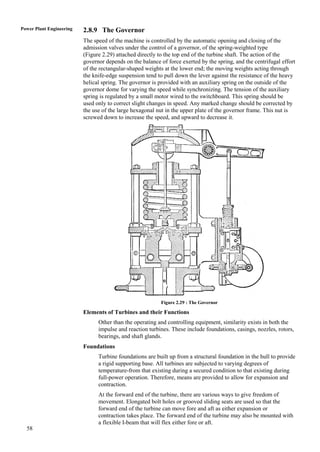
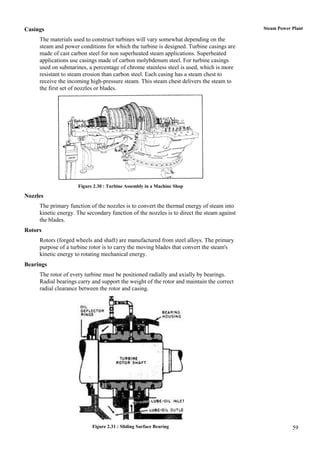
  • 15.
    Air Pre-heater Steam Power Plant The flue gases coming out of the economizer is used to preheat the air before supplying it to the combustion chamber. An increase in air temperature of 20 degrees can be achieved by this method. The pre heated air is used for combustion and also to dry the crushed coal before pulverizing. Soot Blowers The fuel used in thermal power plants causes soot and this is deposited on the boiler tubes, economizer tubes, air pre heaters, etc. This drastically reduces the amount of heat transfer of the heat exchangers. Soot blowers control the formation of soot and reduce its corrosive effects. The types of soot blowers are fixed type, which may be further classified into lane type and mass type depending upon the type of spray and nozzle used. The other type of soot blower is the retractable soot blower. The advantages are that they are placed far away from the high temperature zone, they concentrate the cleaning through a single large nozzle rather than many small nozzles and there is no concern of nozzle arrangement with respect to the boiler tubes. Condenser The use of a condenser in a power plant is to improve the efficiency of the power plant by decreasing the exhaust pressure of the steam below atmosphere. Another advantage of the condenser is that the steam condensed may be recovered to provide a source of good pure feed water to the boiler and reduce the water softening capacity to a considerable extent. A condenser is one of the essential components of a power plant. Cooling Tower The importance of the cooling tower is felt when the cooling water from the condenser has to be cooled. The cooling water after condensing the steam becomes hot and it has to be cooled as it belongs to a closed system. The Cooling towers do the job of decreasing the temperature of the cooling water after condensing the steam in the condenser. The type of cooling tower used in the Columbia Power Plant was an Inline Induced Draft Cross Flow Tower. This tower provides a horizontal air flow as the water falls down the tower in the form of small droplets. The fan centered at the top of units draws air through two cells that are paired to a suction chamber partitioned beneath the fan. The outstanding feature of this tower is lower air static pressure loss as there is less resistance to air flow. The evaporation and effective cooling of air is greater when the air outside is warmer and dryer than when it is cold and already saturated. Superheater The superheater consists of a superheater header and superheater elements. Steam from the main steam pipe arrives at the saturated steam chamber of the superheater header and is fed into the superheater elements. Superheated steam arrives back at the superheated steam chamber of the superheater header and is fed into the steam pipe to the cylinders. Superheated steam is more expansive. Reheater The reheater functions similar to the superheater in that it serves to elevate the steam temperature. Primary steam is supplied to the high pressure turbine. After passing through the high pressure turbine, the steam is returned to the steam generator for reheating (in a reheater) after which it is sent to the low pressure turbine. A second reheat cycle may also be provided. SAQ 1 (a) Describe the various types of power cycles. (b) What is steam generator? Describe the components of steam power plant. (c) What is a boiler? Discuss about different types of boilers, its components and functions. 35
  • 16.
    Power Plant Engineering 2.4 SUPER HEATER One of the most important accessories of a boiler is a super heater. It effects improvement and economy in the following ways :  The super heater increases the capacity of the plant.  Eliminates corrosion of the steam turbine.  Reduces steam consumption of the steam turbine. Types of Super Heater  Plate Super heaters.  Pendant Super heaters.  Radiant Super heaters.  Final Super heaters. 2.4.1 Steam Temperature Control The nominal control of reheat steam temperature is by tilting the burners. The super heater steam temperature is controlled by spraying water. Other control methods that are according to the need and design are : (a) Excess Air Control (b) Flue Gas Recirculation (c) Gas by-pass Control (d) Control of Combination Superheaters (e) Adjustable Burner Control Excess Air Control The steam outlet temperature of a convection superheater may be increased at partial load by increasing the excess air supply. The reduced gas temperature decreases the furnace heat absorption for the same steam production. The increased gas mass flow with its increased total heat content serves to increase the degree of superheat. Radiant superheater Convection superheater Economizer Increased combustion air Combustion zone Tempering air (alternate) Figure 2.12 : Superheat control by increased excess air 36
  • 17.
    Flue Gas Recirculation Steam Power Plant The recirculation of some percentage of the combustion gases serves to control steam temperature in the same manner as does an increase in excess air. By introducing the hot gases below the combustion zone, relatively high efficiency may be maintained. Radiant superheater Convection superheater Increased Economizer combustion air Combustion zone Air heater Flue gas recirculating fan Figure 2.13 : Superheat Control by Flue Gas Recirculation Gas By-pass Control The boiler convection banks can be arranged in such a manner that portion of the gases can be by-passed around the superheater elements. The superheater is oversized so that it will produce the required degree of superheat at partial load conditions. As the load increases, some of the flue gases are by-passed. By-pass clamper Furnace Convection super heater Convection surface Figure 2.14 : Superheat Control using Flue Gas By-pass 37
  • 18.
    Power Plant Engineering Control of Combination Superheaters The control of combination radiant-convection superheaters is relatively simple because of their compensating characteristics. An increase in excess air reduces the radiant heat transfer but increases the convection heat transfer. The reduction in excess air has the opposite effect. Thus the combination superheaters can be operated over the entire control range without additional equipment. Adjustable Burner Control With a multiple burner furnace it is possible to distribute the burners over a considerable burner wall height. This control is obtained by selective firing. Tiltable furnace may be adjusted to shift the position of the combustion zone. Convection superheater . High superheat Low superheat Figure 2.15 : Superheat Control by Burner Tilt 2.5 FEED WATER HEATER Low pressure feed water heaters are used in the condensate system between the condensate pump discharge and boiler feed pumps, and utilize low pressure turbine extraction or auxiliary turbine exhaust steam for heating the condensate. High pressure feed water heaters are used in the feed water system between the boiler feed pump discharge and the boiler, and utilize high pressure turbine extraction steam for heating the feed water. The condensate or feed water temperature increase for each feed water heater will be in the range of 28 to 56 degrees C with the actual value determined by turbine manufacturer‟s stage location of steam extraction nozzles. Depending on turbine size, some turbines offer alternate number of extraction nozzles with usually a choice of using the highest pressure extraction nozzle. The selection, in this case, of the total number of feed water heaters to use should be based on economic evaluation. Low Pressure Heater(s) Use one or more low pressure feed water heaters to raise the temperature of condensate from condensate pump discharge temperature to the de-aerator inlet temperature. The heater drains are cascaded from the higher pressure heater to the next lower pressure heater with the lowest pressure heater draining to the condenser. High Pressure Heater(s) Use one or more high pressure feed water heaters to raise the temperature of feed water from de-aerator outlet temperature to the required boiler economizer inlet 38
  • 19.
    temperature. The heaterdrains are cascaded from heater to heater, back to the Steam Power Plant de-aerator in a fashion similar to the heater drain system for the low pressure heaters. 2.5.1 Advantages (a) Fuel economy. (b) Longer life of the boiler. (c) Increase in steaming capacity. A feedwater heater is a power plant component used to pre-heat water delivered to a steam generating boiler. Preheating the feedwater reduces the irreversibilities involved in steam generation and therefore improves the thermodynamic efficiency of the system. This reduces plant operating costs and also helps to avoid thermal shock to the boiler metal when the feedwater is introduced back into the steam cycle. In a steam power plant (usually modeled as a modified Rankine cycle), feedwater heaters allow the feedwater to be brought up to the saturation temperature very gradually. This minimizes the inevitable irreversibilities associated with heat transfer to the working fluid (water). 2.5.2 Cycle Discussion and Explanation It should be noted that the energy used to heat the feedwater is usually derived from steam extracted between the stages of the steam turbine. Therefore, the steam that would be used to perform expansion work in the turbine is not utilized for that purpose. The percentage of the total cycle steam mass flow used for the feedwater heater must be carefully optimized for maximum power plant thermal efficiency since increasing this causes a decrease in turbine power output. 5 High Low pressure pressure Generator turbine turbine 7 Boiler 6 Condenser 4 3 2 Feed 1 water heater Feed pump 2 Feed pump 1 5 Boiler HPT Temperature 4 FP 2 6 3 Feed water heater 2 LPT FP 1 Condenser 7 7 Entropy FP1 = Feed pump 1 FP2 = Feed pump 2 HPT = High pressure turbine LPT = Low Pressure turbine Figure 2.16 : Rankine Cycle with Two Steam Turbines and a Single Open Feedwater Heater 39
  • 20.
    Power Plant Engineering Feedwater heaters can also be open and closed heat exchangers. An open feedwater heater is merely a direct-contact heat exchanger in which extracted steam is allowed to mix with the feedwater. This kind of heater will normally require a feed pump at both the feed inlet and outlet since the pressure in the heater is between the boiler pressure and the condenser pressure. A deaerator is a special case of the open feedwater heater which is specifically designed to remove non-condensable gases from the feedwater. Closed feedwater heaters are typically shell and tube heat exchangers where the feedwater passes throughout the tubes and is heated by turbine extraction steam. These do not require separate pumps before and after the heater to boost the feedwater to the pressure of the extracted steam as with an open heater. However, the extracted steam must then be throttled to the condenser pressure. Many power plants incorporate a number of feedwater heaters and may use both open and closed components. Feedwater heaters are used in both fossil- and nuclear-fueled power plants. Smaller versions have also been installed on steam locomotives, portable engines and stationary engines. An economiser serves a similar purpose to a feedwater heater, but is technically different. Instead of using actual cycle steam for heating, it uses the lowest-temperature flue gas from the furnace to heat the water before it enters the boiler proper. This allows for the heat transfer between the furnace and the feedwater occurring across a smaller average temperature gradient. System efficiency is therefore further increased when viewed with respect to actual energy content of the fuel. 2.5.3 Air Preheaters An air preheater or air heater is a general term to describe any device designed to heat air before another process (for example, combustion in a boiler) with the primary objective of increasing the thermal efficiency of the process. They may be used alone or to replace a recuperative heat system or to replace a steam coil. In particular, this article describes the combustion air preheaters used in large boilers found in thermal power stations producing electric power from e.g. fossil fuels, biomasses or waste The purpose of the air preheater is to recover the heat from the boiler flue gas which increases the thermal efficiency of the boiler by reducing the useful heat lost in the flue gas. As a consequence, the flue gases are also sent to the flue gas stack (or chimney) at a lower temperature, allowing simplified design of the ducting and the flue gas stack. It also allows control over the temperature of gases leaving the stack (to meet emissions regulations, for example). Steam Superheated Reheated Drum steam steam Reheater High pressure turbine exhaust Steam Blowdow n Economiser Deaerated boiler Boiler feedwater Coal Flue gas Coal-air mix Hot air AHP Ambient air Pulverizer Fan Hot air Ash Figure 2.17 : Coal-fired Power Plant Steam Generator Highlighting the Air Pre-heater Location (Radiant Section Tubing is Not Shown) 40
  • 21.
    Types Steam Power Plant There are two types of air preheaters for use in steam generators in thermal power stations : One is a tubular type built into the boiler flue gas ducting, and the other is a regenerative air preheater. These may be arranged so the gas flows horizontally or vertically across the axis of rotation. Tubular Type Construction Features Tubular preheaters consist of straight tube bundles which pass through the outlet ducting of the boiler and open at each end outside of the ducting. Inside the ducting, the hot furnace gases pass around the preheater tubes, transferring heat from the exhaust gas to the air inside the preheater. Ambient air is forced by a fan through ducting at one end of the preheater tubes and at other end the heated air from inside of the tubes emerges into another set of ducting, which carries it to the boiler furnace for combustion. Problems The tubular preheater ductings for cold and hot air require more space and structural supports than a rotating preheater design. Further, due to dust-laden abrasive flue gases, the tubes outside the ducting wear out faster on the side facing the gas current. Many advances have been made to eliminate this problem such as the use of ceramic and hardened steel. Many new circulating fluidized bed (CFB) and bubbling fluidized bed (BFB) steam generators are currently incorporating tubular air heaters offering an advantage with regards to the moving parts of a rotary type. Dew Point Corrosion Dew point corrosion occurs for a variety of reasons. The type of fuel used, its sulfur content and moisture content are contributing factors. However, by far the most significant cause of dew point corrosion is the metal temperature of the tubes. If the metal temperature within the tubes drops below the acid saturation temperature, usually at between 88°C and 110°C, but sometimes at temperatures as high as 127°C, then the risk of dew point corrosion damage becomes considerable. Regenerative Air Pre-heaters There are two types of regenerative air pre-heaters: the rotating-plate regenerative air preheaters and the stationary-plate regenerative air preheaters. Rotating-plate Regenerative Air Pre-heater The rotating-plate design consists of a central rotating-plate element installed within a casing that is divided into two (bi-sector type), three (tri-sector type) or four (quad-sector type) sectors containing seals around the element. The seals allow the element to rotate through all the sectors, but keep gas leakage between sectors to a minimum while providing separate gas air and flue gas paths through each sector. Figure 2.18 : Typical Rotating-plate Regenerative Air Pre-heater (Bi-sector Type) 41
  • 22.
    Power Plant Engineering Tri-sector types are the most common in modern power generation facilities. In the tri-sector design, the largest sector is connected to the boiler hot gas outlet. The hot exhaust gas flows over the central element, transferring some of its heat to the element, and is then ducted away for further treatment in dust collectors and other equipment before being expelled from the flue gas stack. The second, smaller sector, is fed with ambient air by a fan, which passes over the heated element as it rotates into the sector, and is heated before being carried to the boiler furnace for combustion. The third sector is the smallest one and it heats air which is routed into the pulverizers and used to carry the coal-air mixture to coal boiler burners. Thus, the total air heated in the air preheater provides: heating air to remove the moisture from the pulverised coal dust, carrier air for transporting the pulverised coal to the boiler burners and the primary air for combustion. Stationary-plate Regenerative Air Preheater The heating plate elements in this type of regenerative air preheater are also installed in a casing, but the heating plate elements are stationary rather than rotating. Instead the air ducts in the preheater are rotated so as to alternatively expose sections of the heating plate elements to the upflowing cool air. Air Top FG FG rotating Hood air ducts Stationar y section (stator) FG Air FG = Flue Gas Bottom = hot flue gas rotating = Cooled flue gas air ducts = cool air = Heater air = Heating plate elements Figure 2.19 : Typical Stationary-plate Regenerative Air Preheater As indicated in the figure, there are rotating inlet air ducts at the bottom of the stationary plates similar to the rotating outlet air ducts at the top of the stationary plates. 2.6 FURNACES 2.6.1 Types and Classification of Different Furnaces Based on the method of generating heat, furnaces are broadly classified into two types namely combustion type (using fuels) and electric type. In case of combustion type furnace, depending upon the kind of combustion, it can be broadly classified as oil fired, coal fired or gas fired.  Based on the mode of charging of material, furnaces can be classified as (i) Intermittent or Batch type furnace or Periodical furnace and (ii) Continuous furnace.  Based on mode of waste heat recovery as recuperative and regenerative furnaces.  Another type of furnace classification is made based on mode of heat transfer, mode of charging and mode of heat recovery as shown in the figure 42 below
  • 23.
    Steam Power Plant Open fire place furnace According to Mode of heat transfer Heated through medium Forging Fe-rolling (batch/ Furnace Batch continuous) Pusher According to Classification Mode of heat transfer Continuous Pot Glass tank melting According to Recuperative (regenerative Mode of heat /recuperative) transfer Regenerative Figure 2.20 : Furnace Classification 2.6.2 Characteristics of an Efficient Furnace Furnace should be designed so that in a given time, as much of material as possible can be heated to a uniform temperature as possible with the least possible fuel and labour. To achieve this, the following parameters can be considered.  Determination of the quantity of heat to be imparted to the material or charge.  Liberation of sufficient heat within the furnace to heat the stock and overcome all heat losses.  Transfer of available part of that heat from the furnace gases to the surface of the heating stock.  Equalization of the temperature within the stock.  Reduction of heat losses from the furnace to the minimum possible extent. 2.6.3 Pulverised Coal Systems Pulverised coal firing is done by two systems : (a) Unit System or Direct System. (b) Bin or Central System. Unit System In this system the raw coal from the coal bunker drops on to the feeder Secondary air Furnace Primary Air coal Raw coal Banker Burner Pulverising Mill Feeder Fan Hot Air Figure 2.21 : Unit or Direct System 43
  • 24.
    Power Plant Engineering Hot air is passed through coal in the feeder to dry the coal. The coal is then transferred to the pulverising mill where it is pulverised. Primary air is supplied to the mill, by the fan. The mixture of pulverised coal and primary air then flows to burner where secondary air is added. The unit system is so called from the fact that each burner or a burner group and pulveriser constitutes a unit. Advantages (a) The system is simple and cheaper than the central system. (b) There is direct control of combustion from the pulverising mill. (c) Coal transportation system is simple. Bin or Central System Crushed coal from the raw coal bunker is fed by gravity to a dryer where hot air is passed through the coal to dry it. The dryer may use waste flue gases, preheated air or bleeder steam as drying agent. The dry coal is then transferred to the pulverizing mill. The pulverised coal obtained is transferred to the pulverised coal bunker (bin). The transporting air is separated from the coal in the cyclone separator. The primary air is mixed with the coal at the feeder and the mixture is supplied to the burner. Return air Raw coal burner Cyclone separator Exhaust fan Pulverised Vent coal burner Mill Conveyor Feeder Fan Primary Air Hot air for Dryer fan coal drying Burner Secondary air Figure 2.22 : Bin or Central System Advantages (a) The pulverising mill grinds the coal at a steady rate irrespective of boiler feed. (b) There is always some coal in reserve. Thus any occasional breakdown in the coal supply will not affect the coal feed to the burner. (c) For a given boiler capacity pulverising mill of small capacity will be required as compared to unit system. Disadvantages (a) The initial cost of the system is high. (b) Coal transportation system is quite complicated. (c) The system requires more space. To a large extent the performance of pulverised fuel system depends upon the mill performance. The pulverised mill should satisfy the following requirements : (a) It should deliver the rated tonnage of coal. (b) Pulverised coal produced by it should be have satisfactory fineness over a wide range of capacities. (c) It should be quiet in operation. (d) Its power consumption should be low. 44 (e) Maintenance cost of the mill should be low.
  • 25.
    Figure 2.23 showsthe equipments for unit and central system of pulverised coal Steam Power Plant handling plant. Raw coal Primary crusher Magnetic separator Coal drier Coal bunkers Unit system Central system Scale Scale Pulveriser Pulveriser Central bin Burners Feeder Furnace Burners Figure 2.23 : Equipment for Central and Unit System 2.6.4 Draft System Most boilers now depend on mechanical draft equipment rather than natural draft. This is because natural draft is subject to outside air conditions and temperature of flue gases leaving the furnace, as well as the chimney height. All these factors make proper draft hard to attain and therefore make mechanical draft equipment much more economical. There are three types of mechanical draft : Induced Draft This is obtained one of three ways, the first being the “stack effect” of a heated chimney, in which the flue gas is less dense than the ambient air surrounding the boiler. The denser column of ambient air forces combustion air into and through the boiler. The second method is through use of a steam jet. The steam jet oriented in the direction of flue gas flow induces flue gasses into the stack and allows for a greater flue gas velocity increasing the overall draft in the furnace. This method was common on steam driven locomotives which could not have tall chimneys. The third method is by simply using an induced draft fan (ID fan) which removes flue gases from the furnace and forces the exhaust gas up the stack. Almost all induced draft furnaces operate with a slightly negative pressure. Forced Draft Draft is obtained by forcing air into the furnace by means of a fan (FD fan) and ductwork. Air is often passed through an air heater; which, as the name suggests, heats the air going into the furnace in order to increase the overall efficiency of the boiler. Dampers are used to control the quantity of air admitted to the furnace. Forced draft furnaces usually have a positive pressure. Balanced Draft Balanced draft is obtained through use of both induced and forced draft. This is more common with larger boilers where the flue gases have to travel a long 45
  • 26.
    Power Plant Engineering distance through many boiler passes. The induced draft fan works in conjunction with the forced draft fan allowing the furnace pressure to be maintained slightly below atmospheric. 2.6.5 High Pressure Boilers In all modern power plants, high pressure boilers (> 100 bar) are universally used as they offer the following advantages. In order to obtain efficient operation and high capacity, forced circulation of water through boiler tubes is found helpful. Some special types of boilers operating at super critical pressures and using forced circulations are described in this chapter. (a) The efficiency and the capacity of the plant can be increased as reduced quantity of steam is required for the same power generation if high pressure steam is used. (b) The forced circulation of water through boiler tubes provides freedom in the arrangement of furnace and water walls, in addition to the reduction in the heat exchange area. (c) The tendency of scale formation is reduced due to high velocity of water. (d) The danger of overheating is reduced as all the parts are uniformly heated. (e) The differential expansion is reduced due to uniform temperature and this reduces the possibility of gas and air leakages. (f) Some special types of high pressure supercritical boilers are described in this chapter. 2.6.6 LA MONT Boiler A forced circulation boiler was first introduced in 1925 by La Mont. The arrangement of water circulation and different components are shown in the figure. The feed water from hot well is supplied to a storage and separating drum (boiler) through the economizer. Most of the sensible heat is supplied to the feed water passing through the economizer. A pump circulates the water at a rate 8 to 10 times the mass of steam evaporated. This water is circulated through the evaporator tubes and the part of the vapour is separated in the separator drum. The large quantity of water circulated (10 times that of evaporation) prevents the tubes from being overheated. Chimney Fan Air preheater Air Feed water Feed Economise water r Heater Main steam Hotgas Storage And Evaporator Separator (convective) drum Preheated Down Combustion comer Chamber Fire gate Evaporator Circulating Fuel Ash pan (radiant) Pump Distributing header Figure 2.24 : LA MONT Boiler The centrifugal pump delivers the water to the headers at a pressure of 2.5 bar above the drum pressure. The distribution headers distribute the water through the nozzle into the evaporator. The steam separated in the boiler is further passed through the super-heater. 46
  • 27.
    Secure a uniformflow of feed water through each of the parallel boiler circuits a choke Steam Power Plant is fitted entrance to each circuit. These boilers have been built to generate 45 to 50 tonnes of superheated steam at a pressure of 120 bars and temperature of 500°C. Recently forced circulation has been introduced in large capacity power 2.6.7 Benson Boiler The main difficulty experienced in the La Mont boiler is the formation and attachment of bubbles on the inner surfaces of the heating tubes. The attached bubbles reduce the heat flow and steam generation as it offers higher thermal resistance compared to water film : (a) If the boiler pressure was raised to critical pressure (225 atm), the steam and water would have the same density and therefore the danger of bubble formation can be completely avoided. (b) Natural circulation boilers require expansion joints but these are not required for Benson as the pipes are welded. The erection of Benson boiler is easier and quicker as all the parts are welded at site and workshop job of tube expansion is altogether avoided. (c) The transport of Benson boiler parts is easy as no drums are required and majority of the parts are carried to the site without pre-assembly. (d) The Benson boiler can be erected in a comparatively smaller floor area. The space problem does not control the size of Benson boiler used. (e) The furnace walls of the boiler can be more efficiently protected by using small diameter and close pitched tubes. (f) The superheater in the Benson boiler is an integral part of forced circulation system, therefore no special starting arrangement for superheater is required. (g) The Benson boiler can be started very quickly because of welded joints. (h) The Benson boiler can be operated most economically by varying the temperature and pres- sure at partial loads and overloads. The desired temperature can also be maintained constant at any pressure. (i) Sudden fall of demand creates circulation problems due to bubble formation in the natural circulation boiler which never occurs in Benson boiler. This feature of insensitiveness to load fluctuations makes it more suitable for grid power station as it has better adaptive capacity to meet sudden load fluctuations. (j) The blow-down losses of Benson boiler are hardly 4% of natural circulation boilers of same capacity. (k) Explosion hazards are not at all severe as it consists of only tubes of small diameter and has very little storage capacity compared to drum type boiler. During starting, the water is passed through the economiser, evaporator, superheater and back to the feed line via starting valve. During starting, first circulating pumps are started and then the burners are started to avoid the overheating of evaporator and superheater tubes. 2.6.8 Loeffler Boiler The major difficulty experienced in Benson boiler is the deposition of salt and sediment on the inner surfaces of the water tubes. The deposition reduced the heat transfer and ultimately the generating capacity. This further increased the danger of overheating the tubes due to salt deposition as it has high thermal resistance. The difficulty was solved in Loffler boiler by preventing the flow of water into the boiler tubes. Most of the steam is generated outside from the feed water using part of the superheated steam coming-out from the boiler. 47
  • 28.
    Power Plant Engineering The pressure feed pump draws the water through the economizer and delivers it into the evaporator drum. About 65% of the steam coming out of super heater is passed through the evaporator drum in order to evaporate the feed water coming from economizer. The steam circulating pump draws the saturated steam from the evaporator drum and is passed through the radiant superheater and then convective superheater. About 35% of the steam coming out from the superheater is supplied to the H.P. steam turbine. The steam coming out from H.P. turbine is passed through reheater before supplying to L.P. turbine. The amount of steam generated in the evaporator drum is equal to the steam tapped (65%) from the superheater. The nozzles which distribute the superheated steam through the water into the evaporator drum are of special design to avoid priming and noise. This boiler can carry higher salt concentration than any other type and is more compact than indirectly heated boilers having natural circulation. These qualities fit it for land or sea transport power generation. Loffler boilers with generating capacity of 94.5 tones/hr and operating at 140 bar have already been commissioned. 2.6.9 SCHMIDT-HARTMANN Boiler The operation of the boiler is similar to an electric transformer. Two pressures are used to affect an interchange of energy. In the primary circuit, the steam at 100 bar is produced from distilled water. This steam is passed through a submerged heating coil which is located in an evaporator drum. The high pressure steam in this coil possesses sufficient thermal potential and steam at 60 bars with a heat transfer rate of 2.5 kW/m2-°C is generated in the evaporator drum. The steam produced in the evporator drums from impure water is further passed through the superheater and then supplied to the prime-mover. The high pressure condensate formed in the sub- merged heating coil is circulated through a low pressure feed heater on its way to raise the feed water temperature to its saturation temperature. Therefore, only latent heat is supplied in the evaporator drum. Natural circulation is used in the primary circuit and this is sufficient to effect the desired rate of heat transfer and to overcome the thermo-siphon head of about 2 m to 10 m. In normal circumstances, the replenishment of distilled water in the primary circuit is not required as every care is taken in design and construction to prevent leakage. But as a safeguard against leakage, a pressure gauge and safety valve are fitted in the circuit. 2.6.10 VELOX-Boiler When the gas velocity exceeds the sound-velocity, the heat is transferred from the gas at a much higher rate than rates achieved with sub-sonic flow. The advantages of this theory are taken to obtain the large heat transfer from a smaller surface area in this boiler. Air is compressed to 2.5 bars with the help of a compressor run by gas turbine before supplying to the combustion chamber to get the supersonic velocity of the gases passing through the combustion chamber and gas tubes and high heat release rates. The burned gases in the combustion chamber are passed through the annulus of the tubes. The heat is transferred from gases to water while passing through the annulus to generate the steam. The mixture of water and steam thus formed then passes into a separator which is so designed that the mixture enters with a spiral flow. The centrifugal force thus produced causes the heavier water particles to be thrown outward on the walls. This effect separates the steam from water. The separated steam is further passed to superheater and then supplied to the prime-mover. The water removed from steam in the separator is again passed into the water tubes with the help of a pump. The gases coming out from the annulus at the top are further passed over the superheater where its heat is used-for superheating the steam. The gases coming out of superheater are used to run a gas turbine as they carry sufficient kinetic energy. The power output of the gas turbine is used to run the air-compressor. The exhaust gases coming out from the gas turbine are passed through the economiser to utilize the remaining heat of the gases. The extra power required to run the compressor is supplied with the help of electric 48
  • 29.
    motor. Feed waterof 10 to 20 times the weight of steam generated is circulated through Steam Power Plant the tubes with the help of water circulating pump. This prevents the overheating of metal walls. 2.7 ENERGY PERFORMANCE ASSESSMENT OF BOILERS Performance of the boiler, like efficiency and evaporation ratio reduces with time, due to poor combustion, heat transfer fouling and poor operation and maintenance. Deterioration of fuel quality and water quality also leads to poor performance of boiler. Efficiency testing helps us to find out how far the boiler efficiency drifts away from the best efficiency. Any observed abnormal deviations could therefore be investigated to pinpoint the problem area for necessary corrective action. Hence it is necessary to find out the current level of efficiency for performance evaluation, which is a pre requisite for energy conservation action in industry. Purpose of the Performance Test  To find out the efficiency of the boiler  To find out the Evaporation ratio The purpose of the performance test is to determine actual performance and efficiency of the boiler and compare it with design values or norms. It is an indicator for tracking day-to-day and season-to-season variations in boiler efficiency and energy efficiency improvements Performance Terms and Definitions Heat output (a) Boiler Efficiency,    100 Heat input Heat in steam output (kCals)   100 Heat in fuel input (kCals) Quantity of steam generation (b) Evaporation Ratio  Quantity of fuel consumption Scope The procedure describes routine test for both oil fired and solid fuel fired boilers using coal, agro residues etc. Only those observations and measurements need to be made which can be readily applied and is necessary to attain the purpose of the test. 2.7.1 Reference Standards British standards, BS845 : 1987 The British Standard BS845: 1987 describes the methods and conditions under which a boiler should be tested to determine its efficiency. For the testing to be done, the boiler should be operated under steady load conditions (generally full load) for a period of one hour after which readings would be taken during the next hour of steady operation to enable the efficiency to be calculated. The efficiency of a boiler is quoted as the % of useful heat available, expressed as a percentage of the total energy potentially available by burning the fuel. This is expressed on the basis of gross calorific value (GCV). This deals with the complete heat balance and it has two parts : (a) Part one deals with standard boilers, where the indirect method is specified. 49
  • 30.
    Power Plant Engineering (b) Part two deals with complex plant where there are many channels of heat flow. In this case, both the direct and indirect methods are applicable, in whole or in part. ASME Standard : PTC-4-1 Power Test Code for Steam Generating Units This consists of (c) Part One : Direct method (also called as Input -output method). (d) Part Two : Indirect method (also called as Heat loss method) IS 8753 : Indian Standard for Boiler Efficiency Testing Most standards for computation of boiler efficiency, including IS 8753 and BS845 are designed for spot measurement of boiler efficiency. Invariably, all these standards do not include blow down as a loss in the efficiency determination process. Basically Boiler efficiency can be tested by the following methods : The Direct Method Where the energy gain of the working fluid (water and steam) is compared with the energy content of the boiler fuel. The Indirect Method Where the efficiency is the difference between the losses and the energy input. 2.7.2 The Direct Method Testing Description This is also known as „input-output method‟ due to the fact that it needs only the useful output (steam) and the heat input (i.e. fuel) for evaluating the efficiency. This efficiency can be evaluated using the formula : Heat output Boiler Efficiency   100 Heat input Heat addition to steam Efficiency   100 Gross heat in fuel Steam flow rate  (steam enthalpy  feed water enthalpy) Boiler Efficiency   100 Fuel firing rate  Gross calorific value 50 Figure 2.25 : Direct Method Testing
  • 31.
    Measurements Required forDirect Method Testing Steam Power Plant Heat Input Both heat input and heat output must be measured. The measurement of heat input requires knowledge of the calorific value of the fuel and its flow rate in terms of mass or volume, according to the nature of the fuel. For Gaseous Fuel A gas meter of the approved type can be used and the measured volume should be corrected for temperature and pressure. A sample of gas can be collected for calorific value determination, but it is usually acceptable to use the calorific value declared by the gas suppliers. For Liquid Fuel The meter, which is usually installed on the combustion appliance, should be regarded as a rough indicator only and, for test purposes, a meter calibrated for the particular oil is to be used and over a realistic range of temperature should be installed. Even better is the use of an accurately calibrated day tank. For Solid Fuel The accurate measurement of the flow of coal or other solid fuel is very difficult. The measurement must be based on mass, which means that bulky apparatus must be set up on the boiler-house floor. Samples must be taken and bagged throughout the test, the bags sealed and sent to a laboratory for analysis and calorific value determination. In some more recent boiler houses, the problem has been alleviated by mounting the hoppers over the boilers on calibrated load cells, but these are yet uncommon. Heat Output There are several methods, which can be used for measuring heat output. With steam boilers, an installed steam meter can be used to measure flow rate, but this must be corrected for temperature and pressure. In earlier years, this approach was not favoured due to the change in accuracy of orifice or venturi meters with flow rate. It is now more viable with modern flow meters of the variable-orifice or vortex-shedding types. The alternative with small boilers is to measure feed water, and this can be done by previously calibrating the feed tank and noting down the levels of water during the beginning and end of the trial. Care should be taken not to pump water during this period. Heat addition for conversion of feed water at inlet temperature to steam, is considered for heat output. In case of boilers with intermittent blowdown, blowdown should be avoided during the trial period. In case of boilers with continuous blowdown, the heat loss due to blowdown should be calculated and added to the heat in steam. Merits and Demerits of Direct Method Merits (a) Plant people can evaluate quickly the efficiency of boilers. (b) Requires few parameters for computation. (c) Needs few instruments for monitoring. 51
  • 32.
    Power Plant Engineering Demerits (a) Does not give clues to the operator as to why efficiency of system is lower. (b) Does not calculate various losses accountable for various efficiency levels. (c) Evaporation ratio and efficiency may mislead, if the steam is highly wet due to water carryover 2.7.3 The Indirect Method Testing Description The efficiency can be measured easily by measuring all the losses occurring in the boilers using the principles to be described. The disadvantages of the direct method can be overcome by this method, which calculates the various heat losses associated with boiler. The efficiency can be arrived at, by subtracting the heat loss fractions from 100. An important advantage of this method is that the errors in measurement do not make significant change in efficiency. Thus if boiler efficiency is 90%, an error of 1% in direct method will result in significant change in efficiency, i.e. 90  0.9 = 89.1 to 90.9. In indirect method, 1% error in measurement of losses will result in Efficiency = 100 – (10  0.1) = 90  0.1 = 89.9 to 90.1 The various heat losses occurring in the boiler are Efficiency = 100 – (1 + 2 + 3 + 4 + 5 + 6 + 7 + 8) (by indirect method) Figure 2.26 : Indirect Method Testing The following losses are applicable to liquid, gas and solid fired boiler : L1 – Loss due to dry flue gas (sensible heat) L2 – Loss due to hydrogen in fuel (H2) L3 – Loss due to moisture in fuel (H2O) L4 – Loss due to moisture in air (H2O) L5 – Loss due to carbon monoxide (CO) L6 – Loss due to surface radiation, convection and other unaccounted*. *Losses which are insignificant and are difficult to measure. The following losses are applicable to solid fuel fired boiler in addition to above : L7 – Unburnt losses in fly ash (Carbon) L8 – Unburnt losses in bottom ash (Carbon) 52 Boiler Efficiency by indirect method = 100 – (L1 + L2 + L3 + L4 + L5 + L6 + L7 + L8)
  • 33.
    Energy Balance Steam Power Plant Having established the magnitude of all the losses mentioned above, a simple energy balance would give the efficiency of the boiler. The efficiency is the difference between the energy input to the boiler and the heat losses calculated. Boiler energy Balance : kCal / kg of fuel % Input/Output Parameter Heat Input in fuel = 100 Various Heat losses in boiler 1. Dry flue gas loss = 2. Loss due to hydrogen in fuel = 3. Loss due to moisture in fuel = 4. Loss due to moisture in air = 5. Partial combustion of C to CO = 6. Surface heat losses = 7. Loss due to Unburnt in fly ash = 8. Loss due to Unburnt in bottom ash = Total Losses = Boiler efficiency = 100 – (1 + 2 + 3 + 4 + 5 + 6 + 7 + 8) 2.7.4 Combustion Rate Combustion rate is determined by the rate at which parcels of unburned gas are broken down into smaller ones (create sufficient interfacial area between unburned mixture & hot gases to enable reaction) Factors Affecting Boiler Performance The various factors influencing the boiler performance are listed below : (a) Periodical cleaning of boilers (b) Periodical soot blowing (c) Proper water treatment programme and blow down control (d) Draft control (e) Excess air control (f) Percentage loading of boiler (g) Steam generation pressure and temperature (h) Boiler insulation (i) Quality of fuel All these factors individually/combined, contribute to the performance of the boiler and reflected either in boiler efficiency or evaporation ratio. Based on the results obtained from the testing further improvements have to be carried out for maximizing the performance. The test can be repeated after modification or rectification of the problems and compared with standard norms. Energy auditor should carry out this test as a routine manner once in six months and report to the management for necessary action. Boiler Terminology MCR: Steam boilers rated output is also usually defined as MCR (Maximum Continuous Rating). This is the maximum evaporation rate that can be sustained for 24 hours and may be less than a shorter duration maximum rating. 53
  • 34.
    Power Plant Engineering Boiler Rating Conventionally, boilers are specified by their capacity to hold water and the steam generation rate. Often, the capacity to generate steam is specified in terms of equivalent evaporation (kg of steam/hour at 100oC). The equivalent of the evaporation of 1 kg of water at 100oC to steam at 100oC. Efficiency In the boiler industry there are four common definitions of efficiency : Combustion Efficiency Combustion efficiency is the effectiveness of the burner only and relates to its ability to completely burn the fuel. The boiler has little bearing on combustion efficiency. A well-designed burner will operate with as little as 15 to 20% excess air, while converting all combustibles in the fuel to useful energy. Thermal Efficiency Thermal efficiency is the effectiveness of the heat transfer in a boiler. It does not take into account boiler radiation and convection losses. Boiler Efficiency The term boiler efficiency is often substituted for combustion or thermal efficiency. True boiler efficiency is the measure of fuel to steam efficiency. Fuel to Steam Efficiency Fuel to steam efficiency is calculated using either of the two methods as prescribed by the ASME (American Society for Mechanical Engineers) power test code, PTC 4.1. The first method is input output method. The second method is heat loss method. 2.8 STEAM TURBINES A steam turbine is a mechanical device that extracts thermal energy from pressurized steam, and converts it into rotary motion. It has almost completely replaced the reciprocating piston steam engine primarily because of its greater thermal efficiency and higher power-to-weight ratio. Because the turbine generates rotary motion, it is particularly suited to be used to drive an electrical generator – about 80% of all electricity generation in the world is by use of steam turbines. The steam turbine is a form of heat engine that derives much of its improvement in thermodynamic efficiency through the use of multiple stages in the expansion of the steam, which results in a closer approach to the ideal reversible process. Types Steam turbines are made in a variety of sizes ranging from small 0.75 kW units (rare) used as mechanical drives for pumps, compressors and other shaft driven equipment, to 1,500,000 kW turbines used to generate electricity. There are several classifications for modern steam turbines. 2.8.1 Steam Turbine Classification Steam Turbines have been classified by : (a) Details of stage design as (i) impulse (ii) reaction 54
  • 35.
    (b) Steam supply and exhaust conditions as Steam Power Plant (i) Condensing (ii) Back Pressure (Non Condensing) (iii) Mixed Pressure (iv) Reheat (v) Extraction type (Auto or Controlled) Condensing turbines are most commonly found in electrical power plants. These turbines exhaust steam in a partially condensed state, typically of a quality near 90%, at a pressure well below atmospheric to a condenser. Non-condensing or backpressure turbines are most widely used for process steam applications. The exhaust pressure is controlled by a regulating valve to suit the needs of the process steam pressure. These are commonly found at refineries, district heating units, pulp and paper plants, and desalination facilities where large amounts of low pressure process steam are available. Reheat turbines are also used almost exclusively in electrical power plants. In a reheat turbine, steam flow exits from a high pressure section of the turbine and is returned to the boiler where additional superheat is added. The steam then goes back into an intermediate pressure section of the turbine and continues its expansion. Extracting type turbines are common in all applications. In an extracting type turbine, steam is released from various stages of the turbine, and used for industrial process needs or sent to boiler feedwater heaters to improve overall cycle efficiency. Extraction flows may be controlled with a valve, or left uncontrolled. Induction turbines introduce low pressure steam at an intermediate stage to produce additional power. (c) Casing or shaft arrangement as (i) Single Casing (ii) Tandem compound (iii) Cross Compound Single casing units are the most basic style where a single casing and shaft are coupled to a generator. Tandem compound are used where two or more casings are directly coupled together to drive a single generator. A cross compound turbine arrangement features two or more shafts not in line driving two or more generators that often operate at different speeds. A cross compound turbine is typically used for many large applications. Figure 2.27 : Impulse Main Propulsion Turbine 55
  • 36.
    Power Plant Engineering (d) Number of Exhaust Stages in Parallel (e) Direction of steam flow (f) Steam supply – Superheated or saturated. 2.8.2 Principle of Operation and Design An ideal steam turbine is considered to be an isentropic process, or constant entropy process, in which the entropy of the steam entering the turbine is equal to the entropy of the steam leaving the turbine. No steam turbine is truly “isentropic”, however, with typical isentropic efficiencies ranging from 20%-90% based on the application of the turbine. The interior of a turbine comprises several sets of blades, or “buckets” as they are more commonly referred to. One set of stationary blades is connected to the casing and one set of rotating blades is connected to the shaft. The sets intermesh with certain minimum clearances, with the size and configuration of sets varying to efficiently exploit the expansion of steam at each stage. 2.8.3 Turbine Efficiency To maximize turbine efficiency the steam is expanded, generating work, in a number of stages. These stages are characterized by how the energy is extracted from them and are known as either impulse or reaction turbines. Most steam turbines use a mixture of the reaction and impulse designs : each stage behaves as either one or the other, but the overall turbine uses both. Typically, higher pressure sections are impulse type and lower pressure stages are reaction type. Figure 2.28 : Schematic Diagram Outlining the difference between an Impulse and a Reaction Turbine 2.8.4 Impulse Turbines An impulse turbine has fixed nozzles that orient the steam flow into high speed jets. These jets contain significant kinetic energy, which the rotor blades, shaped like buckets, convert into shaft rotation as the steam jet changes direction. A pressure drop occurs across only the stationary blades, with a net increase in steam velocity across the stage. 56
  • 37.
    As the steamflows through the nozzle its pressure falls from inlet pressure to the exit Steam Power Plant pressure (atmospheric pressure, or more usually, the condenser vacuum). Due to this higher ratio of expansion of steam in the nozzle the steam leaves the nozzle with a very high velocity. The steam leaving the moving blades is a large portion of the maximum velocity of the steam when leaving the nozzle. The loss of energy due to this higher exit velocity is commonly called the “carry over velocity” or “leaving loss”. 2.8.5 Reaction Turbines In the reaction turbine, the rotor blades themselves are arranged to form convergent nozzles. This type of turbine makes use of the reaction force produced as the steam accelerates through the nozzles formed by the rotor. Steam is directed onto the rotor by the fixed vanes of the stator. It leaves the stator as a jet that fills the entire circumference of the rotor. The steam then changes direction and increases its speed relative to the speed of the blades. A pressure drop occurs across both the stator and the rotor, with steam accelerating through the stator and decelerating through the rotor, with no net change in steam velocity across the stage but with a decrease in both pressure and temperature, reflecting the work performed in the driving of the rotor. 2.8.6 Steam Turbine Start up When warming up a steam turbine for use, the main steam stop valves (after the boiler) have a bypass line to allow superheated steam to slowly bypass the valve and proceed to heat up the lines in the system along with the steam turbine. Also a turning gear is engaged when there is no steam to the turbine to slowly rotate the turbine to ensure even heating to prevent uneven expansion. After first rotating the turbine by the turning gear, allowing time for the rotor to assume a straight plane (no bowing), then the turning gear is disengaged and steam is admitted to the turbine, first to the astern blades then to the ahead blades slowly rotating the turbine at 10 to 15 RPM to slowly warm the turbine. 2.8.7 Precautions during Running Problems with turbines are now rare and maintenance requirements are relatively small. Any imbalance of the rotor can lead to vibration, which in extreme cases can lead to a blade letting go and punching straight through the casing. It is, however, essential that the turbine be turned with dry steam. If water gets into the steam and is blasted onto the blades (moisture carryover) rapid impingement and erosion of the blades can occur, possibly leading to imbalance and catastrophic failure. Also, water entering the blades will likely result in the destruction of the thrust bearing for the turbine shaft. To prevent this, along with controls and baffles in the boilers to ensure high quality steam, condensate drains are installed in the steam piping leading to the turbine. 2.8.8 Speed Regulation The control of a turbine with a governor is essential, as turbines need to be run up slowly, to prevent damage while some applications (such as the generation of alternating current electricity) require precise speed control. Uncontrolled acceleration of the turbine rotor can lead to an overspeed trip, which causes the nozzle valves that control the flow of steam to the turbine to close. If this fails then the turbine may continue accelerating until it breaks apart, often spectacularly. Turbines are expensive to make, requiring precision manufacture and special quality materials. During normal operation in synchronization with the electricity net power plants are governed with a five percent speed droop. This means the full load speed is 100% and the no load speed is 105%. This is required for the stable operation of the net without hunting and dropouts of power plants. Normally the changes in speed are minor. Adjustments in power output are made by slowly raising the droop curve by increasing the spring pressure on a centrifugal governor. Generally this is a basic system requirement for all power plants because the older and newer plants have to be compatible in response to the instantaneous changes in frequency without depending on outside communication. 57
  • 38.
    Power Plant Engineering 2.8.9 The Governor The speed of the machine is controlled by the automatic opening and closing of the admission valves under the control of a governor, of the spring-weighted type (Figure 2.29) attached directly to the top end of the turbine shaft. The action of the governor depends on the balance of force exerted by the spring, and the centrifugal effort of the rectangular-shaped weights at the lower end; the moving weights acting through the knife-edge suspension tend to pull down the lever against the resistance of the heavy helical spring. The governor is provided with an auxiliary spring on the outside of the governor dome for varying the speed while synchronizing. The tension of the auxiliary spring is regulated by a small motor wired to the switchboard. This spring should be used only to correct slight changes in speed. Any marked change should be corrected by the use of the large hexagonal nut in the upper plate of the governor frame. This nut is screwed down to increase the speed, and upward to decrease it. Figure 2.29 : The Governor Elements of Turbines and their Functions Other than the operating and controlling equipment, similarity exists in both the impulse and reaction turbines. These include foundations, casings, nozzles, rotors, bearings, and shaft glands. Foundations Turbine foundations are built up from a structural foundation in the hull to provide a rigid supporting base. All turbines are subjected to varying degrees of temperature-from that existing during a secured condition to that existing during full-power operation. Therefore, means are provided to allow for expansion and contraction. At the forward end of the turbine, there are various ways to give freedom of movement. Elongated bolt holes or grooved sliding seats are used so that the forward end of the turbine can move fore and aft as either expansion or contraction takes place. The forward end of the turbine may also be mounted with a flexible I-beam that will flex either fore or aft. 58
  • 39.
    Casings Steam Power Plant The materials used to construct turbines will vary somewhat depending on the steam and power conditions for which the turbine is designed. Turbine casings are made of cast carbon steel for non superheated steam applications. Superheated applications use casings made of carbon molybdenum steel. For turbine casings used on submarines, a percentage of chrome stainless steel is used, which is more resistant to steam erosion than carbon steel. Each casing has a steam chest to receive the incoming high-pressure steam. This steam chest delivers the steam to the first set of nozzles or blades. Figure 2.30 : Turbine Assembly in a Machine Shop Nozzles The primary function of the nozzles is to convert the thermal energy of steam into kinetic energy. The secondary function of the nozzles is to direct the steam against the blades. Rotors Rotors (forged wheels and shaft) are manufactured from steel alloys. The primary purpose of a turbine rotor is to carry the moving blades that convert the steam's kinetic energy to rotating mechanical energy. Bearings The rotor of every turbine must be positioned radially and axially by bearings. Radial bearings carry and support the weight of the rotor and maintain the correct radial clearance between the rotor and casing. Figure 2.31 : Sliding Surface Bearing 59
  • 40.
    Power Plant Engineering Axial (thrust) bearings limit the fore-and-aft travel of the rotor. Thrust bearings take care of any axial thrust, which may develop on a turbine rotor and hold the turbine rotor within definite axial positions. All main turbines and most auxiliary units have a bearing at each end of the rotor. Bearings are generally classified as sliding surface (sleeve and thrust) or as rolling contact (antifriction ball or roller bearings). Figure shows a typical sliding surface bearing. Shaft Packing Glands Shaft packing glands prevent the leaking of steam out of or air into the turbine casing where the turbine rotor shaft extends through the turbine casing. Labyrinth and carbon rings are two types of packing. They are used either separately or in combination. Figure 2.32 : Labyrinth Packing Gland Labyrinth packing consists of rows of metallic strips or fins. The strips fasten to the gland liner so there is a small space between the strips and the shaft. As the steam from the turbine casing leaks through the small space between the packing strips and the shaft, steam pressure gradually reduces. 60 Figure 2.33 : Carbon Packing Gland
  • 41.
    Carbon packing ringsrestrict the passage of steam along the shaft in much the Steam Power Plant same manner as labyrinth packing strips. Carbon packing rings mount around the shaft and are held in place by springs. Three or four carbon rings are usually used in each gland. Each ring fits into a separate compartment of the gland housing and consists of two, three, or four segments that are butt-jointed to each other. A garter spring is used to hold these segments together. The use of keepers (lugs or stop pins) prevents the rotation of the carbon rings when the shaft rotates. The outer carbon ring compartment connects to a drain line. Advantages of the Steam Turbine over Reciprocating Engine (a) Thermal Efficiency of a Steam Turbine is higher than that of a Reciprocating Engine. (b) The Steam Turbine develops power at a uniform rate and hence does not require Flywheel. (c) No internal lubrication is required for Steam Turbine as there are no rubbing parts inside. (d) No heavy foundation is required for Turbine because of the perfect balancing of the different parts. (e) If the Steam Turbine is properly designed and constructed then it is the most durable Prime Mover. (f) Much higher speed may be developed and a far greater range of speed is possible than in the case of Reciprocating Engine. (g) There are some frictional losses in Reciprocating Engine as some arrangements are required for conversion of Reciprocating Motion into circular motion. But in Steam Turbine no friction losses are there. (h) Steam Turbines are quite suitable for large Thermal Power Plant as they can be built in size from few Horse Powers to over 200000 HP in single unit. Advantages of Steam Turbines (a) High efficiency at full load. (b) Mechanical simplicity and hence potential reliability. (c) Conventional reciprocating steam locomotives give a varying torque through the cycle, resembling a sine characteristic. This makes wheel slip at starting much more likely. (d) Conventional steam locomotives have substantial reciprocating masses such as connecting rods and valve gear. This creates fore-and-aft forces that cannot be completely balanced without unacceptably increasing the up-and- down forces on the track. Disadvantages of Steam Turbines (a) High efficiency is only obtained at full-load. Naval vessels very often had cruising turbines which could be run at full output while the main turbines were shut down. (b) High efficiency is only obtained when the turbine exhausts into a near- vacuum, generated by a condenser. These are very large pieces of equipment to carry around. (c) Turbines cannot run in reverse. Ships carried separate turbines solely for reversing, and locomotives had to do the same. 61
  • 42.
    Power Plant Engineering 2.8.10 Performance Analysis of Steam Turbines Need for Performance Analysis (a) To increase availability and reliability. (b) To reduce operating cost and maximize production. (c) To assess the effect of blade washes. (d) To identify optimum range of throttle loading rates. (e) To maintain power demand to the plant or grid. (f) To avoid catastrophic shutdowns. (g) To reduce maintenance expenditure. (h) To determine the underlying causes of operating deviations Parameters to be Monitored in Performance Analysis Isentropic Efficiency Used to determine machine performance trends and effects of maintenance activities. Power Characteristics The power generation, actual or implied, together with expected generation at design or clean conditions. Efficiency/Power Deviation Load independent comparison relative to design. Pressure Ratios Used together with the efficiency curves to determine optimum stage performance selection. Steam Velocities Used as an indicator of the amount of energy removed from the steam feedstock, from each stage. Steam Rates Illustrates changes in performance deviation, relative to isentropic expansion. Power Vs Steam Scatter plot identifies turbine degradation and optimum control regions. Operating Loss Cost Tracks current and historical „lost opportunity‟ – both instantaneous and cumulative. Thermal Efficiency The overall thermal efficiency of a steam turbine plant can be represented by the ratio of the net mechanical energy available to the energy within the fuel supplied. Net outflow of shaft work Energy rejected Thermal Efficiency  1 Calorific value of fuel Energy sup plied Mechanical Efficiency Mechanical Efficiency of a turbine is the ratio of the brake output to the 62 internal input. The Mechanical efficiency is an index of the external losses.
  • 43.
    Steam Rate Steam Power Plant Heat Rate Units and Definitions The economy or efficiency of a steam power plant cycle is expressed in terms of heat rate, which is total thermal input to the cycle divided by the electrical output of the units. Actual Steam Rate The actual steam rate of a turbine can be determined by dividing the actual throttle steam flow rate by the actual corresponding kilowatts, at the generator terminals, produced by that amount of steam. The actual steam rate can also be determined by dividing the theoretical steam rate by the engine efficiency of the turbine generator. 2.9 CONDENSER 2.9.1 Functions of Condensers The main purposes of the condenser are to condense the exhaust steam from the turbine for reuse in the cycle and to maximize turbine efficiency by maintaining proper vacuum. As the operating pressure of the condenser is lowered (vacuum is increased), the enthalpy drop of the expanding steam in the turbine will also increase. This will increase the amount of available work from the turbine (electrical output). By lowering the condenser operating pressure, the following will occur : (a) Increased turbine output (b) Increased plant efficiency (c) Reduced steam flow (for a given plant output) It is therefore very advantageous to operate the condenser at the lowest possible pressure (highest vacuum). 2.9.2 Condenser Types There are two primary types of condensers that can be used in a power plant : (a) Direct Contact (b) Surface Direct contact condensers condense the turbine exhaust steam by mixing it directly with cooling water. The older type Barometric and Jet-Type condensers operate on similar principles. Steam surface condensers are the most commonly used condensers in modern power plants. The exhaust steam from the turbine flows on the shell side (under vacuum) of the condenser, while the plant‟s circulating water flows in the tube side. The source of the circulating water can be either a closed-loop (i.e. cooling tower, spray pond, etc.) or once through (i.e. from a lake, ocean, or river). The condensed steam from the turbine, called condensate, is collected in the bottom of the condenser, which is called a hotwell. The condensate is then pumped back to the steam generator to repeat the cycle. 2.9.3 Surface Condenser The surface condenser is a shell and tube heat exchanger in which cooling water is circulated through the tubes. The exhaust steam from the low pressure turbine enters the shell where it is cooled and converted to condensate (water) by flowing over the tubes as shown in the diagram. Such condensers use steam ejectors or rotary motor-driven exhausters for continuous removal of air and gases from the steam side to maintain vacuum. 63
  • 44.
    Power Plant Engineering Figure 2.34 : Diagram of a Typical Water-cooled Surface Condenser For best efficiency, the temperature in the condenser must be kept as low as practical in order to achieve the lowest possible pressure in the condensing steam. Since the condenser temperature can almost always be kept significantly below 100oC where the vapor pressure of water is much less than atmospheric pressure, the condenser generally works under vacuum. Thus leaks of non-condensable air into the closed loop must be prevented. The condenser generally uses either circulating cooling water from a cooling tower to reject waste heat to the atmosphere, or once-through water from a river, lake or ocean. Note : Tubes are brass, cupro nickel, titanium or stainless steel. The tubes are expanded or rolled and bell mouthed at the ends in the tube sheets. Figure 2.35 : Typical Power Plant Condenser The diagram depicts a typical water-cooled surface condenser as used in power stations to condense the exhaust steam from a steam turbine driving an electrical generator as well in other applications 2.9.4 Condenser Components and their Functions Shell The shell is the condenser's outermost body and contains the heat exchanger tubes. The shell is fabricated from carbon steel plates and is stiffened as needed to provide rigidity for the shell. When required by the selected design, intermediate plates are installed to serve as baffle plates that provide the desired flow path of the condensing steam. The plates also provide support that help prevent sagging of long tube lengths. For most water-cooled surface condensers, the shell is under vacuum during 64 normal operating conditions.
  • 45.
    Hotwell Steam Power Plant At the bottom of the shell, where the condensate collects, an outlet is installed. In some designs, a sump (often referred to as the hotwell) is provided. Condensate is pumped from the outlet or the hotwell for reuse as boiler feedwater. Vacuum System For a steam ejector, the motive fluid is steam. For water-cooled surface condensers, the shell's internal vacuum is most commonly supplied by and maintained by an external steam jet ejector system. Such an ejector system uses steam as the motive fluid to remove any non- condensable gases that may be present in the surface condenser. The Venturi effect, which is a particular case of Bernoulli's principle, applies to the operation of steam jet ejectors. Motor driven mechanical vacuum pumps, such as the liquid ring type, are also popular for this service. Motive fluid nozzle Diverging outlet Converging diffuser inlet nozzle Motive fluid Outlet Diffuser throat Inlet gas, liquid, or other Figure 2.36 : Diagram of a Typical Modern Injector or Ejector Tube Sheets At each end of the shell, a sheet of sufficient thickness usually made of stainless steel is provided, with holes for the tubes to be inserted and rolled. The inlet end of each tube is also bell mouthed for streamlined entry of water. This is to avoid eddies at the inlet of each tube giving rise to erosion, and to reduce flow friction. Some makers also recommend plastic inserts at the entry of tubes to avoid eddies eroding the inlet end. In smaller units some manufacturers use ferrules to seal the tube ends instead of rolling. To take care of length wise expansion of tubes some designs have expansion joint between the shell and the tube sheet allowing the latter to move longitudinally. In smaller units some sag is given to the tubes to take care of tube expansion with both end water boxes fixed rigidly to the shell. Tubes Generally the tubes are made of stainless steel, copper alloys such as brass or bronze, cupro nickel, or titanium depending on several selection criteria. The use of copper bearing alloys such as brass or cupro nickel is rare in new plants, due to environmental concerns of toxic copper alloys. Also depending on the steam cycle water treatment for the boiler, it may be desirable to avoid tube materials containing copper. Titanium condenser tubes are usually the best technical choice; however the use of titanium condenser tubes has been virtually eliminated by the sharp increases in the costs for this material. The tube lengths range to about 17 m for modern power plants, depending on the size of the condenser. The size chosen is based on transportability from the manufacturers‟ site and ease of erection at the installation site. 65
  • 46.
    Power Plant Engineering Waterboxes The tube sheet at each end with tube ends rolled, for each end of the condenser is closed by a fabricated box cover known as a waterbox, with flanged connection to the tube sheet or condenser shell. The waterbox is usually provided with man holes on hinged covers to allow inspection and cleaning. These waterboxes on inlet side will also have flanged connections for cooling water inlet butterfly valves, small vent pipe with hand valve for air venting at higher level, and hand operated drain valve at bottom to drain the waterbox for maintenance. Similarly on the outlet waterbox the cooling water connection will have large flanges, butterfly valves, vent connection also at higher level and drain connections at lower level. Similarly thermometer pockets are located at inlet and outlet pipes for local measurements of cooling water temperature. 2.9.5 Condensate Pumps Condensate pumps are those kinds of pumps that are used to collect and transport condensate back into a steam system for reheating and reuse, or to remove unwanted condensate. Condensate pumps have a tank in which condensate can accumulate. The tank size varies depending on the application. The accumulating liquid raises a float switch which energizes the pump. The pump then runs until the level of liquid in the tank is substantially lowered. Some pumps contain a two-stage switch. As the liquid rises to the trigger point of the first stage, the pump starts working. If the liquid continues to rise, the second stage will be triggered. This stage may switch off the HVAC equipment, which is, preventing the production of further condensate, trigger an alarm or both. Types of Condensate Pump Boiler Feed Pump This pump closes the boiler, steam and condensate loop by returning the condensate back into the system for reuse. Sump Pump This pump is installed in compartments to remove the unwanted build-up of water. In a steam power plant, the condensate pump is normally located adjacent to the main condenser hotwell often directly below it. This pump sends the water to a make-up tank closer to the steam generator or boiler. If the tank is also designed to remove dissolved oxygen from the condensate, it is known as a De aerating feed tank (DFT). The output of the DFT supplies the feed booster pump which, in turn, supplies the feed pump (feedwater pump) which returns the feedwater to the boiler so the cycle can start over. Two pumps in succession are used to provide sufficient Net Positive Suction Head to prevent cavitation and the subsequent damage associated with it. Circulating Pumps Condenser circulating pumps are used to pump cooing water through the condenser. The source of the cooling water can be the sea, lake, river or a cooling tower. Low speed –horizontal-double suction-volute centrifugal pumps are used for this application. This pump has a simple but rugged design that allows ready access to interior for examination and rapid dismantling if repairs are required. Atmospheric Relief Valves Atmospheric relief valves provide automatic protection of costly condenser equipment. These valves are as important as trip throttle valves, over speed governors, and other devices for power plant protection. Atmospheric relief valves are designed and manufactured with the finest materials and the highest quality workmanship. 66
  • 47.
    Atmospheric relief valvesopen and close automatically. Each valve needs to be Steam Power Plant installed vertically and properly leveled for smooth operation. Special ring seals and a water seal is provided for zero leakage in full vacuum conditions. Each valve opens immediately when pressure increases slightly above atmospheric pressure. Higher than atmospheric set pressures can be provided with internally spring loaded discs. During regular maintenance and as many times as possible, each atmospheric valve should be opened by turning the hand wheel clockwise then closing the valves by turning counter clockwise. This process ensures non- binding and self-cleaning valve action. Requirements of a Good Condensing System The requirements of ideal surface condenser used for power plants are as follows : (a) The steam entering the condenser should be evenly distributed over the whole cooling surface of the condenser vessel with minimum pressure loss. (b) The amount of cooling water being circulated in the condenser should be so regulated that the temperature of cooling water leaving the condenser is equivalent to saturation temperature of steam corresponding to steam pressure in the condenser. This will help in preventing under cooling of condensate. (c) The deposition of dirt on the outer surface of tubes should be prevented. Passing the cooling water through the tubes and allowing the steam to flow over the tubes achieve this. (d) There should be no air leakage into the condenser because presence of air destroys the vacuum in the condenser and thus reduces the work obtained per kg of steam. If there is leakage of air into the condenser air extraction pump should be used to remove air as rapidly as possible. 2.10 COOLING TOWER Functions Cooling Towers have one function :  Remove heat from the water discharged from the condenser so that the water can be discharged to the river or recirculated and reused. 2.10.1 What is a Cooling Tower A cooling tower extracts heat from water by evaporation. In an evaporative cooling tower, a small portion of the water being cooled is allowed to evaporate into a moving air stream to provide significant cooling to the rest of that water stream. Cooling Towers are commonly used to provide lower than ambient water temperatures and are more cost effective and energy efficient than most other alternatives. The smallest cooling towers are structured for only a few litres of water per minute while the largest cooling towers may handle upwards of thousands of litres per minute. The pipes are obviously much larger to accommodate this much water in the larger towers and can range up to 12 inches in diameter. 2.10.2 How Cooling Towers Work When water is reused in the process, it is pumped to the top of the cooling tower and will then flow down through plastic or wood shells, much like a honeycomb found in a bee‟s nest. The water will emit heat as it is downward flowing which mixes with the above air flow, which in turn cools the water. Part of this water will also evaporate, causing it to lose even more heat. 67
  • 48.
    Power Plant Engineering 2.10.3 Types of Cooling Towers One way to distinguish between cooling towers is how the air and water interact, open cooling towers or closed cooling towers. Open cooling towers, also called direct cooling towers, allow the water to come into contact with outside air. If cooled water is returned from the cooling tower to be used again, some water must be added to replace the water that has been lost. Pollutants are able to enter into the water used in these processes and must be filtered out. Another method of combating the excess minerals and pollutants is some means of a dissolved solid control, such as a blow down. With this, a small percentage of the flow is drained off to aid in the removal of these contaminants. This is fairly effective, but not as efficient as filtration. Closed loop (or closed circuit) cooling tower systems, also called indirect cooling tower systems, do not allow the water to come into contact with any outside substance, therefore keeping the water more pure due to the lack of foreign particles introduced. Another classification of cooling towers is made between field assembled towers and factory assembled towers. Field assembled towers are shipped in pieces and assembled on site by a highly qualified and certified installation team. Factory assembled towers typically only require the fan motor to be mounted. 2.10.4 Natural Draft Towers Natural draft towers are typically about 120 m high, depending on the differential pressure between the cold outside air and the hot humid air on the inside of the tower as the driving force. No fans are used. Whether the natural or mechanical draft towers are used depends on climatic and operating requirement conditions. The green flow paths show how the warm water leaves the plant proper, is pumped to the natural draft cooling tower and is distributed. The cooled water, including makeup from the lake to account for evaporation losses to the atmosphere, is returned to the condenser. Mechanical Draft Mechanical draft towers uses fans (one or more) to move large quantities of air through the tower. They are two different classes : (a) Forced draft cooling towers (b) Induced draft cooling towers The air flow in either class may be cross flow or counter flow with respect to the falling water. Cross flow indicates that the airflow is horizontal in the filled portion of the tower while counter flow means the air flow is in the opposite direction of the falling water. The counter flow tower occupies less floor space than a cross flow tower but is taller for a given capacity. The principle advantages of the cross flow tower are the low pressure drop in relation to its capacity and lower fan power requirement leading to lower energy costs. All mechanical towers must be located so that the discharge air diffuses freely without recirculation through the tower, and so that air intakes are not restricted. Cooling towers should be located as near as possible to the refrigeration systems they serve, but should never be located below them so as to allow the condenser water to drain out of the system through the tower basin when the system is shut down. Forced Draft The forced draft tower, has the fan, basin, and piping located within the tower structure. In this model, the fan is located at the base. There are no louvered exterior walls. Instead, the structural steel or wood framing is covered with paneling made of aluminum, galvanized steel, or asbestos 68 cement boards.
  • 49.
    Steam Power Plant Figure 2.37 : Mechanical Draft During operation, the fan forces air at a low velocity horizontally through the packing and then vertically against the downward flow of the water that occurs on either side of the fan. The drift eliminators located at the top of the tower remove water entrained in the air. Vibration and noise are minimal since the rotating equipment is built on a solid foundation. The fans handle mostly dry air, greatly reducing erosion and water condensation problems. Induced Draft The induced draft tower show in the following picture has one or more fans, located at the top of the tower, that draw air upwards against the downward flow of water passing around the wooden decking or packing. Since the airflow is counter to the water flow, the coolest water at the bottom is in contact with the driest air while the warmest water at the top is in contact with the moist air, resulting in increased heat transfer efficiency. Figure 2.38 : Induced Draft 69
  • 50.
    Power Plant Engineering Hybrid Draft They are equipped with mechanical draft fans to augment airflow. Consequently, they are also referred to as fan-assisted natural draft towers. The intent of their design is to minimize the power required for the air movement, but to do so with the least possible stack cost impact. Properly designed fans may need to be operated only during periods of high ambient and peak loads. Air out Water in Air in Outflow Figure 2.39 : Hybrid Draft 2.11 STEAM POWER STATION CONTROL 2.11.1 Basic Components of a Control System Most control functions are implemented by means of a computer-based system, so we shall now briefly look at a typical configuration known as DCS. DCS stands for „distributed control system‟. The term „distributed‟ means that several processors are operating together. This is usually achieved by dedicating tasks to different machines. It does not necessarily mean that the separate computers are physically located in different areas of the plant. Figure 2.40 shows how a typical system may be arranged. The following notes relate to individual parts of that system. 70 Figure 2.40 : The Central System Cabinets
  • 51.
    Located near thecentre are the cabinets which house the processors that execute the Steam Power Plant control functions. These cubicles also contain the attendant interface and input/output (I/O) cards and the necessary power supply units (PSUs). The latter will usually be duplicated or triplicated, with automatic changeover from one to another in the event of the first failing. This automatic changeover is often referred to as 'diode auctioneering' because silicon diodes are used to feed power from each unit onto a common bus-main. In the event of the operational power-supply unit failing, its diode prevents a power reversal while the back-up power unit takes over. At this time it is important that the system should raise an alarm to warn that a PSU failure has occurred. Otherwise the DCS will continue to operate with a diminished power-supply reserve and any further failure could have serious consequences. The I/O cards consist of analogue and digital input and output channels. Analogue inputs convert the incoming signals to a form which can be read by the system. The printed-circuit cards for analogue inputs may or may not provide „galvanic isolation‟. With a galvanically isolated device the signal circuit is electrically isolated from others, from the system earth and from the power-supply common rail. Termination and Marshalling It is important to understand that the grouping of inputs and outputs on the I/O cards does not always correspond with the grouping of signals into multipair cables, which is dictated by the physical arrangement of equipment on the plant. While it is sensible to avoid mixing different control systems (e.g. feed water control and combustion control) onto a single card, the signals associated with a single system will not necessarily all be carried in the same cable. The result is that a certain degree of cross connection or 'marshalling' is always required. Operator Workstations The operator workstations consist of screens on which plant information can be observed, plus keyboards, trackballs or „mouse‟ devices allowing the operator to send commands to the system. They also comprise printers for operational records, logging of events (such as start-up of a pump), or alarms. Some systems also provide plotters 2.11.2 Compressed Air Control Systems Compressed air system controls match the compressed air supply with system demand (although not always in real-time) and are one of the most important determinants of overall system energy efficiency. Proper control is essential to efficient system operation and high performance. The objective of any control strategy is also to shut off unneeded compressors or delay bringing on additional compressors until needed. All units which are on should be run at full-load, except for one unit for trimming. Individual Compressor Control Strategies Controls such as start/stop and load/unload respond to reductions in air demand, increasing compressor discharge pressure by turning the compressor off or unloading it so that it does not deliver air for periods of time. Modulating inlet and multi-step controls allow the compressor to operate at part load and deliver a reduced amount of air during periods of reduced demand. Start/Stop Start/stop is the simplest control available and can be applied to either reciprocating or rotary screw compressors. The motor driving the compressor is turned on or off in response to the discharge pressure of the machine. Typically, a simple pressure switch provides the motor start/stop signal. Load/Unload Load/unload control, also known as constant speed control, allows the motor to run continuously, but unloads the compressor when the discharge pressure is inadequate, but in most cases, an unloaded compressor will consume 15-35% of full load power while delivering no useful work. 71
  • 52.
    Power Plant Engineering Modulating Controls Modulating inlet control allows the output of a compressor to be varied to meet flow requirements. Throttling is usually accomplished by closing down the inlet valve, thereby restricting inlet air to the compressor. With the use of inlet guide vanes which direct the air in the same direction as the impeller inlet, centrifugal compressors yield more efficient results. Multi-Step Controls Some compressors are designed to operate in two or more partially loaded conditions. With such a control schemes, output pressure can be closely controlled without requiring the compressor to start/stop or load/unload. 2.11.3 Controls and Instruments in a Modern Central Station Control Room General Instrumentation and Control Design Redundant systems and equipment shall be used in the instrumentation and control systems. Automated control data processing/display shall be considered in order to enhance operability. The logic system shall contain redundant central control units: one active and the second one in a hot standby mode. An automatic shutdown override capability shall be designed into the control system to permit the operator to bypass controls that normally initiate automatic shutdown. Control systems and instruments may be pneumatic, ac or dc electrical, electronic digital, combination pneumatic and electronic, or hydraulic. Mechanical-hydraulic and electro-hydraulic systems shall be used in conjunction with governor speed control systems. Pneumatic controls shall not be used on power systems. Supervisory Control and Data Acquisition System The control system shall consist of a Programmable Logic Controller (PLC) based Supervisory Control and Data Acquisition (SCADA) system. Input/output (I/O) modules located in Remote Terminal Units (RTUs) shall provide the interface between the central control unit and other system hardware such as circuit breaker position indication and control, generator paralleling switchgear, automatic transfer switches, UPS units, etc. Man-machine interface (MMI) software shall run on a Windows based PC and interface with the central control unit. Power Loss and Restoration When the facility is operating solely on commercial power, loss of commercial power shall cause automatic disconnect of all loads from the utility bus and initiation of the sequence to bring generator sets up to their full capabilities. Then loads shall be incrementally added to the power plant bus. The sequence and restoration priority for feeders serving technical loads, as well as consideration of the maximum time to restore the service, shall be determined by the using an agency. The central plant operator shall have an option for manually initiating the start sequence, bringing additional generators on-line, or reconnecting the power plant bus to commercial power and returning the generator sets to the condition existing prior to the loss of commercial power. Manual startup and shutdown control shall be provided locally in each generator area for use by an operator-maintainer. Visual and audible alarms shall indicate out-of-tolerance conditions, and critical information shall be printed out or otherwise recorded. This requirement includes minor discrepancies which, if left uncorrected or allowed to degrade further, could result in shutdown of the power-generating unit. 72
  • 53.
    Table 2.1 :Automatic Control Functions Steam Power Plant Module or Unit Functions 1 Generator set startup sequence A, M1 2 Synchronizing generator to main bus A, M1 3 Generator set normal shutdown sequence M 4 Generator set emergency shutdown (except when in run-to-destruct mode) A 5 Generator voltage regulation C 6 Engine speed regulation C 7 Motor-generator set starting sequence M Power Plant Functions 1 Real load division between generator sets C 2 Reactive load divisions between generators C 3 Bus voltage regulation C 4 Bus frequency regulation C 5 Bus frequency time-error correction C Cooling Equipment Area Functions 1 Shift to backup pump upon failure of any manually or automatically A, M selected pump 2 Control makeup water feed pump by liquid level A, M Station Service Functions 1a Air-conditioning system shutdown upon high temperature signal from A critical components 1b Air-conditioning system shutdown upon loss of refrigerant A 1c Air-conditioning system thermostatic control of each system A 2 Compressed air system – maintain station service receiver at rated pressure A 3 Sump pumps A 4 Direct current supply – maintain rectifier at rated output A A – Automatic initiation, M – Manual initiation, C – Continuous signal Table lists required automatic control functions and their initiation mode(s). These functions are the minimum required, and others may be added as needed. Those functions requiring manual initiation are noted as (M), those initiated by automatic signal are noted as (A), and those operating on a continuous signal are noted as (C). Manual control shall be provided on automatic control functions, as required, for maintenance and testing. Control Room (CR) Instrumentation For installations with a large central power plant, on-site instrumentation and controls shall be provided in the CR to centralize operation of the on-site utilities. Instrumentation in the CR shall be microprocessor-based systems and shall permit the power plant operator to monitor the operating status of all equipment, operate the equipment, and evaluate system conditions affecting delivery of electric power and coolant to the site equipment and the facility. Additionally, monitoring and control of auxiliary equipment and of all equipment required to regulate the environment of the site shall be performed in the CR. Operators shall be able to measure operating conditions, which shall permit analysis of the thermodynamic and mechanical performance of the power plant on a continuous basis. Abnormal incipient failures and failure conditions shall be annunciated in the CR. Mimic status boards and/or CRT color graphic displays shall indicate, by color coded groups arranged graphically, the status of all power generation equipment, commercial power primary substation medium-voltage switchgear, coolant pumps, and other critical items. Printout on a periodic basis and under alarm conditions shall be provided for all critical equipment and plant conditions. Remote CRTs and printouts shall be provided for operation officers or the facility engineer. 73
  • 54.
    Power Plant Engineering (a) A master frequency control system shall be provided for the primary switchgear main bus. Provisions shall be made for sensing and controlling any or all of the buses when they are electrically connected to each other, when they are in service but electrically separated, or when only one is in service. The system shall be capable of being switched in or out of service, to either side of the primary double bus, or to split bus operation without causing system frequency deviation beyond the requirements specified. The system shall include the following : (i) Frequency recorders (ii) Frequency deviation transducers (iii) Master frequency standard (iv) Governor actuator devices (b) A master voltmeter recorder system shall be furnished to indicate and record the line-to-line voltages on the main buses and on each medium- voltage power supply bus. The voltmeter shall measure the true RMS voltage. A multi-channel recorder shall be used to precisely record all bus voltages. (c) Recording watt-hour meters and demand meters shall be installed for the commercial power connection. The installation shall meet the requirements of the serving utility and local regulating agencies, and shall provide with data needed to confirm billing by the utility company. Voltage and current measurements shall be true RMS. (d) Table lists the minimum requirement for the CR control panel instruments and controls for prime movers. These instruments and controls are the minimum required, and others may be added as needed. Table 2.2 : Minimum CR Control Panel Instrumentation for Prime Movers 1 Pressure indicator, fuel oil, supply to engine 2 Pressure indicator, fuel, from main storage tank 3 Level indicator, fuel, main storage tank 4 Level indicator, fuel, day storage tank 5 Pressure indicator, lube oil, supply to engine 6 Pressure indicator, lube oil, supply to turbocharger 7 Level indicator, lube oil, sump tank 8 Pressure indicator, combustion air, turbocharger 9 Pressure indicator, combustion air, filter downstream 10 Temperature indicator, each cylinder and combined exhaust (selector switch) 11 Pressure indicator, starting air, air receiver 12 Pressure indicator, cooling water, pump discharge 13 Temperature indicator, cooling water, supply to engine 14 Temperature indicator, cooling water, return from engine 15 Level indicator, jacket water, surge tank 16 Motor control switches, jacket water pumps, cooling tower fans, fuel oil transfer pumps, centrifuges and related auxiliaries 17 High engine oil temperature 18 Annunciator alarms, low lube oil pressure, high lube oil temperature, low jacket water pressure, high jacket water temperature, high and low day tank levels 74
  • 55.
    Instruments and Controlsfor Power Generation Equipment Steam Power Plant The prime mover control panel shall be located in the unit control compartment or other suitable space in accordance with the manufacturer‟s standard design. Table 2.3 lists the minimum monitoring and control functions required of the prime mover control panel. These monitoring and control functions are the minimum required, and others may be added as needed. Table 2.3 : Monitoring and Control Functions of Engine Control Panel Control Switches 1 Master operation selector (remote-auto-crank-fire-oil) 2 Load selector (base-peak) 3 Master control (stop-start) 4 Fuel selector switch 5 Emergency trip push button (to shut down engine and open generator breaker) Motors and Indicators 1 Tachometer 2 Exhaust temperature 3 Set point 4 Control system voltage 5 Digital temperature indicator with selector switch (or recorder) (12 points minimum) 6 Base operating hours 7 Peak operating hours 8 Total operating hours 9 Fuel flow integrator 10 Counters for fast, manually initiated, fired, and total starts 11 Indicating lamps to show start sequencing 12 Relays, timers, and other devices as required Local Instrumentation Local control shall be provided. Transfer of control to the local station shall be accomplished at the local station upon receipt of permission from the CR operator; the transfer shall be alarmed in the CR. Representative function to be controlled locally are listed in table. These functions are the minimum required, and others may be added as needed. Table 2.4 : Functions to be Controlled Locally 1 Startup/shutdown prime mover-generator (permissive, manual initiate sequence) 2 Trip prime mover-generator (emergency – CR and local) 3 Trip primary feeder switchgear circuit breakers (emergency – CR and local) 4 Start motor-generator set, if applicable (permissive, manual initiative sequence) 5 Trip motor-generator set, if applicable (emergency – CR and local) 6 Initiate startup, operation, and shutdown of refrigeration compressors 7 Startup and shutdown all air-handling units 8 Start and stop air compressors 9 Cool and heat each pump or bank of pumps and at each motorized valve or bank of motorized valves for equipment startup and shutdown; permit an operator-maintainer, upon approval of the power plant operator, to put alternate equipment in service for the purpose of maintenance, repair or replacement 10 Temperature indicator, each cylinder and combined exhaust (selector switch) 11 Pressure indicator, starting air, air receiver 12 Pressure indicator, cooling water, pump discharge 13 Temperature indicator, cooling water, supply to engine 14 Temperature indicator, cooling water, return from engine 15 Level indicator, jacket water, surge tank 16 Motor control switches, jacket water pumps, cooling water towers fans, fuel oil transfer pumps, centrifuges and related auxiliaries 17 High engine oil temperature 18 Annuniciator alarms, low tube oil pressure, high tube oil temperature, low jacket water pressure, high jacket water temperature, high and low day tank levels 75
  • 56.
    Power Plant Engineering Transient Protection, Grounding, Bonding, and Shielding Functional upsets shall be minimized by the appropriate use of redundant data transmission codes and software checks. Damaging upsets shall be minimized by the proper use of transient protection devices in all power supplies and on all data communication lines. (a) Transient protection devices such as fuses and circuit breakers shall be used to limit current in power supplies. (b) Grounding of the instrumentation and control system shall be in accordance with standard specification. (c) Electronic circuits sensitive to EMI shall be protected by filters and electrical shields. Metallic shields shall be used as necessary to protect individual components, transmission lines, equipment installations, or entire buildings to reduce the strength of incident radiated electric and magnetic fields. Filters shall be placed on communications, control, and power circuits to reduce electrical transients to levels that sensitive circuits can endure without causing functional or damaging upsets. 2.11.4 Working of Feed Water System and Steam Temperature Control System Feedwater Control Feedwater systems are available in many forms. Very small boilers may contain a constant-speed pump with on-off control. While this is an inexpensive solution, it does not provide the best efficiency because it tends to interfere with the combustion control system. However, on small systems, this solution may be the most economical. On more complex systems, some sort of variable feedwater flow needs to be realized. This can be achieved through a variable speed pump or by utilizing a constant-speed pump with a proportional valve at its output. As the boiler system gets larger, there is more of a need for complex feedwater control. Digital control systems are now widely used in this application because of the precise control and greater flexibility that they provide. Many utility users are also purchasing fault-tolerant feedwater controls in order to minimize the possibility of a mainline unit shutdown due to feedwater control problems. PID Drum set point + Feed water control valve Drum level - Figure 2.41 : Single Element Simple Level Control The most obvious control scheme for feedwater applications is simple level control. This is also known as single-element control because drum level is the only indicator used to control feedwater flow. Drum level is sensed by a transducer and fed back to the control system, which in turn proportionally moves the valve to compensate. If the drum level is increasing above its nominal point, the modulating valve is cut back; if drum level decreases below the nominal point, the valve is opened to increase feedwater flow. This controller may be strictly proportional or it may include integral gain. The simple goal of this scheme is to maintain a strict level of water in the steam drum. 76
  • 57.
    Steam Power Plant Flow Steam drum Drum level Mud drum Feed water Firing Area Steam Flow output Figure 2.42 : Understanding Shrink and Swell in a Boiler System Under steady-state conditions, the demand from the boiler system (steam flow) will be constant. Ideally, this would indicate that feedwater entering the system will flow at a constant rate and the firing rate from the combustion control is uniform. Now, assume that the steam demanded from the system undergoes a step increase. To make up this increase in energy output, it is obvious that the firing rate must also experience an instantaneous boost. And, to compensate for the increase in mass flow at the output of the system, it is logical to assume that an increase in feedwater flow will be needed. In this situation, it is important to understand the internal dynamics of the boiler system. When the steam demand is instantly increased, the proportion of steam to water in the riser tubes will also increase. When the proportion of steam is increased, the volume of the entire system will also rise. Because of the boiler construction, the only place that this volume will be taken up is in the steam drum. This phenomenon is known as swell and is indicated by an instant increase in drum level when the firing rate undergoes a step increase. The opposite event, known as shrink, occurs upon a decreased firing rate, causing a corresponding drop in drum level. If an instant increase in steam output is required (causing an accelerated firing rate and swell in the steam drum), a simple level control would react to this swell by decreasing the feedwater flow to the drum. However, it can be seen that the increased mass flow at the system output requires an increased feedwater flow at the input and, thus, the level control has reacted in the wrong direction to the firing-rate change. As the increase in steam flow translates to a greater quantity of water leaving the steam drum to enter the downcomer, the level control will eventually have to play “catch-up” to establish proper feedwater flow. Such a scheme will provide unstable feedwater control in large boiler systems. With this in mind, it is worthwhile to define some goals to feedwater control. First, the control should monitor drum level. This is not to say that the drum level should be maintained at a strict level, since this is impossible when shrink and swell are present in the system. However, to an extent, the control should not allow the drum level to deviate beyond specific boundaries, which vary depending on drum size. Second, the control should be able to balance the input of the system (feedwater) with the output of the system (steam). We saw above that the single-element level control does not properly react at first to this requirement. Going along with this, the third objective to feedwater control is to avoid any sudden changes in boiler water inventory. Ideally, the control should smoothly adjust this inventory whenever there are any sudden changes in load. 77
  • 58.
    Power Plant Engineering Incidentally, it is interesting to note that when a boiler is at 100% output (steady state), the boiler water inventory is less than at an output level below 100%. The reason for this is that at high output the ratio of steam to water in the system is greater and, consequently, the total mass of water contained in the system is less. Fourth, it is imperative that the interaction of the feedwater control and the combustion control be minimized. Poor feedwater control will interfere significantly with the firing rate, causing a decrease in overall efficiency. Fifth, a good feedwater control should be able to compensate for any fluctuations in feedwater supply pressure. These fluctuations will change the flow characteristics of the control valve and, thus, the overall dynamics of the feedwater system. Variation in feedwater pressure, along with shrink and swell provide the two greatest challenges for a feedwater supply control. As discussed earlier, single-element level control provides an inadequate response for sudden load changes in the boiler system. To combat the problems encountered with shrink and swell, we introduce a second element of control-steam flow (Figure 2.43). PID Drum set + point Feed water + control valve Drum level - Steam flow + Scaling Figure 2.43 : Two-element Feedwater Control A flow transducer is located at the output of the boiler system. The purpose of this scheme is to sense a change in steam demand and use this signal to compensate for the wrong-way reaction of the drum-level controller. This is demonstrated in the following Figure 2.44. Steam Flow demand Swell Drum level Drum Level control term Steam flow term Resultant term feedwater flow Figure 2.44 : Depiction of Two-element Control System Responses Ideally, a feedwater control should avoid sudden changes to feedwater output when the system load demand changes (objective 3 above). To this end, when steam demand is suddenly increased, the feedwater flow rate should instantaneously remain unchanged. Swell will occur in the steam drum and as the level then begins to drop back to the nominal point, the feedwater flow is gradually increased to match the additional mass flow at the steam output. To achieve this, the reaction of the steam flow term should be equal and opposite in direction to the change in the drum-level term. Figure above demonstrates these reactions separately, and also shows their resultant when combined in a two element feedwater controller. Over time, the steam-flow term will adjust the feedwater flow rate to its new level. 78
  • 59.
    These two controlloops will require field tuning to achieve the proper dynamics. Steam Power Plant When ideally tuned, a step change in steam demand should produce no instantaneous fluctuation in feedwater flow rate. However, immediately following the step change in demand, the feedwater rate should begin to adapt to the new flow demand (as the resultant feedwater curve in Figure above illustrates). As boiler systems get more complex, more elements of control may be added. To compensate for fluctuations in feedwater pressure, a feedwater flow controller may be added. This three-element scheme is shown in Figure 2.45. PID Drum setpoint + + Feedwater control + Drum level - valve - Steam flow x Scaling Feedwater flow x Scaling Figure 2.45 : Three-element Cascade Feedwater Control As mentioned earlier, varying feedwater pressure can pose a problem for feedwater controllers. Fluctuations in pressure will be reflected by changes in the rate of flow through the control valve. By monitoring this flow and employing a cascade controller (as in Figure 2.45 above), compensation can be made for these variations. The feedwater flow is no longer running open-loop. The decision to use a three-element controller will be based on whether the additional control system and instrumentation cost will be offset by the overall increase in boiler efficiency. Systems with inherently large swings in feedwater pressure will most likely employ a controller of this type. 2.11.5 Steam Temperature Control System The control of steam temperatures in power plants is one of the most widely discussed control problems in power plants. The reasons for the extensive attention to this problem are mainly found in issues such as : Plant Lifetime The steam temperature control has a significant influence on the variation of the steam temperatures and accordingly on the thermal stress of the plant. A significant reduction in the low cycle fatigue of superheaters, headers and turbine can of course be advantageous. If the variation in the steam temperatures is large during steady state operation due to a poorly performing control loop, lifetime improvements can be obtained to some degree by introducing better control performance. For small temperature variations during steady-state operation, the costs incurred will most probably exceed the profits as regards increased lifetime Efficiency If the steady-state variations can be reduced significantly, the outlet set-point can be increased and the turbine efficiency will increase accordingly. If the fluctuations during normal operation are already small, the potential for increasing the set-point is of course modest. An important point when determining the upper set-point limit is the temperature distribution across the superheater pipes to the outlet header. The steam temperature control has no influence on this distribution. 79
  • 60.
    Power Plant Engineering A rule of thumb says that increasing the live steam temperature by 10°C will increase the efficiency of a 400 MW unit by approximately 0.25 per cent, leading to large fuel cost savings. Load-following Capability Improved steam temperature control improves the boiler stability, which can improve the load-following capability of the plant significantly. Improving the boiler stability in general can, of course, lead to improved load-following capability, but it is crucial in so-called special situations such as load changes, start/stop of coal mills, soot blowing, fault situations, etc. Availability The improved overall stability and the resulting reduced probability of forced plant outage is an indirect advantage of improving the steam temperature control. Nevertheless, it is an important advantage, e.g. a forced outage of a coal fired base-load unit will imply additional fuel costs for restart, lack of power sales, increased wear of the plant and reduced availability. The costs of a forced outage will be dependent on plant size, time of occurrence, duration, but will most often be of major economic significance. 2.11.6 Superheater Control The superheaters form part of a multivariable system. A simple example of an existing scheme for steam temperature control is shown in Figure. This is a cascade control based on fixed PID controllers in which the controlled variable is the outlet temperature. The inner loop is required to reject temperature disturbances originating upstream. The inner loop is, of course, much faster that the outer loop. Due to the load dependent dynamic and gain variations, a strategy based on fixed controllers, like that shown in Figure 2.46 can only be well tuned in one operating point. T T Pl T Pl M X ref Figure 2.46 : PI-based Control Strategy Performance can be improved relatively easily by introducing load-dependent gain scheduling in the inner control loop. In special cases where the superheater operation is close to the wet steam range, gain scheduling in the outer loop might also be beneficial. Furthermore, introduction of feed forward disturbance compensation may also improve performance, e.g. using fuel flow as an indicator of combustion disturbances. 2.11.7 Feedforward Control The purpose of the feedforward control structure from the load demand to the feedwater and fuel demand is to feed the correct amount of feedwater and fuel to the boiler. From a static point of view the required input is known for each parameter to operate the boiler at a certain load point. This is given through the gain = 1 part of the feedforward 80
  • 61.
    structure. The otherpart of the feedforward is a filter which ensures that the feedwater Steam Power Plant and the fuel are fed to the boiler in a dynamically optimal way thus ensuring that no control fault arise – neither for the temperature nor for the live steam pressure during load changes. Because of the presence of large time constants in the boiler due to the large metal masses and delays in the firing system there is a limitation to how hard the feedback loops can be tuned. This implies that if it is required to operate the plant at large load gradients or it is desired to stress the plant as little as possible the presence and correct tuning of the feedforward part is very important. 2.11.8 Feedback Control The purpose of the feedback control is to reject disturbances which mostly originate from the furnace during normal operation (mainly due to changes in fuel flow and quality). The feedback control consists of a temperature and a pressure control loop. The enthalpy at the evaporator outlet is PI controlled in the inner loop. The reason for controlling the enthalpy at the evaporator outlet instead of the steam temperature is that in this way non-linearities originating from the steam characteristics are automatically incorporated. The proportional and integral part of the PI controllers must be scheduled according to the actual load point since the gain and time constant of the boiler are highly dependent on the load point (because of the change in steam flow). The live steam pressure is controlled by a single PID-based control loop. For this loop the parameters of the PID controller must also be dependent on the actual load point. Since the boiler process is fully connected (the feedwater flow and the fuel flow affect both the steam temperature and the live steam pressure) it is important to introduce a decoupling network between the two feedback loops. Consequently, the two feedback loops can be tuned independently and with as high a bandwidth as possible since no oscillatory modes will arise between the two feedback loops. 2.11.9 Advanced Evaporator Control To estimate the boiler dynamics for the purpose of performing model-based tuning, an open-loop test must be performed or estimation performed in closed loop. Both tasks might be difficult. Furthermore, for plant equipped with non-programmable control systems the implementation of the conventional way is quite tedious. To overcome these difficulties, an alternative concept has been developed. The objective is to improve the load-following capability of existing power plant units. During fast load changes, the major problem is to keep certain critical variables (e.g. steam temperature and steam pressure) within predefined limits, as excessive deviations will seriously affect the lifetime of the components or cause a trip. One way of improving the load-following capability of power plants is to improve the control of these critical variables. Load demand Scheduled LQG controller [0:1] uadd y ref e - y Existing boiler u Boiler control system - + Figure 2.47 : Scheduled LQG Controller with Feedwater Acton from Load Demand Signal, as a Complement to an Existing Boiler Control System 81
  • 62.
    Power Plant Engineering SAQ 2 (a) What is a super-heater? What are its types? Describe any one of them. (b) What is a feed water heater? Explain its advantages. (c) What is a furnace? What are its types? (d) Explain advantages and disadvantages of different types of furnaces. SAQ 3 (a) How do you measure the performance of a boiler? Explain. (b) Describe the various types of performance measurement of boilers. (c) What is a steam turbine? How do they classify? Explain the working of any one steam turbine. (d) Explain the various components of steam turbine and their functions. (e) Describe the advantages and disadvantages of steam turbines. SAQ 4 (a) What is a condenser? What are the various components of condensers? Explain their functions. (b) What is a cooling tower? What are the various types of cooling towers? (c) Describe the working of natural draft cooling tower. (d) Explain the different control systems of steam power plant. 2.12 SUMMARY Steam power plants are located at the water and coal available places. Steam is utilized to run the turbines, in turn gives the power to generator and generator produces the electricity, the electricity is utilized for lighting, running the industries, for lighting of offices, schools, etc. Boiler is an important component of the power plants, it produces the steam. 2.13 KEY WORDS Cooling Tower : Cooling towers do the job of decreasing the temperature of the cooling water after condensing the steam in the condenser. Condenser : It improves the efficiency of the power plant by decreasing the exhaust pressure of the steam below atmosphere. 82
  • 63.
    Steam Power Plant 2.14ANSWERS TO SAQs Refer the preceding text for all the Answers to SAQs. 83