Introduction to SRS What’s SRS? Software Requirement Specification What’s it for? Requirement elicitation (functional & nonfunctional) Analysis  Who are its users?  The client, the users, the system analysts, the system designers… Where is the template? B&D Textbook page 126
What are to be written in SRS Introduction Purpose, scope, objectives, reference, … Current System Describe the current state of affairs Proposed System Overview Functional requirements Nonfunctional requirements Pseudo requirements System models (Scenarios, use cases, object model, dynamic models, user interface) Glossary
Example: Jazz Festival Website This website is to display a table of Jazz shows including show time, location and band name. Tourists can select whatever shows of interest, and upon request a customized list of favorite shows is created as a personal guide to the festival.
Functional requirements The system shall allow the tourists to access the full schedule of Jazz festival shows The system shall allow the tourists to select their favorite shows and customize personalized schedules The system shall maintain the schedule data
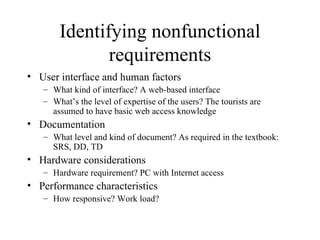
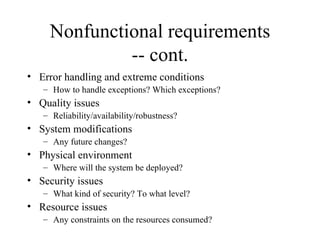
Identifying nonfunctional requirements User interface and human factors What kind of interface? A web-based interface   What’s the level of expertise of the users? The tourists are assumed to have basic web access knowledge Documentation What level and kind of document? As required in the textbook: SRS, DD, TD Hardware considerations Hardware requirement? PC with Internet access Performance characteristics How responsive? Work load?
Nonfunctional requirements -- cont. Error handling and extreme conditions How to handle exceptions? Which exceptions? Quality issues Reliability/availability/robustness? System modifications Any future changes? Physical environment Where will the system be deployed? Security issues What kind of security? To what level? Resource issues Any constraints on the resources consumed?
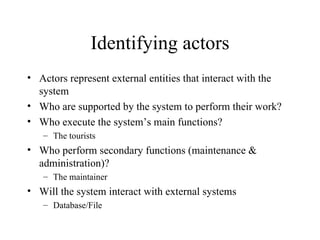
Identifying actors Actors represent external entities that interact with the system Who are supported by the system to perform their work? Who execute the system’s main functions? The tourists Who perform secondary functions (maintenance & administration)? The maintainer Will the system interact with external systems  Database/File
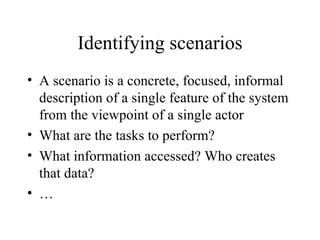
Identifying scenarios A scenario is a concrete, focused, informal description of a single feature of the system from the viewpoint of a single actor What are the tasks to perform? What information accessed? Who creates that data? …
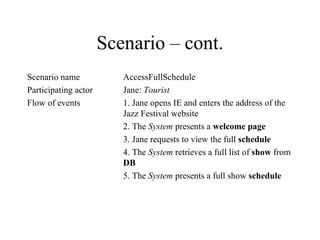
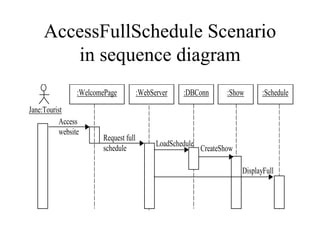
Scenario – cont. Scenario name AccessFullSchedule Participating actor Jane:  Tourist Flow of events  1. Jane opens IE and enters the address of the  Jazz Festival website 2. The  System  presents a  welcome page 3. Jane requests to view the full  schedule   4. The  System  retrieves a full list of  show  from  DB   5. The  System  presents a full show  schedule
AccessFullSchedule Scenario in sequence diagram
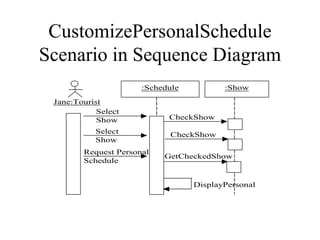
CustomizePersonalSchedule Scenario in Sequence Diagram
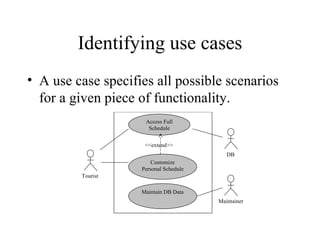
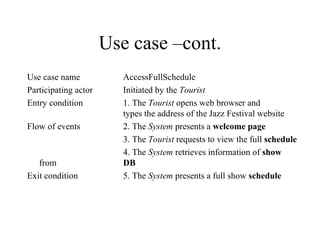
Identifying use cases A use case specifies all possible scenarios for a given piece of functionality.
Use case –cont. Use case name AccessFullSchedule Participating actor Initiated by the  Tourist Entry condition 1. The  Tourist  opens web browser and  types the address of the Jazz Festival website Flow of events 2. The  System  presents a  welcome page 3. The  Tourist  requests to view the full  schedule   4. The  System  retrieves information of  show  from  DB   Exit condition 5. The  System  presents a full show  schedule
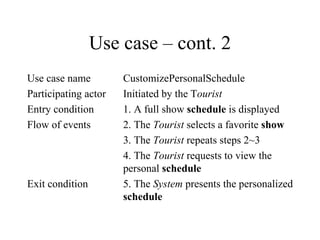
Use case – cont. 2 Use case name CustomizePersonalSchedule Participating actor Initiated by the T ourist Entry condition 1. A full show  schedule  is displayed Flow of events 2. The  Tourist  selects a favorite  show 3. The  Tourist  repeats steps 2~3 4. The  Tourist  requests to view the  personal  schedule Exit condition 5. The  System  presents the personalized  schedule
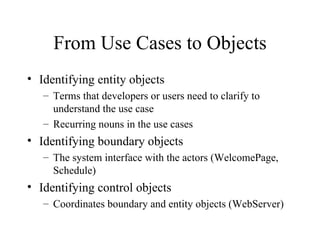
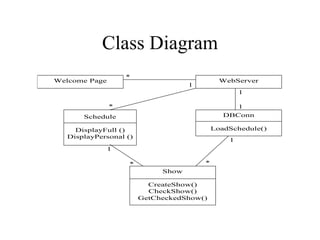
From Use Cases to Objects Identifying entity objects Terms that developers or users need to clarify to understand the use case Recurring nouns in the use cases Identifying boundary objects The system interface with the actors (WelcomePage, Schedule) Identifying control objects Coordinates boundary and entity objects (WebServer)
Class Diagram
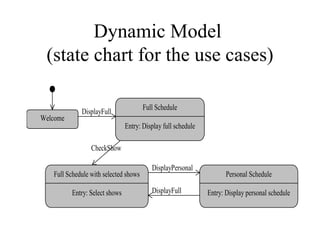
Dynamic Model  (state chart for the use cases)
Role of Diagrams Diagram information + text information  covers  what you   w ant  to represent in a document. How much detail should a diagram reach? The detail and context the reader want. E.g. What should a class diagram provide in SRS?

SRS Slide

  • 1.
    Introduction to SRSWhat’s SRS? Software Requirement Specification What’s it for? Requirement elicitation (functional & nonfunctional) Analysis Who are its users? The client, the users, the system analysts, the system designers… Where is the template? B&D Textbook page 126
  • 2.
    What are tobe written in SRS Introduction Purpose, scope, objectives, reference, … Current System Describe the current state of affairs Proposed System Overview Functional requirements Nonfunctional requirements Pseudo requirements System models (Scenarios, use cases, object model, dynamic models, user interface) Glossary
  • 3.
    Example: Jazz FestivalWebsite This website is to display a table of Jazz shows including show time, location and band name. Tourists can select whatever shows of interest, and upon request a customized list of favorite shows is created as a personal guide to the festival.
  • 4.
    Functional requirements Thesystem shall allow the tourists to access the full schedule of Jazz festival shows The system shall allow the tourists to select their favorite shows and customize personalized schedules The system shall maintain the schedule data
  • 5.
    Identifying nonfunctional requirementsUser interface and human factors What kind of interface? A web-based interface What’s the level of expertise of the users? The tourists are assumed to have basic web access knowledge Documentation What level and kind of document? As required in the textbook: SRS, DD, TD Hardware considerations Hardware requirement? PC with Internet access Performance characteristics How responsive? Work load?
  • 6.
    Nonfunctional requirements --cont. Error handling and extreme conditions How to handle exceptions? Which exceptions? Quality issues Reliability/availability/robustness? System modifications Any future changes? Physical environment Where will the system be deployed? Security issues What kind of security? To what level? Resource issues Any constraints on the resources consumed?
  • 7.
    Identifying actors Actorsrepresent external entities that interact with the system Who are supported by the system to perform their work? Who execute the system’s main functions? The tourists Who perform secondary functions (maintenance & administration)? The maintainer Will the system interact with external systems Database/File
  • 8.
    Identifying scenarios Ascenario is a concrete, focused, informal description of a single feature of the system from the viewpoint of a single actor What are the tasks to perform? What information accessed? Who creates that data? …
  • 9.
    Scenario – cont.Scenario name AccessFullSchedule Participating actor Jane: Tourist Flow of events 1. Jane opens IE and enters the address of the Jazz Festival website 2. The System presents a welcome page 3. Jane requests to view the full schedule 4. The System retrieves a full list of show from DB 5. The System presents a full show schedule
  • 10.
  • 11.
  • 12.
    Identifying use casesA use case specifies all possible scenarios for a given piece of functionality.
  • 13.
    Use case –cont.Use case name AccessFullSchedule Participating actor Initiated by the Tourist Entry condition 1. The Tourist opens web browser and types the address of the Jazz Festival website Flow of events 2. The System presents a welcome page 3. The Tourist requests to view the full schedule 4. The System retrieves information of show from DB Exit condition 5. The System presents a full show schedule
  • 14.
    Use case –cont. 2 Use case name CustomizePersonalSchedule Participating actor Initiated by the T ourist Entry condition 1. A full show schedule is displayed Flow of events 2. The Tourist selects a favorite show 3. The Tourist repeats steps 2~3 4. The Tourist requests to view the personal schedule Exit condition 5. The System presents the personalized schedule
  • 15.
    From Use Casesto Objects Identifying entity objects Terms that developers or users need to clarify to understand the use case Recurring nouns in the use cases Identifying boundary objects The system interface with the actors (WelcomePage, Schedule) Identifying control objects Coordinates boundary and entity objects (WebServer)
  • 16.
  • 17.
    Dynamic Model (state chart for the use cases)
  • 18.
    Role of DiagramsDiagram information + text information covers what you w ant to represent in a document. How much detail should a diagram reach? The detail and context the reader want. E.g. What should a class diagram provide in SRS?