Interim Report
Level 2
Weather - Now
Group Name: Matrix
Faculty of Information Technology
University of Moratuwa
2016
D. G. A. M. Wijayarathna 144193K
K. S. Gunasekara 144060C
T. N. Maduwantha 144113T
P. K. D. S. Madushika 144119R
W. N. Sandeepa 144159M
Interim Report
Level 2
Weather - Now
Group Name: Matrix
Supervised by : Dr. Lochandaka Ranathunga
Faculty of Information Technology
University of Moratuwa
2016
D. G. A. M. Wijayarathna 144193K
K. S. Gunasekara 144060C
T. N. Maduwantha 144113T
P. K. D. S. Madushika 144119R
W. N. Sandeepa 144159M
i
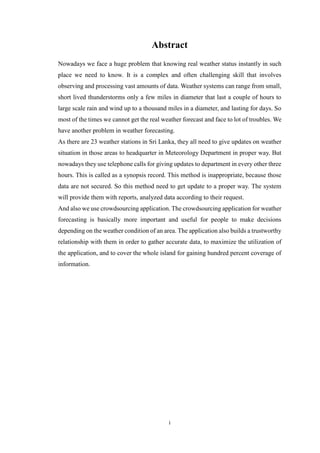
Abstract
Nowadays we face a huge problem that knowing real weather status instantly in such
place we need to know. It is a complex and often challenging skill that involves
observing and processing vast amounts of data. Weather systems can range from small,
short lived thunderstorms only a few miles in diameter that last a couple of hours to
large scale rain and wind up to a thousand miles in a diameter, and lasting for days. So
most of the times we cannot get the real weather forecast and face to lot of troubles. We
have another problem in weather forecasting.
As there are 23 weather stations in Sri Lanka, they all need to give updates on weather
situation in those areas to headquarter in Meteorology Department in proper way. But
nowadays they use telephone calls for giving updates to department in every other three
hours. This is called as a synopsis record. This method is inappropriate, because those
data are not secured. So this method need to get update to a proper way. The system
will provide them with reports, analyzed data according to their request.
And also we use crowdsourcing application. The crowdsourcing application for weather
forecasting is basically more important and useful for people to make decisions
depending on the weather condition of an area. The application also builds a trustworthy
relationship with them in order to gather accurate data, to maximize the utilization of
the application, and to cover the whole island for gaining hundred percent coverage of
information.
ii
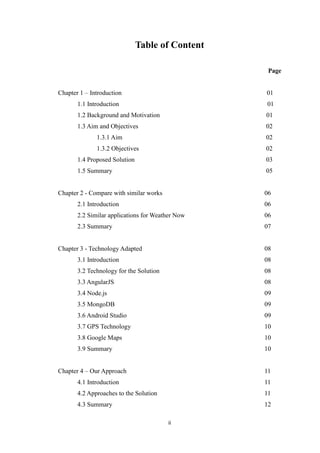
Table of Content
Page
Chapter 1 – Introduction 01
1.1 Introduction 01
1.2 Background and Motivation 01
1.3 Aim and Objectives 02
1.3.1 Aim 02
1.3.2 Objectives 02
1.4 Proposed Solution 03
1.5 Summary 05
Chapter 2 - Compare with similar works 06
2.1 Introduction 06
2.2 Similar applications for Weather Now 06
2.3 Summary 07
Chapter 3 - Technology Adapted 08
3.1 Introduction 08
3.2 Technology for the Solution 08
3.3 AngularJS 08
3.4 Node.js 09
3.5 MongoDB 09
3.6 Android Studio 09
3.7 GPS Technology 10
3.8 Google Maps 10
3.9 Summary 10
Chapter 4 – Our Approach 11
4.1 Introduction 11
4.2 Approaches to the Solution 11
4.3 Summary 12
iii
Chapter 5 - Analysis and Design 13
5.1 Introduction 13
5.2 Top Level Design of the System 13
5.3 System Diagram 14
5.4 Use Case Diagram 15
5.5 Activity Diagram 17
5.6 Entity-Relationship Diagram (E-R) 21
5.7 Sequence Diagram 22
5.8 Summary 26
Chapter 6 – Implementation 27
6.1 Introduction 27
6.2 Implementation 27
6.3 Summary 27
Chapter 7 – Discussion 29
7.1. Introduction 29
7.2. Discussion 29
7.3 Summary 30
Chapter 8 – References 31
Appendix A 32
Appendix B 33
Appendix C 35
iv
List of Figures/ Tables
Page
Figure 5.1: Top Level View 13
Figure 5.2: System Diagram 14
Figure 5.3: Use Case for Weather Stations 15
Figure 5.4: Use Case for Crowdsourcing Application 16
Figure 5.5: Activity Diagram for Weather Station User 17
Figure 5.6: Activity Diagram for Administrator of Weather Station System 18
Figure 5.7: Activity Diagram for Public User 20
Figure 5.8: E-R Diagram 21
Figure 5.9: Sequence diagram for the Admin 22
Figure 5.10: Sequence diagram for the Login 23
Figure 5.11: Sequence diagram for the Public User 24
Figure 5.12: Sequence diagram for the Weather Station User 25
1
Chapter 1
Introduction
1.1 Introduction
In this chapter, we hope to provide a brief depiction on the background and
motivation about our project, point out the aim and objectives and to present the
proposed solution through our project.
1.2 Background and Motivation
It is very important to get educated on the current weather situation of a particular
location as preferred since it affects the day to day life of everyone. It is more effective
if we can get quickly updated on current weather status of a required location, as it
make easy to handle not only our activities, but also our livelihoods too.
A huge problem that we are facing nowadays is inability of knowing real weather status
in such places we need to know. So if we need to know current situation on a certain
place, it is better to ask from a person who is in that area recently or currently. He is a
better source than any prevailing weather information.
We have another problem in weather forecasting as there are twenty three weather
stations in Sri Lanka such as Jaffna, Mannar, Vavniya, Trincomalee, Anuradhapura,
Puttalam, Maha Illuppallama, Polonnaruwa, Kurunegala, Katugastota, Batticaloa,
Pottuwil, Badulla, Bandarawela, Nuwara eliya, Monaragala, Mattala, Hambantota,
Galle, Ratnapura, Ratmalana, Colombo, Katunayaka. All these weather stations which
are island wide need to give updates to the headquarters in a proper way and in a timely
manner. Though it is a complex and significant process, telephone calls are currently
being used to retrieve updates from the stations in Meteorology Department of Sri
Lanka. Therefore, weather forecasting is ultimately a three steps process which includes
observing, forecasting and communicating. This implies that this method needs to be
upgraded into an appropriate approach.
2
1.3 Aim and Objectives
1.3.1 Aim
The aim of this project is to make a software application that can be downloaded and
used in an android device to get to know about real- time weather updates in a
particular place that we need to know and inform others about the current weather
status in our location, and also to make an application for different weather stations of
Meteorology Department to submit their weather synopsis to the system for every
three hours either using the computer at the station or using the specified mobile
application only for them.
1.3.2 Objectives
 Study about weather forecasting applications and systems.
 Study about technologies like web application, android app, which can
overcome problems.
 Study about mapping.
 Design and develop a system which can properly get updates of the current
weather status.
 Evaluate proposed solutions.
 Hand over successful system to the company.
3
1.4 Proposed Solution
Our solution is to implement weather forecasting system of Meteorological
Department and implement a crowd based android application where users can submit
the weather condition of their current location. The system of Meteorological
Department is basically for saturating their current needs on updating weather
synopsis accurately and in a timely manner. This synopsis-record contains a code that
implies the data of temperature, tendency, dew-point, humidity, rainfall, cloud, wind
type, visibility.
Functions of the weather forecasting system of Meteorological Department:
 It allows users from different weather stations to submit synopsis to the
system for every three hours either using the computer at the station or
using the specified mobile application only for them.
 The system provides weather status of a particular area according to the
submitted synopsis using weather maps and weather reports.
 The system analyzes the current weather condition of a particular area with
the track records of past thirty years, and generates reports based on those
analyzed data.
Users of the weather synopsis submission system:
 They have the basic knowledge on how to submit the synopsis, and
they have fully experienced on the encoding techniques used in
synopsis.
 The users submit a weather report from a particular weather station
every three hours.
 They can submit the synopsis from their mobile phone by using a
mobile application developed for them only after verifying their
location.
If users want to know of weather condition of any other location, they can search for
the specific location. Application will provide all the weather condition of that
specific location like is it raining there or not, wind speed, temperature and etc. If
needed application will provide a map of Sri Lanka visualizing temperature, whether
it is raining or not and etc. But users will not be willing to give weather condition of
4
their current locations every time. If this problem keep happening then we can’t
generate an accurate weather forecast based on crowed.
To avoid that we propose some kind of a restriction: If a user want to know weather
condition of a specific location first he or she has to submit the weather condition of
his or her current location. The user does not have to select him or her location as
input. Because based on their GPS position their location will be automatically
submitted. All the user has to do is select weather it is raining or not. But we cannot
rely 100% on user submission as users tend to submit false submissions too. At this
point we have to compare user submissions with a reliable source too. So before
providing a requested weather update to user we decided to compare all the user
submissions within one hour with an online weather forecast provider. Then the result
will be much reliable one.
Functions of the crowdsource mobile weather forecasting application:
 The application covers the all areas within the island to facilitate all the
users of it within the country.
 The mobile application provides current weather status of an area or a
location according to the need of the user.
 It enables users to update the system of the mobile application with the
latest weather condition of a particular area.
Users of the crowdsourcing mobile application:
 These users are the general publics who have this application installed
mobile phones.
 They can get the current weather condition of a place or an area
according to their necessity.
 The users also can update the system by providing the latest status of
the place where he/she is at that moment.
Another bump we did hit while going down our path of achieving this is Department
of Meteorology of Sri Lanka doesn’t provide an API for retrieve weather conditions
for the third party applications. Meteorology Department doesn’t provide hourly base
update of weather conditions therefore, we use Yahoo weather API which gives us
hourly- based weather update for all the locations in Sri Lanka.
5
All the user inputs within one hour will be stored for generating a weather forecast,
and also all the weather parameters from Yahoo weather server will be stored hourly
basis.
1.5 Summary
This chapter, Introduction has provided a brief description of our project including
several captions including background, motivation, aim and objectives, proposed
solution. In the next chapter, we will discuss about prevailing similar applications and
point out the specialty, performance and benefits of our proposed application while
comparing to them.
6
Chapter2
2.0 Compare with similar works
2.1 Introduction
There is large number of weather applications recently used in the world such as Sri
Lanka Weather, Yahoo! Weather, AccuWeather, Weather Live, Weather Bug and so
on. [6] They provide their users with weather information, and this chapter will
supply a comparison between our approach and them.
2.2 Similar applications for Weather Now
 Sri Lanka Weather
This app allows seeing the 10 day weather forecast for every major city in Sri Lanka.
The map features interactivity, including current weather conditions. By simply
tapping on the icon of user choice, user can navigate to a detailed description in
forecast format of user’s area. See the probability of precipitation, wind velocity, and
of course temperatures for all times of the day. As this detailed app focuses
specifically on information for Sri Lanka residents. [7]
This application covers weather forecast only for major cities in Sri Lanka but our
Weather- Now mobile application covers every regional areas throughout the country
acquiring data from its users. And also Weather- Now facilitate its users with the
latest information on weather which is frequently updated by also its users.
 AccuWeather
This free app is designed for iPhone users. It includes something called the “iPhone
weather station,” which allows you to receive alerts for warnings about severe
weather, and it can even forecast out to 15 days, as opposed to the traditional 10 day
limit. To top it all off, it integrates seamlessly with iOS calendar so user can schedule
important events around weather. [7]
7
Though this AccuWeather application is very useful for iPhone users, the majority in
Sri Lanka is android smart phone users. Therefore Our Weather-Now application is
more efficient to be utilized in Sri Lanka.
 Weather Live
Weather Live is also for the iOS system. Focusing on aesthetically pleasing design,
this app focuses on being minimal and easy for its users. Allowing a layout that fills
the entire screen, you can easily view your current weather conditions, represented by
the changing background. It even shows you the current temperature on your main
screen, adjustable by visiting the settings. If you’re focused on beauty and design, this
could be a great weather app for you. [7]
Though this Weather Live application also is very beneficial for iPhone users, the
majority in Sri Lanka is android smart phone users. Therefore Our Weather-Now
application is more resourceful to be employed in Sri Lanka.
2.3 Summary
Today, there are similar applications that complete related tasks, using the same
approach as our application. Therefore, we have detailed down those applications in
this chapter including a comparison and list of special points how our approach differs
from them, and the next chapter will explain the technology that we are going to use
with reasoning.
8
Chapter 3
Technology Adapted
3.1 Introduction
This chapter provides specifics and details about the technology that we have adapted
to solve the problem through implementing our proposed solution. Furthermore, it
will point the reasons and the ways that these techniques and technology are
appropriate for the proposed solution.
3.2 Technology for the Solution
We hope to use following frameworks and techniques through the implementation of
our proposed solution.
 AngularJS
 Node.js
 MongoDB
 Android Studio
 GPS Technology
 Google Maps
3.3 AngularJS
The user interaction with our application is considerable therefore; we should
guarantee that it ensures all aspects that it should be enriched with. Therefore, we
thought to adapt AngularJS for developing our client-side web applications.
AngularJS is a powerful client-side technology that provides a structural framework
for dynamic web applications by extending HTML, CSS and JavaScript for
articulating the application's components concisely. It makes creation of applications
much easier to develop, understand, and test. Thus, it enables to load modular
segments dynamically into a web application. AngularJS facilitates those applications
with a clear Model View Controller (MVC) manner. By employing these concepts and
features in AngularJS, we hope to implement our client-side applications. [8]
9
3.4 Node.js
In our weather forecasting application for Meteorology Department highly rely on
multi-user interaction which is occurred concurrently for every three hours. Thus,
Weather Now mobile application might have users who update and retrieve same data
at the same time which should be arisen with concurrency issues. Therefore, it is
efficient if we can eliminate those issues and provide an efficient performance
throughout the processes, and to achieve this task, we have selected Node.js. It is an
open source, cross-platform run-time environment which is used for developing
server-side and networking applications. Being built on Google Chrome's V8
JavaScript Engine, Node.js library is very fast in code execution, and its nature of
high scalability allows it to provide service for much larger number of requests than
other servers. [9]
3.5 MongoDB
The weather forecasting system frequently involves with information updates and
retrievals. This occurs due to the frequent updates by weather station users. Thus the
users of Weather Now application concurrently and recently update and request for
weather information. These procedures involve a huge amount of data that flow from
and to the database. Therefore, we should ensure that our system will continue its
performance by accomplishing these tasks, and we have chosen MongoDB as our
database for that purpose. It is an open source document-oriented database. MongoDB
can represent rich and hierarchical data structure, it is easily scalable and able to give
high performance. [10]
3.6 Android Studio
The weather forecasting system has a mobile application, and for its implementation,
we have chosen Android Studio. It is an open source and Linux-based operating
system for mobile devices. Android Studio supplies a flexible build system, fast and
feature-rich emulator, unified environment where we can develop the application. [11]
10
3.7 GPS Technology
The crowd-sourcing application of our system requires to verify the location of the
user before he/she updates the current weather status of the location where he/she is at
that moment. It indicates the need of detecting the location of the user, so we have to
use GPS technology. Global Positioning System (GPS) is a network of orbiting
satellites that send precise details of their position in the space back to earth. The
signals are obtained by GPS receivers, and are used to calculate the exact position and
time of a particular location. [12]
3.8 Google Maps
Our solution needs geographical maps for demonstrating the maps to indicate weather
information graphically for the users for their better clarification. We use Google
maps to accomplish this task. By using the Google Maps API which is provided by
Google Maps, it is possible to embed Google Maps site into our application. [13]
3.9 Summary
The technology adapted for implement the system has been described in this chapter,
and in the next chapter, we will provide how we adopted this technology for the
proposed solution.
11
Chapter 4
Our Approach
4.1 Introduction
This chapter is focused on how we are going to adopt the technology to implement the
solution for our weather forecasting system. There are several technologies that we
are using in the solution.
4.2 Approaches to the Solution
The contribution of all the members has been ensured through diving a specific part
for each member while all of us are aware about the overall progress of the system.
The attention for the similar applications to the mobile application and deep
observation of them should be done to achieve the expected performance level of our
solution. It is required to establish a user-friendly environment in the weather
forecasting system for making users easier to interact with it. This needed to be
achieved via understanding the reliability and the perspective of public user.
Especially, we had several field visits to the Meteorological Department with the
intention of gain more information about the procedure that is launched while
updating a weather synopsis. These reports are updated for every three hours, and they
contain weather parameters including tendency, temperature, rainfall, wind type.
Thus, there is a special encoding system which is a universal standard that is used in
updating figures about the parameters. Therefore, we should be aware about these
techniques.
After gathering all the requirements and the details that are essential for the
development, we can design and develop the system by fulfilling all the requirements
of all the users. Here, we employ the technologies such as GPS technology, Node.js,
Android Studio and Google Maps for the implementation stage of the applications.
After the designing stage, we have to engage in testing for identifying the errors,
drawbacks and mistakes in the developing system.
Then, we should stimulate the environment of the weather station users to get them
familiar with the new system, and also to ensure that the application is friendly and
fast enough for the purpose. When considering the mobile application, we have to
12
make it much easier to be used by a user, and to ratify its accomplishment in attaining
its goals.
4.3 Summary
The technologies that we are used to implement our system have been designated in
this chapter as the way of adopting them for the solution for accomplishing its task,
and the next chapter is focused on the analysis and design perspective in order to
provide details about the interaction among the modules within the system.
13
Chapter 5
Analysis and Design
5.1 Introduction
This chapter comprises the particulars about the design of our solution for the weather
forecasting system. Therefore, this includes several diagrams to depict the top level
design of the proposed solution, and the interaction between each and every
components of it.
5.2 Top Level Design of the System
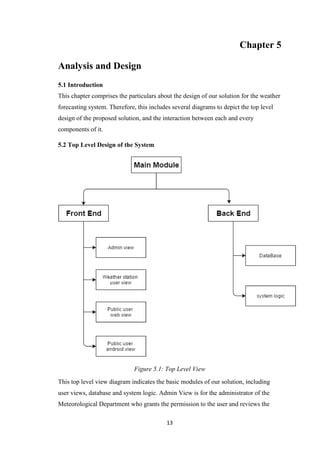
Figure 5.1: Top Level View
This top level view diagram indicates the basic modules of our solution, including
user views, database and system logic. Admin View is for the administrator of the
Meteorological Department who grants the permission to the user and reviews the
14
submitted weather reports by all the weather station users. Weather station users are
able to update the weather synopsis. Web and the App view of the public users allow
retrieving required weather information if and only if they have submitted the current
location’s weather status.
5.3 System Diagram
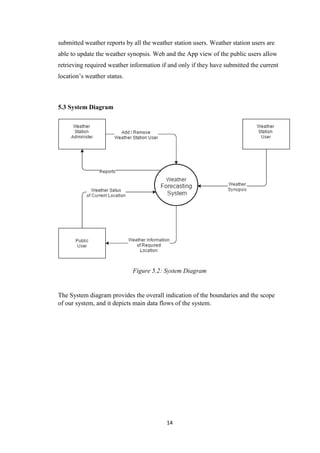
Figure 5.2: System Diagram
The System diagram provides the overall indication of the boundaries and the scope
of our system, and it depicts main data flows of the system.
15
5.4 Use Case Diagrams
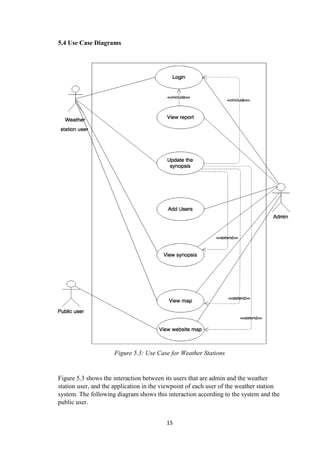
Figure 5.3: Use Case for Weather Stations
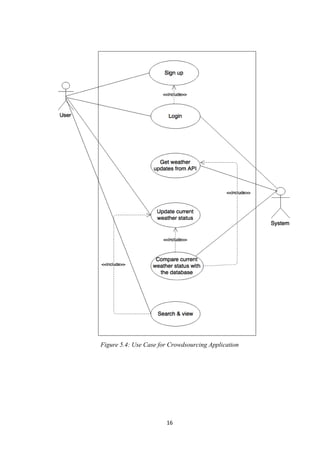
Figure 5.3 shows the interaction between its users that are admin and the weather
station user, and the application in the viewpoint of each user of the weather station
system. The following diagram shows this interaction according to the system and the
public user.
16
Figure 5.4: Use Case for Crowdsourcing Application
17
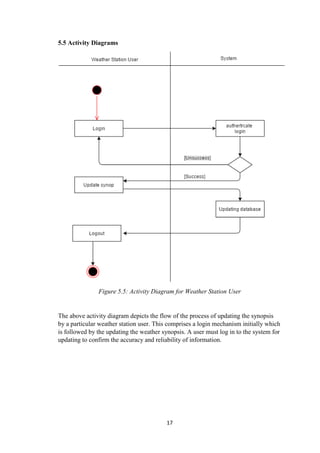
5.5 Activity Diagrams
Figure 5.5: Activity Diagram for Weather Station User
The above activity diagram depicts the flow of the process of updating the synopsis
by a particular weather station user. This comprises a login mechanism initially which
is followed by the updating the weather synopsis. A user must log in to the system for
updating to confirm the accuracy and reliability of information.
18
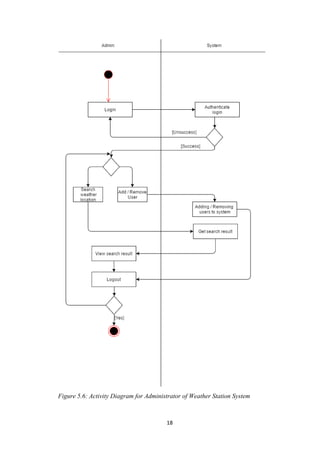
Figure 5.6: Activity Diagram for Administrator of Weather Station System
19
The above activity diagram is about the administrator’s activity flow, and firstly,
he/she should login to the system by confirming their identity. Then, administrator
can remove or add weather station users to the system, and to view updated synopsis
by each user at every prevailing weather station.
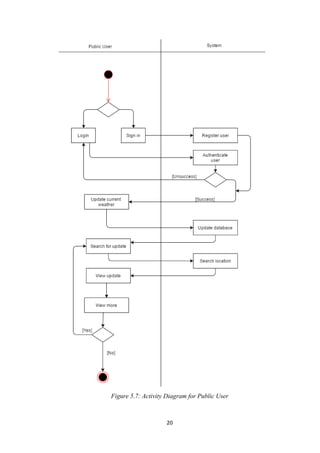
The following activity diagram illustrates the process involved when a public user is
going to acquire necessary weather information. A public user should first sign in to
the application, and in every time he/she would want to use the application, the user
have to login in the beginning. Then, the user must update the weather state of his/her
current location. After this update only they are allowed to acquire information as
their needs.
20
Figure 5.7: Activity Diagram for Public User
21
5.6 Entity-Relationship Diagram (E-R)
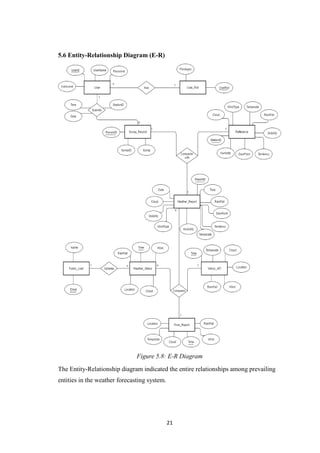
Figure 5.8: E-R Diagram
The Entity-Relationship diagram indicated the entire relationships among prevailing
entities in the weather forecasting system.
22
5.7 Sequence Diagram
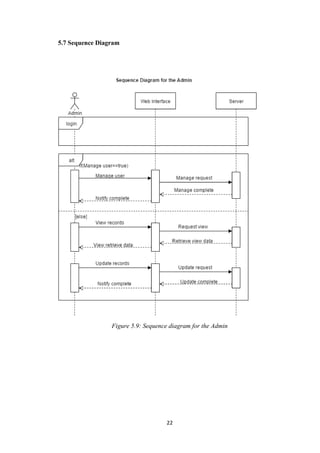
Figure 5.9: Sequence diagram for the Admin
23
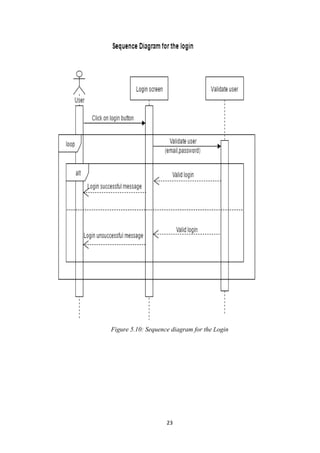
Figure 5.10: Sequence diagram for the Login
24
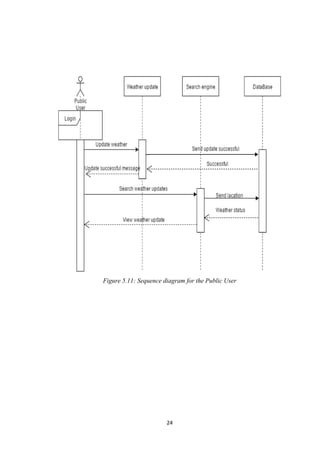
Figure 5.11: Sequence diagram for the Public User
25
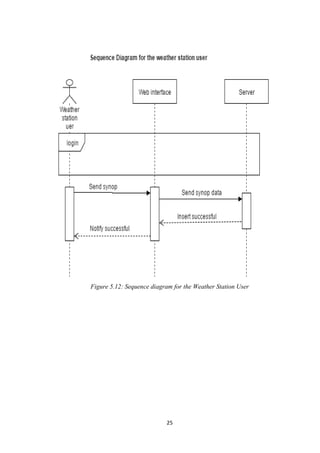
Figure 5.12: Sequence diagram for the Weather Station User
26
5.9 Summary
In this chapter, we have provided the design of the proposed system using various
kind of diagrams in order to verify the fundamental idea, modules and components of
the system which is going to be implemented. The next chapter will convey the
implementation details of the system referring to this analysis and design factors.
27
Chapter 6
Implementation
6.1 Introduction
This chapter is described the way that how we are going to implement our proposed
solution. Thus, in here our main attention focuses to the code techniques and progress
of the implementing system.
6.2 Implementation
After selecting and confirming the project, we went several times to meet our clients
to gather their requirements. As there are two clients we had to spend considerable
time period to gather information. We had some sessions with the Meteorology
Department to gather all their requirements that they have got at this moment. After
gathering all the information, we decided to develop three main modules. They are:
 Weather Station Administrator Interface
 Weather Station User Interface
 Public User Interface
* Web Interfaces
* Android Interface
For developing these interfaces, except Android interface, we decided to use Angular
JS, HTML 5, CSS and for developing Android application we use Android Studio.
And for the backend we decide to use Node.js.
And our project needs to have a considerable size so we decide to use noSQL
database. So we selected MongoDB for the database.
As these technologies are new to us, so we spending more time to learn these
technologies.
6.3 Summary
This chapter has described our implementation of the project. We have number of
user interfaces to create and we have a huge database to maintain. Therefore our
28
implementation is still in progress. In next chapter the summary of the entire scenario
that we have talked so far is included.
29
Chapter 7
Discussion
7.1. Introduction
In previous chapters, we have described the problem that we have, the solution that
we gave for this problem, how we are going to analyze the problem and to create an
overall design for that. In this chapter, we are going to give a quick summary on the
things what we have discussed so far.
7.2. Discussion
It is beneficial if we can know about the current weather condition of a particular
location as desired since it might help our day to day life. It is more effective if we can
get quickly updated on current weather status of a required location, as it make easy to
handle our activities.
Therefore, we thought of implementing a system for weather forecasting in order to
facilitate these needs, and especially, a system for Meteorological Department. The
department requires a system to get all the updates done by each weather station for
every three hours by a specific user who logs into the system. The solution for general
public need is solved through a crowdsource application for mobile phones. The user
can update their current location’s weather status and also get required updates from it.
This application is supported by Yahoo Weather API, and information from weather
stations.
Though there are many similar applications for this, they are not enriched with the latest
data, but this application is frequently updates by its users. Thus, it provides not only
information regarding the main cities of the country, but also other regional locations’
too.
We use several technological approaches for the design of the proposed solution. GPS
technology for detecting the user’s location, Node.js, AngularJS, MongoDB for
application development, and Google Maps for demonstrating weather information
graphically.
Then, we have to ensure and evaluate the performance of the system by testing, and
implement the system. Especially, the maintenance of the system is much important
fact. Throughout the process, we should make sure that the system is enriched with
30
reliability, accuracy, fast as possible, feasibility and user-friendly.
7.3 Summary
This chapter has provided an overall description about all the things of our solution
including background, proposed solution, similar approaches, technology adapted, our
approach, design and implementation.
31
Chapter 8
References
[1] Dayananda, M.D. (2010), Meteorological Observations and Instrumental Systems
for Meteorological services in Sri Lanka, Department of meteorology, Sri Lanka
[2] http://meteo.gov.lk/index.php?lang=en, the official website of Department of
Meteorology, Sri Lanka
[3] http://www.physics.uwo.ca/~whocking/p103/instrum.html, introduction to
meteorology-tools for Science
[4] http://www.indiawaterportal.org/articles/measurement-weather-parameters-data-
collection-and-analysis-presentation-acwadam, measurements of weather parameters
[5] http://www.meteor.wisc.edu/~hopkins/aos100/sfc-anl.htm
[6] http://blog.ikman.lk/5-great-weather-apps-sri-lanka/
[7] http://heavy.com/tech/2015/04/top-5-best-free-weather-channel-app-apps-for-
iphone-ipad-android/
[8] https://angularjs.org/
[9] http://www.codeproject.com/Articles/1037052/Introduction-to-MongoDB
[10] https://nodejs.org
[11] https://www.raywenderlich.com
[12] http://www.mio.com/technology-what-is-gps.htm
[13] https://developers.google.com
32
Appendix A
Crowdsourcing
The process of obtaining needed information, input, services, ideas, or content by
soliciting contributions from a large group of people, especially from an online
community. Furthermore crowdsourcing is the practice of engaging a ‘crowd’ or
group for a common goal often innovation, problem solving, or efficiency. It is
powered by new technologies, social media and web. Crowdsourcing can take place
on many different levels and across various industries.
However, crowdsourcing also brings with it quite a few disadvantages.
 The users may not be able to connect the Internet as soon as they expect.
 The users may be unable to verify the location and information due to weak
network connections.
 The low degree of reliability on information retrieved from the users.
 The inability to find users from all over the country to gain full coverage, and
to provide with required information.
 The difficulties in supplying computer and Internet facilities to all weather
stations, and in repairing, fixing them.
 The problem of not having sufficient amount of staff for stations
Weather Synopsis
SYNOP (surface synoptic observations) is a numerical code used for
reporting weather observations made by manned and automated weather stations. It is
a description of weather patterns which is affected a large area of an island, state,
region or a continent.
33
Appendix B
External Interface Requirements
(1) User Interfaces
 Android Interface
The Android interface of Weather Now is design for the users who needs to know
current weather status of any place.
Features of the android interface of Weather Now will include a login page, searching
for weather updates, update user’s current weather updates and show searched
weather results.
Visual design of the interface will be make in a way that any user without prior
experience of the interface will be able to fulfill his information requirements with a
little effort.
 Web Interface for weather stations
A web interface for weather stations is design for the officers who works in
Meteorology Department weather stations, to update the weather report (Synop).
Features of this interface will include a login page, update the Synop, search and view
weather updates, Add/remove users, view database and add additional information.
Some features of this interface will not be allowed to every user as this interface use
role -based access method.
(2) Hardware interfaces
Since neither the mobile application nor the web portal have any designated hardware,
it does not have any direct hardware interfaces. The physical GPS is managed by the
GPS application in the mobile phone.
34
(3) Software Interfaces
The Weather Now app is to be developed under the Android operating systems using
the Java JDK (Java Development Kit) and the Android SDK (software development
kit) tools.
The mobile application communicates with the GPS in order to get geographical
information about where the user is located and the visual representation of it,
 Incoming and outgoing items
* Incoming data consist of updates from the server regarding to the weather
and search results.
* Outgoing data consist of current weather update sent by user, new login
information and synopsis.
(4) Communication protocols and interfaces
Communication will occur in occasional, short bursts between a user’s phone and the
server in the following situations:
o Whenever a user creates a new login in android phone
o Whenever user send current weather updates to the server
o Whenever server send search results to the user
Communication will occur between web interface and the server between following
situations:
o Whenever officers update synopsis.
o Whenever users search for weather updates.
o Whenever admins add/remove user details.
35
Appendix C
Individuals Contribution to the Project
Name of student: D. G. A. M. Wijayarathna (Group Leader)
I studied the entire project and discussed the details and information with group
members. Then, we shared the main parts of the project. My contribution is to
develop an android application to the Weather-Now project. Nowadays I am studying
about how to develop android applications for the crowdsourcing mobile application
by using Android Studio. And also I am studying about creating wire frames in Ninja
Mock and Marvel.
Name of student: K. S. Gunasekara
My contribution is to develop backend of the web application and android application.
Therefore, I have to consider about the database of the system and the system logic.
This includes the way of implementing obtaining updates from users, retrieving the
location of the user, processing for the supply of required information by user. So,
nowadays I am studying about Node.js and MongoDB to develop those back ends.
And also I am using intelliJ IDEA IDE for the purpose.
Name of student: T. N. Maduwantha
My contribution is design and develop the web interface for weather stations. So
nowadays I am studying about AngularJS, CSS, HTML, Bootstrap for designing web
interfaces. I have to figure out the user interactions occurred between users and the
system. There are two kinds of users and they engage in different activities with the
system. The design of these web interfaces should be compatible with the user
requirements. Thus, they have to be user-friendly.
36
Name of student: P. K. D. S. Madushika
My contribution is to design and develop the web application for the crowdsourcing
application. So, these days I am studying about AngularJS, CSS, HTML and
Bootstrap to develop this web application. I have to search about the parameters that
we are going to acquire information from users, and the way we are going to enable
them through the web application. Thus, it is essential to ensure that the public users
can easily interact with the system via this web interfaces.
Name of student: W. N. Sandeepa
My contribution is to develop backend of the web interface of weather stations. So in
these days I am studying about MongoDB and Node.js. This involves how to obtain
and provide information to the users of the system as their requests and responses.
Therefore, I have to design and develop the database and the logic for the system for
accomplishing its tasks.

Weather Now

  • 1.
    Interim Report Level 2 Weather- Now Group Name: Matrix Faculty of Information Technology University of Moratuwa 2016 D. G. A. M. Wijayarathna 144193K K. S. Gunasekara 144060C T. N. Maduwantha 144113T P. K. D. S. Madushika 144119R W. N. Sandeepa 144159M
  • 2.
    Interim Report Level 2 Weather- Now Group Name: Matrix Supervised by : Dr. Lochandaka Ranathunga Faculty of Information Technology University of Moratuwa 2016 D. G. A. M. Wijayarathna 144193K K. S. Gunasekara 144060C T. N. Maduwantha 144113T P. K. D. S. Madushika 144119R W. N. Sandeepa 144159M
  • 3.
    i Abstract Nowadays we facea huge problem that knowing real weather status instantly in such place we need to know. It is a complex and often challenging skill that involves observing and processing vast amounts of data. Weather systems can range from small, short lived thunderstorms only a few miles in diameter that last a couple of hours to large scale rain and wind up to a thousand miles in a diameter, and lasting for days. So most of the times we cannot get the real weather forecast and face to lot of troubles. We have another problem in weather forecasting. As there are 23 weather stations in Sri Lanka, they all need to give updates on weather situation in those areas to headquarter in Meteorology Department in proper way. But nowadays they use telephone calls for giving updates to department in every other three hours. This is called as a synopsis record. This method is inappropriate, because those data are not secured. So this method need to get update to a proper way. The system will provide them with reports, analyzed data according to their request. And also we use crowdsourcing application. The crowdsourcing application for weather forecasting is basically more important and useful for people to make decisions depending on the weather condition of an area. The application also builds a trustworthy relationship with them in order to gather accurate data, to maximize the utilization of the application, and to cover the whole island for gaining hundred percent coverage of information.
  • 4.
    ii Table of Content Page Chapter1 – Introduction 01 1.1 Introduction 01 1.2 Background and Motivation 01 1.3 Aim and Objectives 02 1.3.1 Aim 02 1.3.2 Objectives 02 1.4 Proposed Solution 03 1.5 Summary 05 Chapter 2 - Compare with similar works 06 2.1 Introduction 06 2.2 Similar applications for Weather Now 06 2.3 Summary 07 Chapter 3 - Technology Adapted 08 3.1 Introduction 08 3.2 Technology for the Solution 08 3.3 AngularJS 08 3.4 Node.js 09 3.5 MongoDB 09 3.6 Android Studio 09 3.7 GPS Technology 10 3.8 Google Maps 10 3.9 Summary 10 Chapter 4 – Our Approach 11 4.1 Introduction 11 4.2 Approaches to the Solution 11 4.3 Summary 12
  • 5.
    iii Chapter 5 -Analysis and Design 13 5.1 Introduction 13 5.2 Top Level Design of the System 13 5.3 System Diagram 14 5.4 Use Case Diagram 15 5.5 Activity Diagram 17 5.6 Entity-Relationship Diagram (E-R) 21 5.7 Sequence Diagram 22 5.8 Summary 26 Chapter 6 – Implementation 27 6.1 Introduction 27 6.2 Implementation 27 6.3 Summary 27 Chapter 7 – Discussion 29 7.1. Introduction 29 7.2. Discussion 29 7.3 Summary 30 Chapter 8 – References 31 Appendix A 32 Appendix B 33 Appendix C 35
  • 6.
    iv List of Figures/Tables Page Figure 5.1: Top Level View 13 Figure 5.2: System Diagram 14 Figure 5.3: Use Case for Weather Stations 15 Figure 5.4: Use Case for Crowdsourcing Application 16 Figure 5.5: Activity Diagram for Weather Station User 17 Figure 5.6: Activity Diagram for Administrator of Weather Station System 18 Figure 5.7: Activity Diagram for Public User 20 Figure 5.8: E-R Diagram 21 Figure 5.9: Sequence diagram for the Admin 22 Figure 5.10: Sequence diagram for the Login 23 Figure 5.11: Sequence diagram for the Public User 24 Figure 5.12: Sequence diagram for the Weather Station User 25
  • 7.
    1 Chapter 1 Introduction 1.1 Introduction Inthis chapter, we hope to provide a brief depiction on the background and motivation about our project, point out the aim and objectives and to present the proposed solution through our project. 1.2 Background and Motivation It is very important to get educated on the current weather situation of a particular location as preferred since it affects the day to day life of everyone. It is more effective if we can get quickly updated on current weather status of a required location, as it make easy to handle not only our activities, but also our livelihoods too. A huge problem that we are facing nowadays is inability of knowing real weather status in such places we need to know. So if we need to know current situation on a certain place, it is better to ask from a person who is in that area recently or currently. He is a better source than any prevailing weather information. We have another problem in weather forecasting as there are twenty three weather stations in Sri Lanka such as Jaffna, Mannar, Vavniya, Trincomalee, Anuradhapura, Puttalam, Maha Illuppallama, Polonnaruwa, Kurunegala, Katugastota, Batticaloa, Pottuwil, Badulla, Bandarawela, Nuwara eliya, Monaragala, Mattala, Hambantota, Galle, Ratnapura, Ratmalana, Colombo, Katunayaka. All these weather stations which are island wide need to give updates to the headquarters in a proper way and in a timely manner. Though it is a complex and significant process, telephone calls are currently being used to retrieve updates from the stations in Meteorology Department of Sri Lanka. Therefore, weather forecasting is ultimately a three steps process which includes observing, forecasting and communicating. This implies that this method needs to be upgraded into an appropriate approach.
  • 8.
    2 1.3 Aim andObjectives 1.3.1 Aim The aim of this project is to make a software application that can be downloaded and used in an android device to get to know about real- time weather updates in a particular place that we need to know and inform others about the current weather status in our location, and also to make an application for different weather stations of Meteorology Department to submit their weather synopsis to the system for every three hours either using the computer at the station or using the specified mobile application only for them. 1.3.2 Objectives  Study about weather forecasting applications and systems.  Study about technologies like web application, android app, which can overcome problems.  Study about mapping.  Design and develop a system which can properly get updates of the current weather status.  Evaluate proposed solutions.  Hand over successful system to the company.
  • 9.
    3 1.4 Proposed Solution Oursolution is to implement weather forecasting system of Meteorological Department and implement a crowd based android application where users can submit the weather condition of their current location. The system of Meteorological Department is basically for saturating their current needs on updating weather synopsis accurately and in a timely manner. This synopsis-record contains a code that implies the data of temperature, tendency, dew-point, humidity, rainfall, cloud, wind type, visibility. Functions of the weather forecasting system of Meteorological Department:  It allows users from different weather stations to submit synopsis to the system for every three hours either using the computer at the station or using the specified mobile application only for them.  The system provides weather status of a particular area according to the submitted synopsis using weather maps and weather reports.  The system analyzes the current weather condition of a particular area with the track records of past thirty years, and generates reports based on those analyzed data. Users of the weather synopsis submission system:  They have the basic knowledge on how to submit the synopsis, and they have fully experienced on the encoding techniques used in synopsis.  The users submit a weather report from a particular weather station every three hours.  They can submit the synopsis from their mobile phone by using a mobile application developed for them only after verifying their location. If users want to know of weather condition of any other location, they can search for the specific location. Application will provide all the weather condition of that specific location like is it raining there or not, wind speed, temperature and etc. If needed application will provide a map of Sri Lanka visualizing temperature, whether it is raining or not and etc. But users will not be willing to give weather condition of
  • 10.
    4 their current locationsevery time. If this problem keep happening then we can’t generate an accurate weather forecast based on crowed. To avoid that we propose some kind of a restriction: If a user want to know weather condition of a specific location first he or she has to submit the weather condition of his or her current location. The user does not have to select him or her location as input. Because based on their GPS position their location will be automatically submitted. All the user has to do is select weather it is raining or not. But we cannot rely 100% on user submission as users tend to submit false submissions too. At this point we have to compare user submissions with a reliable source too. So before providing a requested weather update to user we decided to compare all the user submissions within one hour with an online weather forecast provider. Then the result will be much reliable one. Functions of the crowdsource mobile weather forecasting application:  The application covers the all areas within the island to facilitate all the users of it within the country.  The mobile application provides current weather status of an area or a location according to the need of the user.  It enables users to update the system of the mobile application with the latest weather condition of a particular area. Users of the crowdsourcing mobile application:  These users are the general publics who have this application installed mobile phones.  They can get the current weather condition of a place or an area according to their necessity.  The users also can update the system by providing the latest status of the place where he/she is at that moment. Another bump we did hit while going down our path of achieving this is Department of Meteorology of Sri Lanka doesn’t provide an API for retrieve weather conditions for the third party applications. Meteorology Department doesn’t provide hourly base update of weather conditions therefore, we use Yahoo weather API which gives us hourly- based weather update for all the locations in Sri Lanka.
  • 11.
    5 All the userinputs within one hour will be stored for generating a weather forecast, and also all the weather parameters from Yahoo weather server will be stored hourly basis. 1.5 Summary This chapter, Introduction has provided a brief description of our project including several captions including background, motivation, aim and objectives, proposed solution. In the next chapter, we will discuss about prevailing similar applications and point out the specialty, performance and benefits of our proposed application while comparing to them.
  • 12.
    6 Chapter2 2.0 Compare withsimilar works 2.1 Introduction There is large number of weather applications recently used in the world such as Sri Lanka Weather, Yahoo! Weather, AccuWeather, Weather Live, Weather Bug and so on. [6] They provide their users with weather information, and this chapter will supply a comparison between our approach and them. 2.2 Similar applications for Weather Now  Sri Lanka Weather This app allows seeing the 10 day weather forecast for every major city in Sri Lanka. The map features interactivity, including current weather conditions. By simply tapping on the icon of user choice, user can navigate to a detailed description in forecast format of user’s area. See the probability of precipitation, wind velocity, and of course temperatures for all times of the day. As this detailed app focuses specifically on information for Sri Lanka residents. [7] This application covers weather forecast only for major cities in Sri Lanka but our Weather- Now mobile application covers every regional areas throughout the country acquiring data from its users. And also Weather- Now facilitate its users with the latest information on weather which is frequently updated by also its users.  AccuWeather This free app is designed for iPhone users. It includes something called the “iPhone weather station,” which allows you to receive alerts for warnings about severe weather, and it can even forecast out to 15 days, as opposed to the traditional 10 day limit. To top it all off, it integrates seamlessly with iOS calendar so user can schedule important events around weather. [7]
  • 13.
    7 Though this AccuWeatherapplication is very useful for iPhone users, the majority in Sri Lanka is android smart phone users. Therefore Our Weather-Now application is more efficient to be utilized in Sri Lanka.  Weather Live Weather Live is also for the iOS system. Focusing on aesthetically pleasing design, this app focuses on being minimal and easy for its users. Allowing a layout that fills the entire screen, you can easily view your current weather conditions, represented by the changing background. It even shows you the current temperature on your main screen, adjustable by visiting the settings. If you’re focused on beauty and design, this could be a great weather app for you. [7] Though this Weather Live application also is very beneficial for iPhone users, the majority in Sri Lanka is android smart phone users. Therefore Our Weather-Now application is more resourceful to be employed in Sri Lanka. 2.3 Summary Today, there are similar applications that complete related tasks, using the same approach as our application. Therefore, we have detailed down those applications in this chapter including a comparison and list of special points how our approach differs from them, and the next chapter will explain the technology that we are going to use with reasoning.
  • 14.
    8 Chapter 3 Technology Adapted 3.1Introduction This chapter provides specifics and details about the technology that we have adapted to solve the problem through implementing our proposed solution. Furthermore, it will point the reasons and the ways that these techniques and technology are appropriate for the proposed solution. 3.2 Technology for the Solution We hope to use following frameworks and techniques through the implementation of our proposed solution.  AngularJS  Node.js  MongoDB  Android Studio  GPS Technology  Google Maps 3.3 AngularJS The user interaction with our application is considerable therefore; we should guarantee that it ensures all aspects that it should be enriched with. Therefore, we thought to adapt AngularJS for developing our client-side web applications. AngularJS is a powerful client-side technology that provides a structural framework for dynamic web applications by extending HTML, CSS and JavaScript for articulating the application's components concisely. It makes creation of applications much easier to develop, understand, and test. Thus, it enables to load modular segments dynamically into a web application. AngularJS facilitates those applications with a clear Model View Controller (MVC) manner. By employing these concepts and features in AngularJS, we hope to implement our client-side applications. [8]
  • 15.
    9 3.4 Node.js In ourweather forecasting application for Meteorology Department highly rely on multi-user interaction which is occurred concurrently for every three hours. Thus, Weather Now mobile application might have users who update and retrieve same data at the same time which should be arisen with concurrency issues. Therefore, it is efficient if we can eliminate those issues and provide an efficient performance throughout the processes, and to achieve this task, we have selected Node.js. It is an open source, cross-platform run-time environment which is used for developing server-side and networking applications. Being built on Google Chrome's V8 JavaScript Engine, Node.js library is very fast in code execution, and its nature of high scalability allows it to provide service for much larger number of requests than other servers. [9] 3.5 MongoDB The weather forecasting system frequently involves with information updates and retrievals. This occurs due to the frequent updates by weather station users. Thus the users of Weather Now application concurrently and recently update and request for weather information. These procedures involve a huge amount of data that flow from and to the database. Therefore, we should ensure that our system will continue its performance by accomplishing these tasks, and we have chosen MongoDB as our database for that purpose. It is an open source document-oriented database. MongoDB can represent rich and hierarchical data structure, it is easily scalable and able to give high performance. [10] 3.6 Android Studio The weather forecasting system has a mobile application, and for its implementation, we have chosen Android Studio. It is an open source and Linux-based operating system for mobile devices. Android Studio supplies a flexible build system, fast and feature-rich emulator, unified environment where we can develop the application. [11]
  • 16.
    10 3.7 GPS Technology Thecrowd-sourcing application of our system requires to verify the location of the user before he/she updates the current weather status of the location where he/she is at that moment. It indicates the need of detecting the location of the user, so we have to use GPS technology. Global Positioning System (GPS) is a network of orbiting satellites that send precise details of their position in the space back to earth. The signals are obtained by GPS receivers, and are used to calculate the exact position and time of a particular location. [12] 3.8 Google Maps Our solution needs geographical maps for demonstrating the maps to indicate weather information graphically for the users for their better clarification. We use Google maps to accomplish this task. By using the Google Maps API which is provided by Google Maps, it is possible to embed Google Maps site into our application. [13] 3.9 Summary The technology adapted for implement the system has been described in this chapter, and in the next chapter, we will provide how we adopted this technology for the proposed solution.
  • 17.
    11 Chapter 4 Our Approach 4.1Introduction This chapter is focused on how we are going to adopt the technology to implement the solution for our weather forecasting system. There are several technologies that we are using in the solution. 4.2 Approaches to the Solution The contribution of all the members has been ensured through diving a specific part for each member while all of us are aware about the overall progress of the system. The attention for the similar applications to the mobile application and deep observation of them should be done to achieve the expected performance level of our solution. It is required to establish a user-friendly environment in the weather forecasting system for making users easier to interact with it. This needed to be achieved via understanding the reliability and the perspective of public user. Especially, we had several field visits to the Meteorological Department with the intention of gain more information about the procedure that is launched while updating a weather synopsis. These reports are updated for every three hours, and they contain weather parameters including tendency, temperature, rainfall, wind type. Thus, there is a special encoding system which is a universal standard that is used in updating figures about the parameters. Therefore, we should be aware about these techniques. After gathering all the requirements and the details that are essential for the development, we can design and develop the system by fulfilling all the requirements of all the users. Here, we employ the technologies such as GPS technology, Node.js, Android Studio and Google Maps for the implementation stage of the applications. After the designing stage, we have to engage in testing for identifying the errors, drawbacks and mistakes in the developing system. Then, we should stimulate the environment of the weather station users to get them familiar with the new system, and also to ensure that the application is friendly and fast enough for the purpose. When considering the mobile application, we have to
  • 18.
    12 make it mucheasier to be used by a user, and to ratify its accomplishment in attaining its goals. 4.3 Summary The technologies that we are used to implement our system have been designated in this chapter as the way of adopting them for the solution for accomplishing its task, and the next chapter is focused on the analysis and design perspective in order to provide details about the interaction among the modules within the system.
  • 19.
    13 Chapter 5 Analysis andDesign 5.1 Introduction This chapter comprises the particulars about the design of our solution for the weather forecasting system. Therefore, this includes several diagrams to depict the top level design of the proposed solution, and the interaction between each and every components of it. 5.2 Top Level Design of the System Figure 5.1: Top Level View This top level view diagram indicates the basic modules of our solution, including user views, database and system logic. Admin View is for the administrator of the Meteorological Department who grants the permission to the user and reviews the
  • 20.
    14 submitted weather reportsby all the weather station users. Weather station users are able to update the weather synopsis. Web and the App view of the public users allow retrieving required weather information if and only if they have submitted the current location’s weather status. 5.3 System Diagram Figure 5.2: System Diagram The System diagram provides the overall indication of the boundaries and the scope of our system, and it depicts main data flows of the system.
  • 21.
    15 5.4 Use CaseDiagrams Figure 5.3: Use Case for Weather Stations Figure 5.3 shows the interaction between its users that are admin and the weather station user, and the application in the viewpoint of each user of the weather station system. The following diagram shows this interaction according to the system and the public user.
  • 22.
    16 Figure 5.4: UseCase for Crowdsourcing Application
  • 23.
    17 5.5 Activity Diagrams Figure5.5: Activity Diagram for Weather Station User The above activity diagram depicts the flow of the process of updating the synopsis by a particular weather station user. This comprises a login mechanism initially which is followed by the updating the weather synopsis. A user must log in to the system for updating to confirm the accuracy and reliability of information.
  • 24.
    18 Figure 5.6: ActivityDiagram for Administrator of Weather Station System
  • 25.
    19 The above activitydiagram is about the administrator’s activity flow, and firstly, he/she should login to the system by confirming their identity. Then, administrator can remove or add weather station users to the system, and to view updated synopsis by each user at every prevailing weather station. The following activity diagram illustrates the process involved when a public user is going to acquire necessary weather information. A public user should first sign in to the application, and in every time he/she would want to use the application, the user have to login in the beginning. Then, the user must update the weather state of his/her current location. After this update only they are allowed to acquire information as their needs.
  • 26.
    20 Figure 5.7: ActivityDiagram for Public User
  • 27.
    21 5.6 Entity-Relationship Diagram(E-R) Figure 5.8: E-R Diagram The Entity-Relationship diagram indicated the entire relationships among prevailing entities in the weather forecasting system.
  • 28.
    22 5.7 Sequence Diagram Figure5.9: Sequence diagram for the Admin
  • 29.
    23 Figure 5.10: Sequencediagram for the Login
  • 30.
    24 Figure 5.11: Sequencediagram for the Public User
  • 31.
    25 Figure 5.12: Sequencediagram for the Weather Station User
  • 32.
    26 5.9 Summary In thischapter, we have provided the design of the proposed system using various kind of diagrams in order to verify the fundamental idea, modules and components of the system which is going to be implemented. The next chapter will convey the implementation details of the system referring to this analysis and design factors.
  • 33.
    27 Chapter 6 Implementation 6.1 Introduction Thischapter is described the way that how we are going to implement our proposed solution. Thus, in here our main attention focuses to the code techniques and progress of the implementing system. 6.2 Implementation After selecting and confirming the project, we went several times to meet our clients to gather their requirements. As there are two clients we had to spend considerable time period to gather information. We had some sessions with the Meteorology Department to gather all their requirements that they have got at this moment. After gathering all the information, we decided to develop three main modules. They are:  Weather Station Administrator Interface  Weather Station User Interface  Public User Interface * Web Interfaces * Android Interface For developing these interfaces, except Android interface, we decided to use Angular JS, HTML 5, CSS and for developing Android application we use Android Studio. And for the backend we decide to use Node.js. And our project needs to have a considerable size so we decide to use noSQL database. So we selected MongoDB for the database. As these technologies are new to us, so we spending more time to learn these technologies. 6.3 Summary This chapter has described our implementation of the project. We have number of user interfaces to create and we have a huge database to maintain. Therefore our
  • 34.
    28 implementation is stillin progress. In next chapter the summary of the entire scenario that we have talked so far is included.
  • 35.
    29 Chapter 7 Discussion 7.1. Introduction Inprevious chapters, we have described the problem that we have, the solution that we gave for this problem, how we are going to analyze the problem and to create an overall design for that. In this chapter, we are going to give a quick summary on the things what we have discussed so far. 7.2. Discussion It is beneficial if we can know about the current weather condition of a particular location as desired since it might help our day to day life. It is more effective if we can get quickly updated on current weather status of a required location, as it make easy to handle our activities. Therefore, we thought of implementing a system for weather forecasting in order to facilitate these needs, and especially, a system for Meteorological Department. The department requires a system to get all the updates done by each weather station for every three hours by a specific user who logs into the system. The solution for general public need is solved through a crowdsource application for mobile phones. The user can update their current location’s weather status and also get required updates from it. This application is supported by Yahoo Weather API, and information from weather stations. Though there are many similar applications for this, they are not enriched with the latest data, but this application is frequently updates by its users. Thus, it provides not only information regarding the main cities of the country, but also other regional locations’ too. We use several technological approaches for the design of the proposed solution. GPS technology for detecting the user’s location, Node.js, AngularJS, MongoDB for application development, and Google Maps for demonstrating weather information graphically. Then, we have to ensure and evaluate the performance of the system by testing, and implement the system. Especially, the maintenance of the system is much important fact. Throughout the process, we should make sure that the system is enriched with
  • 36.
    30 reliability, accuracy, fastas possible, feasibility and user-friendly. 7.3 Summary This chapter has provided an overall description about all the things of our solution including background, proposed solution, similar approaches, technology adapted, our approach, design and implementation.
  • 37.
    31 Chapter 8 References [1] Dayananda,M.D. (2010), Meteorological Observations and Instrumental Systems for Meteorological services in Sri Lanka, Department of meteorology, Sri Lanka [2] http://meteo.gov.lk/index.php?lang=en, the official website of Department of Meteorology, Sri Lanka [3] http://www.physics.uwo.ca/~whocking/p103/instrum.html, introduction to meteorology-tools for Science [4] http://www.indiawaterportal.org/articles/measurement-weather-parameters-data- collection-and-analysis-presentation-acwadam, measurements of weather parameters [5] http://www.meteor.wisc.edu/~hopkins/aos100/sfc-anl.htm [6] http://blog.ikman.lk/5-great-weather-apps-sri-lanka/ [7] http://heavy.com/tech/2015/04/top-5-best-free-weather-channel-app-apps-for- iphone-ipad-android/ [8] https://angularjs.org/ [9] http://www.codeproject.com/Articles/1037052/Introduction-to-MongoDB [10] https://nodejs.org [11] https://www.raywenderlich.com [12] http://www.mio.com/technology-what-is-gps.htm [13] https://developers.google.com
  • 38.
    32 Appendix A Crowdsourcing The processof obtaining needed information, input, services, ideas, or content by soliciting contributions from a large group of people, especially from an online community. Furthermore crowdsourcing is the practice of engaging a ‘crowd’ or group for a common goal often innovation, problem solving, or efficiency. It is powered by new technologies, social media and web. Crowdsourcing can take place on many different levels and across various industries. However, crowdsourcing also brings with it quite a few disadvantages.  The users may not be able to connect the Internet as soon as they expect.  The users may be unable to verify the location and information due to weak network connections.  The low degree of reliability on information retrieved from the users.  The inability to find users from all over the country to gain full coverage, and to provide with required information.  The difficulties in supplying computer and Internet facilities to all weather stations, and in repairing, fixing them.  The problem of not having sufficient amount of staff for stations Weather Synopsis SYNOP (surface synoptic observations) is a numerical code used for reporting weather observations made by manned and automated weather stations. It is a description of weather patterns which is affected a large area of an island, state, region or a continent.
  • 39.
    33 Appendix B External InterfaceRequirements (1) User Interfaces  Android Interface The Android interface of Weather Now is design for the users who needs to know current weather status of any place. Features of the android interface of Weather Now will include a login page, searching for weather updates, update user’s current weather updates and show searched weather results. Visual design of the interface will be make in a way that any user without prior experience of the interface will be able to fulfill his information requirements with a little effort.  Web Interface for weather stations A web interface for weather stations is design for the officers who works in Meteorology Department weather stations, to update the weather report (Synop). Features of this interface will include a login page, update the Synop, search and view weather updates, Add/remove users, view database and add additional information. Some features of this interface will not be allowed to every user as this interface use role -based access method. (2) Hardware interfaces Since neither the mobile application nor the web portal have any designated hardware, it does not have any direct hardware interfaces. The physical GPS is managed by the GPS application in the mobile phone.
  • 40.
    34 (3) Software Interfaces TheWeather Now app is to be developed under the Android operating systems using the Java JDK (Java Development Kit) and the Android SDK (software development kit) tools. The mobile application communicates with the GPS in order to get geographical information about where the user is located and the visual representation of it,  Incoming and outgoing items * Incoming data consist of updates from the server regarding to the weather and search results. * Outgoing data consist of current weather update sent by user, new login information and synopsis. (4) Communication protocols and interfaces Communication will occur in occasional, short bursts between a user’s phone and the server in the following situations: o Whenever a user creates a new login in android phone o Whenever user send current weather updates to the server o Whenever server send search results to the user Communication will occur between web interface and the server between following situations: o Whenever officers update synopsis. o Whenever users search for weather updates. o Whenever admins add/remove user details.
  • 41.
    35 Appendix C Individuals Contributionto the Project Name of student: D. G. A. M. Wijayarathna (Group Leader) I studied the entire project and discussed the details and information with group members. Then, we shared the main parts of the project. My contribution is to develop an android application to the Weather-Now project. Nowadays I am studying about how to develop android applications for the crowdsourcing mobile application by using Android Studio. And also I am studying about creating wire frames in Ninja Mock and Marvel. Name of student: K. S. Gunasekara My contribution is to develop backend of the web application and android application. Therefore, I have to consider about the database of the system and the system logic. This includes the way of implementing obtaining updates from users, retrieving the location of the user, processing for the supply of required information by user. So, nowadays I am studying about Node.js and MongoDB to develop those back ends. And also I am using intelliJ IDEA IDE for the purpose. Name of student: T. N. Maduwantha My contribution is design and develop the web interface for weather stations. So nowadays I am studying about AngularJS, CSS, HTML, Bootstrap for designing web interfaces. I have to figure out the user interactions occurred between users and the system. There are two kinds of users and they engage in different activities with the system. The design of these web interfaces should be compatible with the user requirements. Thus, they have to be user-friendly.
  • 42.
    36 Name of student:P. K. D. S. Madushika My contribution is to design and develop the web application for the crowdsourcing application. So, these days I am studying about AngularJS, CSS, HTML and Bootstrap to develop this web application. I have to search about the parameters that we are going to acquire information from users, and the way we are going to enable them through the web application. Thus, it is essential to ensure that the public users can easily interact with the system via this web interfaces. Name of student: W. N. Sandeepa My contribution is to develop backend of the web interface of weather stations. So in these days I am studying about MongoDB and Node.js. This involves how to obtain and provide information to the users of the system as their requests and responses. Therefore, I have to design and develop the database and the logic for the system for accomplishing its tasks.