IBM Final
Presentation
INDUSTRY ANALYSIS:
Industry:
• Textile Industry:
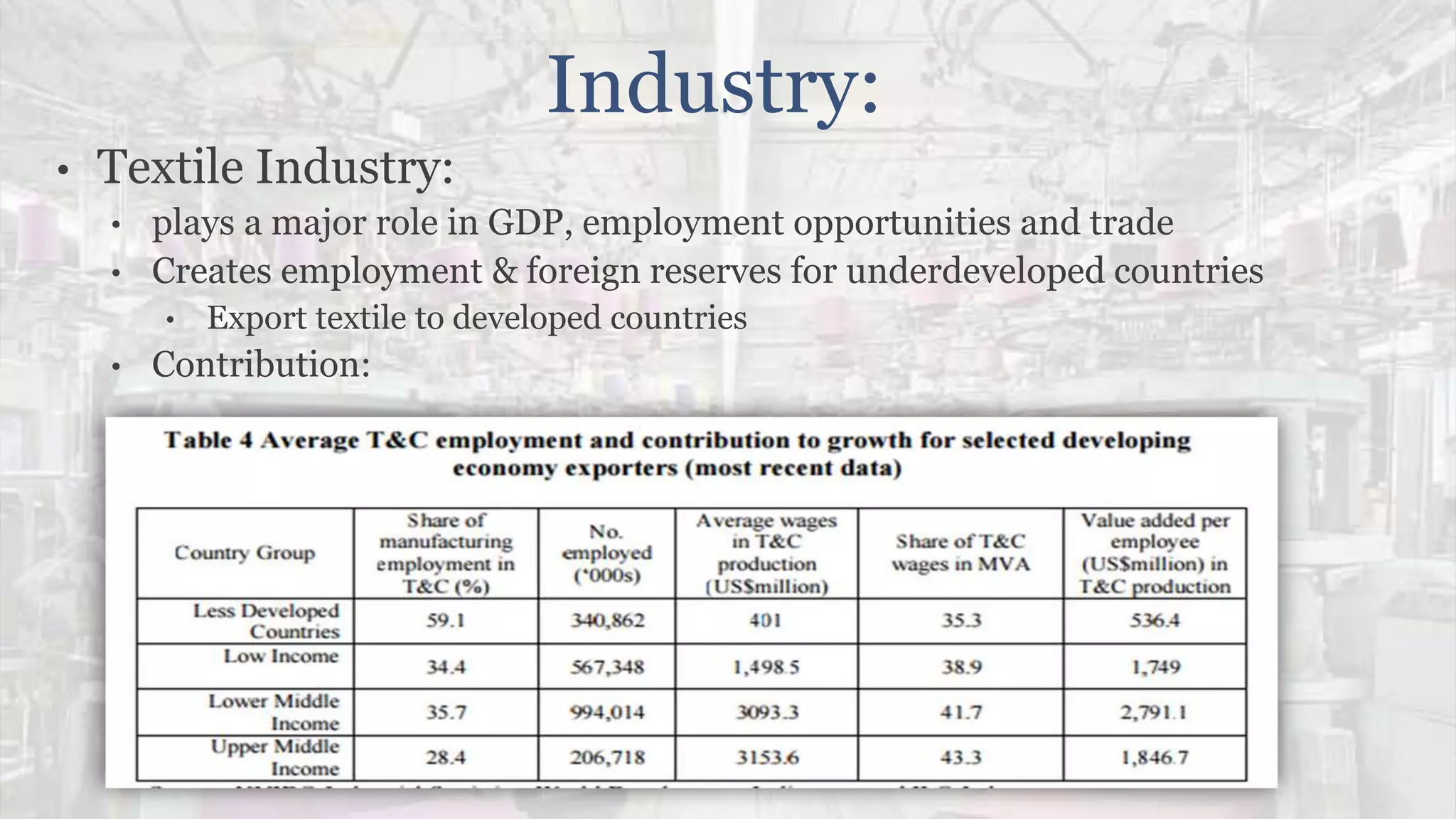
• plays a major role in GDP, employment opportunities and trade
• Creates employment & foreign reserves for underdeveloped countries
• Export textile to developed countries
• Contribution:
• Encourages knowledge sharing between countries
• Countries develop can supply chain
• Poor countries e.g. Bangladesh can compete on low prices
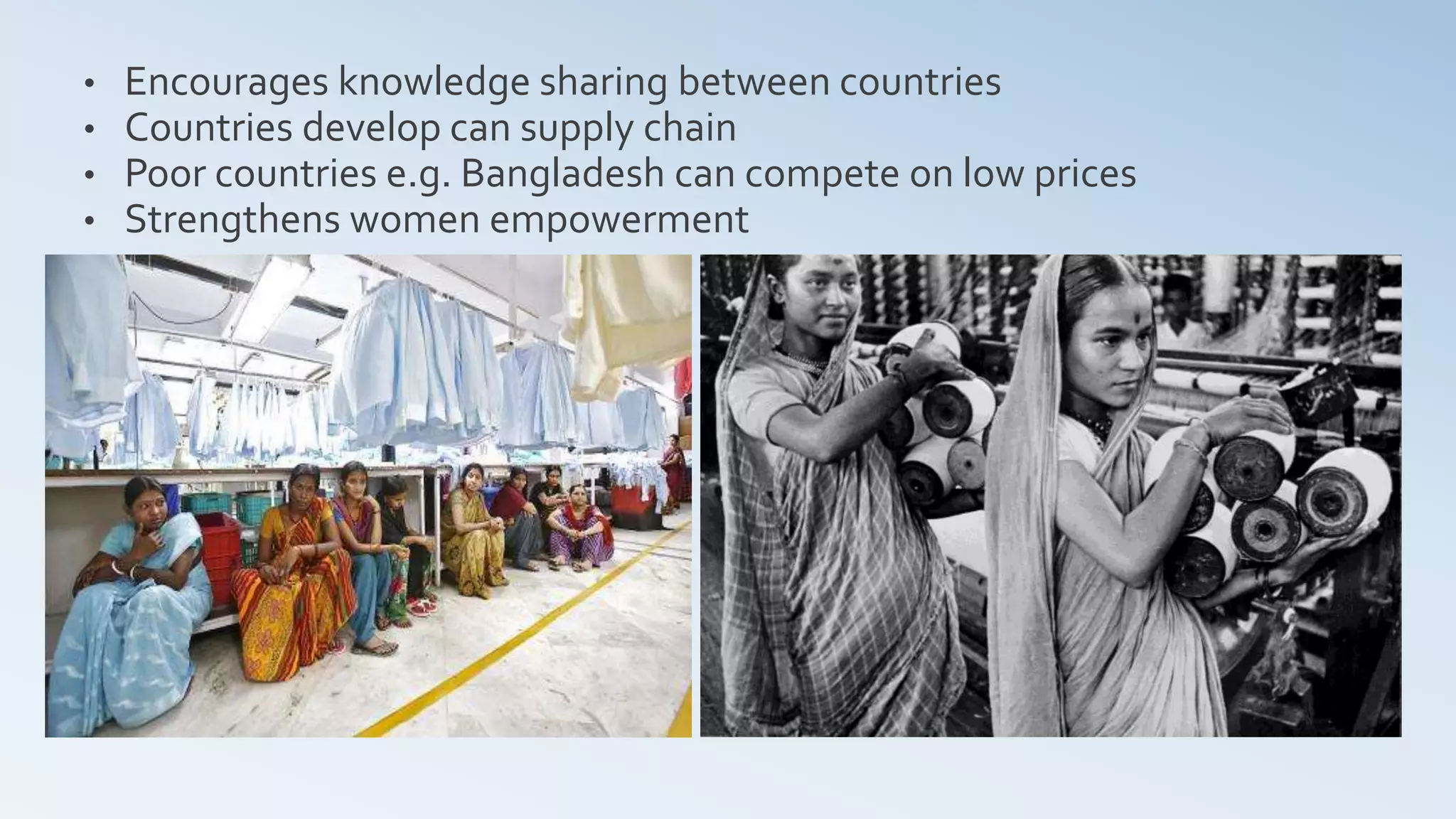
• Strengthens women empowerment
Features of textiles:
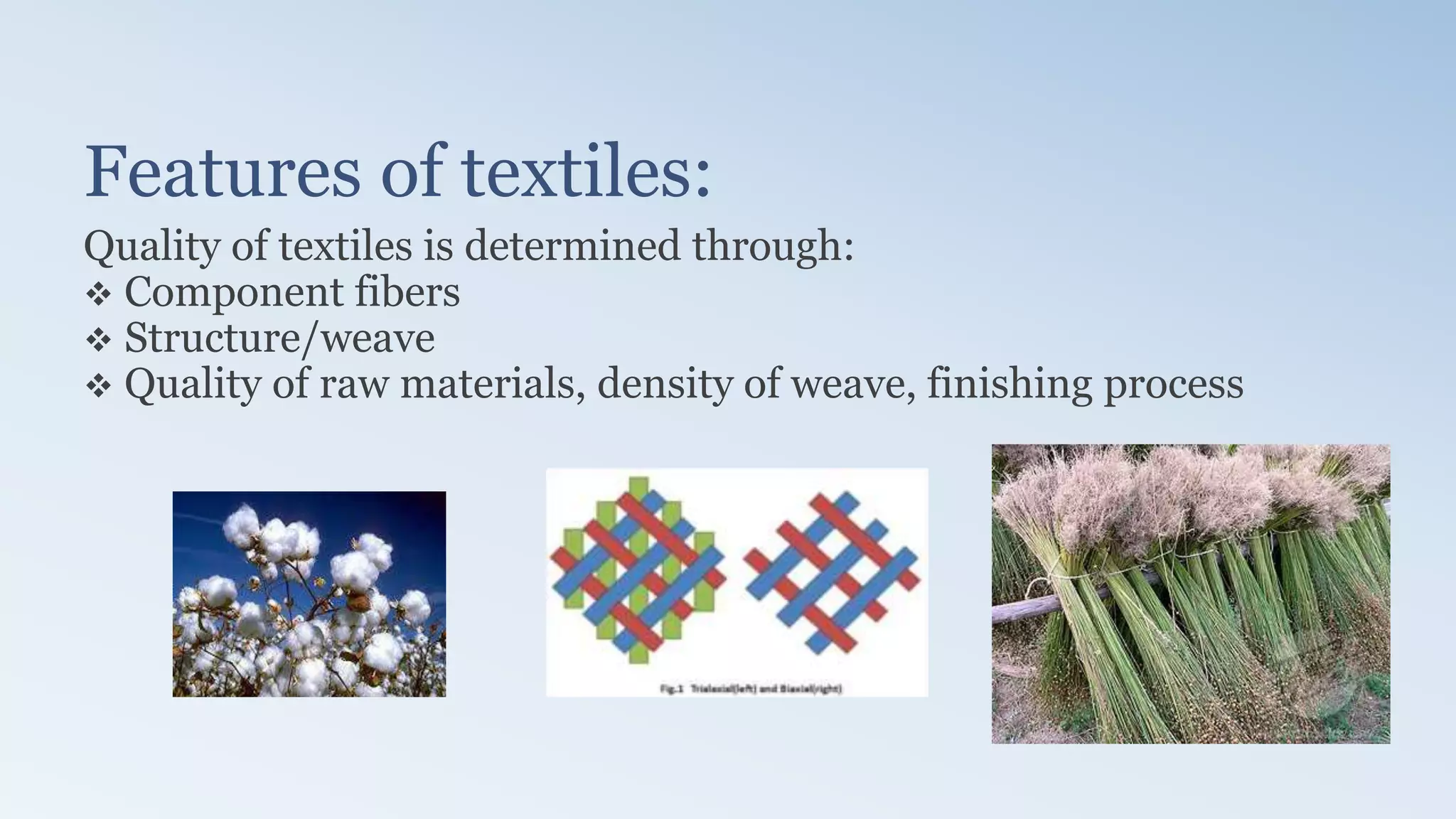
Quality of textiles is determined through:
 Component fibers
 Structure/weave
 Quality of raw materials, density of weave, finishing process
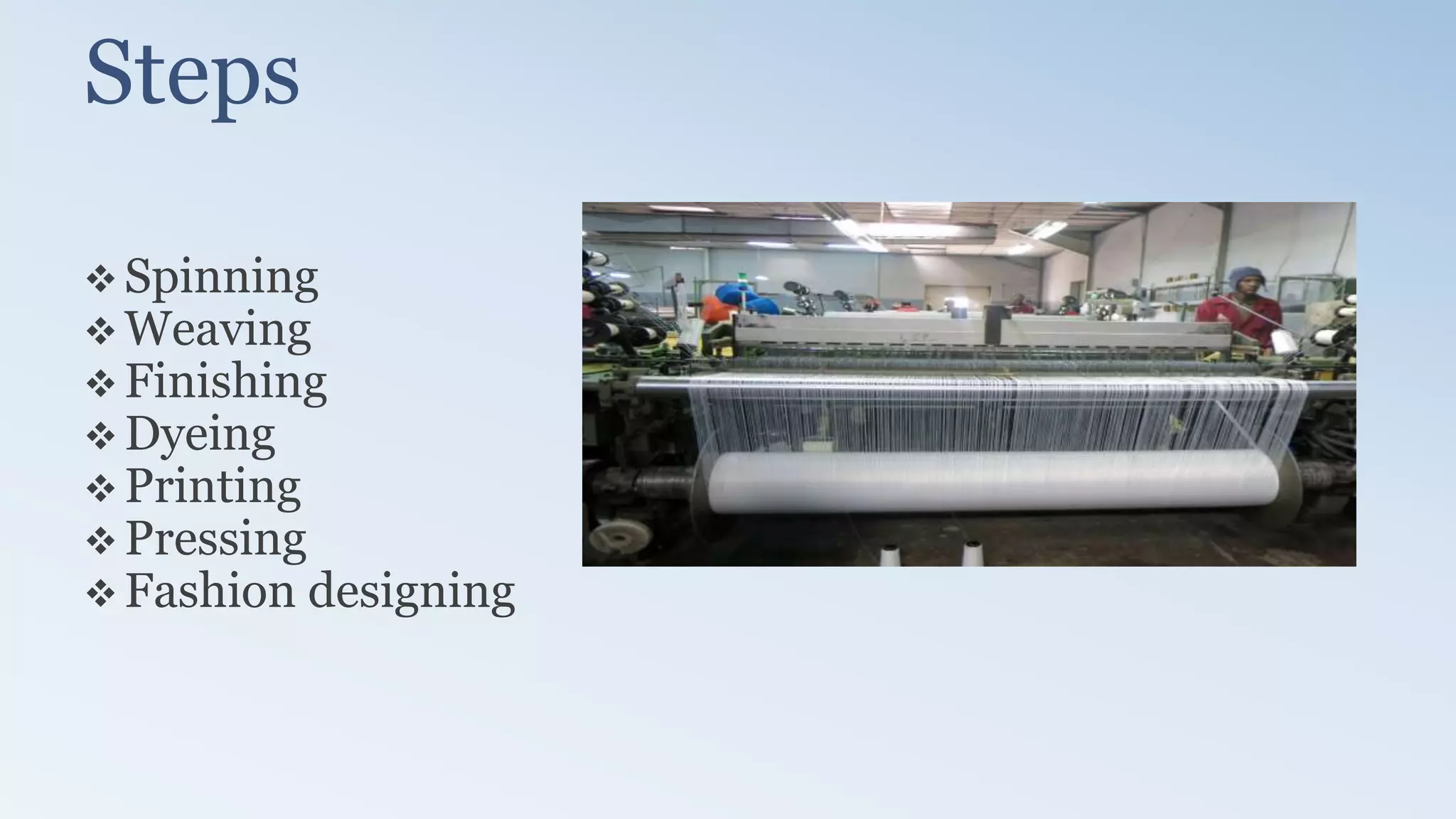
Steps
 Spinning
 Weaving
 Finishing
 Dyeing
 Printing
 Pressing
 Fashion designing
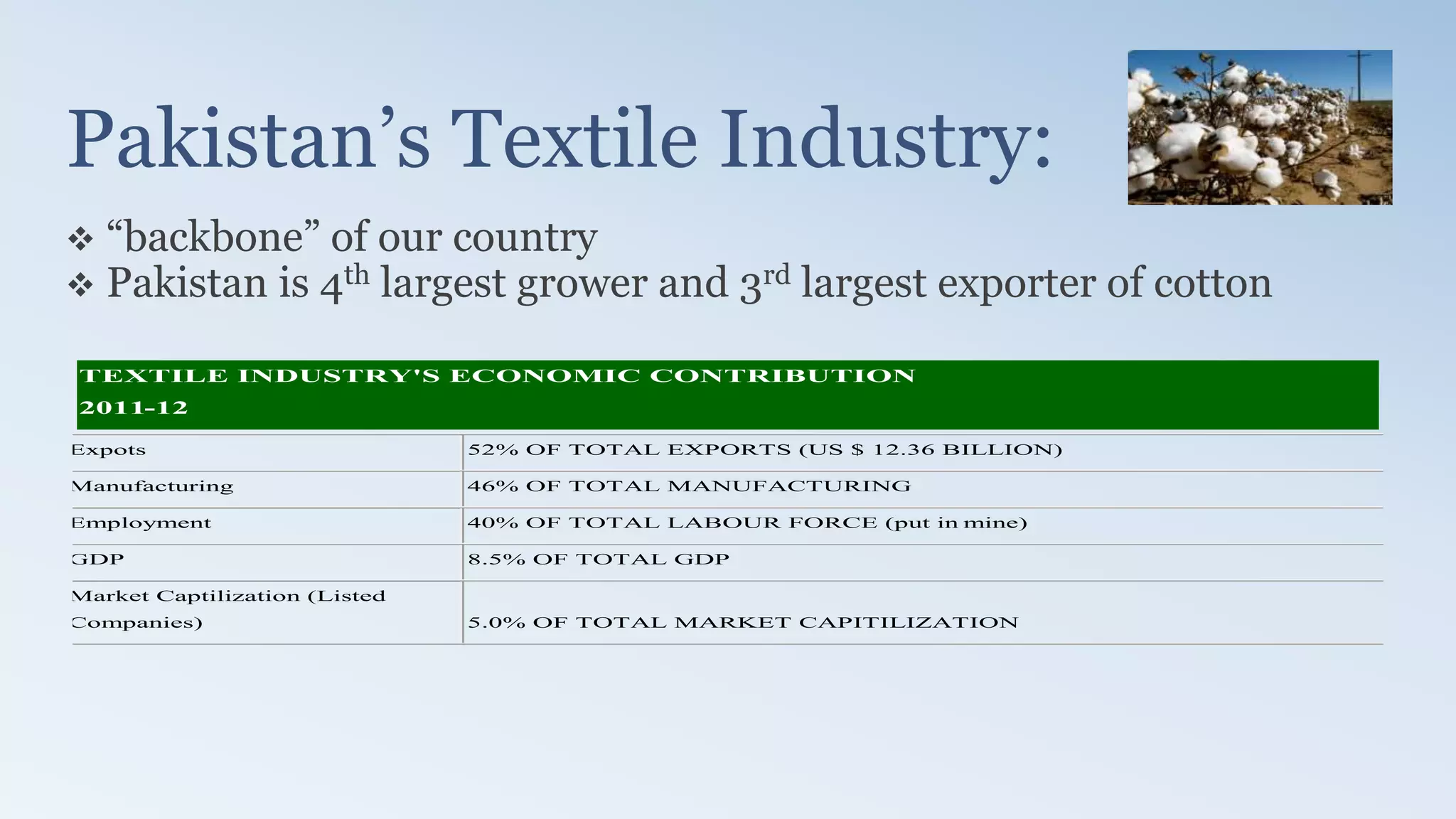
Pakistan’s Textile Industry:
 “backbone” of our country
 Pakistan is 4th largest grower and 3rd largest exporter of cotton
TEXTILE INDUSTRY'S ECONOMIC CONTRIBUTION
2011-12
Expots 52% OF TOTAL EXPORTS (US $ 12.36 BILLION)
Manufacturing 46% OF TOTAL MANUFACTURING
Employment 40% OF TOTAL LABOUR FORCE (put in mine)
GDP 8.5% OF TOTAL GDP
Market Captilization (Listed
Companies) 5.0% OF TOTAL MARKET CAPITILIZATION
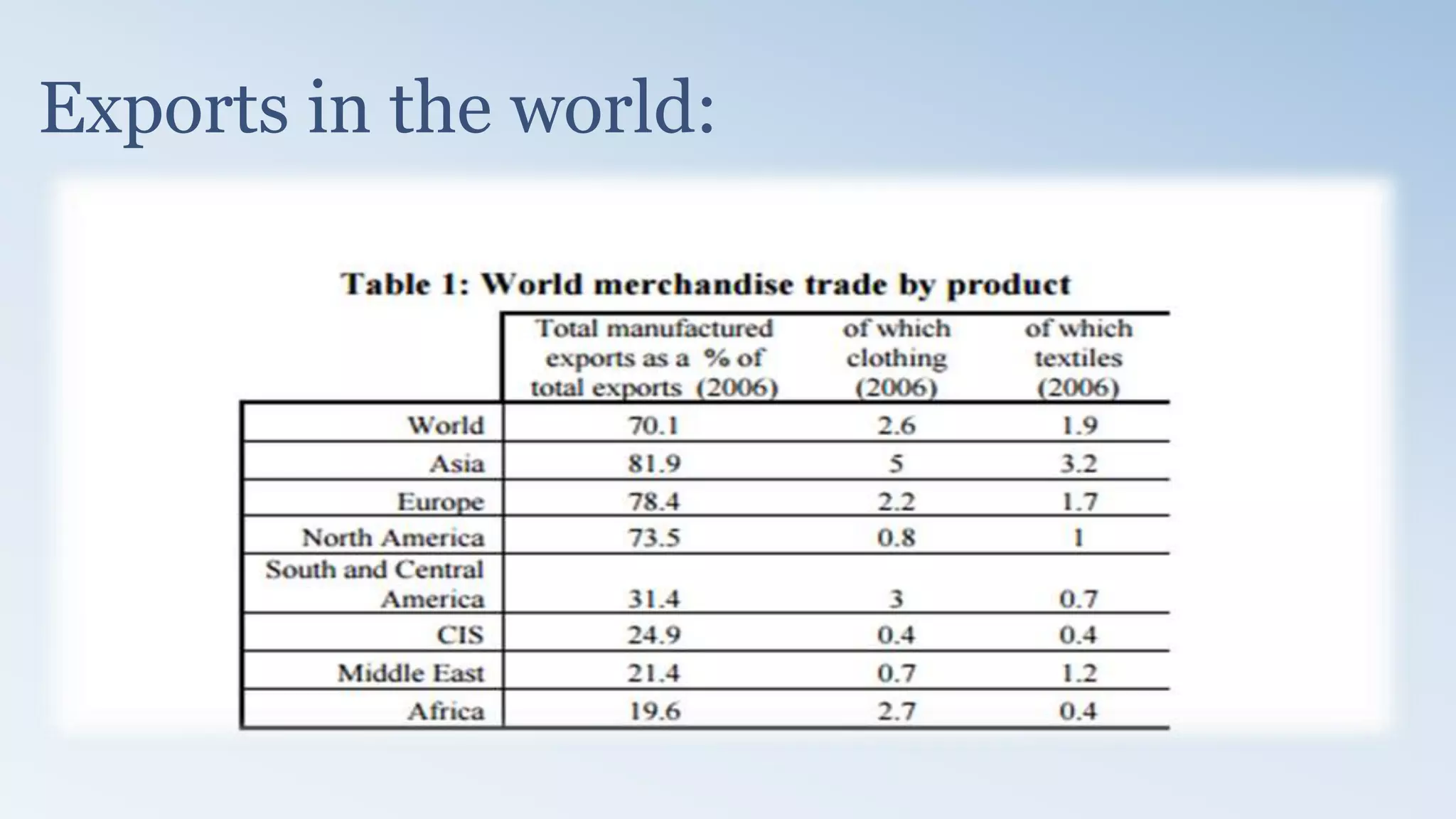
Exports in the world:
T&C Industry:
Vision
“To become a leading country in the field of export of value-added textile
products”.
Mission
“To develop and implement a textiles policy which ensures consistency,
predictability and transparency in Government actions and programs, while
building the reputation of the country as a reliable source of high quality
textile goods”.
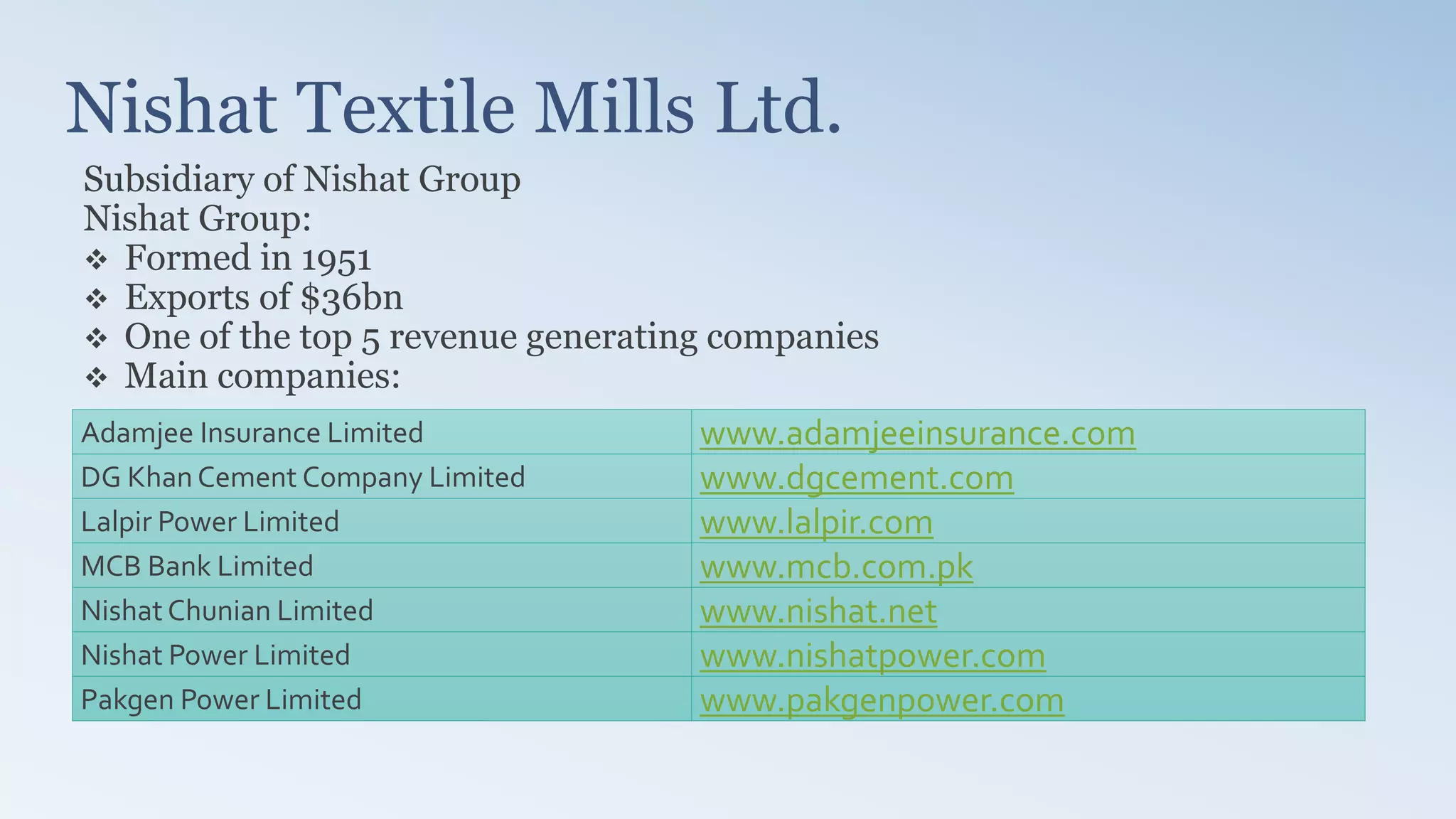
Nishat Textile Mills Ltd.
Subsidiary of Nishat Group
Nishat Group:
 Formed in 1951
 Exports of $36bn
 One of the top 5 revenue generating companies
 Main companies:
Adamjee Insurance Limited www.adamjeeinsurance.com
DG Khan Cement Company Limited www.dgcement.com
Lalpir Power Limited www.lalpir.com
MCB Bank Limited www.mcb.com.pk
Nishat Chunian Limited www.nishat.net
Nishat Power Limited www.nishatpower.com
Pakgen Power Limited www.pakgenpower.com
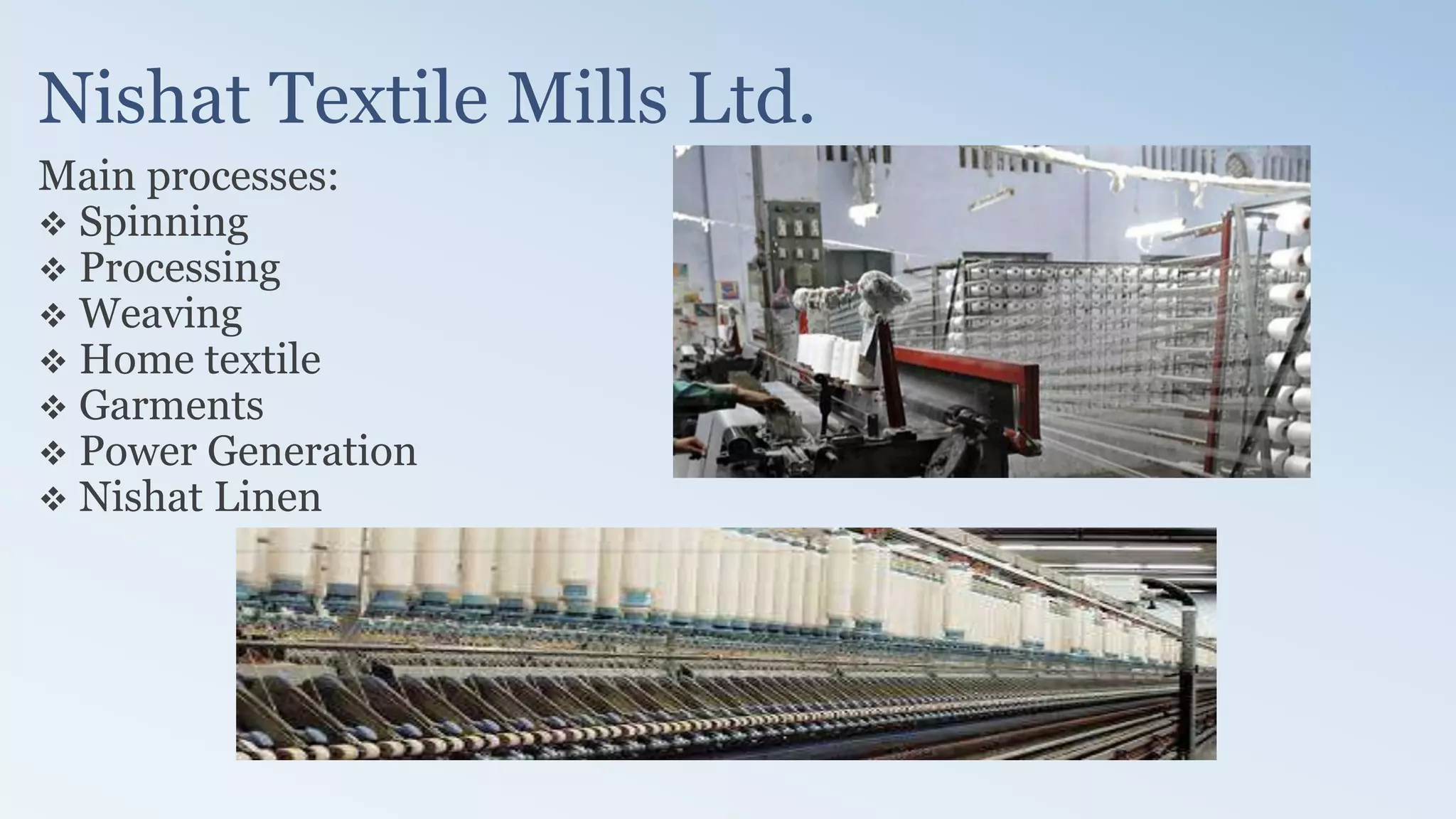
Nishat Textile Mills Ltd.
Main processes:
 Spinning
 Processing
 Weaving
 Home textile
 Garments
 Power Generation
 Nishat Linen
Nishat Linen:
Mission:
“To provide quality products to customers and explore new markets to
promote/expand sales of the Company through good governance and foster a
sound and dynamic team, so as to achieve optimum prices of products of the
Company for sustainable and equitable growth and prosperity of the Company”.
Vision:
“To transform the Company into a modern and dynamic yarn, cloth and
processed cloth and finished product manufacturing Company that is fully
equipped to play a meaningful role on sustainable basis in the economy of
Pakistan. To transform the Company into a modern and dynamic power
generating Company that is fully equipped to play a meaningful role on
sustainable basis in the economy of Pakistan”.
Nishat Textile has two major sub-divisions:
 Nishat Chunian
 Nishat Faisalabad
FDI:
Dubai:
 Similar culture and religion
 Lesser rules and regulations
 World’s leading center for textile automation
 150 clothing manufacturing companies present
 4th largest center for trade and apparel
 5.5% of world’s total textile sales
Global Market Players:
• China
• Japan
• South Korea
Local competitors:
• Crescent
• Chenab
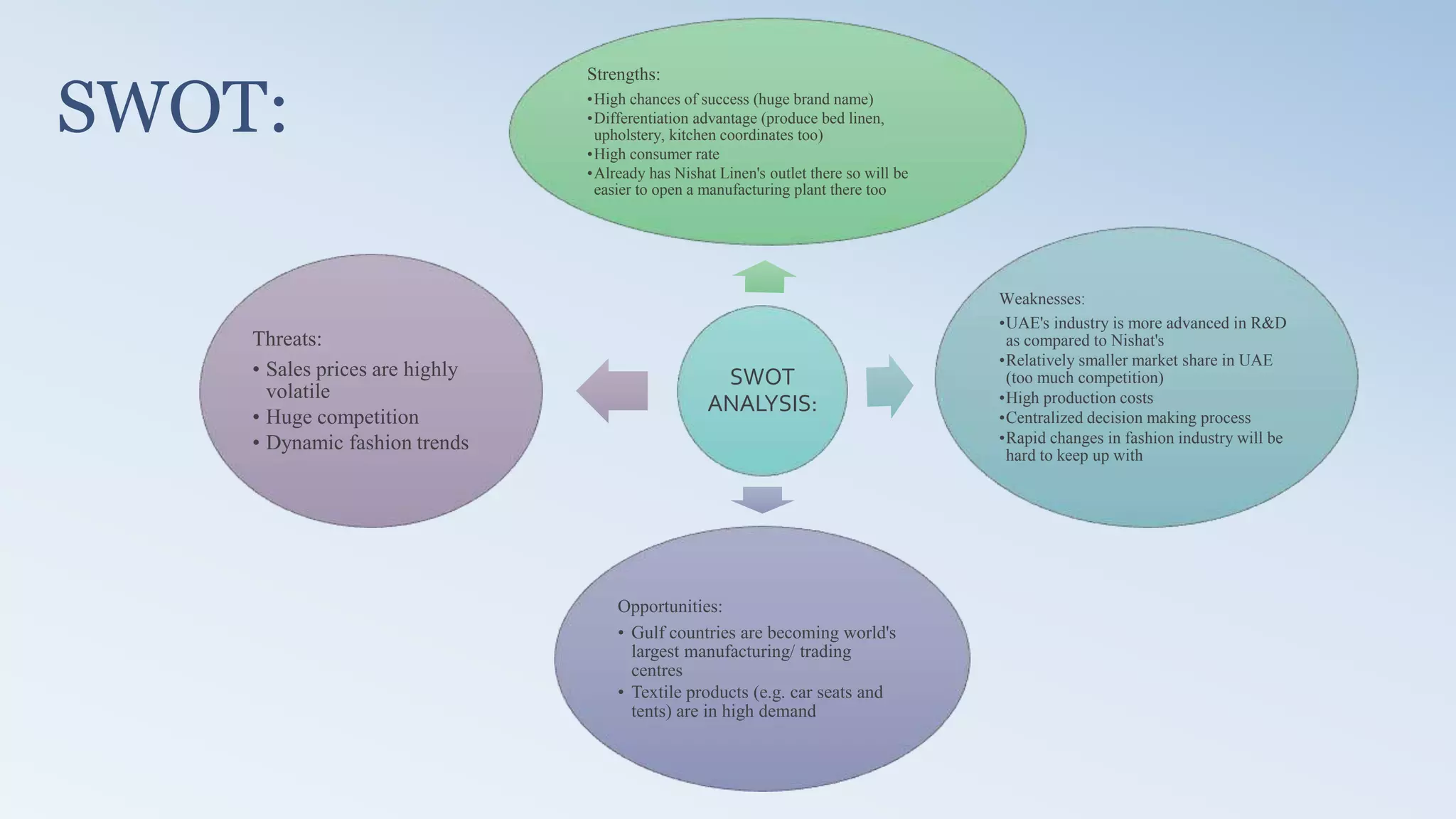
SWOT:
SWOT
ANALYSIS:
Strengths:
•High chances of success (huge brand name)
•Differentiation advantage (produce bed linen,
upholstery, kitchen coordinates too)
•High consumer rate
•Already has Nishat Linen's outlet there so will be
easier to open a manufacturing plant there too
Weaknesses:
•UAE's industry is more advanced in R&D
as compared to Nishat's
•Relatively smaller market share in UAE
(too much competition)
•High production costs
•Centralized decision making process
•Rapid changes in fashion industry will be
hard to keep up with
Opportunities:
• Gulf countries are becoming world's
largest manufacturing/ trading
centres
• Textile products (e.g. car seats and
tents) are in high demand
Threats:
• Sales prices are highly
volatile
• Huge competition
• Dynamic fashion trends
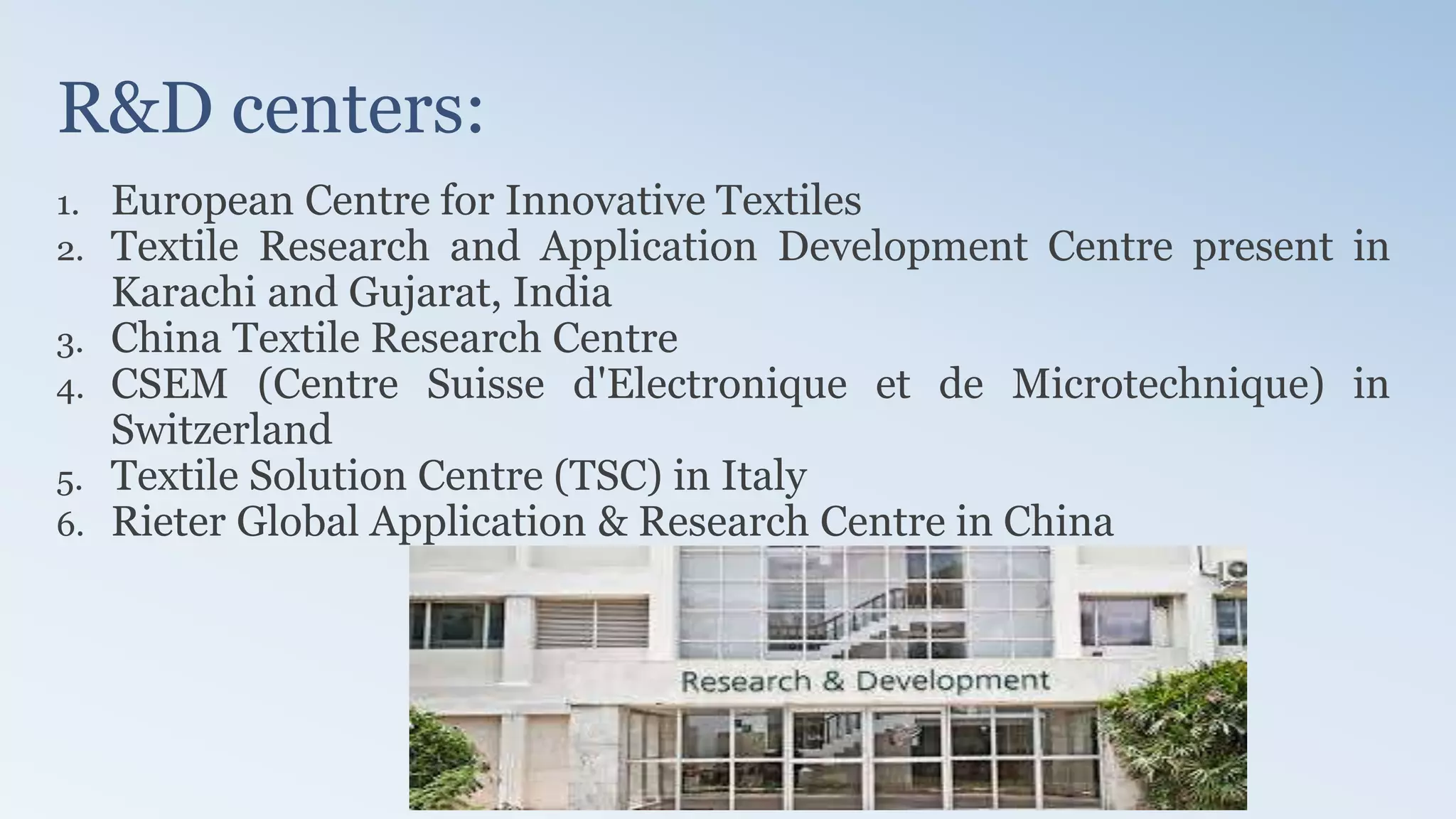
R&D centers:
1. European Centre for Innovative Textiles
2. Textile Research and Application Development Centre present in
Karachi and Gujarat, India
3. China Textile Research Centre
4. CSEM (Centre Suisse d'Electronique et de Microtechnique) in
Switzerland
5. Textile Solution Centre (TSC) in Italy
6. Rieter Global Application & Research Centre in China
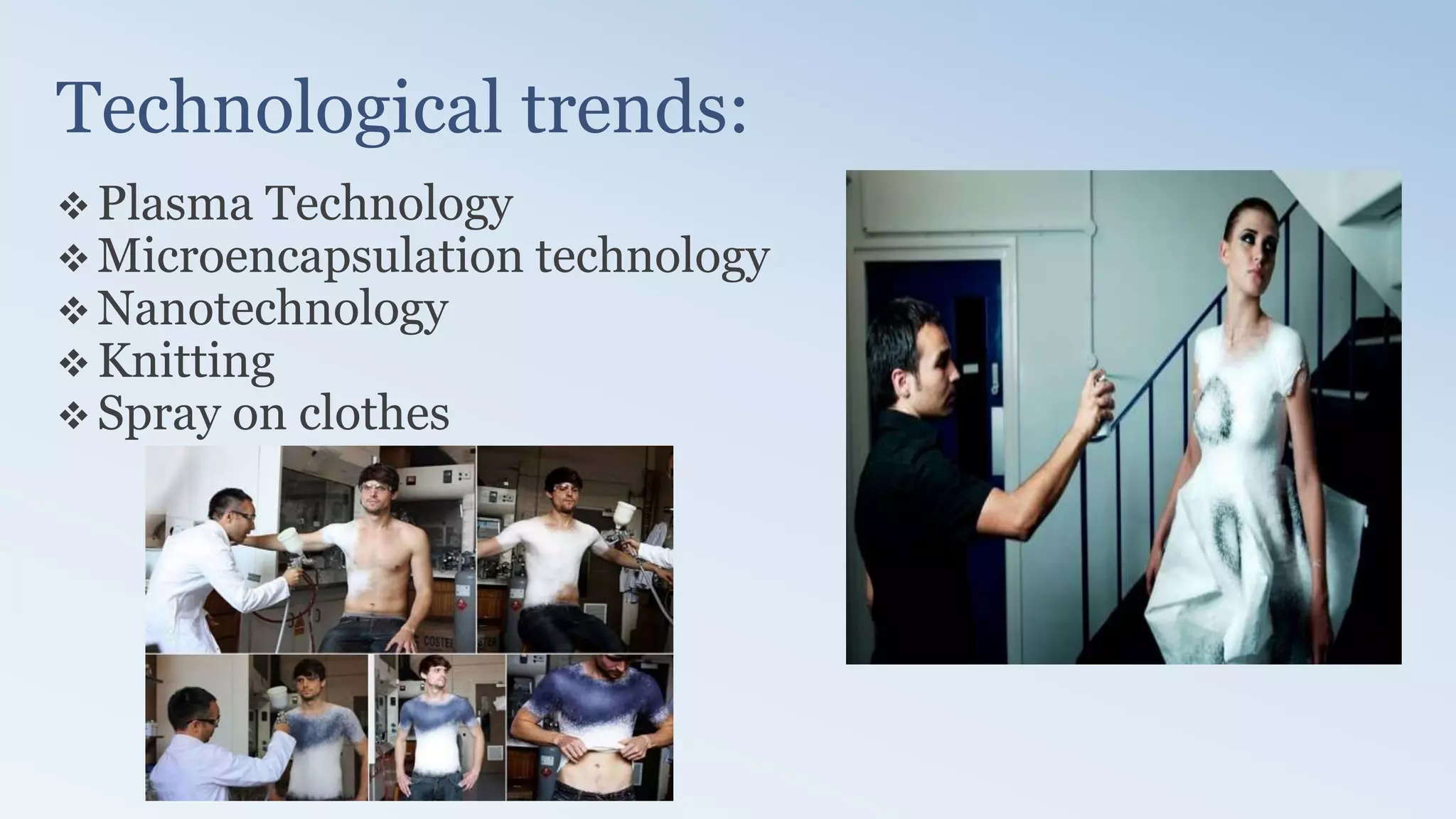
Technological trends:
 Plasma Technology
 Microencapsulation technology
 Nanotechnology
 Knitting
 Spray on clothes
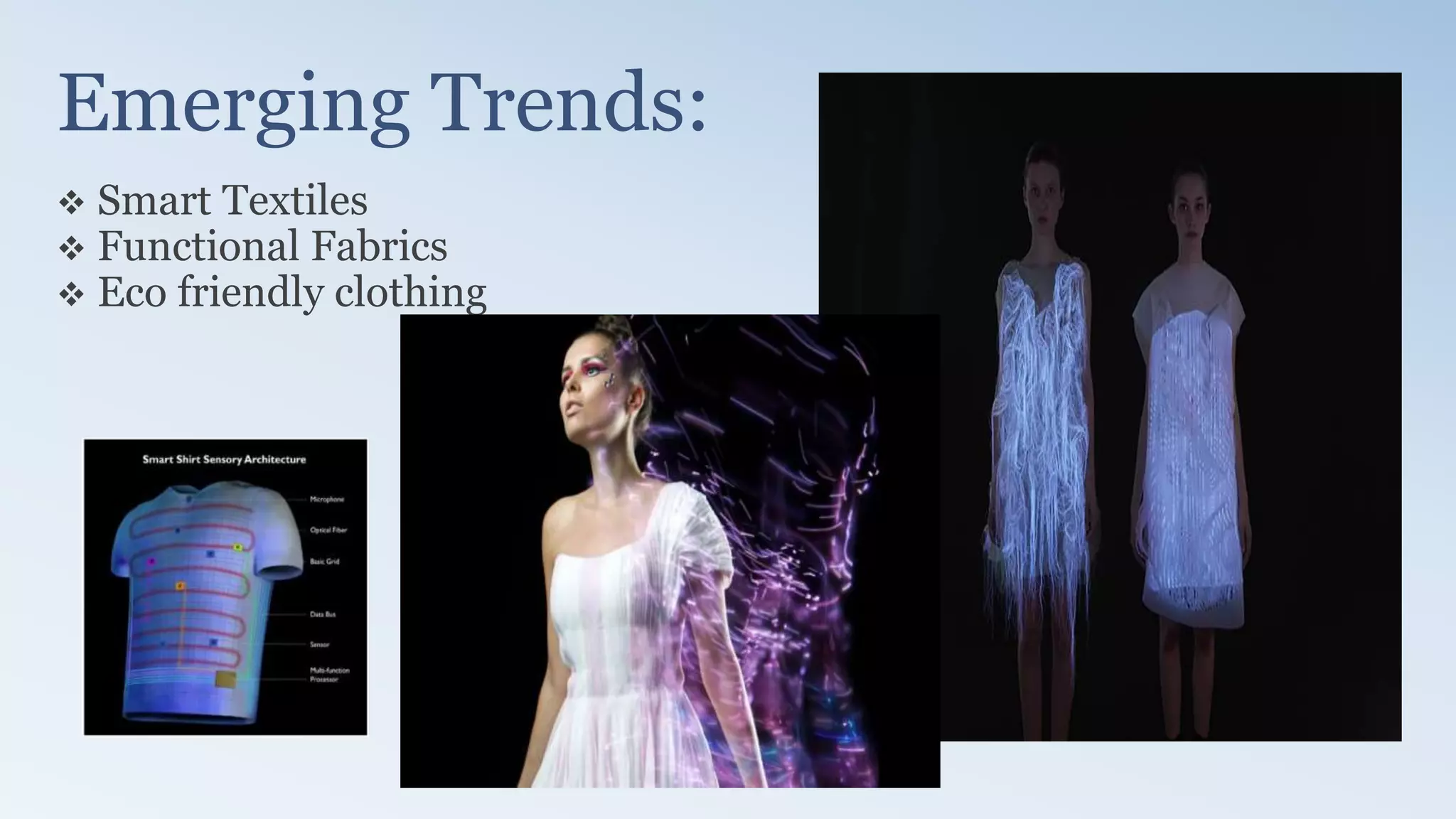
Emerging Trends:
 Smart Textiles
 Functional Fabrics
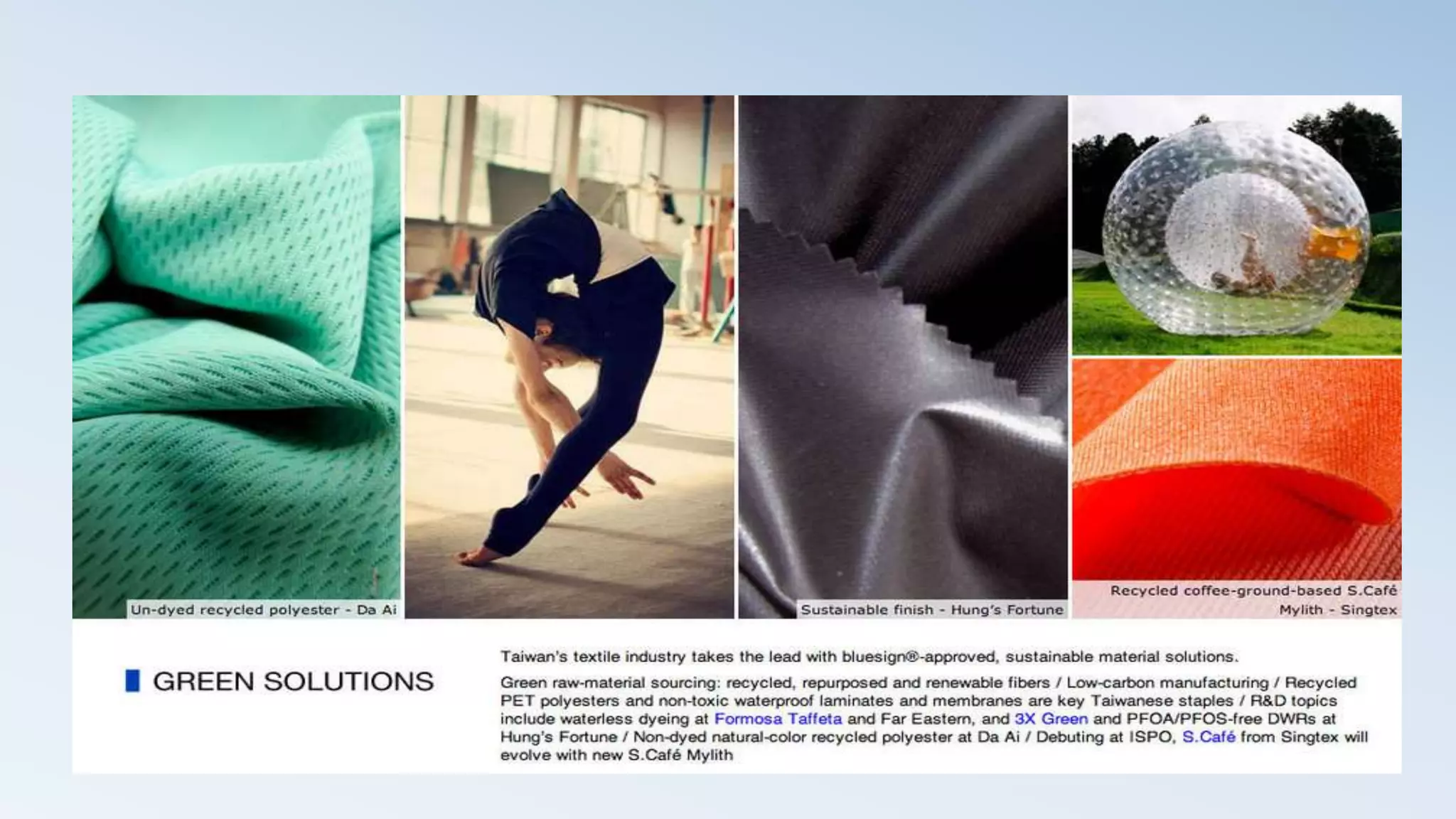
 Eco friendly clothing
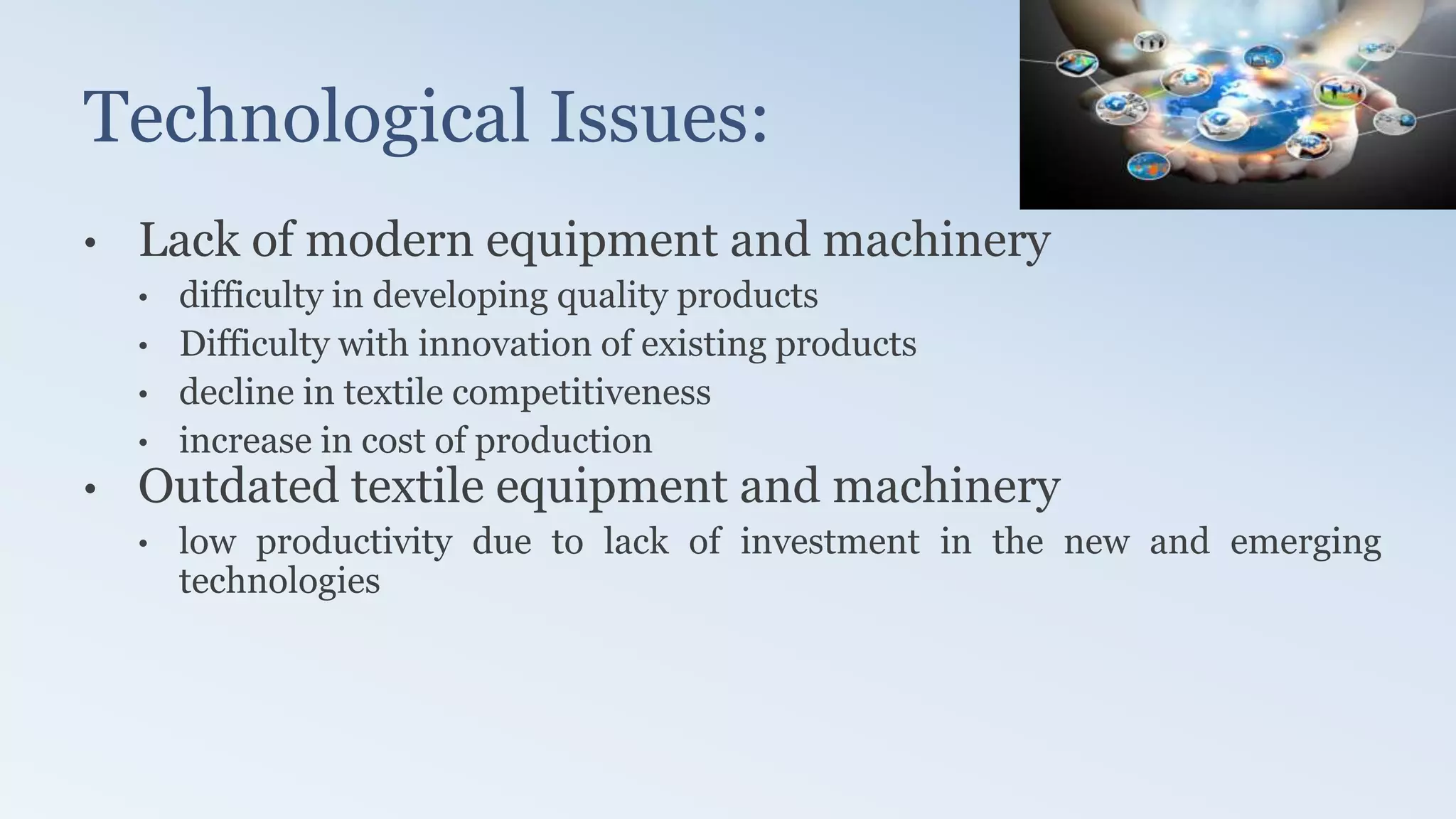
Technological Issues:
• Lack of modern equipment and machinery
• difficulty in developing quality products
• Difficulty with innovation of existing products
• decline in textile competitiveness
• increase in cost of production
• Outdated textile equipment and machinery
• low productivity due to lack of investment in the new and emerging
technologies
Global Demand Centers:
1. USA imports $2.98 billion worth of textiles from Pakistan hence
becoming the largest global demand center
2. China imports $1.527 billion worth of textiles from Pakistan and these
imports include only cotton yarn and fabric. China is the second
largest global demand center
3. UK imports $951 million worth of textile and clothing from Pakistan
4. Germany imports $809 million worth of textile and clothing from
Pakistan
5. Bangladesh imports $520 million of Pakistan textiles
6. India is the 19th largest importer of Pakistani Textiles worth $88.8
million
7. Other top importers hence demand centers include Belgium, Spain,
Italy, Netherlands, UAE, France, Turkey, South Africa, Vietnam,
Korea, Saudi Arabia, Sri Lanka, India and Kenya.
Policies:
• No trade barriers
• Tax incentives
• Safety and security for investors
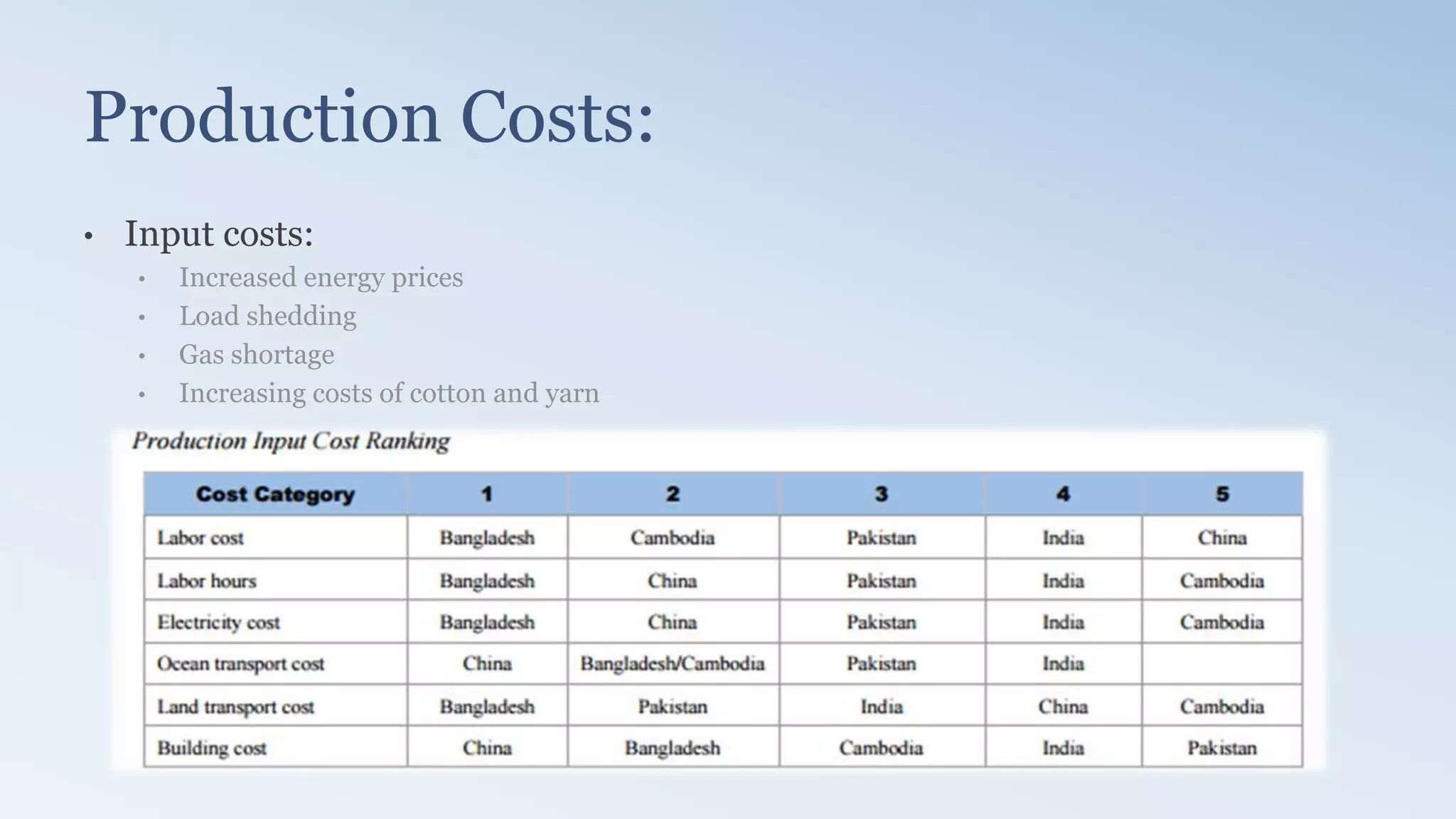
Production Costs:
• Input costs:
• Increased energy prices
• Load shedding
• Gas shortage
• Increasing costs of cotton and yarn
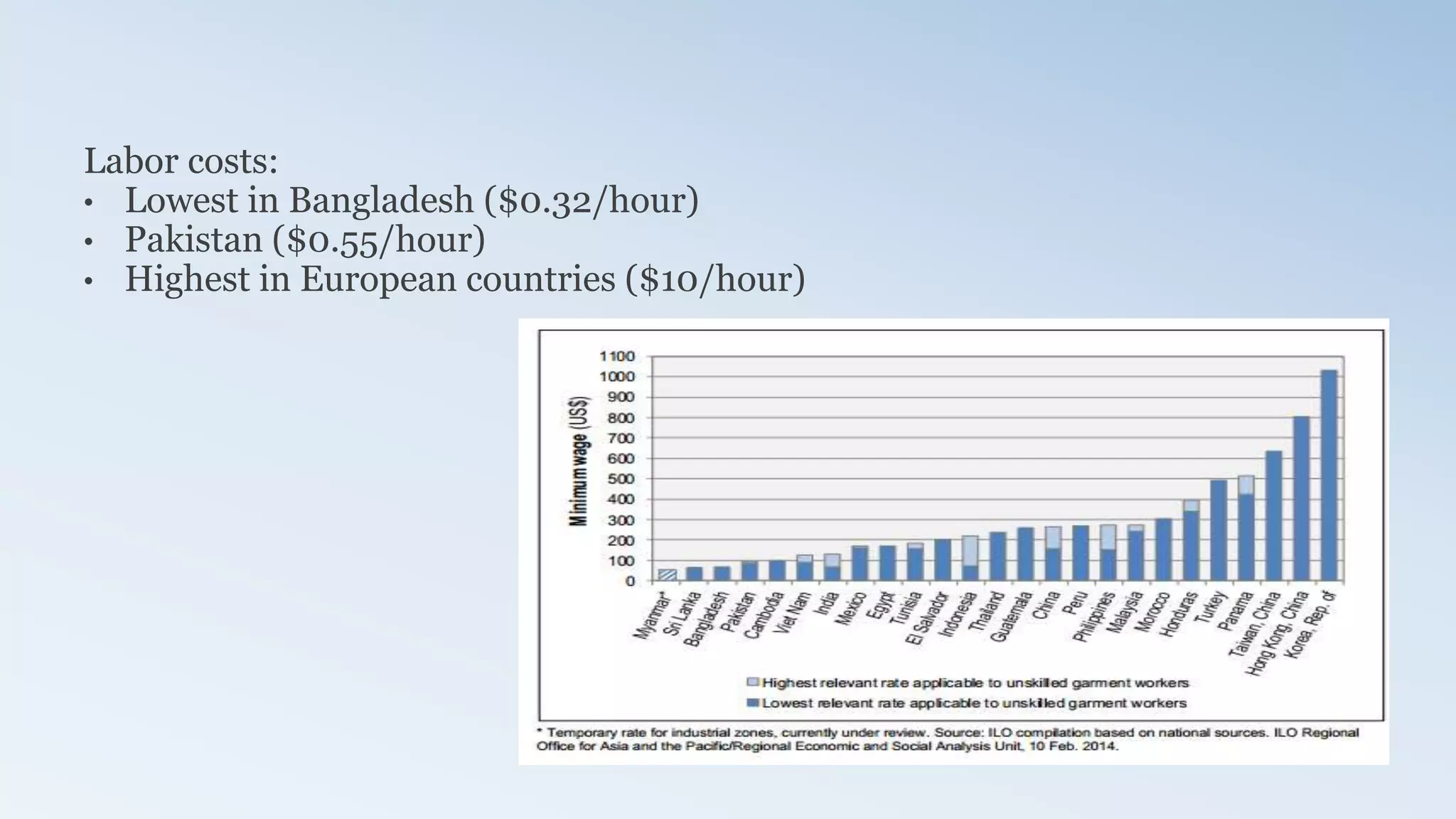
Labor costs:
• Lowest in Bangladesh ($0.32/hour)
• Pakistan ($0.55/hour)
• Highest in European countries ($10/hour)
Taxes:
• In Pakistan, a value-added tax of 15% and a corporate profit tax of
33%
• In China the VAT is 7%, while the corporate profit tax is 25%
• In India VAT and corporate tax is 12.5% and 33.66% respectively.
• Bangladesh applies a VAT of 15% and a corporate tax of 37.5%
• Cambodia has a VAT of 10 % and 20% corporate or 1% of sales
whichever is higher.
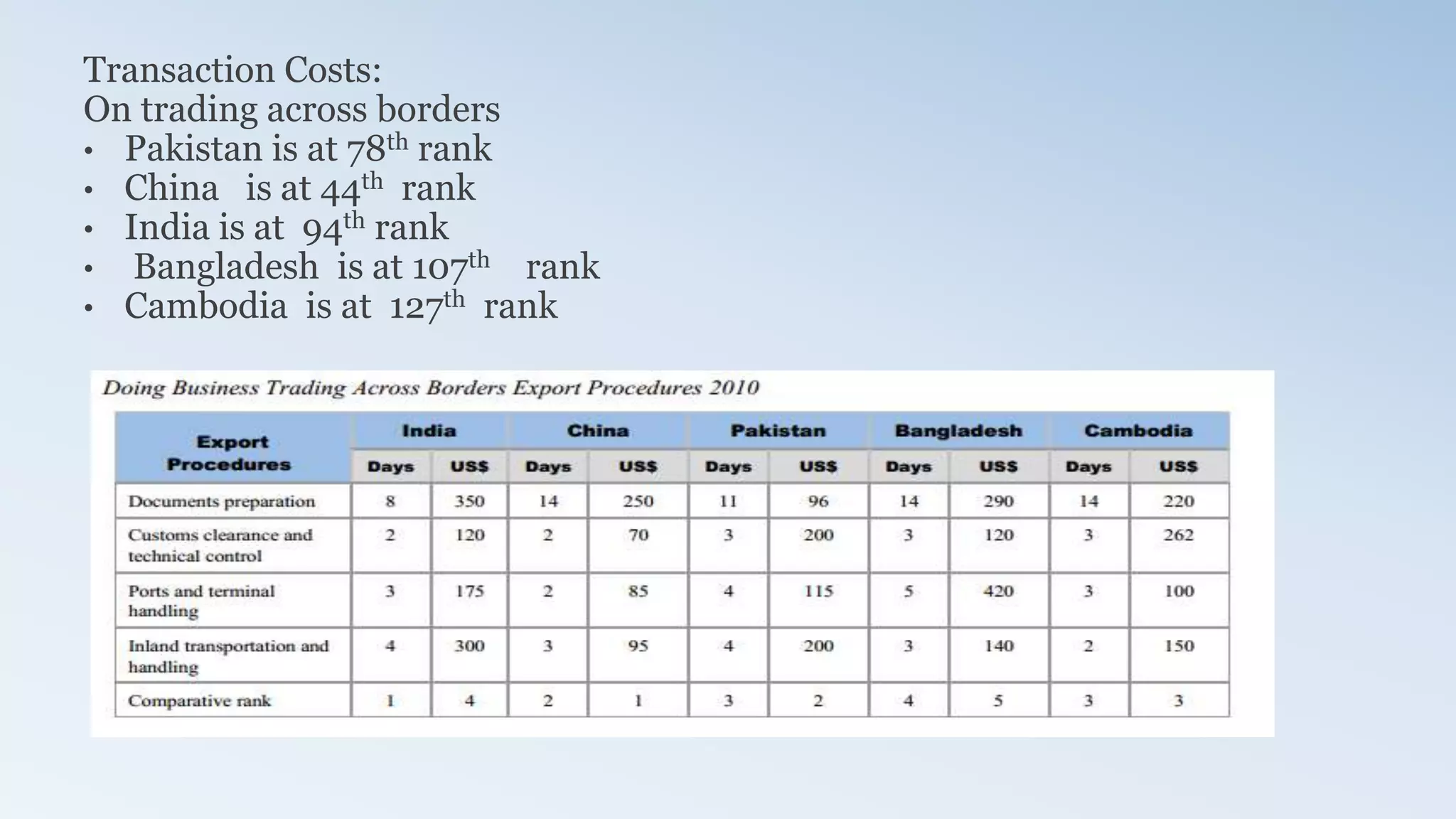
Transaction Costs:
On trading across borders
• Pakistan is at 78th rank
• China is at 44th rank
• India is at 94th rank
• Bangladesh is at 107th rank
• Cambodia is at 127th rank
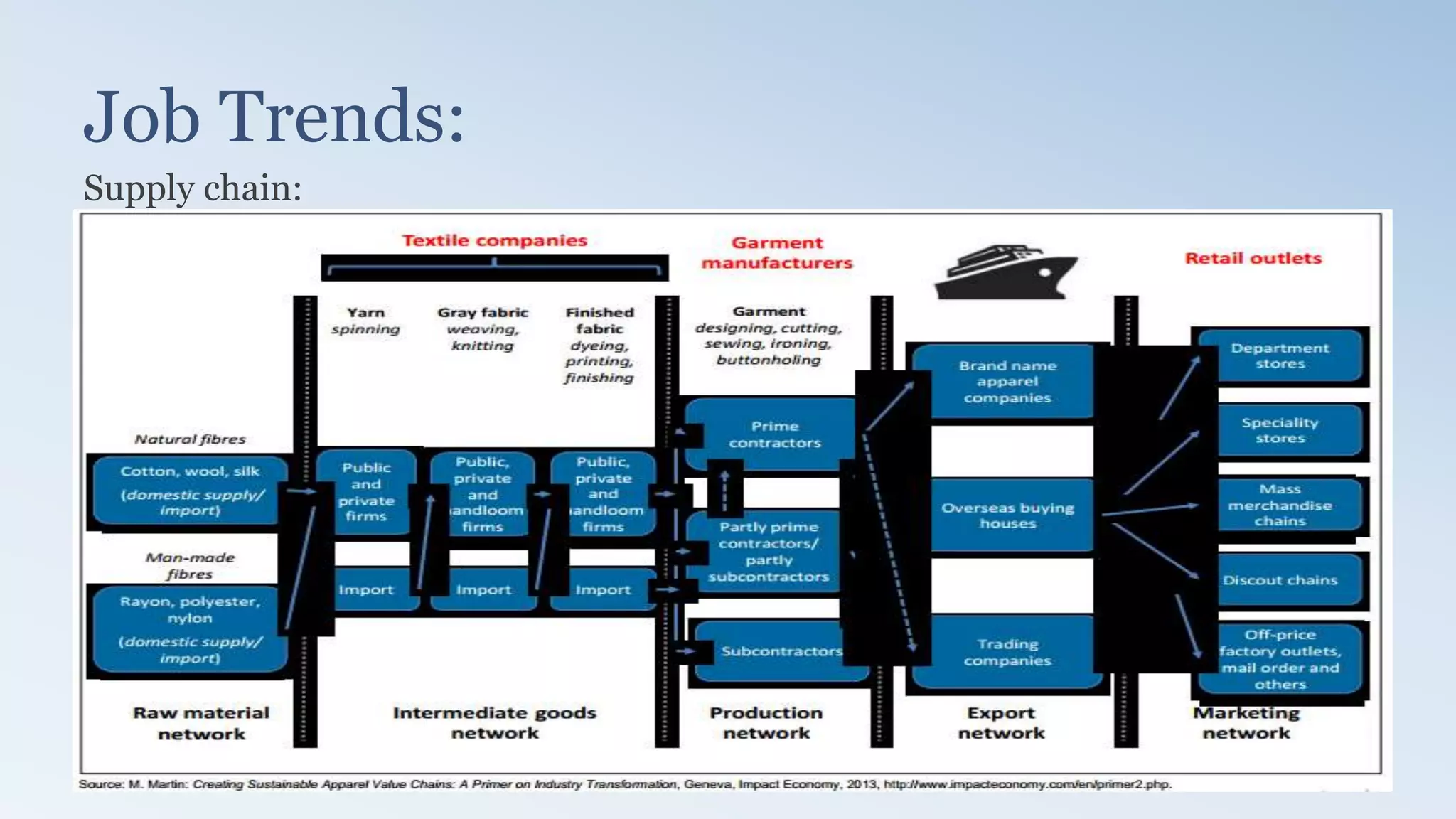
Job Trends:
Supply chain:
Labor Force Characteristics:
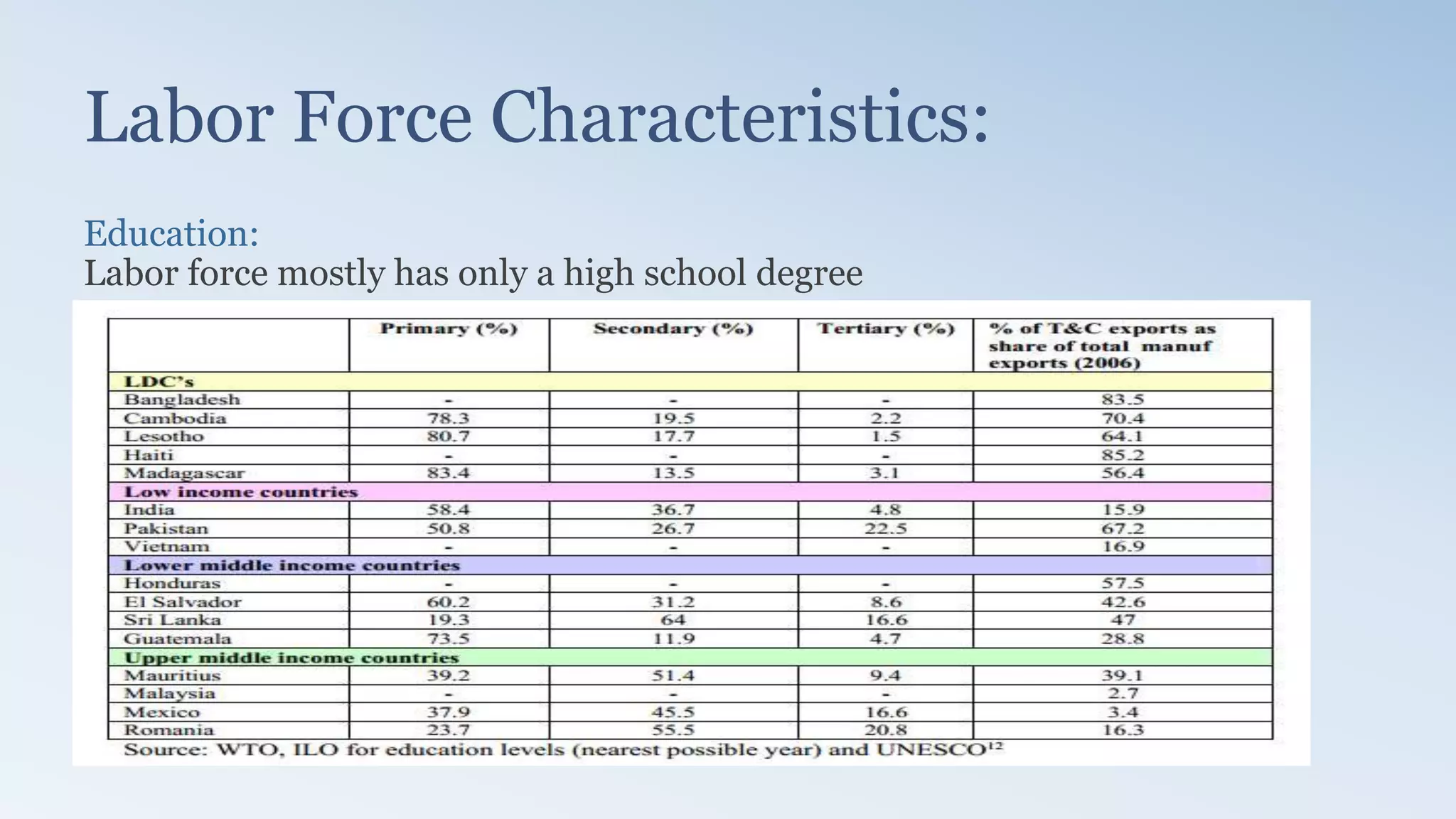
Education:
Labor force mostly has only a high school degree
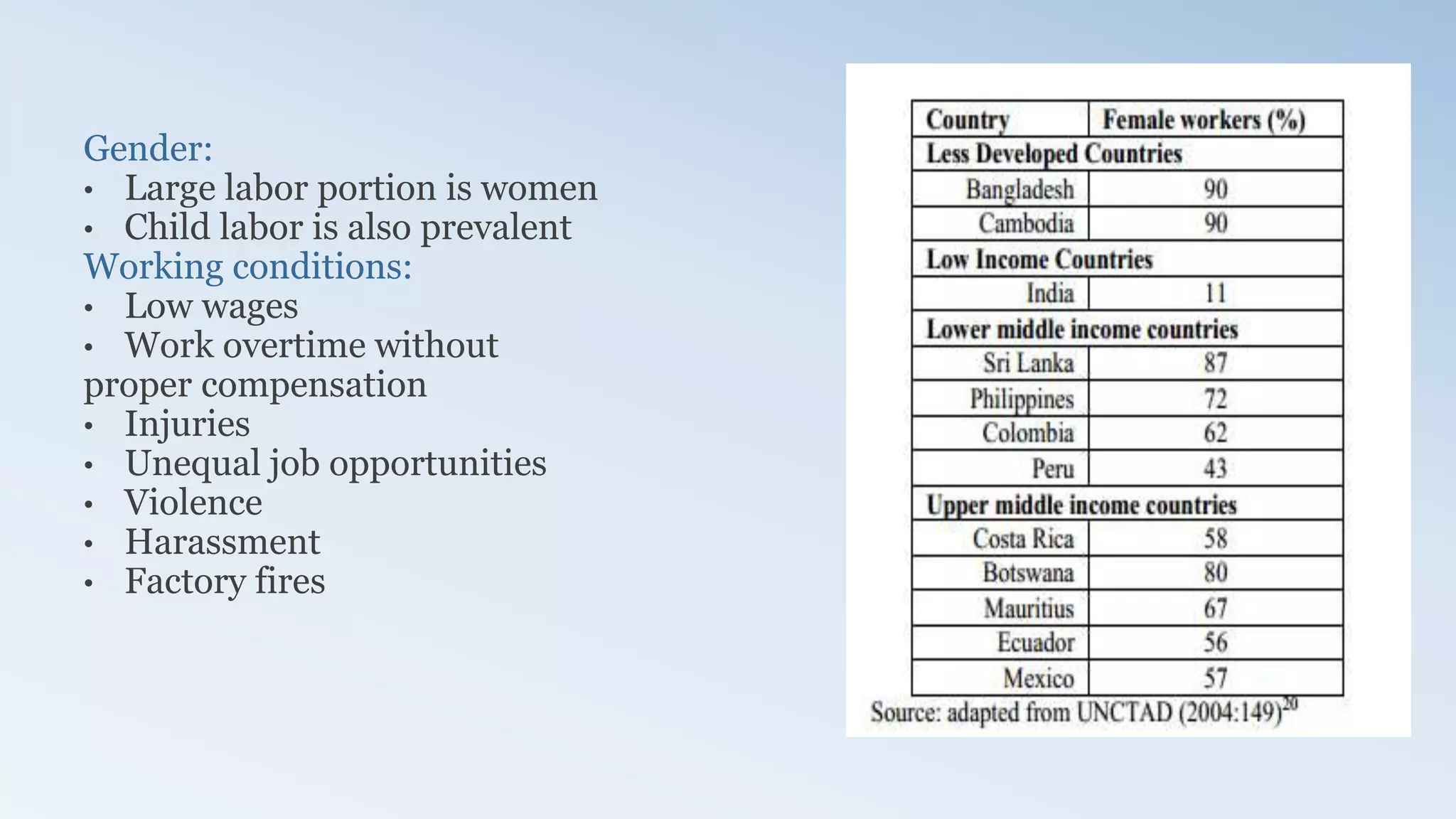
Gender:
• Large labor portion is women
• Child labor is also prevalent
Working conditions:
• Low wages
• Work overtime without
proper compensation
• Injuries
• Unequal job opportunities
• Violence
• Harassment
• Factory fires
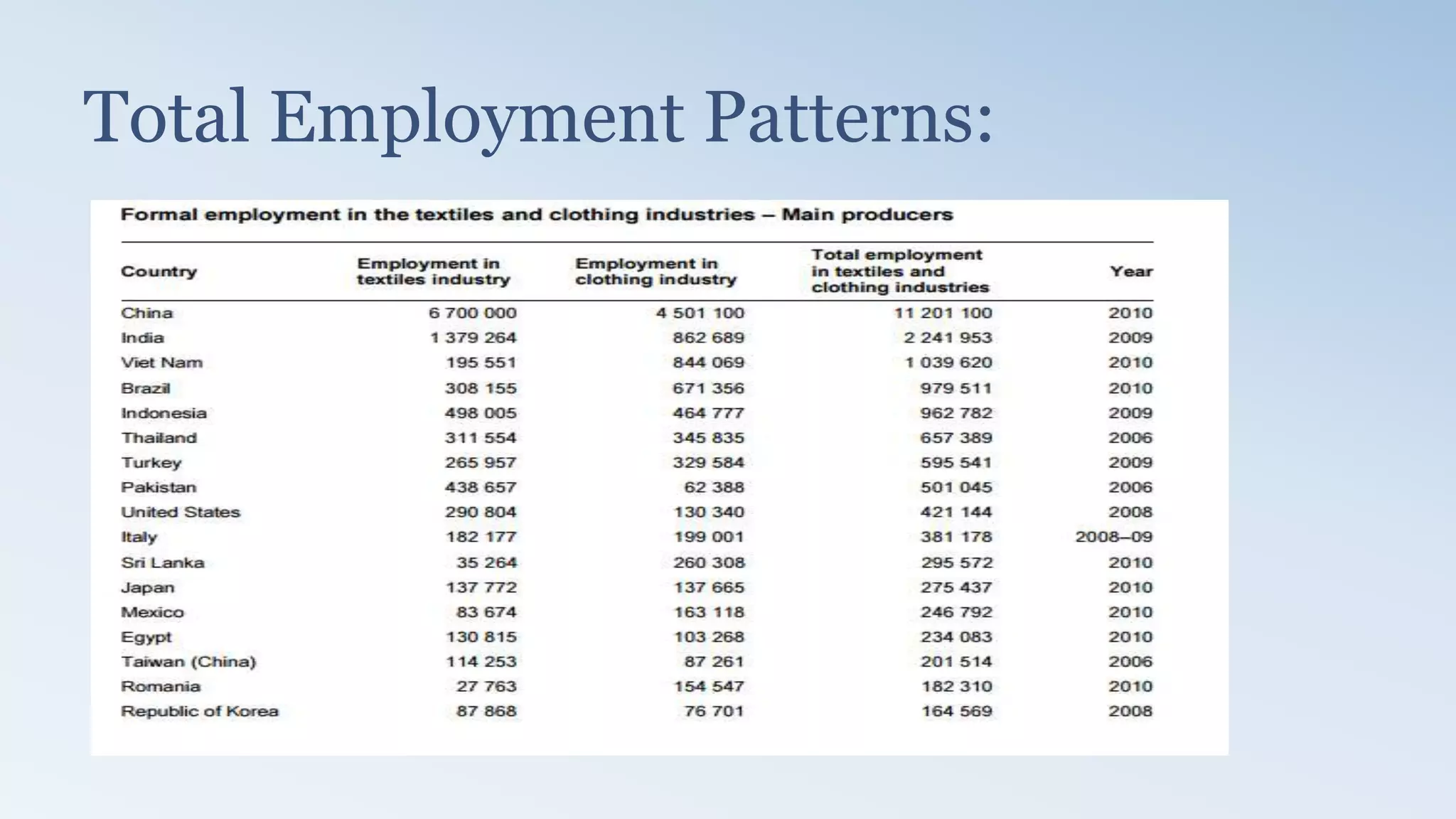
Total Employment Patterns:
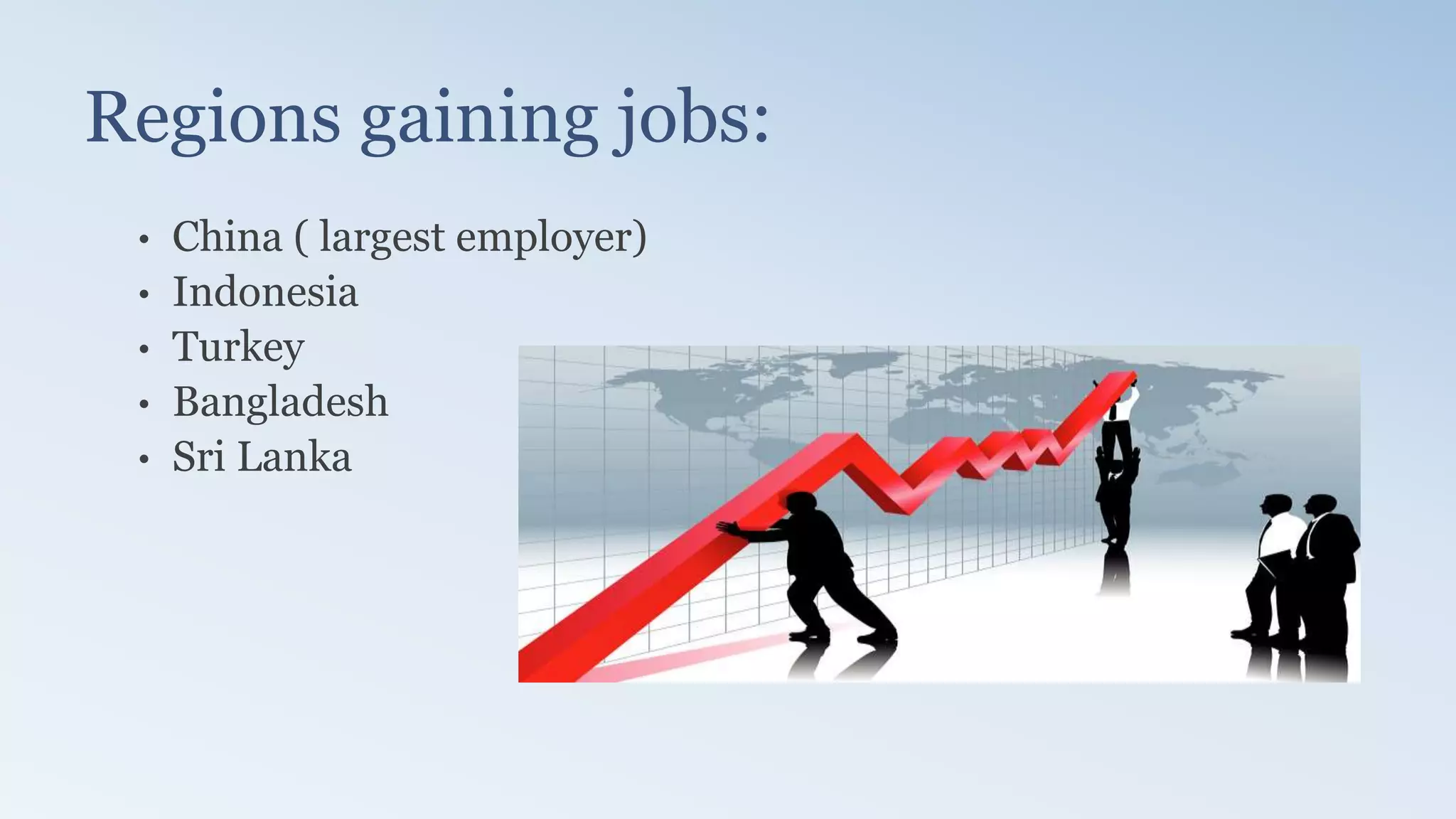
Regions gaining jobs:
• China ( largest employer)
• Indonesia
• Turkey
• Bangladesh
• Sri Lanka
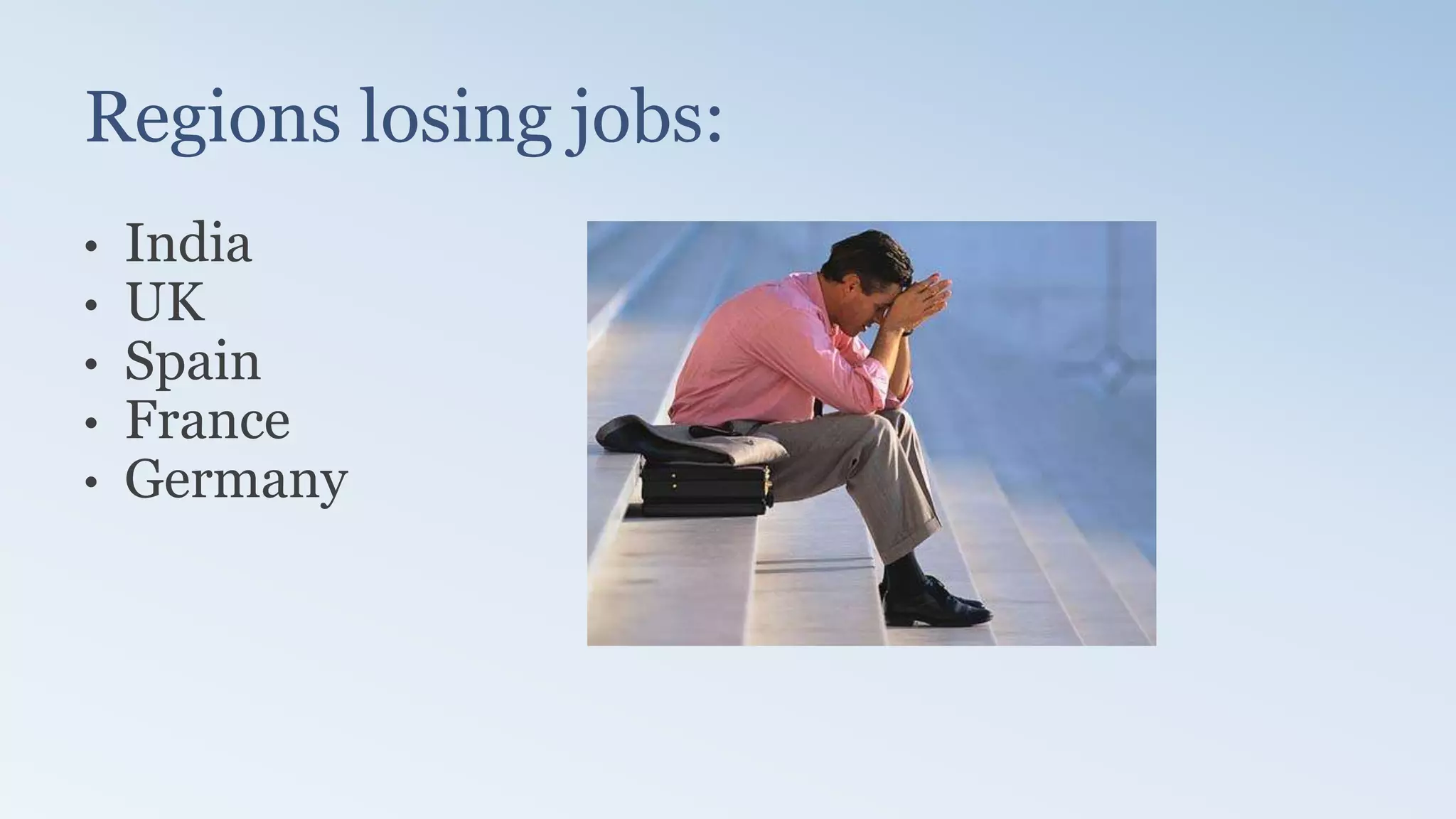
Regions losing jobs:
• India
• UK
• Spain
• France
• Germany
INVESTMENT OPPORTUNITY
ANALYSIS
Barriers:
• The outside investors can only own up to 49% of the company if
they are not in a free zone.
• Intense competition. Around 150 brands are working in UAE.
• UAE ‘s textile industry is highly automated
• High labor costs
Opportunities:
 32 free trade zones which provide 100% foreign ownership, corporate tax holidays, no
personal taxes, freedom to repatriate capital and profits, and no import duties or currency
restrictions.
 corporate tax holidays for most sectors
 no personal taxes
 freedom to repatriate capital and profits
 no currency restrictions
 High standard of living in UAE provides with a large customer base and allows to serve
products at a premium price
 Travel tourism allows to serve to newer segments
Most attractive foreign markets:
Germany:
• fourth largest exporter of textiles and clothing worldwide
• export quota of 42 percent in 2013
• second largest textile importer after the United States
• market share of almost 18%
USA:
• one of the biggest importer of textiles
• skilled workforce along with established plants
• Advanced R&D departments
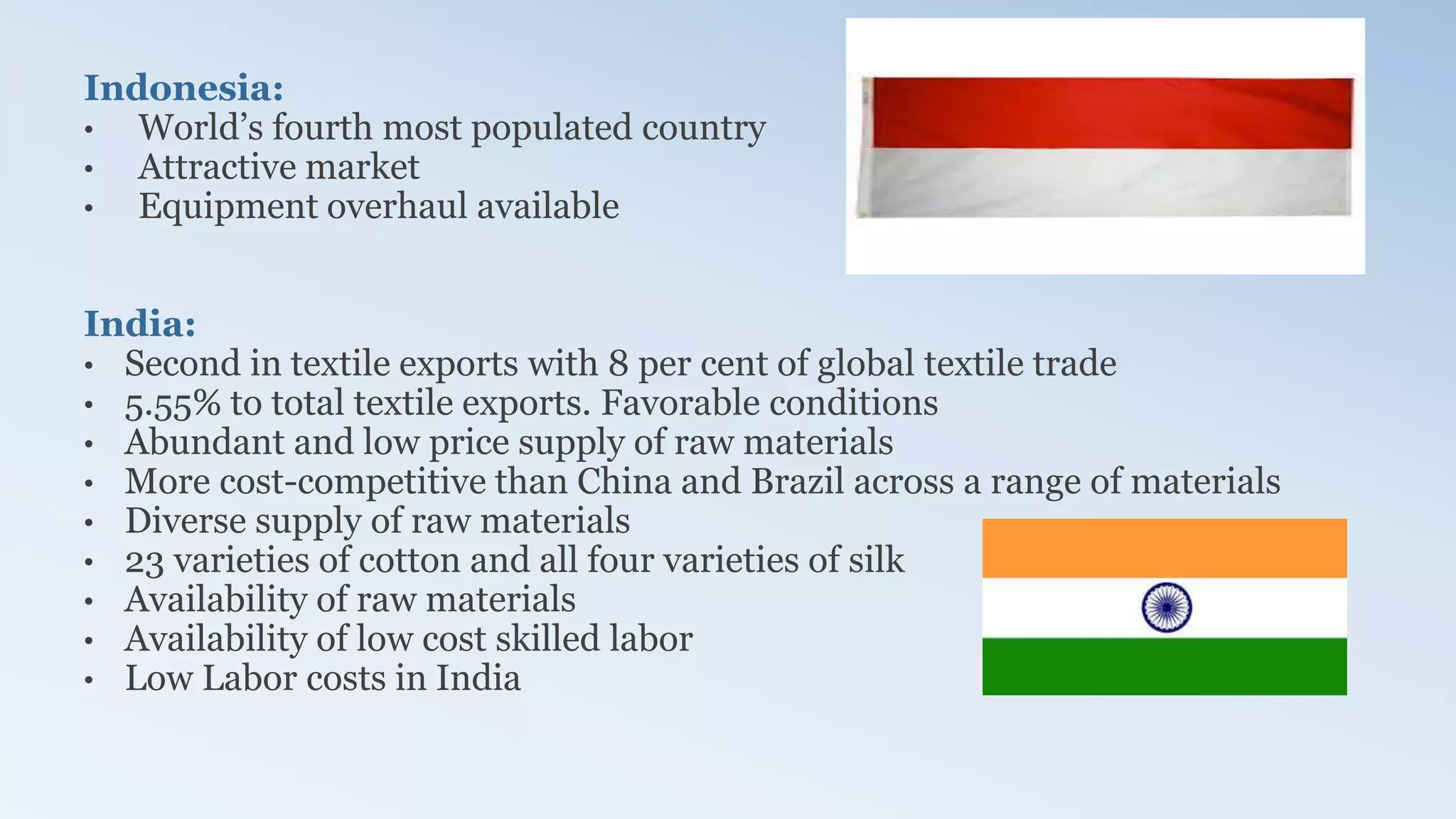
Indonesia:
• World’s fourth most populated country
• Attractive market
• Equipment overhaul available
India:
• Second in textile exports with 8 per cent of global textile trade
• 5.55% to total textile exports. Favorable conditions
• Abundant and low price supply of raw materials
• More cost-competitive than China and Brazil across a range of materials
• Diverse supply of raw materials
• 23 varieties of cotton and all four varieties of silk
• Availability of raw materials
• Availability of low cost skilled labor
• Low Labor costs in India
China:
• Solid industrial foundation
• Cheap cost
• Leads the global textile trade.
• High productivity, competency and experience of labor
• Less cost of labor and quota elimination
• Quality of fabric and garments
• Reliability
• Technology investment (logistics)
• Product diversity in terms of fabric and finished goods
• Availability of abundant raw material and labor
• Workaholic mentality of the management
• Rapidly changing demographics
• Rising incomes which leads to an increase in customer’s spending
Bosnia and Herzegovina:
• Long industrial tradition in the business
• The quality of the products,
• Availability of skilled and price-competitive human capital
• The geographic proximity of the EU market
• Possibility of delivery at lower prices
• Easier and safer transportation
• Flexibility of production
• Secure supply of energy
• Road infrastructure
• Lack of export quotas
• Incentives of entity governments for this sector (through additional fiscal
relief, subsidies, credit lines).
Mauritius and Madagascar:
• low-income countries
• low wages
• variety of labor and infrastructure
Least attractive foreign markets:
SSA countries consisting of South Africa, Kenya, and Zimbabwe have
become less attractive markets due to these factors:
• Lack of capital
• Inadequate Infrastructure
• Poorly developed transportation markets due to political unrest
• Unreliable power supplies which constrains production
• Insufficient access to quality raw materials e.g. yarns and fabrics
• Low industrial development and outdated technology
• Increased in output cost in the recent years along with low labor
productivity
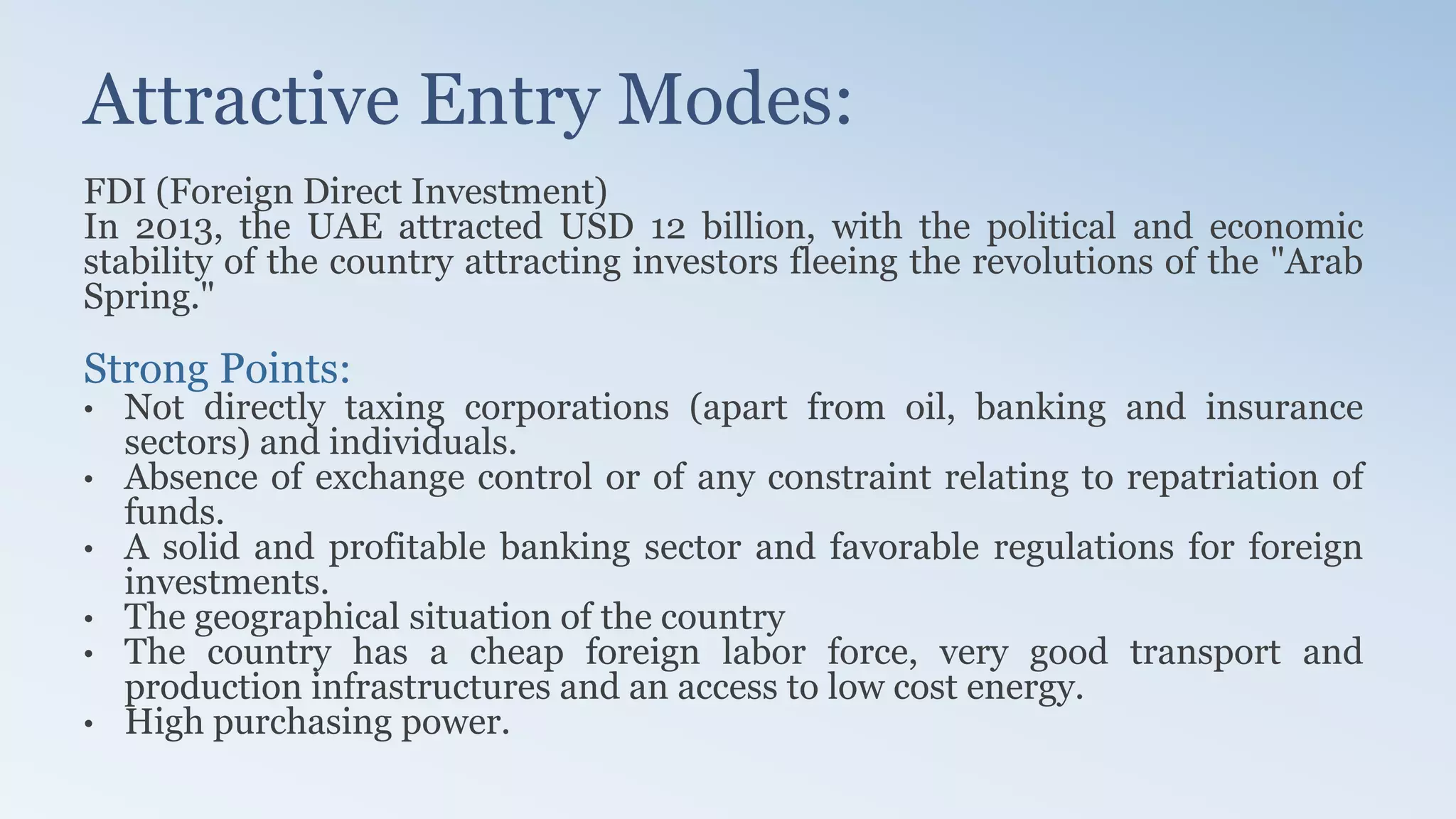
Attractive sectors:
• Spinning
• Weaving
• Finishing
Attractive Entry Modes:
FDI (Foreign Direct Investment)
In 2013, the UAE attracted USD 12 billion, with the political and economic
stability of the country attracting investors fleeing the revolutions of the "Arab
Spring."
Strong Points:
• Not directly taxing corporations (apart from oil, banking and insurance
sectors) and individuals.
• Absence of exchange control or of any constraint relating to repatriation of
funds.
• A solid and profitable banking sector and favorable regulations for foreign
investments.
• The geographical situation of the country
• The country has a cheap foreign labor force, very good transport and
production infrastructures and an access to low cost energy.
• High purchasing power.
• A large pool of expatriate labor .
• Llocal and independent retailers delivering unique and innovative designs
that challenge the offerings of well-known, multi-national brands.
• One third of the world population is accessible from UAE within a four hours
flight according to UAEinteract, 2008, which increases tourism and therefore
sales.
• Bilateral Investment Conventions signed by the United Arab Emirates: UAE
has signed 32 bilateral agreements on investment.
• Presence of organizations offering their assistance in case of disagreement:
ICSID, International Center for settlement of Investment Disputes.
• Member of the Multilateral Investment Guarantee Agency.
Weak Points:
• Government Measures to Motivate or Restrict FDI.
• The interdiction (except for free zone) of more than 49% of shareholding of a
local company for a foreign investor constitutes a significant hindrance.
• The obligation for recourse to a local service agent for the branches and
representative offices of foreign companies represents a limit.
• Tough competition from other local designers but also international brands
with huge market shares.
CONCLUSION:
• Should enter Dubai as an FDI
• Can use fame in Pakistani in Dubai for Pakistani customers
• A few franchises already exist there but can open a manufacturing
unit
• Should introduce apparels, handbags, embroidered
bedsheets/curtains, upholstery etc.
• Can use profits from manufacturing unit to open more franchises
• Can enter Abu Dhabi once manufacturing unit is successful in
Dubai
Recommendations:
Once profits from Dubai become greater, it is feasible for Nishat
Linen to enter other markets as well e.g. China, India etc.
THANK YOU!

International Business Management-Final Project-Nishat Linen

  • 1.
  • 2.
  • 3.
    Industry: • Textile Industry: •plays a major role in GDP, employment opportunities and trade • Creates employment & foreign reserves for underdeveloped countries • Export textile to developed countries • Contribution:
  • 4.
    • Encourages knowledgesharing between countries • Countries develop can supply chain • Poor countries e.g. Bangladesh can compete on low prices • Strengthens women empowerment
  • 5.
    Features of textiles: Qualityof textiles is determined through:  Component fibers  Structure/weave  Quality of raw materials, density of weave, finishing process
  • 6.
    Steps  Spinning  Weaving Finishing  Dyeing  Printing  Pressing  Fashion designing
  • 8.
    Pakistan’s Textile Industry: “backbone” of our country  Pakistan is 4th largest grower and 3rd largest exporter of cotton TEXTILE INDUSTRY'S ECONOMIC CONTRIBUTION 2011-12 Expots 52% OF TOTAL EXPORTS (US $ 12.36 BILLION) Manufacturing 46% OF TOTAL MANUFACTURING Employment 40% OF TOTAL LABOUR FORCE (put in mine) GDP 8.5% OF TOTAL GDP Market Captilization (Listed Companies) 5.0% OF TOTAL MARKET CAPITILIZATION
  • 9.
  • 10.
    T&C Industry: Vision “To becomea leading country in the field of export of value-added textile products”. Mission “To develop and implement a textiles policy which ensures consistency, predictability and transparency in Government actions and programs, while building the reputation of the country as a reliable source of high quality textile goods”.
  • 11.
    Nishat Textile MillsLtd. Subsidiary of Nishat Group Nishat Group:  Formed in 1951  Exports of $36bn  One of the top 5 revenue generating companies  Main companies: Adamjee Insurance Limited www.adamjeeinsurance.com DG Khan Cement Company Limited www.dgcement.com Lalpir Power Limited www.lalpir.com MCB Bank Limited www.mcb.com.pk Nishat Chunian Limited www.nishat.net Nishat Power Limited www.nishatpower.com Pakgen Power Limited www.pakgenpower.com
  • 12.
    Nishat Textile MillsLtd. Main processes:  Spinning  Processing  Weaving  Home textile  Garments  Power Generation  Nishat Linen
  • 13.
    Nishat Linen: Mission: “To providequality products to customers and explore new markets to promote/expand sales of the Company through good governance and foster a sound and dynamic team, so as to achieve optimum prices of products of the Company for sustainable and equitable growth and prosperity of the Company”. Vision: “To transform the Company into a modern and dynamic yarn, cloth and processed cloth and finished product manufacturing Company that is fully equipped to play a meaningful role on sustainable basis in the economy of Pakistan. To transform the Company into a modern and dynamic power generating Company that is fully equipped to play a meaningful role on sustainable basis in the economy of Pakistan”.
  • 14.
    Nishat Textile hastwo major sub-divisions:  Nishat Chunian  Nishat Faisalabad
  • 15.
    FDI: Dubai:  Similar cultureand religion  Lesser rules and regulations  World’s leading center for textile automation  150 clothing manufacturing companies present  4th largest center for trade and apparel  5.5% of world’s total textile sales
  • 16.
    Global Market Players: •China • Japan • South Korea Local competitors: • Crescent • Chenab
  • 17.
    SWOT: SWOT ANALYSIS: Strengths: •High chances ofsuccess (huge brand name) •Differentiation advantage (produce bed linen, upholstery, kitchen coordinates too) •High consumer rate •Already has Nishat Linen's outlet there so will be easier to open a manufacturing plant there too Weaknesses: •UAE's industry is more advanced in R&D as compared to Nishat's •Relatively smaller market share in UAE (too much competition) •High production costs •Centralized decision making process •Rapid changes in fashion industry will be hard to keep up with Opportunities: • Gulf countries are becoming world's largest manufacturing/ trading centres • Textile products (e.g. car seats and tents) are in high demand Threats: • Sales prices are highly volatile • Huge competition • Dynamic fashion trends
  • 18.
    R&D centers: 1. EuropeanCentre for Innovative Textiles 2. Textile Research and Application Development Centre present in Karachi and Gujarat, India 3. China Textile Research Centre 4. CSEM (Centre Suisse d'Electronique et de Microtechnique) in Switzerland 5. Textile Solution Centre (TSC) in Italy 6. Rieter Global Application & Research Centre in China
  • 19.
    Technological trends:  PlasmaTechnology  Microencapsulation technology  Nanotechnology  Knitting  Spray on clothes
  • 20.
    Emerging Trends:  SmartTextiles  Functional Fabrics  Eco friendly clothing
  • 22.
    Technological Issues: • Lackof modern equipment and machinery • difficulty in developing quality products • Difficulty with innovation of existing products • decline in textile competitiveness • increase in cost of production • Outdated textile equipment and machinery • low productivity due to lack of investment in the new and emerging technologies
  • 23.
    Global Demand Centers: 1.USA imports $2.98 billion worth of textiles from Pakistan hence becoming the largest global demand center 2. China imports $1.527 billion worth of textiles from Pakistan and these imports include only cotton yarn and fabric. China is the second largest global demand center 3. UK imports $951 million worth of textile and clothing from Pakistan 4. Germany imports $809 million worth of textile and clothing from Pakistan 5. Bangladesh imports $520 million of Pakistan textiles 6. India is the 19th largest importer of Pakistani Textiles worth $88.8 million 7. Other top importers hence demand centers include Belgium, Spain, Italy, Netherlands, UAE, France, Turkey, South Africa, Vietnam, Korea, Saudi Arabia, Sri Lanka, India and Kenya.
  • 24.
    Policies: • No tradebarriers • Tax incentives • Safety and security for investors
  • 25.
    Production Costs: • Inputcosts: • Increased energy prices • Load shedding • Gas shortage • Increasing costs of cotton and yarn
  • 26.
    Labor costs: • Lowestin Bangladesh ($0.32/hour) • Pakistan ($0.55/hour) • Highest in European countries ($10/hour)
  • 27.
    Taxes: • In Pakistan,a value-added tax of 15% and a corporate profit tax of 33% • In China the VAT is 7%, while the corporate profit tax is 25% • In India VAT and corporate tax is 12.5% and 33.66% respectively. • Bangladesh applies a VAT of 15% and a corporate tax of 37.5% • Cambodia has a VAT of 10 % and 20% corporate or 1% of sales whichever is higher.
  • 28.
    Transaction Costs: On tradingacross borders • Pakistan is at 78th rank • China is at 44th rank • India is at 94th rank • Bangladesh is at 107th rank • Cambodia is at 127th rank
  • 29.
  • 30.
    Labor Force Characteristics: Education: Laborforce mostly has only a high school degree
  • 31.
    Gender: • Large laborportion is women • Child labor is also prevalent Working conditions: • Low wages • Work overtime without proper compensation • Injuries • Unequal job opportunities • Violence • Harassment • Factory fires
  • 32.
  • 33.
    Regions gaining jobs: •China ( largest employer) • Indonesia • Turkey • Bangladesh • Sri Lanka
  • 34.
    Regions losing jobs: •India • UK • Spain • France • Germany
  • 35.
  • 36.
    Barriers: • The outsideinvestors can only own up to 49% of the company if they are not in a free zone. • Intense competition. Around 150 brands are working in UAE. • UAE ‘s textile industry is highly automated • High labor costs
  • 37.
    Opportunities:  32 freetrade zones which provide 100% foreign ownership, corporate tax holidays, no personal taxes, freedom to repatriate capital and profits, and no import duties or currency restrictions.  corporate tax holidays for most sectors  no personal taxes  freedom to repatriate capital and profits  no currency restrictions  High standard of living in UAE provides with a large customer base and allows to serve products at a premium price  Travel tourism allows to serve to newer segments
  • 38.
    Most attractive foreignmarkets: Germany: • fourth largest exporter of textiles and clothing worldwide • export quota of 42 percent in 2013 • second largest textile importer after the United States • market share of almost 18% USA: • one of the biggest importer of textiles • skilled workforce along with established plants • Advanced R&D departments
  • 39.
    Indonesia: • World’s fourthmost populated country • Attractive market • Equipment overhaul available India: • Second in textile exports with 8 per cent of global textile trade • 5.55% to total textile exports. Favorable conditions • Abundant and low price supply of raw materials • More cost-competitive than China and Brazil across a range of materials • Diverse supply of raw materials • 23 varieties of cotton and all four varieties of silk • Availability of raw materials • Availability of low cost skilled labor • Low Labor costs in India
  • 40.
    China: • Solid industrialfoundation • Cheap cost • Leads the global textile trade. • High productivity, competency and experience of labor • Less cost of labor and quota elimination • Quality of fabric and garments • Reliability • Technology investment (logistics) • Product diversity in terms of fabric and finished goods • Availability of abundant raw material and labor • Workaholic mentality of the management • Rapidly changing demographics • Rising incomes which leads to an increase in customer’s spending
  • 41.
    Bosnia and Herzegovina: •Long industrial tradition in the business • The quality of the products, • Availability of skilled and price-competitive human capital • The geographic proximity of the EU market • Possibility of delivery at lower prices • Easier and safer transportation • Flexibility of production • Secure supply of energy • Road infrastructure • Lack of export quotas • Incentives of entity governments for this sector (through additional fiscal relief, subsidies, credit lines).
  • 42.
    Mauritius and Madagascar: •low-income countries • low wages • variety of labor and infrastructure
  • 43.
    Least attractive foreignmarkets: SSA countries consisting of South Africa, Kenya, and Zimbabwe have become less attractive markets due to these factors: • Lack of capital • Inadequate Infrastructure • Poorly developed transportation markets due to political unrest • Unreliable power supplies which constrains production • Insufficient access to quality raw materials e.g. yarns and fabrics • Low industrial development and outdated technology • Increased in output cost in the recent years along with low labor productivity
  • 44.
  • 45.
    Attractive Entry Modes: FDI(Foreign Direct Investment) In 2013, the UAE attracted USD 12 billion, with the political and economic stability of the country attracting investors fleeing the revolutions of the "Arab Spring." Strong Points: • Not directly taxing corporations (apart from oil, banking and insurance sectors) and individuals. • Absence of exchange control or of any constraint relating to repatriation of funds. • A solid and profitable banking sector and favorable regulations for foreign investments. • The geographical situation of the country • The country has a cheap foreign labor force, very good transport and production infrastructures and an access to low cost energy. • High purchasing power.
  • 46.
    • A largepool of expatriate labor . • Llocal and independent retailers delivering unique and innovative designs that challenge the offerings of well-known, multi-national brands. • One third of the world population is accessible from UAE within a four hours flight according to UAEinteract, 2008, which increases tourism and therefore sales. • Bilateral Investment Conventions signed by the United Arab Emirates: UAE has signed 32 bilateral agreements on investment. • Presence of organizations offering their assistance in case of disagreement: ICSID, International Center for settlement of Investment Disputes. • Member of the Multilateral Investment Guarantee Agency.
  • 47.
    Weak Points: • GovernmentMeasures to Motivate or Restrict FDI. • The interdiction (except for free zone) of more than 49% of shareholding of a local company for a foreign investor constitutes a significant hindrance. • The obligation for recourse to a local service agent for the branches and representative offices of foreign companies represents a limit. • Tough competition from other local designers but also international brands with huge market shares.
  • 48.
  • 49.
    • Should enterDubai as an FDI • Can use fame in Pakistani in Dubai for Pakistani customers • A few franchises already exist there but can open a manufacturing unit • Should introduce apparels, handbags, embroidered bedsheets/curtains, upholstery etc. • Can use profits from manufacturing unit to open more franchises • Can enter Abu Dhabi once manufacturing unit is successful in Dubai
  • 50.
    Recommendations: Once profits fromDubai become greater, it is feasible for Nishat Linen to enter other markets as well e.g. China, India etc.
  • 51.

Editor's Notes

  • #16 Dubai Mall and Mall of Emirates
  • #45 The major sub-sectors that comprise the textiles sector include the organized Cotton / Man-Made Fibre Textiles Mill Industry, the Man-Made Fibre / Filament Yarn Industry, the Wool and Woollen Textiles Industry, the Sericulture and Silk Textiles Industry, Handlooms, Handicrafts, the Jute and Jute Textiles Industry, and Textiles Exports.