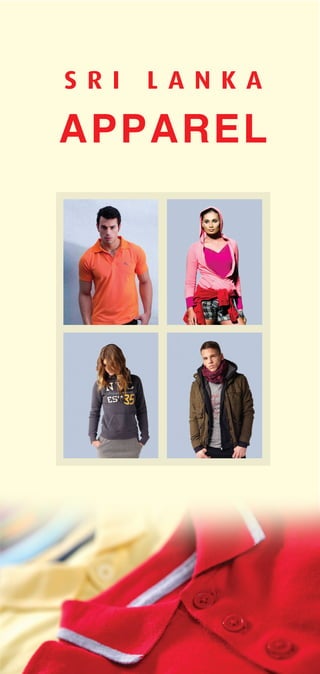
S R I L A N K A
APPAREL
Sri Lanka’s Apparel Export Industry is the most significant
and dynamic contributor towards the country’s economy.
The industry has demonstrated a tremendous growth over
the past four decades and has today become the country’s
primary foreign exchange earner amounting to 40% of the
total exports and 52% of industrial product exports. The
industry, which is entirely privately owned, has successfully
exploited the opportunities in the international market.
The Apparel Industry is the largest single employer in the
manufacturing industry providing direct employment
opportunities to approximately 300,000 and indirect
employment to approximately 600,000 employees, which
includes a substantial number of women in Sri Lanka.
Around 350 garment factories are operating in different
parts of the country, while around 16 textile and fabric
manufacturing units are in operation. These play a key role
in the advancement of the Apparel Industry.
Apparel categories span includes Sportswear, Lingerie,
Loungewear, Bridalwear, Workwear, Swimwear, and
Children’s Wear. For decades, the United States of
America and the United Kingdom have been the largest
buyers of Sri Lankan apparel.
PRODUCT CATEGORIES
The industry, which produces a range of high-quality
garments, is flexible and uniquely capable in servicing
leading international brands such as Victoria’s Secret,
Gap, Liz Claiborne, Next, Jones New York, Nike, Tommy
Hilfiger, Pink, Triumph, Ann Taylor, Speedo, Abercrombie
& Fitch, Land’s End, Marks & Spencer, Intimmissimi, etc.
Catering to
quality conscious
consumers
across the
world, products
belonging to these
international
brands are
sourced and
manufactured in
Sri Lanka - widely
regarded as South
Asia’s fashion
and logistics hub
and a forerunner
in global apparel
visionary.
Sri Lanka is a
producer of
“Garments
Without Guilt”
and the ‘Made in
Sri Lanka’ label
is comfortably
synonymous
worldwide with
the values of
high-quality,
reliability,
social and
environmental
accountability.
The Sri Lankan Apparel
Industry has evolved
from traditional exports
and tailoring designs
to provide sophisticated
solutions, creativity
and experience in BPO
services, Fashion, R&D
and Innovation Centres,
bridging the country’s
gap between eveloping
and developed.
Organic growth is
guaranteed through
market penetration and
capacity expansion in
the recently opened
North and East of the
country. Sri Lanka’s
envisaged exponential
growth through hub
services will emphasise
the industry’s rise to
international fame.
Sri Lanka’s top three
apparel companies
are already amongst
the world’s 50 most
important suppliers,
and the industry has
sustained over US$ 3
Billion in export revenue
for five consecutive
years.
•	 Three decades of experience.
•	 Environmental friendly factories –
world’s first LEED certified Platinum
rated production facility.
•	 Ethical practices – known to the world as a producer of
“Garments without Guilt” under the principles of Ethical
working conditions, free of child labour, free of forced
labour, free of discrimination on any grounds, free of
sweatshop practices.
•	 International reputation as a reliable and a quality
manufacturer with a highly competent, compliant
workforce.
COMPETITIVENESS
•	 Large number of companies that are regional players
and have the capacity to provide competitive regional
advantage by harnessing regional strengths in the
supply chain.
•	 Focus to improve speed on delivery using strategic
location advantage, coupled with the conducive
business friendly environment within the country.
•	 Innovation focused factories which offers superior
product development and design resources.
•	 Literate labour force and high labour standards.
•	 Investment friendly government policies and strategic
shipping advantage.
•	 Continued collective effort to reduce the carbon
footprint of suppliers and manufacturers.
•	 In definition, Sri Lankan Apparel Industry’s sustainability
incorporates its entire production, human resources and
supply chain process.
•	 Showcases the best of technology including the world’s
first eco-friendly “Green Garment Factory” that cut
energy in half and water consumption by 70%. These
factories have found business sustainability through the
practice of lean manufacturing, with lowered overheads
and faster return on investment.
SUSTAINABILITY /SOCIAL COMPLIANCE/
ETHICAL PRACTICES
•	 LEED Platinum and Gold Certified entities practice
international standards of recycling, effluent treatment
and waste management practices.
•	 Positioned as a socially responsible and preferred
destination for apparel sourcing, Sri Lanka stands out
as a reliable source that pays fair wages to its workers
and child labour or forced labour is not at all used in its
businesses.
What We Do
We assist in negotiating business with Sri Lanka, either
as an importer or an investor in export production.
Functions of the EDB encompass a range of activities
such as promoting exports, organising buyer-seller
meets, and exhibitions, providing essential information
to both local and foreign entrepreneurs and assisting in
the formulation and maintenance of quality standards
wherever applicable.
The EDB is manned by a team of professionals,
knowledgeable in their own specialized areas, who
maintain close personal links with the respective sectors
and hence highly competent in providing you helpful
advice.
The EDB has on its Board of Management, representatives
of both state and private sector organisations involved
in export activities. Dedicated to the task of promoting
more exports and better exports for the benefit of
exporters and importers alike, the full range of its
services are provided free of charge.
For further information please contact:
SRI LANKA EXPORT DEVELOPMENT BOARD
NDB-EDB Tower
No.42, Navam Mawatha, Colombo 02, Sri Lanka.
Tel : +94 11 2300705-11
Fax : +94 11 2300715
Email : edb@tradenetsl.lk
Web : www.srilankabussiness.com
SRI LANKA EXPORT DEVELOPMENT BOARD

Apparel & Textiles

  • 1.
    S R IL A N K A APPAREL
  • 2.
    Sri Lanka’s ApparelExport Industry is the most significant and dynamic contributor towards the country’s economy. The industry has demonstrated a tremendous growth over the past four decades and has today become the country’s primary foreign exchange earner amounting to 40% of the total exports and 52% of industrial product exports. The industry, which is entirely privately owned, has successfully exploited the opportunities in the international market. The Apparel Industry is the largest single employer in the manufacturing industry providing direct employment opportunities to approximately 300,000 and indirect employment to approximately 600,000 employees, which includes a substantial number of women in Sri Lanka. Around 350 garment factories are operating in different parts of the country, while around 16 textile and fabric manufacturing units are in operation. These play a key role in the advancement of the Apparel Industry.
  • 3.
    Apparel categories spanincludes Sportswear, Lingerie, Loungewear, Bridalwear, Workwear, Swimwear, and Children’s Wear. For decades, the United States of America and the United Kingdom have been the largest buyers of Sri Lankan apparel. PRODUCT CATEGORIES
  • 4.
    The industry, whichproduces a range of high-quality garments, is flexible and uniquely capable in servicing leading international brands such as Victoria’s Secret, Gap, Liz Claiborne, Next, Jones New York, Nike, Tommy Hilfiger, Pink, Triumph, Ann Taylor, Speedo, Abercrombie & Fitch, Land’s End, Marks & Spencer, Intimmissimi, etc.
  • 5.
    Catering to quality conscious consumers acrossthe world, products belonging to these international brands are sourced and manufactured in Sri Lanka - widely regarded as South Asia’s fashion and logistics hub and a forerunner in global apparel visionary. Sri Lanka is a producer of “Garments Without Guilt” and the ‘Made in Sri Lanka’ label is comfortably synonymous worldwide with the values of high-quality, reliability, social and environmental accountability.
  • 6.
    The Sri LankanApparel Industry has evolved from traditional exports and tailoring designs to provide sophisticated solutions, creativity and experience in BPO services, Fashion, R&D and Innovation Centres, bridging the country’s gap between eveloping and developed. Organic growth is guaranteed through market penetration and capacity expansion in the recently opened North and East of the country. Sri Lanka’s envisaged exponential growth through hub services will emphasise the industry’s rise to international fame. Sri Lanka’s top three apparel companies are already amongst the world’s 50 most important suppliers, and the industry has sustained over US$ 3 Billion in export revenue for five consecutive years.
  • 7.
    • Three decadesof experience. • Environmental friendly factories – world’s first LEED certified Platinum rated production facility. • Ethical practices – known to the world as a producer of “Garments without Guilt” under the principles of Ethical working conditions, free of child labour, free of forced labour, free of discrimination on any grounds, free of sweatshop practices. • International reputation as a reliable and a quality manufacturer with a highly competent, compliant workforce. COMPETITIVENESS
  • 8.
    • Large numberof companies that are regional players and have the capacity to provide competitive regional advantage by harnessing regional strengths in the supply chain. • Focus to improve speed on delivery using strategic location advantage, coupled with the conducive business friendly environment within the country. • Innovation focused factories which offers superior product development and design resources. • Literate labour force and high labour standards. • Investment friendly government policies and strategic shipping advantage.
  • 9.
    • Continued collectiveeffort to reduce the carbon footprint of suppliers and manufacturers. • In definition, Sri Lankan Apparel Industry’s sustainability incorporates its entire production, human resources and supply chain process. • Showcases the best of technology including the world’s first eco-friendly “Green Garment Factory” that cut energy in half and water consumption by 70%. These factories have found business sustainability through the practice of lean manufacturing, with lowered overheads and faster return on investment. SUSTAINABILITY /SOCIAL COMPLIANCE/ ETHICAL PRACTICES
  • 10.
    • LEED Platinumand Gold Certified entities practice international standards of recycling, effluent treatment and waste management practices. • Positioned as a socially responsible and preferred destination for apparel sourcing, Sri Lanka stands out as a reliable source that pays fair wages to its workers and child labour or forced labour is not at all used in its businesses.
  • 11.
    What We Do Weassist in negotiating business with Sri Lanka, either as an importer or an investor in export production. Functions of the EDB encompass a range of activities such as promoting exports, organising buyer-seller meets, and exhibitions, providing essential information to both local and foreign entrepreneurs and assisting in the formulation and maintenance of quality standards wherever applicable. The EDB is manned by a team of professionals, knowledgeable in their own specialized areas, who maintain close personal links with the respective sectors and hence highly competent in providing you helpful advice. The EDB has on its Board of Management, representatives of both state and private sector organisations involved in export activities. Dedicated to the task of promoting more exports and better exports for the benefit of exporters and importers alike, the full range of its services are provided free of charge.
  • 12.
    For further informationplease contact: SRI LANKA EXPORT DEVELOPMENT BOARD NDB-EDB Tower No.42, Navam Mawatha, Colombo 02, Sri Lanka. Tel : +94 11 2300705-11 Fax : +94 11 2300715 Email : edb@tradenetsl.lk Web : www.srilankabussiness.com SRI LANKA EXPORT DEVELOPMENT BOARD