Sloan-C The Sloan Consortium Frank Mayadas, President John Bourne, Executive Director
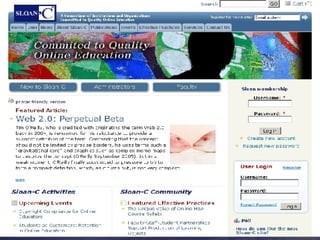
Sloan Consortium The purpose of the Sloan Consortium (Sloan-C) is to help learning organizations continually improve quality, scale, and breadth of their online programs, according to their own distinctive missions, so that education will become a part of everyday life, accessible and affordable for anyone, anywhere, at any time, in a wide variety of disciplines.
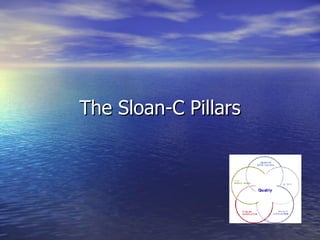
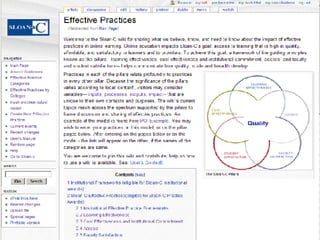
The Sloan-C Pillars
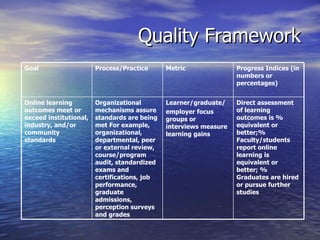
Quality Framework Direct assessment of learning outcomes is % equivalent or better;% Faculty/students report online learning is equivalent or better; % Graduates are hired or pursue further studies  Learner/graduate/ employer focus groups or interviews measure learning gains  Organizational mechanisms assure standards are being met For example, organizational, departmental, peer or external review, course/program audit, standardized exams and certifications, job performance, graduate admissions, perception surveys and grades   Online learning outcomes meet or exceed institutional, industry, and/or community standards Progress Indices (in numbers or percentages) Metric Process/Practice Goal
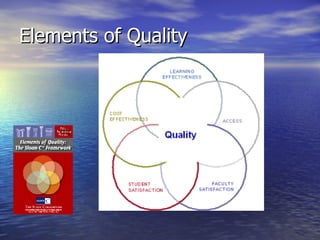
Elements of Quality
Learning Effectiveness Interaction  among instructors, classmates, content, and interface is crucial and takes various forms.  Metrics compare online and traditional courses.  Online course design takes advantage of capabilities of the medium to improve learning (testing, discussion, materials). Courses are  instructor led .  Communications and community building are emphasized.  Swift trust characterizes the online learning community.  Distinctive characteristics of programs are highlighted to demonstrate improved learning.  On-campus and online instruction achieve comparable learning outcomes , and the institution ensures the quality of learning in both modes by tracking instructional methods, student constituencies, and class size.
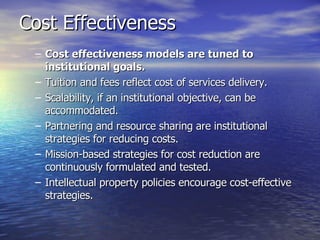
Cost Effectiveness Cost effectiveness models are tuned to institutional goals.   Tuition and fees reflect cost of services delivery.  Scalability, if an institutional objective, can be accommodated.  Partnering and resource sharing are institutional strategies for reducing costs.  Mission-based strategies for cost reduction are continuously formulated and tested.  Intellectual property policies encourage cost-effective strategies.
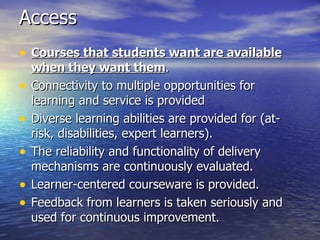
Access Courses that students want are available when they want them .  Connectivity to multiple opportunities for learning and service is provided  Diverse learning abilities are provided for (at-risk, disabilities, expert learners).  The reliability and functionality of delivery mechanisms are continuously evaluated.  Learner-centered courseware is provided.  Feedback from learners is taken seriously and used for continuous improvement.
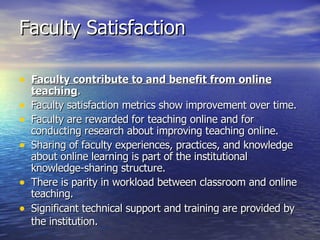
Faculty Satisfaction Faculty contribute to and benefit from online teaching .  Faculty satisfaction metrics show improvement over time.  Faculty are rewarded for teaching online and for conducting research about improving teaching online.  Sharing of faculty experiences, practices, and knowledge about online learning is part of the institutional knowledge-sharing structure.  There is parity in workload between classroom and online teaching.  Significant technical support and training are provided by the institution.
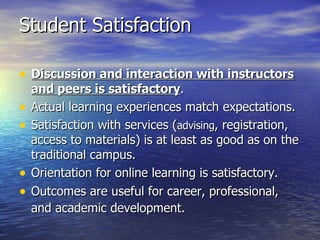
Student Satisfaction Discussion and interaction with instructors and peers is satisfactory .  Actual learning experiences match expectations.  Satisfaction with services ( advising , registration, access to materials) is at least as good as on the traditional campus.  Orientation for online learning is satisfactory.  Outcomes are useful for career, professional, and academic development.
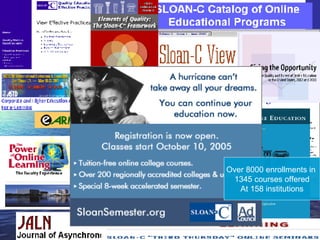
Over 8000 enrollments in  1345 courses offered At 158 institutions
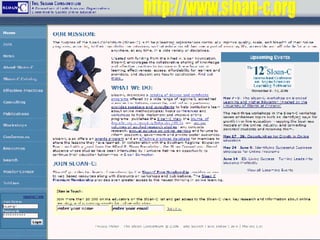
http://www.sloan-c.org


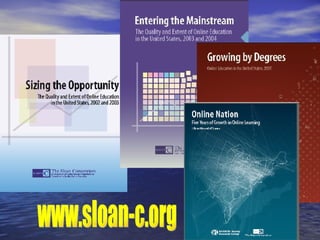
The Annual Survey www.sloan-c.org
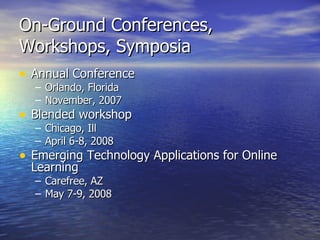
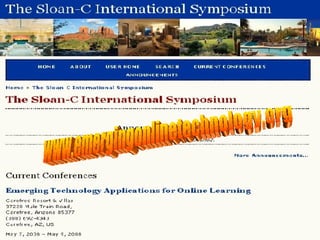
On-Ground Conferences, Workshops, Symposia Annual Conference Orlando, Florida November, 2007 Blended workshop Chicago, Ill April 6-8, 2008 Emerging Technology Applications for Online Learning Carefree, AZ May 7-9, 2008
www.emergingonlinetechnology.org
The Sloan-C Listserv Example recent topics Faculty development New technologies – e.g podcasting Student evaluation News Learning methods Policy issues [email_address] Need to be a member to access Join at Sloan-C.org
Building Community Activities Workshops (over 1000 participants this year)
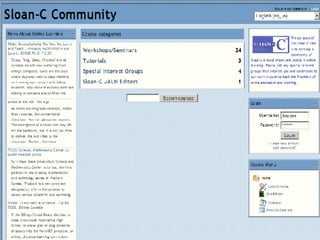
Moodle
Online workshops Provide 24 workshops in 2007 Provide 30 in 2008 Each about one week in length From beginners to more advanced Registration fee supports the workshops Earn a Sloan-C certificate in online teaching
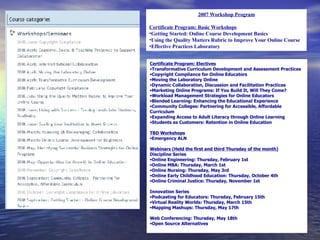
2007 Workshop Program Certificate Program: Basic Workshops Getting Started: Online Course Development Basics Using the Quality Matters Rubric to Improve Your Online Course Effective Practices Laboratory Certificate Program: Electives Transformative Curriculum Development and Assessment Practices Copyright Compliance for Online Educators Moving the Laboratory Online Dynamic Collaboration, Discussion and Facilitation Practices Marketing Online Programs: If You Build It, Will They Come? Workload Management Strategies for Online Educators Blended Learning: Enhancing the Educational Experience Community Colleges: Partnering for Accessible, Affordable Curriculum Expanding Access to Adult Literacy through Online Learning Students as Customers: Retention in Online Education TBD Workshops Emergency ALN Webinars (Held the first and third Thursday of the month) Discipline Series Online Engineering: Thursday, February 1st  Online MBA: Thursday, March 1st  Online Nursing: Thursday, May 3rd  Online Early Childhood Education: Thursday, October 4th  Online Criminal Justice: Thursday, November 1st  Innovation Series Podcasting for Educators: Thursday, February 15th  Virtual Reality Worlds: Thursday, March 15th  Mapping Mashups: Thursday, May 17th  Web Conferencing: Thursday, May 18th  Open Source Alternatives
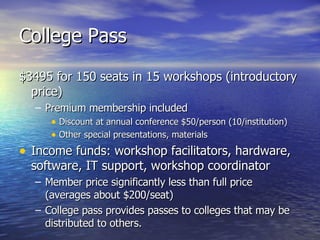
College Pass $3495 for 150 seats in 15 workshops (introductory price) Premium membership included Discount at annual conference $50/person (10/institution) Other special presentations, materials Income funds: workshop facilitators, hardware, software, IT support, workshop coordinator Member price significantly less than full price (averages about $200/seat) College pass provides passes to colleges that may be distributed to others.
 
 
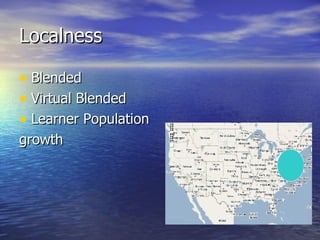
Localness Blended Virtual Blended Learner Population  growth
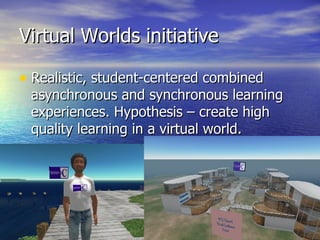
Virtual Worlds initiative Realistic, student-centered combined asynchronous and synchronous learning experiences. Hypothesis – create high quality learning in a virtual world.
 
What to do next Join Sloan-C Join the listserv Investigate Premium membership and College Pass
In conclusion, a beginning: “ The greatest real thrill that life offers is to create, to construct, to develop something useful. Too often we fail to recognize and pay tribute to the creative spirit. It is that spirit that creates our jobs. There has to be this pioneer, the individual who has the courage, the ambition to overcome the obstacles that always develop when one tries to do something worthwhile, especially when it is new and different.”   Alfred P. Sloan
Questions? Visit: http://www.sloan-c.org

Newcomers presentation

  • 1.
    Sloan-C The SloanConsortium Frank Mayadas, President John Bourne, Executive Director
  • 2.
    Sloan Consortium Thepurpose of the Sloan Consortium (Sloan-C) is to help learning organizations continually improve quality, scale, and breadth of their online programs, according to their own distinctive missions, so that education will become a part of everyday life, accessible and affordable for anyone, anywhere, at any time, in a wide variety of disciplines.
  • 3.
  • 4.
    Quality Framework Directassessment of learning outcomes is % equivalent or better;% Faculty/students report online learning is equivalent or better; % Graduates are hired or pursue further studies Learner/graduate/ employer focus groups or interviews measure learning gains Organizational mechanisms assure standards are being met For example, organizational, departmental, peer or external review, course/program audit, standardized exams and certifications, job performance, graduate admissions, perception surveys and grades   Online learning outcomes meet or exceed institutional, industry, and/or community standards Progress Indices (in numbers or percentages) Metric Process/Practice Goal
  • 5.
  • 6.
    Learning Effectiveness Interaction among instructors, classmates, content, and interface is crucial and takes various forms. Metrics compare online and traditional courses. Online course design takes advantage of capabilities of the medium to improve learning (testing, discussion, materials). Courses are instructor led . Communications and community building are emphasized. Swift trust characterizes the online learning community. Distinctive characteristics of programs are highlighted to demonstrate improved learning. On-campus and online instruction achieve comparable learning outcomes , and the institution ensures the quality of learning in both modes by tracking instructional methods, student constituencies, and class size.
  • 7.
    Cost Effectiveness Costeffectiveness models are tuned to institutional goals. Tuition and fees reflect cost of services delivery. Scalability, if an institutional objective, can be accommodated. Partnering and resource sharing are institutional strategies for reducing costs. Mission-based strategies for cost reduction are continuously formulated and tested. Intellectual property policies encourage cost-effective strategies.
  • 8.
    Access Courses thatstudents want are available when they want them . Connectivity to multiple opportunities for learning and service is provided Diverse learning abilities are provided for (at-risk, disabilities, expert learners). The reliability and functionality of delivery mechanisms are continuously evaluated. Learner-centered courseware is provided. Feedback from learners is taken seriously and used for continuous improvement.
  • 9.
    Faculty Satisfaction Facultycontribute to and benefit from online teaching . Faculty satisfaction metrics show improvement over time. Faculty are rewarded for teaching online and for conducting research about improving teaching online. Sharing of faculty experiences, practices, and knowledge about online learning is part of the institutional knowledge-sharing structure. There is parity in workload between classroom and online teaching. Significant technical support and training are provided by the institution.
  • 10.
    Student Satisfaction Discussionand interaction with instructors and peers is satisfactory . Actual learning experiences match expectations. Satisfaction with services ( advising , registration, access to materials) is at least as good as on the traditional campus. Orientation for online learning is satisfactory. Outcomes are useful for career, professional, and academic development.
  • 11.
    Over 8000 enrollmentsin 1345 courses offered At 158 institutions
  • 12.
  • 13.
  • 14.
  • 15.
  • 16.
    The Annual Surveywww.sloan-c.org
  • 17.
    On-Ground Conferences, Workshops,Symposia Annual Conference Orlando, Florida November, 2007 Blended workshop Chicago, Ill April 6-8, 2008 Emerging Technology Applications for Online Learning Carefree, AZ May 7-9, 2008
  • 18.
  • 19.
    The Sloan-C ListservExample recent topics Faculty development New technologies – e.g podcasting Student evaluation News Learning methods Policy issues [email_address] Need to be a member to access Join at Sloan-C.org
  • 20.
    Building Community ActivitiesWorkshops (over 1000 participants this year)
  • 21.
  • 22.
    Online workshops Provide24 workshops in 2007 Provide 30 in 2008 Each about one week in length From beginners to more advanced Registration fee supports the workshops Earn a Sloan-C certificate in online teaching
  • 23.
    2007 Workshop ProgramCertificate Program: Basic Workshops Getting Started: Online Course Development Basics Using the Quality Matters Rubric to Improve Your Online Course Effective Practices Laboratory Certificate Program: Electives Transformative Curriculum Development and Assessment Practices Copyright Compliance for Online Educators Moving the Laboratory Online Dynamic Collaboration, Discussion and Facilitation Practices Marketing Online Programs: If You Build It, Will They Come? Workload Management Strategies for Online Educators Blended Learning: Enhancing the Educational Experience Community Colleges: Partnering for Accessible, Affordable Curriculum Expanding Access to Adult Literacy through Online Learning Students as Customers: Retention in Online Education TBD Workshops Emergency ALN Webinars (Held the first and third Thursday of the month) Discipline Series Online Engineering: Thursday, February 1st Online MBA: Thursday, March 1st Online Nursing: Thursday, May 3rd Online Early Childhood Education: Thursday, October 4th Online Criminal Justice: Thursday, November 1st Innovation Series Podcasting for Educators: Thursday, February 15th Virtual Reality Worlds: Thursday, March 15th Mapping Mashups: Thursday, May 17th Web Conferencing: Thursday, May 18th Open Source Alternatives
  • 24.
    College Pass $3495for 150 seats in 15 workshops (introductory price) Premium membership included Discount at annual conference $50/person (10/institution) Other special presentations, materials Income funds: workshop facilitators, hardware, software, IT support, workshop coordinator Member price significantly less than full price (averages about $200/seat) College pass provides passes to colleges that may be distributed to others.
  • 25.
  • 26.
  • 27.
    Localness Blended VirtualBlended Learner Population growth
  • 28.
    Virtual Worlds initiativeRealistic, student-centered combined asynchronous and synchronous learning experiences. Hypothesis – create high quality learning in a virtual world.
  • 29.
  • 30.
    What to donext Join Sloan-C Join the listserv Investigate Premium membership and College Pass
  • 31.
    In conclusion, abeginning: “ The greatest real thrill that life offers is to create, to construct, to develop something useful. Too often we fail to recognize and pay tribute to the creative spirit. It is that spirit that creates our jobs. There has to be this pioneer, the individual who has the courage, the ambition to overcome the obstacles that always develop when one tries to do something worthwhile, especially when it is new and different.” Alfred P. Sloan
  • 32.