Getting Started in Online Education
The Sloan Consortium Presents
Sloan-C Programs & Resources
• Membership: Lower prices
on
conferences, workshops, pu
blications; full website
access.
• Workshops: Over 100 each
year ($169 for members;
$269 non-members)
• College Pass: lowest prices
on bulk workshops
(25, 50, 75 & 100 seat
options)
http://sloanconsortium.org
• Certificate Program: Online
teaching & learning
• Blended Learning Mastery
Series
• Mobile Learning Mastery
Series
• 3 Annual Conferences:
Blended, Emerging
Tech, Annual Online
Learning
• Workshops :
* Student Satisfaction : Feedback
October 4 - 11, 2013
* Learning Environments: ePortfolios for STEM Learning
October 18 - 25 , 2013
• Webinar: Learn with Michael Wesch - Free
October 8 , 2013 , 3:00 pm ET
• Conference : 19th Annual Sloan Consortium International Conference on
Online Learning
November 20-22, 2013 Lake Buena Vista, FL
Join us for Upcoming Sloan-C Events
Upcoming Webinars
http://sloanconsortium.org/webinar_listing
With You
Today …
Cathy Arreguin
Zeren Eder
Sandra Coswatte
Please Introduce Yourself
Online Student Experience
Q:Have you ever taken
an online class?
Online Faculty Experience
Q:Have you ever taught
an online course?
One Final Question …
Q:Why …
are you here today?
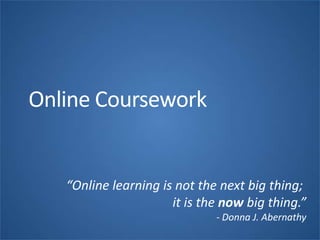
“Online learning is not the next big thing;
it is the now big thing.”
- Donna J. Abernathy
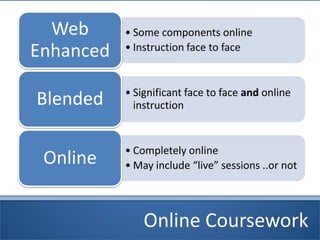
Online Coursework
Online Coursework
• Some components online
• Instruction face to face
Web
Enhanced
• Significant face to face and online
instructionBlended
• Completely online
• May include “live” sessions ..or notOnline
Quality
“Quality is never an accident; it is always the
result of high intention, sincere effort, intelligent
direction and skillful execution; it represents the
wise choice of many alternatives.”
- William A. Foster
Quality Questions
Q:
What does a quality online
class mean to you?
Do students and faculty
measure quality in the
same way?
Do they want the same
thing out of the courses?
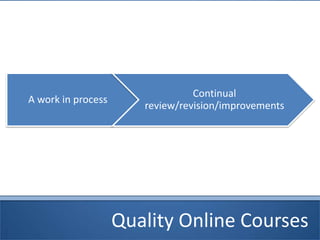
Quality Online Courses
A work in process
Continual
review/revision/improvements
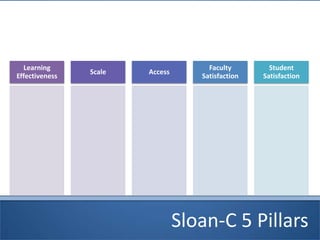
Sloan-C 5 Pillars
Learning
Effectiveness
Scale Access
Faculty
Satisfaction
Student
Satisfaction
Learning Effectiveness
Learning
Effectiveness Take advantage of the
learning environment
Provide learning experiences
that are quality in the modality
being used
Scale
Leverage key educational resources
while offering new
online learning opportunities to
students and faculty
Schools offer their best educational
value to learners and to achieve
capacity enrollment
Cost-effective measures and
practices
Scale
Access
Access
Provide meaningful and effective
access throughout the entire
student's life cycle
• Program Selection
• Course Availability
• Appropriate Learning Resources
• Support
(Academic, Financial, Student, Technical)
Faculty Satisfaction
Faculty
Satisfaction
Instructors find the online teaching
experience personally rewarding
and professionally beneficial
• School Provides Support
• Opportunity for Research/Publication
• Involved in the Governance and Quality
Insurance
• Institutional Reward System
• Opportunity for Continued Professional
Development
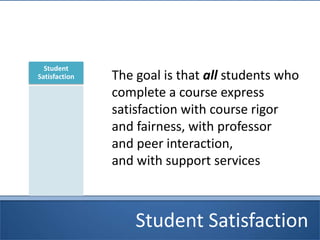
Student Satisfaction
Student
Satisfaction The goal is that all students who
complete a course express
satisfaction with course rigor
and fairness, with professor
and peer interaction,
and with support services
Sloan-C 5 Pillar Resources
A Framework for success
Sloan-C 5 Pillar Resources
• http://sloanconsortium.org/5pillars
Quality
Framework
Chart
• http://sloanconsortium.org/Quality_Framework_Narrative_5_pillars
Quality
Framework
Narrative
Converting Your Course
Convert … or create?
Course Conversion
• Making Relevant Learning Experiences
• Built Around Learning Objectives/Outcomes
that are measurable
• Start backwards what do you want students
to achieve? How will you do this?
• What can be developed for Interactivity?
• What time management will be expected in
class for you and your students?
Course Conversion continued…
• Review Course Objectives/Outcomes
• Develop Online Course Syllabus
• Develop Online Assessments – Match Course
Learning Objectives
• Develop Learning Materials/Plan for class
Course Objectives and
Syllabus
Your roadmap for development
What are Course Objectives?
• What learners should know or be able to do
at the end of your course
• Describe the end results of your learning
experience
• Create a sound basis for your instruction that
can be measured
• Helps students organize and classify their
efforts during the learning pursuits
Course Objectives
A course should be built around objectives:
Specific objectives
Measurable objectives
Understood by students
Connected to learning modules so that
students see why they are doing something
Course Syllabus
• Course Description/Objectives
• Required and recommended textbook(s) and
materials
• Calendar of events and a timeline of due dates
for any activities.
• Examples:
• Assignments, assessments, and scheduled
synchronous online chat/discussions.
• Instructor contact information and virtual
office hours …
Course Syllabus continued…
• Online Participation Requirements
• Grading Scale and how grades are earned
• Special needs/ADA Statement Contact Info
• Hardware/Software Requirements
• Technical Support Resources
• Academic Honesty Policy
• Copyright Policy
Social Presence
Becoming REAL online
Social Presence Online
Instructor’s Role in Social Presence
• Address Students By Name
• Be Responsive in Class and in Emails
• Provide Frequent, Timely, and Constructive
Feedback
• Share Personal Stories and Experiences
• Use multimedia so that students see and
hear you.
 Showing Social Presence
•Expression of emoticons
•Use of humor
•Self-Disclosure
•Interactive Continuing a thread
•Quoting from other messages
•Referring explicitly to other messages
•Asking questions
•Complimenting, expressing
appreciation, expressing agreement
New to Online: The Essentials
Join
Us!
• 1 week workshop
• Hands on experience
• Learn as a student
• Plan as a facilitator
• Chance to learn and network with
other professionals
• Remaining 2013 Session
• November 1 – November 8
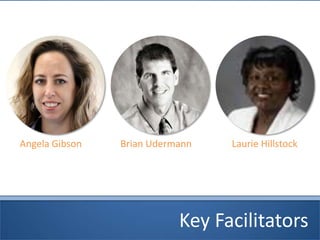
Key Facilitators
Angela Gibson Brian Udermann Laurie Hillstock
What To Expect
Online Learning Overview
Course Conversion/Creation
Assessment Strategies
Synchronous/Asynchronous Tools
Preparing Students for Online
Professional Development Online
Questions?
Questions?
Thank you and keep
learning!
“Learning is what most adults will do for a living
in the 21st century.“
- Perelman
For More Information
workshops@sloanconsortium.org
www.sloanconsortium.org
Getting Started in Online Education
An Overview

Sloan c Getting Started Online Webinar

  • 1.
    Getting Started inOnline Education The Sloan Consortium Presents
  • 2.
    Sloan-C Programs &Resources • Membership: Lower prices on conferences, workshops, pu blications; full website access. • Workshops: Over 100 each year ($169 for members; $269 non-members) • College Pass: lowest prices on bulk workshops (25, 50, 75 & 100 seat options) http://sloanconsortium.org • Certificate Program: Online teaching & learning • Blended Learning Mastery Series • Mobile Learning Mastery Series • 3 Annual Conferences: Blended, Emerging Tech, Annual Online Learning
  • 3.
    • Workshops : *Student Satisfaction : Feedback October 4 - 11, 2013 * Learning Environments: ePortfolios for STEM Learning October 18 - 25 , 2013 • Webinar: Learn with Michael Wesch - Free October 8 , 2013 , 3:00 pm ET • Conference : 19th Annual Sloan Consortium International Conference on Online Learning November 20-22, 2013 Lake Buena Vista, FL Join us for Upcoming Sloan-C Events Upcoming Webinars http://sloanconsortium.org/webinar_listing
  • 4.
    With You Today … CathyArreguin Zeren Eder Sandra Coswatte
  • 5.
  • 6.
    Online Student Experience Q:Haveyou ever taken an online class?
  • 7.
    Online Faculty Experience Q:Haveyou ever taught an online course?
  • 8.
    One Final Question… Q:Why … are you here today?
  • 9.
    “Online learning isnot the next big thing; it is the now big thing.” - Donna J. Abernathy Online Coursework
  • 10.
    Online Coursework • Somecomponents online • Instruction face to face Web Enhanced • Significant face to face and online instructionBlended • Completely online • May include “live” sessions ..or notOnline
  • 11.
    Quality “Quality is neveran accident; it is always the result of high intention, sincere effort, intelligent direction and skillful execution; it represents the wise choice of many alternatives.” - William A. Foster
  • 12.
    Quality Questions Q: What doesa quality online class mean to you? Do students and faculty measure quality in the same way? Do they want the same thing out of the courses?
  • 13.
    Quality Online Courses Awork in process Continual review/revision/improvements
  • 14.
    Sloan-C 5 Pillars Learning Effectiveness ScaleAccess Faculty Satisfaction Student Satisfaction
  • 15.
    Learning Effectiveness Learning Effectiveness Takeadvantage of the learning environment Provide learning experiences that are quality in the modality being used
  • 16.
    Scale Leverage key educationalresources while offering new online learning opportunities to students and faculty Schools offer their best educational value to learners and to achieve capacity enrollment Cost-effective measures and practices Scale
  • 17.
    Access Access Provide meaningful andeffective access throughout the entire student's life cycle • Program Selection • Course Availability • Appropriate Learning Resources • Support (Academic, Financial, Student, Technical)
  • 18.
    Faculty Satisfaction Faculty Satisfaction Instructors findthe online teaching experience personally rewarding and professionally beneficial • School Provides Support • Opportunity for Research/Publication • Involved in the Governance and Quality Insurance • Institutional Reward System • Opportunity for Continued Professional Development
  • 19.
    Student Satisfaction Student Satisfaction Thegoal is that all students who complete a course express satisfaction with course rigor and fairness, with professor and peer interaction, and with support services
  • 20.
    Sloan-C 5 PillarResources A Framework for success
  • 21.
    Sloan-C 5 PillarResources • http://sloanconsortium.org/5pillars Quality Framework Chart • http://sloanconsortium.org/Quality_Framework_Narrative_5_pillars Quality Framework Narrative
  • 22.
  • 23.
    Course Conversion • MakingRelevant Learning Experiences • Built Around Learning Objectives/Outcomes that are measurable • Start backwards what do you want students to achieve? How will you do this? • What can be developed for Interactivity? • What time management will be expected in class for you and your students?
  • 24.
    Course Conversion continued… •Review Course Objectives/Outcomes • Develop Online Course Syllabus • Develop Online Assessments – Match Course Learning Objectives • Develop Learning Materials/Plan for class
  • 25.
    Course Objectives and Syllabus Yourroadmap for development
  • 26.
    What are CourseObjectives? • What learners should know or be able to do at the end of your course • Describe the end results of your learning experience • Create a sound basis for your instruction that can be measured • Helps students organize and classify their efforts during the learning pursuits
  • 27.
    Course Objectives A courseshould be built around objectives: Specific objectives Measurable objectives Understood by students Connected to learning modules so that students see why they are doing something
  • 28.
    Course Syllabus • CourseDescription/Objectives • Required and recommended textbook(s) and materials • Calendar of events and a timeline of due dates for any activities. • Examples: • Assignments, assessments, and scheduled synchronous online chat/discussions. • Instructor contact information and virtual office hours …
  • 29.
    Course Syllabus continued… •Online Participation Requirements • Grading Scale and how grades are earned • Special needs/ADA Statement Contact Info • Hardware/Software Requirements • Technical Support Resources • Academic Honesty Policy • Copyright Policy
  • 30.
  • 31.
  • 32.
    Instructor’s Role inSocial Presence • Address Students By Name • Be Responsive in Class and in Emails • Provide Frequent, Timely, and Constructive Feedback • Share Personal Stories and Experiences • Use multimedia so that students see and hear you.
  • 33.
     Showing SocialPresence •Expression of emoticons •Use of humor •Self-Disclosure •Interactive Continuing a thread •Quoting from other messages •Referring explicitly to other messages •Asking questions •Complimenting, expressing appreciation, expressing agreement
  • 34.
    New to Online:The Essentials Join Us! • 1 week workshop • Hands on experience • Learn as a student • Plan as a facilitator • Chance to learn and network with other professionals • Remaining 2013 Session • November 1 – November 8
  • 35.
    Key Facilitators Angela GibsonBrian Udermann Laurie Hillstock
  • 36.
    What To Expect OnlineLearning Overview Course Conversion/Creation Assessment Strategies Synchronous/Asynchronous Tools Preparing Students for Online Professional Development Online
  • 37.
  • 38.
  • 39.
    Thank you andkeep learning! “Learning is what most adults will do for a living in the 21st century.“ - Perelman
  • 40.
  • 41.
    Getting Started inOnline Education An Overview

Editor's Notes

  • #4 Workshops and webinars run year-round at Sloan-C so that you can extend your professional expertise when it is convenient to your schedule.Our next two events are the Dynamic Collaboration workshop and the Cloud Computing webinar. They both should provide some great information and ideas. If they look interesting to you, registration is currently open. To learn more about and register for any upcoming workshops, visit http://sloanconsortium.org/workshops/upcomingTo learn more about and register for upcoming webinars, visit http://sloanconsortium.org/webinar_listing[Advance Slide]
  • #9 Alt: Why did you choose to register/sign up for the webinar today?
  • #13 Alt: Why did you choose to register/sign up for the webinar today?
  • #14 Quality Definition: A degree of Excellence. A distinguishing attribute“Every civilization depends upon the quality of the individuals it produces.” ~FRANK HERBERT
  • #15 What makes a quality online course?
  • #23 Conversion – Revise MaterialsCreation – Start From Scratch
  • #32 Learning is a social activityDesign and Delivery need to connect students to you and their learning peers.Social Presence – the degree to which people feel you are “real”.. SO .. How do you create that “realness” or sense of “being there” with your students .. When you are typing away by yourself?
  • #35 Workshop: New to Online: The Essentials