
Evaluating Online Teachers Barbara Treacy iNACOL Southeast December, 2011
Questions to Address Why does evaluation matter? What’s different about evaluating  online  teachers? How do we align to iNACOL Online Teaching Standards ? What strategies, tools and approaches work? How do we connect evaluation to professional development?
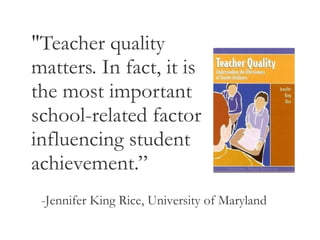
"Teacher quality matters. In fact, it is the most important school-related factor influencing student achievement.”  -Jennifer King Rice, University of Maryland
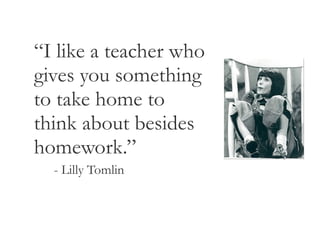
“ I like a teacher who gives you something to take home to think about besides homework.” - Lilly Tomlin
 
Why is Evaluation Important? Quality requires accountability Online programs are under scrutiny Student success depends on quality teachers Strong evaluation supports teacher retention
Teacher Evaluation Challenges  Lots of buzz about evaluation but little clarity Teachers must be respected AND accountable  Evaluation requires staff, time and expertise Clear expectations for teachers are needed Follow-up professional development and collaborative opportunities are critical
Good Teaching is Good Teaching: Online or Face-to-face "If you want to teach well to very high standards, you have to know the students well, you have to have that relationship that allows you to both challenge them, and adapt what you're doing for them so that it works."  - Linda Darling-Hammond
All Teachers Need To: establish clear expectations have good curriculum provide regular feedback and assessment listen to and learn from their students address individual learning needs  incorporate technology effectively collaborate with and contribute to school and professional communities
What’s Different About Teaching Online? Online curriculum:  different structure Student expectations:   make use of new tools Social dynamic:  different pace and structures Online discussion:  new facilitation strategies needed; importance of written communication Classroom management:  different methods to address cohort and individual pacing needs Assessment:  new tools and strategies needed Technical:  challenges may occur
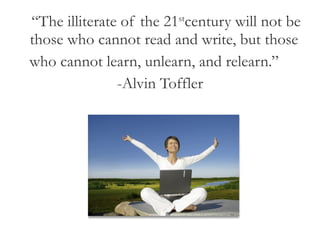
“ The illiterate of the 21 st century will not be those who cannot read and write, but those  who cannot learn, unlearn, and relearn.”  -Alvin Toffler
iNACOL Online Teaching Standards Initial: 2008; Updated: October, 2011 Focus on good teaching practices AND the online context –  Connecting them together Adapted from SREB Standards Address: Teacher knowledge and understanding Teacher abilities Set the agenda for quality teaching AND preparation of new online instructors
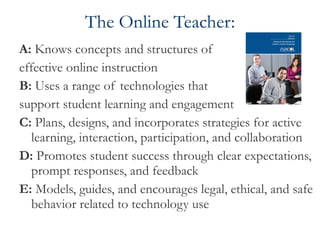
The Online Teacher: A:  Knows concepts and structures of  effective online instruction B:  Uses a range of technologies that  support student learning and engagement C:  Plans, designs, and incorporates strategies for active learning, interaction, participation, and collaboration D:  Promotes student success through clear expectations, prompt responses, and feedback E:  Models, guides, and encourages legal, ethical, and safe behavior related to technology use
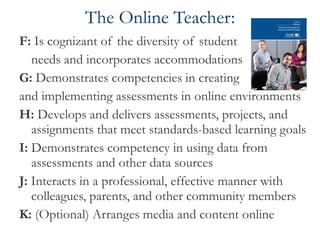
The Online Teacher: F:  Is cognizant of the diversity of student  needs and incorporates accommodations G:  Demonstrates competencies in creating  and implementing assessments in online environments H:  Develops and delivers assessments, projects, and assignments that meet standards-based learning goals I:  Demonstrates competency in using data from assessments and other data sources J:  Interacts in a professional, effective manner with colleagues, parents, and other community members K:  (Optional) Arranges media and content online
Evaluation Strategies And Tools Establish clear expectations and incorporate iNACOL Online Teaching Standards Ensure all teachers understand the Standards and expectations, including new teachers Encourage teachers to conduct self-evaluations based on Standards Work with teachers to set annual goals, with accountability measures and PD plans
Strategies and Tools, cont. Develop and prepare administrative staff to conduct regular teacher evaluations Establish and share observation process At least annually for all teachers More frequently for new teachers  As needed when issues arise Use the LMS/CMS and other data thoughtfully Include teacher artifacts/portfolios
Role of Professional Development Evaluation must be coupled with a PD plan; targeted to the outcomes of the evaluation Online teachers also need ongoing PD in: subject matter content and pedagogy online pedagogy and instructional practice new technologies and tools school/district policies Recognize importance of teacher communities and collaborative opportunities
Questions for Discussion What challenges do you face in implementing teacher evaluation? What strategies and tools do you use? What’s different when evaluating online teachers? How do you use the iNACOL Online Teaching Standards?
Thank you! Barbara Treacy [email_address] EdTech Leaders Online http://edtechleaders.org   Education Development Center http://edc.org

Evaluating onlineteacherinacol dec2011

  • 1.
    Evaluating Online TeachersBarbara Treacy iNACOL Southeast December, 2011
  • 2.
    Questions to AddressWhy does evaluation matter? What’s different about evaluating online teachers? How do we align to iNACOL Online Teaching Standards ? What strategies, tools and approaches work? How do we connect evaluation to professional development?
  • 3.
    "Teacher quality matters.In fact, it is the most important school-related factor influencing student achievement.” -Jennifer King Rice, University of Maryland
  • 4.
    “ I likea teacher who gives you something to take home to think about besides homework.” - Lilly Tomlin
  • 5.
  • 6.
    Why is EvaluationImportant? Quality requires accountability Online programs are under scrutiny Student success depends on quality teachers Strong evaluation supports teacher retention
  • 7.
    Teacher Evaluation Challenges Lots of buzz about evaluation but little clarity Teachers must be respected AND accountable Evaluation requires staff, time and expertise Clear expectations for teachers are needed Follow-up professional development and collaborative opportunities are critical
  • 8.
    Good Teaching isGood Teaching: Online or Face-to-face "If you want to teach well to very high standards, you have to know the students well, you have to have that relationship that allows you to both challenge them, and adapt what you're doing for them so that it works." - Linda Darling-Hammond
  • 9.
    All Teachers NeedTo: establish clear expectations have good curriculum provide regular feedback and assessment listen to and learn from their students address individual learning needs incorporate technology effectively collaborate with and contribute to school and professional communities
  • 10.
    What’s Different AboutTeaching Online? Online curriculum: different structure Student expectations: make use of new tools Social dynamic: different pace and structures Online discussion: new facilitation strategies needed; importance of written communication Classroom management: different methods to address cohort and individual pacing needs Assessment: new tools and strategies needed Technical: challenges may occur
  • 11.
    “ The illiterateof the 21 st century will not be those who cannot read and write, but those who cannot learn, unlearn, and relearn.” -Alvin Toffler
  • 12.
    iNACOL Online TeachingStandards Initial: 2008; Updated: October, 2011 Focus on good teaching practices AND the online context – Connecting them together Adapted from SREB Standards Address: Teacher knowledge and understanding Teacher abilities Set the agenda for quality teaching AND preparation of new online instructors
  • 13.
    The Online Teacher:A: Knows concepts and structures of effective online instruction B: Uses a range of technologies that support student learning and engagement C: Plans, designs, and incorporates strategies for active learning, interaction, participation, and collaboration D: Promotes student success through clear expectations, prompt responses, and feedback E: Models, guides, and encourages legal, ethical, and safe behavior related to technology use
  • 14.
    The Online Teacher:F: Is cognizant of the diversity of student needs and incorporates accommodations G: Demonstrates competencies in creating and implementing assessments in online environments H: Develops and delivers assessments, projects, and assignments that meet standards-based learning goals I: Demonstrates competency in using data from assessments and other data sources J: Interacts in a professional, effective manner with colleagues, parents, and other community members K: (Optional) Arranges media and content online
  • 15.
    Evaluation Strategies AndTools Establish clear expectations and incorporate iNACOL Online Teaching Standards Ensure all teachers understand the Standards and expectations, including new teachers Encourage teachers to conduct self-evaluations based on Standards Work with teachers to set annual goals, with accountability measures and PD plans
  • 16.
    Strategies and Tools,cont. Develop and prepare administrative staff to conduct regular teacher evaluations Establish and share observation process At least annually for all teachers More frequently for new teachers As needed when issues arise Use the LMS/CMS and other data thoughtfully Include teacher artifacts/portfolios
  • 17.
    Role of ProfessionalDevelopment Evaluation must be coupled with a PD plan; targeted to the outcomes of the evaluation Online teachers also need ongoing PD in: subject matter content and pedagogy online pedagogy and instructional practice new technologies and tools school/district policies Recognize importance of teacher communities and collaborative opportunities
  • 18.
    Questions for DiscussionWhat challenges do you face in implementing teacher evaluation? What strategies and tools do you use? What’s different when evaluating online teachers? How do you use the iNACOL Online Teaching Standards?
  • 19.
    Thank you! BarbaraTreacy [email_address] EdTech Leaders Online http://edtechleaders.org Education Development Center http://edc.org

Editor's Notes

  • #2 Why do teachers have to transform their practice?
  • #8 Online or face to face
  • #12 How will we get there? PD is a critical compoent in “helping teachers change” – but what will be our approach. We have to liberate learning and be willing to experiement