Donna Simiele| eLearning Technology Support Coordinator
dsimiele@niagaracc.suny.edu
SUNY –Niagara County Community College, Sanborn, NY
www.niagaracc.suny.edu
 eLearning Technology Support
Coordinator/Instructional Designer for 3 years
 Teaching undergraduate on campus and online
courses for 14 years
 Quality Matters / OSCQR Reviewer
 Open SUNY Center for Online Teaching
Excellence (COTE) Expert Instructional
Designer Fellow
ncccelearning.com
About SUNY & NCCC
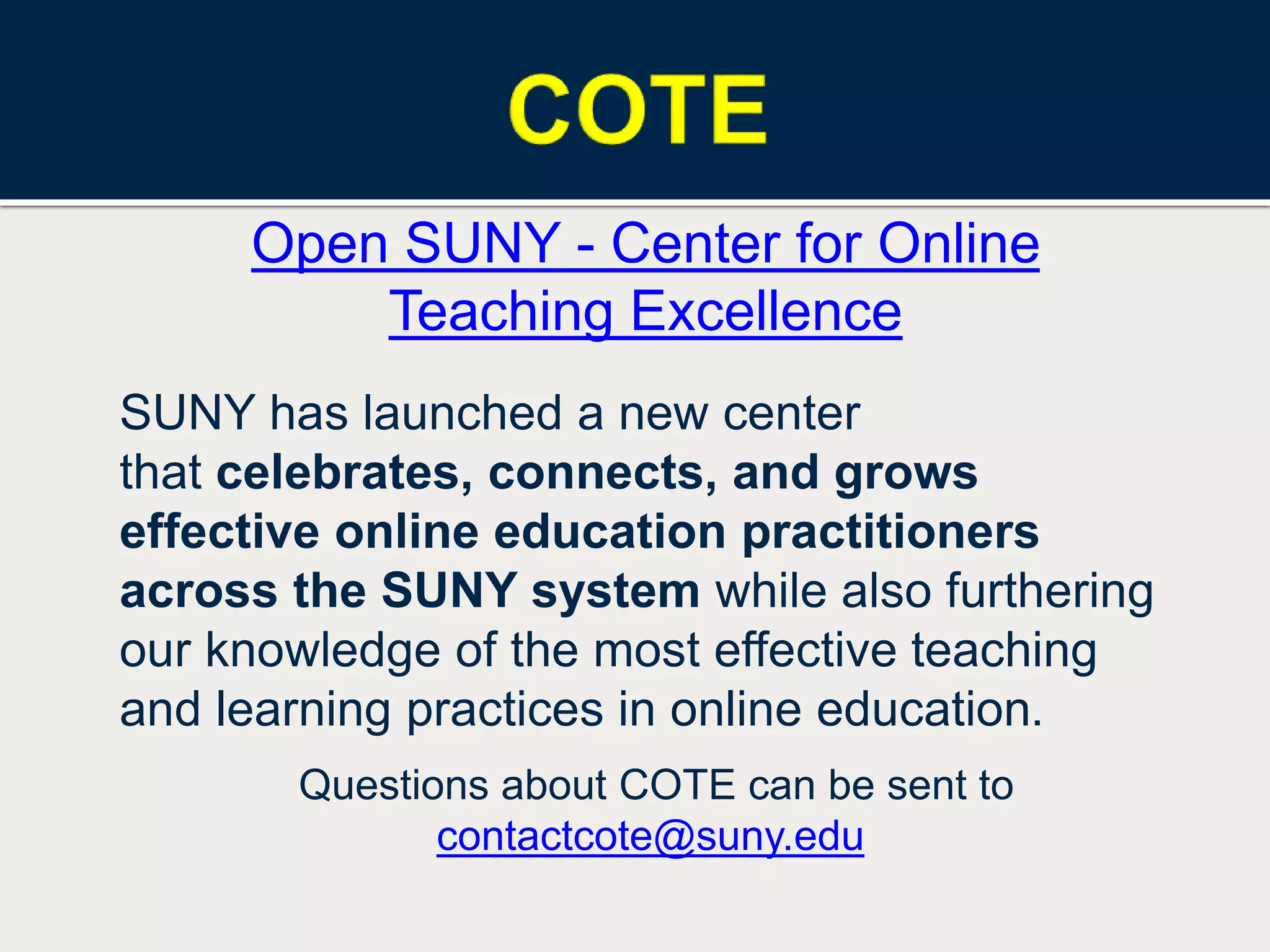
• 64 Campuses
• 459,550 students
• University Centers
• University
Colleges
• Technology
Colleges
• Community
Colleges
 NCCC has been
online for 16 years:
 8 online programs,
 2 online
certifications,
 180 online &
blended
courses/semester.
Open SUNY is a SUNY-wide
collaboration that opens the door to
world-class online-enabled learning
opportunities. Open SUNY is not a
new degree program or a new
school; it’s a seamless way for you
to access the courses, degrees,
professors, and rich academics of
all 64 SUNY campuses flexibly—
wherever and whenever you want.
For the first time, SUNY is
delivering its renowned high-quality
education with an unprecedented
breadth of tools, services, and
supports designed to help you be
successful. With Open SUNY, you
can look forward to:
 Flexibility
 Support
 Experience
 Simplicity
 Excellence Access
Open SUNY - Center for Online
Teaching Excellence
SUNY has launched a new center
that celebrates, connects, and grows
effective online education practitioners
across the SUNY system while also furthering
our knowledge of the most effective teaching
and learning practices in online education.
Questions about COTE can be sent to
contactcote@suny.edu
 Time of registration
 Poor advising
 Age
 Engagement and Course
Design
 Development Needs
 Gender
 Technical Factors/Business
Processes
 First-time e-Learning student
 Previous College Success-
GPA
 Learning Styles
SUNY Directors of Distance Learning Environments
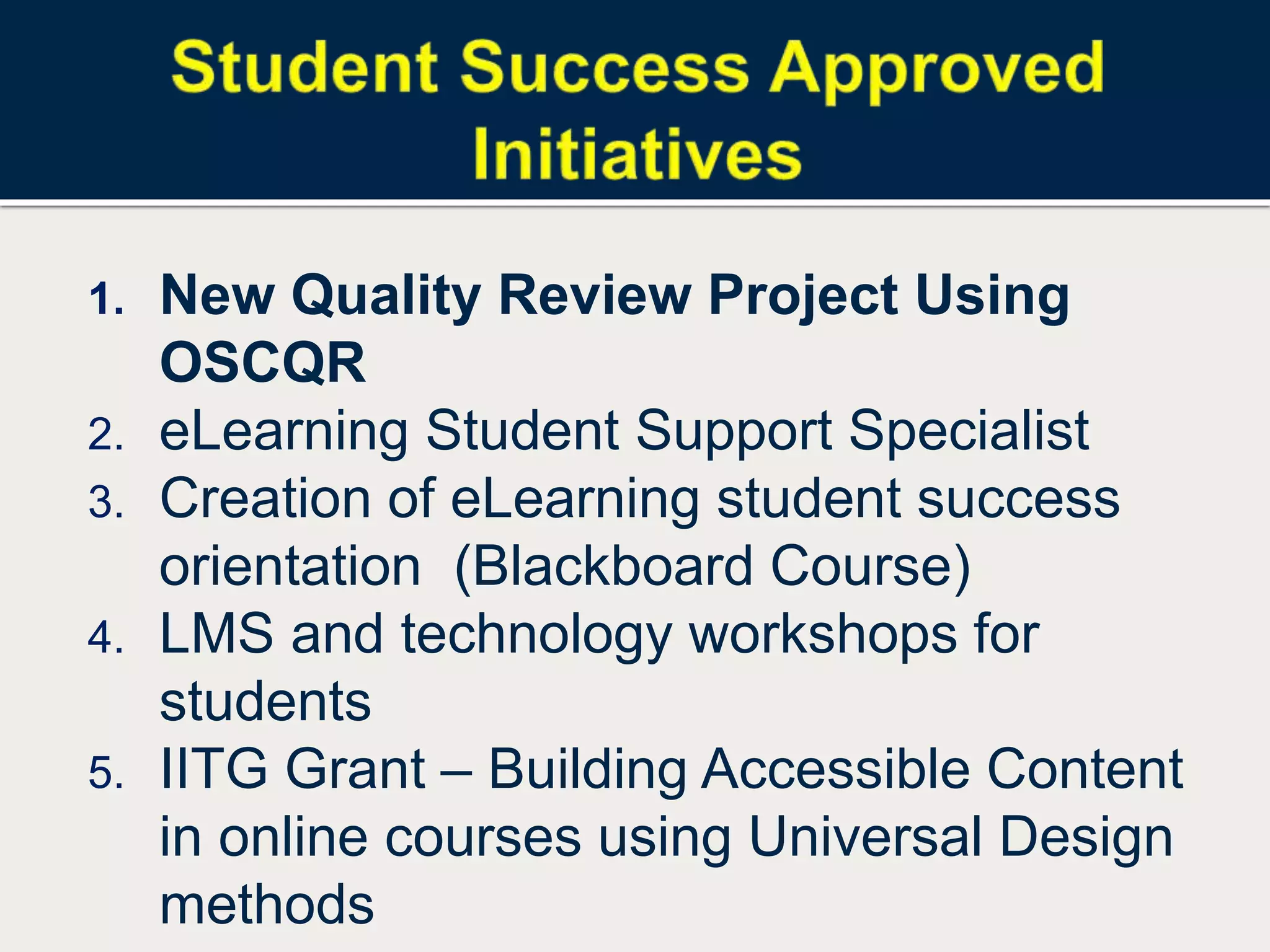
1. New Quality Review Project Using
OSCQR
2. eLearning Student Support Specialist
3. Creation of eLearning student success
orientation (Blackboard Course)
4. LMS and technology workshops for
students
5. IITG Grant – Building Accessible Content
in online courses using Universal Design
methods
OSCQR
Chico
Rubric
SLN Best
Practices
SUNY
Office of
General
Counsel
Quality
Matters
iNACOL
Blackboard
Community
of Inquiry
Seven
Principles
for Good
Practice
The Adult
Learner
Bloom’s
Taxonomy
How People
Learn
Open SUNY
COTE
 About the NCCC Quality Review Project
 The NCCC Quality Review process is a faculty-driven, collegial
course design review process. The rubric does not evaluate the
faculty member or the faculty member’s content expertise.
 The review makes use of the Open SUNY COTE Quality Review
Rubric known as “OSCQR.”
 This project will help NCCC maintain and enhance the quality of its
online courses through a process of continuous improvement.
 This review process is not a part of NCCC’s faculty evaluation
process. It evaluates the online course itself. The reviewers evaluate
the course before it goes live so that the focus is on the course
design, not the faculty member or how the course is run.
 The review process is completely voluntary.
 OSCQR
 NCCC (Modified) Version of OSCQR
 Video about OSCQR
 Meet the OSCQR Rubric (Alexandra
Pickett)
 Accessibility Issues
 Open SUNY OSCQR included an Accessibility
Component
 NCCC Required Materials
 Course Interaction
 Received a SUNY Innovative Instruction
Technology Grant (IITG)
 With Grant Funding:
▪ Built a compliance checklist (based on Middle
States, Higher Education Opportunity Act, and
OSCQR Accessibility standards)
▪ Checked online courses for compliance issues
▪ Sent findings to faculty
▪ Provided professional development sessions based
on findings
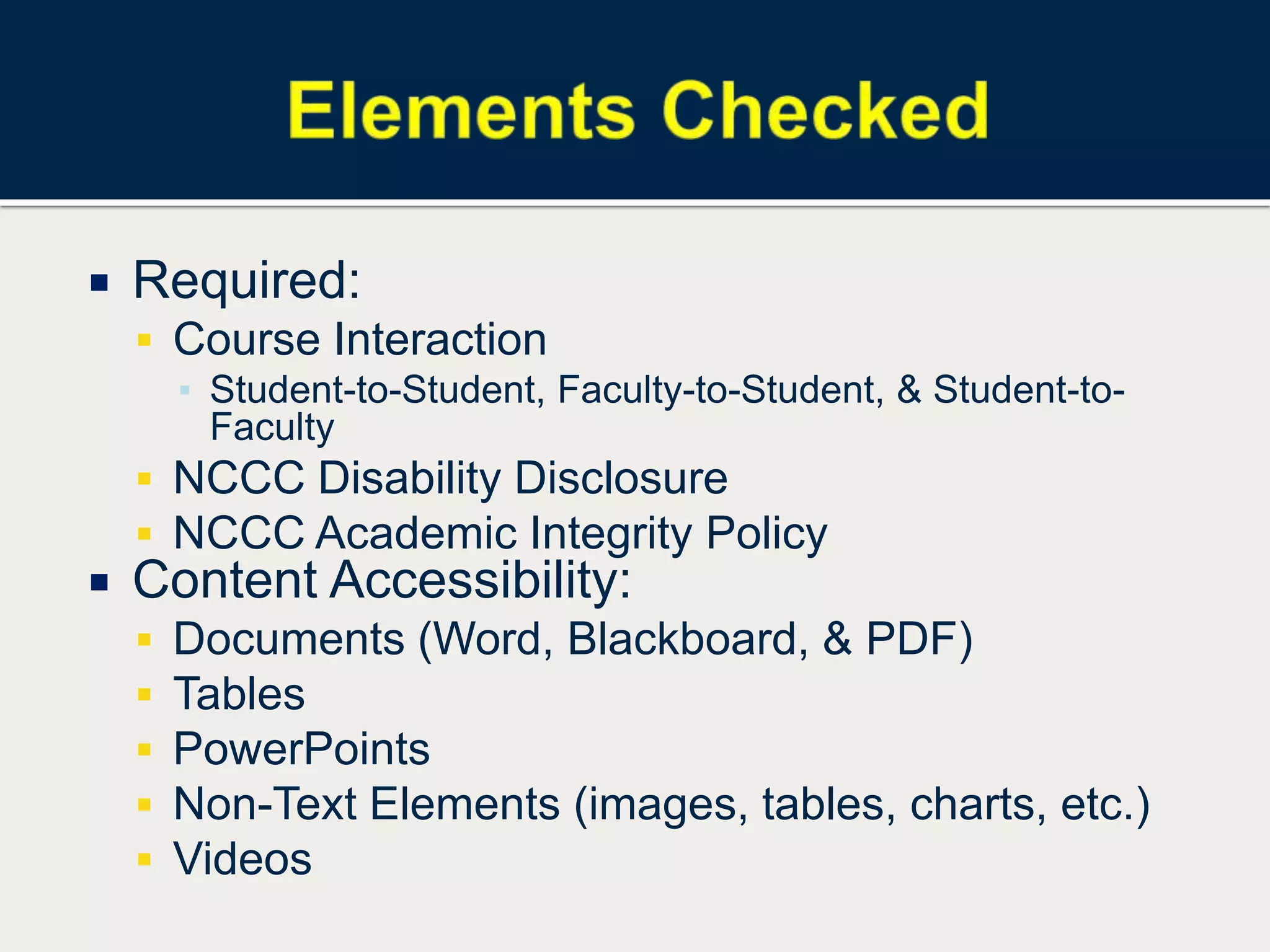
 Required:
 Course Interaction
▪ Student-to-Student, Faculty-to-Student, & Student-to-
Faculty
 NCCC Disability Disclosure
 NCCC Academic Integrity Policy
 Content Accessibility:
 Documents (Word, Blackboard, & PDF)
 Tables
 PowerPoints
 Non-Text Elements (images, tables, charts, etc.)
 Videos
 Checked
66 Courses
52 Faculty
3 Reviewers
Approx. 400 hours
0
10
20
30
40
50
60
70
Documents PowerPoints Tables Non-Text
Elements
Links Videos 3rd Party
Content
67
15
62 61
64
38
44
 Documents
 Font type, font size, colors
 Blackboard did not have a print function
 Documents were only offered in Word not PDF
 PDF
 Some PDF files were hand written and scanned
 Tables
 Blackboard does not have the ability to make
tables accessible – All docs with tables needed to
be created in Word
 Hyperlinks
 Showed URL not text, Alt Text was not provided
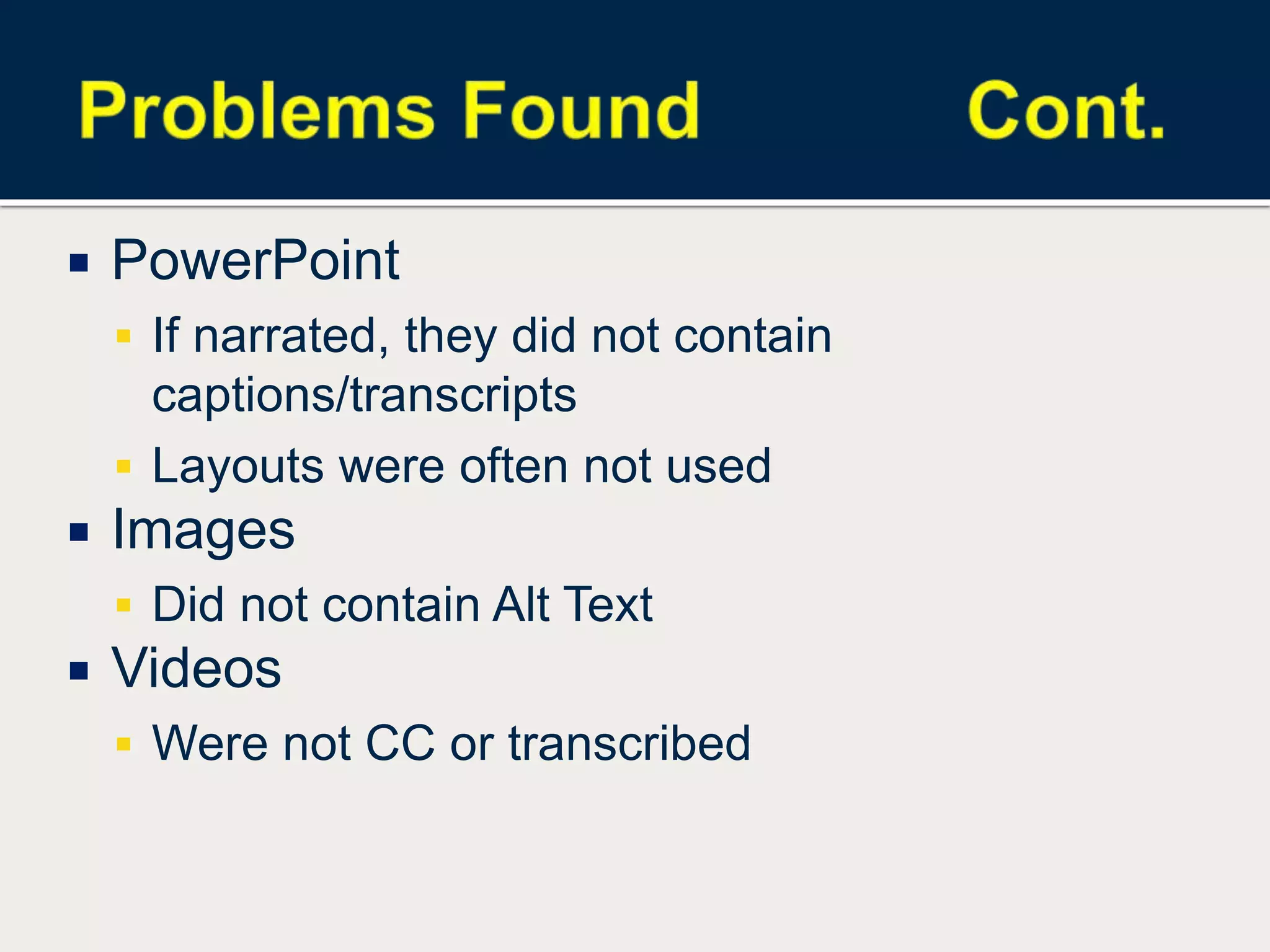
 PowerPoint
 If narrated, they did not contain
captions/transcripts
 Layouts were often not used
 Images
 Did not contain Alt Text
 Videos
 Were not CC or transcribed
 Provided Individual Results to Each
Faculty
 One-on-One Sessions
 30 Minute Mentor Monday’s (Recorded)
 Open Compliance Sessions
 Accessibility Resources
 Progress Survey Sent (End of the Fall
semester)
 13 Open Sessions
 12 One-on-One Meetings
 6 30 Minute Mentor Sessions
(Recorded)
 Accessibility Training –
Atomic Learning Videos
(Total Watching Time 20
min.)
 Self Evaluation (20 question
Quiz)
 Accessibility Resources
 Student Testimonials
 Tools and Techniques for
Improving Course
Accessibility (Magna
Commons)
Donna Simiele
eLearning Technology
Support Coordinator
dsimiele@niagaracc.suny.edu
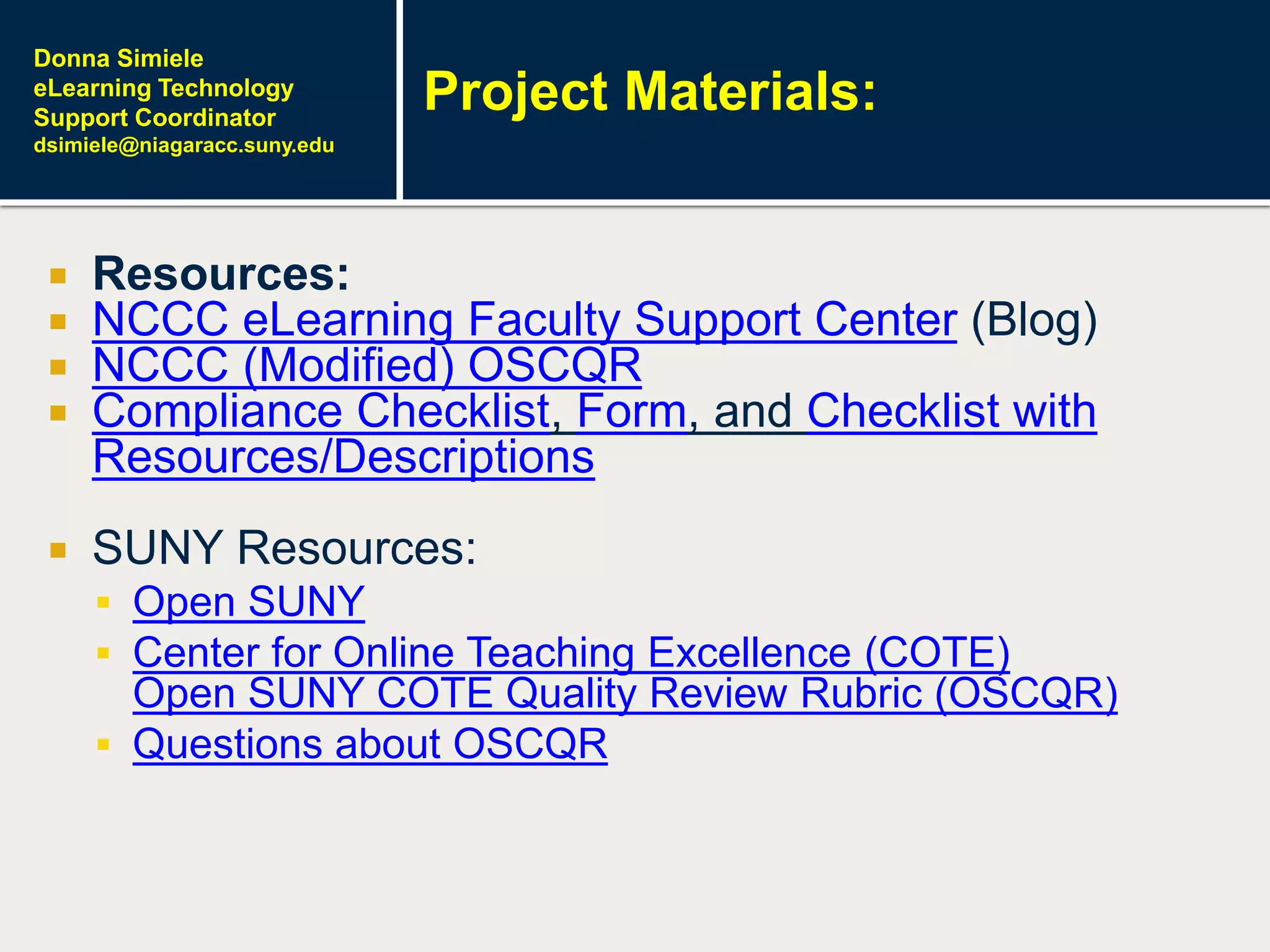
Project Materials:
 Resources:
 NCCC eLearning Faculty Support Center (Blog)
 NCCC (Modified) OSCQR
 Compliance Checklist, Form, and Checklist with
Resources/Descriptions
 SUNY Resources:
 Open SUNY
 Center for Online Teaching Excellence (COTE)
Open SUNY COTE Quality Review Rubric (OSCQR)
 Questions about OSCQR

ITC eLearning 2016 Donna Simiele

  • 1.
    Donna Simiele| eLearningTechnology Support Coordinator dsimiele@niagaracc.suny.edu SUNY –Niagara County Community College, Sanborn, NY www.niagaracc.suny.edu
  • 2.
     eLearning TechnologySupport Coordinator/Instructional Designer for 3 years  Teaching undergraduate on campus and online courses for 14 years  Quality Matters / OSCQR Reviewer  Open SUNY Center for Online Teaching Excellence (COTE) Expert Instructional Designer Fellow ncccelearning.com
  • 3.
    About SUNY &NCCC • 64 Campuses • 459,550 students • University Centers • University Colleges • Technology Colleges • Community Colleges
  • 5.
     NCCC hasbeen online for 16 years:  8 online programs,  2 online certifications,  180 online & blended courses/semester.
  • 6.
    Open SUNY isa SUNY-wide collaboration that opens the door to world-class online-enabled learning opportunities. Open SUNY is not a new degree program or a new school; it’s a seamless way for you to access the courses, degrees, professors, and rich academics of all 64 SUNY campuses flexibly— wherever and whenever you want. For the first time, SUNY is delivering its renowned high-quality education with an unprecedented breadth of tools, services, and supports designed to help you be successful. With Open SUNY, you can look forward to:  Flexibility  Support  Experience  Simplicity  Excellence Access
  • 7.
    Open SUNY -Center for Online Teaching Excellence SUNY has launched a new center that celebrates, connects, and grows effective online education practitioners across the SUNY system while also furthering our knowledge of the most effective teaching and learning practices in online education. Questions about COTE can be sent to contactcote@suny.edu
  • 9.
     Time ofregistration  Poor advising  Age  Engagement and Course Design  Development Needs  Gender  Technical Factors/Business Processes  First-time e-Learning student  Previous College Success- GPA  Learning Styles SUNY Directors of Distance Learning Environments
  • 10.
    1. New QualityReview Project Using OSCQR 2. eLearning Student Support Specialist 3. Creation of eLearning student success orientation (Blackboard Course) 4. LMS and technology workshops for students 5. IITG Grant – Building Accessible Content in online courses using Universal Design methods
  • 12.
    OSCQR Chico Rubric SLN Best Practices SUNY Office of General Counsel Quality Matters iNACOL Blackboard Community ofInquiry Seven Principles for Good Practice The Adult Learner Bloom’s Taxonomy How People Learn Open SUNY COTE
  • 13.
     About theNCCC Quality Review Project  The NCCC Quality Review process is a faculty-driven, collegial course design review process. The rubric does not evaluate the faculty member or the faculty member’s content expertise.  The review makes use of the Open SUNY COTE Quality Review Rubric known as “OSCQR.”  This project will help NCCC maintain and enhance the quality of its online courses through a process of continuous improvement.  This review process is not a part of NCCC’s faculty evaluation process. It evaluates the online course itself. The reviewers evaluate the course before it goes live so that the focus is on the course design, not the faculty member or how the course is run.  The review process is completely voluntary.
  • 14.
     OSCQR  NCCC(Modified) Version of OSCQR  Video about OSCQR  Meet the OSCQR Rubric (Alexandra Pickett)
  • 15.
     Accessibility Issues Open SUNY OSCQR included an Accessibility Component  NCCC Required Materials  Course Interaction
  • 16.
     Received aSUNY Innovative Instruction Technology Grant (IITG)  With Grant Funding: ▪ Built a compliance checklist (based on Middle States, Higher Education Opportunity Act, and OSCQR Accessibility standards) ▪ Checked online courses for compliance issues ▪ Sent findings to faculty ▪ Provided professional development sessions based on findings
  • 17.
     Required:  CourseInteraction ▪ Student-to-Student, Faculty-to-Student, & Student-to- Faculty  NCCC Disability Disclosure  NCCC Academic Integrity Policy  Content Accessibility:  Documents (Word, Blackboard, & PDF)  Tables  PowerPoints  Non-Text Elements (images, tables, charts, etc.)  Videos
  • 18.
     Checked 66 Courses 52Faculty 3 Reviewers Approx. 400 hours
  • 20.
    0 10 20 30 40 50 60 70 Documents PowerPoints TablesNon-Text Elements Links Videos 3rd Party Content 67 15 62 61 64 38 44
  • 21.
     Documents  Fonttype, font size, colors  Blackboard did not have a print function  Documents were only offered in Word not PDF  PDF  Some PDF files were hand written and scanned  Tables  Blackboard does not have the ability to make tables accessible – All docs with tables needed to be created in Word  Hyperlinks  Showed URL not text, Alt Text was not provided
  • 22.
     PowerPoint  Ifnarrated, they did not contain captions/transcripts  Layouts were often not used  Images  Did not contain Alt Text  Videos  Were not CC or transcribed
  • 23.
     Provided IndividualResults to Each Faculty  One-on-One Sessions  30 Minute Mentor Monday’s (Recorded)  Open Compliance Sessions  Accessibility Resources  Progress Survey Sent (End of the Fall semester)
  • 24.
     13 OpenSessions  12 One-on-One Meetings  6 30 Minute Mentor Sessions (Recorded)
  • 25.
     Accessibility Training– Atomic Learning Videos (Total Watching Time 20 min.)  Self Evaluation (20 question Quiz)  Accessibility Resources  Student Testimonials  Tools and Techniques for Improving Course Accessibility (Magna Commons)
  • 26.
    Donna Simiele eLearning Technology SupportCoordinator dsimiele@niagaracc.suny.edu Project Materials:  Resources:  NCCC eLearning Faculty Support Center (Blog)  NCCC (Modified) OSCQR  Compliance Checklist, Form, and Checklist with Resources/Descriptions  SUNY Resources:  Open SUNY  Center for Online Teaching Excellence (COTE) Open SUNY COTE Quality Review Rubric (OSCQR)  Questions about OSCQR

Editor's Notes

  • #4 427,000 students in 2013 – 239,791 Enrollments in Community Colleges
  • #5 Our campus is located about 10 miles from Niagara Falls New York
  • #7 SLN has morphed into Open SUNY. How has Open SUNY changed?
  • #8 This vibrant community combines the knowledge and experience of researchers, instructional designers, librarians, technologists, and online educators. Non-SUNY faculty can join as interested participants. Offer Community Discussion boards COTE Chats
  • #9 Why did we need Quality Reviews Performed at NCCC? - Trying to increase student success and retention.
  • #10 Look at risk factors and focused on the two factors that we had control over. - Course Design & Learning Styles
  • #11 These are some of the initiatives that we worked on since my predecessor Lisa Dubuc presented two years ago. -We moved from using Quality Matters for course reviews to OSCQR in 2014.
  • #12 Open SUNY was formally known as SUNY Learning Network or SLN. OSCQR was developed to replace the QM rubric for reviewing online courses. To enable campuses to ensure that their online courses are learner centric and well designed, a team of Open SUNY Center for Online Teaching Excellence staff and campus stakeholders has designed the OSCQR Rubric, a customizable and flexible tool for measurement. The 37 incorporated standards focus on course design from the perspective of the Community of Inquiry (CoI) model, and help reviewers assess opportunities for social presence, cognitive presence, and teaching presence in addition to the overall online course educational experience.  The OSCQR Rubric is intended to be used for assessing course design rather than the actual course delivery.
  • #13 The rubric started with the Chico Rubric, twenty years of SUNY Learning Network research informed best online practices, the SUNY Office of General Counsel’s, memorandum on accessibility considerations, and conducted a gap analysis with the Quality Matters, iNACOL (North American Council for Online Learning- international), and Blackboard Exemplary Courses. The resulting 37 point checklist also incorporates the Community of Inquiry Model, the Seven Principles for Good Practice in Undergraduate Education, the Adult Learner, Bloom’s Taxonomy, How People Learn, and has been mapped to the Open SUNY COTE fundamental and core competencies for online course design.
  • #14 We used QM from 2011 to 2014. Once SUNY built the OSCQR rubric we trained several of our reviewers to use the new rubric.
  • #16 While using the new OSCQR rubric to do Quality Reviews at NCCC we found a need to delve deeper into the accessibility issues and other required materials for online courses.
  • #17 We felt that funding was needed in order to do a check of this magnitude. We modified the OSCQR Accessibility rubric by building a checklist that can be used by all faculty to check their courses. This checklist not only included specific aspects to look for based on accessibility but also the materials required by NCCC and Middle States. (e.g. course interaction) The SUNY IITG grant was used to check online courses at NCCC to see where we could build professional development sessions that would provide the necessary skills to make the needed updates for compliance issues along with necessary standards set by Middle States and the Higher Education Opportunity Act. Part of our compliance checklist looked into student-to-student, faculty-to-student, and student-to-faculty interaction. These forms of interact are required by Middle States for all online courses.
  • #18 Not only did we look at the accessibility requirements but also used the theory of Universal Design.
  • #19 We checked at least one course taught by each faculty member. We found that the same issues were occurring in all of the courses so we thought our time was better spent selecting one course per faculty.
  • #21 MyLabs was the highest 3rd Party content at 13 courses. -Cengage (SAM) -McGraw Hill (Connect) -Websites Etc.
  • #24 Using the Survey from faculty we decided it was best to work with faculty in a more one-on-one setting. We continued to have open sessions this semester but several faculty scheduled appointments or called to discuss their individual results.
  • #26 This training is currently available in the Bb eLearning Faculty User Group.