The Ticket to Success in 
Supporting Faculty Online 
Course Development 
Mariann Hawken § HBCU Leadership Summit 
Online Learning Consortium Conference, Orlando, FL 
#alnhbcu-hawken #hbcu2014 #aln14 
October 29, 2014
Instructional 
Technology 
Specialist 
July 7th - now 
Instructional 
Technologist 
Sept ‘07 – July 
’14 
(1999 – 2014) 
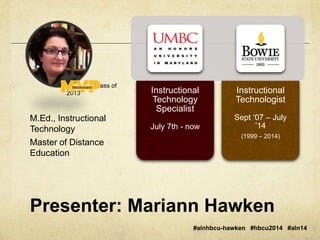
Presenter: Mariann Hawken 
#alnhbcu-hawken #hbcu2014 #aln14 
Class of 
2013 
M.Ed., Instructional 
Technology 
Master of Distance 
Education
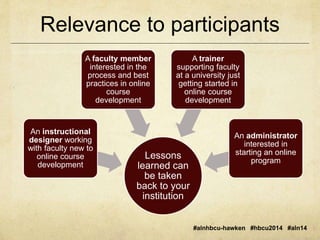
Relevance to participants 
#alnhbcu-hawken #hbcu2014 #aln14 
Lessons 
learned can 
be taken 
back to your 
institution 
An instructional 
designer working 
with faculty new to 
online course 
development 
A faculty member 
interested in the 
process and best 
practices in online 
course 
development 
A trainer 
supporting faculty 
at a university just 
getting started in 
online course 
development 
An administrator 
interested in 
starting an online 
program
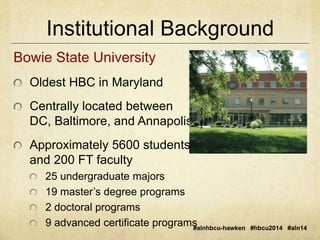
Institutional Background 
#alnhbcu-hawken #hbcu2014 #aln14 
Bowie State University 
Oldest HBC in Maryland 
Centrally located between 
DC, Baltimore, and Annapolis 
Approximately 5600 students 
and 200 FT faculty 
25 undergraduate majors 
19 master’s degree programs 
2 doctoral programs 
9 advanced certificate programs
Defining the Need - External 
Online education is more likely to be considered 
as necessary for survival by public institutions 
& distance education enrollment is growing very 
fast. (Sloan-C, 2010) 
Distance education provides positive 
alternatives to the rapidly growing population 
of non-traditional students. (Folkers, 2005) 
However, a “critical mass of adopters is needed 
to convince the majority of [others] of the utility of 
the technology.” (Baltaci-Goktalay & Ocak, 2006) 
#alnhbcu-hawken #hbcu2014 #aln14
Defining the Need - Internal 
#alnhbcu-hawken #hbcu2014 #aln14 
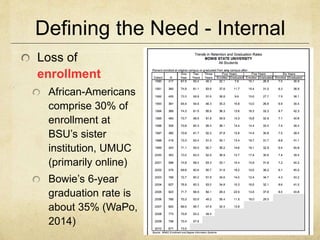
Loss of 
enrollment 
African-Americans 
comprise 30% of 
enrollment at 
BSU’s sister 
institution, UMUC 
(primarily online) 
Bowie’s 6-year 
graduation rate is 
about 35% (WaPo, 
2014)
Defining the Need - Internal 
#alnhbcu-hawken #hbcu2014 #aln14 
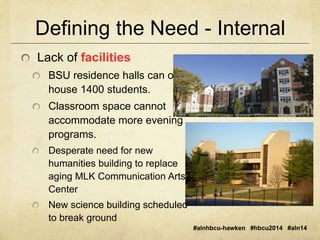
Lack of facilities 
BSU residence halls can only 
house 1400 students. 
Classroom space cannot 
accommodate more evening 
programs. 
Desperate need for new 
humanities building to replace 
aging MLK Communication Arts 
Center 
New science building scheduled 
to break ground
Defining the Need - Internal 
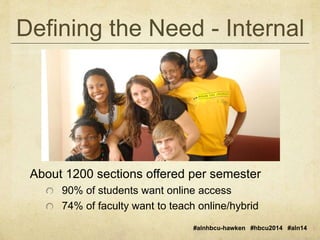
About 1200 sections offered per semester 
90% of students want online access 
74% of faculty want to teach online/hybrid 
#alnhbcu-hawken #hbcu2014 #aln14
Further challenges… 
Any instructor could offer an online or hybrid 
course 
#alnhbcu-hawken #hbcu2014 #aln14 
However… 
No department approval or awareness 
No development required 
No evaluation before/during/after 
No training required
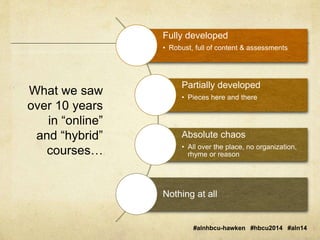
Fully developed 
• Robust, full of content & assessments 
Partially developed 
• Pieces here and there 
Absolute chaos 
• All over the place, no organization, 
rhyme or reason 
Nothing at all 
#alnhbcu-hawken #hbcu2014 #aln14 
What we saw 
over 10 years 
in “online” 
and “hybrid” 
courses…
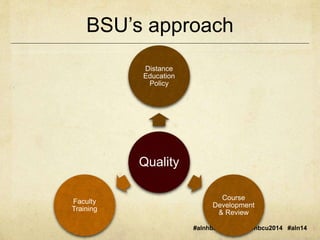
BSU’s approach 
#alnhbcu-hawken #hbcu2014 #aln14 
Distance 
Education 
Policy 
Quality 
Course 
Development 
& Review 
Faculty 
Training
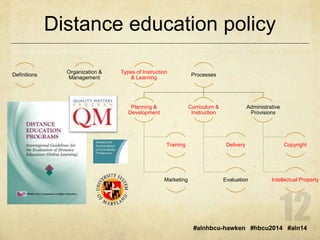
Distance education policy 
Administrative 
Provisions 
#alnhbcu-hawken #hbcu2014 #aln14 
Definitions 
Organization & 
Management 
Types of Instruction 
& Learning 
Processes 
Planning & 
Development 
Training 
Marketing 
Curriculum & 
Instruction 
Delivery 
Evaluation 
Copyright 
Intellectual Property
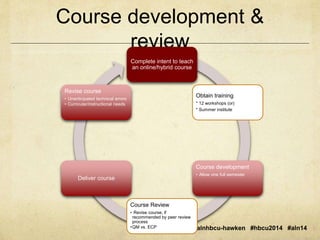
Course development & 
#alnhbcu-hawken #hbcu2014 #aln14 
review 
Complete intent to teach 
an online/hybrid course 
Obtain training 
* 12 workshops (or) 
* Summer institute 
Course development 
• Allow one full semester 
Course Review 
• Revise course, if 
recommended by peer review 
process 
•QM vs. ECP 
Revise course 
• Unanticipated technical errors 
• Curricular/instructional needs 
Deliver course
Examples of previous 
training 
#alnhbcu-hawken #hbcu2014 #aln14
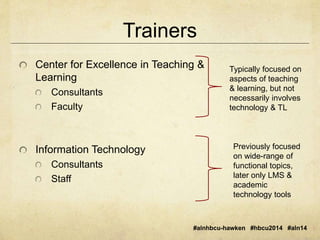
Trainers 
Center for Excellence in Teaching & 
Learning 
#alnhbcu-hawken #hbcu2014 #aln14 
Consultants 
Faculty 
Information Technology 
Consultants 
Staff 
Typically focused on 
aspects of teaching 
& learning, but not 
necessarily involves 
technology & TL 
Previously focused 
on wide-range of 
functional topics, 
later only LMS & 
academic 
technology tools
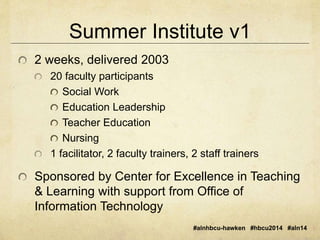
Summer Institute v1 
#alnhbcu-hawken #hbcu2014 #aln14 
2 weeks, delivered 2003 
20 faculty participants 
Social Work 
Education Leadership 
Teacher Education 
Nursing 
1 facilitator, 2 faculty trainers, 2 staff trainers 
Sponsored by Center for Excellence in Teaching 
& Learning with support from Office of 
Information Technology
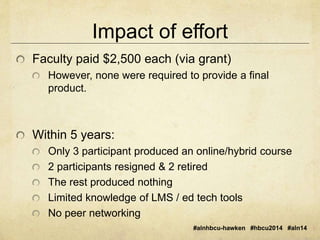
Impact of effort 
Faculty paid $2,500 each (via grant) 
However, none were required to provide a final 
product. 
#alnhbcu-hawken #hbcu2014 #aln14 
Within 5 years: 
Only 3 participant produced an online/hybrid course 
2 participants resigned & 2 retired 
The rest produced nothing 
Limited knowledge of LMS / ed tech tools 
No peer networking
Observations 
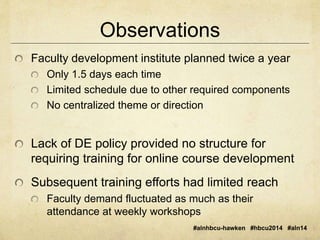
Faculty development institute planned twice a year 
Only 1.5 days each time 
Limited schedule due to other required components 
No centralized theme or direction 
Lack of DE policy provided no structure for 
requiring training for online course development 
Subsequent training efforts had limited reach 
Faculty demand fluctuated as much as their 
attendance at weekly workshops 
#alnhbcu-hawken #hbcu2014 #aln14
Time to Reboot 
#alnhbcu-hawken #hbcu2014 #aln14
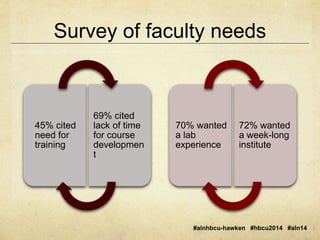
Survey of faculty needs 
#alnhbcu-hawken #hbcu2014 #aln14 
45% cited 
need for 
training 
69% cited 
lack of time 
for course 
developmen 
t 
70% wanted 
a lab 
experience 
72% wanted 
a week-long 
institute
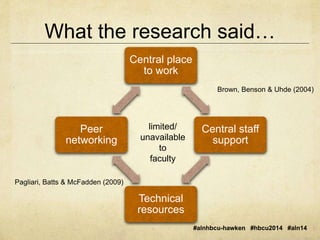
What the research said… 
#alnhbcu-hawken #hbcu2014 #aln14 
Central place 
to work 
Central staff 
support 
Technical 
resources 
Peer 
networking 
limited/ 
unavailable 
to 
faculty 
Pagliari, Batts & McFadden (2009) 
Brown, Benson & Uhde (2004)
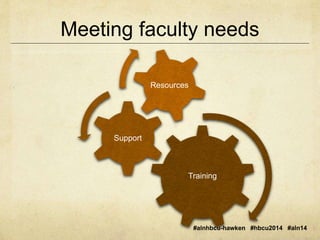
Meeting faculty needs 
Training 
#alnhbcu-hawken #hbcu2014 #aln14 
Support 
Resources
LOTTO Institute 
Modeled after 2003 effort in concept 
Time reduced to 1 week to accommodate faculty 
schedules/vacations 
Planned for 1st week in June 
Lack of funding eliminated faculty stipends 
However, we could provide meals 
#alnhbcu-hawken #hbcu2014 #aln14
LOTTO Institute 
Faculty identified and directly invited (year 1) 
Years 2-5: open invitation to apply 
75+ faculty and 3 librarians participated over 5 years 
AVP for GenEd Assessment also attended 
ENGL / COSC chairs also attended 
Organized by theme/purpose per day 
#alnhbcu-hawken #hbcu2014 #aln14
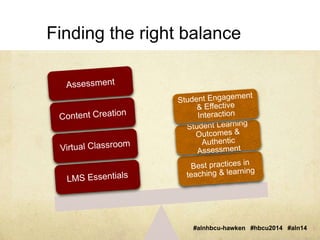
Technical Pedagogy Finding the right balance 
#alnhbcu-hawken #hbcu2014 #aln14
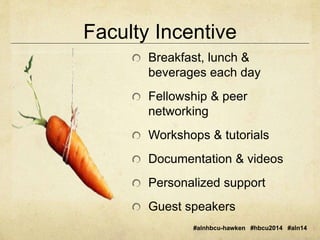
Faculty Incentive 
Breakfast, lunch & 
beverages each day 
Fellowship & peer 
networking 
Workshops & tutorials 
Documentation & videos 
Personalized support 
Guest speakers 
#alnhbcu-hawken #hbcu2014 #aln14
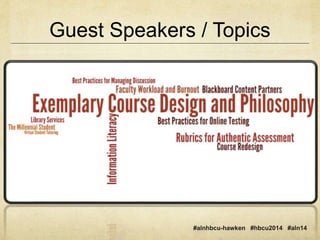
Guest Speakers / Topics 
#alnhbcu-hawken #hbcu2014 #aln14
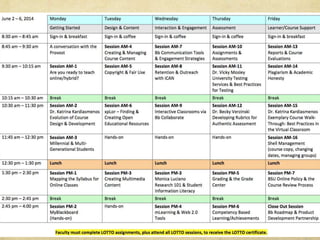
LOTTO Institute v2 
#alnhbcu-hawken #hbcu2014 #aln14
LOTTO Institute v2 
#alnhbcu-hawken #hbcu2014 #aln14
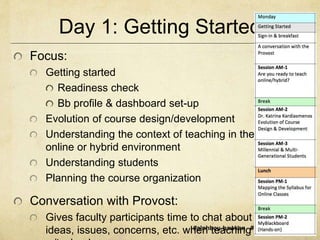
Day 1: Getting Started 
#alnhbcu-hawken #hbcu2014 #aln14 
Focus: 
Getting started 
Readiness check 
Bb profile & dashboard set-up 
Evolution of course design/development 
Understanding the context of teaching in the 
online or hybrid environment 
Understanding students 
Planning the course organization 
Conversation with Provost: 
Gives faculty participants time to chat about 
ideas, issues, concerns, etc. when teaching 
w/technology
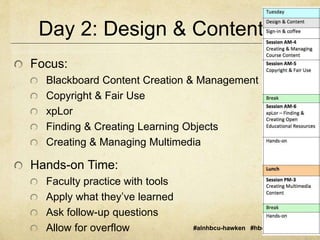
Day 2: Design & Content 
#alnhbcu-hawken #hbcu2014 #aln14 
Focus: 
Blackboard Content Creation & Management 
Copyright & Fair Use 
xpLor 
Finding & Creating Learning Objects 
Creating & Managing Multimedia 
Hands-on Time: 
Faculty practice with tools 
Apply what they’ve learned 
Ask follow-up questions 
Allow for overflow
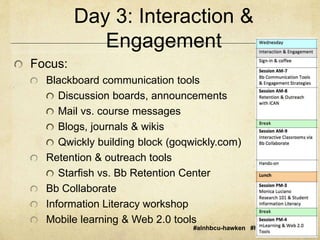
Day 3: Interaction & 
Engagement 
#alnhbcu-hawken #hbcu2014 #aln14 
Focus: 
Blackboard communication tools 
Discussion boards, announcements 
Mail vs. course messages 
Blogs, journals & wikis 
Qwickly building block (goqwickly.com) 
Retention & outreach tools 
Starfish vs. Bb Retention Center 
Bb Collaborate 
Information Literacy workshop 
Mobile learning & Web 2.0 tools
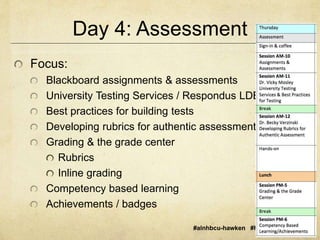
Day 4: Assessment 
#alnhbcu-hawken #hbcu2014 #aln14 
Focus: 
Blackboard assignments & assessments 
University Testing Services / Respondus LDB 
Best practices for building tests 
Developing rubrics for authentic assessment 
Grading & the grade center 
Rubrics 
Inline grading 
Competency based learning 
Achievements / badges
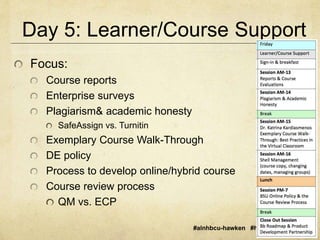
Day 5: Learner/Course Support 
#alnhbcu-hawken #hbcu2014 #aln14 
Focus: 
Course reports 
Enterprise surveys 
Plagiarism& academic honesty 
SafeAssign vs. Turnitin 
Exemplary Course Walk-Through 
DE policy 
Process to develop online/hybrid course 
Course review process 
QM vs. ECP
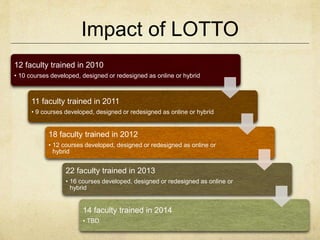
Impact of LOTTO 
12 faculty trained in 2010 
• 10 courses developed, designed or redesigned as online or hybrid 
11 faculty trained in 2011 
• 9 courses developed, designed or redesigned as online or hybrid 
18 faculty trained in 2012 
• 12 courses developed, designed or redesigned as online or 
hybrid 
22 faculty trained in 2013 
• 16 courses developed, designed or redesigned as online or 
hybrid 
#alnhbcu-hawken #hbcu2014 #aln14 
14 faculty trained in 2014 
• TBD
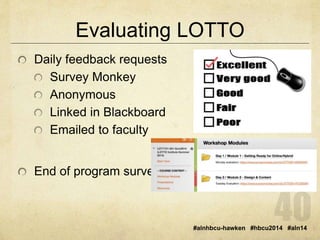
Evaluating LOTTO 
#alnhbcu-hawken #hbcu2014 #aln14 
Daily feedback requests 
Survey Monkey 
Anonymous 
Linked in Blackboard 
Emailed to faculty 
End of program survey
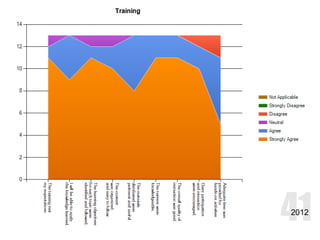
2012 
#alnhbcu-hawken #hbcu2014 #aln14
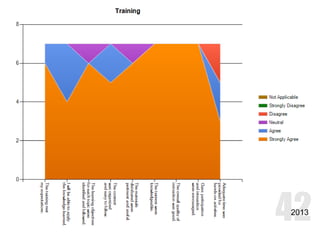
2013 
#alnhbcu-hawken #hbcu2014 #aln14
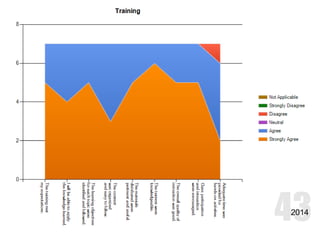
2014 
#alnhbcu-hawken #hbcu2014 #aln14
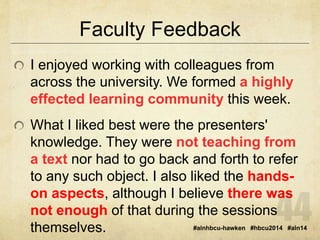
Faculty Feedback 
I enjoyed working with colleagues from 
across the university. We formed a highly 
effected learning community this week. 
What I liked best were the presenters' 
knowledge. They were not teaching from 
a text nor had to go back and forth to refer 
to any such object. I also liked the hands-on 
aspects, although I believe there was 
not enough of that during the sessions 
themselves. 
#alnhbcu-hawken #hbcu2014 #aln14
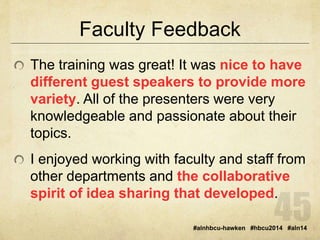
Faculty Feedback 
The training was great! It was nice to have 
different guest speakers to provide more 
variety. All of the presenters were very 
knowledgeable and passionate about their 
topics. 
I enjoyed working with faculty and staff from 
other departments and the collaborative 
spirit of idea sharing that developed. 
#alnhbcu-hawken #hbcu2014 #aln14
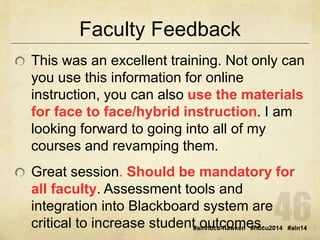
Faculty Feedback 
This was an excellent training. Not only can 
you use this information for online 
instruction, you can also use the materials 
for face to face/hybrid instruction. I am 
looking forward to going into all of my 
courses and revamping them. 
Great session. Should be mandatory for 
all faculty. Assessment tools and 
integration into Blackboard system are 
critical to increase student outcomes. 
#alnhbcu-hawken #hbcu2014 #aln14
Faculty Feedback 
The lab was practically standing room 
only, but it worked! 
I enjoyed most being exposed to so many 
different ideas about how to teach class 
differently. 
#alnhbcu-hawken #hbcu2014 #aln14
Faculty Feedback 
Agenda is very professionally done. Links 
to Blackboard menu items and making the 
material available after the class is over 
is such a great asset. The PM-5 /AM-15 
type of tagging menu items was informative 
way of organizing the presentations. 
#alnhbcu-hawken #hbcu2014 #aln14
Faculty Feedback 
I thoroughly enjoyed the LOTTO Institute. I 
particularly benefited from the step by step 
guidance for navigating Bb, practical tips 
for preparing to teach online and the 
awesome demonstrations of cool online 
resources to enhance your courses. I also 
appreciated the opportunity to interact 
with other faculty across disciplines. Did 
I mention the great and filling menu? 
#alnhbcu-hawken #hbcu2014 #aln14
Post-LOTTO Support 
#alnhbcu-hawken #hbcu2014 #aln14 
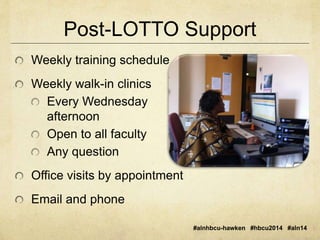
Weekly training schedule 
Weekly walk-in clinics 
Every Wednesday 
afternoon 
Open to all faculty 
Any question 
Office visits by appointment 
Email and phone
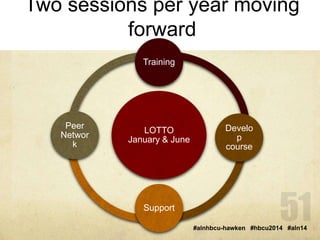
Two sessions per year moving 
forward 
#alnhbcu-hawken #hbcu2014 #aln14 
Training 
LOTTO 
January & June 
Develo 
p 
course 
Support 
Peer 
Networ 
k
#alnhbcu-hawken #hbcu2014 #aln14
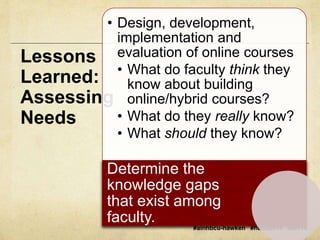
• Design, development, 
implementation and 
evaluation of online courses 
• What do faculty think they 
#alnhbcu-hawken #hbcu2014 #aln14 
Lessons 
Learned: 
Assessing 
Needs 
know about building 
online/hybrid courses? 
• What do they really know? 
• What should they know? 
Determine the 
knowledge gaps 
that exist among 
faculty.
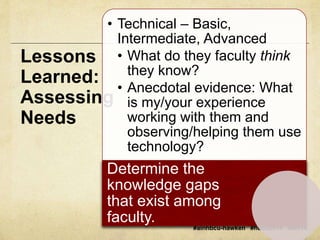
• Technical – Basic, 
Intermediate, Advanced 
• What do they faculty think 
#alnhbcu-hawken #hbcu2014 #aln14 
Lessons 
Learned: 
Assessing 
Needs 
they know? 
• Anecdotal evidence: What 
is my/your experience 
working with them and 
observing/helping them use 
technology? 
Determine the 
knowledge gaps 
that exist among 
faculty.
• Pedagogy – Online/Digital 
Context 
• Have they ever taken an 
#alnhbcu-hawken #hbcu2014 #aln14 
Lessons 
Learned: 
Assessing 
Needs 
online/hybrid course before 
planning to teach? 
• How do they currently use 
technology for teaching? 
Determine the 
knowledge gaps 
that exist among 
faculty.
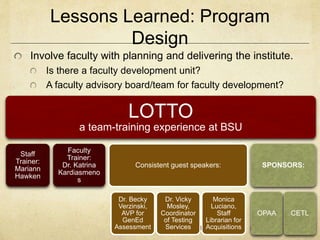
Lessons Learned: Program 
#alnhbcu-hawken #hbcu2014 #aln14 
Design 
Involve faculty with planning and delivering the institute. 
Is there a faculty development unit? 
A faculty advisory board/team for faculty development? 
LOTTO 
a team-training experience at BSU 
Staff 
Trainer: 
Mariann 
Hawken 
Faculty 
Trainer: 
Dr. Katrina 
Kardiasmeno 
s 
Consistent guest speakers: 
Dr. Becky 
Verzinski, 
AVP for 
GenEd 
Assessment 
Dr. Vicky 
Mosley, 
Coordinator 
of Testing 
Services 
Monica 
Luciano, 
Staff 
Librarian for 
Acquisitions 
SPONSORS: 
OPAA CETL
Lessons Learned: Funding 
#alnhbcu-hawken #hbcu2014 #aln14 
Weigh the pros/cons of funding 
Who pays? Annual budget vs. find the funds? 
Stable amount vs. flexible amount 
How does the amount impact the budget? 
Faculty stipends 
Will there be requirements to receive payment? 
Guest speakers 
Meals
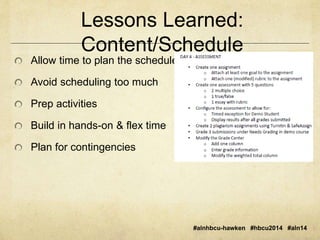
Lessons Learned: 
Content/Schedule 
#alnhbcu-hawken #hbcu2014 #aln14 
Allow time to plan the schedule 
Avoid scheduling too much 
Prep activities 
Build in hands-on & flex time 
Plan for contingencies
Lessons Learned: Program 
Assessment 
#alnhbcu-hawken #hbcu2014 #aln14 
Outcome Measures 
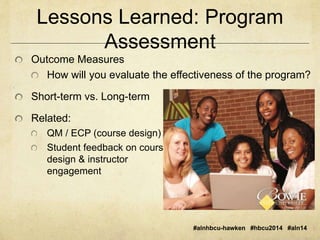
How will you evaluate the effectiveness of the program? 
Short-term vs. Long-term 
Related: 
QM / ECP (course design) 
Student feedback on course 
design & instructor 
engagement
Questions? 
#alnhbcu-hawken #hbcu2014 #aln14 
Mariann Hawken 
Instructional Technology Specialist 
University of Maryland Baltimore County 
Formerly of Bowie State University 
mariannhawken@umbc.edu 
@marihawk

Winning the LOTTO: The Ticket to Success in Supporting Online Course Development

  • 1.
    The Ticket toSuccess in Supporting Faculty Online Course Development Mariann Hawken § HBCU Leadership Summit Online Learning Consortium Conference, Orlando, FL #alnhbcu-hawken #hbcu2014 #aln14 October 29, 2014
  • 2.
    Instructional Technology Specialist July 7th - now Instructional Technologist Sept ‘07 – July ’14 (1999 – 2014) Presenter: Mariann Hawken #alnhbcu-hawken #hbcu2014 #aln14 Class of 2013 M.Ed., Instructional Technology Master of Distance Education
  • 3.
    Relevance to participants #alnhbcu-hawken #hbcu2014 #aln14 Lessons learned can be taken back to your institution An instructional designer working with faculty new to online course development A faculty member interested in the process and best practices in online course development A trainer supporting faculty at a university just getting started in online course development An administrator interested in starting an online program
  • 4.
    Institutional Background #alnhbcu-hawken#hbcu2014 #aln14 Bowie State University Oldest HBC in Maryland Centrally located between DC, Baltimore, and Annapolis Approximately 5600 students and 200 FT faculty 25 undergraduate majors 19 master’s degree programs 2 doctoral programs 9 advanced certificate programs
  • 5.
    Defining the Need- External Online education is more likely to be considered as necessary for survival by public institutions & distance education enrollment is growing very fast. (Sloan-C, 2010) Distance education provides positive alternatives to the rapidly growing population of non-traditional students. (Folkers, 2005) However, a “critical mass of adopters is needed to convince the majority of [others] of the utility of the technology.” (Baltaci-Goktalay & Ocak, 2006) #alnhbcu-hawken #hbcu2014 #aln14
  • 6.
    Defining the Need- Internal #alnhbcu-hawken #hbcu2014 #aln14 Loss of enrollment African-Americans comprise 30% of enrollment at BSU’s sister institution, UMUC (primarily online) Bowie’s 6-year graduation rate is about 35% (WaPo, 2014)
  • 7.
    Defining the Need- Internal #alnhbcu-hawken #hbcu2014 #aln14 Lack of facilities BSU residence halls can only house 1400 students. Classroom space cannot accommodate more evening programs. Desperate need for new humanities building to replace aging MLK Communication Arts Center New science building scheduled to break ground
  • 8.
    Defining the Need- Internal About 1200 sections offered per semester 90% of students want online access 74% of faculty want to teach online/hybrid #alnhbcu-hawken #hbcu2014 #aln14
  • 9.
    Further challenges… Anyinstructor could offer an online or hybrid course #alnhbcu-hawken #hbcu2014 #aln14 However… No department approval or awareness No development required No evaluation before/during/after No training required
  • 10.
    Fully developed •Robust, full of content & assessments Partially developed • Pieces here and there Absolute chaos • All over the place, no organization, rhyme or reason Nothing at all #alnhbcu-hawken #hbcu2014 #aln14 What we saw over 10 years in “online” and “hybrid” courses…
  • 11.
    BSU’s approach #alnhbcu-hawken#hbcu2014 #aln14 Distance Education Policy Quality Course Development & Review Faculty Training
  • 12.
    Distance education policy Administrative Provisions #alnhbcu-hawken #hbcu2014 #aln14 Definitions Organization & Management Types of Instruction & Learning Processes Planning & Development Training Marketing Curriculum & Instruction Delivery Evaluation Copyright Intellectual Property
  • 13.
    Course development & #alnhbcu-hawken #hbcu2014 #aln14 review Complete intent to teach an online/hybrid course Obtain training * 12 workshops (or) * Summer institute Course development • Allow one full semester Course Review • Revise course, if recommended by peer review process •QM vs. ECP Revise course • Unanticipated technical errors • Curricular/instructional needs Deliver course
  • 14.
    Examples of previous training #alnhbcu-hawken #hbcu2014 #aln14
  • 15.
    Trainers Center forExcellence in Teaching & Learning #alnhbcu-hawken #hbcu2014 #aln14 Consultants Faculty Information Technology Consultants Staff Typically focused on aspects of teaching & learning, but not necessarily involves technology & TL Previously focused on wide-range of functional topics, later only LMS & academic technology tools
  • 16.
    Summer Institute v1 #alnhbcu-hawken #hbcu2014 #aln14 2 weeks, delivered 2003 20 faculty participants Social Work Education Leadership Teacher Education Nursing 1 facilitator, 2 faculty trainers, 2 staff trainers Sponsored by Center for Excellence in Teaching & Learning with support from Office of Information Technology
  • 17.
    Impact of effort Faculty paid $2,500 each (via grant) However, none were required to provide a final product. #alnhbcu-hawken #hbcu2014 #aln14 Within 5 years: Only 3 participant produced an online/hybrid course 2 participants resigned & 2 retired The rest produced nothing Limited knowledge of LMS / ed tech tools No peer networking
  • 18.
    Observations Faculty developmentinstitute planned twice a year Only 1.5 days each time Limited schedule due to other required components No centralized theme or direction Lack of DE policy provided no structure for requiring training for online course development Subsequent training efforts had limited reach Faculty demand fluctuated as much as their attendance at weekly workshops #alnhbcu-hawken #hbcu2014 #aln14
  • 19.
    Time to Reboot #alnhbcu-hawken #hbcu2014 #aln14
  • 20.
    Survey of facultyneeds #alnhbcu-hawken #hbcu2014 #aln14 45% cited need for training 69% cited lack of time for course developmen t 70% wanted a lab experience 72% wanted a week-long institute
  • 21.
    What the researchsaid… #alnhbcu-hawken #hbcu2014 #aln14 Central place to work Central staff support Technical resources Peer networking limited/ unavailable to faculty Pagliari, Batts & McFadden (2009) Brown, Benson & Uhde (2004)
  • 22.
    Meeting faculty needs Training #alnhbcu-hawken #hbcu2014 #aln14 Support Resources
  • 23.
    LOTTO Institute Modeledafter 2003 effort in concept Time reduced to 1 week to accommodate faculty schedules/vacations Planned for 1st week in June Lack of funding eliminated faculty stipends However, we could provide meals #alnhbcu-hawken #hbcu2014 #aln14
  • 24.
    LOTTO Institute Facultyidentified and directly invited (year 1) Years 2-5: open invitation to apply 75+ faculty and 3 librarians participated over 5 years AVP for GenEd Assessment also attended ENGL / COSC chairs also attended Organized by theme/purpose per day #alnhbcu-hawken #hbcu2014 #aln14
  • 25.
    Technical Pedagogy Findingthe right balance #alnhbcu-hawken #hbcu2014 #aln14
  • 26.
    Faculty Incentive Breakfast,lunch & beverages each day Fellowship & peer networking Workshops & tutorials Documentation & videos Personalized support Guest speakers #alnhbcu-hawken #hbcu2014 #aln14
  • 27.
    Guest Speakers /Topics #alnhbcu-hawken #hbcu2014 #aln14
  • 28.
    LOTTO Institute v2 #alnhbcu-hawken #hbcu2014 #aln14
  • 29.
    LOTTO Institute v2 #alnhbcu-hawken #hbcu2014 #aln14
  • 30.
  • 31.
  • 32.
  • 33.
  • 34.
    Day 1: GettingStarted #alnhbcu-hawken #hbcu2014 #aln14 Focus: Getting started Readiness check Bb profile & dashboard set-up Evolution of course design/development Understanding the context of teaching in the online or hybrid environment Understanding students Planning the course organization Conversation with Provost: Gives faculty participants time to chat about ideas, issues, concerns, etc. when teaching w/technology
  • 35.
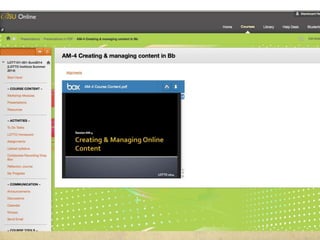
    Day 2: Design& Content #alnhbcu-hawken #hbcu2014 #aln14 Focus: Blackboard Content Creation & Management Copyright & Fair Use xpLor Finding & Creating Learning Objects Creating & Managing Multimedia Hands-on Time: Faculty practice with tools Apply what they’ve learned Ask follow-up questions Allow for overflow
  • 36.
    Day 3: Interaction& Engagement #alnhbcu-hawken #hbcu2014 #aln14 Focus: Blackboard communication tools Discussion boards, announcements Mail vs. course messages Blogs, journals & wikis Qwickly building block (goqwickly.com) Retention & outreach tools Starfish vs. Bb Retention Center Bb Collaborate Information Literacy workshop Mobile learning & Web 2.0 tools
  • 37.
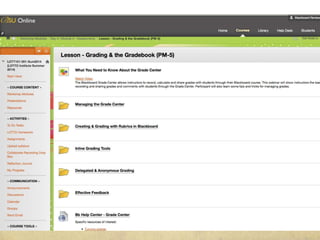
    Day 4: Assessment #alnhbcu-hawken #hbcu2014 #aln14 Focus: Blackboard assignments & assessments University Testing Services / Respondus LDB Best practices for building tests Developing rubrics for authentic assessment Grading & the grade center Rubrics Inline grading Competency based learning Achievements / badges
  • 38.
    Day 5: Learner/CourseSupport #alnhbcu-hawken #hbcu2014 #aln14 Focus: Course reports Enterprise surveys Plagiarism& academic honesty SafeAssign vs. Turnitin Exemplary Course Walk-Through DE policy Process to develop online/hybrid course Course review process QM vs. ECP
  • 39.
    Impact of LOTTO 12 faculty trained in 2010 • 10 courses developed, designed or redesigned as online or hybrid 11 faculty trained in 2011 • 9 courses developed, designed or redesigned as online or hybrid 18 faculty trained in 2012 • 12 courses developed, designed or redesigned as online or hybrid 22 faculty trained in 2013 • 16 courses developed, designed or redesigned as online or hybrid #alnhbcu-hawken #hbcu2014 #aln14 14 faculty trained in 2014 • TBD
  • 40.
    Evaluating LOTTO #alnhbcu-hawken#hbcu2014 #aln14 Daily feedback requests Survey Monkey Anonymous Linked in Blackboard Emailed to faculty End of program survey
  • 41.
  • 42.
  • 43.
  • 44.
    Faculty Feedback Ienjoyed working with colleagues from across the university. We formed a highly effected learning community this week. What I liked best were the presenters' knowledge. They were not teaching from a text nor had to go back and forth to refer to any such object. I also liked the hands-on aspects, although I believe there was not enough of that during the sessions themselves. #alnhbcu-hawken #hbcu2014 #aln14
  • 45.
    Faculty Feedback Thetraining was great! It was nice to have different guest speakers to provide more variety. All of the presenters were very knowledgeable and passionate about their topics. I enjoyed working with faculty and staff from other departments and the collaborative spirit of idea sharing that developed. #alnhbcu-hawken #hbcu2014 #aln14
  • 46.
    Faculty Feedback Thiswas an excellent training. Not only can you use this information for online instruction, you can also use the materials for face to face/hybrid instruction. I am looking forward to going into all of my courses and revamping them. Great session. Should be mandatory for all faculty. Assessment tools and integration into Blackboard system are critical to increase student outcomes. #alnhbcu-hawken #hbcu2014 #aln14
  • 47.
    Faculty Feedback Thelab was practically standing room only, but it worked! I enjoyed most being exposed to so many different ideas about how to teach class differently. #alnhbcu-hawken #hbcu2014 #aln14
  • 48.
    Faculty Feedback Agendais very professionally done. Links to Blackboard menu items and making the material available after the class is over is such a great asset. The PM-5 /AM-15 type of tagging menu items was informative way of organizing the presentations. #alnhbcu-hawken #hbcu2014 #aln14
  • 49.
    Faculty Feedback Ithoroughly enjoyed the LOTTO Institute. I particularly benefited from the step by step guidance for navigating Bb, practical tips for preparing to teach online and the awesome demonstrations of cool online resources to enhance your courses. I also appreciated the opportunity to interact with other faculty across disciplines. Did I mention the great and filling menu? #alnhbcu-hawken #hbcu2014 #aln14
  • 50.
    Post-LOTTO Support #alnhbcu-hawken#hbcu2014 #aln14 Weekly training schedule Weekly walk-in clinics Every Wednesday afternoon Open to all faculty Any question Office visits by appointment Email and phone
  • 51.
    Two sessions peryear moving forward #alnhbcu-hawken #hbcu2014 #aln14 Training LOTTO January & June Develo p course Support Peer Networ k
  • 52.
  • 53.
    • Design, development, implementation and evaluation of online courses • What do faculty think they #alnhbcu-hawken #hbcu2014 #aln14 Lessons Learned: Assessing Needs know about building online/hybrid courses? • What do they really know? • What should they know? Determine the knowledge gaps that exist among faculty.
  • 54.
    • Technical –Basic, Intermediate, Advanced • What do they faculty think #alnhbcu-hawken #hbcu2014 #aln14 Lessons Learned: Assessing Needs they know? • Anecdotal evidence: What is my/your experience working with them and observing/helping them use technology? Determine the knowledge gaps that exist among faculty.
  • 55.
    • Pedagogy –Online/Digital Context • Have they ever taken an #alnhbcu-hawken #hbcu2014 #aln14 Lessons Learned: Assessing Needs online/hybrid course before planning to teach? • How do they currently use technology for teaching? Determine the knowledge gaps that exist among faculty.
  • 56.
    Lessons Learned: Program #alnhbcu-hawken #hbcu2014 #aln14 Design Involve faculty with planning and delivering the institute. Is there a faculty development unit? A faculty advisory board/team for faculty development? LOTTO a team-training experience at BSU Staff Trainer: Mariann Hawken Faculty Trainer: Dr. Katrina Kardiasmeno s Consistent guest speakers: Dr. Becky Verzinski, AVP for GenEd Assessment Dr. Vicky Mosley, Coordinator of Testing Services Monica Luciano, Staff Librarian for Acquisitions SPONSORS: OPAA CETL
  • 57.
    Lessons Learned: Funding #alnhbcu-hawken #hbcu2014 #aln14 Weigh the pros/cons of funding Who pays? Annual budget vs. find the funds? Stable amount vs. flexible amount How does the amount impact the budget? Faculty stipends Will there be requirements to receive payment? Guest speakers Meals
  • 58.
    Lessons Learned: Content/Schedule #alnhbcu-hawken #hbcu2014 #aln14 Allow time to plan the schedule Avoid scheduling too much Prep activities Build in hands-on & flex time Plan for contingencies
  • 59.
    Lessons Learned: Program Assessment #alnhbcu-hawken #hbcu2014 #aln14 Outcome Measures How will you evaluate the effectiveness of the program? Short-term vs. Long-term Related: QM / ECP (course design) Student feedback on course design & instructor engagement
  • 60.
    Questions? #alnhbcu-hawken #hbcu2014#aln14 Mariann Hawken Instructional Technology Specialist University of Maryland Baltimore County Formerly of Bowie State University mariannhawken@umbc.edu @marihawk

Editor's Notes

  • #3 Explain role at Bowie: LMS admin – Blackboard, Turnitin, Smarthinking, Starfish Support for faculty & students Course redesign & online/hybrid course development Faculty training
  • #4 Instructional designers – layered faculty development & support approach Faculty – not only best practices & process of developing an online course, but joining a community / network of other instructors in the same position Trainers – getting started with putting together a comprehensive plan or restarting a program Administrators – starting an online program or supporting an existing one
  • #5 No online programs yet – moving toward online tracks (e.g., information assurance, nursing education)
  • #6 Lots of competition from for profits with fully online programs, from University of Maryland University College (UMUC) with fully online programs Many students work full-time, necessary evil – the 10 AM to 3 PM, M-W-F schedule is unrealistic for non-traditional students Faculty need to know they’re not alone – they have someone to talk to about designing and developing a course, brainstorming teaching strategies That someone can help them figure out the technology if they have more questions or need support
  • #7 Graduation rate – 35% (6-year)
  • #8 Graduation rate – 35% (6-year)
  • #9 Sections are not all unique Applied music may have 150 individual sections on their own! Once we pull out the sections that don’t need course shells, we’re down to about 1000 or so courses Most students were juniors and seniors who wanted gen-ed and required program courses to complete their programs for graduation deadlines
  • #10 The University didn’t have any process to track online or hybrid courses – no consistent course codes for sections, no requirements for information in the course schedule. If faculty had access to online software, they could offer a course at a distance – early courses at a distance were College of the Air through Maryland Public Television. Students watched 30 minute episodes, took quizzes or completed projects. Once COA was discontinued, these courses had to be converted to the online format.
  • #11 Fully developed – comprehensive, well organized, assessments, discussions Partially development – like the faculty started off with the best of intentions, but lost interest or got distracted or ran out of time Absolute chaos – whatever, anything goes, some folders, some items, some courses looked the same in every single class, even if they were lower level or upper level right down to the assignment guidelines Nothing at al – really nothing. Not even a syllabus
  • #12 BSU recognized there was a problem – we wanted quality but needed to figure out how to get started. We could offer training, but that didn’t guarantee anything without a way to enforce it. We could have a policy, but if the policy didn’t include a process to review, there wasn’t much meaning. We could have a review, but if there wasn’t any training or support, it was a hollow gesture. The answer was a comprehensive, layered approach. All of these things meant quality if they worked together.
  • #13 We started with the policy – it was born out of shared governance, starting in the IT committee and working its way through academic standards & policies, curriculum faculty senate, etc. The policy had its foundation in Middle State, QM, AAUP, COMAR. Took 3 years to get through FS with lots of negotiations over language, esp in context of faculty handbook. Areas of concern were copyright/IP and compensation.
  • #14 Course development & Review – ideal scenario Areas of challenge – lack of enforcement, primarily. Then what defined a peer, whether the instructor could request alternative rubrics aligned to QM, whether an instructor could substitute training or demonstrate competency in lieu of training, what the alternatives would be in place for the provost if the instructors failed to follow the process in a timely manner These are all issues facing Bowie today, but not what I’m going to talk about with LOTTO.
  • #16 CETL – faculty development unit Faculty PT director, FT admin support, no other staff Limited budget, reduced over the years DIT – Has been faculty friendly in the past, but not so of late Staff were viewed as support, not as experts in subject matter or pedagogy (even if they had the education or experience) Eventually the academic computing staff were transferred out of IT and moved under the provost’s office
  • #17 Grant funded project External trainer, former director of academic computing Took place during former governor’s lay-off period, which meant one of the staff trainers abruptly left during the workshop
  • #18 Faculty signed up through an application process, but there wasn’t really an approval process – everyone who wanted to participate was accepted No requirements, no contract beyond attendance
  • #19 Faculty institute covered a wide range of topics – required sessions, presentations, pedagogy. We were lucky to get a technology track, which we had to share with other technology topics, and time limitations (e.g., 90 minute sessions) limited what we could deliver. Instead of 6 sessions in a day, we could only offer 3. Faculty said they wanted training, even gave specific topics, sometimes even signed up – but then failed to attend or attend regularly from week to week. We adjusted the schedule frequently to try and accommodate interest, offered online options and webinars. No luck.
  • #21 We started surveying faculty needs.
  • #22 My graduate capstone project on faculty development for online course development led me to develop 3-part strategy to provide support in 3 core components: Comprehensive training, consistent support, and strong resources. If all three were available, faculty would have a solid opportunity for success. Research suggested this would work very well.
  • #23 My graduate capstone project on faculty development for online course development led me to develop 3-part strategy to provide support in 3 core components: Comprehensive training, consistent support, and strong resources. If all three were available, faculty would have a solid opportunity for success. Research suggested this would work very well.
  • #24 CETL director had some funds, needed to spend them before the end of the year Did not want to buy more technology Wanted something that would benefit faculty in some way
  • #25 Year 1 – we targeted faculty who already taught online First year, we were also using a different LMS Year 2, we switched LMS so the interest increased Faculty came from a wide range of departments – humanities, STEM
  • #26 Balance – technology vs. pedagogy Faculty need to know how to use the tools and how to use the appropriately Not the kitchen sink approach to using the tools, phasing things, trying things
  • #27 Feed them – feed them well Course shell available after training as reference
  • #28 Guest speakers came from other University System of Maryland institutions Coppin, Towson, UMUC Bowie State library, gen-ed assessment, faculty who teach online
  • #29 Course schedule is modeled off the Bb Exemplary Course Rubric, which we aligned to QM We felt the ECP rubric’s organization lined up nicely to the 5-day format and helped chunk the training piece Areas of weakness = not enough hands-on
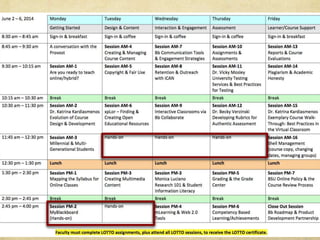
  • #30 Areas of weakness = not enough hands-on
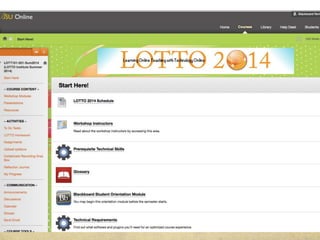
  • #31 Here is the course shell for LOTTO Bb is hosted – using April 2014 release. The nifty icons are made possible through Tweaks
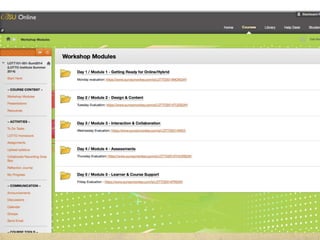
  • #32 Each day is organized with sub-folders for the themed activity and resources. Evaluations were posted at the end of the day and emailed to faculty.
  • #35 Day 1 also includes learning objectives, instructional module
  • #37 Qwickly – batch post announcements, batch email
  • #39 Using tech to improve your teaching Course evaluations
  • #41 Satisfaction surveys were posted at the end of the day and emailed to faculty. Faculty were also given time at the beginning of the next day to fill out the survey.
  • #54 THINK – subject matter experts REALLY – just upload PPTs and handouts and build a test, and they’re done “set it and forget it” SHOULD – learning outcomes, assessments, organization, engagement
  • #55 THINK – varying degree of expertise What I think is expert is actually intermediate
  • #56 TAKEN – do they know what it’s like to take an online course? USE – are they consistently using technology? Checking email?
  • #57 Does the faculty development unit define the schedule and content? Does the content stay the same from year to year? Does faculty senate or shared governance play a part in approving the content? Is there a certificate issued at the end? If so, what are the requirements?
  • #58 Find the funds was our MO Beg & borrow – CETL, OPAA, deans, provost, vendors Flexible amount forced us to modify each year Stipends = milestone requirements for course development
  • #59 We started planning 4-6 months ahead for LOTTO Meals take about 2-3 months to plan, depending on the budget – sometimes $$ must be encumbered ahead of schedule Avoid the course and a half syndrome Prep activities within the LMS – assignments, tests, drop boxes, presentations, etc. Faculty like to follow along. Technology needs to work, but if it doesn’t, have alternative activities.
  • #60 Evaluations – number of faculty participants, number of online courses, number of satisfied online students Other - QM or ECP for the course, etc. Also prepped a survey to evaluate the basic design of the course