

.
DR.MD.SHADAB ANWAR
PERIODONTOLOGIST & IMPLANTOLOGIST
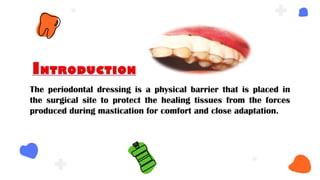
The periodontal dressing is a physical barrier that is placed in
the surgical site to protect the healing tissues from the forces
produced during mastication for comfort and close adaptation.
.
.
.
.
.
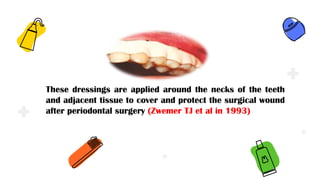
These dressings are applied around the necks of the teeth
and adjacent tissue to cover and protect the surgical wound
after periodontal surgery (Zwemer TJ et al in 1993)
.
.
.
o soft, but still have enough plasticity and flexibility to
facilitate its placement in the operated area and to allow
proper adaptation.
o set within a reasonable time.
o sufficient rigidity to prevent fracture and dislocation.
o smooth surface after setting to prevent irritation to the
cheeks and lips.
o bactericidal properties to prevent excessive plaque
formation.
.
.
.
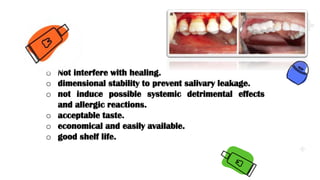
o Not interfere with healing.
o dimensional stability to prevent salivary leakage.
o not induce possible systemic detrimental effects
and allergic reactions.
o acceptable taste.
o economical and easily available.
o good shelf life.
.
.
.
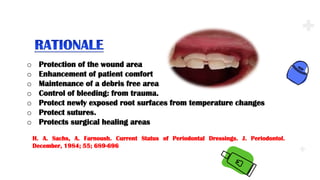
o Protection of the wound area
o Enhancement of patient comfort
o Maintenance of a debris free area
o Control of bleeding: from trauma.
o Protect newly exposed root surfaces from temperature changes
o Protect sutures.
o Protects surgical healing areas
H. A. Sachs, A. Farnoush. Current Status of Periodontal Dressings. J. Periodontol.
December, 1984; 55; 689-696
.
.
.
USES OF PERIODONTAL DRESSING
o Provide mechanical protection for the surgical wound and
therefore facilitate healing
o Enchancement of patient comfort .
o Prevents post operative bleeding by maintaining the initial clot
in place.
o Maintainance of debris free area.
o Control of bleeding
o Supports mobile teeth during healing
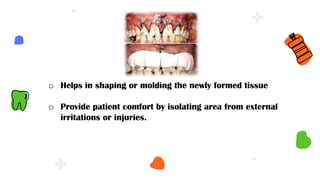
o Helps in shaping or molding the newly formed tissue
o Provide patient comfort by isolating area from external
irritations or injuries.
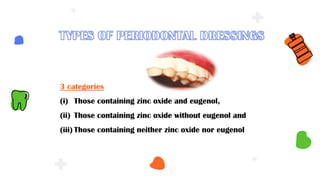
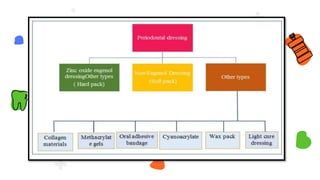
3 categories
(i) Those containing zinc oxide and eugenol,
(ii) Those containing zinc oxide without eugenol and
(iii) Those containing neither zinc oxide nor eugenol
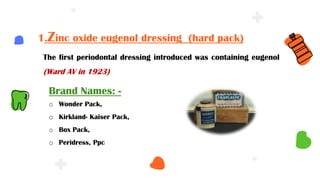
1.Zinc oxide eugenol dressing (hard pack)
Brand Names: -
o Wonder Pack,
o Kirkland- Kaiser Pack,
o Box Pack,
o Peridress, Ppc
The first periodontal dressing introduced was containing eugenol
(Ward AV in 1923)
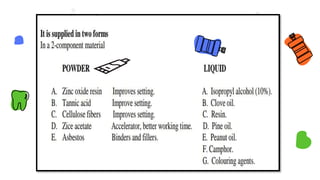
A modified form of a eugenol dressing was introduced by
Kirkland.
It consists of zinc oxide, resin, zinc acetate, eugenol, tannic
acid and olive oil.
Kirkland Formula
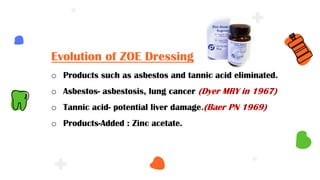
Evolution of ZOE Dressing
o Products such as asbestos and tannic acid eliminated.
o Asbestos- asbestosis, lung cancer (Dyer MRY in 1967)
o Tannic acid- potential liver damage.(Baer PN 1969)
o Products-Added : Zinc acetate.
Obtundant property & make the sites less sensitive.
(O Neil 1975)
Prevent or retard bacterial growth (Antiseptic properties).
(Waerhaug and Loe in 1957)
o Irritate oral mucosal tissues.
o May cause allergic reactions which can lead to tissue necrosis
(Sarrami et al 2002)
o Difficult manipulation.
o Rough surface after setting.
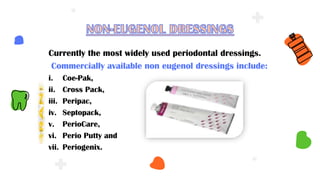
Currently the most widely used periodontal dressings.
Commercially available non eugenol dressings include:
i. Coe-Pak,
ii. Cross Pack,
iii. Peripac,
iv. Septopack,
v. PerioCare,
vi. Perio Putty and
vii. Periogenix.
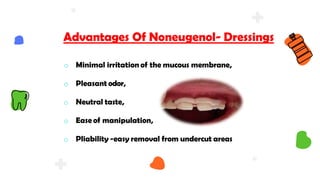
Advantages Of Noneugenol- Dressings
o Minimal irritation of the mucous membrane,
o Pleasant odor,
o Neutral taste,
o Ease of manipulation,
o Pliability -easy removal from undercut areas
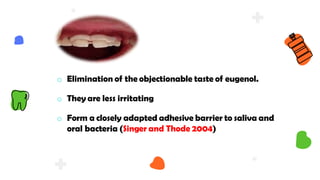
o Elimination of the objectionable taste of eugenol.
o They are less irritating
o Form a closely adapted adhesive barrier to saliva and
oral bacteria (Singer and Thode 2004)
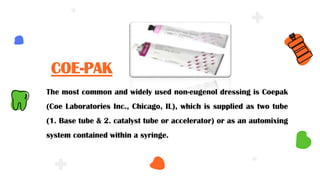
The most common and widely used non-eugenol dressing is Coepak
(Coe Laboratories Inc., Chicago, IL), which is supplied as two tube
(1. Base tube & 2. catalyst tube or accelerator) or as an automixing
system contained within a syringe.
COE-PAK
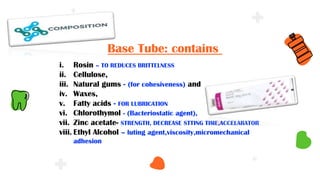
i. Rosin – TO REDUCES BRITTELNESS
ii. Cellulose,
iii. Natural gums - (for cohesiveness) and
iv. Waxes,
v. Fatty acids - FOR LUBRICATION
vi. Chlorothymol - (Bacteriostatic agent),
vii. Zinc acetate- STRENGTH, DECREASE STTING TIME,ACCELARATOR
viii. Ethyl Alcohol – luting agent,viscosity,micromechanical
adhesion
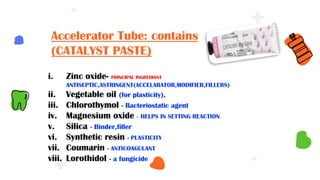
Base Tube: contains
i. Zinc oxide- PRINCIPAL INGREDIANT
ANTISEPTIC,ASTRINGENT(ACCELARATOR,MODIFIER,FILLERS)
ii. Vegetable oil (for plasticity),
iii. Chlorothymol - Bacteriostatic agent
iv. Magnesium oxide - HELPS IN SETTING REACTION
v. Silica - Binder,filler
vi. Synthetic resin - PLASTICITY
vii. Coumarin - ANTICOAGULANT
viii. Lorothidol - a fungicide
Accelerator Tube: contains
(CATALYST PASTE)
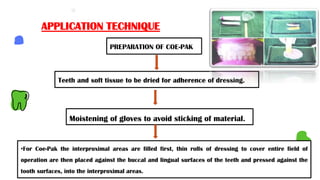
PREPARATION OF COE-PAK
APPLICATION TECHNIQUE
Moistening of gloves to avoid sticking of material.
Teeth and soft tissue to be dried for adherence of dressing.
•For Coe-Pak the interproximal areas are filled first, thin rolls of dressing to cover entire field of
operation are then placed against the buccal and lingual surfaces of the teeth and pressed against the
tooth surfaces, into the interproximal areas.
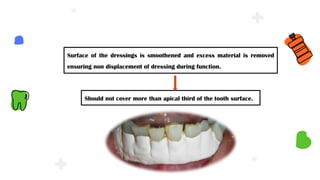
Surface of the dressings is smoothened and excess material is removed
ensuring non displacement of dressing during function.
Should not cover more than apical third of the tooth surface.
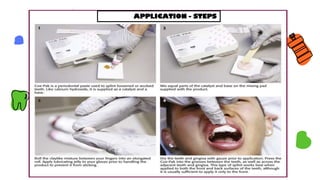
APPLICATION - STEPS
o Insert a scaler or plastic instrument under the border of the
dressing and apply lateral pressure.
o Watch for sutures that can get lodged in the dressings.
o Remove fragments of dressing gently with cotton pliers to avoid
scratching the thin epithelial covering of the healing tissue.
o Use a scaler for removal of fragments adhering to tooth surfaces.
REMOVAL OF THE PACK
o For the first 3 hours after the operation avoid hot foods in order to permit the
pack to harden
o Do not brush over the pack.
o Brush and floss normally the areas of the mouth not covered by the pack.
o Use chlorhexidine mouth rinses after brushing
o After the pack is removed the gums most likely will bleed more than they did
before the operation. This is perfectly normal in the early stage of healing.
Care after periodontal pack
i. Cyanoacrylate dressing,
ii. Light cure dressing (BARRICAID)
iii. Collagen dressing and
iv. Mucoadhesive dressing
v. Modification( chlorhexidine dressing)
DRESSINGS CONTAINING NEITHER ZINC
OXIDE NOR EUGENOL
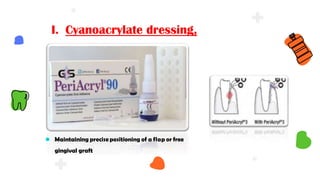
I. Cyanoacrylate dressing,
⚫ Maintaining precise positioning of a flap or free
gingival graft
Collagen dressings (e.g., Colla products from Zimmer Dental, Carlsbad, CA,
USA) are biological dressings which create a physiologic interface
between the wound and the environment and encourage healing.
The advantages over other dressings include ease of application, non-
immunogenic, non-pyrogenic, hypoallergenic properties.
COLLAGEN DRESSINGS
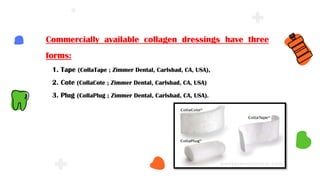
Commercially available collagen dressings have three
forms:
1. Tape (CollaTape ; Zimmer Dental, Carlsbad, CA, USA),
2. Cote (CollaCote ; Zimmer Dental, Carlsbad, CA, USA)
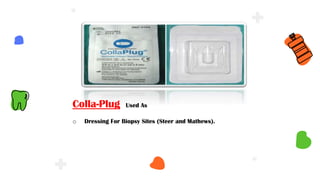
3. Plug (CollaPlug ; Zimmer Dental, Carlsbad, CA, USA).
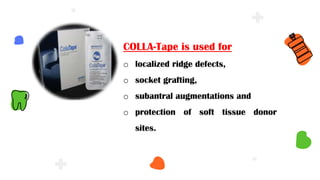
COLLA-Tape is used for
o localized ridge defects,
o socket grafting,
o subantral augmentations and
o protection of soft tissue donor
sites.
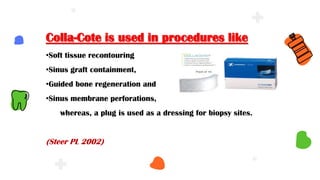
Colla-Cote is used in procedures like
•Soft tissue recontouring
•Sinus graft containment,
•Guided bone regeneration and
•Sinus membrane perforations,
whereas, a plug is used as a dressing for biopsy sites.
(Steer PL 2002)
Colla-Plug Used As
o Dressing For Biopsy Sites (Steer and Mathews).
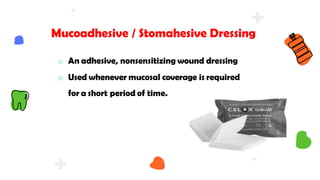
Mucoadhesive / Stomahesive Dressing
o An adhesive, nonsensitizing wound dressing
o Used whenever mucosal coverage is required
for a short period of time.
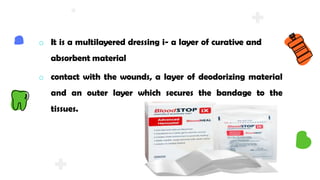
o It is a multilayered dressing i- a layer of curative and
absorbent material
o contact with the wounds, a layer of deodorizing material
and an outer layer which secures the bandage to the
tissues.
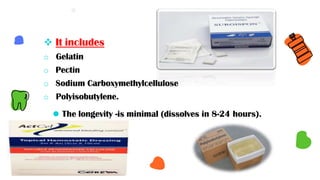
 It includes
o Gelatin
o Pectin
o Sodium Carboxymethylcellulose
o Polyisobutylene.
⚫ The longevity -is minimal (dissolves in 8-24 hours).
THANKS

Periodontal dressing ppt

  • 1.
  • 2.
    The periodontal dressingis a physical barrier that is placed in the surgical site to protect the healing tissues from the forces produced during mastication for comfort and close adaptation.
  • 3.
    . . . . . These dressings areapplied around the necks of the teeth and adjacent tissue to cover and protect the surgical wound after periodontal surgery (Zwemer TJ et al in 1993)
  • 4.
    . . . o soft, butstill have enough plasticity and flexibility to facilitate its placement in the operated area and to allow proper adaptation. o set within a reasonable time. o sufficient rigidity to prevent fracture and dislocation. o smooth surface after setting to prevent irritation to the cheeks and lips. o bactericidal properties to prevent excessive plaque formation.
  • 5.
    . . . o Not interferewith healing. o dimensional stability to prevent salivary leakage. o not induce possible systemic detrimental effects and allergic reactions. o acceptable taste. o economical and easily available. o good shelf life.
  • 6.
    . . . o Protection ofthe wound area o Enhancement of patient comfort o Maintenance of a debris free area o Control of bleeding: from trauma. o Protect newly exposed root surfaces from temperature changes o Protect sutures. o Protects surgical healing areas H. A. Sachs, A. Farnoush. Current Status of Periodontal Dressings. J. Periodontol. December, 1984; 55; 689-696
  • 7.
    . . . USES OF PERIODONTALDRESSING o Provide mechanical protection for the surgical wound and therefore facilitate healing o Enchancement of patient comfort . o Prevents post operative bleeding by maintaining the initial clot in place. o Maintainance of debris free area. o Control of bleeding o Supports mobile teeth during healing
  • 8.
    o Helps inshaping or molding the newly formed tissue o Provide patient comfort by isolating area from external irritations or injuries.
  • 9.
    3 categories (i) Thosecontaining zinc oxide and eugenol, (ii) Those containing zinc oxide without eugenol and (iii) Those containing neither zinc oxide nor eugenol
  • 11.
    1.Zinc oxide eugenoldressing (hard pack) Brand Names: - o Wonder Pack, o Kirkland- Kaiser Pack, o Box Pack, o Peridress, Ppc The first periodontal dressing introduced was containing eugenol (Ward AV in 1923)
  • 13.
    A modified formof a eugenol dressing was introduced by Kirkland. It consists of zinc oxide, resin, zinc acetate, eugenol, tannic acid and olive oil. Kirkland Formula
  • 14.
    Evolution of ZOEDressing o Products such as asbestos and tannic acid eliminated. o Asbestos- asbestosis, lung cancer (Dyer MRY in 1967) o Tannic acid- potential liver damage.(Baer PN 1969) o Products-Added : Zinc acetate.
  • 15.
    Obtundant property &make the sites less sensitive. (O Neil 1975) Prevent or retard bacterial growth (Antiseptic properties). (Waerhaug and Loe in 1957)
  • 16.
    o Irritate oralmucosal tissues. o May cause allergic reactions which can lead to tissue necrosis (Sarrami et al 2002) o Difficult manipulation. o Rough surface after setting.
  • 17.
    Currently the mostwidely used periodontal dressings. Commercially available non eugenol dressings include: i. Coe-Pak, ii. Cross Pack, iii. Peripac, iv. Septopack, v. PerioCare, vi. Perio Putty and vii. Periogenix.
  • 18.
    Advantages Of Noneugenol-Dressings o Minimal irritation of the mucous membrane, o Pleasant odor, o Neutral taste, o Ease of manipulation, o Pliability -easy removal from undercut areas
  • 19.
    o Elimination ofthe objectionable taste of eugenol. o They are less irritating o Form a closely adapted adhesive barrier to saliva and oral bacteria (Singer and Thode 2004)
  • 20.
    The most commonand widely used non-eugenol dressing is Coepak (Coe Laboratories Inc., Chicago, IL), which is supplied as two tube (1. Base tube & 2. catalyst tube or accelerator) or as an automixing system contained within a syringe. COE-PAK
  • 21.
    i. Rosin –TO REDUCES BRITTELNESS ii. Cellulose, iii. Natural gums - (for cohesiveness) and iv. Waxes, v. Fatty acids - FOR LUBRICATION vi. Chlorothymol - (Bacteriostatic agent), vii. Zinc acetate- STRENGTH, DECREASE STTING TIME,ACCELARATOR viii. Ethyl Alcohol – luting agent,viscosity,micromechanical adhesion Base Tube: contains
  • 22.
    i. Zinc oxide-PRINCIPAL INGREDIANT ANTISEPTIC,ASTRINGENT(ACCELARATOR,MODIFIER,FILLERS) ii. Vegetable oil (for plasticity), iii. Chlorothymol - Bacteriostatic agent iv. Magnesium oxide - HELPS IN SETTING REACTION v. Silica - Binder,filler vi. Synthetic resin - PLASTICITY vii. Coumarin - ANTICOAGULANT viii. Lorothidol - a fungicide Accelerator Tube: contains (CATALYST PASTE)
  • 23.
    PREPARATION OF COE-PAK APPLICATIONTECHNIQUE Moistening of gloves to avoid sticking of material. Teeth and soft tissue to be dried for adherence of dressing. •For Coe-Pak the interproximal areas are filled first, thin rolls of dressing to cover entire field of operation are then placed against the buccal and lingual surfaces of the teeth and pressed against the tooth surfaces, into the interproximal areas.
  • 24.
    Surface of thedressings is smoothened and excess material is removed ensuring non displacement of dressing during function. Should not cover more than apical third of the tooth surface.
  • 25.
  • 26.
    o Insert ascaler or plastic instrument under the border of the dressing and apply lateral pressure. o Watch for sutures that can get lodged in the dressings. o Remove fragments of dressing gently with cotton pliers to avoid scratching the thin epithelial covering of the healing tissue. o Use a scaler for removal of fragments adhering to tooth surfaces. REMOVAL OF THE PACK
  • 27.
    o For thefirst 3 hours after the operation avoid hot foods in order to permit the pack to harden o Do not brush over the pack. o Brush and floss normally the areas of the mouth not covered by the pack. o Use chlorhexidine mouth rinses after brushing o After the pack is removed the gums most likely will bleed more than they did before the operation. This is perfectly normal in the early stage of healing. Care after periodontal pack
  • 28.
    i. Cyanoacrylate dressing, ii.Light cure dressing (BARRICAID) iii. Collagen dressing and iv. Mucoadhesive dressing v. Modification( chlorhexidine dressing) DRESSINGS CONTAINING NEITHER ZINC OXIDE NOR EUGENOL
  • 29.
    I. Cyanoacrylate dressing, ⚫Maintaining precise positioning of a flap or free gingival graft
  • 30.
    Collagen dressings (e.g.,Colla products from Zimmer Dental, Carlsbad, CA, USA) are biological dressings which create a physiologic interface between the wound and the environment and encourage healing. The advantages over other dressings include ease of application, non- immunogenic, non-pyrogenic, hypoallergenic properties. COLLAGEN DRESSINGS
  • 31.
    Commercially available collagendressings have three forms: 1. Tape (CollaTape ; Zimmer Dental, Carlsbad, CA, USA), 2. Cote (CollaCote ; Zimmer Dental, Carlsbad, CA, USA) 3. Plug (CollaPlug ; Zimmer Dental, Carlsbad, CA, USA).
  • 32.
    COLLA-Tape is usedfor o localized ridge defects, o socket grafting, o subantral augmentations and o protection of soft tissue donor sites.
  • 33.
    Colla-Cote is usedin procedures like •Soft tissue recontouring •Sinus graft containment, •Guided bone regeneration and •Sinus membrane perforations, whereas, a plug is used as a dressing for biopsy sites. (Steer PL 2002)
  • 34.
    Colla-Plug Used As oDressing For Biopsy Sites (Steer and Mathews).
  • 35.
    Mucoadhesive / StomahesiveDressing o An adhesive, nonsensitizing wound dressing o Used whenever mucosal coverage is required for a short period of time.
  • 36.
    o It isa multilayered dressing i- a layer of curative and absorbent material o contact with the wounds, a layer of deodorizing material and an outer layer which secures the bandage to the tissues.
  • 37.
     It includes oGelatin o Pectin o Sodium Carboxymethylcellulose o Polyisobutylene. ⚫ The longevity -is minimal (dissolves in 8-24 hours).
  • 38.