SPS451/FSRUiTM
Warm up & Flexibility
Training
Courtesy from YM Raja Mohammed Firhad B.
Raja Azidin
Faculty of Sport Science & Recreation
MARA University of Technology (MALAYSIA)
SPS451/FSRUiTM
Warm Up
• Helps protect against injury by improving muscle
flexibility
• Raise the body internal temperature
• General Warm Up
• 5-10 min slow jog, cycle – increase HR, BF, deep
muscle temperature, respiration rate, perspiration and
increase viscosity of joints fluids
• Increase muscle temperature allow greater amount of
flexibility (athletes readiness)
• Specific Warm UP
• Incorporates movements similar to athletes sport.
• 8-12 min of dynamic warm up
SPS451/FSRUiTM
• Increases the degradation of
oxyhemoglobin
Breaking down the chemical complex
of oxygen and hemoglobin results in
the release of oxygen from the
blood, enhancing the delivery of
oxygen to the exercising muscle.
• Increases body temperature
The elevation in body temperature
produced by warming up reduces the
potential for skeletal muscle injuries
and connective injuries, since cold
muscle and tendons have been
shown to be more susceptible to
injury.
• Increases blood flow to the exercising
muscles
The greater level of blood reaching the
muscles involved in the activity aids in
the delivery of the fuels (e.g., glucose
and free fatty acids) required for energy
production.
• Increases blood flow to the heart
A greater level of blood delivered to the
heart reduces the potential for
exercise-induced cardiac abnormalities
(e.g., electrocardiographic
disturbances), reducing the potential
for myocardial ischemia.
Why Warming Up is Important?
SPS451/FSRUiTM
• Decreases the viscosity of the
muscle
Reduced muscle viscosity increases
the suppleness of the muscle,
thereby enhancing the mechanical
efficiency and power of the
exercising muscles.
• Causes an early onset of sweating
The earlier onset of sweating
promotes evaporative heat loss and,
as a result, decreases the amount of
heat stored by the body. This will
help to prevent an individual's body
temperature from rising to
dangerously high levels during (more
strenuous) exercise.
Why Warming Up is Important?
• Enhances the speed of transmission
of nerve impulses
As nerve impulses are conducted at a
faster rate, neuromuscular
coordination tends to improve,
resulting in better performance of
certain motor tasks.

• Increases the blood saturation of
muscles and connective tissues
A higher level of blood reaching the
muscles, tendons, and ligaments
involved in the activity increases the
elasticity of these tissues, resulting
in a safer, more effective
performance of stretching exercises.
SPS451/FSRUiTM
Why Warming Up is Important?
• Prepares the cardiovascular system for the upcoming (more strenuous)
physical activity
Warming up helps to ensure that the cardiovascular system (heart and blood
vessels) is given time to adjust to the body's increased demands for blood and
oxygen.
• Prepares the muscular system for the upcoming (more strenuous) physical
activity
Warming up provides a transition from rest to strenuous exercise, and may
reduce the likelihood that excessive muscular soreness will be a concomitant
result of strenuous activity.
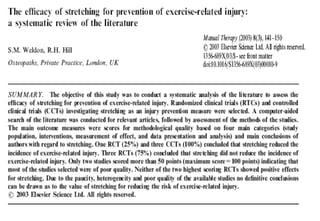
Does Warm Up Reduce The
Risk of Injury?
SPS451/FSRUiTM
Specific Warm Up?
SPS451/FSRUiTM
SPS451/FSRUiTM
Flexibility
• ROM available in a joint or group of joint.
• Optimal musculoskeletal flex can improve
performance by increasing a joint movement,
decreasing risk of injury
• The degree of movement that occur at a
joint is ROM
SPS451/FSRUiTM
Flexibility Training Program
“ A planned, deliberate & regular exercise
program that can permanently & progressively
increase the usable ROM of a joint or a set of
joints over a period of time”
SPS451/FSRUiTM
SPS451/FSRUiTM
Factors Affecting Flexibility
• Joint structure
– Ball & socket joint (shoulder & hip) have the greatest
ROM
• Age & Gender
– Young people tend to be more flexible
– Female more flexible than male
• Connective tissue
– Tendons, ligaments fascial shealths, joint capsules &
skin may limit ROM
SPS451/FSRUiTM
Factors Affecting Flexibility
• Weight training with limited ROM
– Heavy resistance training with limited ROM may
decrease ROM
– To prevent loss of ROM athletes should perform
exercises that develop both agonist & antagonist
muscles, & exercise through full ROM
SPS451/FSRUiTM
Factors Affecting Flexibility
• Muscle Bulk
– A large increase in muscle bulk may adversely affect
ROM by impeding joint movement
– E.g athletes with large biceps will have difficulty in
stretching the triceps, racking a power clean, or
holding a bar while performing front squat
• Activity Level
– Active person tends to be more flexible
SPS451/FSRUiTM
Frequency, Duration & Intensity
of Flexibility Exercise
• Stretching twice a week for 5 weeks has been shown to
improve flexibility
• Each practice session should be preceded with 5 to 6 min of
general warm up, 8 to 12 min of sport specific stretching &
conclude with 4 to 5 min of stretching
• Individual stretches should be held to the point of mild
discomfort, not pain for 15-30s
SPS451/FSRUiTM
Proprioceptors & Stretching
• Muscle spindles
– Monitor changes in muscle length
– Rapid stretching will cause stretch reflex (motion will
be limited by the reflexive muscle action)
• Golgi Tendon organ (GTOs)
– Sensitive to increase in muscular tension
SPS451/FSRUiTM
Type of Stretching
• Active Stretch
– Occurs when the person stretching supplies the force of
the stretch
• Passive
– Occur when a partner or stretching machine provides
the force of the stretch
SPS451/FSRUiTM
Type of Stretching
• Static Stretch
– Slow & constant with end position held for 15-30s
– Includes the relaxation & concurrent elongation of the
stretched muscle
– Does not elicit the stretch reflex
– Less risk of injury
SPS451/FSRUiTM
Type of Stretching
• Ballistic Stretch
– Typically involves active muscular effort & uses a
bouncing-type movement in which the end position is not
held
– Often used in pre-exercise warm up
– Trigger stretch reflex
– Not the preferred technique
SPS451/FSRUiTM
Type of Stretching
• Dynamic Stretch
– Similar with ballistic but dynamic stretching avoids
bouncing & includes movements specific to a sport or
movement pattern
– Specific warm up
Advantages of Dynamic
Stretching?
SPS451/FSRUiTM
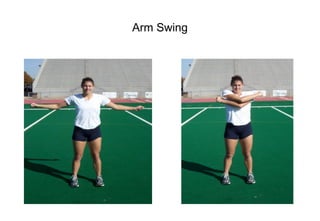
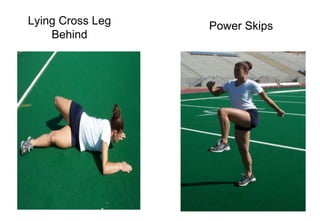
Arm Swing
Lying Cross Leg
Behind
Power Skips
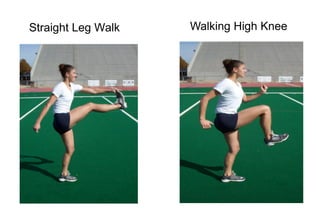
Straight Leg Walk Walking High Knee
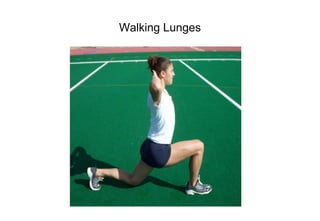
Walking Lunges
SPS451/FSRUiTM
Proprioceptive Neuromuscular
Facilitation Stretch (PNF)
3 basic type of PNF
1. Hold Relax
2. Contract Relax
3. Hold Relax with Agonist Contraction
A stretch to improve hamstring flexibility is used
as example.
SPS451/FSRUiTM
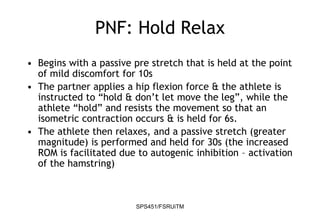
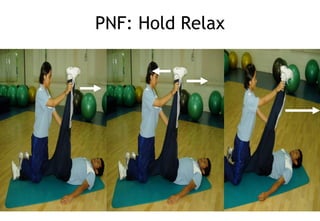
PNF: Hold Relax
• Begins with a passive pre stretch that is held at the point
of mild discomfort for 10s
• The partner applies a hip flexion force & the athlete is
instructed to “hold & don’t let move the leg”, while the
athlete “hold” and resists the movement so that an
isometric contraction occurs & is held for 6s.
• The athlete then relaxes, and a passive stretch (greater
magnitude) is performed and held for 30s (the increased
ROM is facilitated due to autogenic inhibition – activation
of the hamstring)
SPS451/FSRUiTM
PNF: Hold Relax
SPS451/FSRUiTM
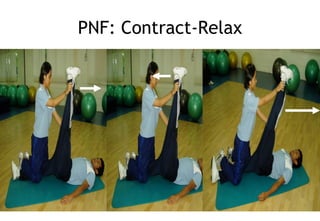
PNF: Contract-Relax
• Begins with a passive pre stretch that is held at the point of
mild discomfort for 10s
• The athletes then extends the hip against a resistance from
the partner so that a concentric muscle action through the
full ROM occurs.
• The athlete then relaxes, and a passive hip-flexion stretch is
applied & held for 30s
SPS451/FSRUiTM
PNF: Contract-Relax
SPS451/FSRUiTM
PNF: Hold-Relax with
Agonist Contraction
• This technique is identical to hold-relax in the first two
phases.
• During the third phase, a concentric action of the agonist is
used in addition to the passive stretch to add to the stretch
force
SPS451/FSRUiTM
PNF: Hold-Relax with
Agonist Contraction
SPS451/FSRUiTM
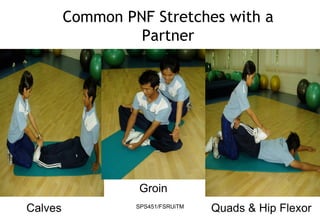
Common PNF Stretches with a
Partner
Calves
Groin
Quads & Hip Flexor
SPS451/FSRUiTM
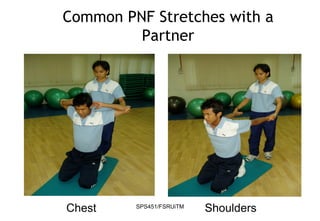
Common PNF Stretches with a
Partner
Chest Shoulders
SPS451/FSRUiTM
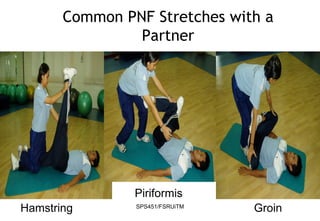
Common PNF Stretches with a
Partner
Hamstring
Piriformis
Groin
SPS451/FSRUiTM
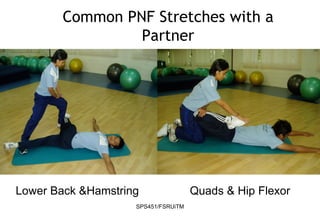
Common PNF Stretches with a
Partner
Lower Back &Hamstring Quads & Hip Flexor
Does Static Stretching Decrease
Muscular Performance?
SPS451/FSRUiTM
Enhancing Flexibility Through
Whole Body Vibration?
SPS451/FSRUiTM
SPS451/FSRUiTM
Stretching Guidelines for Older Adults
• Always precede stretching exercises with some type of warm
up activity
– Increase circulation & internal btm
– Stretch smoothly & don’t bounce
– Don’t stretch a joint beyond its pain free ROM
– Gradually ease into a stretch, & hold it only as long as it
feels comfortable (10 – 30 s)
SPS451/FSRUiTM
Conclusion
To improve performance & decrease the chance of
injury, athletes should use both a warm up & stretching
to prepare for sport or activity. The most effective
stretching techniques are those that take advantage of
the inhibition provided by PNF.
However, if a partner with appropriate expertise is not
available, static stretching is an easy & effective
alternatives.

Sps451 t8 warm up & flexibility

  • 1.
    SPS451/FSRUiTM Warm up &Flexibility Training Courtesy from YM Raja Mohammed Firhad B. Raja Azidin Faculty of Sport Science & Recreation MARA University of Technology (MALAYSIA)
  • 2.
    SPS451/FSRUiTM Warm Up • Helpsprotect against injury by improving muscle flexibility • Raise the body internal temperature • General Warm Up • 5-10 min slow jog, cycle – increase HR, BF, deep muscle temperature, respiration rate, perspiration and increase viscosity of joints fluids • Increase muscle temperature allow greater amount of flexibility (athletes readiness) • Specific Warm UP • Incorporates movements similar to athletes sport. • 8-12 min of dynamic warm up
  • 3.
    SPS451/FSRUiTM • Increases thedegradation of oxyhemoglobin Breaking down the chemical complex of oxygen and hemoglobin results in the release of oxygen from the blood, enhancing the delivery of oxygen to the exercising muscle. • Increases body temperature The elevation in body temperature produced by warming up reduces the potential for skeletal muscle injuries and connective injuries, since cold muscle and tendons have been shown to be more susceptible to injury. • Increases blood flow to the exercising muscles The greater level of blood reaching the muscles involved in the activity aids in the delivery of the fuels (e.g., glucose and free fatty acids) required for energy production. • Increases blood flow to the heart A greater level of blood delivered to the heart reduces the potential for exercise-induced cardiac abnormalities (e.g., electrocardiographic disturbances), reducing the potential for myocardial ischemia. Why Warming Up is Important?
  • 4.
    SPS451/FSRUiTM • Decreases theviscosity of the muscle Reduced muscle viscosity increases the suppleness of the muscle, thereby enhancing the mechanical efficiency and power of the exercising muscles. • Causes an early onset of sweating The earlier onset of sweating promotes evaporative heat loss and, as a result, decreases the amount of heat stored by the body. This will help to prevent an individual's body temperature from rising to dangerously high levels during (more strenuous) exercise. Why Warming Up is Important? • Enhances the speed of transmission of nerve impulses As nerve impulses are conducted at a faster rate, neuromuscular coordination tends to improve, resulting in better performance of certain motor tasks. • Increases the blood saturation of muscles and connective tissues A higher level of blood reaching the muscles, tendons, and ligaments involved in the activity increases the elasticity of these tissues, resulting in a safer, more effective performance of stretching exercises.
  • 5.
    SPS451/FSRUiTM Why Warming Upis Important? • Prepares the cardiovascular system for the upcoming (more strenuous) physical activity Warming up helps to ensure that the cardiovascular system (heart and blood vessels) is given time to adjust to the body's increased demands for blood and oxygen. • Prepares the muscular system for the upcoming (more strenuous) physical activity Warming up provides a transition from rest to strenuous exercise, and may reduce the likelihood that excessive muscular soreness will be a concomitant result of strenuous activity.
  • 6.
    Does Warm UpReduce The Risk of Injury? SPS451/FSRUiTM
  • 7.
  • 8.
    SPS451/FSRUiTM Flexibility • ROM availablein a joint or group of joint. • Optimal musculoskeletal flex can improve performance by increasing a joint movement, decreasing risk of injury • The degree of movement that occur at a joint is ROM
  • 9.
    SPS451/FSRUiTM Flexibility Training Program “A planned, deliberate & regular exercise program that can permanently & progressively increase the usable ROM of a joint or a set of joints over a period of time”
  • 10.
  • 11.
    SPS451/FSRUiTM Factors Affecting Flexibility •Joint structure – Ball & socket joint (shoulder & hip) have the greatest ROM • Age & Gender – Young people tend to be more flexible – Female more flexible than male • Connective tissue – Tendons, ligaments fascial shealths, joint capsules & skin may limit ROM
  • 12.
    SPS451/FSRUiTM Factors Affecting Flexibility •Weight training with limited ROM – Heavy resistance training with limited ROM may decrease ROM – To prevent loss of ROM athletes should perform exercises that develop both agonist & antagonist muscles, & exercise through full ROM
  • 13.
    SPS451/FSRUiTM Factors Affecting Flexibility •Muscle Bulk – A large increase in muscle bulk may adversely affect ROM by impeding joint movement – E.g athletes with large biceps will have difficulty in stretching the triceps, racking a power clean, or holding a bar while performing front squat • Activity Level – Active person tends to be more flexible
  • 14.
    SPS451/FSRUiTM Frequency, Duration &Intensity of Flexibility Exercise • Stretching twice a week for 5 weeks has been shown to improve flexibility • Each practice session should be preceded with 5 to 6 min of general warm up, 8 to 12 min of sport specific stretching & conclude with 4 to 5 min of stretching • Individual stretches should be held to the point of mild discomfort, not pain for 15-30s
  • 15.
    SPS451/FSRUiTM Proprioceptors & Stretching •Muscle spindles – Monitor changes in muscle length – Rapid stretching will cause stretch reflex (motion will be limited by the reflexive muscle action) • Golgi Tendon organ (GTOs) – Sensitive to increase in muscular tension
  • 16.
    SPS451/FSRUiTM Type of Stretching •Active Stretch – Occurs when the person stretching supplies the force of the stretch • Passive – Occur when a partner or stretching machine provides the force of the stretch
  • 17.
    SPS451/FSRUiTM Type of Stretching •Static Stretch – Slow & constant with end position held for 15-30s – Includes the relaxation & concurrent elongation of the stretched muscle – Does not elicit the stretch reflex – Less risk of injury
  • 18.
    SPS451/FSRUiTM Type of Stretching •Ballistic Stretch – Typically involves active muscular effort & uses a bouncing-type movement in which the end position is not held – Often used in pre-exercise warm up – Trigger stretch reflex – Not the preferred technique
  • 19.
    SPS451/FSRUiTM Type of Stretching •Dynamic Stretch – Similar with ballistic but dynamic stretching avoids bouncing & includes movements specific to a sport or movement pattern – Specific warm up
  • 20.
  • 21.
  • 22.
  • 23.
    Straight Leg WalkWalking High Knee
  • 24.
  • 25.
    SPS451/FSRUiTM Proprioceptive Neuromuscular Facilitation Stretch(PNF) 3 basic type of PNF 1. Hold Relax 2. Contract Relax 3. Hold Relax with Agonist Contraction A stretch to improve hamstring flexibility is used as example.
  • 26.
    SPS451/FSRUiTM PNF: Hold Relax •Begins with a passive pre stretch that is held at the point of mild discomfort for 10s • The partner applies a hip flexion force & the athlete is instructed to “hold & don’t let move the leg”, while the athlete “hold” and resists the movement so that an isometric contraction occurs & is held for 6s. • The athlete then relaxes, and a passive stretch (greater magnitude) is performed and held for 30s (the increased ROM is facilitated due to autogenic inhibition – activation of the hamstring)
  • 27.
  • 28.
    SPS451/FSRUiTM PNF: Contract-Relax • Beginswith a passive pre stretch that is held at the point of mild discomfort for 10s • The athletes then extends the hip against a resistance from the partner so that a concentric muscle action through the full ROM occurs. • The athlete then relaxes, and a passive hip-flexion stretch is applied & held for 30s
  • 29.
  • 30.
    SPS451/FSRUiTM PNF: Hold-Relax with AgonistContraction • This technique is identical to hold-relax in the first two phases. • During the third phase, a concentric action of the agonist is used in addition to the passive stretch to add to the stretch force
  • 31.
  • 32.
    SPS451/FSRUiTM Common PNF Stretcheswith a Partner Calves Groin Quads & Hip Flexor
  • 33.
    SPS451/FSRUiTM Common PNF Stretcheswith a Partner Chest Shoulders
  • 34.
    SPS451/FSRUiTM Common PNF Stretcheswith a Partner Hamstring Piriformis Groin
  • 35.
    SPS451/FSRUiTM Common PNF Stretcheswith a Partner Lower Back &Hamstring Quads & Hip Flexor
  • 36.
    Does Static StretchingDecrease Muscular Performance? SPS451/FSRUiTM
  • 37.
    Enhancing Flexibility Through WholeBody Vibration? SPS451/FSRUiTM
  • 38.
    SPS451/FSRUiTM Stretching Guidelines forOlder Adults • Always precede stretching exercises with some type of warm up activity – Increase circulation & internal btm – Stretch smoothly & don’t bounce – Don’t stretch a joint beyond its pain free ROM – Gradually ease into a stretch, & hold it only as long as it feels comfortable (10 – 30 s)
  • 39.
    SPS451/FSRUiTM Conclusion To improve performance& decrease the chance of injury, athletes should use both a warm up & stretching to prepare for sport or activity. The most effective stretching techniques are those that take advantage of the inhibition provided by PNF. However, if a partner with appropriate expertise is not available, static stretching is an easy & effective alternatives.