CHAPTER 7

STRATEGIES FOR
COMPETING IN
INTERNATIONAL MARKETS
STUDENT VERSION
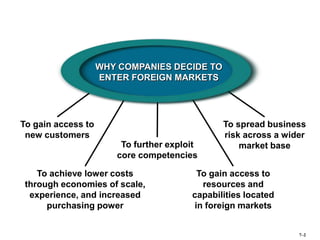
WHY COMPANIES DECIDE TO
ENTER FOREIGN MARKETS

To gain access to
new customers
To further exploit
core competencies
To achieve lower costs
through economies of scale,
experience, and increased
purchasing power

To spread business
risk across a wider
market base

To gain access to
resources and
capabilities located
in foreign markets

7–2
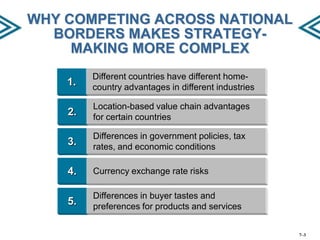
WHY COMPETING ACROSS NATIONAL
BORDERS MAKES STRATEGYMAKING MORE COMPLEX
1.

Different countries have different homecountry advantages in different industries

2.

Location-based value chain advantages
for certain countries

3.

Differences in government policies, tax
rates, and economic conditions

4.

Currency exchange rate risks

5.

Differences in buyer tastes and
preferences for products and services
7–3
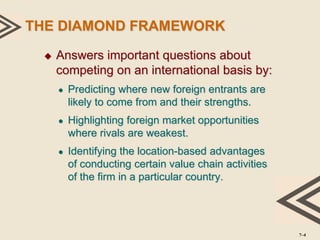
THE DIAMOND FRAMEWORK


Answers important questions about
competing on an international basis by:
●

Predicting where new foreign entrants are
likely to come from and their strengths.

●

Highlighting foreign market opportunities
where rivals are weakest.

●

Identifying the location-based advantages
of conducting certain value chain activities
of the firm in a particular country.

7–4
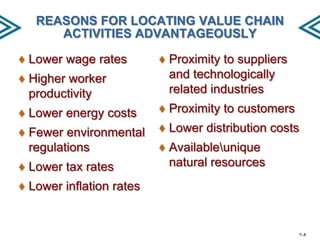
REASONS FOR LOCATING VALUE CHAIN
ACTIVITIES ADVANTAGEOUSLY

♦ Lower wage rates
♦ Higher worker
productivity

♦ Proximity to suppliers
and technologically
related industries

♦ Lower energy costs

♦ Proximity to customers

♦ Fewer environmental
regulations

♦ Lower distribution costs

♦ Lower tax rates

♦ Availableunique
natural resources

♦ Lower inflation rates

7–5
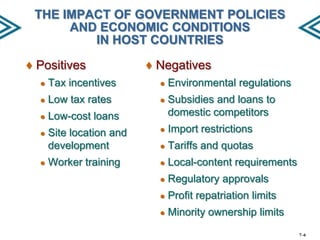
THE IMPACT OF GOVERNMENT POLICIES
AND ECONOMIC CONDITIONS
IN HOST COUNTRIES
♦ Positives

♦ Negatives

●

Tax incentives

●

Environmental regulations

●

Low tax rates

●

●

Low-cost loans

Subsidies and loans to
domestic competitors

●

Site location and
development

●

Import restrictions

●

Tariffs and quotas

Worker training

●

Local-content requirements

●

Regulatory approvals

●

Profit repatriation limits

●

Minority ownership limits

●

7–6
THE RISKS OF ADVERSE
EXCHANGE RATE SHIFTS


Effects of Exchange Rate Shifts:
●

Exporters experience a rising demand for their
goods whenever their currency grows weaker
relative to the importing country’s currency.

●

Exporters experience a falling demand for their
goods whenever their currency grows stronger
relative to the importing country’s currency.

7–7
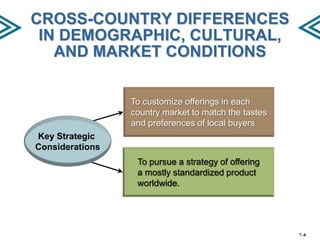
CROSS-COUNTRY DIFFERENCES
IN DEMOGRAPHIC, CULTURAL,
AND MARKET CONDITIONS
To customize offerings in each
country market to match the tastes
and preferences of local buyers
Key Strategic
Considerations
To pursue a strategy of offering
a mostly standardized product
worldwide.

7–8
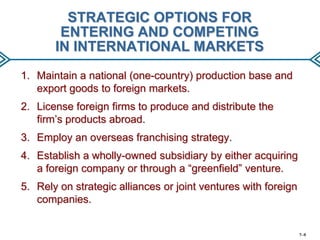
STRATEGIC OPTIONS FOR
ENTERING AND COMPETING
IN INTERNATIONAL MARKETS
1. Maintain a national (one-country) production base and
export goods to foreign markets.
2. License foreign firms to produce and distribute the
firm’s products abroad.
3. Employ an overseas franchising strategy.
4. Establish a wholly-owned subsidiary by either acquiring
a foreign company or through a “greenfield” venture.

5. Rely on strategic alliances or joint ventures with foreign
companies.

7–9
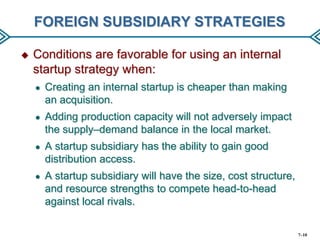
FOREIGN SUBSIDIARY STRATEGIES


Conditions are favorable for using an internal
startup strategy when:
●

Creating an internal startup is cheaper than making
an acquisition.

●

Adding production capacity will not adversely impact
the supply–demand balance in the local market.

●

A startup subsidiary has the ability to gain good
distribution access.

●

A startup subsidiary will have the size, cost structure,
and resource strengths to compete head-to-head
against local rivals.
7–10
GREENFIELD STRATEGIES
♦ Advantages

♦ Disadvantages

●

High level of control
over venture

●

Capital costs of initial
development

●

“Learning by doing”
in the local market

●

●

Direct transfer of the
firm’s technology,
skills, business
practices, and culture

Risks of loss due to
political instability or lack
of legal protection of
ownership

●

Slowest form of entry due
to extended time required
to construct facility

7–11
BENEFITS OF ALLIANCE AND
JOINT VENTURE STRATEGIES


Gaining partner’s knowledge of local market conditions



Achieving economies of scale through joint operations



Gaining technical expertise and local market knowledge



Sharing distribution facilities and dealer networks, and
mutually strengthening each partner’s access to buyers.



Directing competitive energies more toward mutual rivals
and less toward one another



Establishing working relationships with key officials in the
host-country government

7–12
THE RISKS OF STRATEGIC ALLIANCES
WITH FOREIGN PARTNERS


Outdated knowledge and expertise of local partners



Cultural and language barriers



Costs of establishing the working arrangement



Conflicting objectives and strategies and/or deep
differences of opinion about joint control



Differences in corporate values and ethical standards.



Loss of legal protection of proprietary technology or
competitive advantage



Over dependence on foreign partners for essential
expertise and competitive capabilities.
7–13
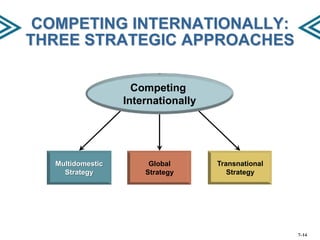
COMPETING INTERNATIONALLY:
THREE STRATEGIC APPROACHES
Competing
Internationally

Multidomestic
Strategy

Global
Strategy

Transnational
Strategy

7–14
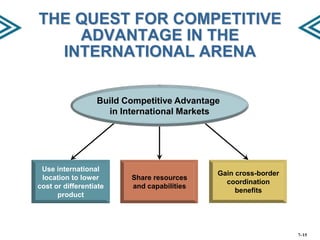
THE QUEST FOR COMPETITIVE
ADVANTAGE IN THE
INTERNATIONAL ARENA
Build Competitive Advantage
in International Markets

Use international
location to lower
cost or differentiate
product

Share resources
and capabilities

Gain cross-border
coordination
benefits

7–15
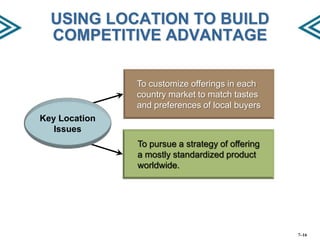
USING LOCATION TO BUILD
COMPETITIVE ADVANTAGE
To customize offerings in each
country market to match tastes
and preferences of local buyers

Key Location
Issues
To pursue a strategy of offering
a mostly standardized product
worldwide.

7–16
SHARING AND TRANSFERRING
RESOURCES AND CAPABILITIES
TO BUILD COMPETITIVE ADVANTAGE


Build a Resource-Based
Competitive Advantage By:
●

Using powerful brand names to extend
a differentiation-based competitive
advantage beyond the home market.

●

Coordinating activities for sharing and transferring
resources and production capabilities across different
countries’ domains to develop market dominating
depth in key competencies.

7–17
STRATEGY OPTIONS FOR COMPETING
IN THE MARKETS OF DEVELOPING
COUNTRIES


Prepare to compete on the basis of low price.



Prepare to modify the firm’s business model or
strategy to accommodate local circumstances.



Try to change the local market to better match
the way the firm does business elsewhere.



Avoid developing markets where it is too difficult
or costly to accommodate local circumstances.

7–18
DEFENDING AGAINST GLOBAL GIANTS:
STRATEGIES FOR LOCAL COMPANIES
IN DEVELOPING COUNTRIES


Develop a business model that exploits shortcomings in
local distribution networks or infrastructure.



Utilize knowledge of local customer needs and
preferences to create customized products or services.



Take advantage of aspects of the local workforce with
which large multinational firms may be unfamiliar.



Use local acquisition and rapid-growth strategies to
defend against expansion-minded internationals.



Transfer the firm’s expertise to cross-border markets.

7–19

MGMT449 chap007

  • 1.
    CHAPTER 7 STRATEGIES FOR COMPETINGIN INTERNATIONAL MARKETS STUDENT VERSION
  • 2.
    WHY COMPANIES DECIDETO ENTER FOREIGN MARKETS To gain access to new customers To further exploit core competencies To achieve lower costs through economies of scale, experience, and increased purchasing power To spread business risk across a wider market base To gain access to resources and capabilities located in foreign markets 7–2
  • 3.
    WHY COMPETING ACROSSNATIONAL BORDERS MAKES STRATEGYMAKING MORE COMPLEX 1. Different countries have different homecountry advantages in different industries 2. Location-based value chain advantages for certain countries 3. Differences in government policies, tax rates, and economic conditions 4. Currency exchange rate risks 5. Differences in buyer tastes and preferences for products and services 7–3
  • 4.
    THE DIAMOND FRAMEWORK  Answersimportant questions about competing on an international basis by: ● Predicting where new foreign entrants are likely to come from and their strengths. ● Highlighting foreign market opportunities where rivals are weakest. ● Identifying the location-based advantages of conducting certain value chain activities of the firm in a particular country. 7–4
  • 5.
    REASONS FOR LOCATINGVALUE CHAIN ACTIVITIES ADVANTAGEOUSLY ♦ Lower wage rates ♦ Higher worker productivity ♦ Proximity to suppliers and technologically related industries ♦ Lower energy costs ♦ Proximity to customers ♦ Fewer environmental regulations ♦ Lower distribution costs ♦ Lower tax rates ♦ Availableunique natural resources ♦ Lower inflation rates 7–5
  • 6.
    THE IMPACT OFGOVERNMENT POLICIES AND ECONOMIC CONDITIONS IN HOST COUNTRIES ♦ Positives ♦ Negatives ● Tax incentives ● Environmental regulations ● Low tax rates ● ● Low-cost loans Subsidies and loans to domestic competitors ● Site location and development ● Import restrictions ● Tariffs and quotas Worker training ● Local-content requirements ● Regulatory approvals ● Profit repatriation limits ● Minority ownership limits ● 7–6
  • 7.
    THE RISKS OFADVERSE EXCHANGE RATE SHIFTS  Effects of Exchange Rate Shifts: ● Exporters experience a rising demand for their goods whenever their currency grows weaker relative to the importing country’s currency. ● Exporters experience a falling demand for their goods whenever their currency grows stronger relative to the importing country’s currency. 7–7
  • 8.
    CROSS-COUNTRY DIFFERENCES IN DEMOGRAPHIC,CULTURAL, AND MARKET CONDITIONS To customize offerings in each country market to match the tastes and preferences of local buyers Key Strategic Considerations To pursue a strategy of offering a mostly standardized product worldwide. 7–8
  • 9.
    STRATEGIC OPTIONS FOR ENTERINGAND COMPETING IN INTERNATIONAL MARKETS 1. Maintain a national (one-country) production base and export goods to foreign markets. 2. License foreign firms to produce and distribute the firm’s products abroad. 3. Employ an overseas franchising strategy. 4. Establish a wholly-owned subsidiary by either acquiring a foreign company or through a “greenfield” venture. 5. Rely on strategic alliances or joint ventures with foreign companies. 7–9
  • 10.
    FOREIGN SUBSIDIARY STRATEGIES  Conditionsare favorable for using an internal startup strategy when: ● Creating an internal startup is cheaper than making an acquisition. ● Adding production capacity will not adversely impact the supply–demand balance in the local market. ● A startup subsidiary has the ability to gain good distribution access. ● A startup subsidiary will have the size, cost structure, and resource strengths to compete head-to-head against local rivals. 7–10
  • 11.
    GREENFIELD STRATEGIES ♦ Advantages ♦Disadvantages ● High level of control over venture ● Capital costs of initial development ● “Learning by doing” in the local market ● ● Direct transfer of the firm’s technology, skills, business practices, and culture Risks of loss due to political instability or lack of legal protection of ownership ● Slowest form of entry due to extended time required to construct facility 7–11
  • 12.
    BENEFITS OF ALLIANCEAND JOINT VENTURE STRATEGIES  Gaining partner’s knowledge of local market conditions  Achieving economies of scale through joint operations  Gaining technical expertise and local market knowledge  Sharing distribution facilities and dealer networks, and mutually strengthening each partner’s access to buyers.  Directing competitive energies more toward mutual rivals and less toward one another  Establishing working relationships with key officials in the host-country government 7–12
  • 13.
    THE RISKS OFSTRATEGIC ALLIANCES WITH FOREIGN PARTNERS  Outdated knowledge and expertise of local partners  Cultural and language barriers  Costs of establishing the working arrangement  Conflicting objectives and strategies and/or deep differences of opinion about joint control  Differences in corporate values and ethical standards.  Loss of legal protection of proprietary technology or competitive advantage  Over dependence on foreign partners for essential expertise and competitive capabilities. 7–13
  • 14.
    COMPETING INTERNATIONALLY: THREE STRATEGICAPPROACHES Competing Internationally Multidomestic Strategy Global Strategy Transnational Strategy 7–14
  • 15.
    THE QUEST FORCOMPETITIVE ADVANTAGE IN THE INTERNATIONAL ARENA Build Competitive Advantage in International Markets Use international location to lower cost or differentiate product Share resources and capabilities Gain cross-border coordination benefits 7–15
  • 16.
    USING LOCATION TOBUILD COMPETITIVE ADVANTAGE To customize offerings in each country market to match tastes and preferences of local buyers Key Location Issues To pursue a strategy of offering a mostly standardized product worldwide. 7–16
  • 17.
    SHARING AND TRANSFERRING RESOURCESAND CAPABILITIES TO BUILD COMPETITIVE ADVANTAGE  Build a Resource-Based Competitive Advantage By: ● Using powerful brand names to extend a differentiation-based competitive advantage beyond the home market. ● Coordinating activities for sharing and transferring resources and production capabilities across different countries’ domains to develop market dominating depth in key competencies. 7–17
  • 18.
    STRATEGY OPTIONS FORCOMPETING IN THE MARKETS OF DEVELOPING COUNTRIES  Prepare to compete on the basis of low price.  Prepare to modify the firm’s business model or strategy to accommodate local circumstances.  Try to change the local market to better match the way the firm does business elsewhere.  Avoid developing markets where it is too difficult or costly to accommodate local circumstances. 7–18
  • 19.
    DEFENDING AGAINST GLOBALGIANTS: STRATEGIES FOR LOCAL COMPANIES IN DEVELOPING COUNTRIES  Develop a business model that exploits shortcomings in local distribution networks or infrastructure.  Utilize knowledge of local customer needs and preferences to create customized products or services.  Take advantage of aspects of the local workforce with which large multinational firms may be unfamiliar.  Use local acquisition and rapid-growth strategies to defend against expansion-minded internationals.  Transfer the firm’s expertise to cross-border markets. 7–19