International Strategy Chapter Nine
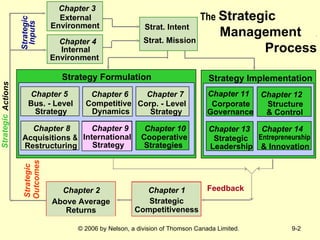
Chapter 5 Bus. - Level Strategy Chapter 6 Competitive Dynamics Chapter 9 International Strategy Chapter 10 Cooperative Strategies Chapter 8 Acquisitions  & Restructuring Chapter 11 Corporate Governance Chapter 12 Structure & Control Chapter 13 Strategic Leadership Chapter 14 Entrepreneurship & Innovation The   Strategic   Management   . Process Chapter 7 Corp. - Level Strategy Chapter 5 Bus. - Level Strategy Strategic Inputs Strategic Actions Strategic Outcomes Chapter 4 Internal Environment Chapter 3 External Environment Strat. Intent Strat. Mission Strategy Formulation Strategy Implementation Strategic Competitiveness Chapter 1 Above Average Returns Chapter 2 Feedback Strategic Competitiveness Chapter 1 Chapter 9 International Strategy
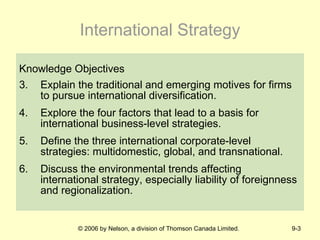
International Strategy Knowledge Objectives Explain the traditional and emerging motives for firms to pursue international diversification. Explore the four factors that lead to a basis for international business-level strategies. Define the three international corporate-level strategies: multidomestic, global, and transnational. Discuss the environmental trends affecting international strategy, especially liability of foreignness and regionalization.
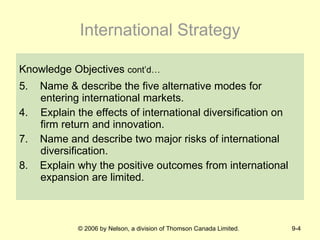
International Strategy Knowledge Objectives  cont’d… 5.  Name & describe the five alternative modes for entering international markets. Explain the effects of international diversification on firm return and innovation. 7.  Name and describe two major risks of international diversification. 8.  Explain why the positive outcomes from international expansion are limited.
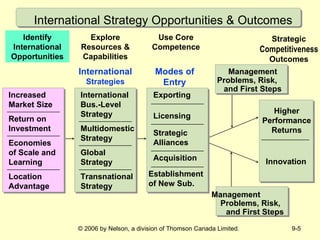
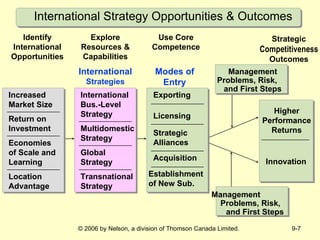
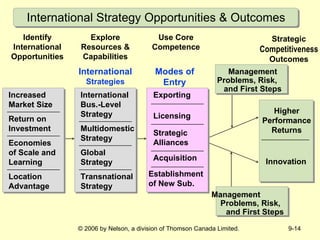
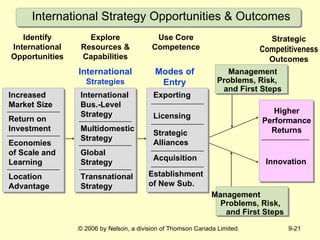
International Strategy Opportunities & Outcomes Strategic Competitiveness Outcomes Higher Performance Returns Innovation Use Core Competence Modes of Entry Exporting Establishment of New Sub. Licensing Strategic Alliances Acquisition Explore Resources & Capabilities International  Strategies International Bus.-Level Strategy Multidomestic Strategy Global Strategy Transnational Strategy Identify International Opportunities Increased Market Size Return on Investment Economies of Scale and Learning Location Advantage Management Problems, Risk,  and First Steps Management  Problems, Risk,  and First Steps Increased Market Size Return on Investment Economies of Scale and Learning Location Advantage
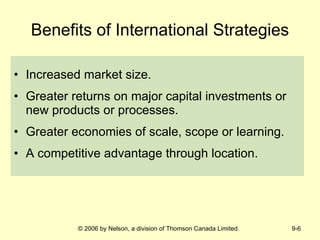
Benefits of International Strategies Increased market size. Greater returns on major capital investments or new products or processes. Greater economies of scale, scope or learning. A competitive advantage through location.
International Strategy Opportunities & Outcomes Identify International Opportunities Explore Resources & Capabilities Use Core Competence Strategic Competitiveness Outcomes International  Strategies Modes of Entry Increased Market Size Return on Investment Economies of Scale and Learning Location Advantage International Bus.-Level Strategy Multidomestic Strategy Global Strategy Transnational Strategy Exporting Establishment of New Sub. Licensing Strategic Alliances Acquisition Higher Performance Returns Innovation Management Problems, Risk,  and First Steps Management  Problems, Risk,  and First Steps
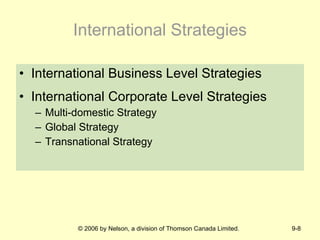
International Strategies International Business Level Strategies International Corporate Level Strategies Multi-domestic Strategy Global Strategy Transnational Strategy
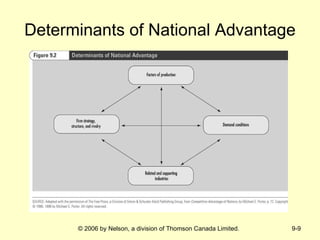
Determinants of National Advantage
Determinants of National Advantage Factors of Production Inputs – Labour, land, natural resources, capital & infrastructure Demand Conditions The nature and size of he buyers needs in the home market of goods & services Related & Supporting Industries Industries in which the target country is considered the leader  eg.  Italy  - shoes with a supporting leather industry,  Japan  -  cameras & photocopiers,    Denmark  - diary & an industry focused on food enzymes.  Firm Strategy, Structure & Rivalry make up Germany focused on methodical product & process improvements,  Italy’s national pride of designers helped spawn fashion apparel, furniture & sports car industries.
International Corporate-Level Strategy
International Corporate-Level Strategy Multi-domestic Strategy Strategic & operating decisions are decentralized to the strategic business unit in each country to tailor products to the local market.
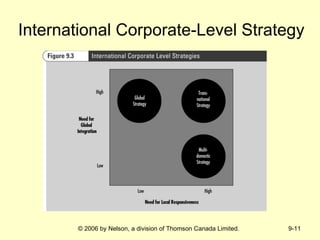
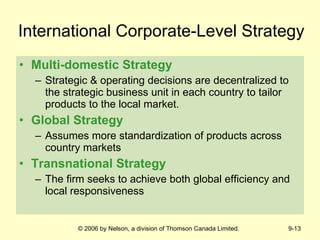
International Corporate-Level Strategy Multi-domestic Strategy Strategic & operating decisions are decentralized to the strategic business unit in each country to tailor products to the local market. Global Strategy Assumes more standardization of products across country markets Transnational Strategy The firm seeks to achieve both global efficiency and local responsiveness
International Strategy Opportunities & Outcomes Identify International Opportunities Explore Resources & Capabilities Use Core Competence Strategic Competitiveness Outcomes International  Strategies Modes of Entry Increased Market Size Return on Investment Economies of Scale and Learning Location Advantage International Bus.-Level Strategy Multidomestic Strategy Global Strategy Transnational Strategy Exporting Establishment of New Sub. Licensing Strategic Alliances Acquisition Higher Performance Returns Innovation Management Problems, Risk,  and First Steps Management  Problems, Risk,  and First Steps
Choice of International Entry Mode Exporting No need to establish operations in other nations. Establish distribution channels through contractual relationships. May have high transportation costs. May encounter high import tariffs. May have less control on marketing and distribution. Difficult to customize product. Common way to enter new international markets.
Licensing Choice of International Entry Mode Licensing firm is paid a royalty on each unit produced and sold. Licensee takes risks in manufacturing investments. Least risky way to enter a foreign market. Licensing firm loses control over product quality & distribution. Relatively low profit potential. Firm authorizes another firm to manufacture & sell its products -
Strategic Alliances Choice of International Entry Mode Most joint ventures (JVs) involve a foreign corp. with a new product or technology & a host company with access to distribution or knowledge of local customs, norms or politics.   May experience difficulties in merging disparate cultures. May not understand the strategic intent of partners or experience divergent goals. Enable firms to shares risks and  resources to expand into international ventures.
Acquisitions  Choice of International Entry Mode Can be very costly. Legal and regulatory requirements may present barriers to foreign ownership. Usually require complex and costly negotiations. Potentially disparate corporate culture. Enable firms to make most rapid international  expansion.
New   Wholly-Owned Subsidiary – Greenfield Venture Choice of International Entry Mode Most costly & complex of entry alternatives. Achieves greatest degree of control. Potentially most profitable, if successful. Maintain control over technology, marketing and distribution. May need to acquire expertise & knowledge that is relevant to host country. Could require hiring host country nationals or consultants at high cost.
Strategic Competitiveness Outcomes International diversification facilitates innovation in the firm. May generate resources necessary to sustain a large-scale R&D program. Generally related to above-average returns, assuming effective implementation and management of international operations. Provides larger market to gain more and faster returns form investments in innovation. International diversification provides greater economies of scope and learning.
International Strategy Opportunities & Outcomes Identify International Opportunities Explore Resources & Capabilities Use Core Competence Strategic Competitiveness Outcomes International  Strategies Modes of Entry Increased Market Size Return on Investment Economies of Scale and Learning Location Advantage International Bus.-Level Strategy Multidomestic Strategy Global Strategy Transnational Strategy Exporting Establishment of New Sub. Licensing Strategic Alliances Acquisition Higher Performance Returns Innovation Management Problems, Risk,  and First Steps Management  Problems, Risk,  and First Steps
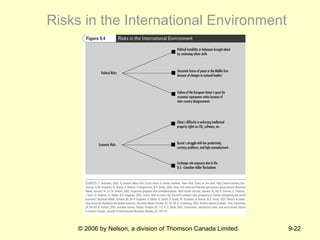
Risks in the International Environment
Major Risks of  International Diversification Political Risk National government  instability may create potential problems for internationally diversified firms. Legal authority obtained from previous   administration may become invalid.   Potential changes in attitudes or regulations regarding foreign ownership. Potential for nationalization of firms’ assets.
Economic Risk Econ. risks are interdependent with political risks. Differences in inflation rates may affect inter-nationally diversified firms’ ability to compete. Differences and fluctuations in international currencies may affect value of assets & liabilities. This affects prices & thus ability to compete. Enforcing intellectual property rights on CDs, software, etc.   Major Risks of International Diversification

Chapter 9 hitt pp slides

  • 1.
  • 2.
    Chapter 5 Bus.- Level Strategy Chapter 6 Competitive Dynamics Chapter 9 International Strategy Chapter 10 Cooperative Strategies Chapter 8 Acquisitions & Restructuring Chapter 11 Corporate Governance Chapter 12 Structure & Control Chapter 13 Strategic Leadership Chapter 14 Entrepreneurship & Innovation The Strategic Management . Process Chapter 7 Corp. - Level Strategy Chapter 5 Bus. - Level Strategy Strategic Inputs Strategic Actions Strategic Outcomes Chapter 4 Internal Environment Chapter 3 External Environment Strat. Intent Strat. Mission Strategy Formulation Strategy Implementation Strategic Competitiveness Chapter 1 Above Average Returns Chapter 2 Feedback Strategic Competitiveness Chapter 1 Chapter 9 International Strategy
  • 3.
    International Strategy KnowledgeObjectives Explain the traditional and emerging motives for firms to pursue international diversification. Explore the four factors that lead to a basis for international business-level strategies. Define the three international corporate-level strategies: multidomestic, global, and transnational. Discuss the environmental trends affecting international strategy, especially liability of foreignness and regionalization.
  • 4.
    International Strategy KnowledgeObjectives cont’d… 5. Name & describe the five alternative modes for entering international markets. Explain the effects of international diversification on firm return and innovation. 7. Name and describe two major risks of international diversification. 8. Explain why the positive outcomes from international expansion are limited.
  • 5.
    International Strategy Opportunities& Outcomes Strategic Competitiveness Outcomes Higher Performance Returns Innovation Use Core Competence Modes of Entry Exporting Establishment of New Sub. Licensing Strategic Alliances Acquisition Explore Resources & Capabilities International Strategies International Bus.-Level Strategy Multidomestic Strategy Global Strategy Transnational Strategy Identify International Opportunities Increased Market Size Return on Investment Economies of Scale and Learning Location Advantage Management Problems, Risk, and First Steps Management Problems, Risk, and First Steps Increased Market Size Return on Investment Economies of Scale and Learning Location Advantage
  • 6.
    Benefits of InternationalStrategies Increased market size. Greater returns on major capital investments or new products or processes. Greater economies of scale, scope or learning. A competitive advantage through location.
  • 7.
    International Strategy Opportunities& Outcomes Identify International Opportunities Explore Resources & Capabilities Use Core Competence Strategic Competitiveness Outcomes International Strategies Modes of Entry Increased Market Size Return on Investment Economies of Scale and Learning Location Advantage International Bus.-Level Strategy Multidomestic Strategy Global Strategy Transnational Strategy Exporting Establishment of New Sub. Licensing Strategic Alliances Acquisition Higher Performance Returns Innovation Management Problems, Risk, and First Steps Management Problems, Risk, and First Steps
  • 8.
    International Strategies InternationalBusiness Level Strategies International Corporate Level Strategies Multi-domestic Strategy Global Strategy Transnational Strategy
  • 9.
  • 10.
    Determinants of NationalAdvantage Factors of Production Inputs – Labour, land, natural resources, capital & infrastructure Demand Conditions The nature and size of he buyers needs in the home market of goods & services Related & Supporting Industries Industries in which the target country is considered the leader eg. Italy - shoes with a supporting leather industry, Japan - cameras & photocopiers, Denmark - diary & an industry focused on food enzymes. Firm Strategy, Structure & Rivalry make up Germany focused on methodical product & process improvements, Italy’s national pride of designers helped spawn fashion apparel, furniture & sports car industries.
  • 11.
  • 12.
    International Corporate-Level StrategyMulti-domestic Strategy Strategic & operating decisions are decentralized to the strategic business unit in each country to tailor products to the local market.
  • 13.
    International Corporate-Level StrategyMulti-domestic Strategy Strategic & operating decisions are decentralized to the strategic business unit in each country to tailor products to the local market. Global Strategy Assumes more standardization of products across country markets Transnational Strategy The firm seeks to achieve both global efficiency and local responsiveness
  • 14.
    International Strategy Opportunities& Outcomes Identify International Opportunities Explore Resources & Capabilities Use Core Competence Strategic Competitiveness Outcomes International Strategies Modes of Entry Increased Market Size Return on Investment Economies of Scale and Learning Location Advantage International Bus.-Level Strategy Multidomestic Strategy Global Strategy Transnational Strategy Exporting Establishment of New Sub. Licensing Strategic Alliances Acquisition Higher Performance Returns Innovation Management Problems, Risk, and First Steps Management Problems, Risk, and First Steps
  • 15.
    Choice of InternationalEntry Mode Exporting No need to establish operations in other nations. Establish distribution channels through contractual relationships. May have high transportation costs. May encounter high import tariffs. May have less control on marketing and distribution. Difficult to customize product. Common way to enter new international markets.
  • 16.
    Licensing Choice ofInternational Entry Mode Licensing firm is paid a royalty on each unit produced and sold. Licensee takes risks in manufacturing investments. Least risky way to enter a foreign market. Licensing firm loses control over product quality & distribution. Relatively low profit potential. Firm authorizes another firm to manufacture & sell its products -
  • 17.
    Strategic Alliances Choiceof International Entry Mode Most joint ventures (JVs) involve a foreign corp. with a new product or technology & a host company with access to distribution or knowledge of local customs, norms or politics. May experience difficulties in merging disparate cultures. May not understand the strategic intent of partners or experience divergent goals. Enable firms to shares risks and resources to expand into international ventures.
  • 18.
    Acquisitions Choiceof International Entry Mode Can be very costly. Legal and regulatory requirements may present barriers to foreign ownership. Usually require complex and costly negotiations. Potentially disparate corporate culture. Enable firms to make most rapid international expansion.
  • 19.
    New Wholly-Owned Subsidiary – Greenfield Venture Choice of International Entry Mode Most costly & complex of entry alternatives. Achieves greatest degree of control. Potentially most profitable, if successful. Maintain control over technology, marketing and distribution. May need to acquire expertise & knowledge that is relevant to host country. Could require hiring host country nationals or consultants at high cost.
  • 20.
    Strategic Competitiveness OutcomesInternational diversification facilitates innovation in the firm. May generate resources necessary to sustain a large-scale R&D program. Generally related to above-average returns, assuming effective implementation and management of international operations. Provides larger market to gain more and faster returns form investments in innovation. International diversification provides greater economies of scope and learning.
  • 21.
    International Strategy Opportunities& Outcomes Identify International Opportunities Explore Resources & Capabilities Use Core Competence Strategic Competitiveness Outcomes International Strategies Modes of Entry Increased Market Size Return on Investment Economies of Scale and Learning Location Advantage International Bus.-Level Strategy Multidomestic Strategy Global Strategy Transnational Strategy Exporting Establishment of New Sub. Licensing Strategic Alliances Acquisition Higher Performance Returns Innovation Management Problems, Risk, and First Steps Management Problems, Risk, and First Steps
  • 22.
    Risks in theInternational Environment
  • 23.
    Major Risks of International Diversification Political Risk National government instability may create potential problems for internationally diversified firms. Legal authority obtained from previous administration may become invalid. Potential changes in attitudes or regulations regarding foreign ownership. Potential for nationalization of firms’ assets.
  • 24.
    Economic Risk Econ.risks are interdependent with political risks. Differences in inflation rates may affect inter-nationally diversified firms’ ability to compete. Differences and fluctuations in international currencies may affect value of assets & liabilities. This affects prices & thus ability to compete. Enforcing intellectual property rights on CDs, software, etc. Major Risks of International Diversification

Editor's Notes