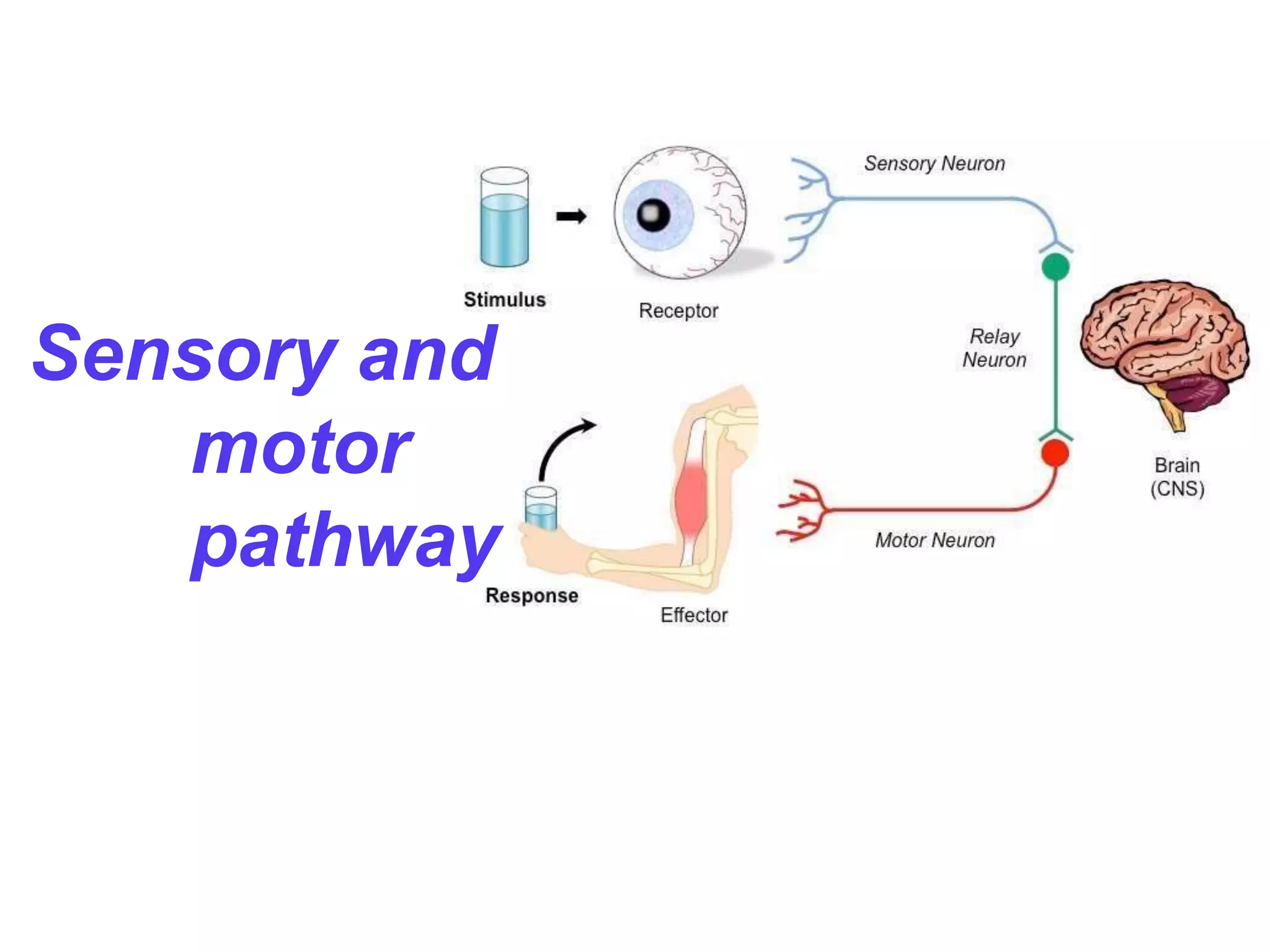
Sensory and
motor
pathway
Myelinated and Non-myelinated Nerve
Fibers
• A motor neuron is a nerve that carries an impulse
for a response from the CNS to an effector.
• A mylinated neuron is covered by a myelin
sheaths. A myelin sheath is membrane of a
Schwann cell- the cell wraps itself around the
axon of a neuron many times creating the
sheath.
Myelinated and Non-myelinated Nerve
Fibers
• Non-myelinated fibers comprise
the smaller axons of the CNS, in
addition to peripheral
postganglionic autonomic
fibers, several types of fine
sensory fibers (C fibers of skin,
muscle and viscera), olfactory
nerves, etc.
Myelinated and Non-myelinated Nerve
Fibers
Nerve fibres: A. Myelinated. B. Non-
myelinated.
Myelinated and Non-myelinated Nerve
Fibers
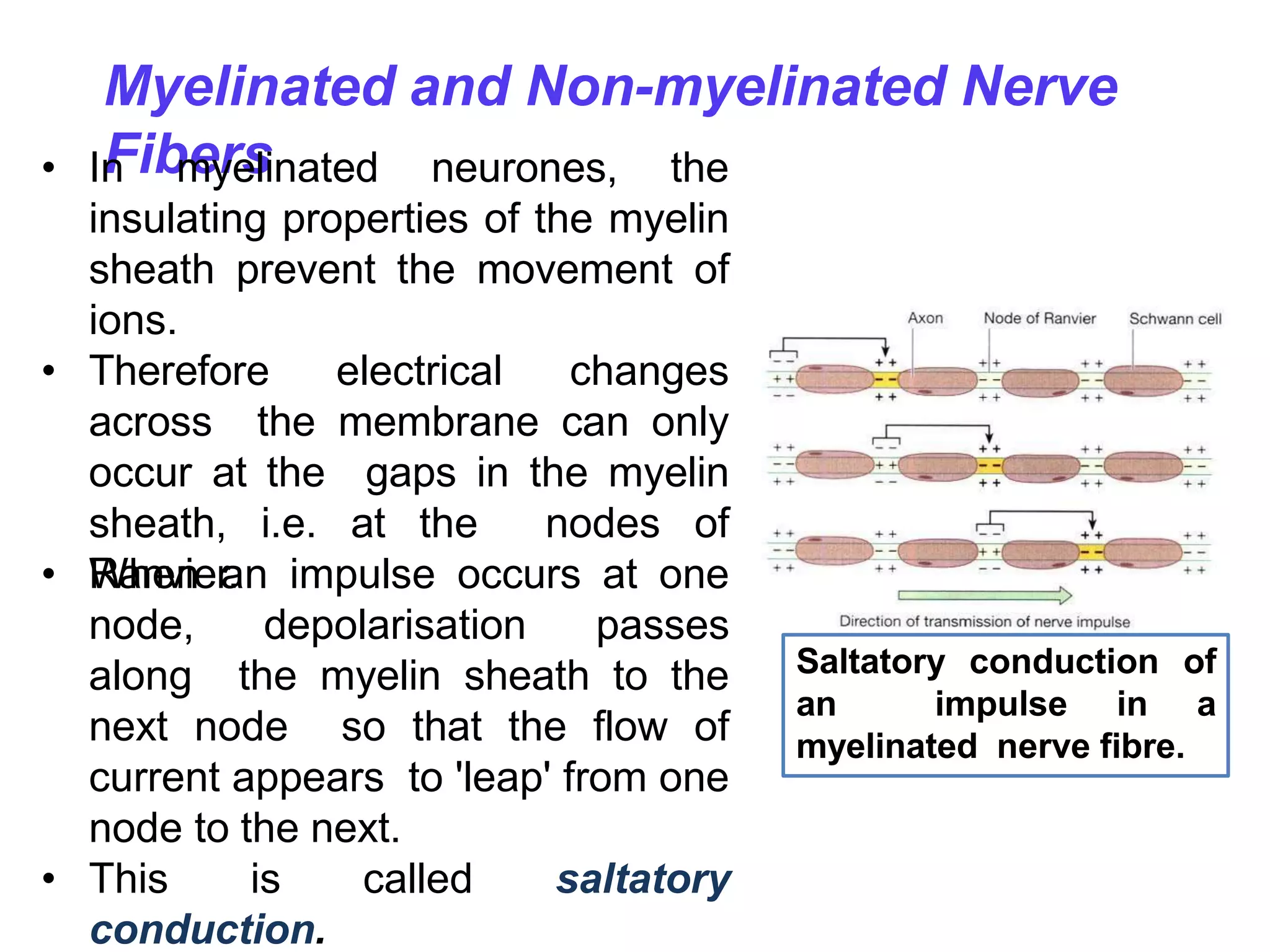
Saltatory conduction of
an impulse in a
myelinated nerve fibre.
• In myelinated neurones, the
insulating properties of the myelin
sheath prevent the movement of
ions.
• Therefore electrical changes
across the membrane can only
occur at the gaps in the myelin
sheath, i.e. at the nodes of
Ranvier.
• When an impulse occurs at one
node, depolarisation passes
along the myelin sheath to the
next node so that the flow of
current appears to 'leap' from one
node to the next.
• This is called saltatory
conduction.
Myelinated and Non-myelinated Nerve
Fibers
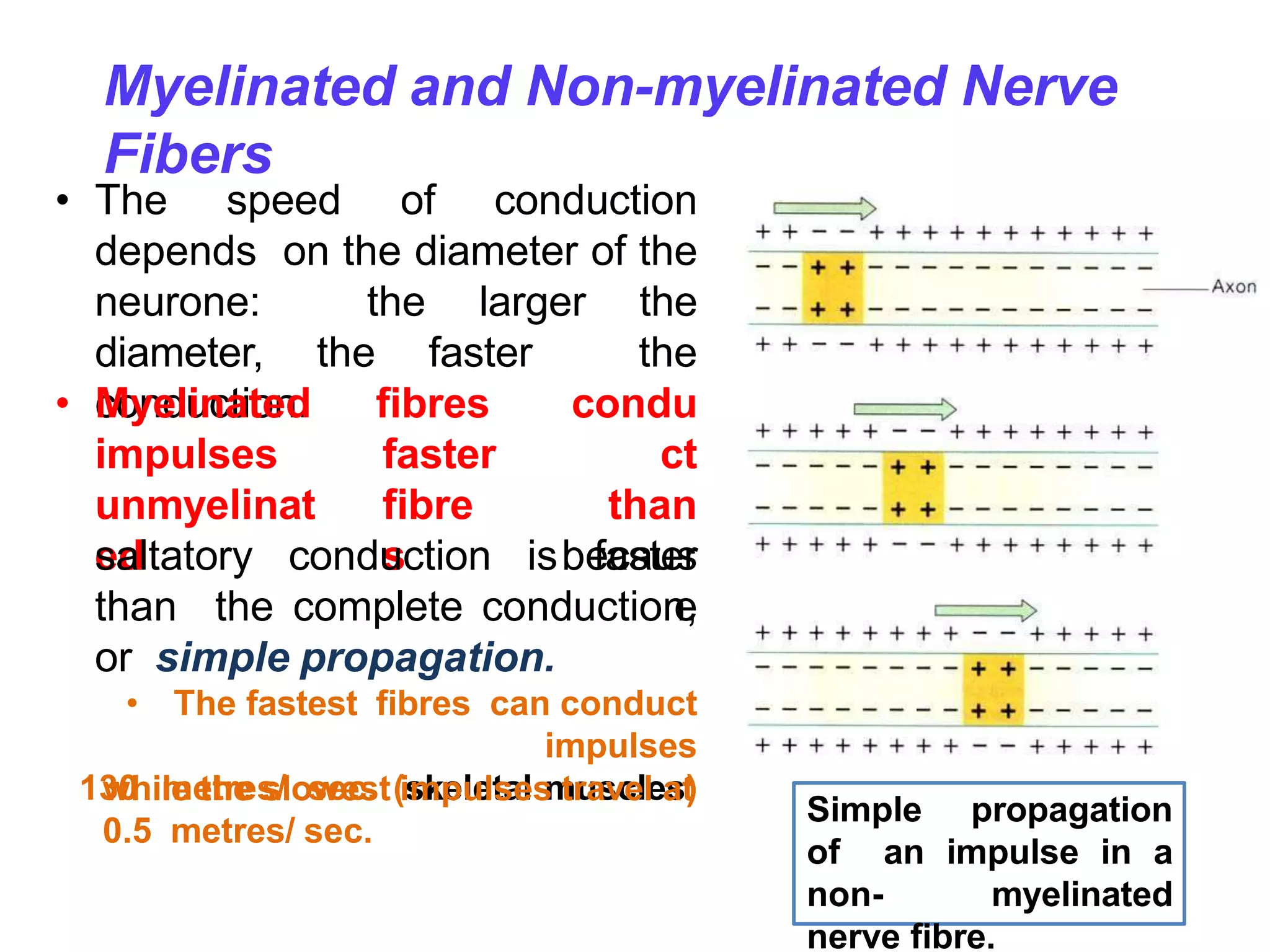
Simple propagation
of an impulse in a
non- myelinated
nerve fibre.
• The speed of conduction
depends on the diameter of the
neurone: the larger the
diameter, the faster the
conduction.
• Myelinated
impulses
unmyelinat
ed
fibres
faster
fibre
s
condu
ct
than
becaus
e
saltatory conduction is faster
than the complete conduction,
or simple propagation.
• The fastest fibres can conduct
impulses
130 metres/ sec. (skeletal muscles)
while the slowest impulses travel at
0.5 metres/ sec.
Sensory pathway
(Transmit action potentials from periphery to
brain)
Motor
pathways
Sensory nerve tracts (afferent or
ascending) in the spinal
cord
• The white matter
tracts
in the spinal cord
are
highways for nerve impulse propagation. Sensory
input travels along these tracts toward the brain,
and motor output travels from the brain along
these tracts toward skeletal muscles and other
effector tissues.
• The gray matter of the spinal cord receives and
integrates incoming and outgoing information.
Sensory nerve
tracts
• There are two main sources
of sensation transmitted to
the brain via the spinal
cord.
– SKIN: Sensory receptors
(nerve
endings) in the skin,
cutaneous
receptor
s,
calle
d
are
stimulated by pain, heat, cold
and touch, including
pressure. Nerve impulses
generated are conducted by
three neurones to the
sensory area in the opposite
hemisphere of the cerebrum
where the sensation.
Sensory nerve
tracts
• There are two main sources of sensation
transmitted to the brain via the spinal cord.
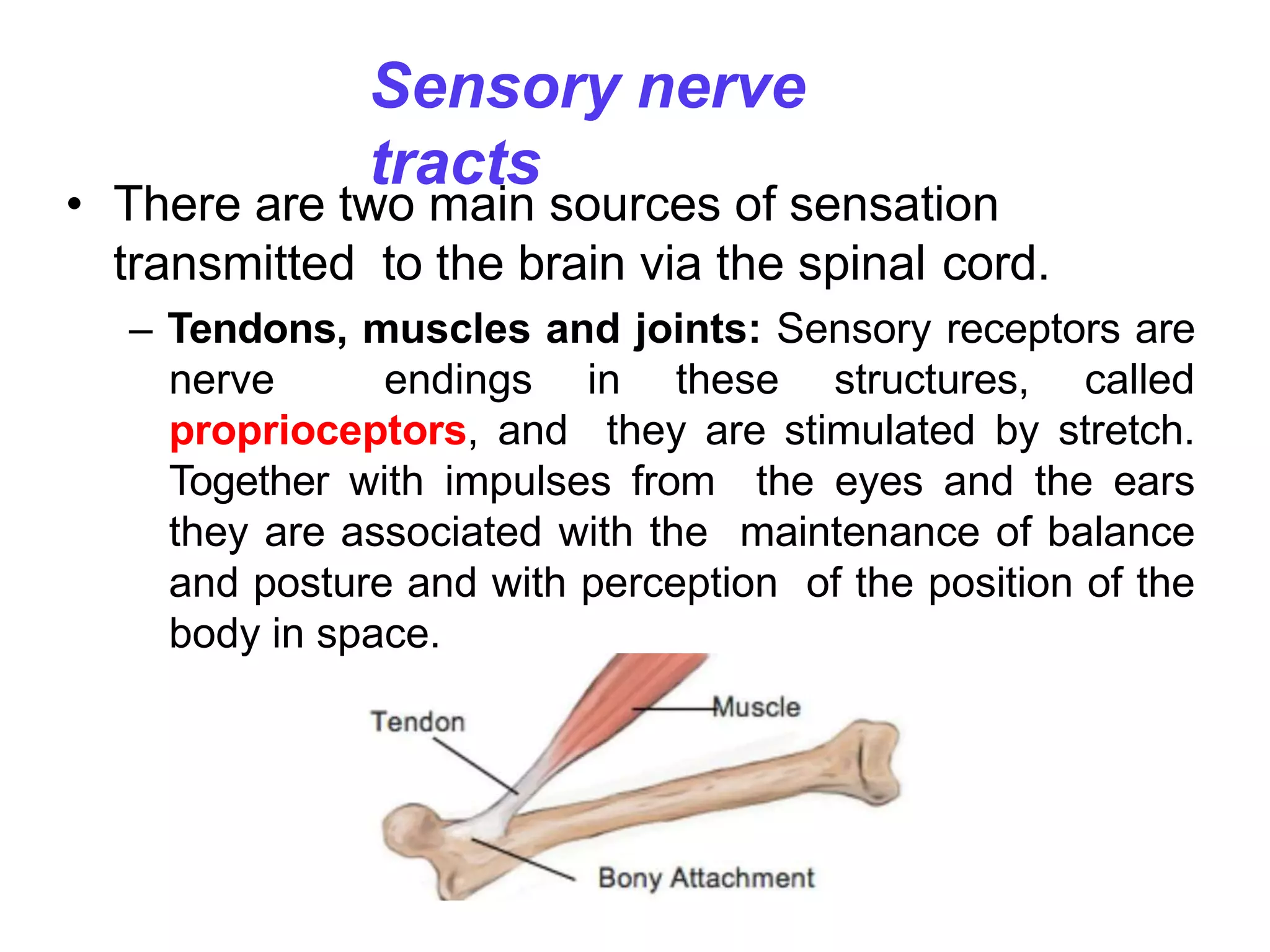
– Tendons, muscles and joints: Sensory receptors are
nerve endings in these structures, called
proprioceptors, and they are stimulated by stretch.
Together with impulses from the eyes and the ears
they are associated with the maintenance of balance
and posture and with perception of the position of the
body in space.
Sensory nerve
tracts
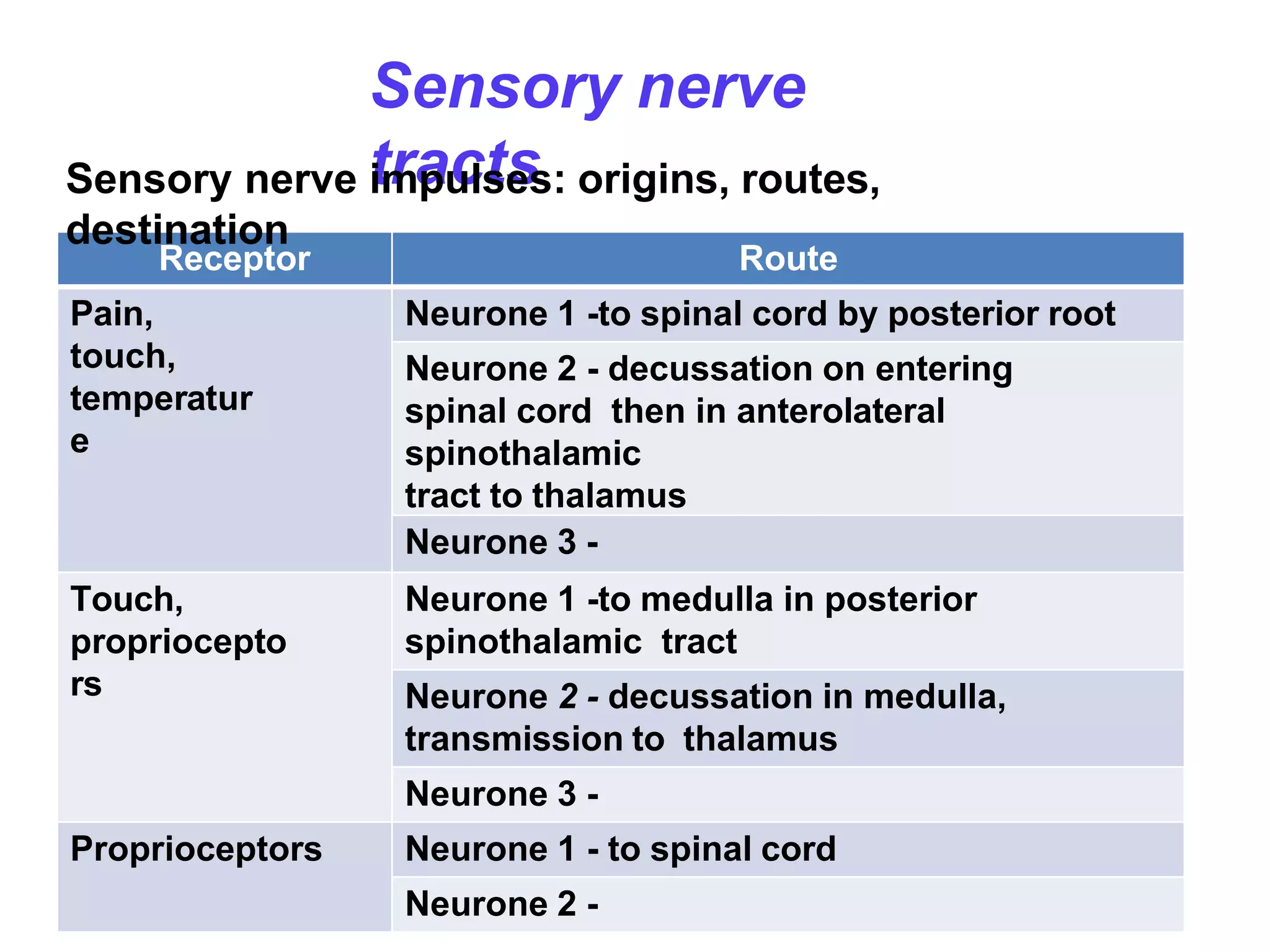
Receptor Route
Pain,
touch,
temperatur
e
Neurone 1 -to spinal cord by posterior root
Neurone 2 - decussation on entering
spinal cord then in anterolateral
spinothalamic
tract to thalamus
Neurone 3 -
Touch,
propriocepto
rs
Neurone 1 -to medulla in posterior
spinothalamic tract
Neurone 2 - decussation in medulla,
transmission to thalamus
Neurone 3 -
Proprioceptors Neurone 1 - to spinal cord
Neurone 2 -
Sensory nerve impulses: origins, routes,
destination
Sensory and Motor
Tracts
Origin Name of tract Functions
Midbrain and
pons
Rubrospinal tract
decussates in brain
stem
Control of
skilled muscle
movement
Reticular
formation
Reticulospinal tract
does not decussate
Coordination of
muscle
movement
Maintenance of
posture and
balance
Midbrain and
pons
Tectospinal tract
decussates
in midbrain
Midbrain and
pons
Vestibulospinal tract,
some fibres decussate
in the cord
Extrapyramidal upper motor neurones: origins
and tracts
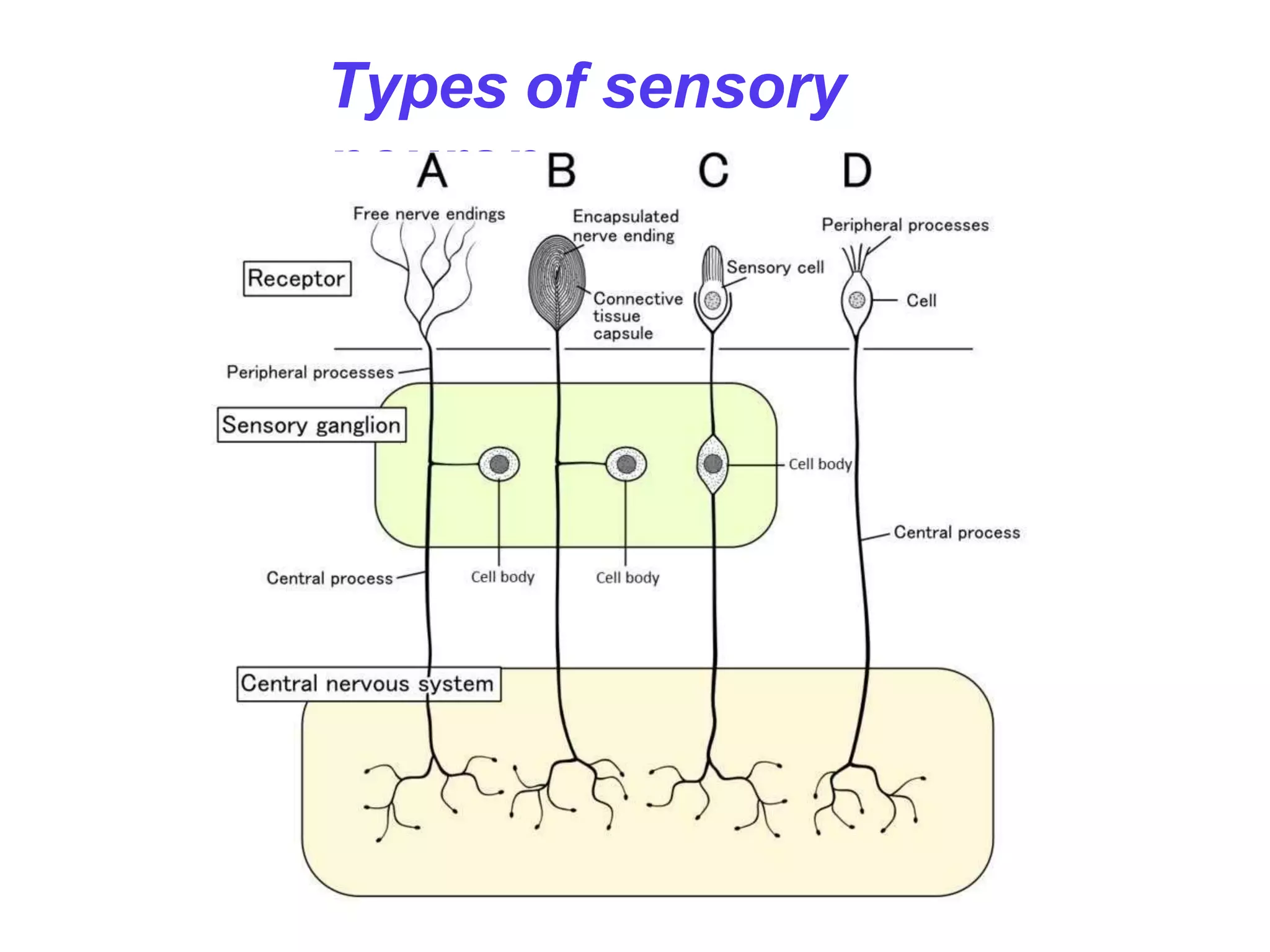
Types of sensory
neuron
Types of sensory
neuron
Sensory
receptors
• In a sensory system, sensory receptors serve as
the front-liners because they are in contact with
the stimulus.
• E.g.: Taste or gustatory receptors, odor or
olfactory receptors have receptor molecules
which undergo a process of binding to
chemicals in the stimuli.
Sensory
receptors
Sensory Receptor Adequate Stimulus (sensory receptor responds
to…)
Ampullae of
Lorenzini
(electroreceptors)
electric fields, salinity, temperature
Baroreceptors pressure in blood vessels
Chemoreceptors chemical stimuli
Hydroreceptors humidity changes
Mechanoreceptors mechanical stress or mechanical strain
Nociceptors damage to body tissues (which leads to pain
perception)
Osmoreceptors osmolarity of fluids
Photoreceptors light
Proprioceptors sense of position
Thermoreceptors temperature, heat, cold or both
Electromagnet
ic receptors
electromagnetic waves
Pacinian Corpuscles pressure on skin; weight of an object
Functions of sensory
neuron
• External
– Smell (olfactory receptors)
– Taste (gustatory receptors)
– Vision
– Auditory
– Temperature (Thermoreceptors )
– Mechanoreceptors
(mechanoreceptors )
• Internal
– Blood (peripheral chemoreceptors )
– Nociceptors
Motor
pathway
Motor
pathways
• The motor system is the part of the central
nervous system that is involved with movement. It
consists of the pyramidal and extrapyramidal
system.
• Pyramidal tracts:
– corticobulbar tract
– corticospinal tract
• Extrapyramidal tracts:
– rubrospinal tract
– pontine reticulospinal tract
– medullary reticulospinal tract
– lateral vestibulospinal tract
– tectospinal tract
Motor
pathways
• Functions of pyramidal tracts:
– nerves within the corticospinal tractare
involved in
movement of muscles of the body.
– The nerves within the corticobulbar tract
are involved in
movement in muscles of the head.
– The corticobulbar tract is also responsible for
transmitting
facial expression.
• Functions of extrapyramidal tracts:
– It causing involuntary actions
– Extrapyramidal tracts involved in reflexes,
locomotion,
Motor nerve
tracts
• Neurones which transmit nerve impulses away
from the brain are motor (efferent or descending)
neurones.
• The motor pathways from the brain to the muscles
are made up of two neurones [pyramidal
(corticospinal), extrapyramidal].
• Motor neurone stimulation results in:
– contraction of skeletal (striated, voluntary) muscle
– contraction of smooth (involuntary) muscle, cardiac
muscle and the secretion by glands controlled by
nerves of the autonomic nervous system
Motor nerve tracts –
Voluntary muscle
movement
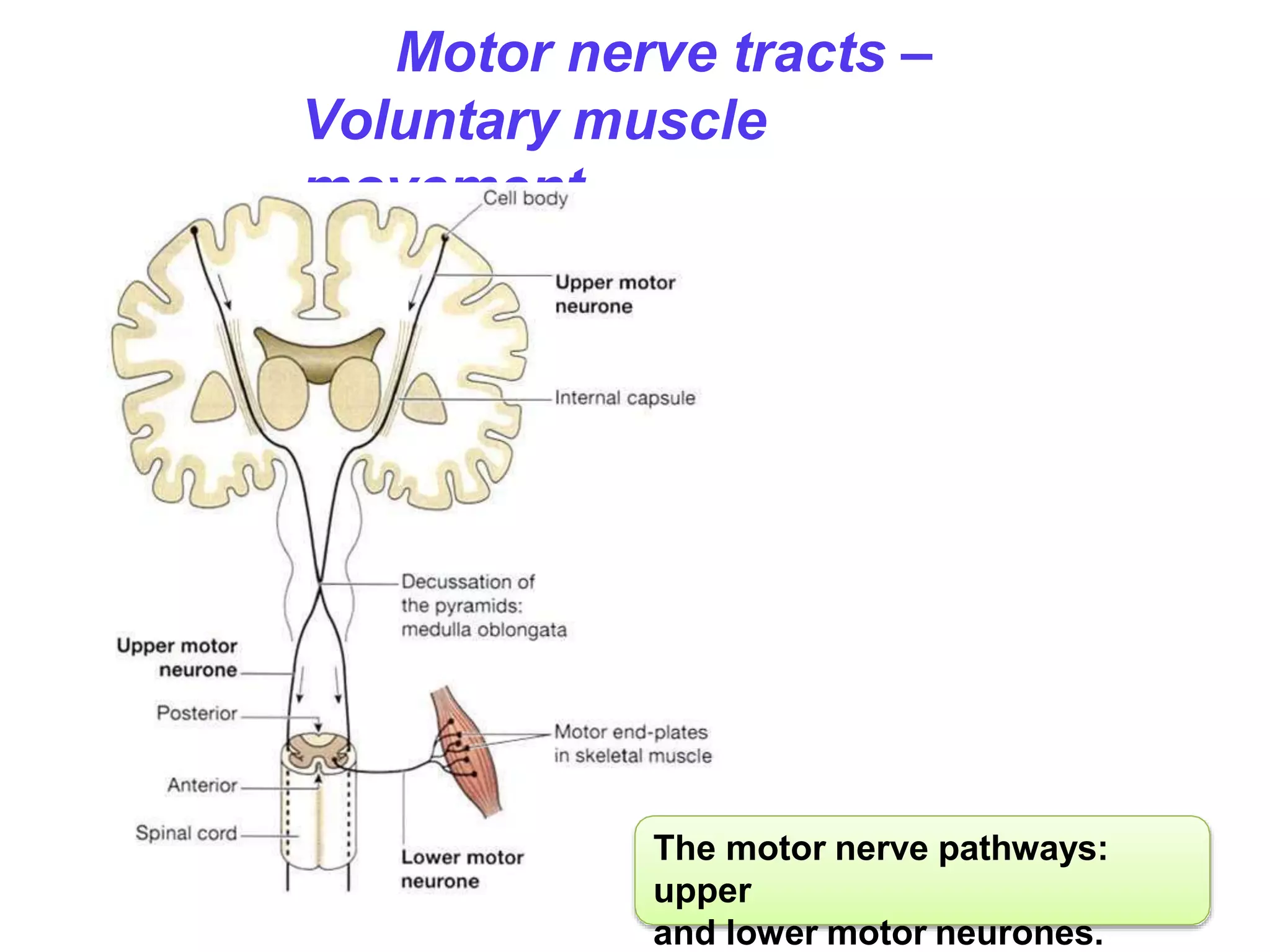
The motor nerve pathways:
upper
and lower motor neurones.
Motor nerve tracts –
Voluntary muscle
movement
• The stimulus to contract originates at the level of
consciousness in the cerebrum.
• The upper motor neurone:
– This has its cell body (Betz's cell) in the precentral sulcus
area of the cerebrum.
– The axons pass through the internal capsule, pons and
medulla.
– The axons of these upper motor neurones make up the
pyramidal tracts and decussate in the medulla oblongata,
forming the pyramids.
• The lower motor neurone:
– This has its cell body in the anterior horn of grey matter in
the spinal cord.
– The motor end-plates of each nerve and the muscle fibres
they supply form a motor unit.
Motor nerve tracts –
Involuntary muscle
movement
• The upper motor neurone:
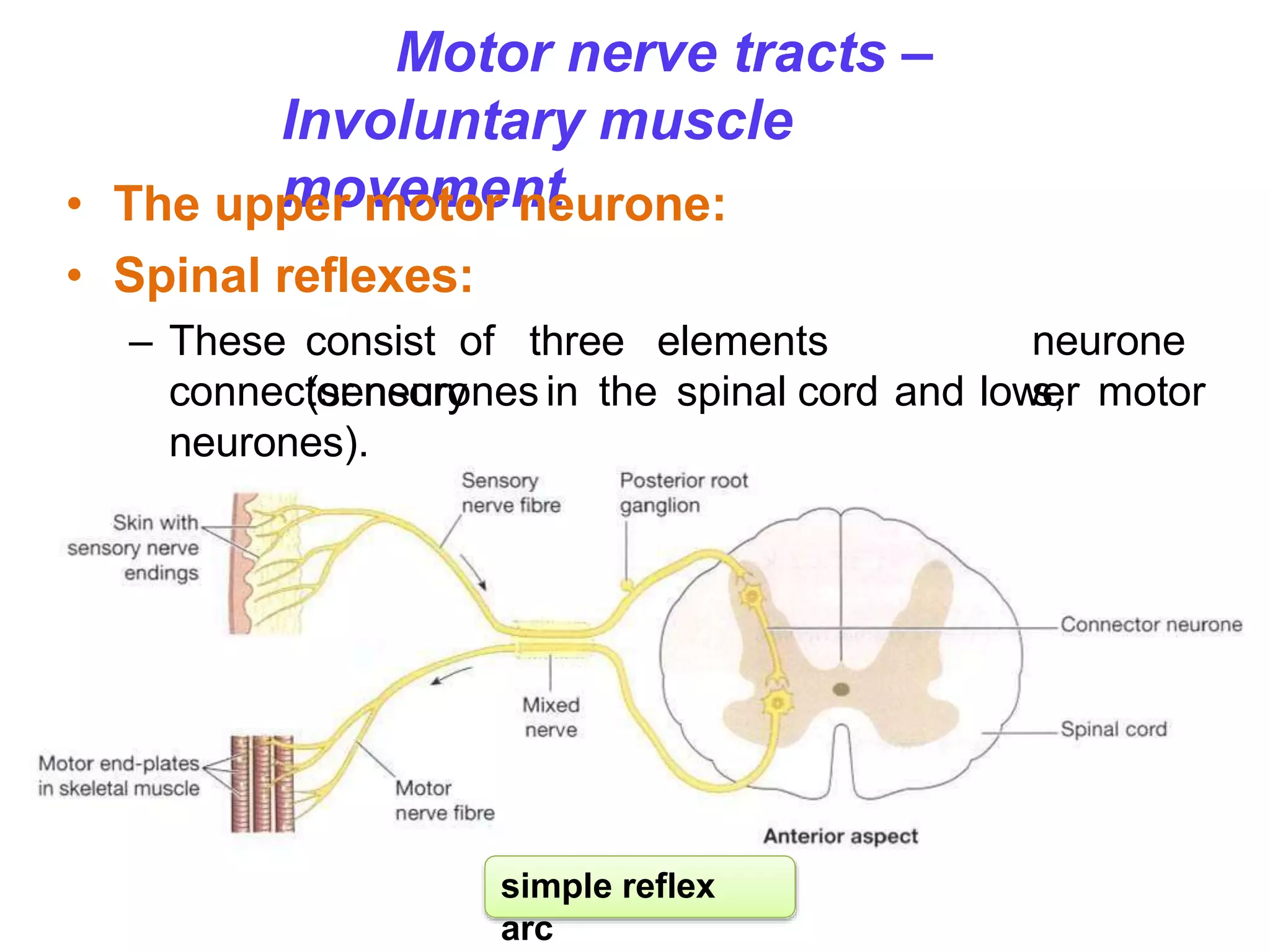
• Spinal reflexes:
– These consist of three elements
(sensory
neurone
s,
connector neurones in the spinal cord and lower motor
neurones).
simple reflex
arc
Motor nerve tracts –
Involuntary muscle
movement
• Spinal reflexes (Cont.,):
– It is an involuntary and nearly instantaneous
movement in
response to a stimulus.
– In higher animals, most sensory neurons do not pass
directly into the brain, but synapse in the spinal cord.
This characteristic allows reflex actions to occur
relatively quickly by activating spinal motor neurons
without the delay of routing signals through the brain,
although the brain will receive sensory input while the
reflex action occurs.
Motor nerve tracts –
Involuntary muscle
movement
• Stretch reflexes (Myotatic reflex):
– The stretch reflex is a muscle contraction in response
to
stretching within the muscle.
– This reflex has the shortest latency of all spinal
reflexes. It is a monosynaptic reflex that provides
automatic regulation of skeletal muscle length.
• Autonomic reflexes:
– Autonomic reflexes are also known as visceral
reflexes
because they often involve the internal organs of the
body.
– Eg: Urination and defecation, are spinal reflexes that
can
Motor nerve tracts –
Involuntary muscle
movement
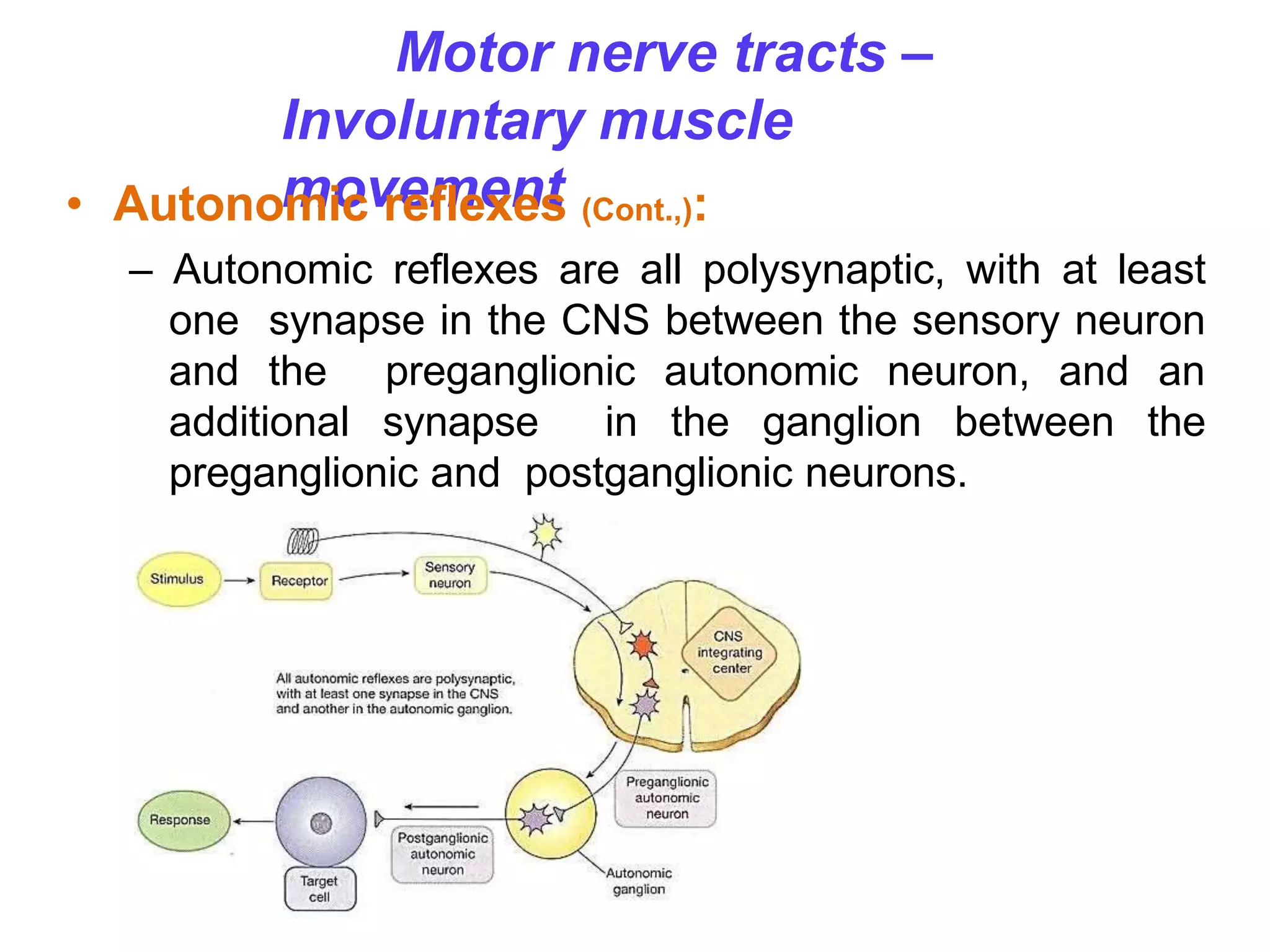
• Autonomic reflexes (Cont.,):
– Autonomic reflexes are all polysynaptic, with at least
one synapse in the CNS between the sensory neuron
and the preganglionic autonomic neuron, and an
additional synapse in the ganglion between the
preganglionic and postganglionic neurons.
Thank
you

sensory_neurons.pptx

  • 1.
  • 2.
    Myelinated and Non-myelinatedNerve Fibers • A motor neuron is a nerve that carries an impulse for a response from the CNS to an effector. • A mylinated neuron is covered by a myelin sheaths. A myelin sheath is membrane of a Schwann cell- the cell wraps itself around the axon of a neuron many times creating the sheath.
  • 3.
    Myelinated and Non-myelinatedNerve Fibers • Non-myelinated fibers comprise the smaller axons of the CNS, in addition to peripheral postganglionic autonomic fibers, several types of fine sensory fibers (C fibers of skin, muscle and viscera), olfactory nerves, etc.
  • 4.
    Myelinated and Non-myelinatedNerve Fibers Nerve fibres: A. Myelinated. B. Non- myelinated.
  • 5.
    Myelinated and Non-myelinatedNerve Fibers Saltatory conduction of an impulse in a myelinated nerve fibre. • In myelinated neurones, the insulating properties of the myelin sheath prevent the movement of ions. • Therefore electrical changes across the membrane can only occur at the gaps in the myelin sheath, i.e. at the nodes of Ranvier. • When an impulse occurs at one node, depolarisation passes along the myelin sheath to the next node so that the flow of current appears to 'leap' from one node to the next. • This is called saltatory conduction.
  • 6.
    Myelinated and Non-myelinatedNerve Fibers Simple propagation of an impulse in a non- myelinated nerve fibre. • The speed of conduction depends on the diameter of the neurone: the larger the diameter, the faster the conduction. • Myelinated impulses unmyelinat ed fibres faster fibre s condu ct than becaus e saltatory conduction is faster than the complete conduction, or simple propagation. • The fastest fibres can conduct impulses 130 metres/ sec. (skeletal muscles) while the slowest impulses travel at 0.5 metres/ sec.
  • 7.
    Sensory pathway (Transmit actionpotentials from periphery to brain)
  • 8.
  • 9.
    Sensory nerve tracts(afferent or ascending) in the spinal cord • The white matter tracts in the spinal cord are highways for nerve impulse propagation. Sensory input travels along these tracts toward the brain, and motor output travels from the brain along these tracts toward skeletal muscles and other effector tissues. • The gray matter of the spinal cord receives and integrates incoming and outgoing information.
  • 10.
    Sensory nerve tracts • Thereare two main sources of sensation transmitted to the brain via the spinal cord. – SKIN: Sensory receptors (nerve endings) in the skin, cutaneous receptor s, calle d are stimulated by pain, heat, cold and touch, including pressure. Nerve impulses generated are conducted by three neurones to the sensory area in the opposite hemisphere of the cerebrum where the sensation.
  • 11.
    Sensory nerve tracts • Thereare two main sources of sensation transmitted to the brain via the spinal cord. – Tendons, muscles and joints: Sensory receptors are nerve endings in these structures, called proprioceptors, and they are stimulated by stretch. Together with impulses from the eyes and the ears they are associated with the maintenance of balance and posture and with perception of the position of the body in space.
  • 12.
    Sensory nerve tracts Receptor Route Pain, touch, temperatur e Neurone1 -to spinal cord by posterior root Neurone 2 - decussation on entering spinal cord then in anterolateral spinothalamic tract to thalamus Neurone 3 - Touch, propriocepto rs Neurone 1 -to medulla in posterior spinothalamic tract Neurone 2 - decussation in medulla, transmission to thalamus Neurone 3 - Proprioceptors Neurone 1 - to spinal cord Neurone 2 - Sensory nerve impulses: origins, routes, destination
  • 13.
    Sensory and Motor Tracts OriginName of tract Functions Midbrain and pons Rubrospinal tract decussates in brain stem Control of skilled muscle movement Reticular formation Reticulospinal tract does not decussate Coordination of muscle movement Maintenance of posture and balance Midbrain and pons Tectospinal tract decussates in midbrain Midbrain and pons Vestibulospinal tract, some fibres decussate in the cord Extrapyramidal upper motor neurones: origins and tracts
  • 14.
  • 15.
  • 16.
    Sensory receptors • In asensory system, sensory receptors serve as the front-liners because they are in contact with the stimulus. • E.g.: Taste or gustatory receptors, odor or olfactory receptors have receptor molecules which undergo a process of binding to chemicals in the stimuli.
  • 17.
    Sensory receptors Sensory Receptor AdequateStimulus (sensory receptor responds to…) Ampullae of Lorenzini (electroreceptors) electric fields, salinity, temperature Baroreceptors pressure in blood vessels Chemoreceptors chemical stimuli Hydroreceptors humidity changes Mechanoreceptors mechanical stress or mechanical strain Nociceptors damage to body tissues (which leads to pain perception) Osmoreceptors osmolarity of fluids Photoreceptors light Proprioceptors sense of position Thermoreceptors temperature, heat, cold or both Electromagnet ic receptors electromagnetic waves Pacinian Corpuscles pressure on skin; weight of an object
  • 18.
    Functions of sensory neuron •External – Smell (olfactory receptors) – Taste (gustatory receptors) – Vision – Auditory – Temperature (Thermoreceptors ) – Mechanoreceptors (mechanoreceptors ) • Internal – Blood (peripheral chemoreceptors ) – Nociceptors
  • 19.
  • 20.
    Motor pathways • The motorsystem is the part of the central nervous system that is involved with movement. It consists of the pyramidal and extrapyramidal system. • Pyramidal tracts: – corticobulbar tract – corticospinal tract • Extrapyramidal tracts: – rubrospinal tract – pontine reticulospinal tract – medullary reticulospinal tract – lateral vestibulospinal tract – tectospinal tract
  • 21.
    Motor pathways • Functions ofpyramidal tracts: – nerves within the corticospinal tractare involved in movement of muscles of the body. – The nerves within the corticobulbar tract are involved in movement in muscles of the head. – The corticobulbar tract is also responsible for transmitting facial expression. • Functions of extrapyramidal tracts: – It causing involuntary actions – Extrapyramidal tracts involved in reflexes, locomotion,
  • 22.
    Motor nerve tracts • Neuroneswhich transmit nerve impulses away from the brain are motor (efferent or descending) neurones. • The motor pathways from the brain to the muscles are made up of two neurones [pyramidal (corticospinal), extrapyramidal]. • Motor neurone stimulation results in: – contraction of skeletal (striated, voluntary) muscle – contraction of smooth (involuntary) muscle, cardiac muscle and the secretion by glands controlled by nerves of the autonomic nervous system
  • 23.
    Motor nerve tracts– Voluntary muscle movement The motor nerve pathways: upper and lower motor neurones.
  • 24.
    Motor nerve tracts– Voluntary muscle movement • The stimulus to contract originates at the level of consciousness in the cerebrum. • The upper motor neurone: – This has its cell body (Betz's cell) in the precentral sulcus area of the cerebrum. – The axons pass through the internal capsule, pons and medulla. – The axons of these upper motor neurones make up the pyramidal tracts and decussate in the medulla oblongata, forming the pyramids. • The lower motor neurone: – This has its cell body in the anterior horn of grey matter in the spinal cord. – The motor end-plates of each nerve and the muscle fibres they supply form a motor unit.
  • 25.
    Motor nerve tracts– Involuntary muscle movement • The upper motor neurone: • Spinal reflexes: – These consist of three elements (sensory neurone s, connector neurones in the spinal cord and lower motor neurones). simple reflex arc
  • 26.
    Motor nerve tracts– Involuntary muscle movement • Spinal reflexes (Cont.,): – It is an involuntary and nearly instantaneous movement in response to a stimulus. – In higher animals, most sensory neurons do not pass directly into the brain, but synapse in the spinal cord. This characteristic allows reflex actions to occur relatively quickly by activating spinal motor neurons without the delay of routing signals through the brain, although the brain will receive sensory input while the reflex action occurs.
  • 27.
    Motor nerve tracts– Involuntary muscle movement • Stretch reflexes (Myotatic reflex): – The stretch reflex is a muscle contraction in response to stretching within the muscle. – This reflex has the shortest latency of all spinal reflexes. It is a monosynaptic reflex that provides automatic regulation of skeletal muscle length. • Autonomic reflexes: – Autonomic reflexes are also known as visceral reflexes because they often involve the internal organs of the body. – Eg: Urination and defecation, are spinal reflexes that can
  • 28.
    Motor nerve tracts– Involuntary muscle movement • Autonomic reflexes (Cont.,): – Autonomic reflexes are all polysynaptic, with at least one synapse in the CNS between the sensory neuron and the preganglionic autonomic neuron, and an additional synapse in the ganglion between the preganglionic and postganglionic neurons.
  • 29.