DR.MUMTAZ ALI
NEUROSURGERY DEPARTMENT
JPMC KARACHI
History
 A 25 year old female , single , right handed ,student
,resident of karachi with NKCM presented in opd with
c/o :
 Lower backache 1 year
 No hx of weakness , urinary incontinence , headache
,seizures , dec vision , difficulty in speech and dec
hearing
 According to pt she was alright 1 year back then she
developed lower backache which radiate in both legs ,
thigh and ankle .It is grdaual ,gripping ,moderate to
severe , continuous ,usually occuring in night and
lying down.it aggravates by coughing relived by
painkillers.It is more on left side .It is not associated
with movements. It is not associated with fever ,
weight loss , night sweats , trauma.
 No hx of lobar , cranial nerve , cerebellar , endocrine ,
systemic symptoms
 No significant past medical surgical hx , personal hx ,
family hx , socioeconomic hx , drug hx and allergic hx.
 LEVEL : L5 (Cauda equina syndrome secondary to
intradural tumor)
 D/D :
 Meningioma
 Scwannoma
 Disc
Examination
 A young age pt , well dressed ,good looking ,well oriented
with time place and person with normal built and height
with canula in right hand with following vitals and non
vitals
 Pulse : 80 bpm , BP : 120/80 mm hg , RR : 16 breaths/min ,
T: A/F
 Pallorness , clubbing , koilynchia dehydration , cynosis ,
jaundice , lymphadenopathy , edema not present.
 No buldge on scalp palpation and scar mark of Vp shunt
presnet on head
 No thydroid swelling is palpated on deglutition
 MME 30/30
 Primitive reflex : Absent
Lower limb Upper limb
 No scar, wasting , involuntary
movements , fasciculation and
tremors.
 Tone : normal in all joints
 Bulk : symmetrical
 Power 5/5 in all muscles
 Reflexes : +2
 Sensation : only pinprick is dec
on lateral side of left leg and web
space of big toe and 2nd toe and
normal and equal in all
dermatomes
 No scar, wasting ,
involuntary movements ,
fasciculation and tremors.
 Tone : normal in all joints
 Bulk : symmetrical
 Power 5/5 in all muscles
 Reflexes : +2
 Sensation : symmetrical and
normal in all dermatomes
 Spine : Tenderness on deep palpation on lower back
 SLR : negative
 Lobar signs : negative
 Cranial nerve signs : negative
 Cerebellar signs : negative
 Systemic signs : negative
 LEVEL : L5 (cauda equina syndrome sec to intradural
tumor)
 D/D :
 Meningioma
 Scwannoma
 Disc
Investigations
 Specific :
 Xray lumbosacral spine (AP XTSX CC)
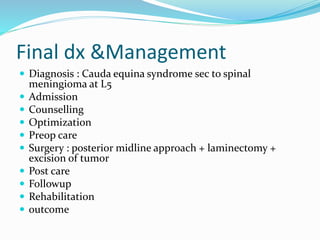
 MRI lumbosacral spine with contrast
 Relevant :
 Routine :
 CBC , SUCE ,PT/APTT/INR,Hep b & c , CXR
Final dx &Management
 Diagnosis : Cauda equina syndrome sec to spinal
meningioma at L5
 Admission
 Counselling
 Optimization
 Preop care
 Surgery : posterior midline approach + laminectomy +
excision of tumor
 Post care
 Followup
 Rehabilitation
 outcome
Surgery
 Shifting : shifted to ot after consent & counselling
 Position : prone , pressure points padded
 Equipments : microscope , cusa , bipolar , c.arm , intraoperative u/s ,
neuromonitoring
 Anesthesia : G/A
 Level identification
 Incision : Posterior midline
 Disection : skin , subcutaneous, paraspinal muscle , L5 laminectomy
 Microscopic dissection :
 Durotomy
 Tumor excision
 Hemostatsis
 Dural closure
 Wound closure
Complications and outcome
 Complications :
 Injury to dura
 Injury to nerve root
 Injury to cauda equina
 Injury to vascular structure
 Bleeding
 Csf leak
 Neurological deficit
 Urinary incontinence
 Outcome :
 Pain : improves
 Recurrence rate with compelete excision : 7%
THANKYOU

Spinal meningioma (case presentation)dr.mumtaz ali

  • 1.
  • 2.
    History  A 25year old female , single , right handed ,student ,resident of karachi with NKCM presented in opd with c/o :  Lower backache 1 year  No hx of weakness , urinary incontinence , headache ,seizures , dec vision , difficulty in speech and dec hearing
  • 3.
     According topt she was alright 1 year back then she developed lower backache which radiate in both legs , thigh and ankle .It is grdaual ,gripping ,moderate to severe , continuous ,usually occuring in night and lying down.it aggravates by coughing relived by painkillers.It is more on left side .It is not associated with movements. It is not associated with fever , weight loss , night sweats , trauma.  No hx of lobar , cranial nerve , cerebellar , endocrine , systemic symptoms
  • 4.
     No significantpast medical surgical hx , personal hx , family hx , socioeconomic hx , drug hx and allergic hx.  LEVEL : L5 (Cauda equina syndrome secondary to intradural tumor)  D/D :  Meningioma  Scwannoma  Disc
  • 5.
    Examination  A youngage pt , well dressed ,good looking ,well oriented with time place and person with normal built and height with canula in right hand with following vitals and non vitals  Pulse : 80 bpm , BP : 120/80 mm hg , RR : 16 breaths/min , T: A/F  Pallorness , clubbing , koilynchia dehydration , cynosis , jaundice , lymphadenopathy , edema not present.  No buldge on scalp palpation and scar mark of Vp shunt presnet on head  No thydroid swelling is palpated on deglutition  MME 30/30  Primitive reflex : Absent
  • 6.
    Lower limb Upperlimb  No scar, wasting , involuntary movements , fasciculation and tremors.  Tone : normal in all joints  Bulk : symmetrical  Power 5/5 in all muscles  Reflexes : +2  Sensation : only pinprick is dec on lateral side of left leg and web space of big toe and 2nd toe and normal and equal in all dermatomes  No scar, wasting , involuntary movements , fasciculation and tremors.  Tone : normal in all joints  Bulk : symmetrical  Power 5/5 in all muscles  Reflexes : +2  Sensation : symmetrical and normal in all dermatomes
  • 7.
     Spine :Tenderness on deep palpation on lower back  SLR : negative  Lobar signs : negative  Cranial nerve signs : negative  Cerebellar signs : negative  Systemic signs : negative  LEVEL : L5 (cauda equina syndrome sec to intradural tumor)  D/D :  Meningioma  Scwannoma  Disc
  • 8.
    Investigations  Specific : Xray lumbosacral spine (AP XTSX CC)  MRI lumbosacral spine with contrast  Relevant :  Routine :  CBC , SUCE ,PT/APTT/INR,Hep b & c , CXR
  • 10.
    Final dx &Management Diagnosis : Cauda equina syndrome sec to spinal meningioma at L5  Admission  Counselling  Optimization  Preop care  Surgery : posterior midline approach + laminectomy + excision of tumor  Post care  Followup  Rehabilitation  outcome
  • 11.
    Surgery  Shifting :shifted to ot after consent & counselling  Position : prone , pressure points padded  Equipments : microscope , cusa , bipolar , c.arm , intraoperative u/s , neuromonitoring  Anesthesia : G/A  Level identification  Incision : Posterior midline  Disection : skin , subcutaneous, paraspinal muscle , L5 laminectomy  Microscopic dissection :  Durotomy  Tumor excision  Hemostatsis  Dural closure  Wound closure
  • 12.
    Complications and outcome Complications :  Injury to dura  Injury to nerve root  Injury to cauda equina  Injury to vascular structure  Bleeding  Csf leak  Neurological deficit  Urinary incontinence  Outcome :  Pain : improves  Recurrence rate with compelete excision : 7%
  • 13.