RADIOLOGY
ENT
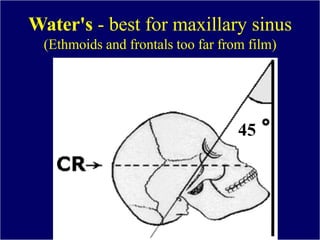
Water's - best for maxillary sinus
(Ethmoids and frontals too far from film)
45
Basic Patient Position
The patient sits erect facing the bucky, midsagittal plane
in the midline of the film, coronal plane parallel to the
film interpupillary line parallel to the floor. The chin is
raised to bring the orbital meatal line at 45 degrees to the
film.
In some centers the patient is imaged mouth open to
demonstrate the sphenoid sinuses.
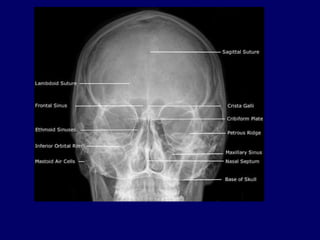
Caldwell
best for ethmoids and frontal sinus
(Temporal bones overlie maxillary)
Xray PNS Water’s view showing
• Opacity in B/L
maxillary sinuses
• Diagnosis:
– B/L Maxillary sinusitis
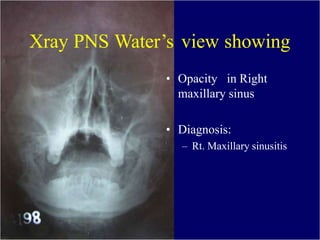
Xray PNS Water’s view showing
• Opacity in Right
maxillary sinus
• Diagnosis:
– Rt. Maxillary sinusitis
Xray PNS Water’s view showing
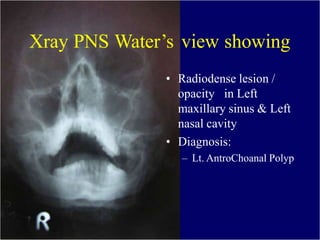
• Radiodense lesion /
opacity in Left
maxillary sinus & Left
nasal cavity
• Diagnosis:
– Lt. AntroChoanal Polyp
Xray of PNS – Water’s view
showing Rt. Antral Polyp
• Opacity seen in Rt.
Maxillary sinus
• Convexity upwards
Xray PNS Water’s view showing
• Opacity seen in Rt.
Maxillary sinus
• Tooth on the medial
wall
• Thinned out Sinus
walls
DIAGNOSIS:
Dentigerous cyst
Xray PNS Water’s view showing
• Opacity seen in Rt.
Maxillary, ethmoidal
& Frontal sinuses
DIAGNOSIS:Rt.
Pansinusitis
Common radiologic abnormalities:
Air-fluid levels suggest an acute process
• Opacification = secretions, polyps, etc.
• Thickened mucosa (check lateral maxillary wall):
Suggests chronic inflammation
• Maxillary sinus retention cysts
– Very frequent finding
– Harmless unless symptomatic
• Frontal sinus mucocele
– Nasofrontal duct obstruction (head injury?)
– Potentially serious problem
– Look for loss of scalloped edge
Nasopharynx
enlargement of the adenoids (red arrow)
The white arrow points toenlarged lingual tonsils at
the base of the tongue.
Neck lateral veiw
1. Cervical vertebrae
• Erosion of vertebral bodies- No.
• Loss of cervical Lordosis – due to prevertebral muscle
spasm
2. Pre-vertebral soft tissue shadow
• Should be < 2/3 of AP diameter of cervical vertebral
body (c2-6mm, c6-22 mm)
• If > suspect Retropharyngeal abscess
• Look for FB / Air fluid level / Gas shadow
3. Air collumn in trachea
4. Hyoid bone & Laryngeal cartilage ossifications
Chronic Retropharyngeal abscess
•Secondary to TB spine(Pott’s spine)
•Erosion of cervical vertebra
•Treatment with ATT
FB Cricopharynx with Acute
retropharyngeal abscess
Foreign Body Aspiration
Radiography
PA & lateral views of chest & neck
Inspiration & expiration
Lateral decubitus views
25% have normal radiography
• Radiopaque FB easily seen with xray
• Radiolucent FB (the majority) may have
obliterated bronchial air
column, atelectasis, mediastinal shifts, or air-
trapping in the affected lung
• Inspiratory hypoinflation and expiratory
hyperinflation in hallmark of bronchial FB
• Decubitus films – dependent lung should collapse
but will remain inflated if FB
Foreign Body Aspiration
X ray neck AP view
•Round radio opaque
object ( Coin)
•In Esophagus
•Because the
esophagus is an AP
compressed tubular
structure
•A coin would
occupy this
position
•Can be confirmed
by lateral view
X ray neck Lateral view
Foreign Body Ingestion
Common locations in esophagus
Cricopharyngeus
Aorta/left mainstem bronchus
Gastroesophageal junction
Sialography
Radiologic examination of the salivary glands
The submandibular and parotid glands are
investigated by this method
The sublingual gland is usually not evaluated this
way
Difficulty in cannulation
Procedure
1. Obtain preliminary radiographs
• Any condition that is visibe w/o contrast
• Optimum technique obtained
2. 2-3 min before procedure give lemon
3. Contrast media (iohexol) injected into main duct
4. After procedure suck on lemon to clear contrast
5. 10 min after procedure take radiograph
Parotid Radiographs Set-Up
Parotid Radiographs
Lateral Parotid Gland Radiograph
Lateral Submandibular Set-Up
Lateral Submandibular Glands
bronchogram
Radiographic examination of the tracheobronchial
tree by radiopaque iodinated compound
(dianosil,iohexaol) in a low viscous suspension.
rarely performed today, having been superseded by
high resolution computed tomography HRCT
BARIUM SWALLOW
procedure used to examine upper gastrointestinal
tract,which include the pharynx, esophagus, cardia of
stomach.
The contrast used is barium sulfate.
CONTRAST
TYPES OF CONTRAST STUDY
(i) SINGLE CONTRAST STUDY
(ii) DOUBLE CONTRAST STUDY
CONTRAINDICATION
Suspected esophageal perforation.
Tracheo-esophageal fistula
If strong clincal suspicion of aspiration or TEF,then
omnipaque swallow (iohexol) advised.
XRAY VIEW
SOFT TISSUE NECK,CHEST – AP & LAT –
SCOUT
NECK-AP & LATERAL
THORAX-RAO VIEW
NORMAL-AP /LAT VIEW - SCOUT
AP/LAT VIEW WITH BARIUM
RAO VIEW
TECHNIQUE
PHARYNX
-One mouthful contrast bolus with high
density(250% w/v).
-Patient is asked to swallow once and stop
swallowing there after.
-This is to get optimum mucosal coating.
-frontal and lateral view x-ray taken.
ESOPHAGUS
Single contrast
-Multiple mouthful barium suspension given.
-prone swallow to assess esophageal contraction.
-useful in esophageal compression, displacement
or disordered motility.
EFT: Lateral view: Epiglottis (red arrow). Post
cricoid impression (yellow arrows).
Cricopharyngeous impression (white arrow).RIGHT:
AP-view: Small lateral pharyngeal pouches (arrows)
PHARYNGEAL WEB
.
P
Partially obstructing cervical
esophageal web.
Frontal view shows a
circumferential, radiolucent ring
(straight white arrows) in the proximal
cervical esophagus. Partial obstruction
is suggested by a jet phenomenon
(black arrows), with barium spurting
through the ring, and by mild
dilatation of the proximal cervical
esophagus .
A Zenker's diverticulum is a pulsion hypopharyngeal
false diverticulum with only mucosa and submucosa
protruding through triangular posterior wall weak site
(Killian's dehiscence) between horizontal and oblique
components of cricopharyngeus muscle
CARCINOMA
Preferably high viscosity
with normal density barium
is used.
Classical finding in
carcinoma –rat tail
appearance.
CA ESOPHAGUSWith shouldering
The stenotic segment is long giving a “" *rat-tail” appearance
Barium swallow shows mild dilatation of the esophagus with irregular
stenotic lesion in the lower end of the esophagus “moth eaten appearance
ACHALASIA CARDIA
Bird beak appearance
63
P-A Skull
Patient seated or standing
facing the Bucky.
Nose and forehead touching
the Bucky to get the
canthomeatal line
perpendicular to film.
65
P-A Skull Film
.There should be no rotation.
The petrous ridges will be
superimposed with the orbits.
To clear the ridges, the
Caldwell view can be taken.
66
Chamberlain-Townes
Patient is seated facing the
tube.The chin is tucked into the
chest until the canthomeatal line
is perpendicular to film. A chair
the allows some reclining will
make this easier for the patient.
67
Chamberlain-Townes Film
The entire skull and especially
the occipital region of the skull
must be on the film.
Structure seen include the
foramen magnum, petrous
ridges, IAC’s and TM Joints
No rotation of skull
68
Skull Lateral
Patient seated of standing
facing the Bucky. Rotate the
body into an oblique position.
Turn skull so the affected side
is next to the Bucky.
The interpupillary line must be
perpendicular to film and tube.
Mid sagittal plane parallel to
the film.
70
Skull Lateral Film
Entire skull must be on the
film.
There should be no rotation of
the skull, orbits and mandible
ramus superimposed.
The facial bones are sinuses
will be dark (over exposed).
Usually both lateral views are
taken.

Ent radiology

  • 1.
  • 2.
    Water's - bestfor maxillary sinus (Ethmoids and frontals too far from film) 45
  • 3.
    Basic Patient Position Thepatient sits erect facing the bucky, midsagittal plane in the midline of the film, coronal plane parallel to the film interpupillary line parallel to the floor. The chin is raised to bring the orbital meatal line at 45 degrees to the film. In some centers the patient is imaged mouth open to demonstrate the sphenoid sinuses.
  • 5.
    Caldwell best for ethmoidsand frontal sinus (Temporal bones overlie maxillary)
  • 8.
    Xray PNS Water’sview showing • Opacity in B/L maxillary sinuses • Diagnosis: – B/L Maxillary sinusitis
  • 9.
    Xray PNS Water’sview showing • Opacity in Right maxillary sinus • Diagnosis: – Rt. Maxillary sinusitis
  • 10.
    Xray PNS Water’sview showing • Radiodense lesion / opacity in Left maxillary sinus & Left nasal cavity • Diagnosis: – Lt. AntroChoanal Polyp
  • 11.
    Xray of PNS– Water’s view showing Rt. Antral Polyp • Opacity seen in Rt. Maxillary sinus • Convexity upwards
  • 12.
    Xray PNS Water’sview showing • Opacity seen in Rt. Maxillary sinus • Tooth on the medial wall • Thinned out Sinus walls DIAGNOSIS: Dentigerous cyst
  • 13.
    Xray PNS Water’sview showing • Opacity seen in Rt. Maxillary, ethmoidal & Frontal sinuses DIAGNOSIS:Rt. Pansinusitis
  • 15.
    Common radiologic abnormalities: Air-fluidlevels suggest an acute process • Opacification = secretions, polyps, etc. • Thickened mucosa (check lateral maxillary wall): Suggests chronic inflammation • Maxillary sinus retention cysts – Very frequent finding – Harmless unless symptomatic • Frontal sinus mucocele – Nasofrontal duct obstruction (head injury?) – Potentially serious problem – Look for loss of scalloped edge
  • 16.
  • 17.
    enlargement of theadenoids (red arrow) The white arrow points toenlarged lingual tonsils at the base of the tongue.
  • 19.
    Neck lateral veiw 1.Cervical vertebrae • Erosion of vertebral bodies- No. • Loss of cervical Lordosis – due to prevertebral muscle spasm 2. Pre-vertebral soft tissue shadow • Should be < 2/3 of AP diameter of cervical vertebral body (c2-6mm, c6-22 mm) • If > suspect Retropharyngeal abscess • Look for FB / Air fluid level / Gas shadow 3. Air collumn in trachea 4. Hyoid bone & Laryngeal cartilage ossifications
  • 22.
    Chronic Retropharyngeal abscess •Secondaryto TB spine(Pott’s spine) •Erosion of cervical vertebra •Treatment with ATT
  • 24.
    FB Cricopharynx withAcute retropharyngeal abscess
  • 29.
    Foreign Body Aspiration Radiography PA& lateral views of chest & neck Inspiration & expiration Lateral decubitus views 25% have normal radiography
  • 30.
    • Radiopaque FBeasily seen with xray • Radiolucent FB (the majority) may have obliterated bronchial air column, atelectasis, mediastinal shifts, or air- trapping in the affected lung • Inspiratory hypoinflation and expiratory hyperinflation in hallmark of bronchial FB • Decubitus films – dependent lung should collapse but will remain inflated if FB
  • 31.
  • 32.
    X ray neckAP view •Round radio opaque object ( Coin) •In Esophagus •Because the esophagus is an AP compressed tubular structure •A coin would occupy this position •Can be confirmed by lateral view
  • 33.
    X ray neckLateral view
  • 34.
    Foreign Body Ingestion Commonlocations in esophagus Cricopharyngeus Aorta/left mainstem bronchus Gastroesophageal junction
  • 36.
    Sialography Radiologic examination ofthe salivary glands The submandibular and parotid glands are investigated by this method The sublingual gland is usually not evaluated this way Difficulty in cannulation
  • 37.
    Procedure 1. Obtain preliminaryradiographs • Any condition that is visibe w/o contrast • Optimum technique obtained 2. 2-3 min before procedure give lemon 3. Contrast media (iohexol) injected into main duct 4. After procedure suck on lemon to clear contrast 5. 10 min after procedure take radiograph
  • 38.
  • 39.
  • 41.
  • 42.
  • 43.
  • 44.
    bronchogram Radiographic examination ofthe tracheobronchial tree by radiopaque iodinated compound (dianosil,iohexaol) in a low viscous suspension. rarely performed today, having been superseded by high resolution computed tomography HRCT
  • 46.
    BARIUM SWALLOW procedure usedto examine upper gastrointestinal tract,which include the pharynx, esophagus, cardia of stomach. The contrast used is barium sulfate.
  • 47.
    CONTRAST TYPES OF CONTRASTSTUDY (i) SINGLE CONTRAST STUDY (ii) DOUBLE CONTRAST STUDY
  • 48.
    CONTRAINDICATION Suspected esophageal perforation. Tracheo-esophagealfistula If strong clincal suspicion of aspiration or TEF,then omnipaque swallow (iohexol) advised.
  • 49.
    XRAY VIEW SOFT TISSUENECK,CHEST – AP & LAT – SCOUT NECK-AP & LATERAL THORAX-RAO VIEW
  • 50.
  • 51.
  • 52.
  • 53.
    TECHNIQUE PHARYNX -One mouthful contrastbolus with high density(250% w/v). -Patient is asked to swallow once and stop swallowing there after. -This is to get optimum mucosal coating. -frontal and lateral view x-ray taken.
  • 54.
    ESOPHAGUS Single contrast -Multiple mouthfulbarium suspension given. -prone swallow to assess esophageal contraction. -useful in esophageal compression, displacement or disordered motility.
  • 55.
    EFT: Lateral view:Epiglottis (red arrow). Post cricoid impression (yellow arrows). Cricopharyngeous impression (white arrow).RIGHT: AP-view: Small lateral pharyngeal pouches (arrows)
  • 56.
  • 57.
    Partially obstructing cervical esophagealweb. Frontal view shows a circumferential, radiolucent ring (straight white arrows) in the proximal cervical esophagus. Partial obstruction is suggested by a jet phenomenon (black arrows), with barium spurting through the ring, and by mild dilatation of the proximal cervical esophagus .
  • 59.
    A Zenker's diverticulumis a pulsion hypopharyngeal false diverticulum with only mucosa and submucosa protruding through triangular posterior wall weak site (Killian's dehiscence) between horizontal and oblique components of cricopharyngeus muscle
  • 60.
    CARCINOMA Preferably high viscosity withnormal density barium is used. Classical finding in carcinoma –rat tail appearance.
  • 61.
    CA ESOPHAGUSWith shouldering Thestenotic segment is long giving a “" *rat-tail” appearance Barium swallow shows mild dilatation of the esophagus with irregular stenotic lesion in the lower end of the esophagus “moth eaten appearance
  • 62.
  • 63.
    63 P-A Skull Patient seatedor standing facing the Bucky. Nose and forehead touching the Bucky to get the canthomeatal line perpendicular to film.
  • 65.
    65 P-A Skull Film .Thereshould be no rotation. The petrous ridges will be superimposed with the orbits. To clear the ridges, the Caldwell view can be taken.
  • 66.
    66 Chamberlain-Townes Patient is seatedfacing the tube.The chin is tucked into the chest until the canthomeatal line is perpendicular to film. A chair the allows some reclining will make this easier for the patient.
  • 67.
    67 Chamberlain-Townes Film The entireskull and especially the occipital region of the skull must be on the film. Structure seen include the foramen magnum, petrous ridges, IAC’s and TM Joints No rotation of skull
  • 68.
    68 Skull Lateral Patient seatedof standing facing the Bucky. Rotate the body into an oblique position. Turn skull so the affected side is next to the Bucky. The interpupillary line must be perpendicular to film and tube. Mid sagittal plane parallel to the film.
  • 70.
    70 Skull Lateral Film Entireskull must be on the film. There should be no rotation of the skull, orbits and mandible ramus superimposed. The facial bones are sinuses will be dark (over exposed). Usually both lateral views are taken.