Neuroanatomy of Spinal cord
Presentor: Dr.Deepika.T
Post graduate student
Moderator: Dr.Byrareddy
Professor
Department of General Medicine,
RRMCH, Bengaluru
Gross anatomy
Meninges surrounding the spinal cord
Cross sectional anatomy
Ascending & descending tracts
Blood supply
Clinical correlation & application
Gross Anatomy
 Spinal cord lies in vertebral canal
 Extends from level of cranial border of atlas to lower border of L1
or upper border of L2 vertebrae in adults
 About 18 inches (45 cm) long
 1/2 inch (14 mm) wide
 Approx weight = 30 gms
 Corresponding average length of spinal column is 70cm
 Anchored to duramater by dentate ligament
 Cylindrical in shape & flattened dorso ventrally
Gross Anatomy
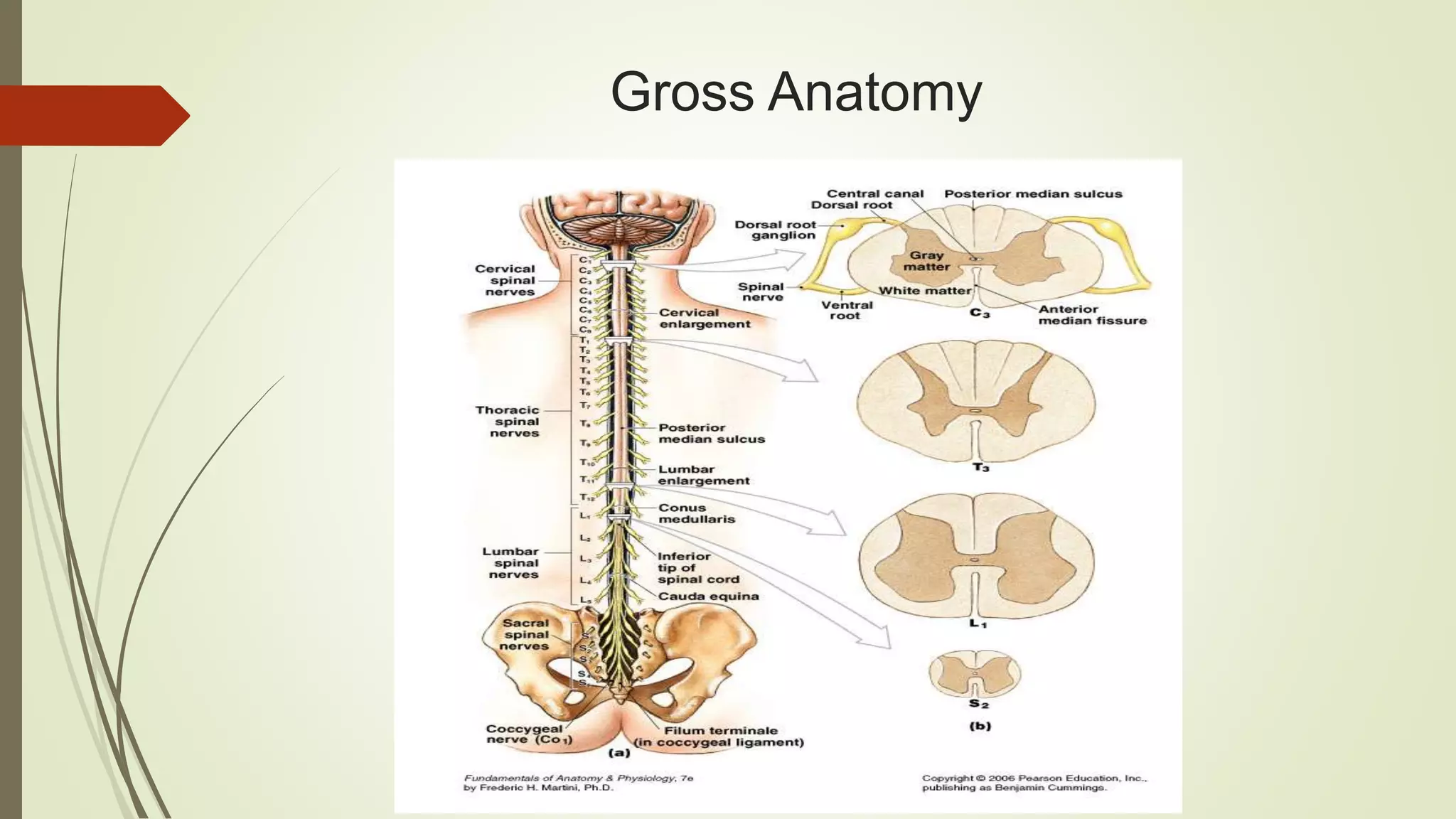
 Has cervical (C5 to T1) and lumbar (L3 to S2) enlargements
 Below Lumbar enlargement, spinal cord narrows ending as conus
medullaris
 CNS tissue ends between vertebrae L1 and L2 whereas in neonates
ends at upper border of L3
 At birth, cord and vertebrae are about the same size but cord stops
elongating at around age 4
 Although it is a continuous & non segmental structure, 31 pair of
originating nerves give it a segmental appearance
 31 pairs of spinal nerves: 8C, 12T, 5L, 5S & 1Co
 Each pair of nerves exits the vertebral column at the level it initially
lined up with at birth
Gross Anatomy
Conus medullaris:
thin, conical end of the spinal cord
Cauda equina:
nerve roots extending below conus medullaris
Filum terminale:
thin thread of fibrous tissue at end of conus medullaris
attaches to coccygeal ligament
Gross Anatomy
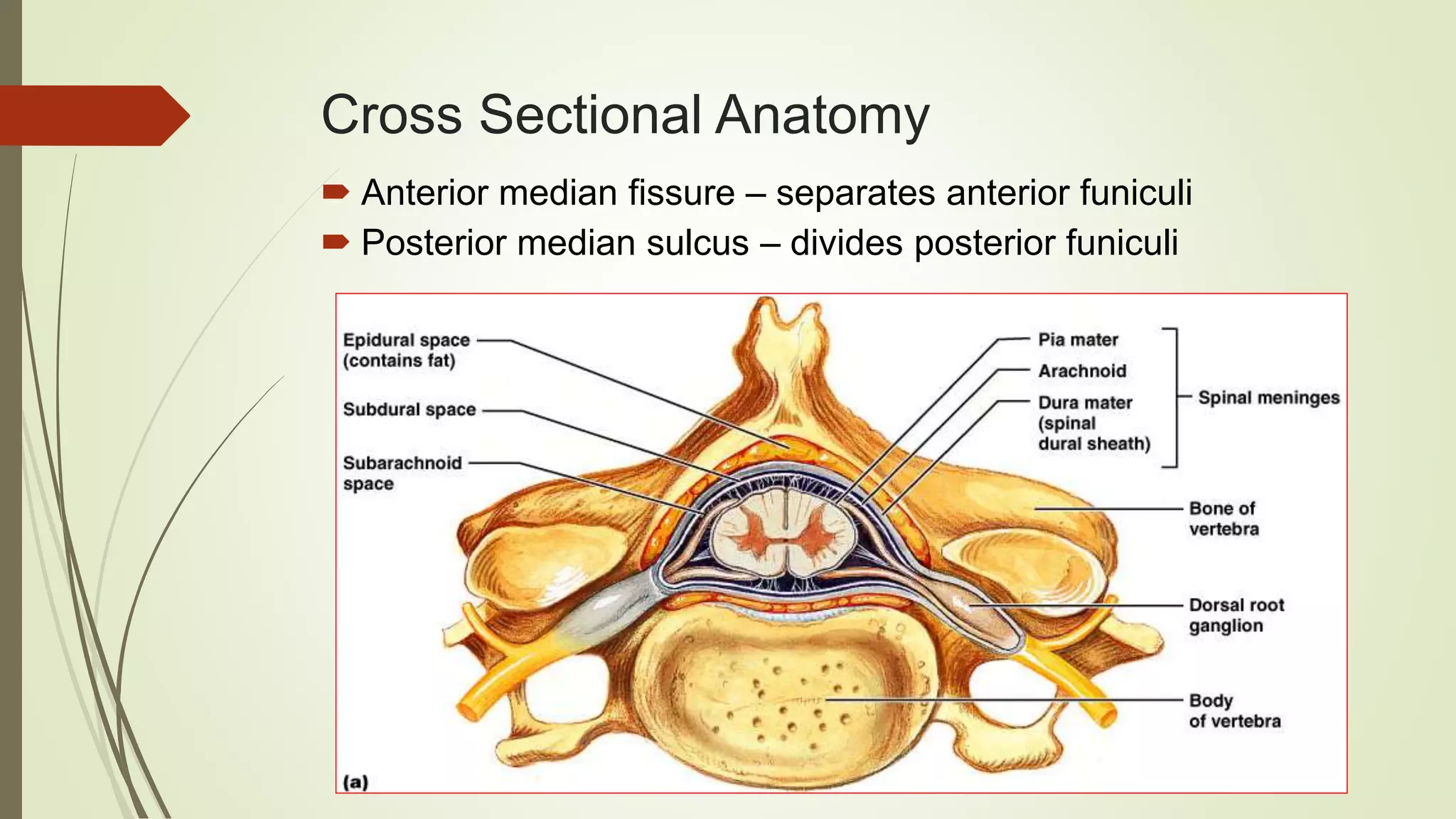
MENINGES
 Specialized membranes, isolate spinal cord from surroundings
Dura mater: outer layer
Arachnoid mater: middle layer
Pia mater : inner layer
 Spinal meninges:
 protect spinal cord
 carry blood supply
 continuous with cranial meninges
 Epidural space :
between spinal duramater and walls of spinal column,
contains loose connective and areolar tissue
 Subdural space
 between arachnoid mater and dura mater
 Subarachnoid space:
 between arachnoid mater and pia mater
 filled with cerebrospinal fluid (CSF)
SPACES
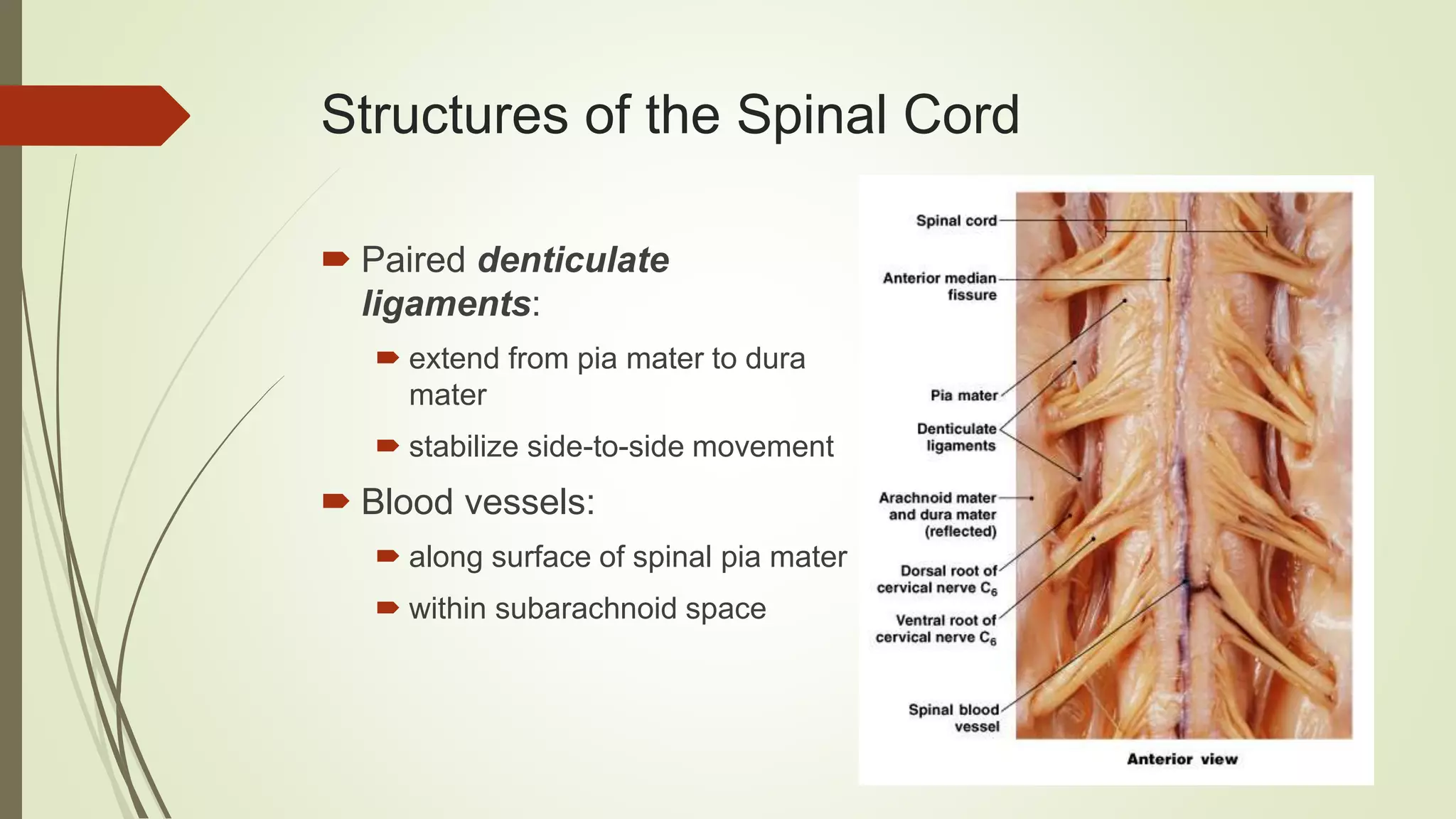
Structures of the Spinal Cord
 Paired denticulate
ligaments:
 extend from pia mater to dura
mater
 stabilize side-to-side movement
 Blood vessels:
 along surface of spinal pia mater
 within subarachnoid space
Cross Sectional Anatomy
 Anterior median fissure – separates anterior funiculi
 Posterior median sulcus – divides posterior funiculi
Cross Sectional Anatomy
Spinal cord has a narrow, fluid filled central canal
Central canal is surrounded by butterfly or H-shaped
gray matter containing sensory and motor nuclei
(soma), unmyelinated processes, and neuroglia
White matter is on the outside of the gray matter
(opposite of the brain) and contains myelinated and
unmyelinated fibers
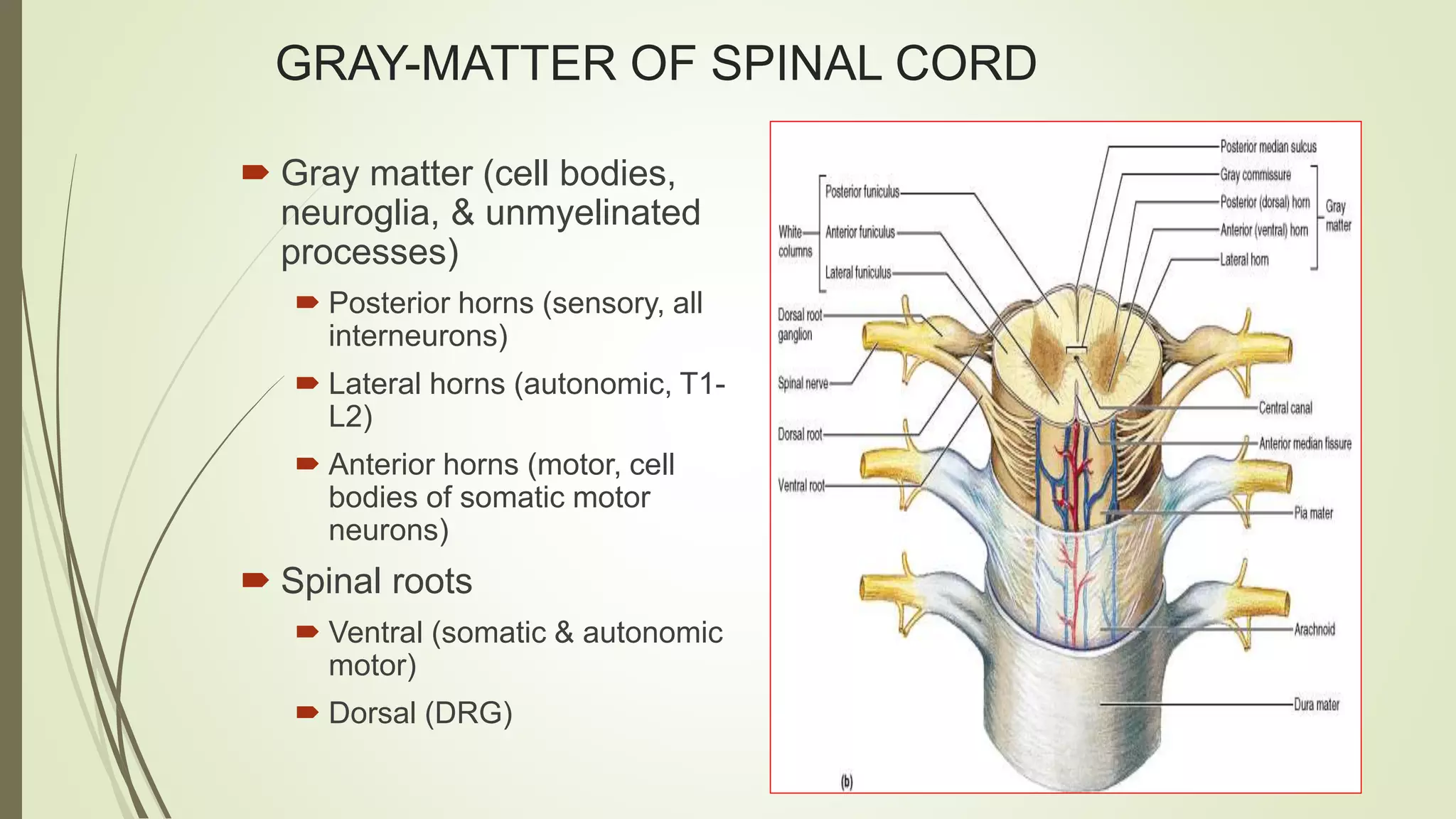
GRAY-MATTER OF SPINAL CORD
 Gray matter (cell bodies,
neuroglia, & unmyelinated
processes)
 Posterior horns (sensory, all
interneurons)
 Lateral horns (autonomic, T1-
L2)
 Anterior horns (motor, cell
bodies of somatic motor
neurons)
 Spinal roots
 Ventral (somatic & autonomic
motor)
 Dorsal (DRG)
Gray Matter: Organization
 Dorsal half – sensory roots and ganglia
 Ventral half – motor roots
 Dorsal and ventral roots fuse laterally to form spinal nerves
 Four zones are evident within the gray matter – somatic sensory
(SS), visceral sensory (VS), visceral motor (VM), and somatic
motor (SM)
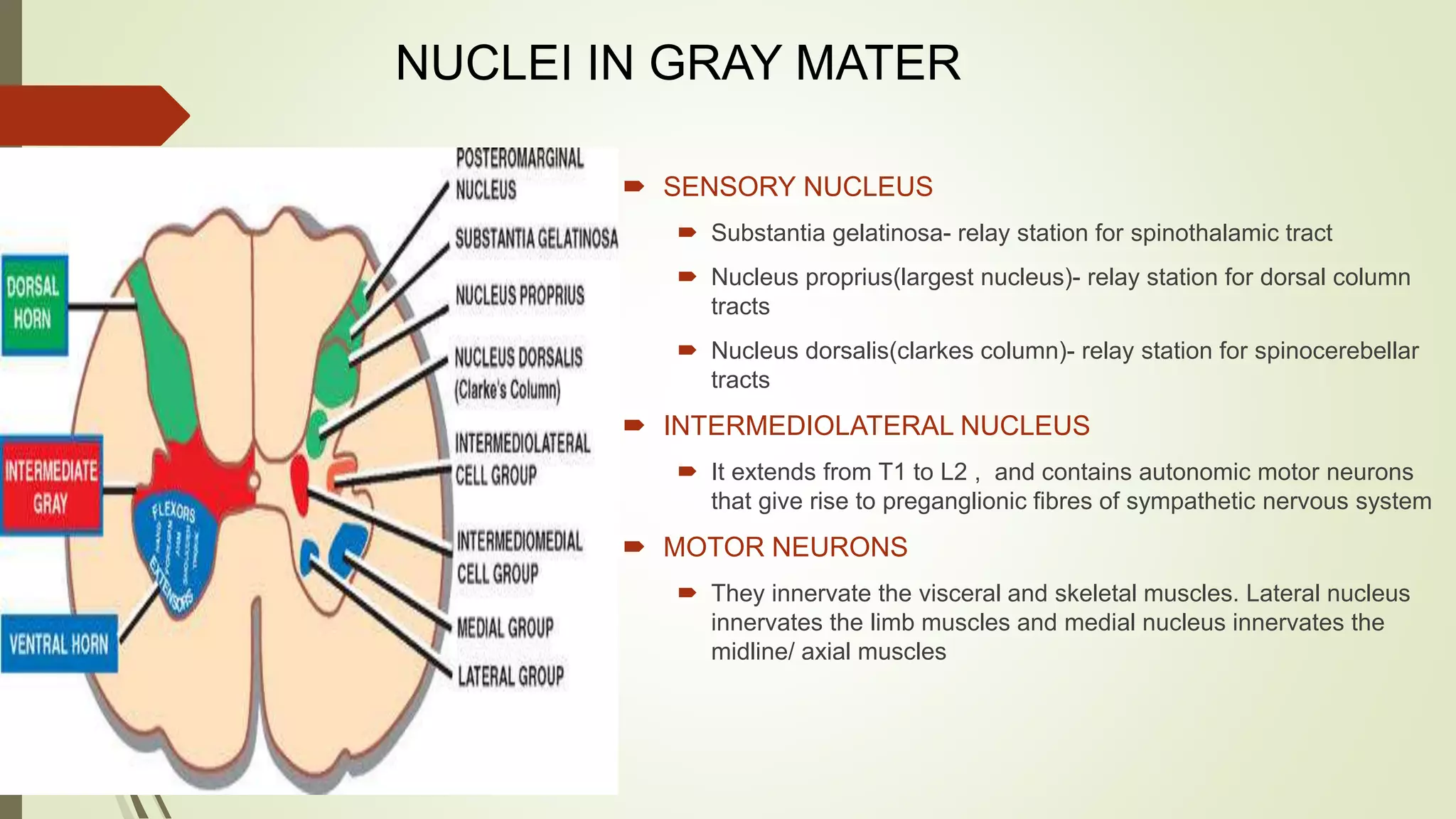
 SENSORY NUCLEUS
 Substantia gelatinosa- relay station for spinothalamic tract
 Nucleus proprius(largest nucleus)- relay station for dorsal column
tracts
 Nucleus dorsalis(clarkes column)- relay station for spinocerebellar
tracts
 INTERMEDIOLATERAL NUCLEUS
 It extends from T1 to L2 , and contains autonomic motor neurons
that give rise to preganglionic fibres of sympathetic nervous system
 MOTOR NEURONS
 They innervate the visceral and skeletal muscles. Lateral nucleus
innervates the limb muscles and medial nucleus innervates the
midline/ axial muscles
NUCLEI IN GRAY MATER
White matter
 Tracts (or fasciculi):
 bundles of axons in the white columns
 relay certain type of information in same direction
 Ascending tracts:
 carry information to brain
 Descending tracts:
 carry motor commands to spinal cord
Cross-sectional anatomy – white mater
 White matter
 3 funiculi (posterior, lateral,
anterior)
Ascending, descending,
transverse
 Consist of “tracts” containing
similarly functional axons
All tracts are paired
Most cross over (decussate) at
some point
Most consist of a chain of 2 or 3
successive neurons
ASCENDING & DESCENDING TRACTS
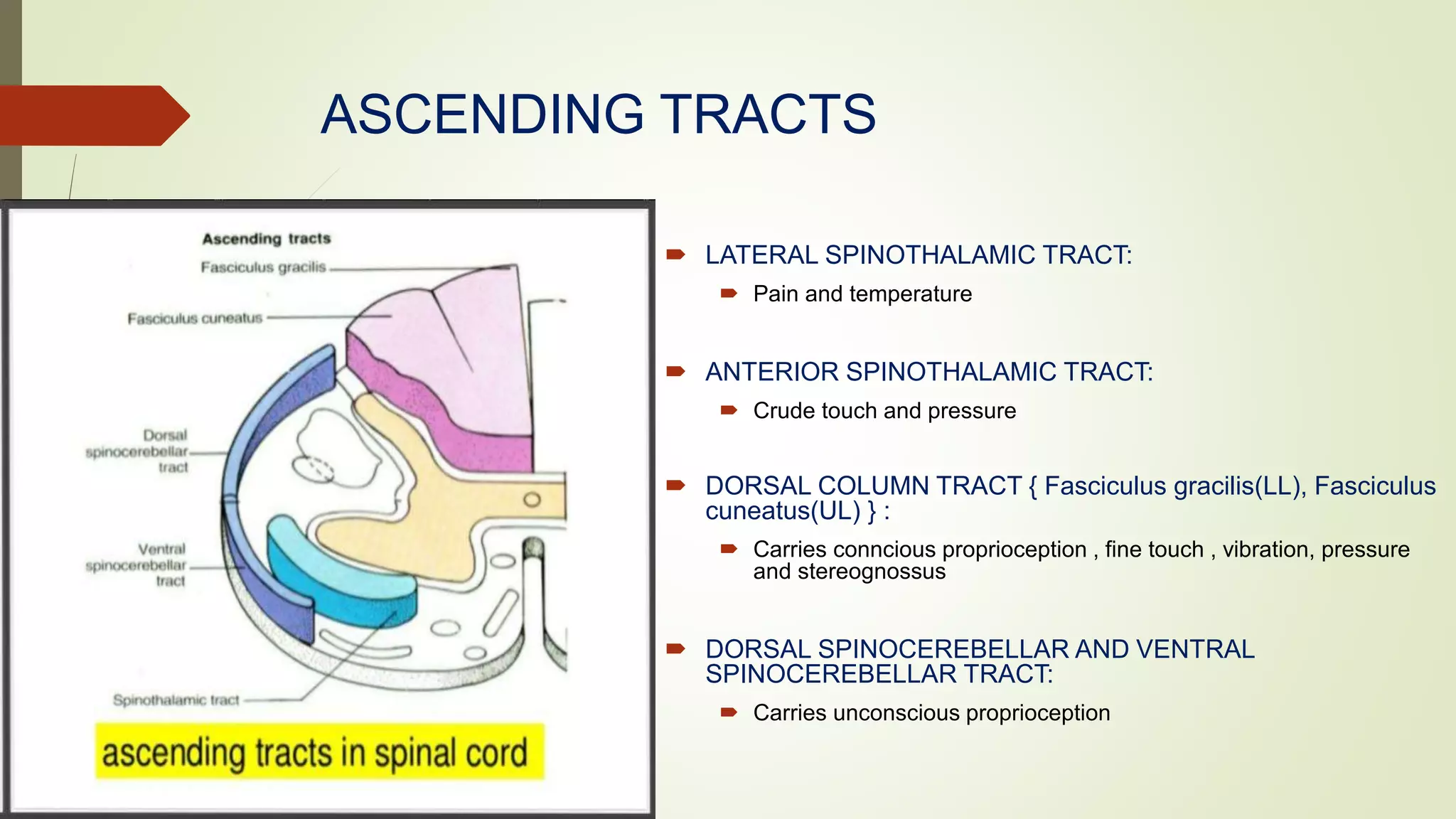
ASCENDING TRACTS
 LATERAL SPINOTHALAMIC TRACT:
 Pain and temperature
 ANTERIOR SPINOTHALAMIC TRACT:
 Crude touch and pressure
 DORSAL COLUMN TRACT { Fasciculus gracilis(LL), Fasciculus
cuneatus(UL) } :
 Carries conncious proprioception , fine touch , vibration, pressure
and stereognossus
 DORSAL SPINOCEREBELLAR AND VENTRAL
SPINOCEREBELLAR TRACT:
 Carries unconscious proprioception
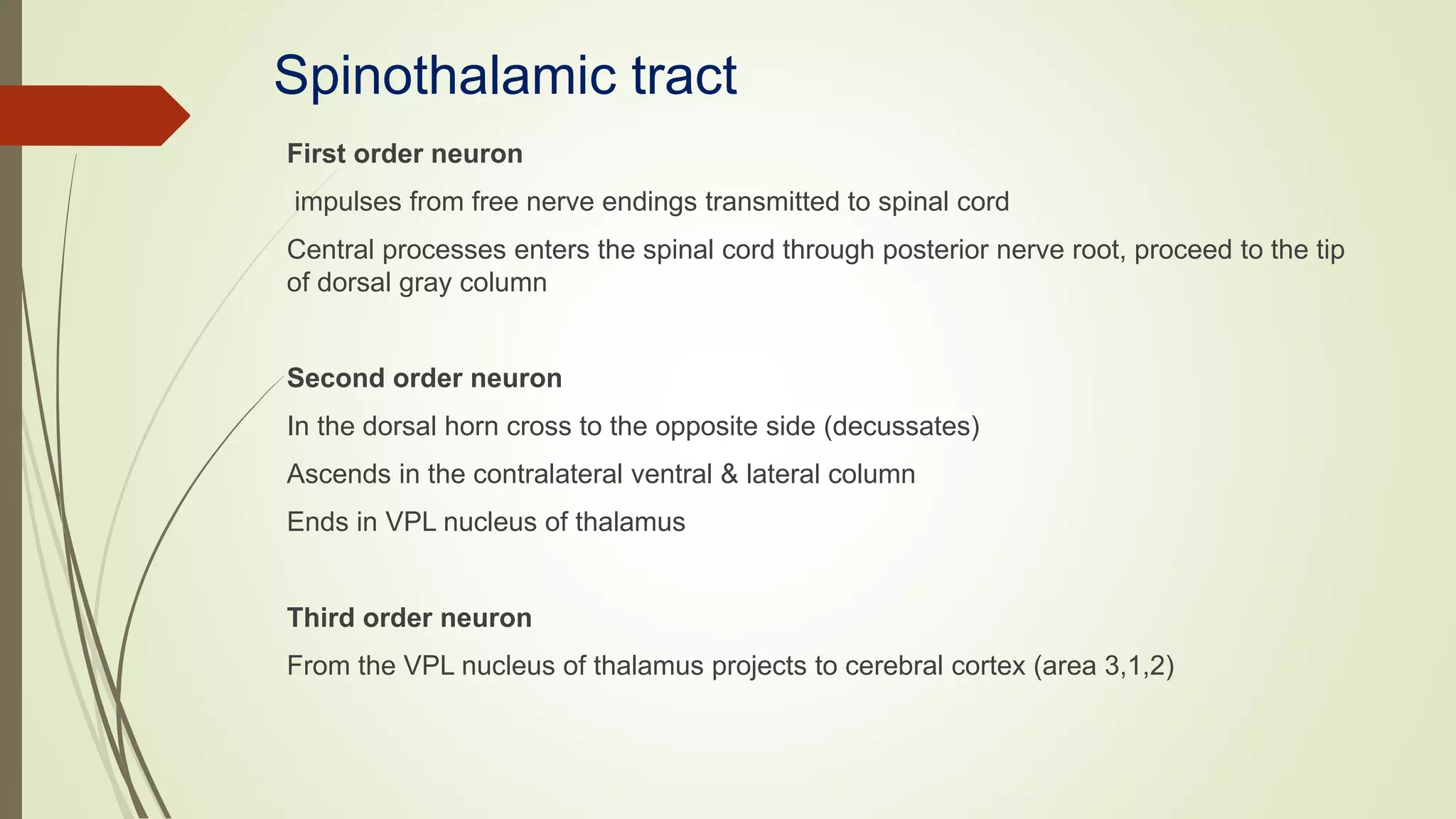
Spinothalamic tract
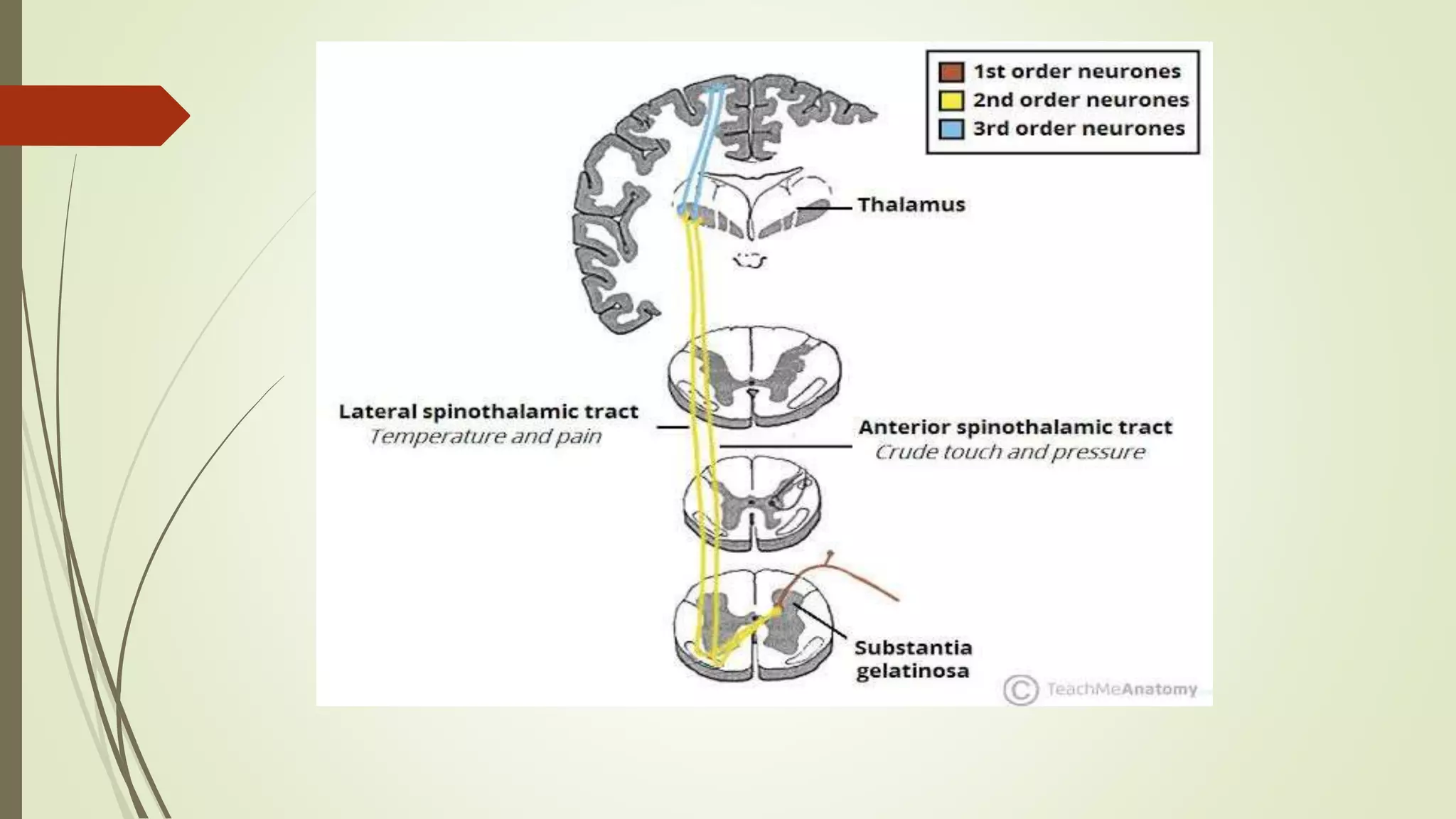
First order neuron
impulses from free nerve endings transmitted to spinal cord
Central processes enters the spinal cord through posterior nerve root, proceed to the tip
of dorsal gray column
Second order neuron
In the dorsal horn cross to the opposite side (decussates)
Ascends in the contralateral ventral & lateral column
Ends in VPL nucleus of thalamus
Third order neuron
From the VPL nucleus of thalamus projects to cerebral cortex (area 3,1,2)
Lateral spinothalamic tract
 Clinical application
 Destruction of LSTT
 Loss of pain & thermal sensation
- Below the level of lesion
- On the contralateral side of the body
 Patient will not respond to pinprick & cannot recognise
hot & cold
Anterior spinothalamic tract
 Clinical application
 Destruction of ASTT
 Loss of light touch & pressure sense
- Below the level of lesion
- On the contralateral side of the body
 (Discriminative touch will still be present, as this infprmation is carried by posterior
column)
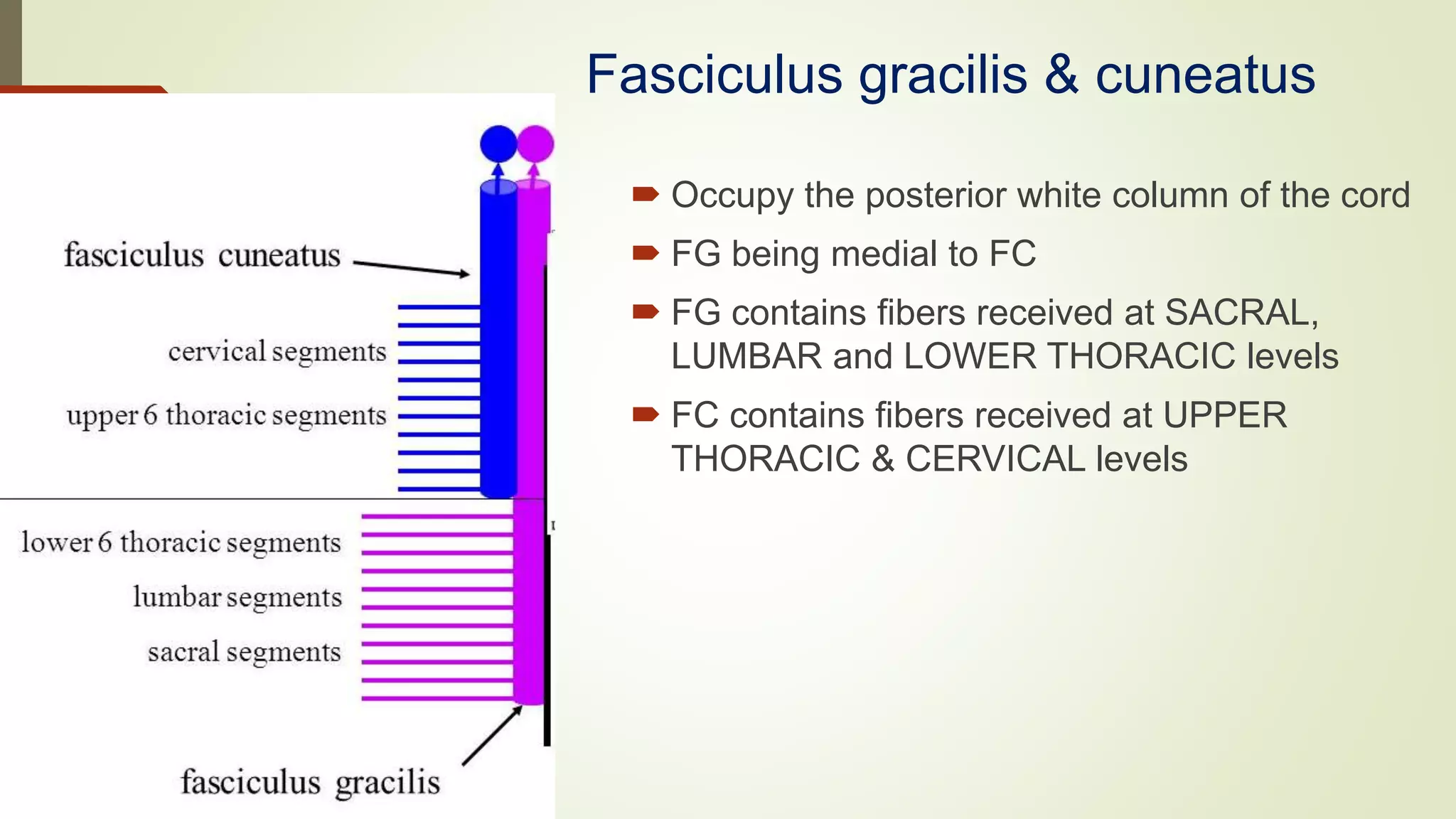
Fasciculus gracilis & cuneatus
 Occupy the posterior white column of the cord
 FG being medial to FC
 FG contains fibers received at SACRAL,
LUMBAR and LOWER THORACIC levels
 FC contains fibers received at UPPER
THORACIC & CERVICAL levels
Fasciculus gracilis & cuneatus
 First order neuron
Ascend without interruption and terminate upon 2nd
order neurons in NUCLEUS GRACILIS & NUCLEUS
CUNEATUS
 Second order neuron
Axons of 2nd order neurons decussate in the
medulla as internal arcuate fibers and ascend through
the brain as medial lemniscus
 Third order neuron
Medial lemniscus terminates in the VENTRAL
POSTERIOR nucleus of THALAMUS,3rd order neurons
project to somatosensory cortex
Fasciculus gracilis & cuneatus
 Clinical application
 Destruction of Fasciculus gracilia & cuneatus
 Loss of muscle joint sense, position sense, vibration sense
& tactile discrimination light touch & pressure sense
- Below the level of lesion
- On the same side of the body
 POSTERIOR & ANTERIOR SPINOCEREBELLAR TRACT
 Transmit unconscious proprioceptive information to the cerebellum
 Receive input from muscle spindles and pressure receptors
 Involved in coordination of posture and movement of individual muscles of the lower limb
 SPINOTECTAL TRACT
 Transmits pain, thermal, tactile information to superior colliculus for spinovisual reflexes
 Integrate visual and somatic sensory information (it brings about the movement of eye and
head towards the source of information)
 SPINORETICULAR TRACT
 Uncrossed fibers, synapse with neurons of reticular formation (important role in influencing
level of consciousness)
 SPINO-OLIVARY TRACT
 Located in anterior funiculus
 Carries unconscious proprioception as well as cutaneous impulses from ipsilateral side of
the body to the olivary bodies and involved in maintaining balance.
POSTERIOR & ANTERIOR SPINOCEREBELLAR
TRACT
 PYRAMIDAL TRACT ( ANTERIOR AND LATERAL
CORTICOSPINAL TRACT):
 Skilled voluntary movements
 RUBROSPINAL TRACT:
 Facilitates flexors
 Inhibits extensors
 TECTOSPINAL TRACT:
 Responsible for coordinated movements of head and neck,
eyeball and limbs based on visual stimulus
 VESTIBULOSPINAL TRACT
 Also called as postural tract
 Helps in maintaining posture
DESCENDING TRACTS
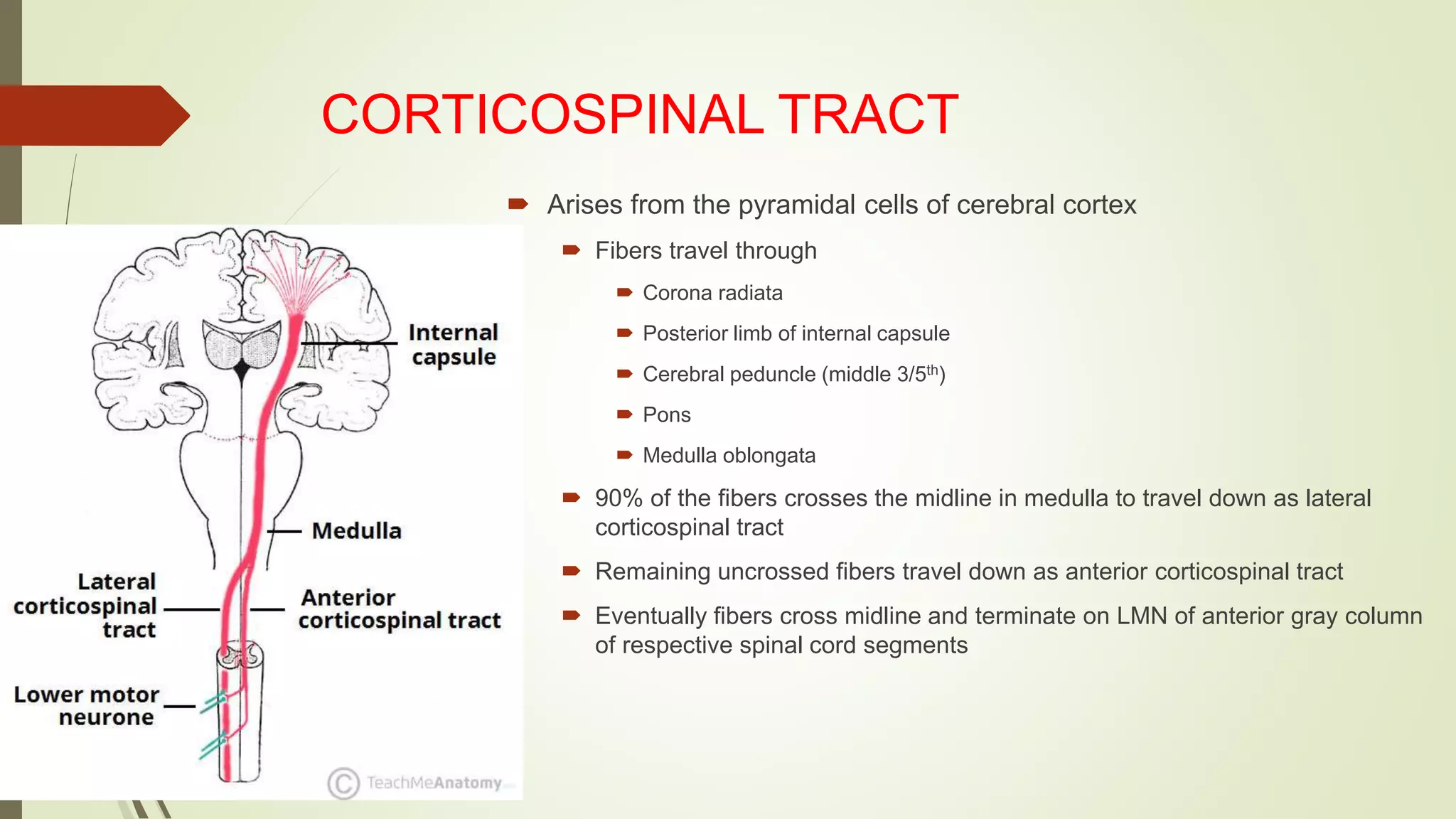
CORTICOSPINAL TRACT
 Arises from the pyramidal cells of cerebral cortex
 Fibers travel through
 Corona radiata
 Posterior limb of internal capsule
 Cerebral peduncle (middle 3/5th)
 Pons
 Medulla oblongata
 90% of the fibers crosses the midline in medulla to travel down as lateral
corticospinal tract
 Remaining uncrossed fibers travel down as anterior corticospinal tract
 Eventually fibers cross midline and terminate on LMN of anterior gray column
of respective spinal cord segments
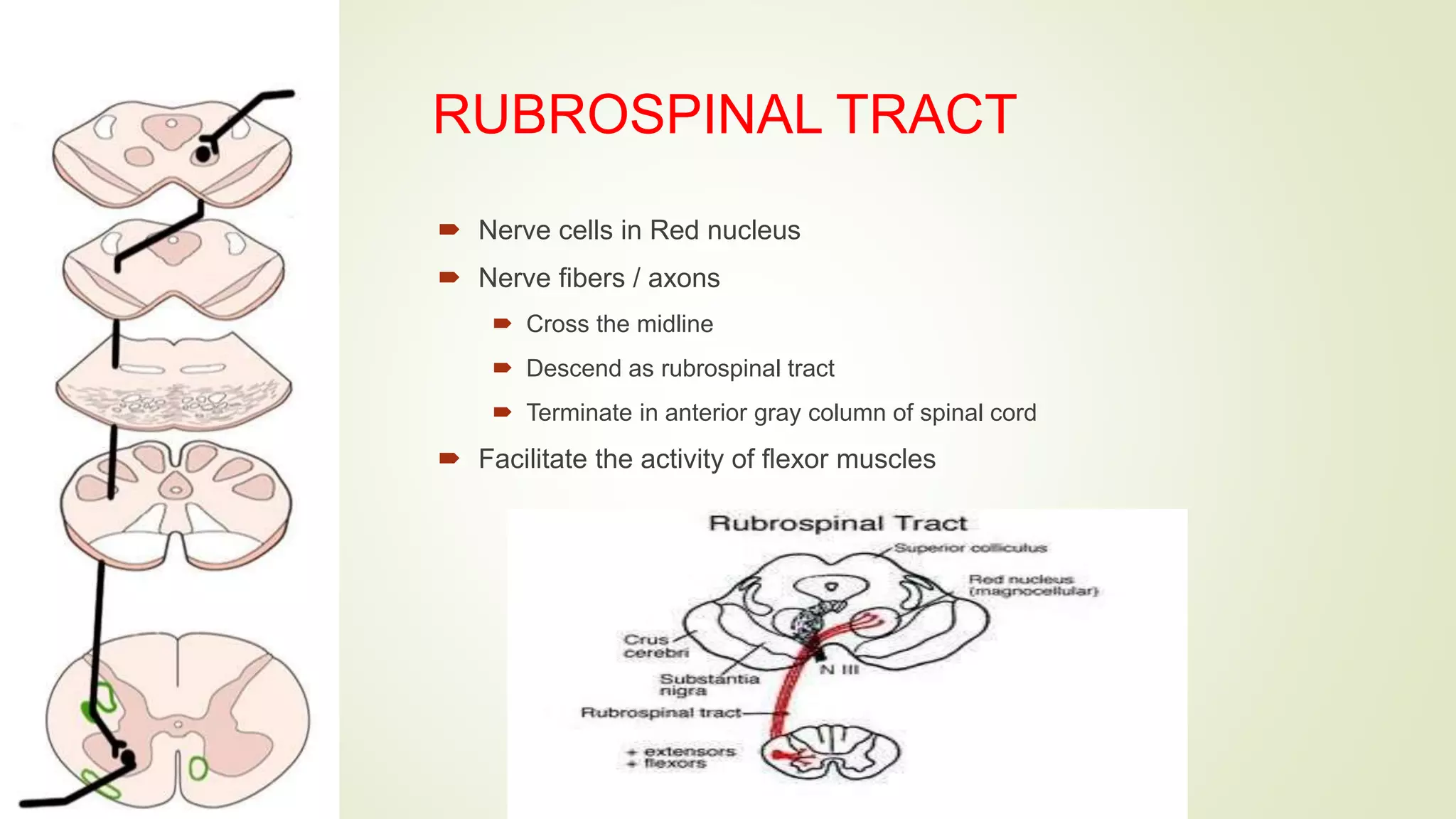
RUBROSPINAL TRACT
 Nerve cells in Red nucleus
 Nerve fibers / axons
 Cross the midline
 Descend as rubrospinal tract
 Terminate in anterior gray column of spinal cord
 Facilitate the activity of flexor muscles
TECTOSPINAL TRACT
 Nerve cells in superior colliculus of midbrain
 Nerve fibers / axons
 Cross the midline
 Descend close to medial longitudinal fasciculus
 Terminate in the anterior gray column of upper cervical segments of spinal
cord
 Responsible for reflex movement of head & neck in response to visual
stimuli
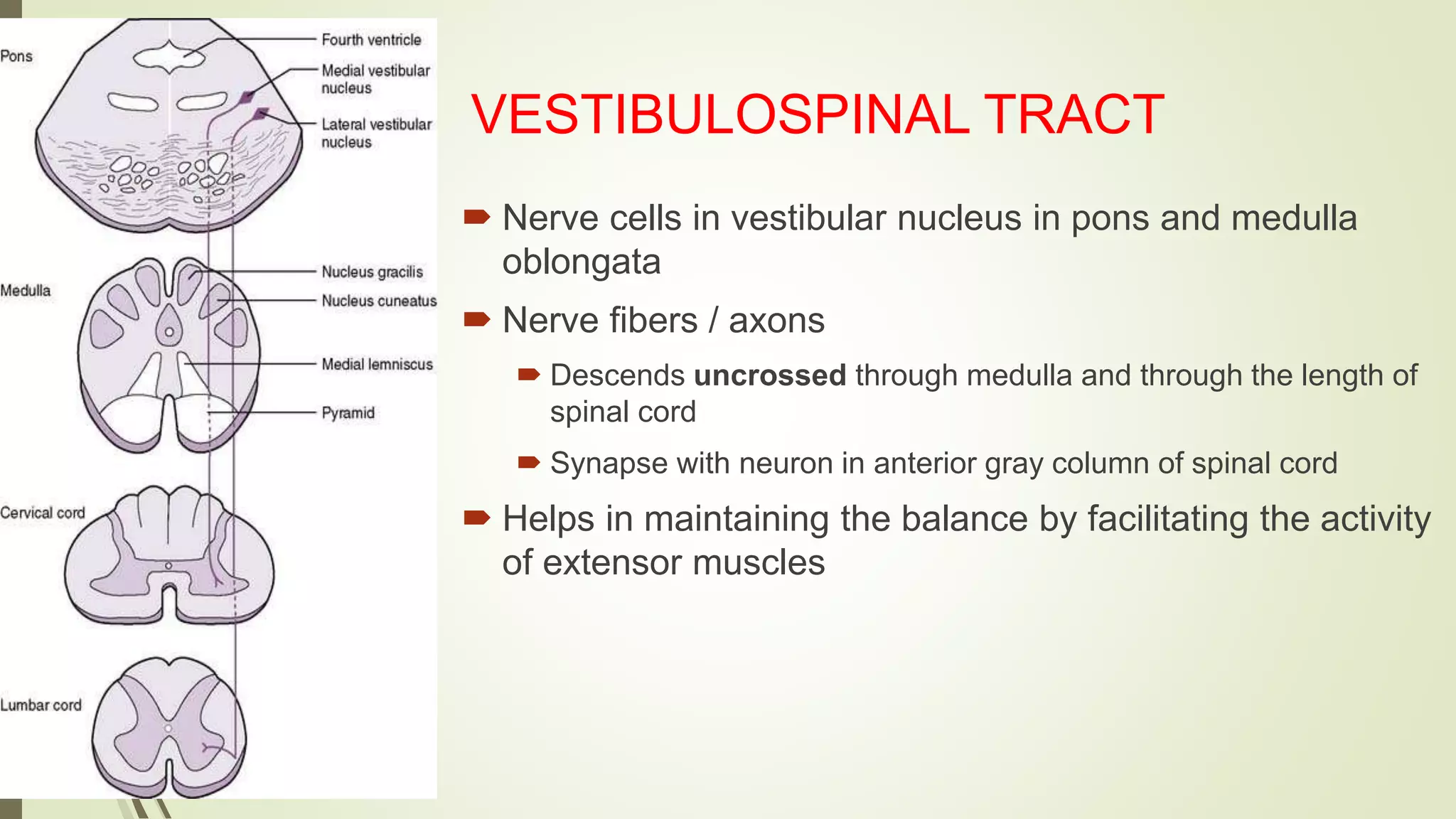
VESTIBULOSPINAL TRACT
 Nerve cells in vestibular nucleus in pons and medulla
oblongata
 Nerve fibers / axons
 Descends uncrossed through medulla and through the length of
spinal cord
 Synapse with neuron in anterior gray column of spinal cord
 Helps in maintaining the balance by facilitating the activity
of extensor muscles
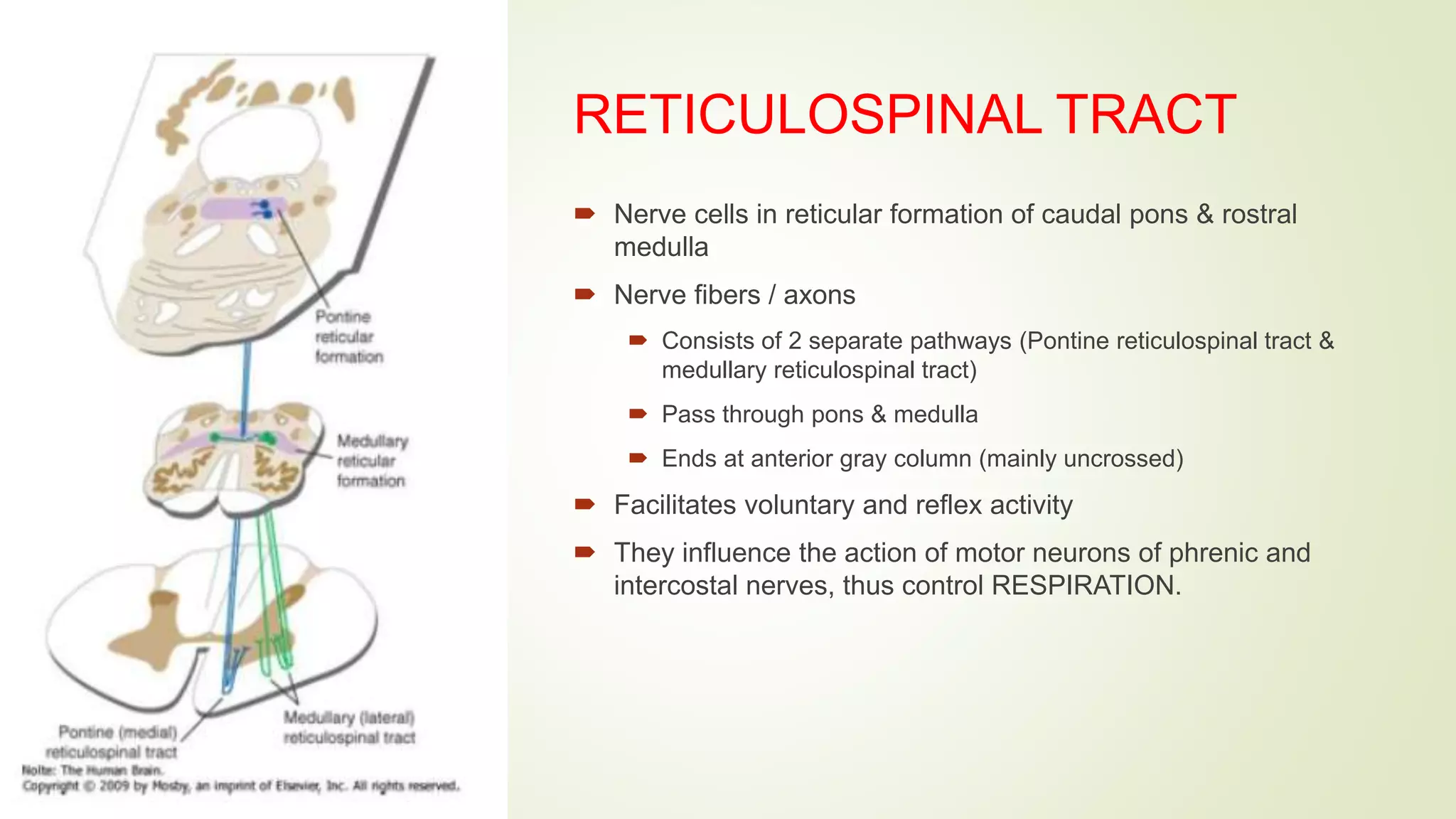
RETICULOSPINAL TRACT
 Nerve cells in reticular formation of caudal pons & rostral
medulla
 Nerve fibers / axons
 Consists of 2 separate pathways (Pontine reticulospinal tract &
medullary reticulospinal tract)
 Pass through pons & medulla
 Ends at anterior gray column (mainly uncrossed)
 Facilitates voluntary and reflex activity
 They influence the action of motor neurons of phrenic and
intercostal nerves, thus control RESPIRATION.
Blood supply of spinal cord
Arterial supply of spinal cord
Anterior spinal artery
2 Posterior spinal arteries
Segmental arteries
ANTERIOR SPINAL ARTERY
Origin : formed by union of 2 small spinal branches
of right & left vertebral arteries in the upper cervical
canal
Course : runs caudally in the anterior median fissure
Termination : filum terminale
Supplies : anterior 2/3rd of the cord
ANTERIOR SPINAL ARTERY
Due to occlusion (thrombosis or compression) of
anterior spinal artery
Results in
Motor symptoms: coz of involvement of corticospinal tracts
and anterior gray columns
Bilateral loss of pain & temperature sensation due to
ischemia of spinothalamic tracts
POSTERIOR SPINAL ARTERY
 Origin : branched from either
 Vertebral
 Posterior inferior cerebellar arteries
 Course :
 runs down in posterolateral sulcus, divides into 2 collateral arteries
medial and lateral along the posterior nerve roots
 Thus there are 5 longitudinal arteries around the spinal cord. These
arteries reinforced by the segmental arteries to form 5 longitudinal
arterial trunks
 These communicate around the cord forming pial plexus, the arterial
vaso-corona
 Supplies : posterior 1/3rd of the spinal cord
SEGMENTAL ARTERIES
 They reach the spinal cord as anterior and posterior radicular
arteries along the corresponding roots of the spinal nerves
respectively and nourish the nerve roots
 Anterior radicular arteries: larger and less in number
 Posterior radicular arteries: smaller and more in number
 Importance: end arteries, if anyone of them is blocked, there
will not be any collateral circulation
 Branches of
 Deep cervical
 Ascending cervical
 Intercostal &
 Lumbar
CLINICAL CORRELATION
 Artery of T11/ T12 spinal segment (arteria radicularis magna)
is remarkably large, arises directly from aorta on its left side
 A fracture of vertebra involving this artery leads to ischemia of
several segments of the cord
 T1, T4 and L1 segments – the meeting places of different
major arteries are vulnerable to ischemic necrosis
VENOUS DRAINAGE
Two median longitudinal – one in the anterior median
fissure another in posteromedian sulcus
Two anterolateral - one on either side posterior to
the anterior nerve roots
Two posterlateral – one on either side posterior to
posterior nerve roots
VENOUS DRAINAGE
 Drain below through internal vertebral venous
plexus into the vertebral posterior intercostal, lumbar
and lateral scral veins
 Internal vertebral venous plexus communicates
above with the basilar venous plexus.
ETIOLOGY OF SPINAL CORD
DISORDERS
THANK YOU

SPINAL CORD NEUROANATOMY BY Dr.Deepika.T

  • 1.
    Neuroanatomy of Spinalcord Presentor: Dr.Deepika.T Post graduate student Moderator: Dr.Byrareddy Professor Department of General Medicine, RRMCH, Bengaluru
  • 2.
    Gross anatomy Meninges surroundingthe spinal cord Cross sectional anatomy Ascending & descending tracts Blood supply Clinical correlation & application
  • 3.
    Gross Anatomy  Spinalcord lies in vertebral canal  Extends from level of cranial border of atlas to lower border of L1 or upper border of L2 vertebrae in adults  About 18 inches (45 cm) long  1/2 inch (14 mm) wide  Approx weight = 30 gms  Corresponding average length of spinal column is 70cm  Anchored to duramater by dentate ligament  Cylindrical in shape & flattened dorso ventrally
  • 4.
    Gross Anatomy  Hascervical (C5 to T1) and lumbar (L3 to S2) enlargements  Below Lumbar enlargement, spinal cord narrows ending as conus medullaris  CNS tissue ends between vertebrae L1 and L2 whereas in neonates ends at upper border of L3  At birth, cord and vertebrae are about the same size but cord stops elongating at around age 4  Although it is a continuous & non segmental structure, 31 pair of originating nerves give it a segmental appearance  31 pairs of spinal nerves: 8C, 12T, 5L, 5S & 1Co  Each pair of nerves exits the vertebral column at the level it initially lined up with at birth
  • 5.
    Gross Anatomy Conus medullaris: thin,conical end of the spinal cord Cauda equina: nerve roots extending below conus medullaris Filum terminale: thin thread of fibrous tissue at end of conus medullaris attaches to coccygeal ligament
  • 6.
  • 7.
    MENINGES  Specialized membranes,isolate spinal cord from surroundings Dura mater: outer layer Arachnoid mater: middle layer Pia mater : inner layer  Spinal meninges:  protect spinal cord  carry blood supply  continuous with cranial meninges
  • 8.
     Epidural space: between spinal duramater and walls of spinal column, contains loose connective and areolar tissue  Subdural space  between arachnoid mater and dura mater  Subarachnoid space:  between arachnoid mater and pia mater  filled with cerebrospinal fluid (CSF) SPACES
  • 9.
    Structures of theSpinal Cord  Paired denticulate ligaments:  extend from pia mater to dura mater  stabilize side-to-side movement  Blood vessels:  along surface of spinal pia mater  within subarachnoid space
  • 11.
    Cross Sectional Anatomy Anterior median fissure – separates anterior funiculi  Posterior median sulcus – divides posterior funiculi
  • 12.
    Cross Sectional Anatomy Spinalcord has a narrow, fluid filled central canal Central canal is surrounded by butterfly or H-shaped gray matter containing sensory and motor nuclei (soma), unmyelinated processes, and neuroglia White matter is on the outside of the gray matter (opposite of the brain) and contains myelinated and unmyelinated fibers
  • 13.
    GRAY-MATTER OF SPINALCORD  Gray matter (cell bodies, neuroglia, & unmyelinated processes)  Posterior horns (sensory, all interneurons)  Lateral horns (autonomic, T1- L2)  Anterior horns (motor, cell bodies of somatic motor neurons)  Spinal roots  Ventral (somatic & autonomic motor)  Dorsal (DRG)
  • 14.
    Gray Matter: Organization Dorsal half – sensory roots and ganglia  Ventral half – motor roots  Dorsal and ventral roots fuse laterally to form spinal nerves  Four zones are evident within the gray matter – somatic sensory (SS), visceral sensory (VS), visceral motor (VM), and somatic motor (SM)
  • 15.
     SENSORY NUCLEUS Substantia gelatinosa- relay station for spinothalamic tract  Nucleus proprius(largest nucleus)- relay station for dorsal column tracts  Nucleus dorsalis(clarkes column)- relay station for spinocerebellar tracts  INTERMEDIOLATERAL NUCLEUS  It extends from T1 to L2 , and contains autonomic motor neurons that give rise to preganglionic fibres of sympathetic nervous system  MOTOR NEURONS  They innervate the visceral and skeletal muscles. Lateral nucleus innervates the limb muscles and medial nucleus innervates the midline/ axial muscles NUCLEI IN GRAY MATER
  • 16.
    White matter  Tracts(or fasciculi):  bundles of axons in the white columns  relay certain type of information in same direction  Ascending tracts:  carry information to brain  Descending tracts:  carry motor commands to spinal cord
  • 17.
    Cross-sectional anatomy –white mater  White matter  3 funiculi (posterior, lateral, anterior) Ascending, descending, transverse  Consist of “tracts” containing similarly functional axons All tracts are paired Most cross over (decussate) at some point Most consist of a chain of 2 or 3 successive neurons
  • 18.
  • 19.
    ASCENDING TRACTS  LATERALSPINOTHALAMIC TRACT:  Pain and temperature  ANTERIOR SPINOTHALAMIC TRACT:  Crude touch and pressure  DORSAL COLUMN TRACT { Fasciculus gracilis(LL), Fasciculus cuneatus(UL) } :  Carries conncious proprioception , fine touch , vibration, pressure and stereognossus  DORSAL SPINOCEREBELLAR AND VENTRAL SPINOCEREBELLAR TRACT:  Carries unconscious proprioception
  • 20.
    Spinothalamic tract First orderneuron impulses from free nerve endings transmitted to spinal cord Central processes enters the spinal cord through posterior nerve root, proceed to the tip of dorsal gray column Second order neuron In the dorsal horn cross to the opposite side (decussates) Ascends in the contralateral ventral & lateral column Ends in VPL nucleus of thalamus Third order neuron From the VPL nucleus of thalamus projects to cerebral cortex (area 3,1,2)
  • 22.
    Lateral spinothalamic tract Clinical application  Destruction of LSTT  Loss of pain & thermal sensation - Below the level of lesion - On the contralateral side of the body  Patient will not respond to pinprick & cannot recognise hot & cold
  • 23.
    Anterior spinothalamic tract Clinical application  Destruction of ASTT  Loss of light touch & pressure sense - Below the level of lesion - On the contralateral side of the body  (Discriminative touch will still be present, as this infprmation is carried by posterior column)
  • 24.
    Fasciculus gracilis &cuneatus  Occupy the posterior white column of the cord  FG being medial to FC  FG contains fibers received at SACRAL, LUMBAR and LOWER THORACIC levels  FC contains fibers received at UPPER THORACIC & CERVICAL levels
  • 25.
    Fasciculus gracilis &cuneatus  First order neuron Ascend without interruption and terminate upon 2nd order neurons in NUCLEUS GRACILIS & NUCLEUS CUNEATUS  Second order neuron Axons of 2nd order neurons decussate in the medulla as internal arcuate fibers and ascend through the brain as medial lemniscus  Third order neuron Medial lemniscus terminates in the VENTRAL POSTERIOR nucleus of THALAMUS,3rd order neurons project to somatosensory cortex
  • 26.
    Fasciculus gracilis &cuneatus  Clinical application  Destruction of Fasciculus gracilia & cuneatus  Loss of muscle joint sense, position sense, vibration sense & tactile discrimination light touch & pressure sense - Below the level of lesion - On the same side of the body
  • 27.
     POSTERIOR &ANTERIOR SPINOCEREBELLAR TRACT  Transmit unconscious proprioceptive information to the cerebellum  Receive input from muscle spindles and pressure receptors  Involved in coordination of posture and movement of individual muscles of the lower limb  SPINOTECTAL TRACT  Transmits pain, thermal, tactile information to superior colliculus for spinovisual reflexes  Integrate visual and somatic sensory information (it brings about the movement of eye and head towards the source of information)  SPINORETICULAR TRACT  Uncrossed fibers, synapse with neurons of reticular formation (important role in influencing level of consciousness)  SPINO-OLIVARY TRACT  Located in anterior funiculus  Carries unconscious proprioception as well as cutaneous impulses from ipsilateral side of the body to the olivary bodies and involved in maintaining balance.
  • 28.
    POSTERIOR & ANTERIORSPINOCEREBELLAR TRACT
  • 29.
     PYRAMIDAL TRACT( ANTERIOR AND LATERAL CORTICOSPINAL TRACT):  Skilled voluntary movements  RUBROSPINAL TRACT:  Facilitates flexors  Inhibits extensors  TECTOSPINAL TRACT:  Responsible for coordinated movements of head and neck, eyeball and limbs based on visual stimulus  VESTIBULOSPINAL TRACT  Also called as postural tract  Helps in maintaining posture DESCENDING TRACTS
  • 30.
    CORTICOSPINAL TRACT  Arisesfrom the pyramidal cells of cerebral cortex  Fibers travel through  Corona radiata  Posterior limb of internal capsule  Cerebral peduncle (middle 3/5th)  Pons  Medulla oblongata  90% of the fibers crosses the midline in medulla to travel down as lateral corticospinal tract  Remaining uncrossed fibers travel down as anterior corticospinal tract  Eventually fibers cross midline and terminate on LMN of anterior gray column of respective spinal cord segments
  • 31.
    RUBROSPINAL TRACT  Nervecells in Red nucleus  Nerve fibers / axons  Cross the midline  Descend as rubrospinal tract  Terminate in anterior gray column of spinal cord  Facilitate the activity of flexor muscles
  • 32.
    TECTOSPINAL TRACT  Nervecells in superior colliculus of midbrain  Nerve fibers / axons  Cross the midline  Descend close to medial longitudinal fasciculus  Terminate in the anterior gray column of upper cervical segments of spinal cord  Responsible for reflex movement of head & neck in response to visual stimuli
  • 33.
    VESTIBULOSPINAL TRACT  Nervecells in vestibular nucleus in pons and medulla oblongata  Nerve fibers / axons  Descends uncrossed through medulla and through the length of spinal cord  Synapse with neuron in anterior gray column of spinal cord  Helps in maintaining the balance by facilitating the activity of extensor muscles
  • 34.
    RETICULOSPINAL TRACT  Nervecells in reticular formation of caudal pons & rostral medulla  Nerve fibers / axons  Consists of 2 separate pathways (Pontine reticulospinal tract & medullary reticulospinal tract)  Pass through pons & medulla  Ends at anterior gray column (mainly uncrossed)  Facilitates voluntary and reflex activity  They influence the action of motor neurons of phrenic and intercostal nerves, thus control RESPIRATION.
  • 35.
    Blood supply ofspinal cord
  • 36.
    Arterial supply ofspinal cord Anterior spinal artery 2 Posterior spinal arteries Segmental arteries
  • 38.
    ANTERIOR SPINAL ARTERY Origin: formed by union of 2 small spinal branches of right & left vertebral arteries in the upper cervical canal Course : runs caudally in the anterior median fissure Termination : filum terminale Supplies : anterior 2/3rd of the cord
  • 39.
    ANTERIOR SPINAL ARTERY Dueto occlusion (thrombosis or compression) of anterior spinal artery Results in Motor symptoms: coz of involvement of corticospinal tracts and anterior gray columns Bilateral loss of pain & temperature sensation due to ischemia of spinothalamic tracts
  • 40.
    POSTERIOR SPINAL ARTERY Origin : branched from either  Vertebral  Posterior inferior cerebellar arteries  Course :  runs down in posterolateral sulcus, divides into 2 collateral arteries medial and lateral along the posterior nerve roots  Thus there are 5 longitudinal arteries around the spinal cord. These arteries reinforced by the segmental arteries to form 5 longitudinal arterial trunks  These communicate around the cord forming pial plexus, the arterial vaso-corona  Supplies : posterior 1/3rd of the spinal cord
  • 42.
    SEGMENTAL ARTERIES  Theyreach the spinal cord as anterior and posterior radicular arteries along the corresponding roots of the spinal nerves respectively and nourish the nerve roots  Anterior radicular arteries: larger and less in number  Posterior radicular arteries: smaller and more in number  Importance: end arteries, if anyone of them is blocked, there will not be any collateral circulation  Branches of  Deep cervical  Ascending cervical  Intercostal &  Lumbar
  • 43.
    CLINICAL CORRELATION  Arteryof T11/ T12 spinal segment (arteria radicularis magna) is remarkably large, arises directly from aorta on its left side  A fracture of vertebra involving this artery leads to ischemia of several segments of the cord  T1, T4 and L1 segments – the meeting places of different major arteries are vulnerable to ischemic necrosis
  • 44.
    VENOUS DRAINAGE Two medianlongitudinal – one in the anterior median fissure another in posteromedian sulcus Two anterolateral - one on either side posterior to the anterior nerve roots Two posterlateral – one on either side posterior to posterior nerve roots
  • 45.
    VENOUS DRAINAGE  Drainbelow through internal vertebral venous plexus into the vertebral posterior intercostal, lumbar and lateral scral veins  Internal vertebral venous plexus communicates above with the basilar venous plexus.
  • 48.
    ETIOLOGY OF SPINALCORD DISORDERS
  • 49.