AMERICA
AMERICA Famous  Places
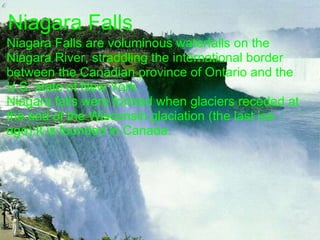
Niagara Falls   Niagara Falls are voluminous waterfalls on the Niagara River, straddling the international border between the Canadian province of Ontario and the U.S. state of New York. Niagara falls were formed when glaciers receded at the end of the Wisconsin glaciation (the last ice age).It is founded in Canada.
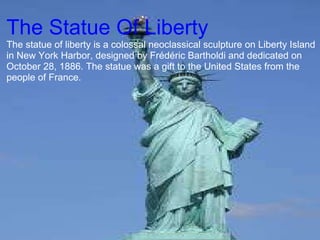
  The Statue Of Liberty  The statue of liberty is a colossal neoclassical sculpture on Liberty Island in New York Harbor, designed by Frédéric Bartholdi and dedicated on October 28, 1886. The statue was a gift to the United States from the people of France.
  The Grand Canyon  The Grand Canyon is a steep side canyon carved by the Colorado River  in the United States (Arizona).Theodor Roosevelt was a major proponent of preservation of The Grand Canyon area,and visited it numerous occasions to hunt and enjoy the scenery.
Golden Gate Bridge The Golden Gate Bridge is a suspension bridge spanning the Golden Gate,the opening of San Francisco Bay into the Pacific Ocean.  The Golden Gate Bridge was the longest suspension bridge span in the world when it was completed in 1937,and has become one of the most internationally recognized of San Francisco(California). 
Christ The Redeemer  Christ the Redeemer is a statue of Jesus Christ in Rio de Janeiro, Brazil; considered the second largest statue in the world. The statue is 39.6 metres long.
Pyramid Tikal  The pyramid of Tikal is one of the largest archaeological sites and urban centres of the pre-Columbian Maya civilization. It is located in the archaeological region of the Péten Basin in what is now northern Guatemala.The pyramid of Tikal was declarated in 1979 a World Heritage Site.  
AMERICA Food
      Some people say that an american food is dirty food but is not true look at this photo. This is a typical food from America
The Argentine  choripán  consists of a sausage made out of beef and pork, hot off the grill, split down the middle, and served on a roll. The  chorizo  may be  cut in half lengthwise, in which case it is called a butterfly. It is customary to add  bread, most likely chimichurri  Choripanes  are commonly served as an appetizer during the preparation of an  asado.
The cooking  of the United States defies easy categorization. While well known for the mass production and global uniformity of fast food , America is actually home to wide-ranging regional cuisine and the influence of immigrant groups past and present.
The cuisine of Brazil, like Brazil itself, varies greatly by region. Brazilian cuisine can be divided into several distinct locations. This diversity reflects the country's  Portuguese, Africans, Italians, Spaniards, Germans, Syrians, Lebanese and Japanese among others. This has created a national cooking style marked by the preservation of regional differences
AMERICA Geography
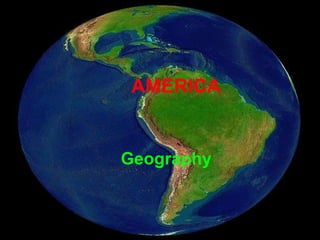
North America  is the third largest  continent , or a portion of the second largest if North and  South America  are combined into the  Americas  and  Africa ,  Europe  and  Asia  are considered to be part of one  supercontinent  called  Afro-Eurasia . With an estimated population of 460 million and an area of 24,346,000 km²  
    The coastal plain of the Atlantic seaboard gives way further inland to  deciduous  forests and the rolling hills of the  Piedmont . The  Appalachian Mountains  divide the eastern seaboard from the  Great Lakes  and the grasslands of the  Midwest . The  Mississippi – Missouri River , the world's  fourth longest river system , runs mainly north–south through the heart of the country. The flat, fertile  prairie  of the  Great Plains  stretches to the west, interrupted by  a highland region  in the southeast. The Rocky Mountains, at the western edge of the Great Plains, extend north to south across the country, reaching altitudes higher than 14,000 feet (4,300 m) in  Colorado . Farther west are the rocky  Great Basin  and deserts such as the  Mojave . The  Sierra Nevada  and  Cascade  mountain ranges run close to the Pacific coast. At 20,320 feet (6,194 m), Alaska's  Mount McKinley  is the tallest peak in the country and in North America. Active  volcanoes  are common throughout Alaska's  Alexander  and  Aleutian Islands , and Hawaii consists of volcanic islands.                 
        The  Great Plains  is the broad expanse of  prairie  and  steppe  which lies east of the  Rocky Mountains  in the  United States  and  Canada . The narrow plains in the  Mexican  coast and the  savannas  of the Mississippi are analogous to, respectively, the  Patagonian steppes  and the pampas of the Piranha, Paraguay, and Rio de la Plata .
                                                                                                                                                                                                                         AMERICA                                                                             Culture
The United States is a multicultural nation, home to a wide variety of ethnic groups, traditions, and values.Aside from the now small Native American and Native Hawaiian populations, nearly all Americans or their ancestors immigrated within the past five centuries. Culture of America
It has been developing since long before the United States became a country with its own unique social and cultural characteristics such as dialect, music, arts, social habits, cuisine, and folklore. Today the United States of America is an ethnically and racially diverse country as result of large-scale immigration from many different countries throughout its history
American culture includes both conservative and liberal elements, military and scientific competitiveness, political structures, risk taking and free expression, materialist and moral elements. Despite certain consistent ideological principles (e.g. individualism, egalitarianism, and faith in freedom and democracy), American culture has a variety of expressions due to its geographical scale and demographic diversity.
AMERICA        HISTORY
The  history of the United States  traditionally starts with the Declaration   of Independence in the year 1776, yet its territory was occupied first by the Native   Americans since prehistoric times and then also by  European colonists colonists  who followed the  voyages of Christopher Columbus  starting in 1492. The largest settlements were by the English on the East Coast, starting in 1607. By the 1770s the  Thirteen Colonies  contained two and half million people, were prosperous, and had developed their own political and legal systems. Be British government's threat to American self-government led to war and 1775 and the Declaration of Independence in 1776. With major military and financial s
  The   archaeology of the Americas  is the study of the     archaeology of North America (Mesoamerica   included), Central America, South America and the    Caribbean. This includes the study of pre-   historic/Pre-Columbian and historic indigenous    American peoples.
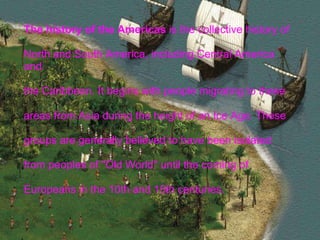
The  history of the Americas  is the collective history of    North and South America, including Central America and     the Caribbean.  It begins with people migrating to these    areas from Asia during the height of an Ice Age. These   groups are generally believed to have been isolated from    peoples of the "Old World'' until the coming of Europeans     in the 10th and 15th centuries. The history of the Americas  is the collective history of    North and South America, including Central America and    the Caribbean. It begins with people migrating to these    areas from Asia during the height of an Ice Age. These    groups are generally believed to have been isolated    from peoples of ''Old World'' until the coming of    Europeans in the 10th and 15th centuries.
Christopher Columbus  (c. 31 October, 1451 – 20 May, 1506)    was an  explorer ,  colonizer , and  navigator  from the  Republic of    Genoa, in northwestern  Italy , [1][2][3][4]  whose voyages across the    Atlantic Ocean  led to general European awareness of the    American continents  in the  Western Hemisphere . With his four    voyages of exploration and several attempts at establishing a    settlement on the island of  Hispaniola , all funded by  Isabella I of    Castile, he initiated the process of  Spanish colonization  which      Christopher Columbus  was an explorer, colonizer, and    navigator from the Republic of Genoa, in northwestern    Italy whose voyages across the Atlantic Ocean led to general    European awareness of the American continents in the    Western Hemisphere. With his four voyages of exploration    and several attempts at establishing a settlement on the    island of Hispaniola, all funded by Isabella I of Castile, he    initiated the process of Spanish colonization which    foreshadowed general European colonization of the "New     World".
BY:IRIA,CARMEN, PATRICIA,JAIME & PATRICIA

America 6B

  • 1.
  • 2.
  • 3.
    Niagara Falls Niagara Falls are voluminous waterfalls on the Niagara River, straddling the international border between the Canadian province of Ontario and the U.S. state of New York. Niagara falls were formed when glaciers receded at the end of the Wisconsin glaciation (the last ice age).It is founded in Canada.
  • 4.
      The StatueOf Liberty The statue of liberty is a colossal neoclassical sculpture on Liberty Island in New York Harbor, designed by Frédéric Bartholdi and dedicated on October 28, 1886. The statue was a gift to the United States from the people of France.
  • 5.
      The GrandCanyon The Grand Canyon is a steep side canyon carved by the Colorado River  in the United States (Arizona).Theodor Roosevelt was a major proponent of preservation of The Grand Canyon area,and visited it numerous occasions to hunt and enjoy the scenery.
  • 6.
    Golden Gate BridgeThe Golden Gate Bridge is a suspension bridge spanning the Golden Gate,the opening of San Francisco Bay into the Pacific Ocean. The Golden Gate Bridge was the longest suspension bridge span in the world when it was completed in 1937,and has become one of the most internationally recognized of San Francisco(California). 
  • 7.
    Christ The Redeemer Christ the Redeemer is a statue of Jesus Christ in Rio de Janeiro, Brazil; considered the second largest statue in the world. The statue is 39.6 metres long.
  • 8.
    Pyramid Tikal The pyramid of Tikal is one of the largest archaeological sites and urban centres of the pre-Columbian Maya civilization. It is located in the archaeological region of the Péten Basin in what is now northern Guatemala.The pyramid of Tikal was declarated in 1979 a World Heritage Site.  
  • 9.
  • 10.
         Some people say that an american food is dirty food but is not true look at this photo. This is a typical food from America
  • 11.
    The Argentine choripán consists of a sausage made out of beef and pork, hot off the grill, split down the middle, and served on a roll. The chorizo may be  cut in half lengthwise, in which case it is called a butterfly. It is customary to add  bread, most likely chimichurri Choripanes are commonly served as an appetizer during the preparation of an asado.
  • 12.
    The cooking  ofthe United States defies easy categorization. While well known for the mass production and global uniformity of fast food , America is actually home to wide-ranging regional cuisine and the influence of immigrant groups past and present.
  • 13.
    The cuisine of Brazil,like Brazil itself, varies greatly by region. Brazilian cuisine can be divided into several distinct locations. This diversity reflects the country's  Portuguese, Africans, Italians, Spaniards, Germans, Syrians, Lebanese and Japanese among others. This has created a national cooking style marked by the preservation of regional differences
  • 14.
  • 15.
    North America is the third largest continent , or a portion of the second largest if North and South America are combined into the Americas and Africa , Europe and Asia are considered to be part of one supercontinent called Afro-Eurasia . With an estimated population of 460 million and an area of 24,346,000 km² 
  • 16.
        Thecoastal plain of the Atlantic seaboard gives way further inland to deciduous forests and the rolling hills of the Piedmont . The Appalachian Mountains divide the eastern seaboard from the Great Lakes and the grasslands of the Midwest . The Mississippi – Missouri River , the world's fourth longest river system , runs mainly north–south through the heart of the country. The flat, fertile prairie of the Great Plains stretches to the west, interrupted by a highland region in the southeast. The Rocky Mountains, at the western edge of the Great Plains, extend north to south across the country, reaching altitudes higher than 14,000 feet (4,300 m) in Colorado . Farther west are the rocky Great Basin and deserts such as the Mojave . The Sierra Nevada and Cascade mountain ranges run close to the Pacific coast. At 20,320 feet (6,194 m), Alaska's Mount McKinley is the tallest peak in the country and in North America. Active volcanoes are common throughout Alaska's Alexander and Aleutian Islands , and Hawaii consists of volcanic islands.                
  • 17.
           The Great Plains is the broad expanse of prairie and steppe which lies east of the Rocky Mountains in the United States and Canada . The narrow plains in the Mexican coast and the savannas of the Mississippi are analogous to, respectively, the Patagonian steppes and the pampas of the Piranha, Paraguay, and Rio de la Plata .
  • 18.
                                                                                                                                                                                                                            AMERICA                                                                             Culture
  • 19.
    The United Statesis a multicultural nation, home to a wide variety of ethnic groups, traditions, and values.Aside from the now small Native American and Native Hawaiian populations, nearly all Americans or their ancestors immigrated within the past five centuries. Culture of America
  • 20.
    It has beendeveloping since long before the United States became a country with its own unique social and cultural characteristics such as dialect, music, arts, social habits, cuisine, and folklore. Today the United States of America is an ethnically and racially diverse country as result of large-scale immigration from many different countries throughout its history
  • 21.
    American culture includesboth conservative and liberal elements, military and scientific competitiveness, political structures, risk taking and free expression, materialist and moral elements. Despite certain consistent ideological principles (e.g. individualism, egalitarianism, and faith in freedom and democracy), American culture has a variety of expressions due to its geographical scale and demographic diversity.
  • 22.
    AMERICA      HISTORY
  • 23.
    The  history ofthe United States  traditionally starts with the Declaration   of Independence in the year 1776, yet its territory was occupied first by the Native   Americans since prehistoric times and then also by  European colonists colonists  who followed the  voyages of Christopher Columbus  starting in 1492. The largest settlements were by the English on the East Coast, starting in 1607. By the 1770s the  Thirteen Colonies  contained two and half million people, were prosperous, and had developed their own political and legal systems. Be British government's threat to American self-government led to war and 1775 and the Declaration of Independence in 1776. With major military and financial s
  • 24.
      The archaeology of the Americas  is the study of the     archaeology of North America (Mesoamerica   included), Central America, South America and the   Caribbean. This includes the study of pre-   historic/Pre-Columbian and historic indigenous   American peoples.
  • 25.
    The historyof the Americas is the collective history of   North and South America, including Central America and     the Caribbean.  It begins with people migrating to these   areas from Asia during the height of an Ice Age. These   groups are generally believed to have been isolated from   peoples of the "Old World'' until the coming of Europeans     in the 10th and 15th centuries. The history of the Americas is the collective history of   North and South America, including Central America and   the Caribbean. It begins with people migrating to these   areas from Asia during the height of an Ice Age. These   groups are generally believed to have been isolated   from peoples of ''Old World'' until the coming of   Europeans in the 10th and 15th centuries.
  • 26.
    Christopher Columbus (c. 31 October, 1451 – 20 May, 1506)   was an explorer , colonizer , and navigator from the Republic of   Genoa, in northwestern Italy , [1][2][3][4] whose voyages across the   Atlantic Ocean led to general European awareness of the   American continents in the Western Hemisphere . With his four   voyages of exploration and several attempts at establishing a   settlement on the island of Hispaniola , all funded by Isabella I of   Castile, he initiated the process of Spanish colonization which     Christopher Columbus  was an explorer, colonizer, and   navigator from the Republic of Genoa, in northwestern   Italy whose voyages across the Atlantic Ocean led to general   European awareness of the American continents in the   Western Hemisphere. With his four voyages of exploration   and several attempts at establishing a settlement on the   island of Hispaniola, all funded by Isabella I of Castile, he   initiated the process of Spanish colonization which   foreshadowed general European colonization of the "New   World".
  • 27.