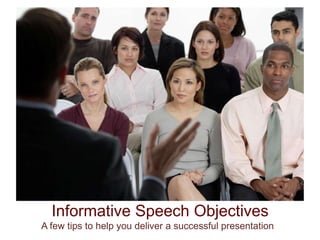


















Informative Speech ObjectivesA few tips to help you deliver a successful presentation
The following instructions come with one caveatEither your proposal or draft outline was approved by me
RequirementsThese are the topics that this presentation will touch upon.For more info, check out my posts and your personal feedback (via Courseworks) on The Q as well as your textbook.Your GoalsYour TopicInformation LiteracyChoice of TopicsInformation LiteracyDefine Your TermsOrganizational PatternsSupporting MaterialConclusionBe Yourself!Go for it!
First, The RequirementsSpeeches and assignments should be given on the day they are due.An outline as well as a Works Cited page listing a minimum of 3 sources is due on the day the speech is delivered. Not more than one Wikipedia source. Dress professionally on speech days and do not wear hatsor chew gum during your speech.The informative speech is 7-9 minutes in length. You must use PowerPoint.Data in the form of graphs, statistics, etc. must support each main point. 
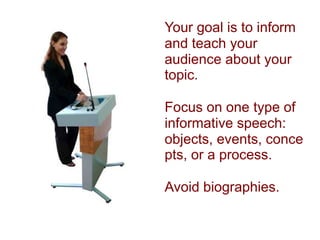
Your goal is to inform and teach your audience about your topic.   Focus on one type of informative speech: objects, events, concepts, or a process.   Avoid biographies.
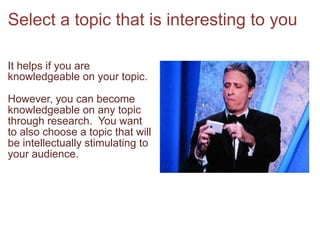
Select a topic that is interesting to youIt helps if you are knowledgeable on your topic.  However, you can become knowledgeable on any topic through research.  You want to also choose a topic that will be intellectually stimulating to your audience. 
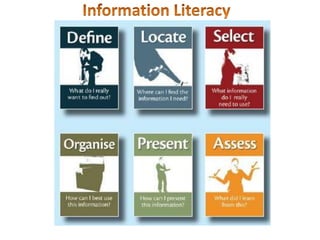
Information Literacy
Determine what information you need.Information Literacy
Access information effectively and efficiently.Information Literacy
Evaluate information critically.Information Literacy
Use and incorporate information ethically and legally.Information Literacy
Transfer these information literacy skills to new research tasks in the future.Information Literacy
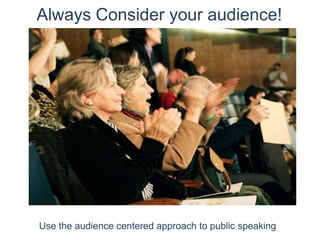
Always Consider your audience! Use the audience centered approach to public speaking
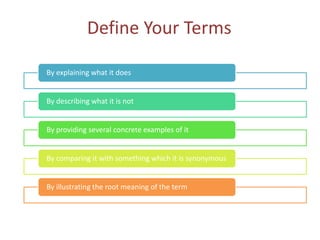
Define Your TermsClear definitions are especially important in informative speeches.If you are unsure whether audience members will know the meaning of a term, plan to define it in one or more of the following ways
Define Your Terms
Stimulate your audience's imagination Use "imagine if" scenarios, tell a story or refer to a recent event.Establish the relevance of your topic to your audience
Use concrete and colorful nouns and verbs that convey your meaning in a specific and tangible way.
Use repetition to help listeners retain information
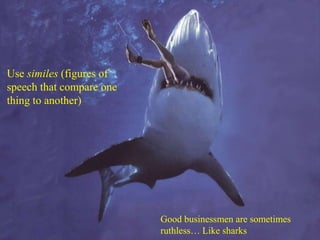
Use similes (figures of speech that compare one thing to another)Good businessmen are sometimes ruthless… Like sharks
They are figures of speech that compare two things by describing one thing as being the other.Use metaphorsLike a knight in shining armor.
Or…Painting oneself into a corner!
Organizational Pattern
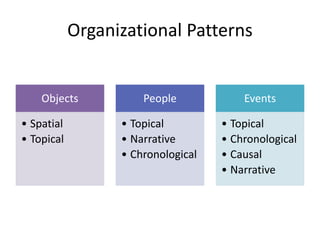
There are different ways to organize your informative speech.
Organizational Patterns
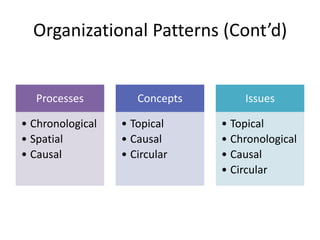
Organizational Patterns (Cont’d)
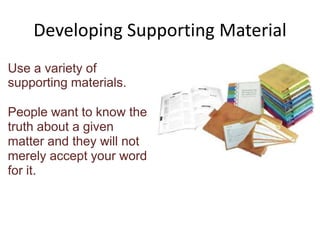
Developing Supporting MaterialUse a variety of supporting materials. People want to know the truth about a given matter and they will not merely accept your word for it.
Refer Orally to Your SourcesListeners place more value on conclusions drawn by multiple sources that they find credible(1).There is no set format, make sure to clearly identify where your information came from and provide the context.1. Rodney Reynolds and Michael Burgoon, “Evidence,” in The Persuasion Handbook: Developmetns in Theory and Practice, etd. J.P. Dillard and M. Pfau (Thousand Oaks, Calif.: Sage, 2002), 427-44
Possible Forms for Citing Testimony“According to John Miller, one of the three founders of the community’s rapid-transit committee…”“Teresa Allen, fund-raising chairperson from the Chicago Society of the Performing Arts, gave some insight into the proper way to obtain donations when she said…”“Dr. Mary Klein, a stem cell researcher from the Brown University School of Medicine , echoed this sentiment when she spoke Monday at the Public Health Committee Meeting…”
Possible Forms for Citing Examples“Let me give you two examples of outsourcing …”“Lance Armstrong’s Livestrong Foundation is an example of a fiscally effective charity…”“For example, what if, in five years, the average temperature of the Pacific Ocean rises one half of one degree Fahrenheit?”
Possible Forms for Citing Facts & Statistics“As published in the October 2008 Edition of Nature…”“According to the U.S. Department of Health and Human Services website, accessed on April 10, 2010…”“According to a january 2008 report posted on the Centers for Disease Control and Prevention website, 70.8 percent of all deaths…”
Show Your Audience the DataUse appropriate tables, graphs …
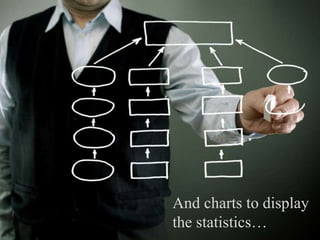
And charts to display the statistics…
Make The Conclusion Memorable
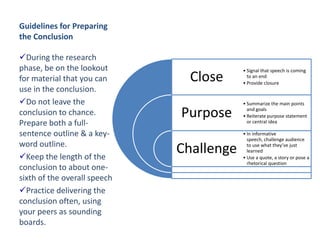
Guidelines for Preparing the ConclusionDuring the research phase, be on the lookout for material that you can use in the conclusion.
Do not leave the conclusion to chance. Prepare both a full-sentence outline & a key-word outline.
Keep the length of the conclusion to about one-sixth of the overall speech
Practice delivering the conclusion often, using your peers as sounding boards.Now, Remember…
Dress Codes Are A Reality In The Business World, To Wit…These Ads By A Leading Consulting Company
This Look Is Great For CollegeNot So Much For An Interview Or A Presentation
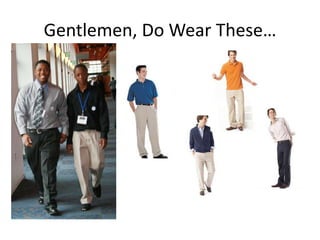
Gentlemen, Do Wear These…
Please Avoid These Looks…Gentlemen, no hats
Ladies, Try These…
But Please Avoid These…
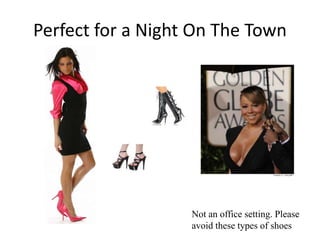
Perfect for a Night On The TownNot an office setting. Please avoid these types of shoes

Informative Speech Objectives

  • 1.
    Informative Speech ObjectivesAfew tips to help you deliver a successful presentation
  • 2.
    The following instructionscome with one caveatEither your proposal or draft outline was approved by me
  • 3.
    RequirementsThese are thetopics that this presentation will touch upon.For more info, check out my posts and your personal feedback (via Courseworks) on The Q as well as your textbook.Your GoalsYour TopicInformation LiteracyChoice of TopicsInformation LiteracyDefine Your TermsOrganizational PatternsSupporting MaterialConclusionBe Yourself!Go for it!
  • 4.
    First, The RequirementsSpeechesand assignments should be given on the day they are due.An outline as well as a Works Cited page listing a minimum of 3 sources is due on the day the speech is delivered. Not more than one Wikipedia source. Dress professionally on speech days and do not wear hatsor chew gum during your speech.The informative speech is 7-9 minutes in length. You must use PowerPoint.Data in the form of graphs, statistics, etc. must support each main point. 
  • 5.
    Your goal isto inform and teach your audience about your topic.   Focus on one type of informative speech: objects, events, concepts, or a process.   Avoid biographies.
  • 6.
    Select a topicthat is interesting to youIt helps if you are knowledgeable on your topic.  However, you can become knowledgeable on any topic through research.  You want to also choose a topic that will be intellectually stimulating to your audience. 
  • 7.
  • 8.
    Determine what informationyou need.Information Literacy
  • 9.
    Access information effectivelyand efficiently.Information Literacy
  • 10.
  • 11.
    Use and incorporateinformation ethically and legally.Information Literacy
  • 12.
    Transfer these informationliteracy skills to new research tasks in the future.Information Literacy
  • 13.
    Always Consider youraudience! Use the audience centered approach to public speaking
  • 14.
    Define Your TermsCleardefinitions are especially important in informative speeches.If you are unsure whether audience members will know the meaning of a term, plan to define it in one or more of the following ways
  • 15.
  • 16.
    Stimulate your audience'simagination Use "imagine if" scenarios, tell a story or refer to a recent event.Establish the relevance of your topic to your audience
  • 17.
    Use concrete andcolorful nouns and verbs that convey your meaning in a specific and tangible way.
  • 18.
    Use repetition tohelp listeners retain information
  • 19.
    Use similes (figuresof speech that compare one thing to another)Good businessmen are sometimes ruthless… Like sharks
  • 20.
    They are figuresof speech that compare two things by describing one thing as being the other.Use metaphorsLike a knight in shining armor.
  • 21.
  • 22.
  • 23.
    There are differentways to organize your informative speech.
  • 24.
  • 25.
  • 26.
    Developing Supporting MaterialUsea variety of supporting materials. People want to know the truth about a given matter and they will not merely accept your word for it.
  • 27.
    Refer Orally toYour SourcesListeners place more value on conclusions drawn by multiple sources that they find credible(1).There is no set format, make sure to clearly identify where your information came from and provide the context.1. Rodney Reynolds and Michael Burgoon, “Evidence,” in The Persuasion Handbook: Developmetns in Theory and Practice, etd. J.P. Dillard and M. Pfau (Thousand Oaks, Calif.: Sage, 2002), 427-44
  • 28.
    Possible Forms forCiting Testimony“According to John Miller, one of the three founders of the community’s rapid-transit committee…”“Teresa Allen, fund-raising chairperson from the Chicago Society of the Performing Arts, gave some insight into the proper way to obtain donations when she said…”“Dr. Mary Klein, a stem cell researcher from the Brown University School of Medicine , echoed this sentiment when she spoke Monday at the Public Health Committee Meeting…”
  • 29.
    Possible Forms forCiting Examples“Let me give you two examples of outsourcing …”“Lance Armstrong’s Livestrong Foundation is an example of a fiscally effective charity…”“For example, what if, in five years, the average temperature of the Pacific Ocean rises one half of one degree Fahrenheit?”
  • 30.
    Possible Forms forCiting Facts & Statistics“As published in the October 2008 Edition of Nature…”“According to the U.S. Department of Health and Human Services website, accessed on April 10, 2010…”“According to a january 2008 report posted on the Centers for Disease Control and Prevention website, 70.8 percent of all deaths…”
  • 31.
    Show Your Audiencethe DataUse appropriate tables, graphs …
  • 32.
    And charts todisplay the statistics…
  • 33.
  • 34.
    Guidelines for Preparingthe ConclusionDuring the research phase, be on the lookout for material that you can use in the conclusion.
  • 35.
    Do not leavethe conclusion to chance. Prepare both a full-sentence outline & a key-word outline.
  • 36.
    Keep the lengthof the conclusion to about one-sixth of the overall speech
  • 37.
    Practice delivering theconclusion often, using your peers as sounding boards.Now, Remember…
  • 39.
    Dress Codes AreA Reality In The Business World, To Wit…These Ads By A Leading Consulting Company
  • 40.
    This Look IsGreat For CollegeNot So Much For An Interview Or A Presentation
  • 41.
  • 42.
    Please Avoid TheseLooks…Gentlemen, no hats
  • 43.
  • 44.
  • 45.
    Perfect for aNight On The TownNot an office setting. Please avoid these types of shoes