TYPES OF SPEECH STYLE
ORAL COMMUNICATION IN CONTEXT
ALMA T. ACIERTO
Picture 1
Picture 2
Picture 3
Picture 4
Picture 5
What is a Speech Style?
 According to Martin Joos (1976), it is a form of language that
the speaker uses which is characterized by the degree of
formality from the most formal to least formal styles.
 the distinct variations or forms of the language used for the
same purpose by a particular situation or the form of
language that the speaker uses.
 set of linguistic variants that a person uses that has specific
social meanings
Types of Speech Styles
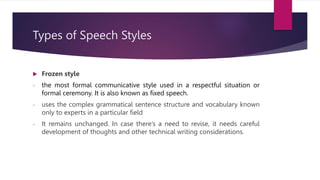
 Frozen style
- the most formal communicative style used in a respectful situation or
formal ceremony. It is also known as fixed speech.
- uses the complex grammatical sentence structure and vocabulary known
only to experts in a particular field
- It remains unchanged. In case there’s a need to revise, it needs careful
development of thoughts and other technical writing considerations.
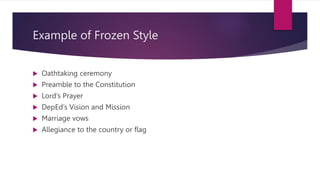
Example of Frozen Style
 Oathtaking ceremony
 Preamble to the Constitution
 Lord’s Prayer
 DepEd’s Vision and Mission
 Marriage vows
 Allegiance to the country or flag
Types of Speech Styles
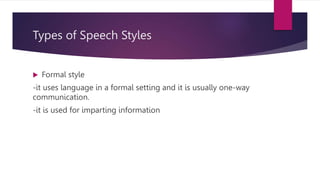
 Formal style
-it uses language in a formal setting and it is usually one-way
communication.
-it is used for imparting information
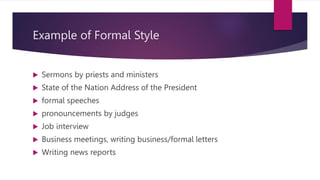
Example of Formal Style
 Sermons by priests and ministers
 State of the Nation Address of the President
 formal speeches
 pronouncements by judges
 Job interview
 Business meetings, writing business/formal letters
 Writing news reports
Types of Speech Styles
 Consultative Style
-This style is the standard one. Professional or mutually
acceptable language is a must in this style.
- In this style, the speaker constantly observes the listener’s
verbal and non-verbal cues for feedback.
- What the speaker will say next depends on the feedback
provided by the listener.
Example of Consultative Style
 Doctor and patient dialogue
 Teacher and student conversation
 Teacher and parent discussion
 Employers and employees talk
 Meeting of Mayor and his constituents
Types of Speech Styles
 Casual Style
- This style is more informal compared to the other speech
styles.
- It is common among peers and friends. Jargon, slang, or
vernacular language are used.
- It is usually used in social interactions
Example of Casual Style
 A conversation with your family during dinner
 Casual talks with friends thru chats, phone calls, text
messaging
Types of Speech Styles
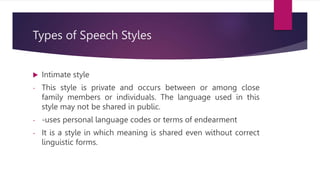
 Intimate style
- This style is private and occurs between or among close
family members or individuals. The language used in this
style may not be shared in public.
- -uses personal language codes or terms of endearment
- It is a style in which meaning is shared even without correct
linguistic forms.
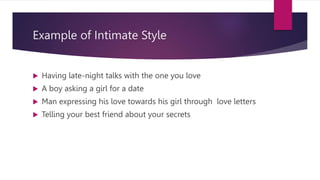
Example of Intimate Style
 Having late-night talks with the one you love
 A boy asking a girl for a date
 Man expressing his love towards his girl through love letters
 Telling your best friend about your secrets
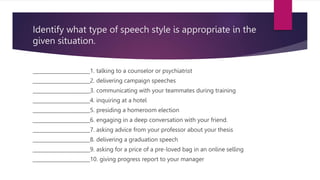
Identify what type of speech style is appropriate in the
given situation.
_______________________1. talking to a counselor or psychiatrist
_______________________2. delivering campaign speeches
_______________________3. communicating with your teammates during training
_______________________4. inquiring at a hotel
_______________________5. presiding a homeroom election
_______________________6. engaging in a deep conversation with your friend.
_______________________7. asking advice from your professor about your thesis
_______________________8. delivering a graduation speech
_______________________9. asking for a price of a pre-loved bag in an online selling
_______________________10. giving progress report to your manager
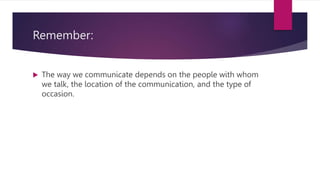
Remember:
 The way we communicate depends on the people with whom
we talk, the location of the communication, and the type of
occasion.
602805379-Speech-Styles.pptx

602805379-Speech-Styles.pptx

  • 1.
    TYPES OF SPEECHSTYLE ORAL COMMUNICATION IN CONTEXT ALMA T. ACIERTO
  • 2.
  • 3.
  • 4.
  • 5.
  • 6.
  • 7.
    What is aSpeech Style?  According to Martin Joos (1976), it is a form of language that the speaker uses which is characterized by the degree of formality from the most formal to least formal styles.  the distinct variations or forms of the language used for the same purpose by a particular situation or the form of language that the speaker uses.  set of linguistic variants that a person uses that has specific social meanings
  • 8.
    Types of SpeechStyles  Frozen style - the most formal communicative style used in a respectful situation or formal ceremony. It is also known as fixed speech. - uses the complex grammatical sentence structure and vocabulary known only to experts in a particular field - It remains unchanged. In case there’s a need to revise, it needs careful development of thoughts and other technical writing considerations.
  • 9.
    Example of FrozenStyle  Oathtaking ceremony  Preamble to the Constitution  Lord’s Prayer  DepEd’s Vision and Mission  Marriage vows  Allegiance to the country or flag
  • 10.
    Types of SpeechStyles  Formal style -it uses language in a formal setting and it is usually one-way communication. -it is used for imparting information
  • 11.
    Example of FormalStyle  Sermons by priests and ministers  State of the Nation Address of the President  formal speeches  pronouncements by judges  Job interview  Business meetings, writing business/formal letters  Writing news reports
  • 12.
    Types of SpeechStyles  Consultative Style -This style is the standard one. Professional or mutually acceptable language is a must in this style. - In this style, the speaker constantly observes the listener’s verbal and non-verbal cues for feedback. - What the speaker will say next depends on the feedback provided by the listener.
  • 13.
    Example of ConsultativeStyle  Doctor and patient dialogue  Teacher and student conversation  Teacher and parent discussion  Employers and employees talk  Meeting of Mayor and his constituents
  • 14.
    Types of SpeechStyles  Casual Style - This style is more informal compared to the other speech styles. - It is common among peers and friends. Jargon, slang, or vernacular language are used. - It is usually used in social interactions
  • 15.
    Example of CasualStyle  A conversation with your family during dinner  Casual talks with friends thru chats, phone calls, text messaging
  • 16.
    Types of SpeechStyles  Intimate style - This style is private and occurs between or among close family members or individuals. The language used in this style may not be shared in public. - -uses personal language codes or terms of endearment - It is a style in which meaning is shared even without correct linguistic forms.
  • 17.
    Example of IntimateStyle  Having late-night talks with the one you love  A boy asking a girl for a date  Man expressing his love towards his girl through love letters  Telling your best friend about your secrets
  • 18.
    Identify what typeof speech style is appropriate in the given situation. _______________________1. talking to a counselor or psychiatrist _______________________2. delivering campaign speeches _______________________3. communicating with your teammates during training _______________________4. inquiring at a hotel _______________________5. presiding a homeroom election _______________________6. engaging in a deep conversation with your friend. _______________________7. asking advice from your professor about your thesis _______________________8. delivering a graduation speech _______________________9. asking for a price of a pre-loved bag in an online selling _______________________10. giving progress report to your manager
  • 19.
    Remember:  The waywe communicate depends on the people with whom we talk, the location of the communication, and the type of occasion.