Special VFR – What is it??
Introduction
• Introductions
• Sign in Sheet
• Familiarization with Facility
• Emergency Procedures
• Overview of Seminar
Cell Phones
Objectives
At the completion of the training, you will be
able to:
• Define Special VFR
• Identify weather minimums for airspace
• How to request Special VFR
• How to use the clearance safely
Special VFR
• Meteorological conditions are less than those
required for basic VFR flight in controlled
airspace.
• Some aircraft are permitted flight under visual
flight rules
• Must be requested by the pilot & approved by
ATC
14 CFR Part 1 Section 1
Special VFR Departure
• Can be conducted when –
– ATC gives clearance
– Clear of clouds
– In flight visibility is at least 1 SM, and
– Between sunrise & sunset
• Waived if instrument rated pilot & plane
14 CFR Part 91 Section 161 (91.161)
Special VFR Arrival
• Same applies to arrivals
• What if ground visibility is not reported?
• If the pilot reports the visibility, is it
considered an official ground visibility report?
• Atlanta, GA (The William B. Hartsfield Atlanta International Airport)
• Baltimore, MD (Baltimore Washington International Airport)
• Boston, MA (General Edward Lawrence Logan International Airport)
• Chantilly, VA (Washington Dulles International Airport)
• Charlotte, NC (Charlotte/Douglas International Airport)
• Chicago, IL Chicago-O'Hare International Airport)
• Cleveland, OH (Cleveland-Hopkins International Airport)
• Covington, KY (Cincinnati Northern Kentucky International Airport)
• Dallas, TX (Dallas/Fort Worth Regional Airport)
• Denver, CO (Denver International Airport)
• Detroit, MI (Metropolitan Wayne County Airport)
• Honolulu, HI (Honolulu International Airport)
• Houston, TX (George Bush Intercontinental Airport/Houston)
• Kansas City, KS (Mid-Continent International Airport)
• Las Vegas, NV (McCarran International Airport)
• Los Angeles, CA (Los Angeles International Airport)
• Memphis, TN (Memphis International Airport)
• Miami, FL (Miami International Airport)
• Minneapolis, MN (Minneapolis-St. Paul International Airport)
• Newark, NJ (Newark International Airport)
• New Orleans, LA (New Orleans International Airport-Moisant Field)
• New York, NY (John F. Kennedy International Airport)
• New York, NY (LaGuardia Airport)
• Orlando, FL (Orlando International Airport)
• Philadelphia, PA (Philadelphia International Airport)
• Phoenix, AZ (Phoenix Sky Harbor International Airport)
• Pittsburgh, PA (Greater Pittsburgh International Airport)
• St. Louis, MO (Lambert-St. Louis International Airport)
• Salt Lake City, UT (Salt Lake City International Airport)
• San Diego, CA (San Diego International Airport)
• San Francisco, CA (San Francisco International Airport)
• Seattle, WA (Seattle-Tacoma International Airport)
• Tampa, FL (Tampa International Airport)
• Washington, DC (Ronald Reagan Washington National Airport and Andrews
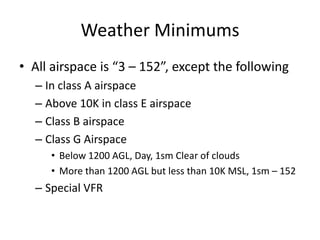
Weather Minimums
• All airspace is “3 – 152”, except the following
– In class A airspace
– Above 10K in class E airspace
– Class B airspace
– Class G Airspace
• Below 1200 AGL, Day, 1sm Clear of clouds
• More than 1200 AGL but less than 10K MSL, 1sm – 152
– Special VFR
So – How to Request It?
• Obtain weather
• Contact ATC
• KCSG?
• KLGC?
• Does a flight plan need be filed?
• Who is responsible for obstacle & terrain
clearance?
AIM 4-4-6 Special VFR Clearances
Charting
How Much Visibility?
QUESTIONS?
VOR Navigation – The Easy Way
Intro Questions
• What is the only way to positively identify a
VOR?
• How often is this system checked?
• When do you HAVE to have VOR receivers
installed in the aircraft?
VOR Navigation
• Very High Frequency Omni-Directional Range
• 108.0 – 117.95
• Some equipped with Voice Capabilities
• More than one type
• More than one strength level (output)
Service Volumes & Types
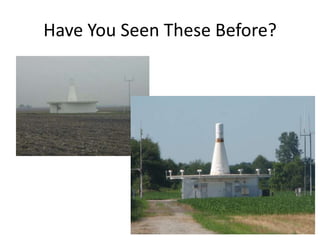
Have You Seen These Before?
The OBS (Omni-Bearing Selector)
One More Piece
Simulator Introduction

Special VFR

  • 1.
    Special VFR –What is it??
  • 2.
    Introduction • Introductions • Signin Sheet • Familiarization with Facility • Emergency Procedures • Overview of Seminar
  • 3.
  • 4.
    Objectives At the completionof the training, you will be able to: • Define Special VFR • Identify weather minimums for airspace • How to request Special VFR • How to use the clearance safely
  • 5.
    Special VFR • Meteorologicalconditions are less than those required for basic VFR flight in controlled airspace. • Some aircraft are permitted flight under visual flight rules • Must be requested by the pilot & approved by ATC 14 CFR Part 1 Section 1
  • 6.
    Special VFR Departure •Can be conducted when – – ATC gives clearance – Clear of clouds – In flight visibility is at least 1 SM, and – Between sunrise & sunset • Waived if instrument rated pilot & plane 14 CFR Part 91 Section 161 (91.161)
  • 7.
    Special VFR Arrival •Same applies to arrivals • What if ground visibility is not reported? • If the pilot reports the visibility, is it considered an official ground visibility report?
  • 8.
    • Atlanta, GA(The William B. Hartsfield Atlanta International Airport) • Baltimore, MD (Baltimore Washington International Airport) • Boston, MA (General Edward Lawrence Logan International Airport) • Chantilly, VA (Washington Dulles International Airport) • Charlotte, NC (Charlotte/Douglas International Airport) • Chicago, IL Chicago-O'Hare International Airport) • Cleveland, OH (Cleveland-Hopkins International Airport) • Covington, KY (Cincinnati Northern Kentucky International Airport) • Dallas, TX (Dallas/Fort Worth Regional Airport) • Denver, CO (Denver International Airport) • Detroit, MI (Metropolitan Wayne County Airport) • Honolulu, HI (Honolulu International Airport) • Houston, TX (George Bush Intercontinental Airport/Houston) • Kansas City, KS (Mid-Continent International Airport) • Las Vegas, NV (McCarran International Airport) • Los Angeles, CA (Los Angeles International Airport) • Memphis, TN (Memphis International Airport) • Miami, FL (Miami International Airport) • Minneapolis, MN (Minneapolis-St. Paul International Airport) • Newark, NJ (Newark International Airport) • New Orleans, LA (New Orleans International Airport-Moisant Field) • New York, NY (John F. Kennedy International Airport) • New York, NY (LaGuardia Airport) • Orlando, FL (Orlando International Airport) • Philadelphia, PA (Philadelphia International Airport) • Phoenix, AZ (Phoenix Sky Harbor International Airport) • Pittsburgh, PA (Greater Pittsburgh International Airport) • St. Louis, MO (Lambert-St. Louis International Airport) • Salt Lake City, UT (Salt Lake City International Airport) • San Diego, CA (San Diego International Airport) • San Francisco, CA (San Francisco International Airport) • Seattle, WA (Seattle-Tacoma International Airport) • Tampa, FL (Tampa International Airport) • Washington, DC (Ronald Reagan Washington National Airport and Andrews
  • 9.
    Weather Minimums • Allairspace is “3 – 152”, except the following – In class A airspace – Above 10K in class E airspace – Class B airspace – Class G Airspace • Below 1200 AGL, Day, 1sm Clear of clouds • More than 1200 AGL but less than 10K MSL, 1sm – 152 – Special VFR
  • 10.
    So – Howto Request It? • Obtain weather • Contact ATC • KCSG? • KLGC? • Does a flight plan need be filed? • Who is responsible for obstacle & terrain clearance? AIM 4-4-6 Special VFR Clearances
  • 11.
  • 12.
  • 13.
  • 14.
    VOR Navigation –The Easy Way
  • 15.
    Intro Questions • Whatis the only way to positively identify a VOR? • How often is this system checked? • When do you HAVE to have VOR receivers installed in the aircraft?
  • 16.
    VOR Navigation • VeryHigh Frequency Omni-Directional Range • 108.0 – 117.95 • Some equipped with Voice Capabilities • More than one type • More than one strength level (output)
  • 17.
  • 18.
    Have You SeenThese Before?
  • 19.
  • 20.
  • 21.

Editor's Notes

  • #11 Must not delay IFR Operations. State intentions in detail.