Thursday August 15, 2013
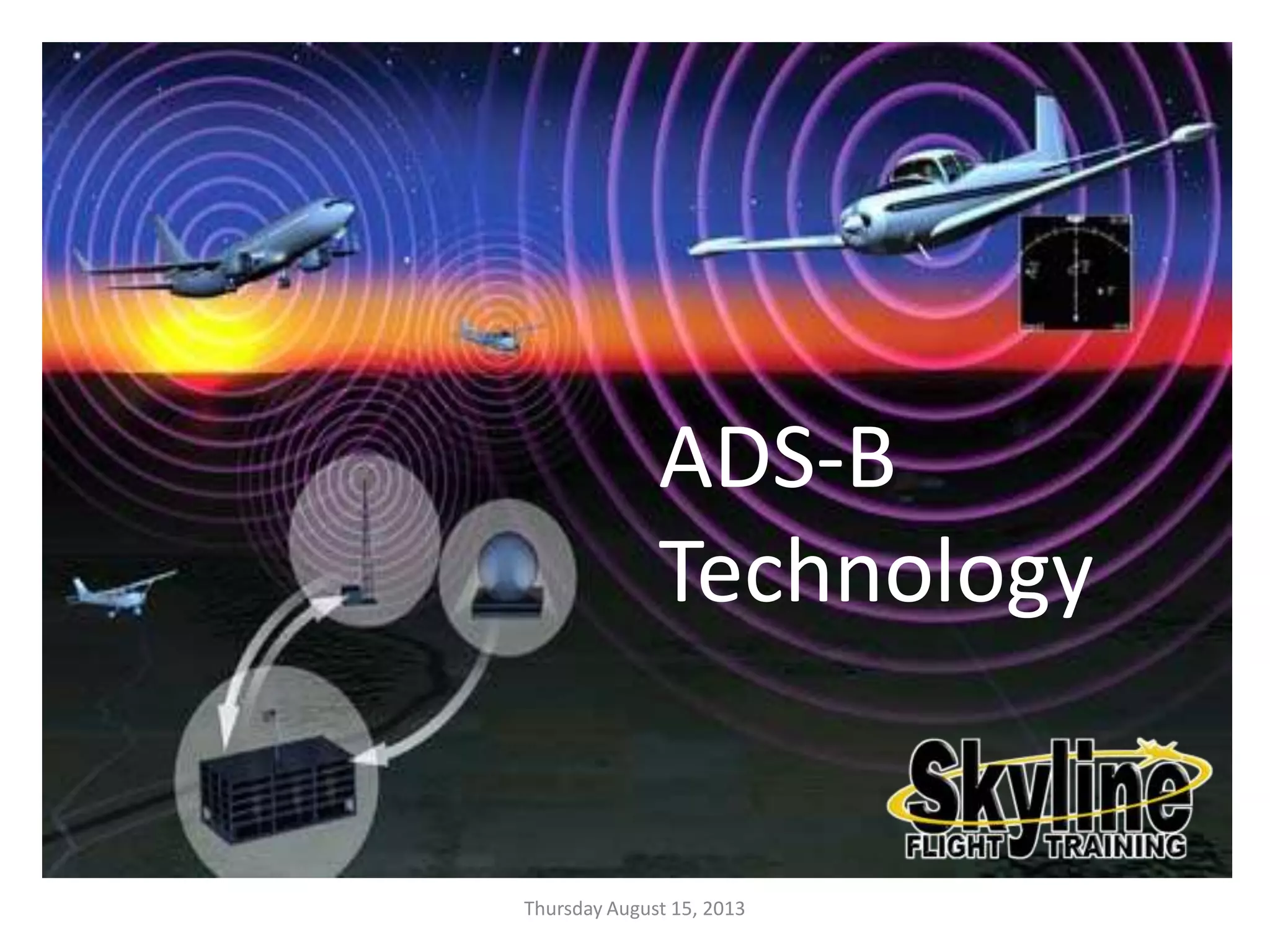
ADS-B
Technology
FAA Wings Program
• www.FAASafety.gov
• Takes the place of the flight review
• Online courses or attend seminars
• No minimum time for flights
• Most of you might already meet the
requirements for a phase completion
• Earn your cool set of Wings to display
however you wish
Thursday August 15, 2013
Some Basics
• Operates using two modes or functions
– Out from the aircraft (ADS-B Out)
– Into the aircraft (ADS-B In)
• Designed to accomplish 3 goals
– Replace radar as the primary means to track aircraft
(ADS-B)
– To provide a host of advisory-only text & graphic
information in the flight deck (FIS-B)
– To provide advisory-only traffic data in the flight deck
(TIS-B)
Thursday August 15, 2013
ADS-B & GPS
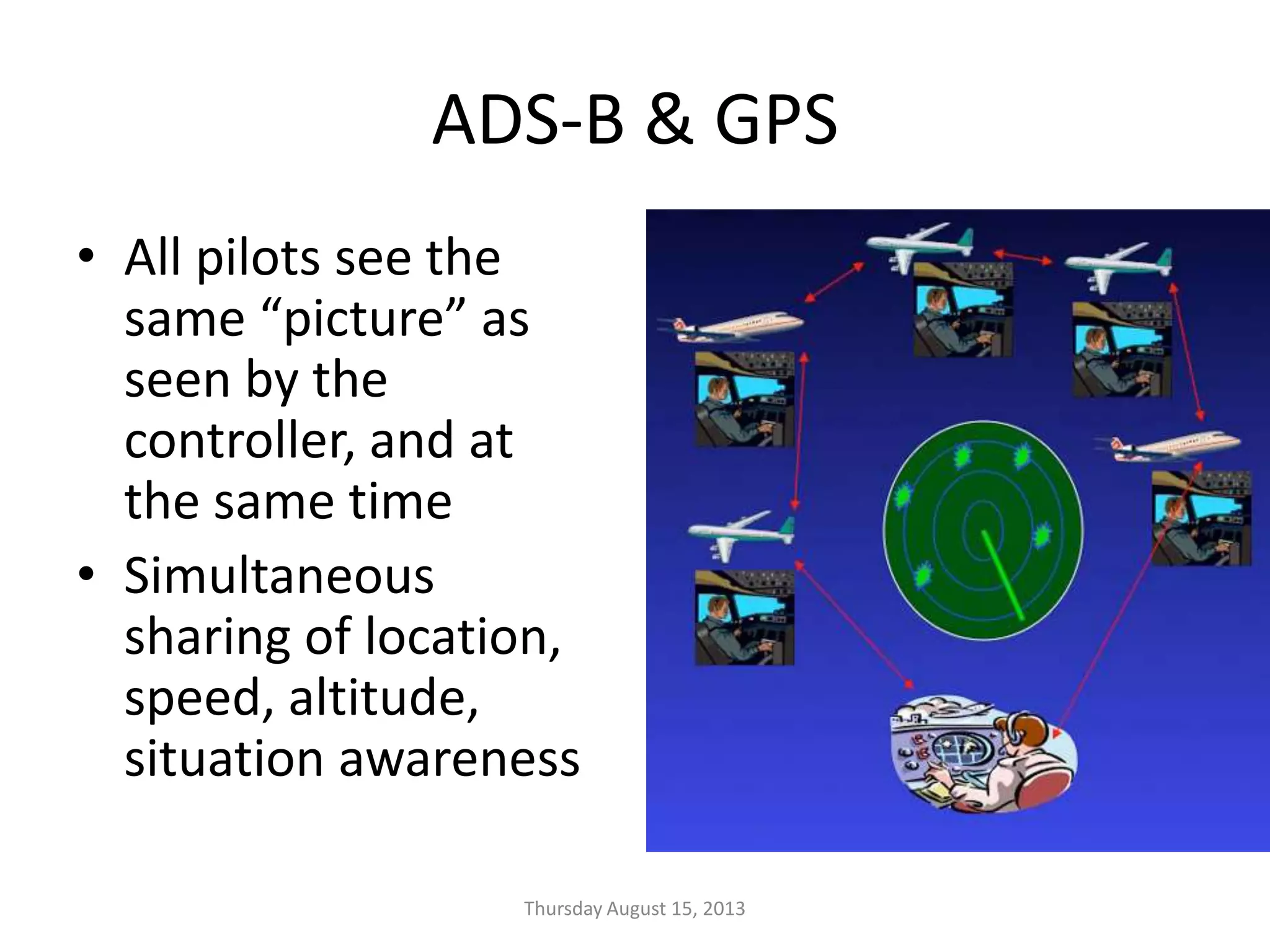
• All pilots see the
same “picture” as
seen by the
controller, and at
the same time
• Simultaneous
sharing of location,
speed, altitude,
situation awareness
Thursday August 15, 2013
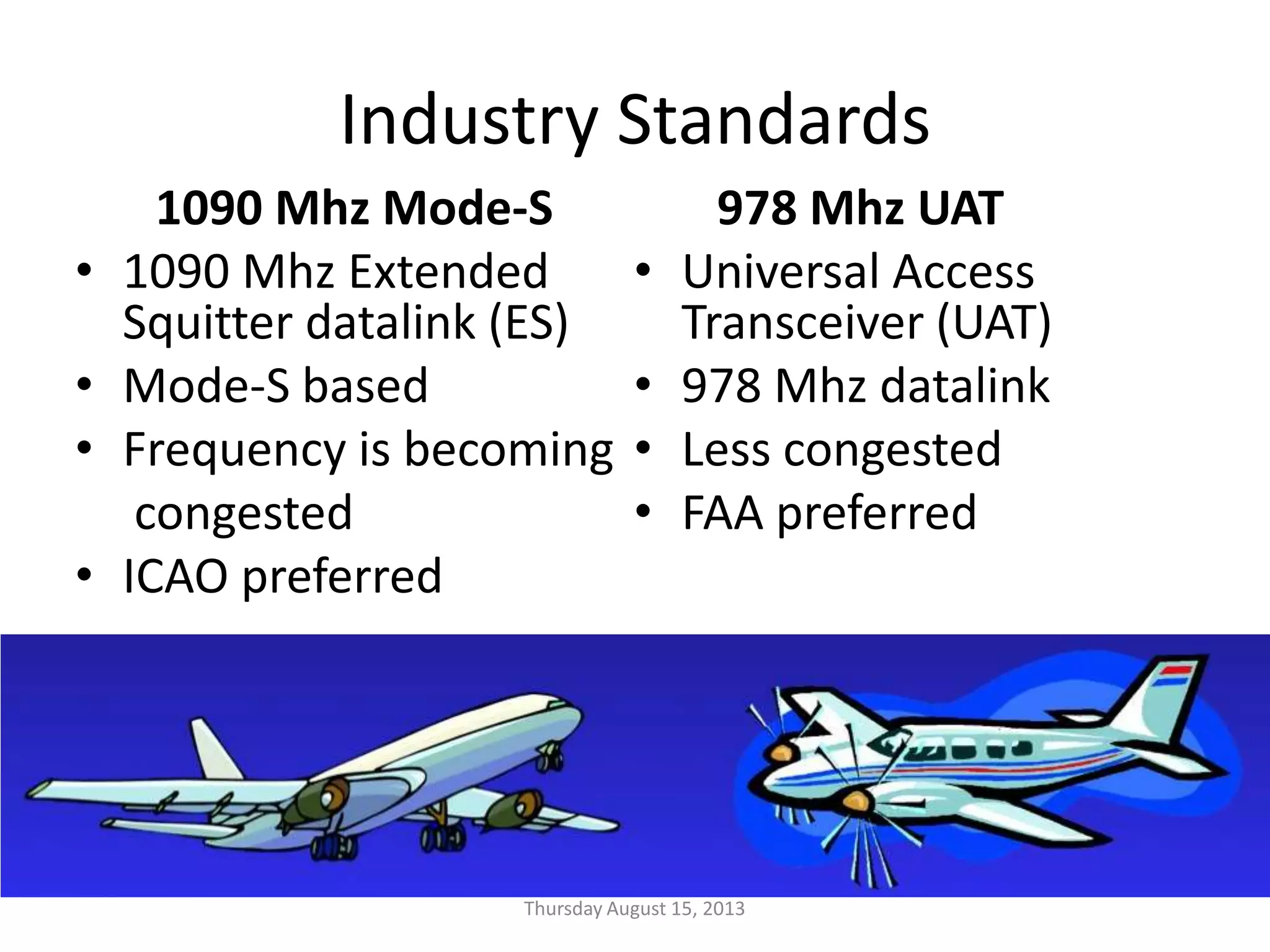
Industry Standards
1090 Mhz Mode-S
• 1090 Mhz Extended
Squitter datalink (ES)
• Mode-S based
• Frequency is becoming
congested
• ICAO preferred
978 Mhz UAT
• Universal Access
Transceiver (UAT)
• 978 Mhz datalink
• Less congested
• FAA preferred
Thursday August 15, 2013
What’s a Squitter?
A periodic burst or broadcast of aircraft-tracking
data that is transmitted periodically by a Mode S
transponder (or equivalent) without
interrogation from controller’s radar
Thursday August 15, 2013
ADS-B and the 2020 FAA Final Rule
• By January 1, 2020 all aircraft operating in
transponder airspace will be required to carry
equipment that produces an ADS-B Out
broadcast
• There is currently no mandate for ADS-B In
– ADS-B In receives ADS-B datalink information and
displays it to the cockpit
• 2020 rule established the engineering criteria
for ADS-B Out
Thursday August 15, 2013
How do we efficiently transition to the
2020 ADS-B Rule?
• Avionics manufacturers can now design ADS-B out
equipment that is “ADS-B 2020 Compliant”
• No ADS-B 2020 Compliant Out equipment has been
designed and certified by the FAA
• Equipment costs will be initially high
• High equipment costs will discourage aircraft owners
from purchasing and installing this equipment
• Manufacturers cannot reduce costs until many units are
sold
• Aircraft owners are waiting for the costs to go down
• Many aircraft owners are unaware of the ADS-B 2020
Rule
Thursday August 15, 2013
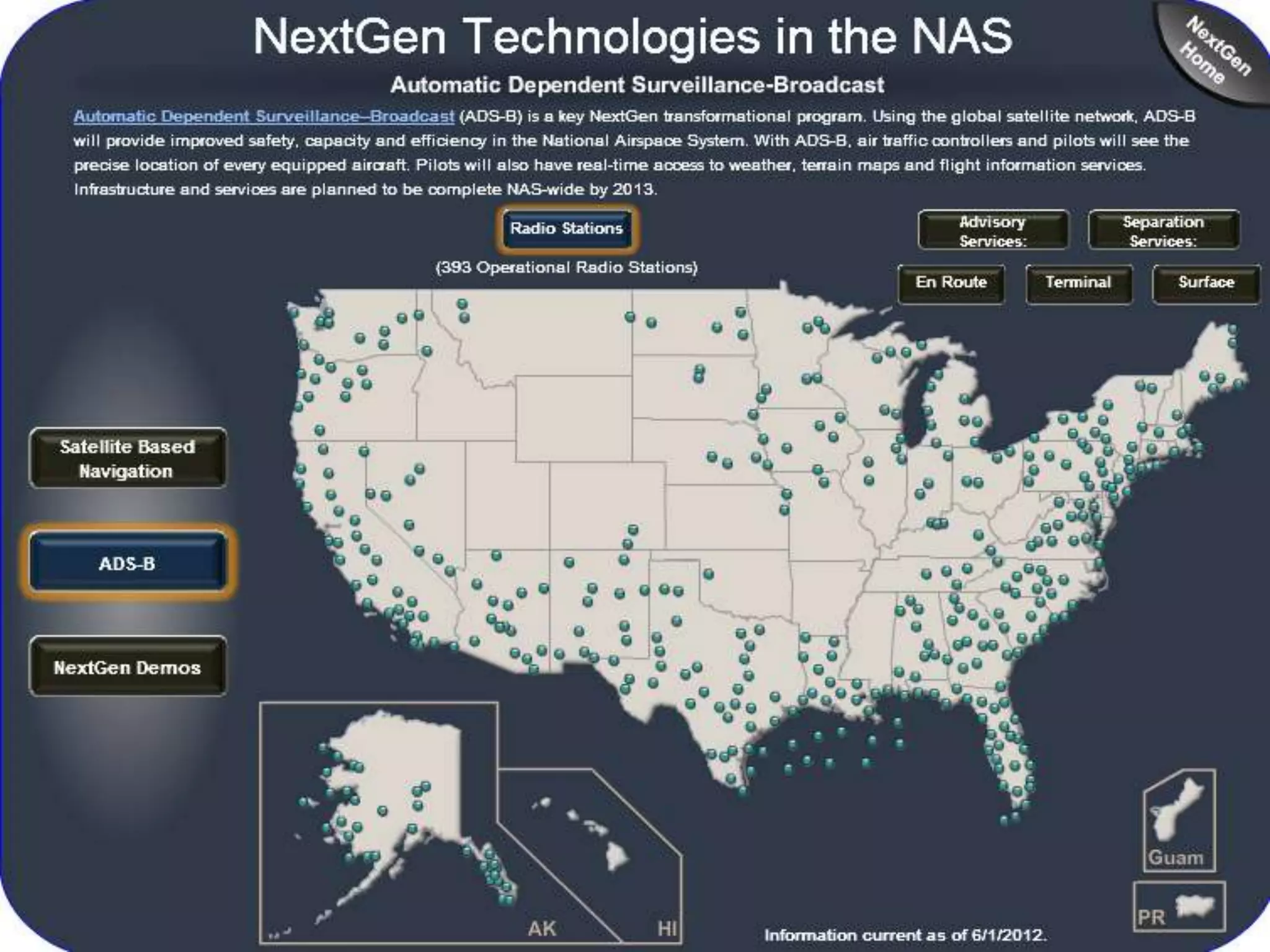
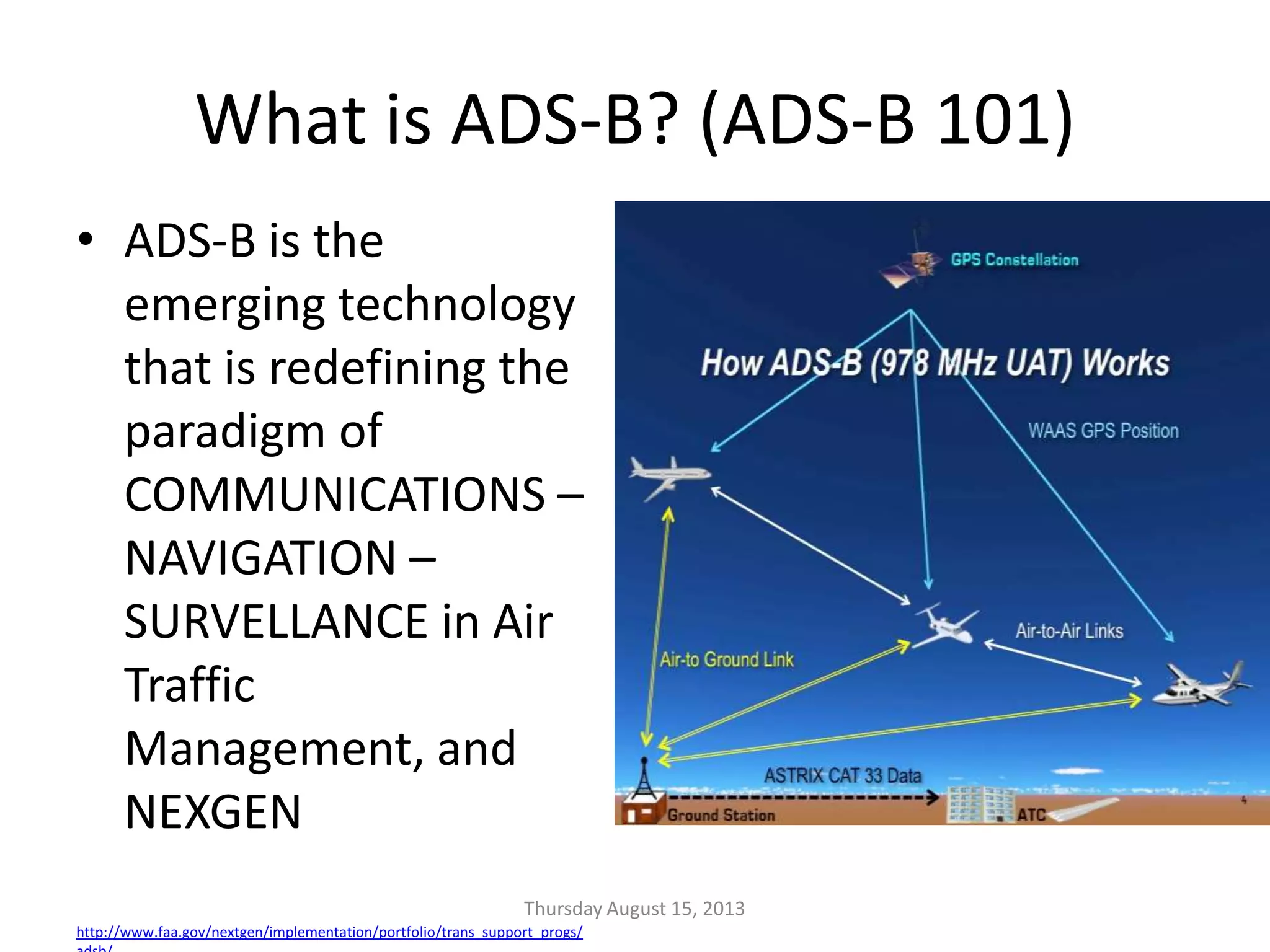
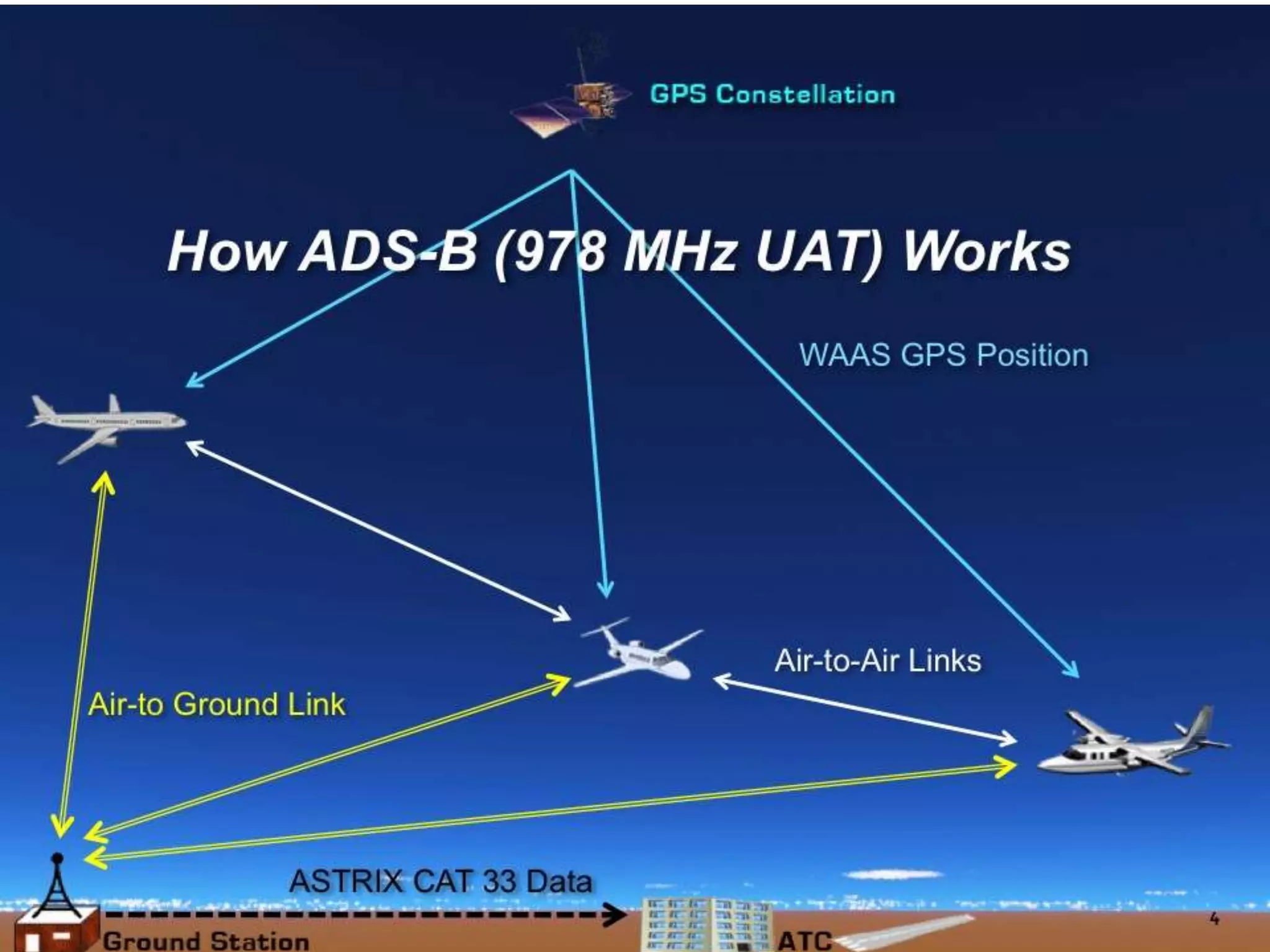
What is ADS-B? (ADS-B 101)
• ADS-B is the
emerging technology
that is redefining the
paradigm of
COMMUNICATIONS –
NAVIGATION –
SURVELLANCE in Air
Traffic
Management, and
NEXGEN
http://www.faa.gov/nextgen/implementation/portfolio/trans_support_progs/
Thursday August 15, 2013
ADS-B
Automatic  Always ON
Dependent  Relies on very accurate GPS Data
Surveillance  Provides aircraft position, altitude,
speed, heading, identification,
and other data
Broadcast  Does not require interrogation –
data is broadcast to any aircraft or
ground station equipped to receive
the datalink signal
Thursday August 15, 2013
ADS-B Services
• Traffic Information Service – Broadcast (TIS-B)
– Sends a composite of radar and ADS-B data back
through the ground stations to the cockpit
– The pilot sees what the controller sees
– Cockpit display will show all aircraft in radar
contact with controllers, ADS-B equipped or not,
within 15 miles, plus or minus 3,500 feet
– No subscription costs
Thursday August 15, 2013
Flight Information Service - Broadcast
• Ground-Based transceivers (GBT)
– Operate both 1090ES & 978 protocols
– Many are linked to ATC via dedicated landline
• Continuous broadcast
• May not always be in range of suitable GBT
– Particularly on the ground or remote location
Thursday August 15, 2013
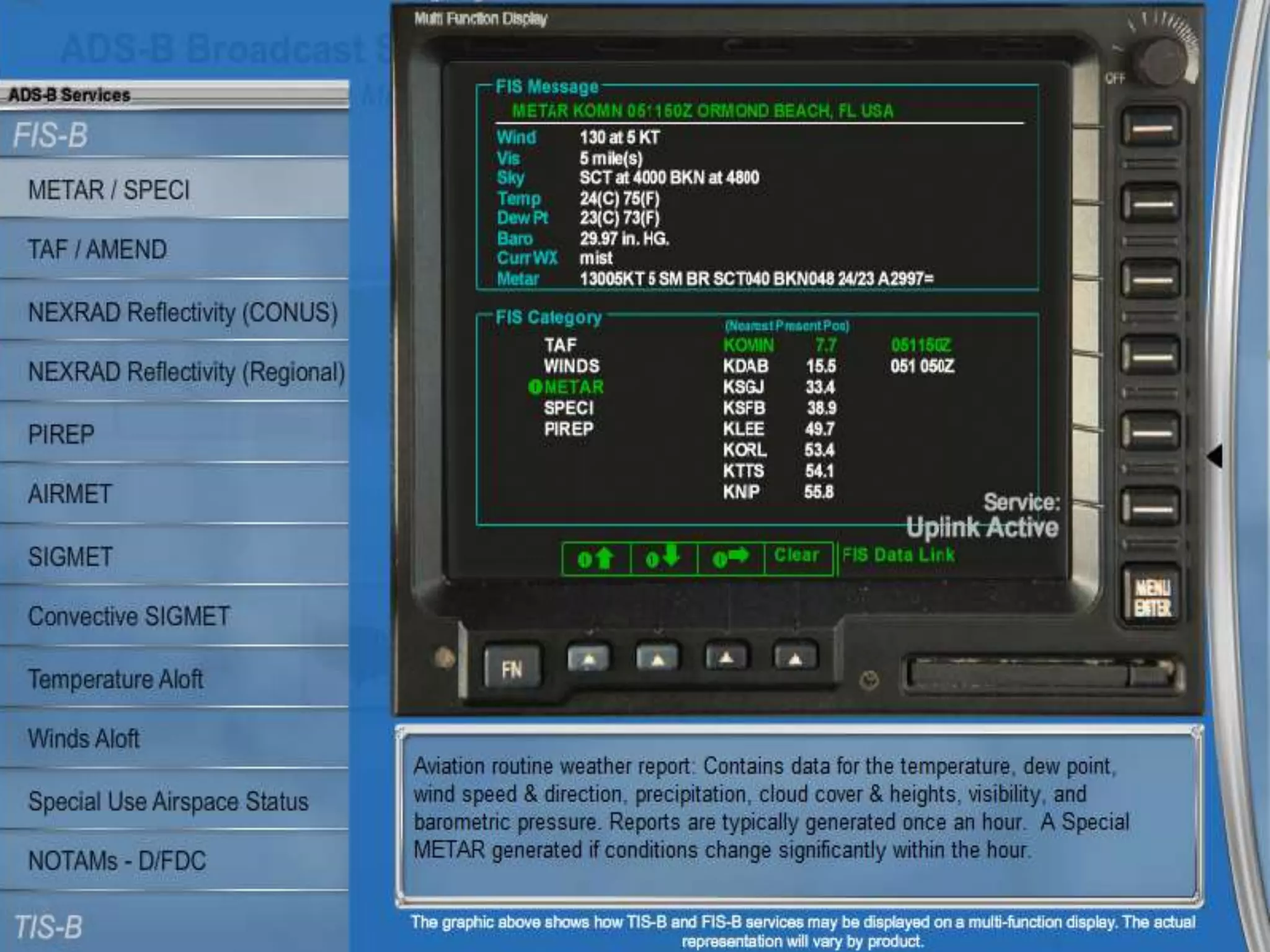
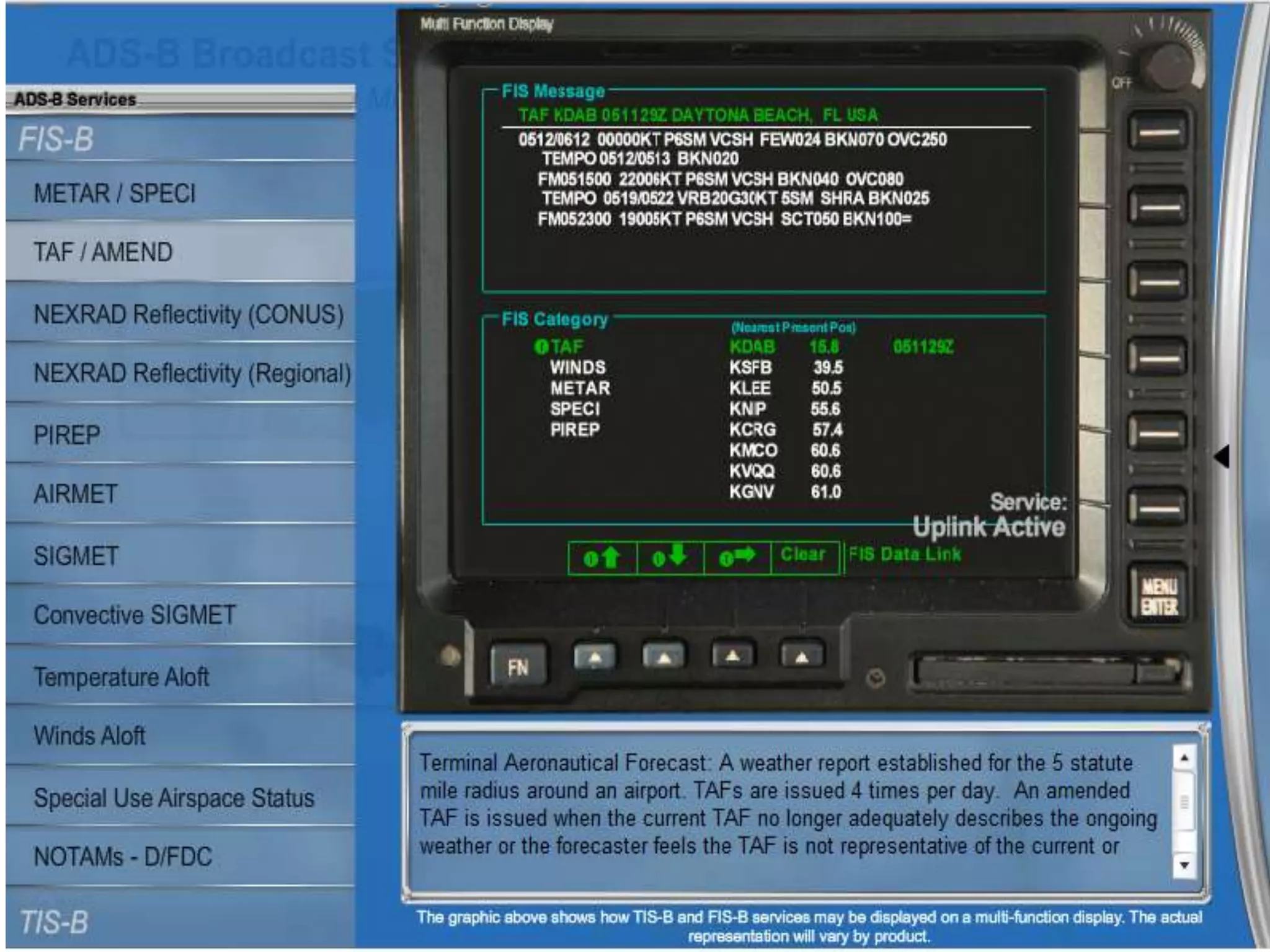
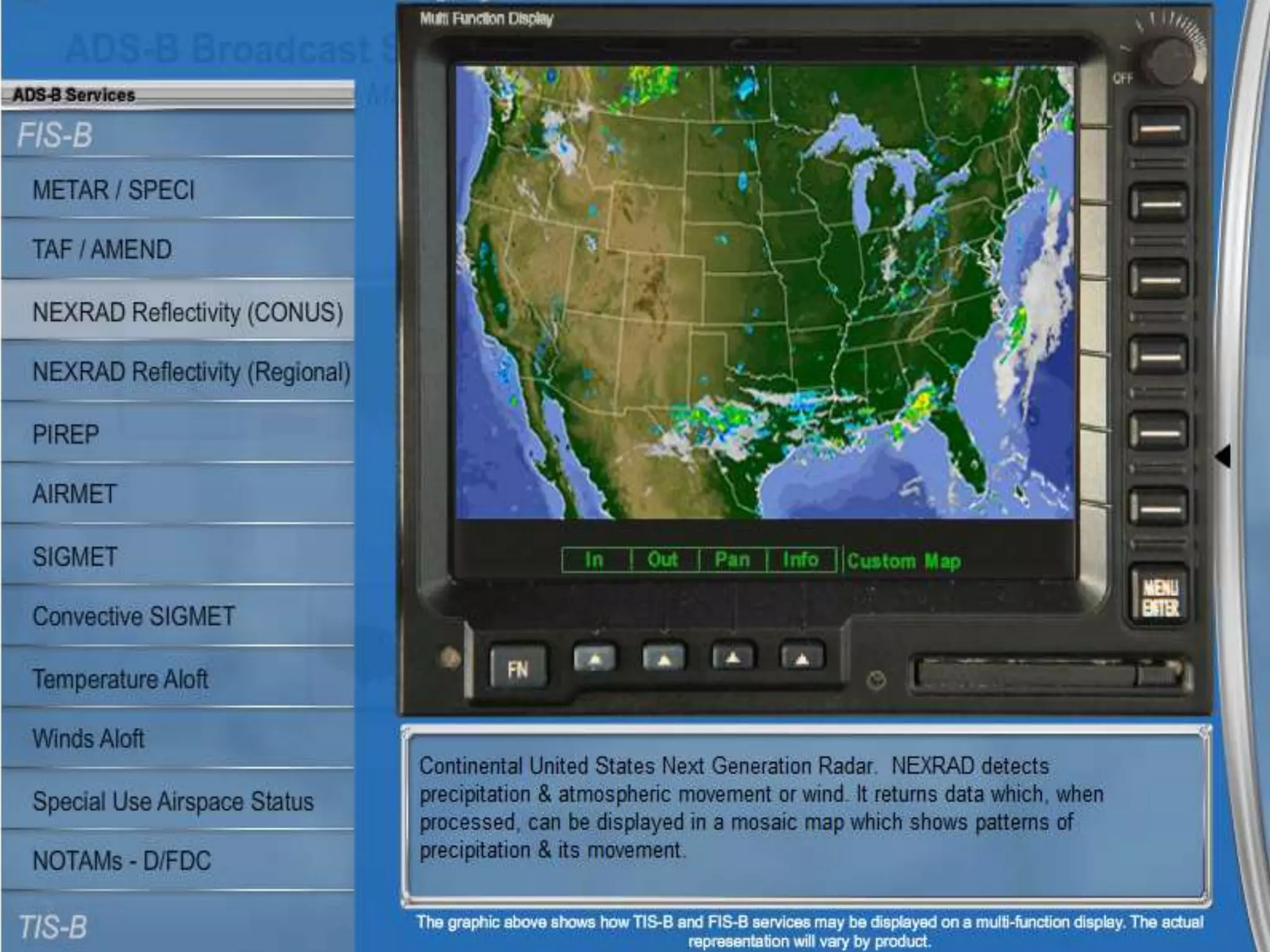
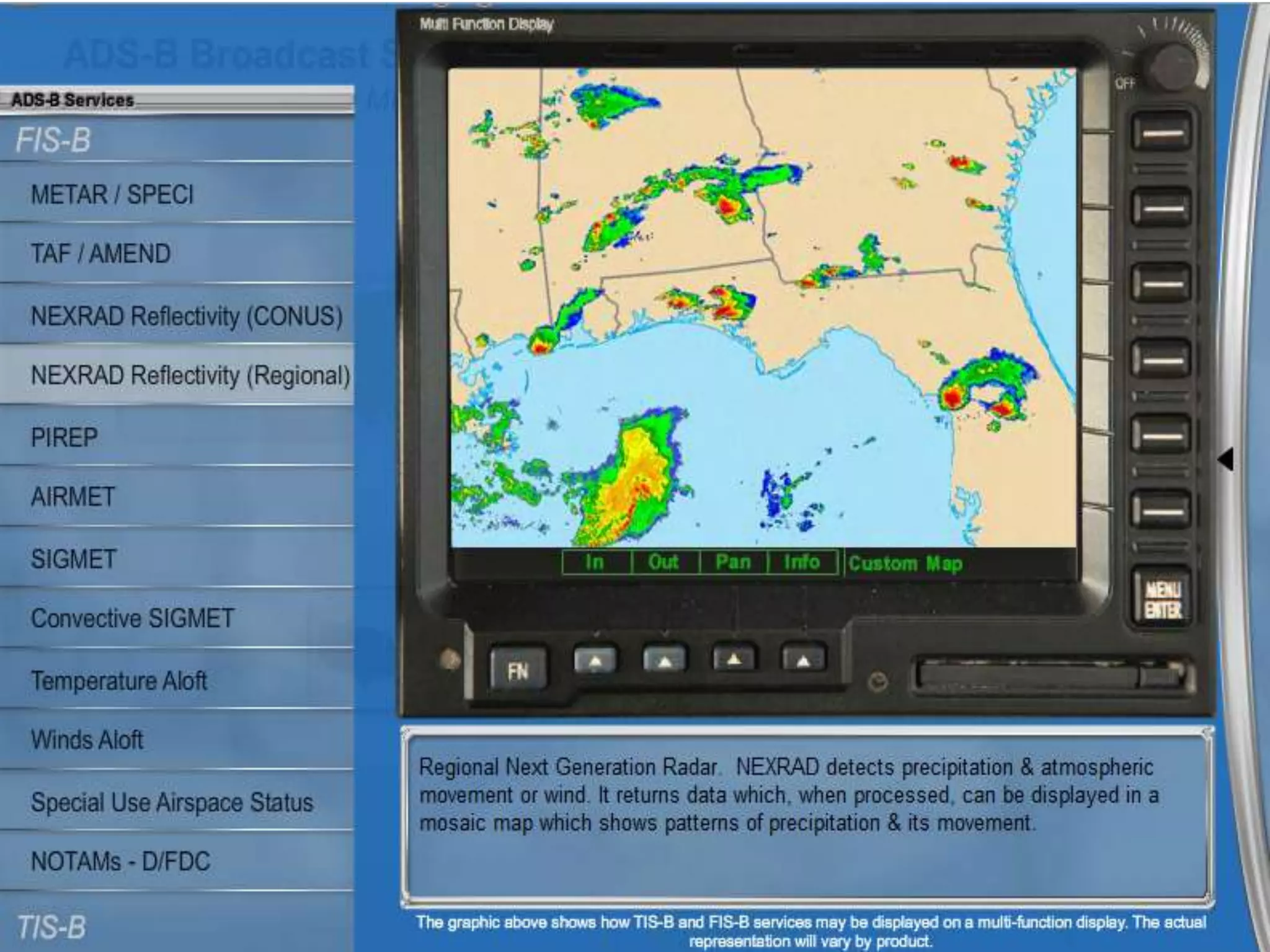
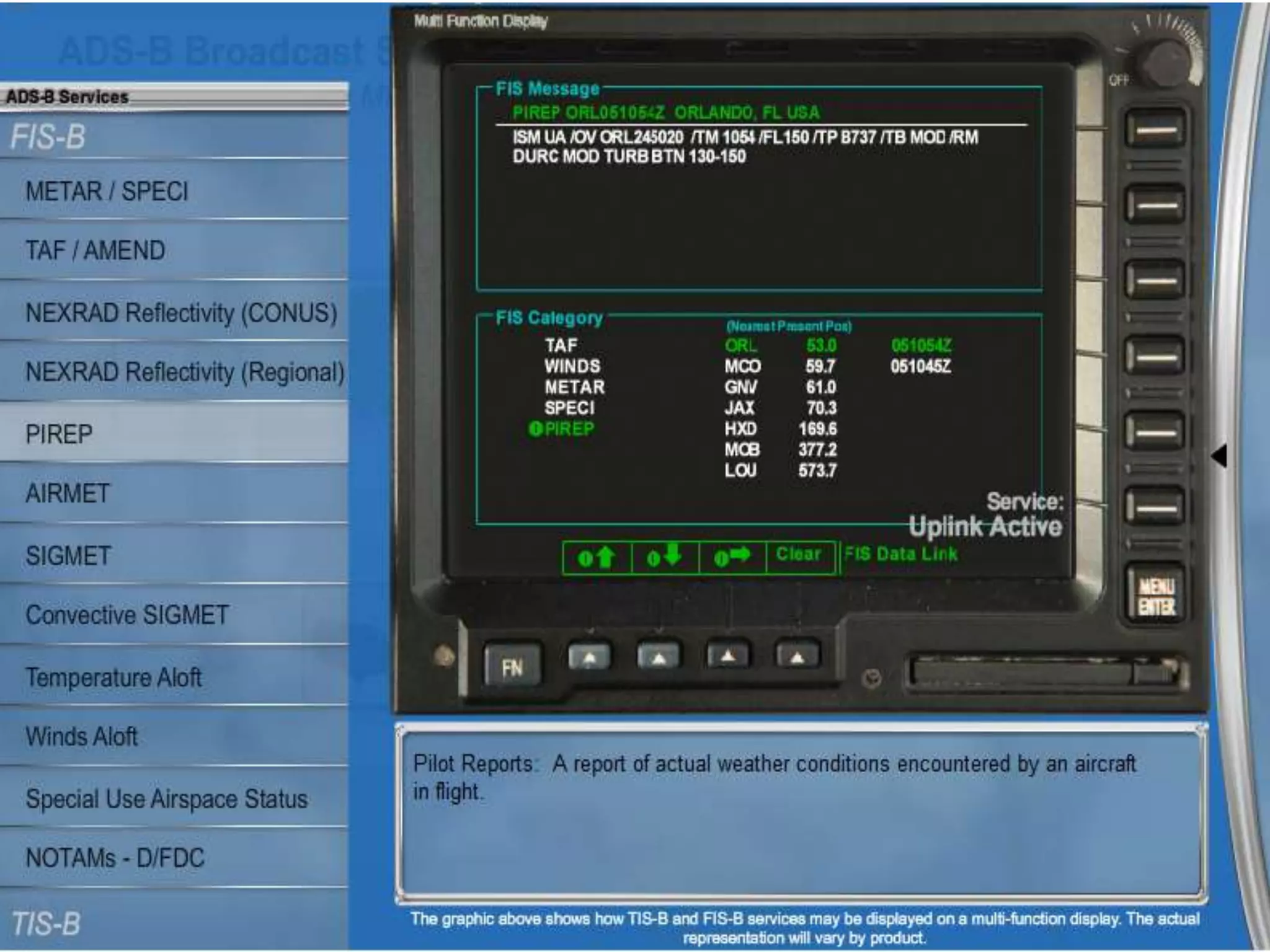
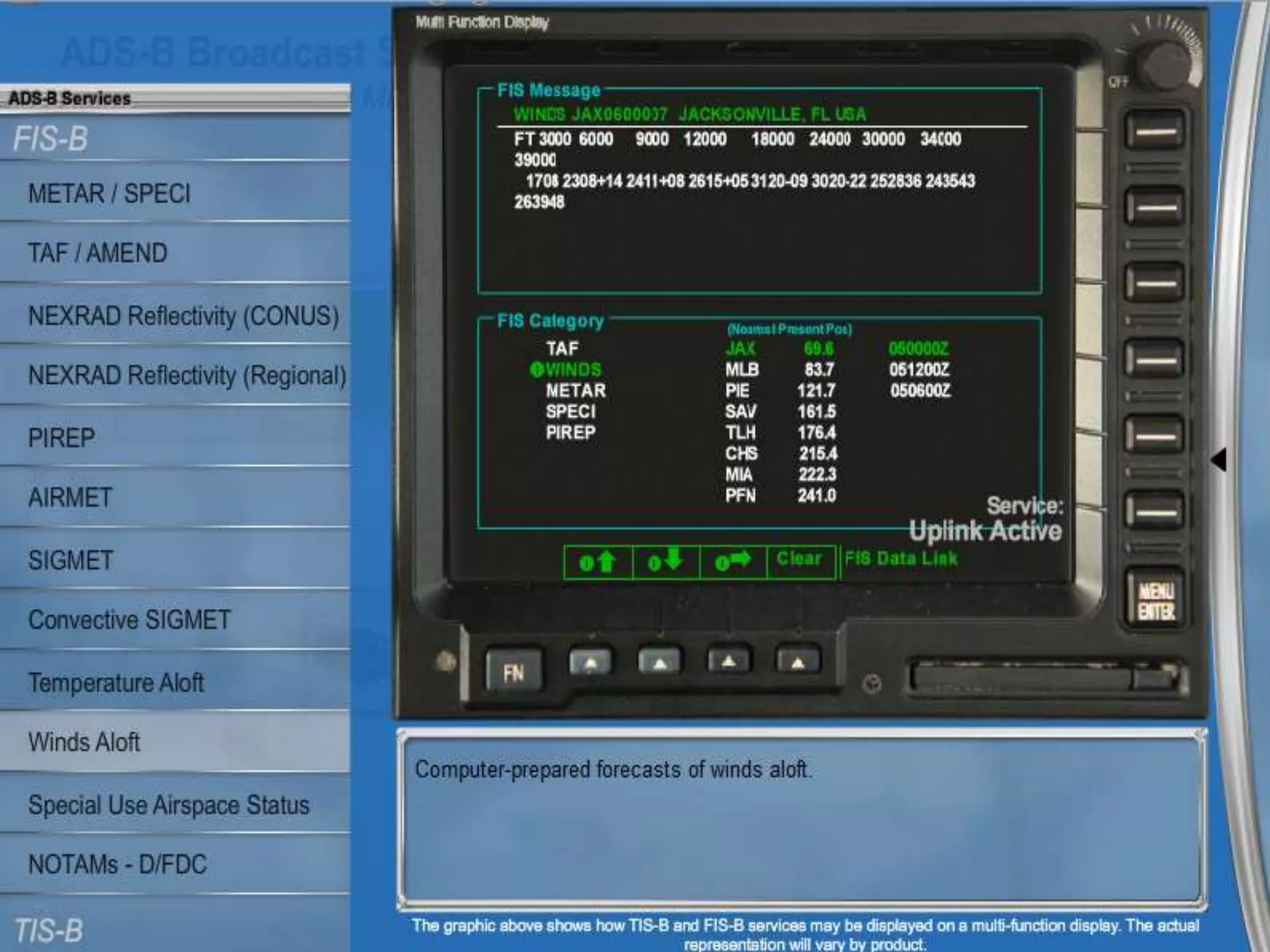
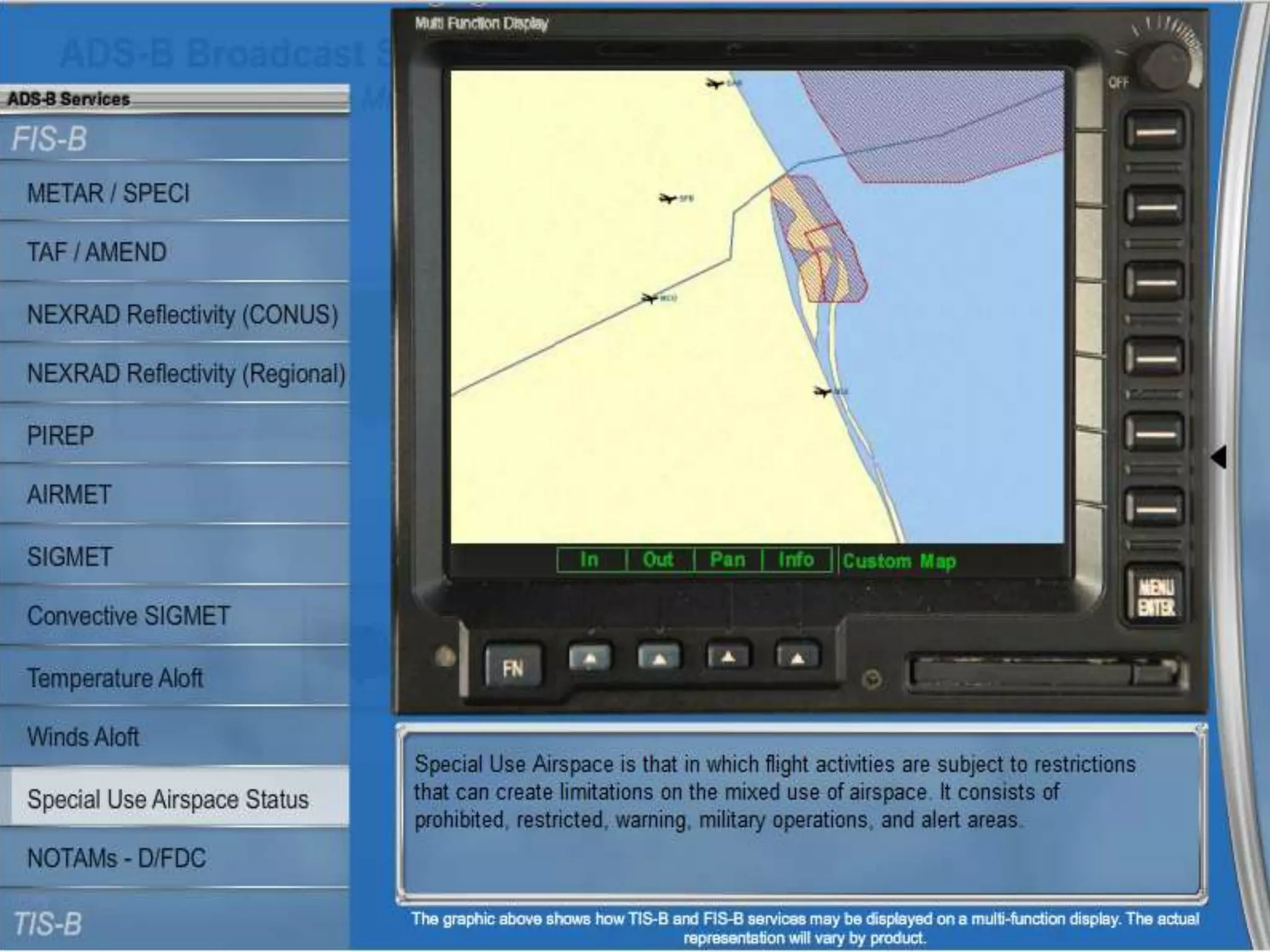
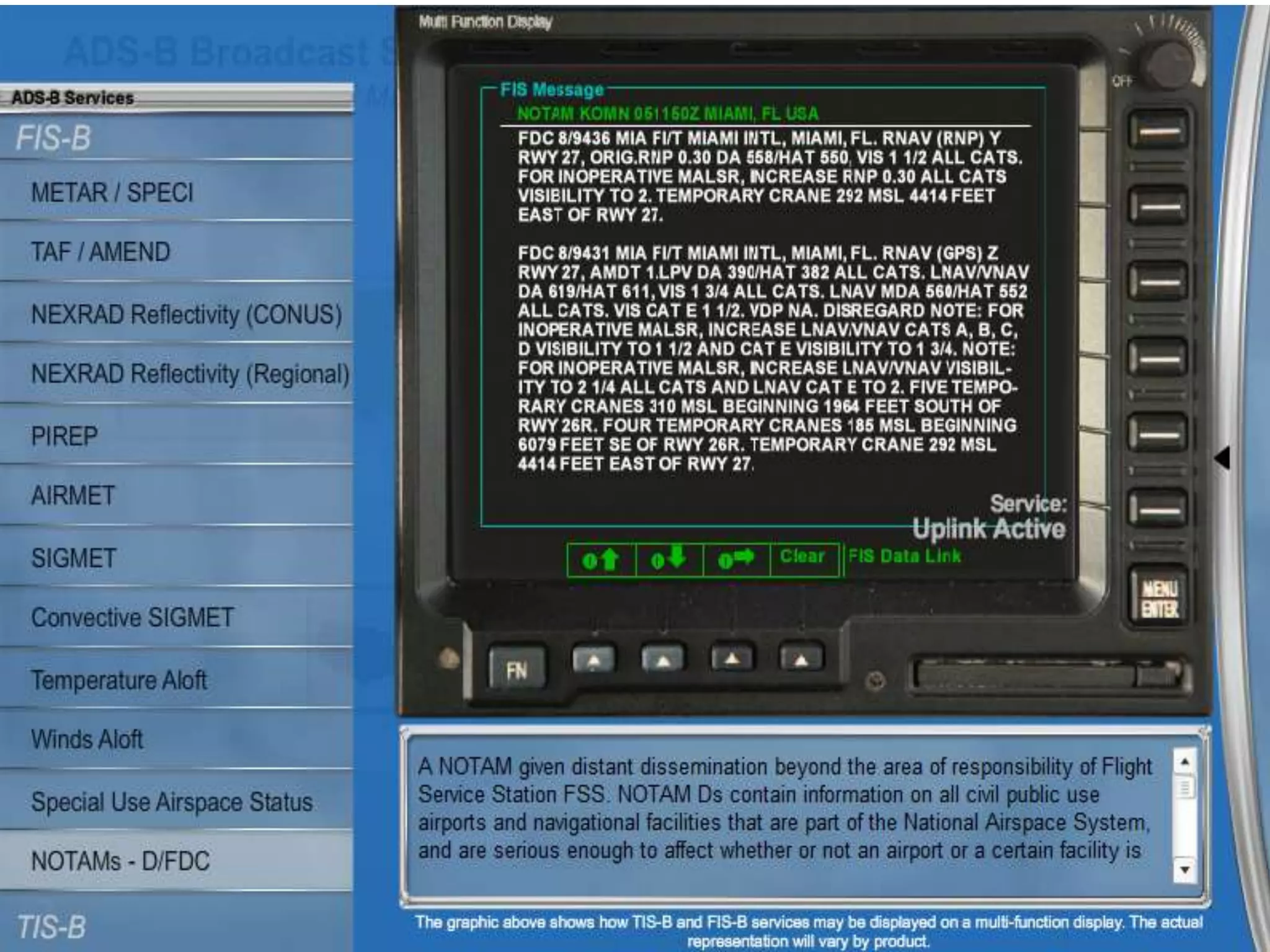
FIS-B
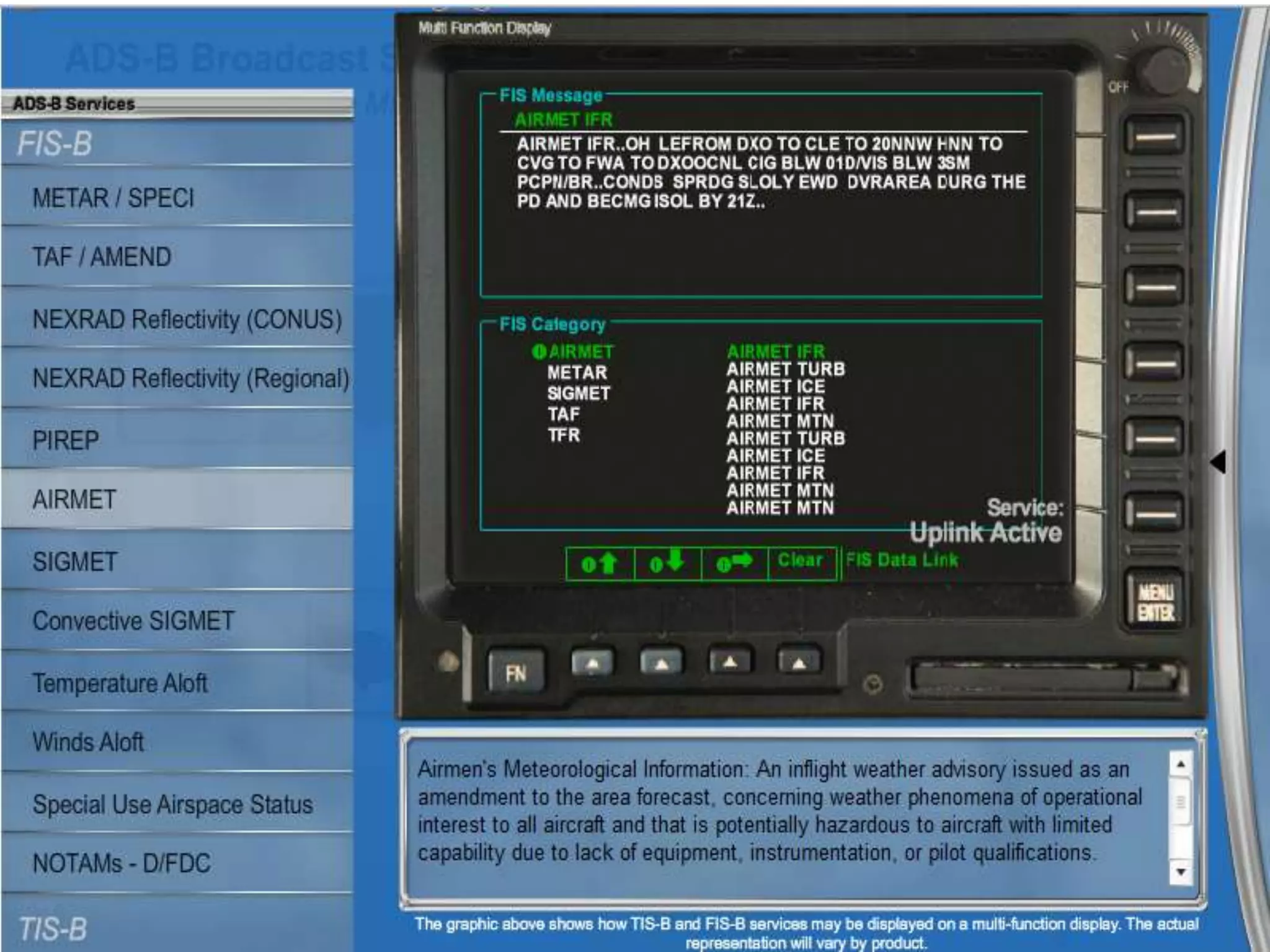
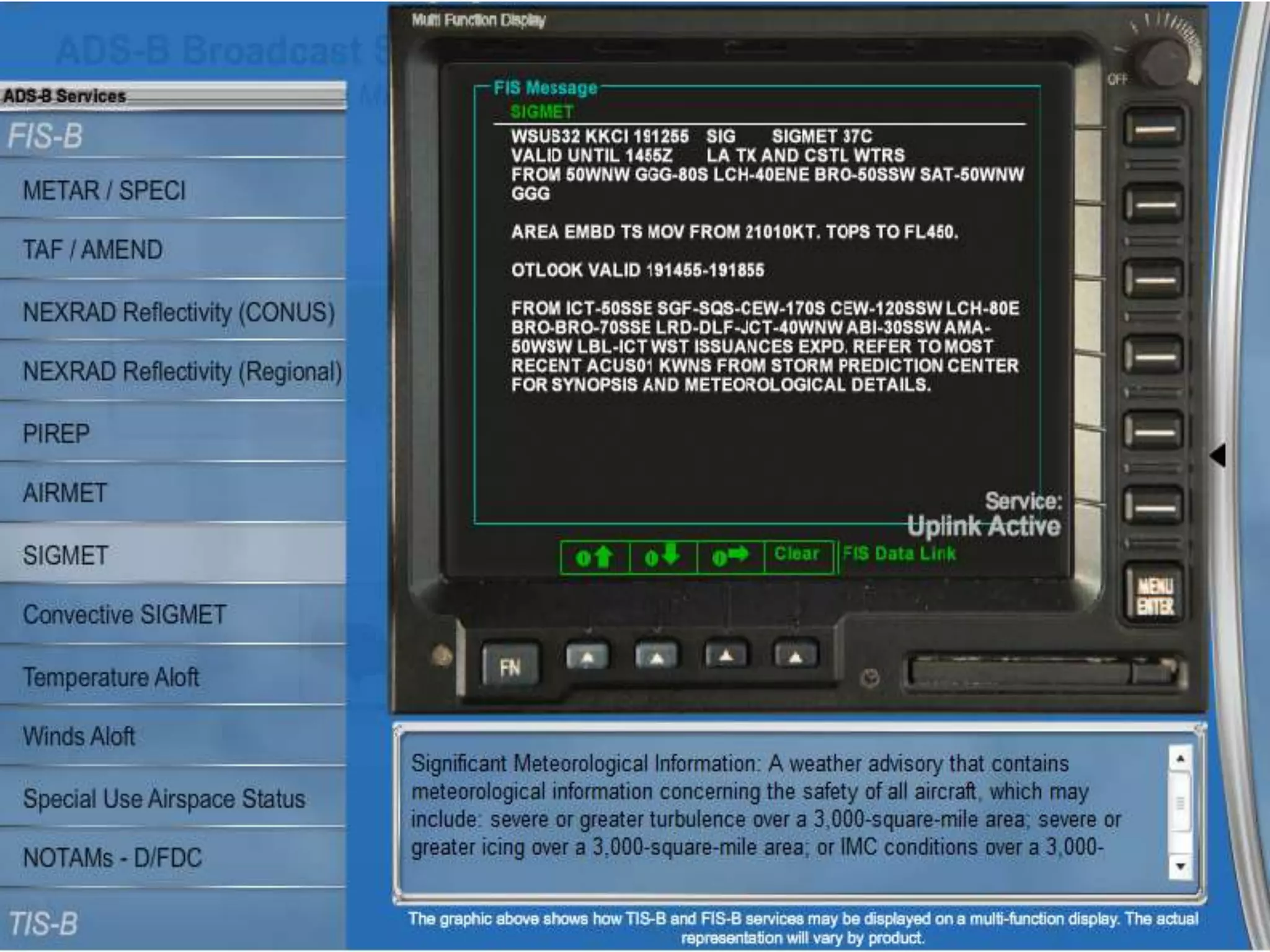
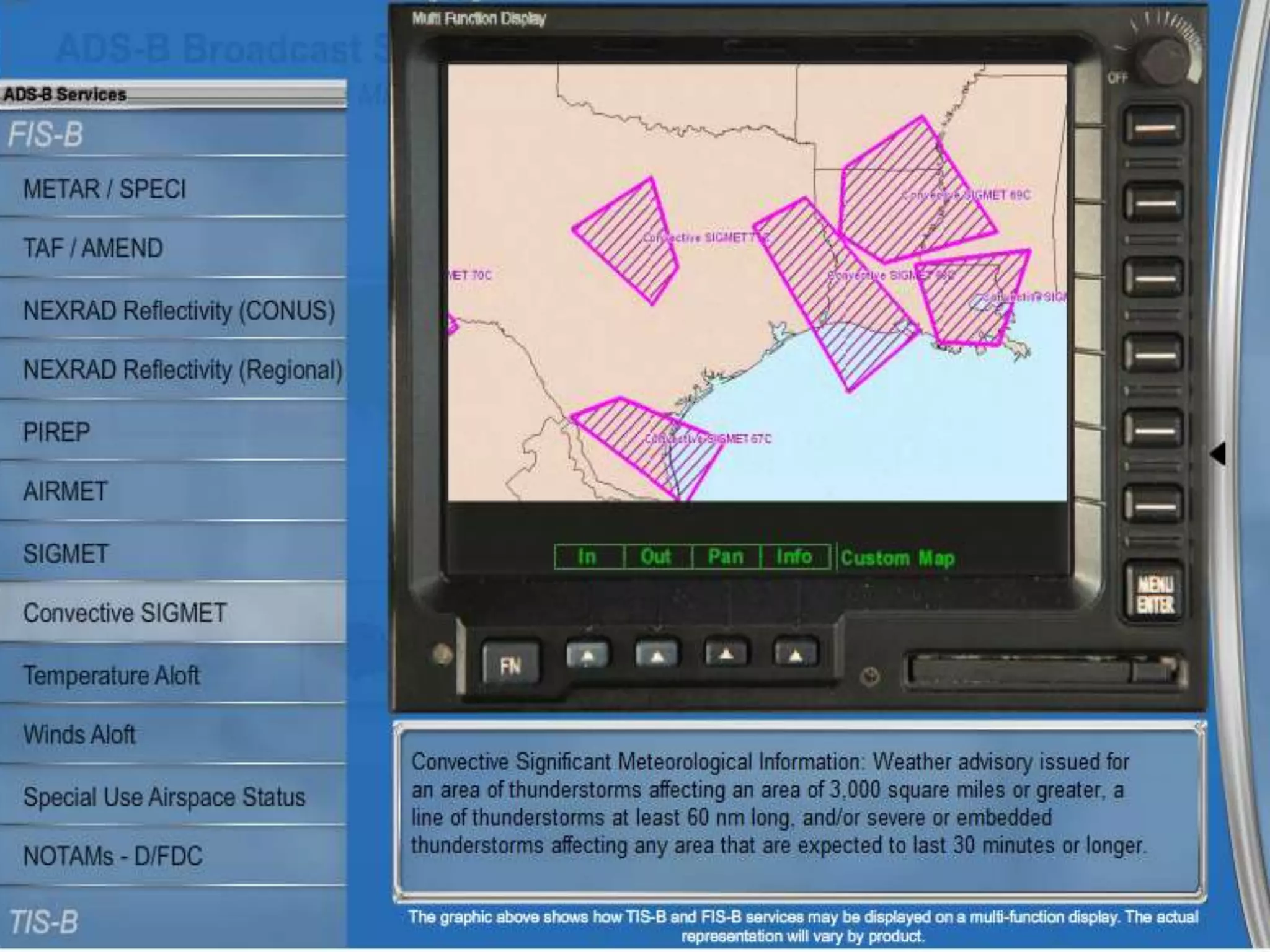
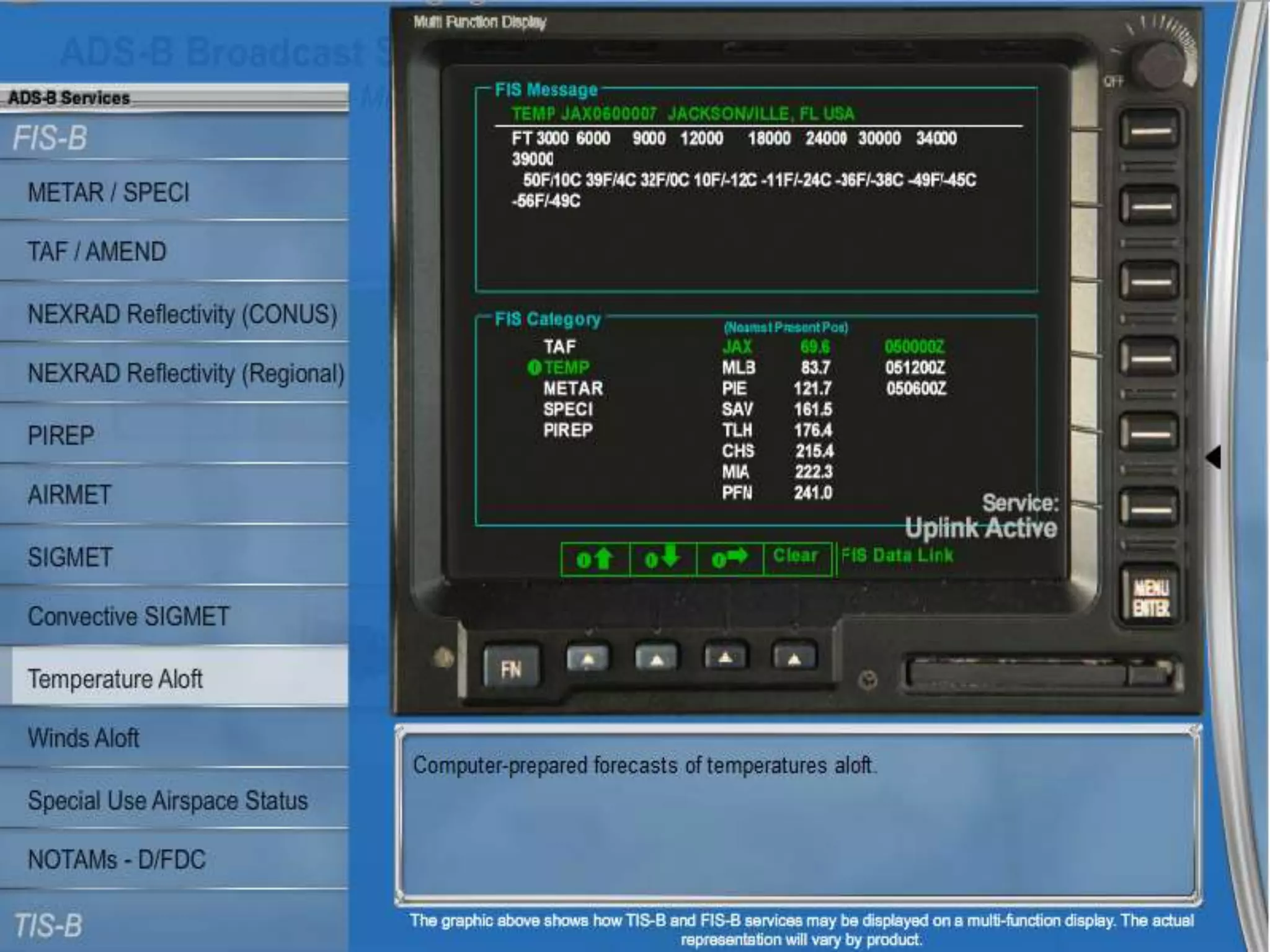
• Share graphical weather including
thunderstorms depicted by NEXRAD
ground-based radar and a wide range of
graphical and text messages
• Significant and hazardous weather
• Winds and temperatures aloft
• Pilot reports
• Status of Special Use Airspace
• Temporary flight Restrictions
• No subscription costs
• http://www.faa.gov/nextgen/implementation/portfolio/trans_support_progs/adsb/broadcastservices/
Thursday August 15, 2013
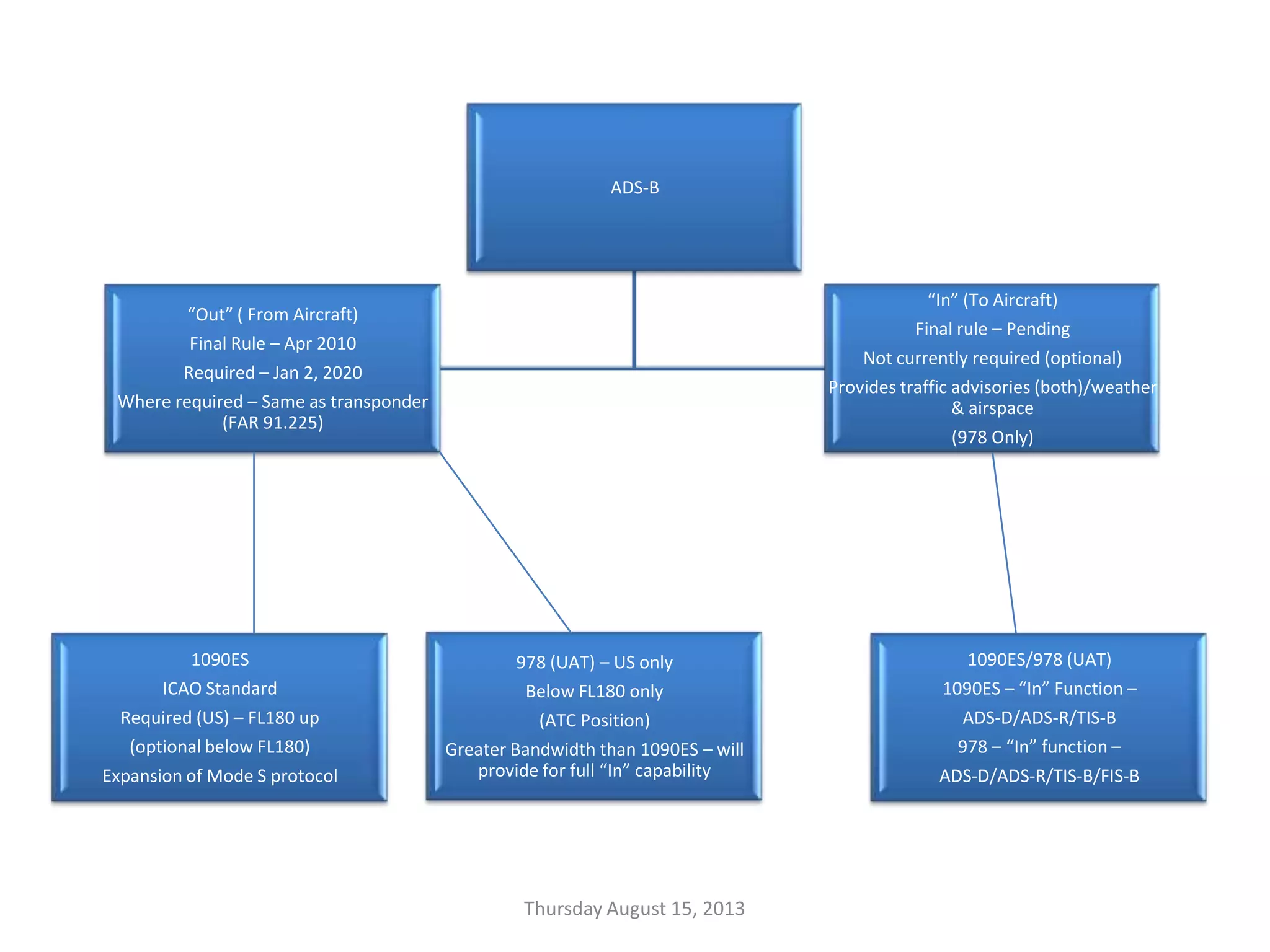
ADS-B
1090ES
ICAO Standard
Required (US) – FL180 up
(optional below FL180)
Expansion of Mode S protocol
978 (UAT) – US only
Below FL180 only
(ATC Position)
Greater Bandwidth than 1090ES – will
provide for full “In” capability
1090ES/978 (UAT)
1090ES – “In” Function –
ADS-D/ADS-R/TIS-B
978 – “In” function –
ADS-D/ADS-R/TIS-B/FIS-B
“Out” ( From Aircraft)
Final Rule – Apr 2010
Required – Jan 2, 2020
Where required – Same as transponder
(FAR 91.225)
“In” (To Aircraft)
Final rule – Pending
Not currently required (optional)
Provides traffic advisories (both)/weather
& airspace
(978 Only)
Thursday August 15, 2013
Questions?
Thursday August 15, 2013

ADS-B & The 2020 FAA Final Rule

  • 1.
    Thursday August 15,2013 ADS-B Technology
  • 2.
    FAA Wings Program •www.FAASafety.gov • Takes the place of the flight review • Online courses or attend seminars • No minimum time for flights • Most of you might already meet the requirements for a phase completion • Earn your cool set of Wings to display however you wish Thursday August 15, 2013
  • 3.
    Some Basics • Operatesusing two modes or functions – Out from the aircraft (ADS-B Out) – Into the aircraft (ADS-B In) • Designed to accomplish 3 goals – Replace radar as the primary means to track aircraft (ADS-B) – To provide a host of advisory-only text & graphic information in the flight deck (FIS-B) – To provide advisory-only traffic data in the flight deck (TIS-B) Thursday August 15, 2013
  • 4.
    ADS-B & GPS •All pilots see the same “picture” as seen by the controller, and at the same time • Simultaneous sharing of location, speed, altitude, situation awareness Thursday August 15, 2013
  • 5.
    Industry Standards 1090 MhzMode-S • 1090 Mhz Extended Squitter datalink (ES) • Mode-S based • Frequency is becoming congested • ICAO preferred 978 Mhz UAT • Universal Access Transceiver (UAT) • 978 Mhz datalink • Less congested • FAA preferred Thursday August 15, 2013
  • 6.
    What’s a Squitter? Aperiodic burst or broadcast of aircraft-tracking data that is transmitted periodically by a Mode S transponder (or equivalent) without interrogation from controller’s radar Thursday August 15, 2013
  • 7.
  • 8.
    ADS-B and the2020 FAA Final Rule • By January 1, 2020 all aircraft operating in transponder airspace will be required to carry equipment that produces an ADS-B Out broadcast • There is currently no mandate for ADS-B In – ADS-B In receives ADS-B datalink information and displays it to the cockpit • 2020 rule established the engineering criteria for ADS-B Out Thursday August 15, 2013
  • 9.
    How do weefficiently transition to the 2020 ADS-B Rule? • Avionics manufacturers can now design ADS-B out equipment that is “ADS-B 2020 Compliant” • No ADS-B 2020 Compliant Out equipment has been designed and certified by the FAA • Equipment costs will be initially high • High equipment costs will discourage aircraft owners from purchasing and installing this equipment • Manufacturers cannot reduce costs until many units are sold • Aircraft owners are waiting for the costs to go down • Many aircraft owners are unaware of the ADS-B 2020 Rule Thursday August 15, 2013
  • 10.
    What is ADS-B?(ADS-B 101) • ADS-B is the emerging technology that is redefining the paradigm of COMMUNICATIONS – NAVIGATION – SURVELLANCE in Air Traffic Management, and NEXGEN http://www.faa.gov/nextgen/implementation/portfolio/trans_support_progs/ Thursday August 15, 2013
  • 11.
    ADS-B Automatic  AlwaysON Dependent  Relies on very accurate GPS Data Surveillance  Provides aircraft position, altitude, speed, heading, identification, and other data Broadcast  Does not require interrogation – data is broadcast to any aircraft or ground station equipped to receive the datalink signal Thursday August 15, 2013
  • 12.
  • 13.
    ADS-B Services • TrafficInformation Service – Broadcast (TIS-B) – Sends a composite of radar and ADS-B data back through the ground stations to the cockpit – The pilot sees what the controller sees – Cockpit display will show all aircraft in radar contact with controllers, ADS-B equipped or not, within 15 miles, plus or minus 3,500 feet – No subscription costs Thursday August 15, 2013
  • 14.
    Flight Information Service- Broadcast • Ground-Based transceivers (GBT) – Operate both 1090ES & 978 protocols – Many are linked to ATC via dedicated landline • Continuous broadcast • May not always be in range of suitable GBT – Particularly on the ground or remote location Thursday August 15, 2013
  • 15.
    FIS-B • Share graphicalweather including thunderstorms depicted by NEXRAD ground-based radar and a wide range of graphical and text messages • Significant and hazardous weather • Winds and temperatures aloft • Pilot reports • Status of Special Use Airspace • Temporary flight Restrictions • No subscription costs • http://www.faa.gov/nextgen/implementation/portfolio/trans_support_progs/adsb/broadcastservices/ Thursday August 15, 2013
  • 16.
  • 17.
  • 18.
  • 19.
  • 20.
  • 21.
  • 22.
  • 23.
  • 24.
  • 25.
  • 26.
  • 27.
  • 28.
    ADS-B 1090ES ICAO Standard Required (US)– FL180 up (optional below FL180) Expansion of Mode S protocol 978 (UAT) – US only Below FL180 only (ATC Position) Greater Bandwidth than 1090ES – will provide for full “In” capability 1090ES/978 (UAT) 1090ES – “In” Function – ADS-D/ADS-R/TIS-B 978 – “In” function – ADS-D/ADS-R/TIS-B/FIS-B “Out” ( From Aircraft) Final Rule – Apr 2010 Required – Jan 2, 2020 Where required – Same as transponder (FAR 91.225) “In” (To Aircraft) Final rule – Pending Not currently required (optional) Provides traffic advisories (both)/weather & airspace (978 Only) Thursday August 15, 2013
  • 29.

Editor's Notes

  • #4 May also include ADS direct & ADS rebroadcast (ADS-R)
  • #15 All that is needed is a passive recevier.