Diverse Learners
Presented by: Audra Brazell
Kerese Millen
Caryn Burkes
Marie Nolen
 Dyslexia is a language-based learning disability
that refers to a cluster of symptoms which result
in people having difficulties with specific
language skills, particularly reading.
 Students with dyslexia usually experience
difficulties with other language skills such as
writing, spelling, and pronouncing words.
 According to the International Dyslexia
Association, the exact causes of dyslexia
are still not clear.
 Studies show that there are differences in
the way the brain of a dyslexic person
develops and function.
 Detecting problems early, in order to avoid
other problems later on, is the most
practical course.
* Dyslexics appear bright and highly intelligent but unable to
perform at grade level.
 They can be confused by letters, numbers, words, sequences,
and verbal explanations.
 The dyslexic student may spell phonetically and inconsistently.
 In addition, he or she will continue to read and reread with little
comprehension.
 They compute math operations with dependence on finger
counting and other tricks, and understands, but, is unable to
translate to paper.
 They may use repetitions, additions, transpositions, omissions,
and reversals in their letters, numbers, or words.
 Many have poor memory for sequences and facts that they have
not yet experienced, however, they have excellent long term
memory for experiences, locations, and faces.
 The dyslexic child has little internal dialogue, and thinks with
pictures and feelings rather than words and sounds.
 Learning to speak
 Learning letters and
their sounds
 Organizing written and
spoken language
 Memorizing number
facts
 Reading quickly
enough to comprehend
 Persisting with and
comprehending longer
reading assignments
 Spelling
 Learning a foreign
language
 Correctly doing math
operations
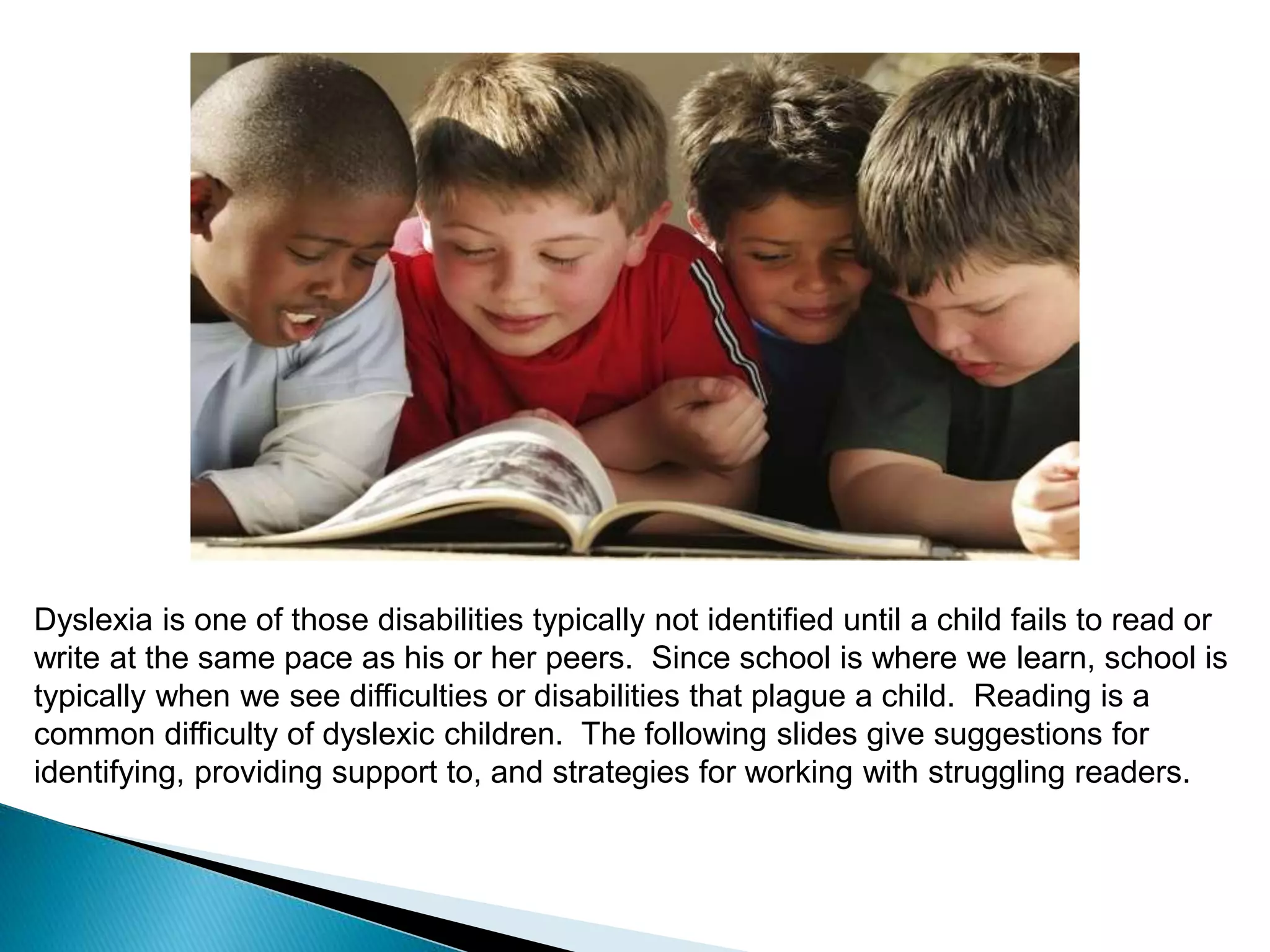
Dyslexia is one of those disabilities typically not identified until a child fails to read or
write at the same pace as his or her peers. Since school is where we learn, school is
typically when we see difficulties or disabilities that plague a child. Reading is a
common difficulty of dyslexic children. The following slides give suggestions for
identifying, providing support to, and strategies for working with struggling readers.
 It is common for struggling readers to feel that they are
failing at their “job” as students. Learning to read is key to
being successful at that job, so when students struggle in this
area, they can easily become discouraged, overwhelmed, and
frustrated. Such feelings not only affect their peer
relationships and academic success, but their image of self-
worth as well.
 Children who struggle with low self-esteem may have little or
no desire to learn to read or go to school. They might start
acting out in class or responding with negative feedback.
They often use self-defeating phrases such as “I’m just not
smart enough” or “I’ll never learn how to do this.” They need
your help in turning their negative thoughts into positive
ones.
 If students cannot read, they cannot be
independent learners.
 Teachers in all content areas must model the
same thinking processes that are used for
reading content.
 Teachers must provide content related
vocabulary.
 Teachers should also highlight features of the
textbook(s) used in class.
 Teachers can construct rich
knowledge goals as the
basis of reading instruction.
 Teachers can use real world
interactions to connect
reading to students
experiences.
 Teachers can bring in
interesting books and
materials.
 Teachers can provide some
choice among material to
read.
 Teachers can give direct
instruction for important
reading strategies.
 Teachers can also
encourage collaboration in
many aspects of learning.
1. Phonemic Awareness
2. Phonics
3. Fluency
4. Vocabulary
5. Comprehension
Comprehension: “Components of an
Effective Reading Program”
http://www.k8accesscenter.org/training_re
sources/effectivereadingcomponents.asp
 First, it is imperative that comprehension
instruction is explicit.
 Second, the strategies must be modeled by
skillful readers including teachers and
peers.
 Lastly, strategies must be scaffolded by
teachers until the students are able to use
them successfully while independently
reading (Raphael, 2004).
 Prediction
 Think Aloud
 Visual Representation
 Summarization
 Questioning the Author
 Popcorn Reading
 Read Aloud
 Reading Buddies
 SSR: Sustained Silent
Reading
 Directed Notes
 Vocabulary Building
 Highlighting
 Paired Partner
Reading
 Tape-Assisted
Reading
 Chunking
 Fluency can be defined as the ability to read connected text
rapidly, smoothly, effortlessly, and automatically with little
conscious attention to the mechanics of reading, such as
decoding (Meyer and Felton, 1999).
 Fluency provides a bridge between word recognition and
comprehension. It also combines rate, accuracy, and reading
with expression.
 Becoming a fluent reader allows a child to focus more on
developing comprehension and understanding what the text
means rather than decoding the words themselves.
 Both parents and teachers alike can promote fluency by
working with the child and encouraging reading in all forms.
 Repeated oral reading improves both word recognition and
the speed and accuracy at which a child reads.
 However, it is important to make sure the child is reading
books that are a “good fit”; books that are at the level they
are able to decode and understand.
 Encourage children to read and reread their favorite books.
 Repeated reading can also improve a child’s comprehension
and reading expression as well.
 Reviewing sight words to allow the words to become easier to
recognize and the pace to continue moving forward.
 Try reading in different locations.
 Make it fun!
 The 2005 video, Dyslexia Support, features Lee Pascal, author
and teacher, who has been studying dyslexia for over 35 years.
 In this engaging and light-hearted workshop for teaching
assistants, he tackles the serious subject of dyslexia and offers
real insight into how dyslexics think, learn and remember.
 He also looks at strategies and techniques for helping them with
learning, spelling and reading.
 After an introduction to the subject of dyslexia, Lee talks about
the visual, auditory and kinesthetic approach to learning that
dyslexics and others who have similar problems, find most
useful. He engages his audience with some participatory games
and passes on useful tips about how to support them with
spelling.'Joined-up writing' and 'joined-up speaking' are just two
of the methods he advocates.
 He also looks at spelling techniques - look, cover, learn,
remember - and concludes with the moving story of a boy who
grew to love reading but only once books were made easy
enough for him.
 Allington, R.L. (2001). What really matters for
struggling readers: Designing research-based
programs. New York: Addison-Wesley.
 Crawford, E.C. and Torgesen, J.K. (2006). Teaching All
Students to Read: Practices for Reading First Schools
with Strong Intervention Outcomes, Summary
Document. Tallahassee, FL: Florida Center for
Reading Research.
 International Dyslexia Association, 2007. Dyslexia
Basics. © International Dyslexia Association
 Reading Rockets (2011)

GroupPOWERPOINTDyslexiarevised10-29-12b

  • 1.
    Diverse Learners Presented by:Audra Brazell Kerese Millen Caryn Burkes Marie Nolen
  • 2.
     Dyslexia isa language-based learning disability that refers to a cluster of symptoms which result in people having difficulties with specific language skills, particularly reading.  Students with dyslexia usually experience difficulties with other language skills such as writing, spelling, and pronouncing words.
  • 3.
     According tothe International Dyslexia Association, the exact causes of dyslexia are still not clear.  Studies show that there are differences in the way the brain of a dyslexic person develops and function.  Detecting problems early, in order to avoid other problems later on, is the most practical course.
  • 4.
    * Dyslexics appearbright and highly intelligent but unable to perform at grade level.  They can be confused by letters, numbers, words, sequences, and verbal explanations.  The dyslexic student may spell phonetically and inconsistently.  In addition, he or she will continue to read and reread with little comprehension.  They compute math operations with dependence on finger counting and other tricks, and understands, but, is unable to translate to paper.  They may use repetitions, additions, transpositions, omissions, and reversals in their letters, numbers, or words.  Many have poor memory for sequences and facts that they have not yet experienced, however, they have excellent long term memory for experiences, locations, and faces.  The dyslexic child has little internal dialogue, and thinks with pictures and feelings rather than words and sounds.
  • 5.
     Learning tospeak  Learning letters and their sounds  Organizing written and spoken language  Memorizing number facts  Reading quickly enough to comprehend  Persisting with and comprehending longer reading assignments  Spelling  Learning a foreign language  Correctly doing math operations
  • 6.
    Dyslexia is oneof those disabilities typically not identified until a child fails to read or write at the same pace as his or her peers. Since school is where we learn, school is typically when we see difficulties or disabilities that plague a child. Reading is a common difficulty of dyslexic children. The following slides give suggestions for identifying, providing support to, and strategies for working with struggling readers.
  • 7.
     It iscommon for struggling readers to feel that they are failing at their “job” as students. Learning to read is key to being successful at that job, so when students struggle in this area, they can easily become discouraged, overwhelmed, and frustrated. Such feelings not only affect their peer relationships and academic success, but their image of self- worth as well.  Children who struggle with low self-esteem may have little or no desire to learn to read or go to school. They might start acting out in class or responding with negative feedback. They often use self-defeating phrases such as “I’m just not smart enough” or “I’ll never learn how to do this.” They need your help in turning their negative thoughts into positive ones.
  • 8.
     If studentscannot read, they cannot be independent learners.  Teachers in all content areas must model the same thinking processes that are used for reading content.  Teachers must provide content related vocabulary.  Teachers should also highlight features of the textbook(s) used in class.
  • 9.
     Teachers canconstruct rich knowledge goals as the basis of reading instruction.  Teachers can use real world interactions to connect reading to students experiences.  Teachers can bring in interesting books and materials.  Teachers can provide some choice among material to read.  Teachers can give direct instruction for important reading strategies.  Teachers can also encourage collaboration in many aspects of learning.
  • 10.
    1. Phonemic Awareness 2.Phonics 3. Fluency 4. Vocabulary 5. Comprehension Comprehension: “Components of an Effective Reading Program” http://www.k8accesscenter.org/training_re sources/effectivereadingcomponents.asp
  • 11.
     First, itis imperative that comprehension instruction is explicit.  Second, the strategies must be modeled by skillful readers including teachers and peers.  Lastly, strategies must be scaffolded by teachers until the students are able to use them successfully while independently reading (Raphael, 2004).
  • 12.
     Prediction  ThinkAloud  Visual Representation  Summarization  Questioning the Author  Popcorn Reading  Read Aloud  Reading Buddies  SSR: Sustained Silent Reading  Directed Notes  Vocabulary Building  Highlighting  Paired Partner Reading  Tape-Assisted Reading  Chunking
  • 13.
     Fluency canbe defined as the ability to read connected text rapidly, smoothly, effortlessly, and automatically with little conscious attention to the mechanics of reading, such as decoding (Meyer and Felton, 1999).  Fluency provides a bridge between word recognition and comprehension. It also combines rate, accuracy, and reading with expression.  Becoming a fluent reader allows a child to focus more on developing comprehension and understanding what the text means rather than decoding the words themselves.  Both parents and teachers alike can promote fluency by working with the child and encouraging reading in all forms.
  • 14.
     Repeated oralreading improves both word recognition and the speed and accuracy at which a child reads.  However, it is important to make sure the child is reading books that are a “good fit”; books that are at the level they are able to decode and understand.  Encourage children to read and reread their favorite books.  Repeated reading can also improve a child’s comprehension and reading expression as well.  Reviewing sight words to allow the words to become easier to recognize and the pace to continue moving forward.  Try reading in different locations.  Make it fun!
  • 15.
     The 2005video, Dyslexia Support, features Lee Pascal, author and teacher, who has been studying dyslexia for over 35 years.  In this engaging and light-hearted workshop for teaching assistants, he tackles the serious subject of dyslexia and offers real insight into how dyslexics think, learn and remember.  He also looks at strategies and techniques for helping them with learning, spelling and reading.  After an introduction to the subject of dyslexia, Lee talks about the visual, auditory and kinesthetic approach to learning that dyslexics and others who have similar problems, find most useful. He engages his audience with some participatory games and passes on useful tips about how to support them with spelling.'Joined-up writing' and 'joined-up speaking' are just two of the methods he advocates.  He also looks at spelling techniques - look, cover, learn, remember - and concludes with the moving story of a boy who grew to love reading but only once books were made easy enough for him.
  • 16.
     Allington, R.L.(2001). What really matters for struggling readers: Designing research-based programs. New York: Addison-Wesley.  Crawford, E.C. and Torgesen, J.K. (2006). Teaching All Students to Read: Practices for Reading First Schools with Strong Intervention Outcomes, Summary Document. Tallahassee, FL: Florida Center for Reading Research.  International Dyslexia Association, 2007. Dyslexia Basics. © International Dyslexia Association  Reading Rockets (2011)