@txtbks
Scholarly Publishing &
Academic Resources Coalition
www.sparc.arl.org
@SPARC_NA
#openeducationwk
#sparcOEW
Libraries Leading
the Way on OER
A Free SPARC Webcast
March 13, 2014
Moderator: Nicole Allen (@txtbks), Director of Open Education for SPARC
@txtbks
Scholarly Publishing &
Academic Resources Coalition
www.sparc.arl.org
@SPARC_NA
#openeducationwk
#sparcOEW
SPARC®, the Scholarly Publishing and Academic
Resources Coalition, is an international alliance of
academic and research libraries working to create a
more open system of scholarly communication.
@txtbks
Scholarly Publishing &
Academic Resources Coalition
www.sparc.arl.org
@SPARC_NA
#openeducationwk
#sparcOEW
Open Educational Resources
Textbooks and other academic materials that
are published under a license permitting
everyone to freely use, adapt and share the
content.
@txtbks
Scholarly Publishing &
Academic Resources Coalition
www.sparc.arl.org
@SPARC_NA
#openeducationwk
#sparcOEW
(1) Free
Immediate access for zero cost.
@txtbks
Scholarly Publishing &
Academic Resources Coalition
www.sparc.arl.org
@SPARC_NA
#openeducationwk
#sparcOEW
(2) Open
Amends the default “All Rights Reserved”
terms of © to “Some Rights Reserved,”
granting blanket permission in advance to
everyone to use the material
@txtbks
Scholarly Publishing &
Academic Resources Coalition
www.sparc.arl.org
@SPARC_NA
#openeducationwk
#sparcOEW
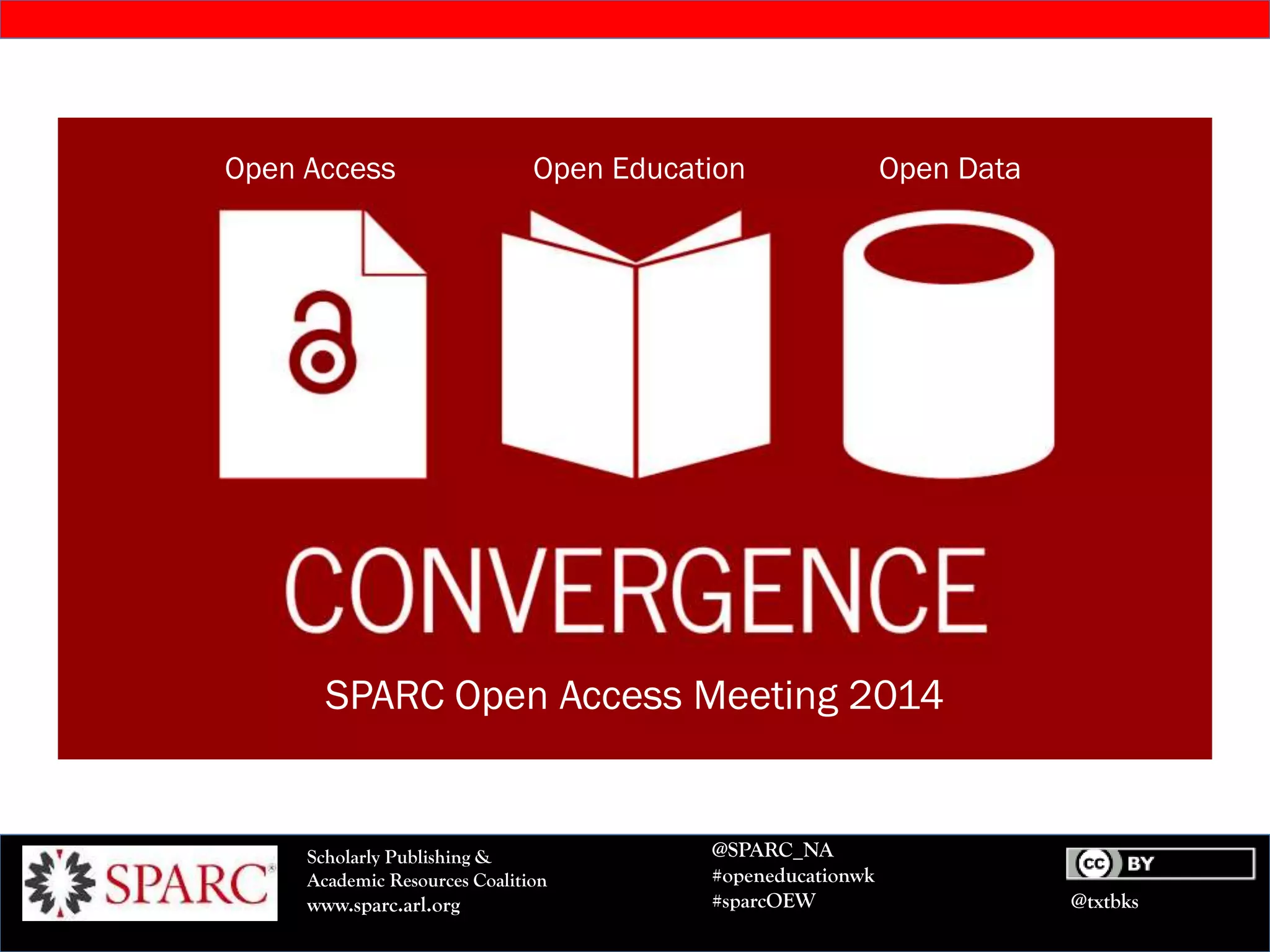
Open Access Open Education Open Data
SPARC Open Access Meeting 2014
@txtbks
Scholarly Publishing &
Academic Resources Coalition
www.sparc.arl.org
@SPARC_NA
#openeducationwk
#sparcOEW
Webcast Goals
• Showcase three SPARC member libraries that are
leading the way on OER
• Illustrate the impact these libraries’ work is having
on campus
• Provide guidance to other libraries on how to
advance OER
@txtbks
Scholarly Publishing &
Academic Resources Coalition
www.sparc.arl.org
@SPARC_NA
#openeducationwk
#sparcOEW
Webcast Speakers
• Marilyn Billings Scholarly Communication & Special
Initiatives Librarian, University of Massachusetts Amherst
• Kristi Jensen Program Development Lead, eLearning
Support Initiative, University of Minnesota
• Shan Sutton Associate University Librarian for Research and
Scholarly Communication, Oregon State University Libraries
Seeking Alternatives to High-cost Textbooks:
A Case Study of the
UMass Amherst Open Education Initiative
SPARC Webinar
March 13, 2014
Marilyn Billings
Scholarly Communication Librarian
University Libraries
Outline
 National and UMass context
 Genesis of Open Education Initiative
 Implementation of OEI
 Preliminary assessment
 Next steps
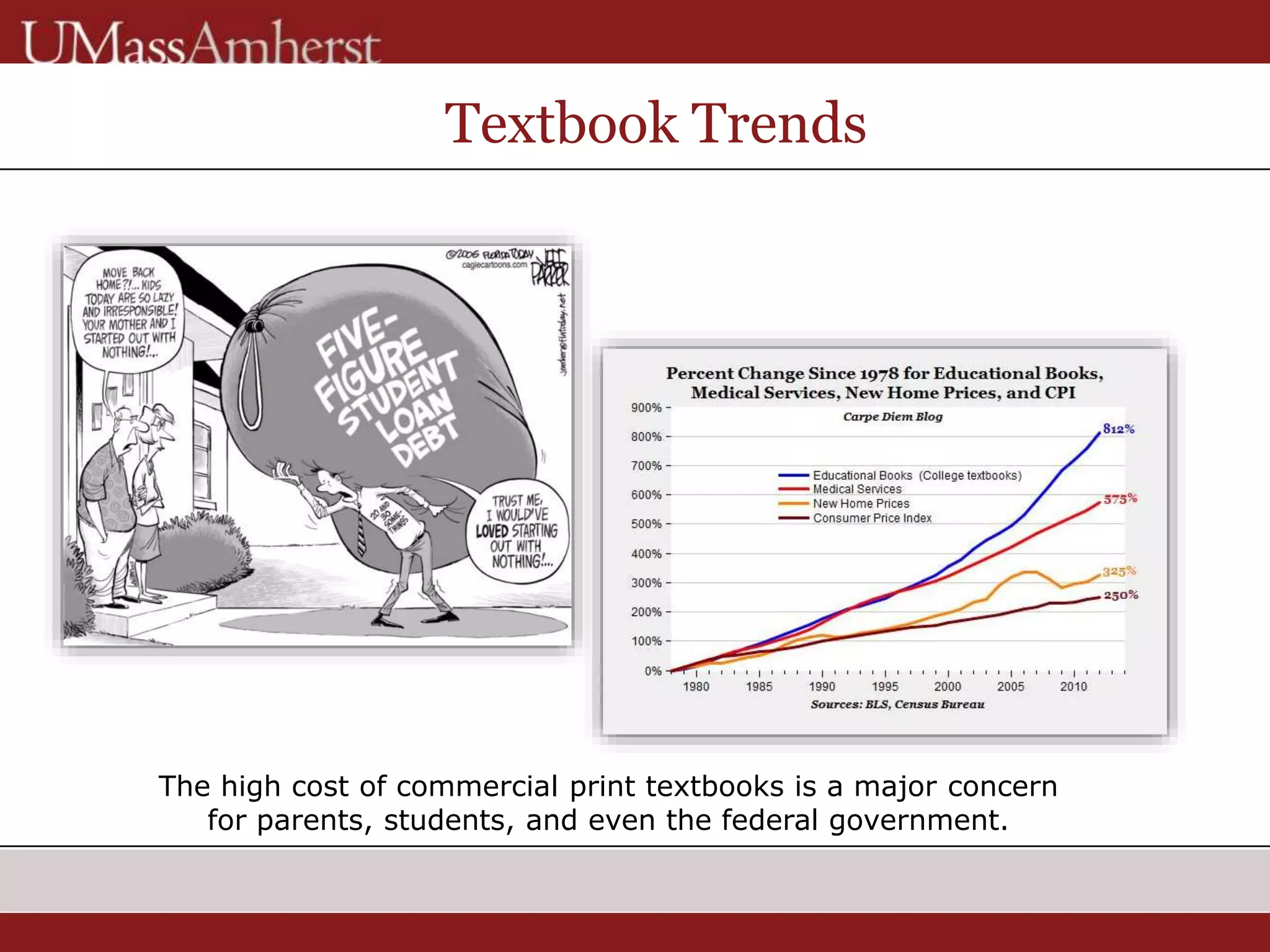
Textbook Trends
The high cost of commercial print textbooks is a major concern
for parents, students, and even the federal government.
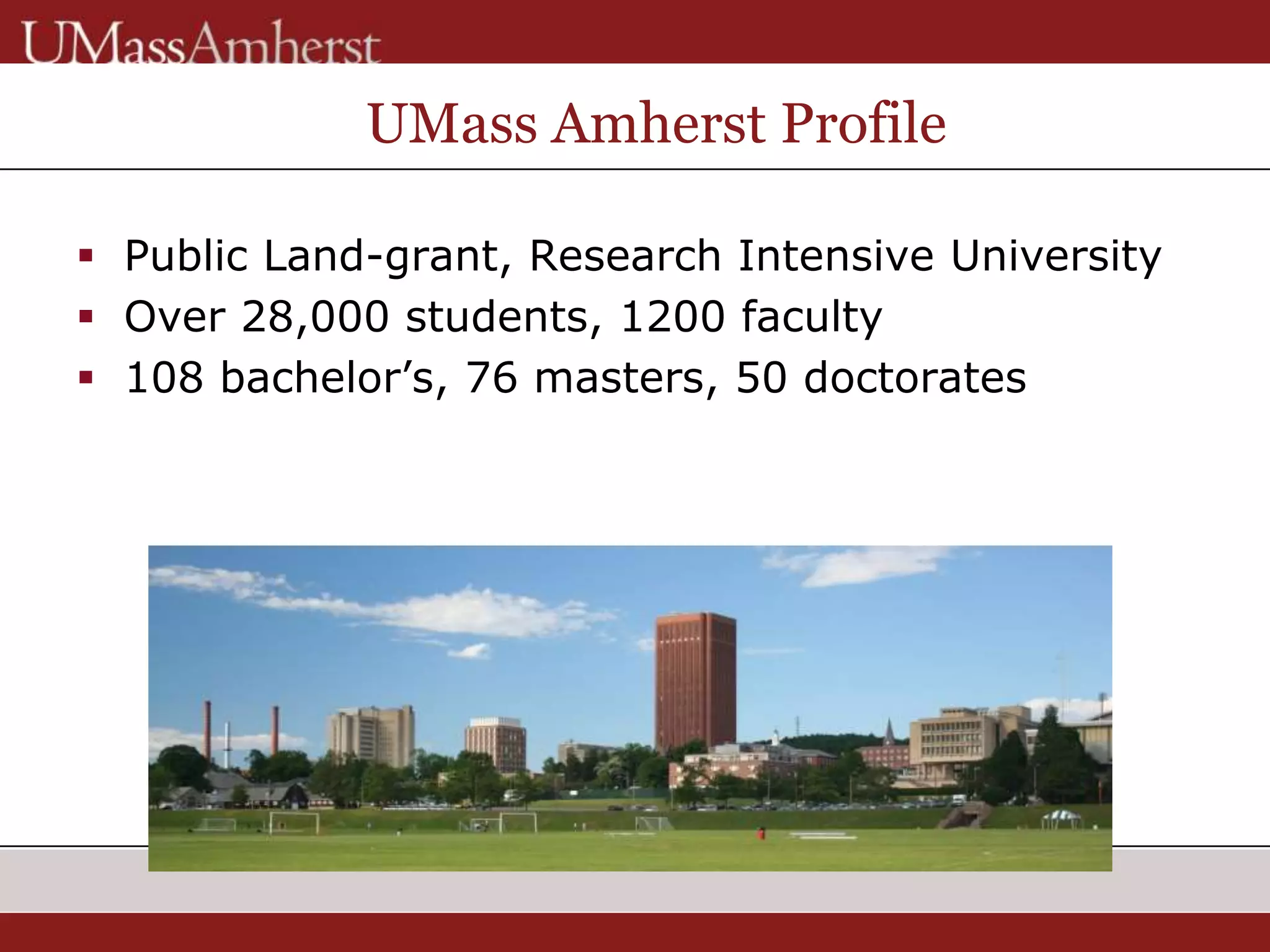
UMass Amherst Profile
 Public Land-grant, Research Intensive University
 Over 28,000 students, 1200 faculty
 108 bachelor’s, 76 masters, 50 doctorates
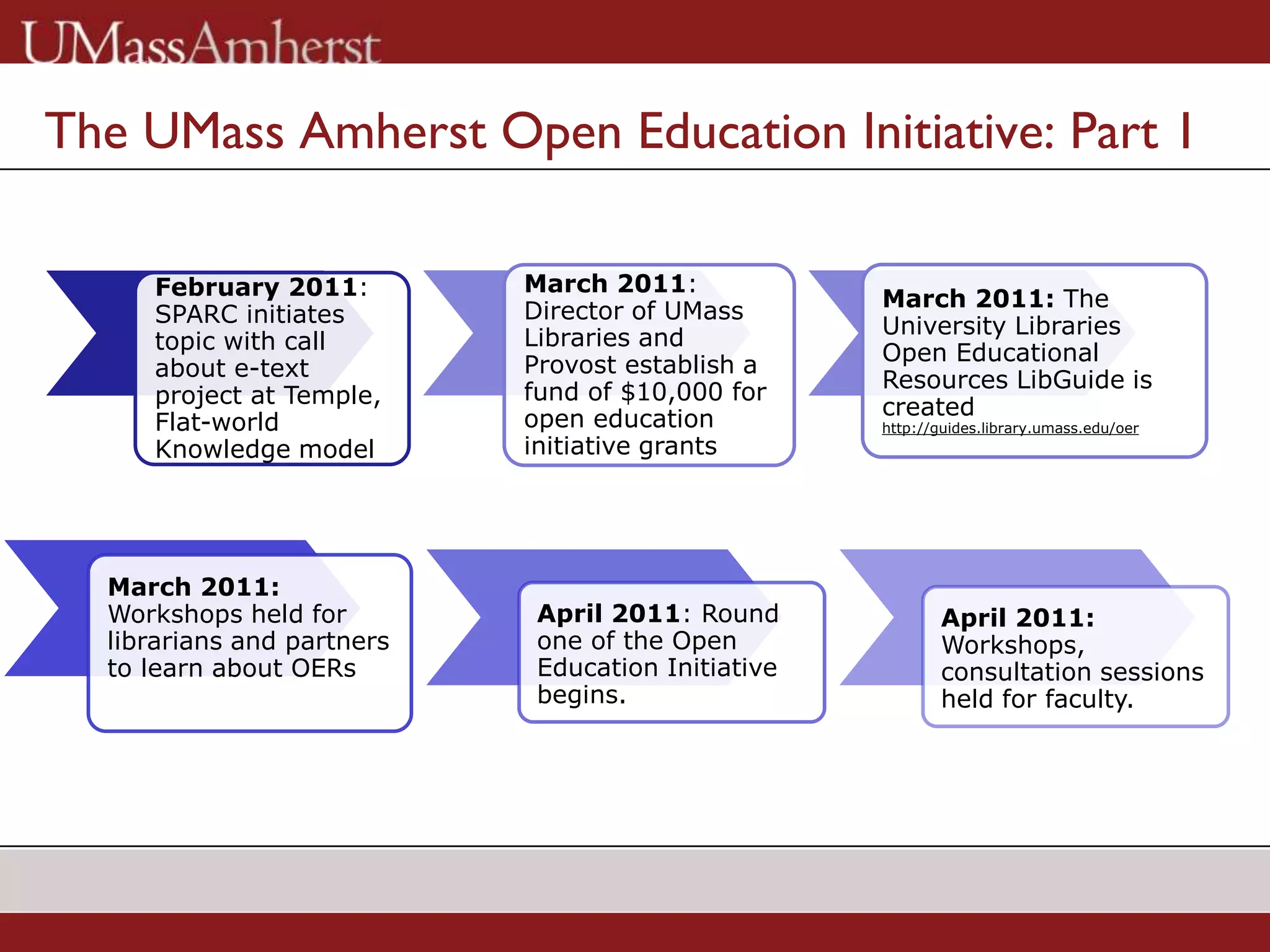
The UMass Amherst Open Education Initiative: Part 1
February 2011:
SPARC initiates
topic with call
about e-text
project at Temple,
Flat-world
Knowledge model
March 2011:
Director of UMass
Libraries and
Provost establish a
fund of $10,000 for
open education
initiative grants
March 2011: The
University Libraries
Open Educational
Resources LibGuide is
created
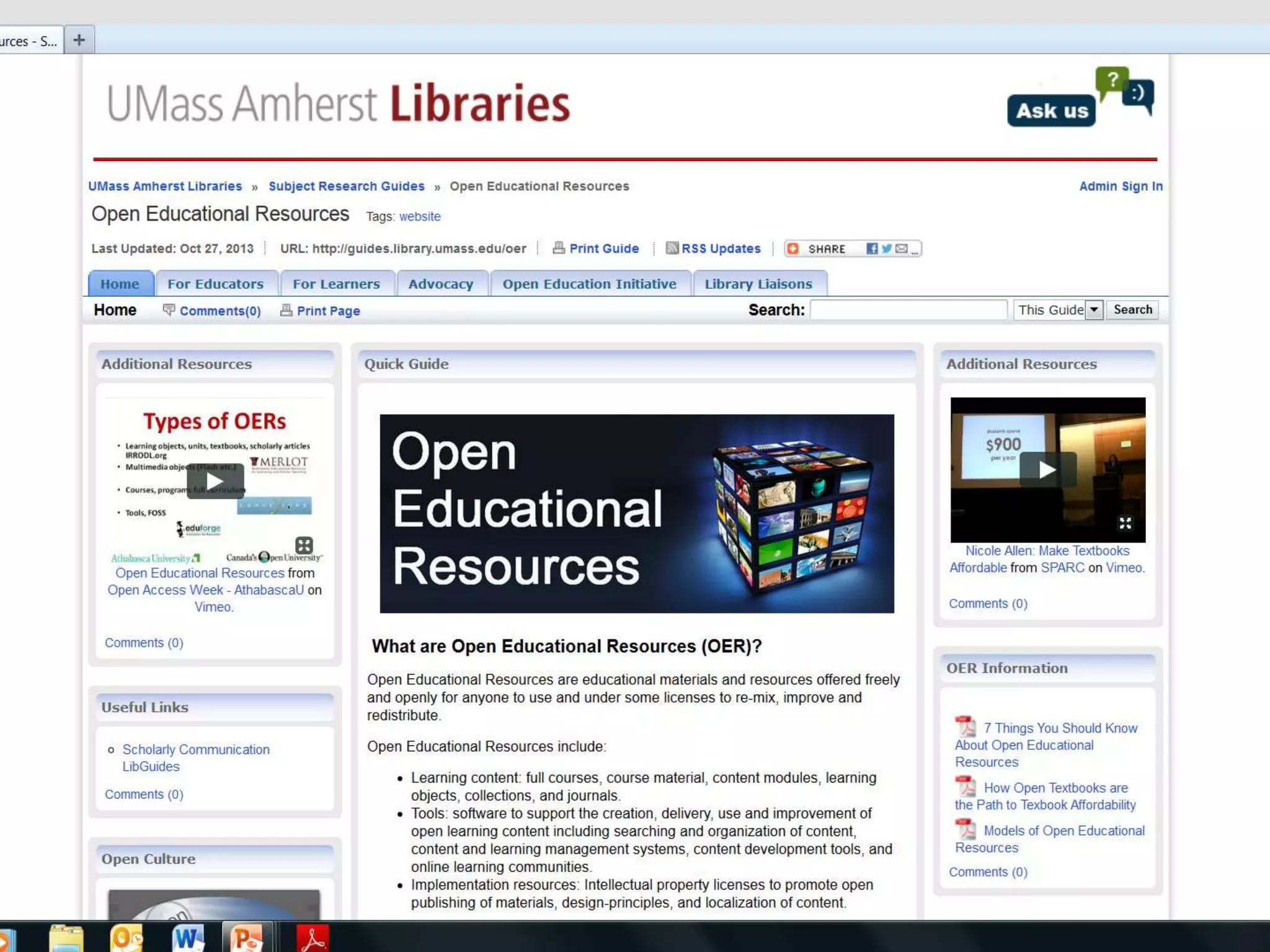
http://guides.library.umass.edu/oer
March 2011:
Workshops held for
librarians and partners
to learn about OERs
April 2011: Round
one of the Open
Education Initiative
begins.
April 2011:
Workshops,
consultation sessions
held for faculty.
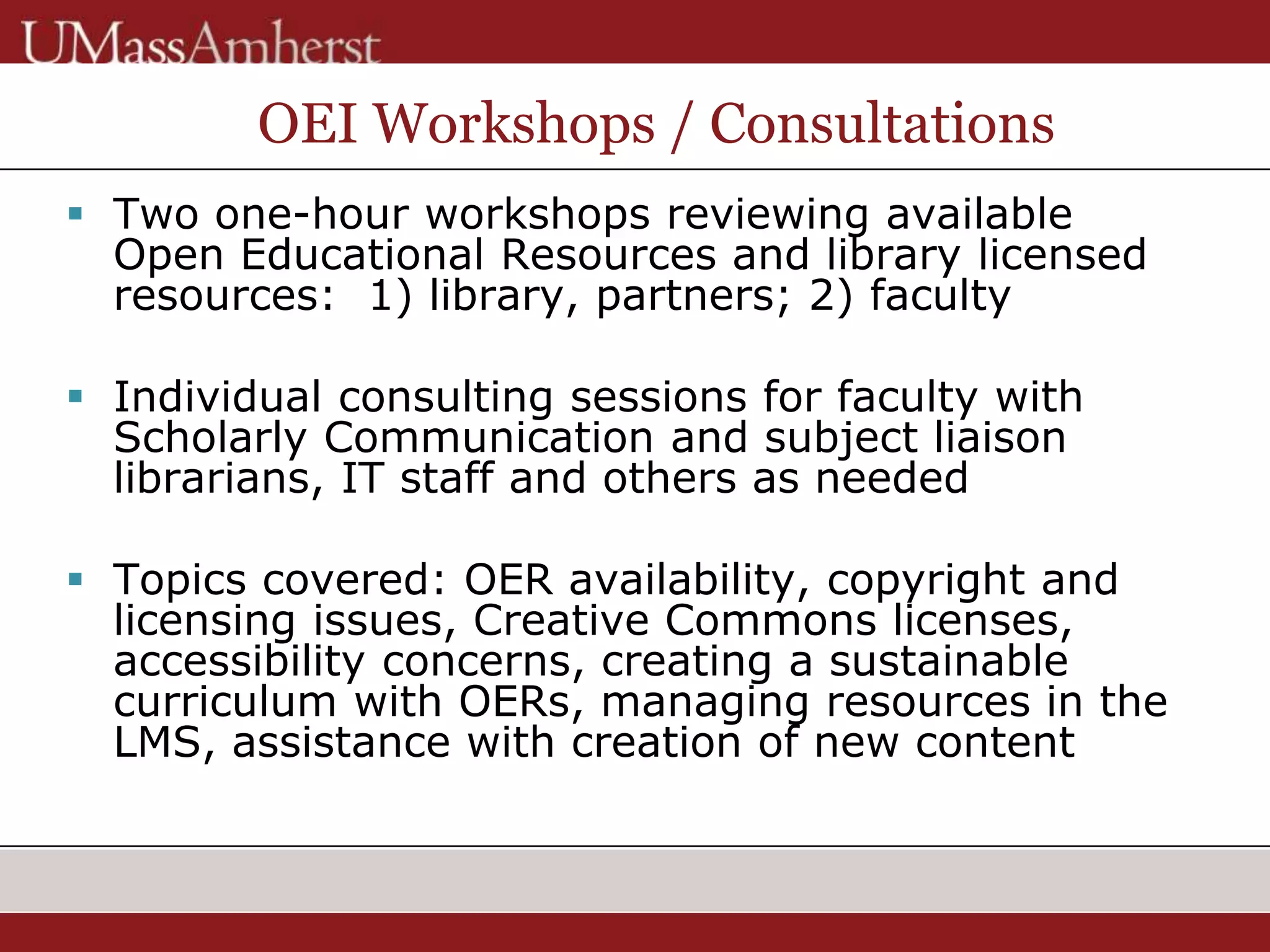
OEI Workshops / Consultations
 Two one-hour workshops reviewing available
Open Educational Resources and library licensed
resources: 1) library, partners; 2) faculty
 Individual consulting sessions for faculty with
Scholarly Communication and subject liaison
librarians, IT staff and others as needed
 Topics covered: OER availability, copyright and
licensing issues, Creative Commons licenses,
accessibility concerns, creating a sustainable
curriculum with OERs, managing resources in the
LMS, assistance with creation of new content
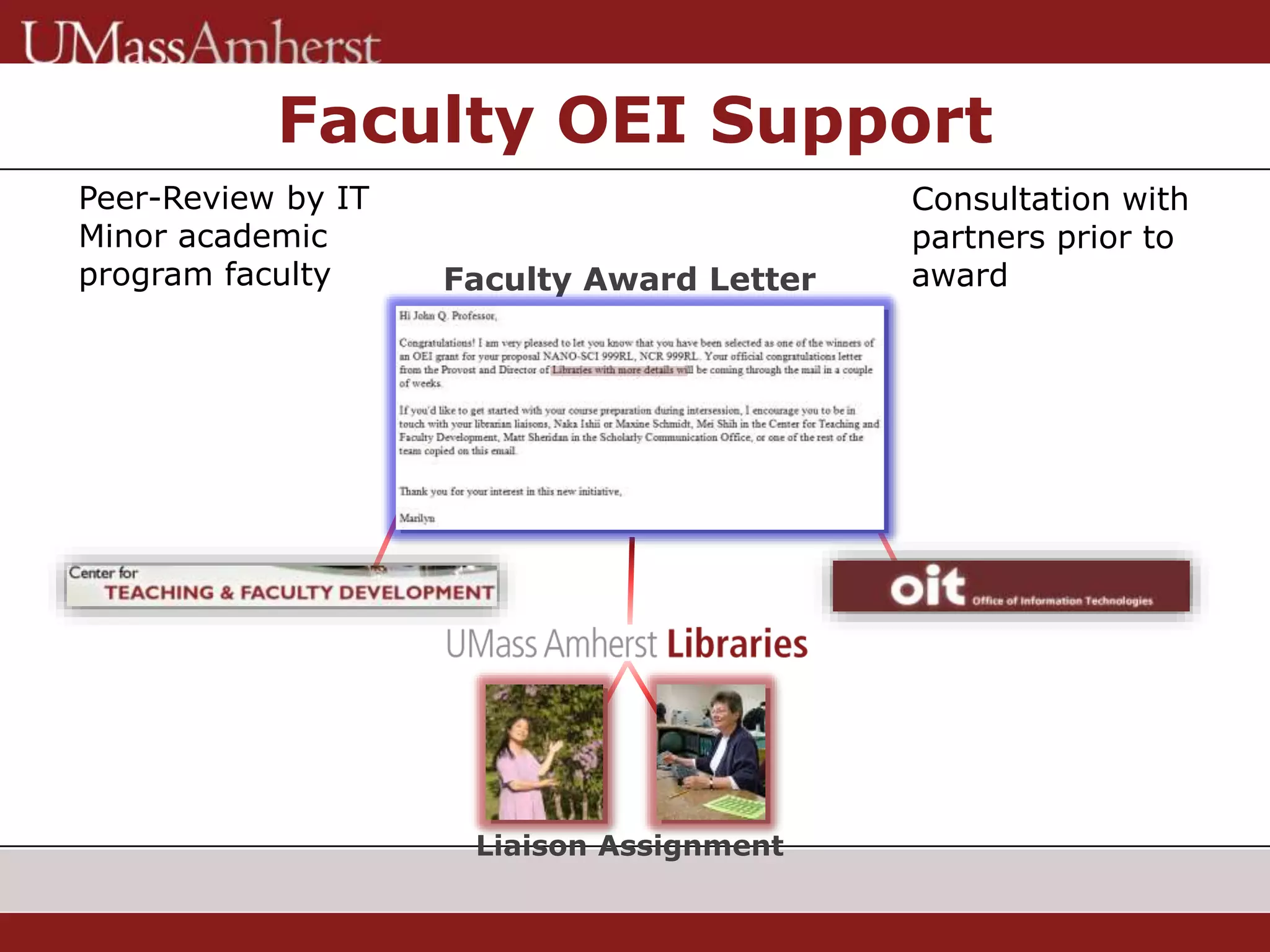
Faculty OEI Support
Faculty Award Letter
Liaison Assignment
Peer-Review by IT
Minor academic
program faculty
Consultation with
partners prior to
award
April 23, 2012 Living the Future
Conference
1
6
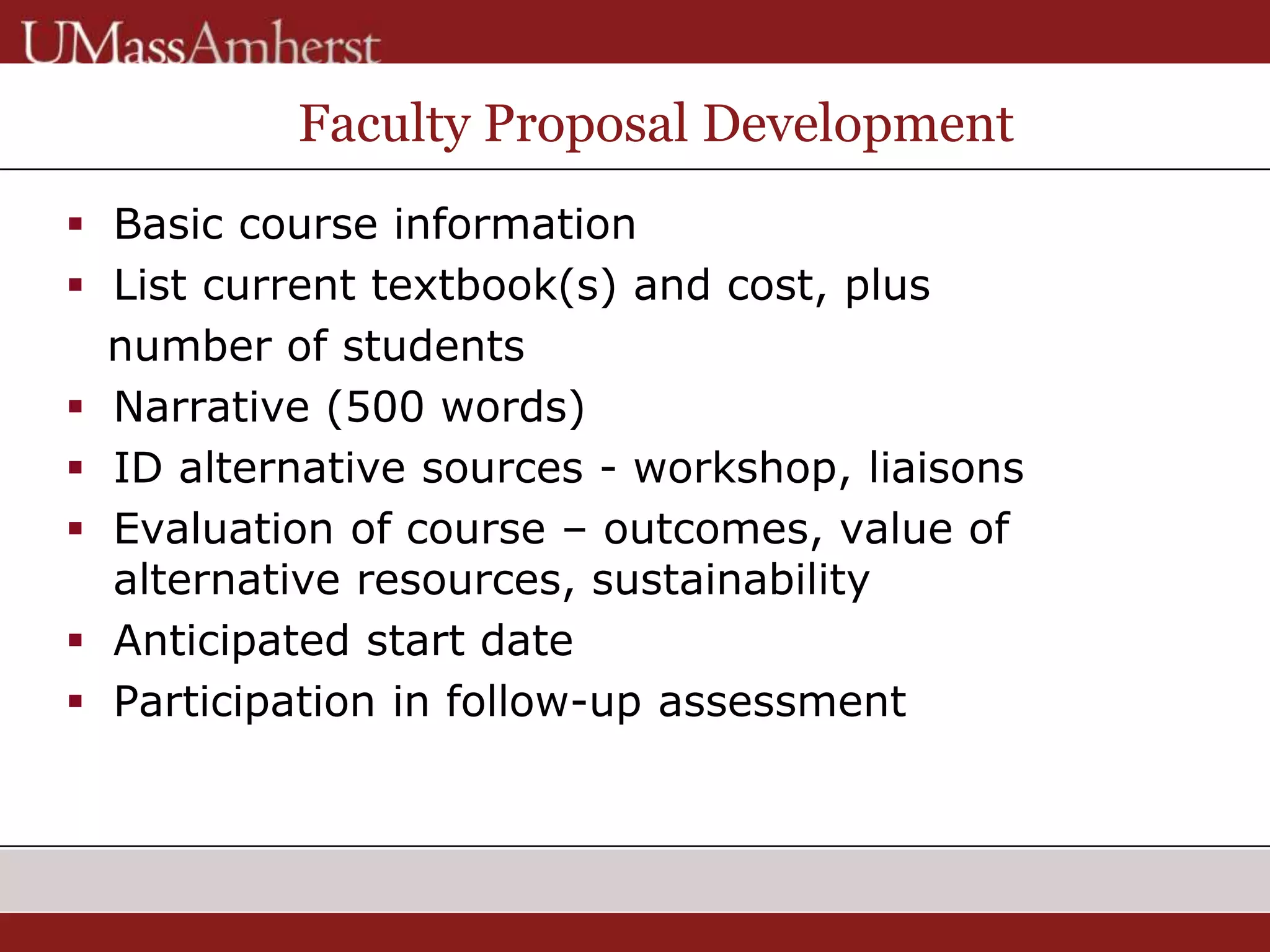
Faculty Proposal Development
 Basic course information
 List current textbook(s) and cost, plus
number of students
 Narrative (500 words)
 ID alternative sources - workshop, liaisons
 Evaluation of course – outcomes, value of
alternative resources, sustainability
 Anticipated start date
 Participation in follow-up assessment
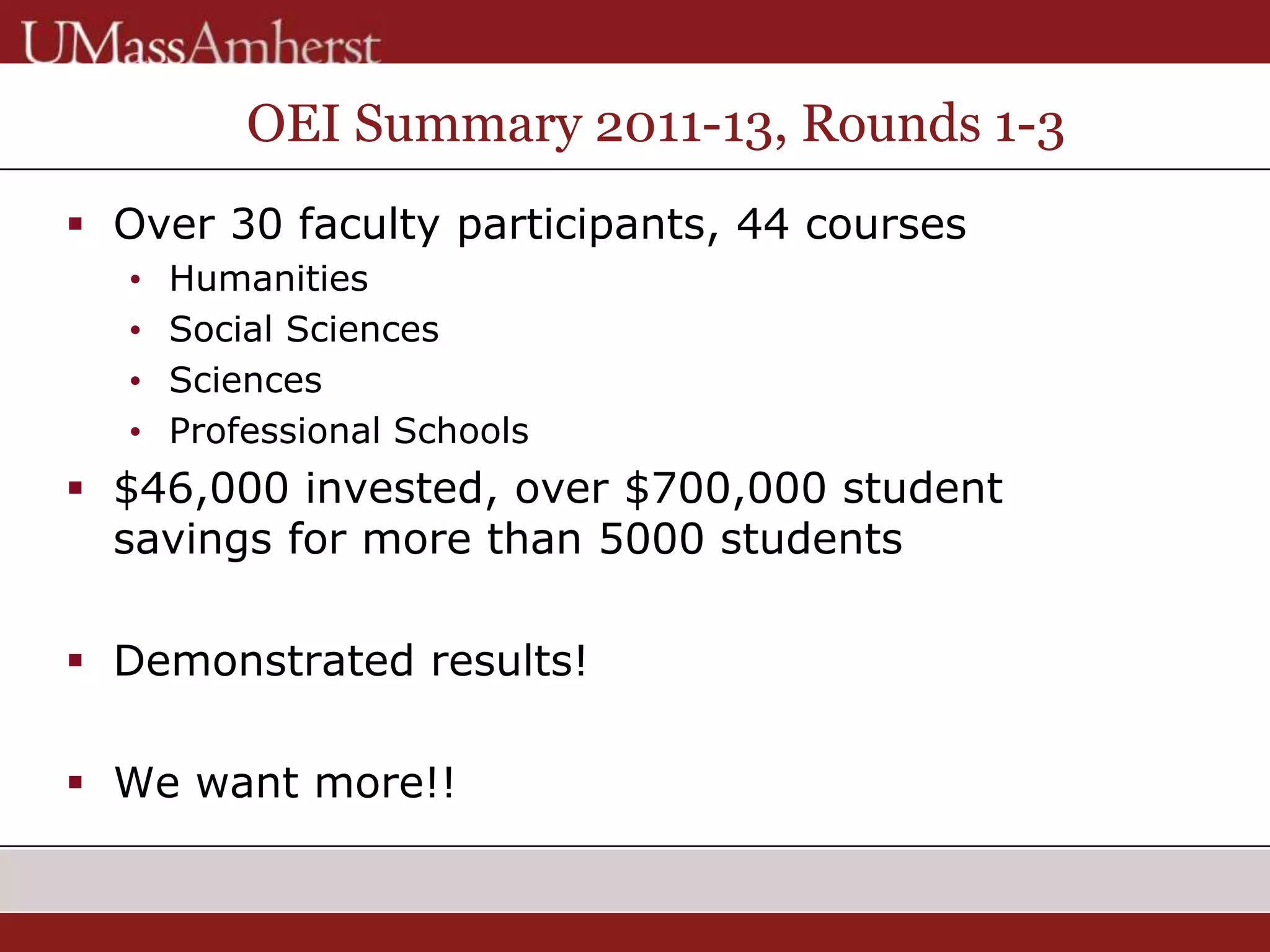
OEI Summary 2011-13, Rounds 1-3
 Over 30 faculty participants, 44 courses
• Humanities
• Social Sciences
• Sciences
• Professional Schools
 $46,000 invested, over $700,000 student
savings for more than 5000 students
 Demonstrated results!
 We want more!!
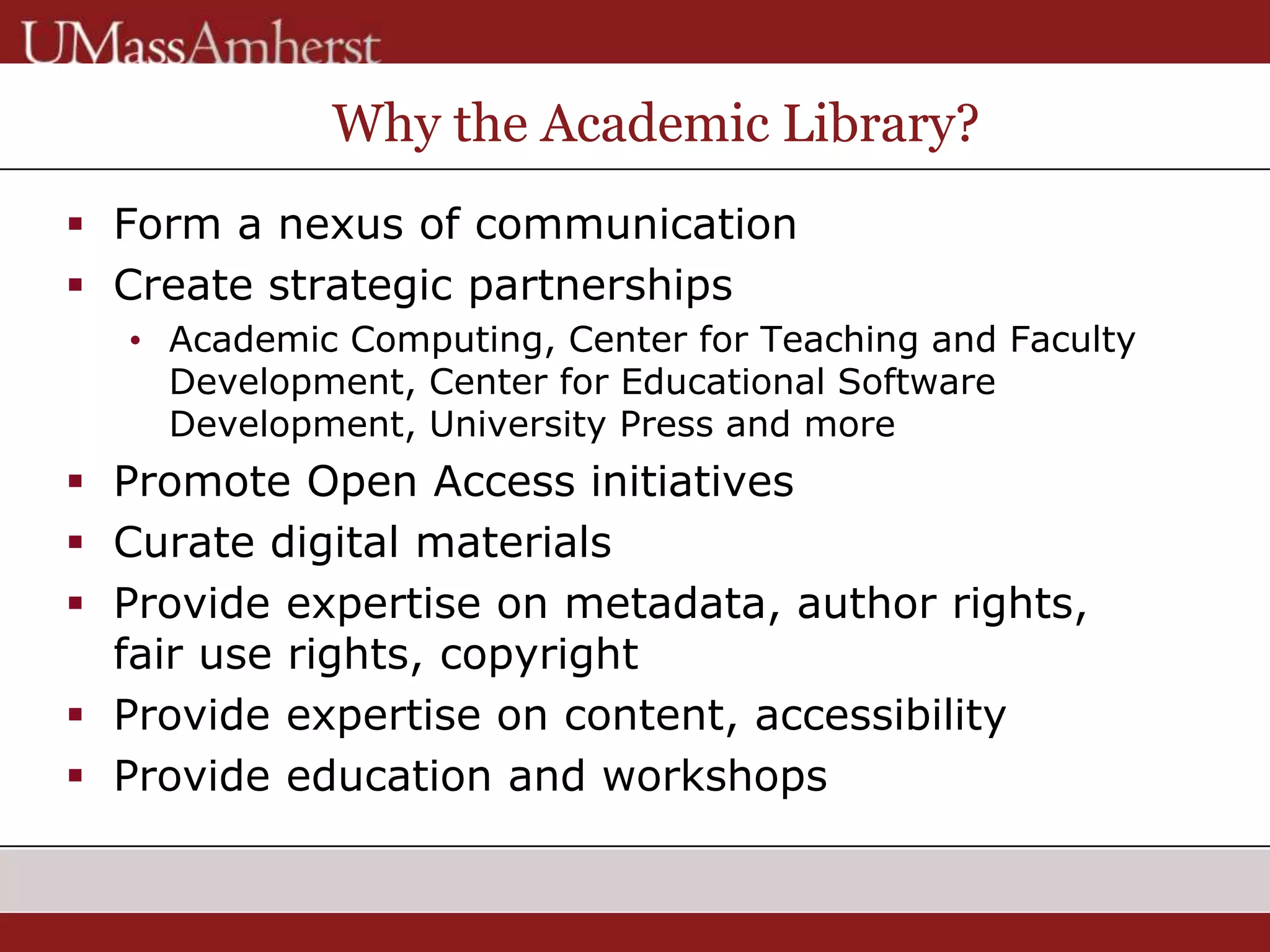
Why the Academic Library?
 Form a nexus of communication
 Create strategic partnerships
• Academic Computing, Center for Teaching and Faculty
Development, Center for Educational Software
Development, University Press and more
 Promote Open Access initiatives
 Curate digital materials
 Provide expertise on metadata, author rights,
fair use rights, copyright
 Provide expertise on content, accessibility
 Provide education and workshops
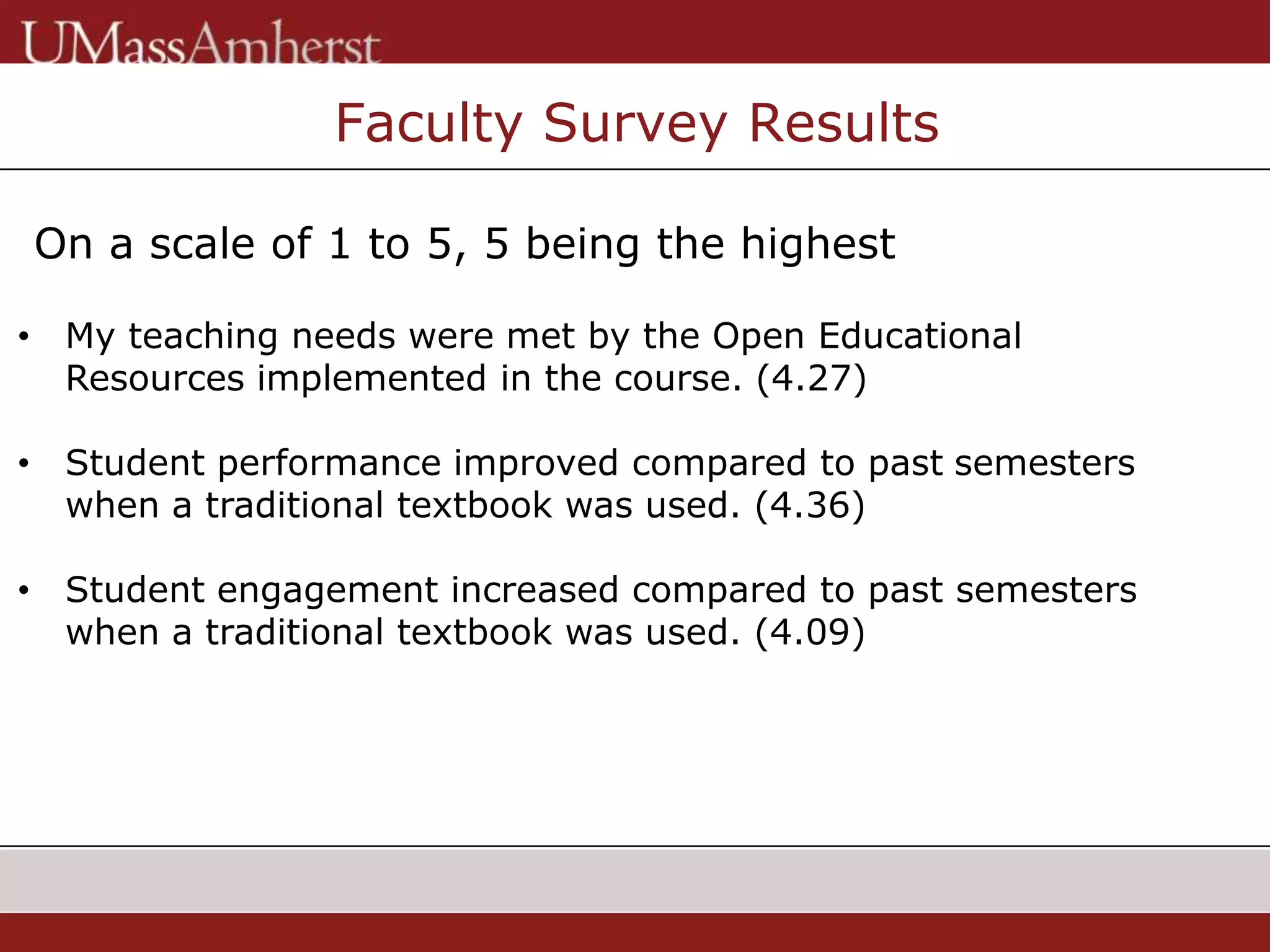
Faculty Survey Results
• My teaching needs were met by the Open Educational
Resources implemented in the course. (4.27)
• Student performance improved compared to past semesters
when a traditional textbook was used. (4.36)
• Student engagement increased compared to past semesters
when a traditional textbook was used. (4.09)
On a scale of 1 to 5, 5 being the highest
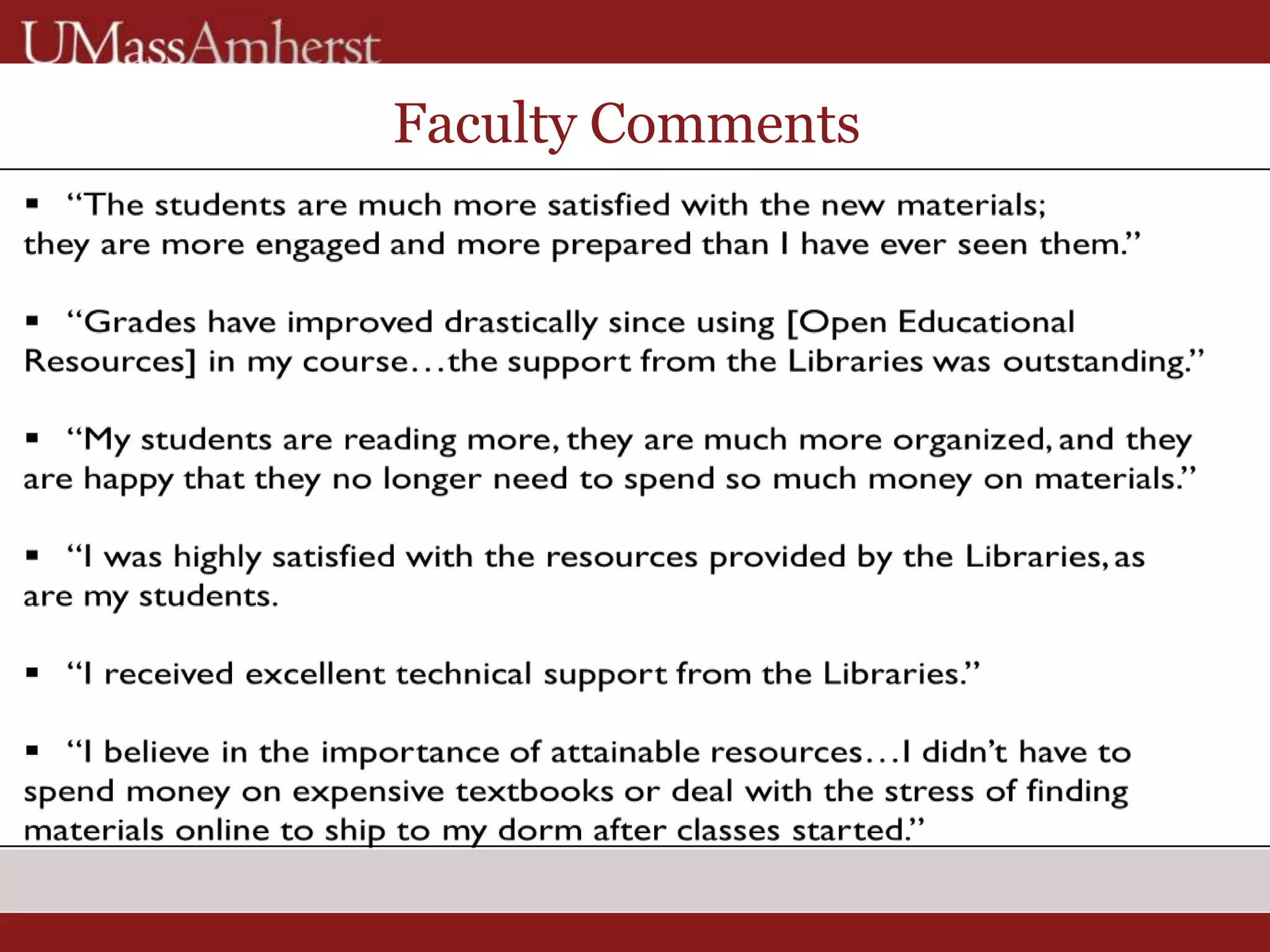
Faculty Comments
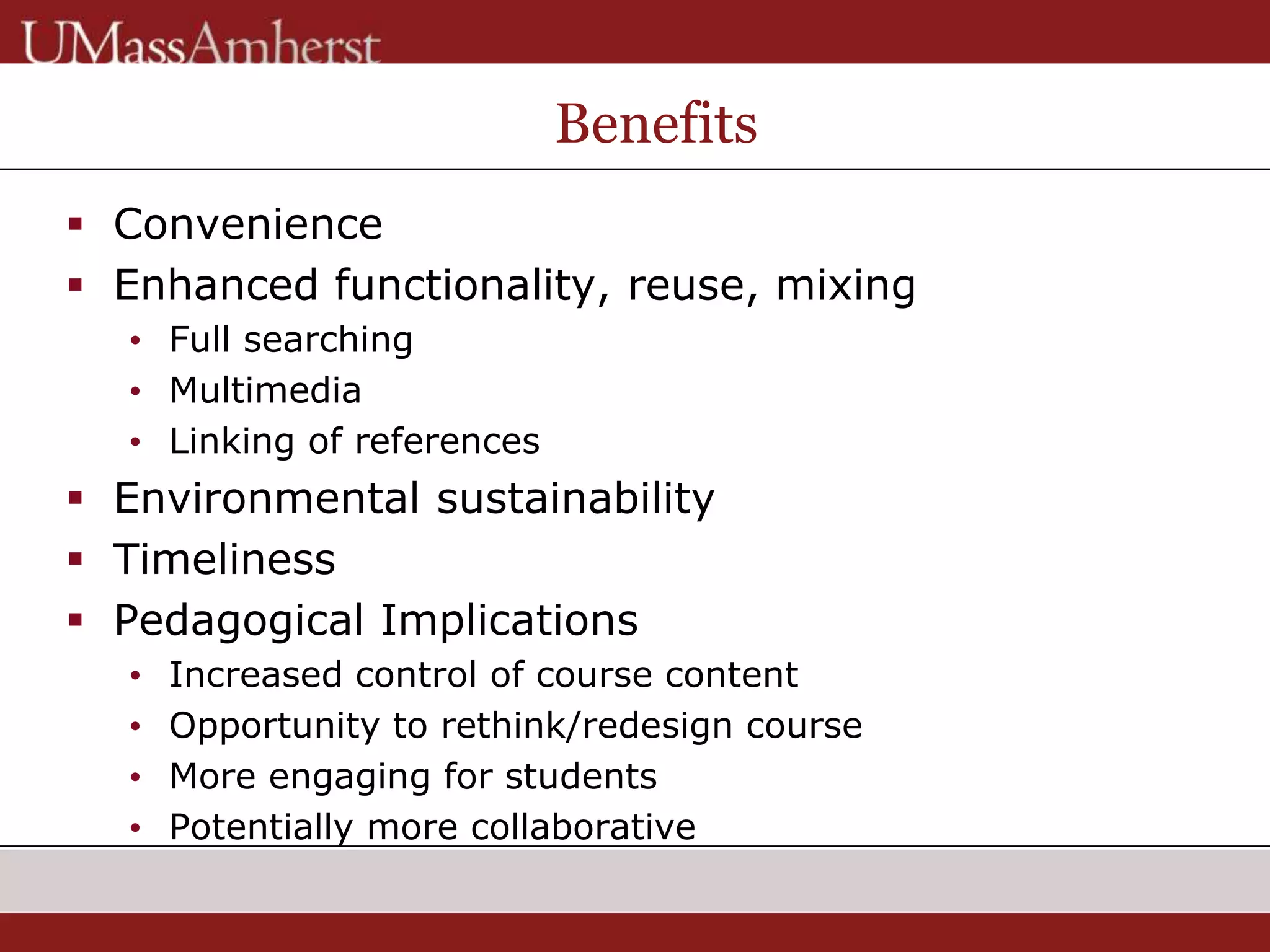
Benefits
 Convenience
 Enhanced functionality, reuse, mixing
• Full searching
• Multimedia
• Linking of references
 Environmental sustainability
 Timeliness
 Pedagogical Implications
• Increased control of course content
• Opportunity to rethink/redesign course
• More engaging for students
• Potentially more collaborative
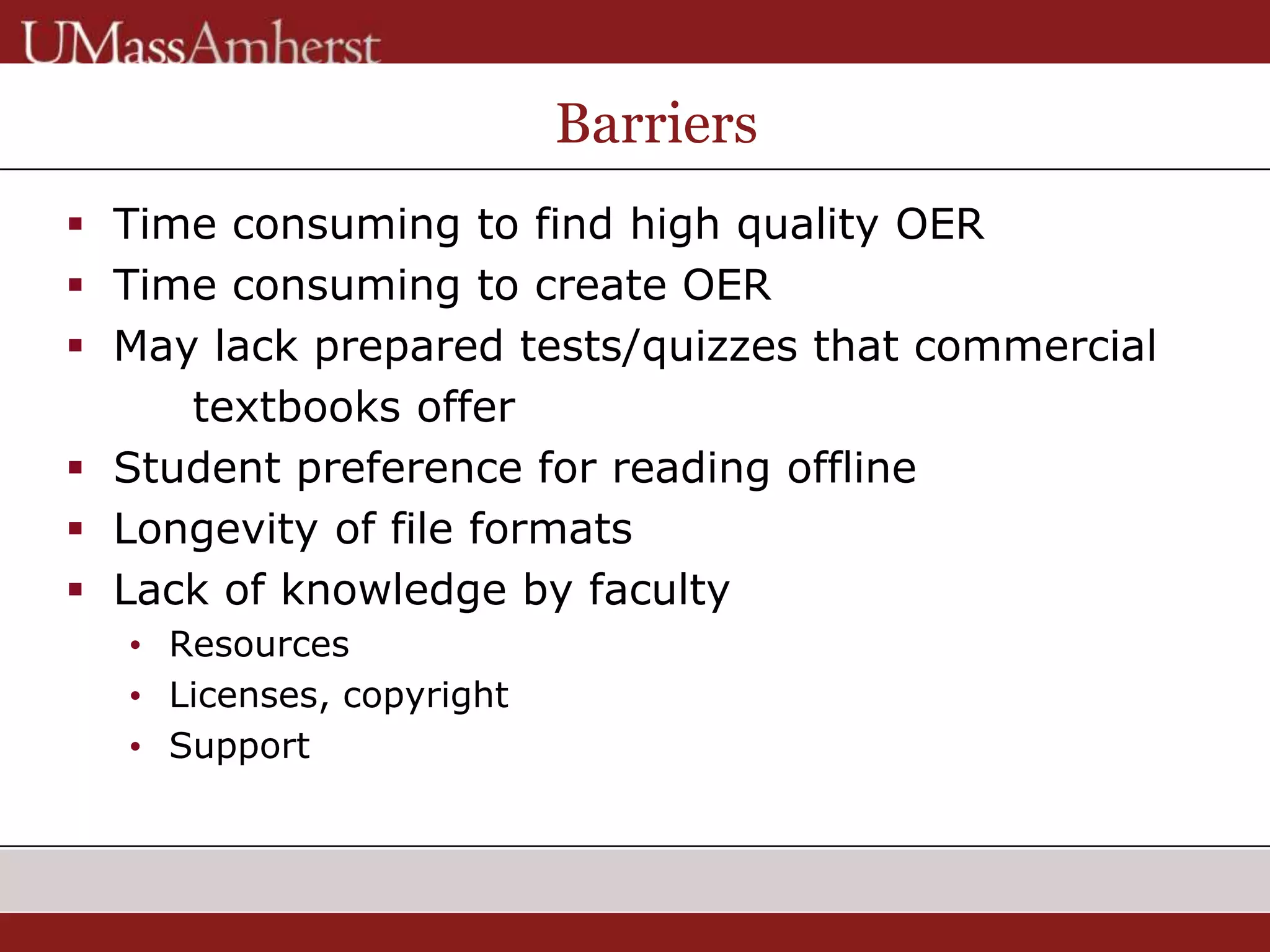
Barriers
 Time consuming to find high quality OER
 Time consuming to create OER
 May lack prepared tests/quizzes that commercial
textbooks offer
 Student preference for reading offline
 Longevity of file formats
 Lack of knowledge by faculty
• Resources
• Licenses, copyright
• Support
Best Practices
 Library leadership
 Partnerships
 Peer review mechanism
 Assessment tools
 Marketing and Advocacy
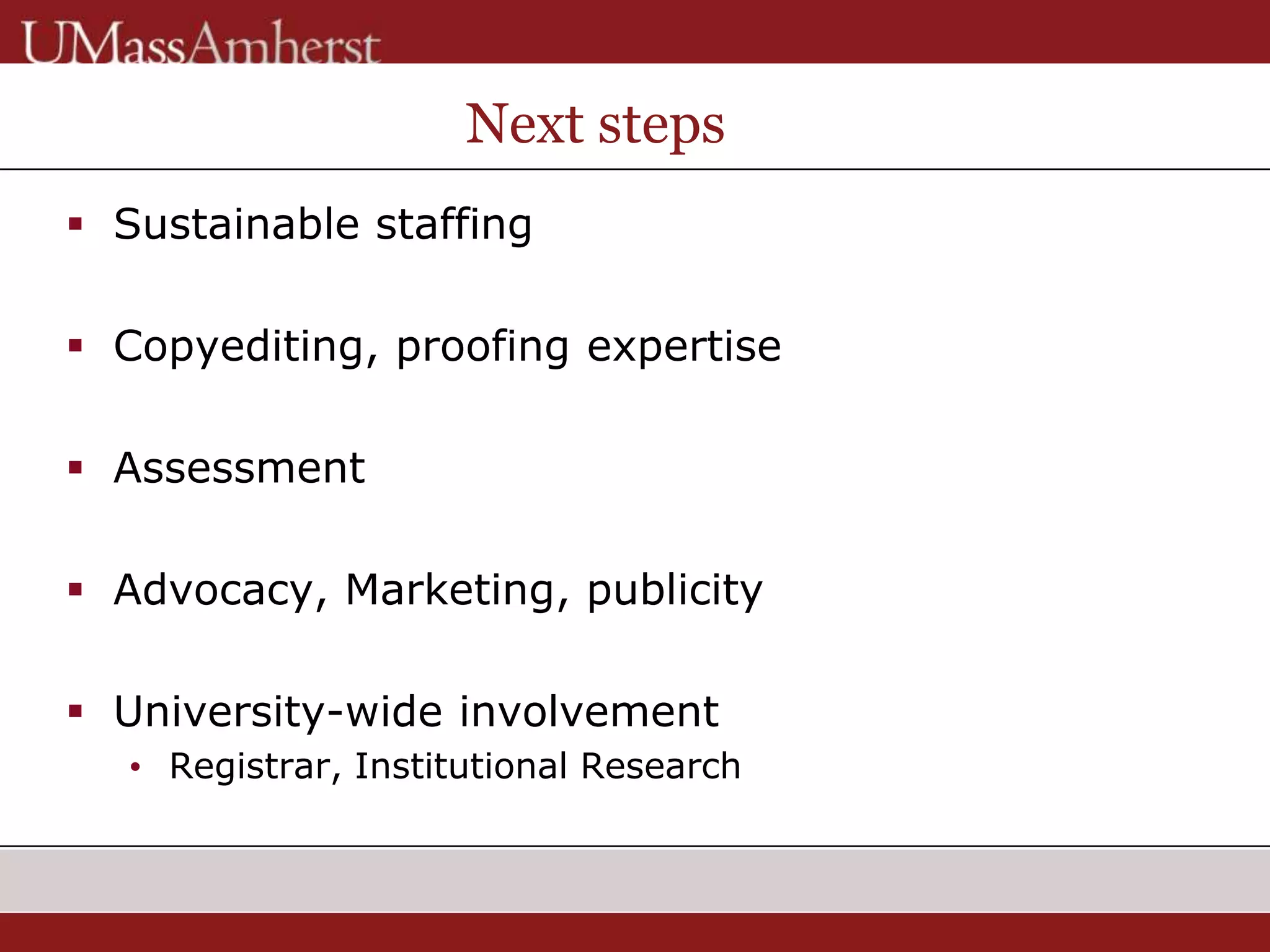
Next steps
 Sustainable staffing
 Copyediting, proofing expertise
 Assessment
 Advocacy, Marketing, publicity
 University-wide involvement
• Registrar, Institutional Research
Questions/Discussion
Contact Information
Marilyn Billings
Scholarly Communication Librarian
mbillings@library.umass.edu
OER and the University of
Minnesota Libraries
Kristi Jensen, MLS
Program Development Lead
eLearning Support Initiative
U of M Libraries
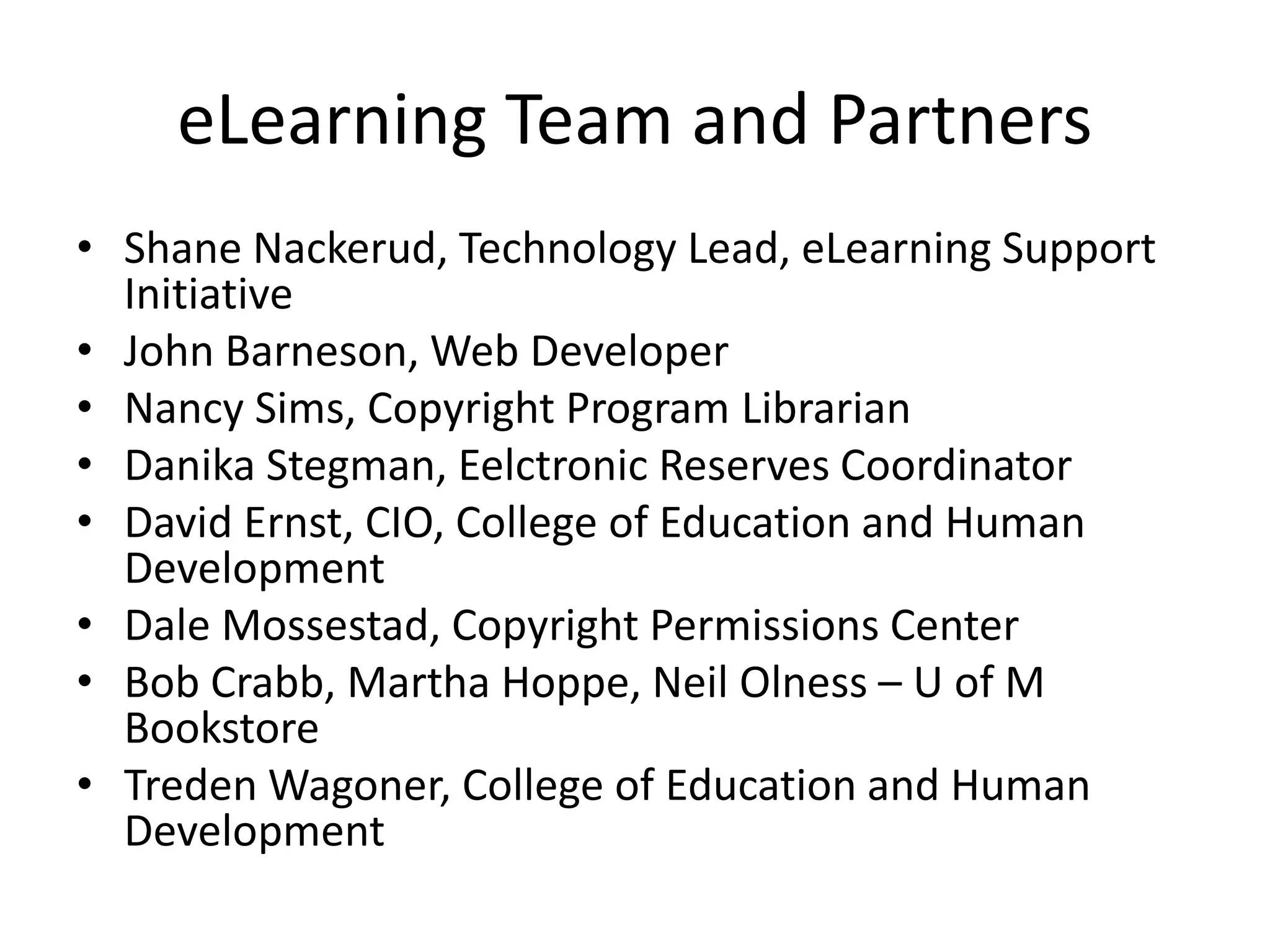
eLearning Team and Partners
• Shane Nackerud, Technology Lead, eLearning Support
Initiative
• John Barneson, Web Developer
• Nancy Sims, Copyright Program Librarian
• Danika Stegman, Eelctronic Reserves Coordinator
• David Ernst, CIO, College of Education and Human
Development
• Dale Mossestad, Copyright Permissions Center
• Bob Crabb, Martha Hoppe, Neil Olness – U of M
Bookstore
• Treden Wagoner, College of Education and Human
Development
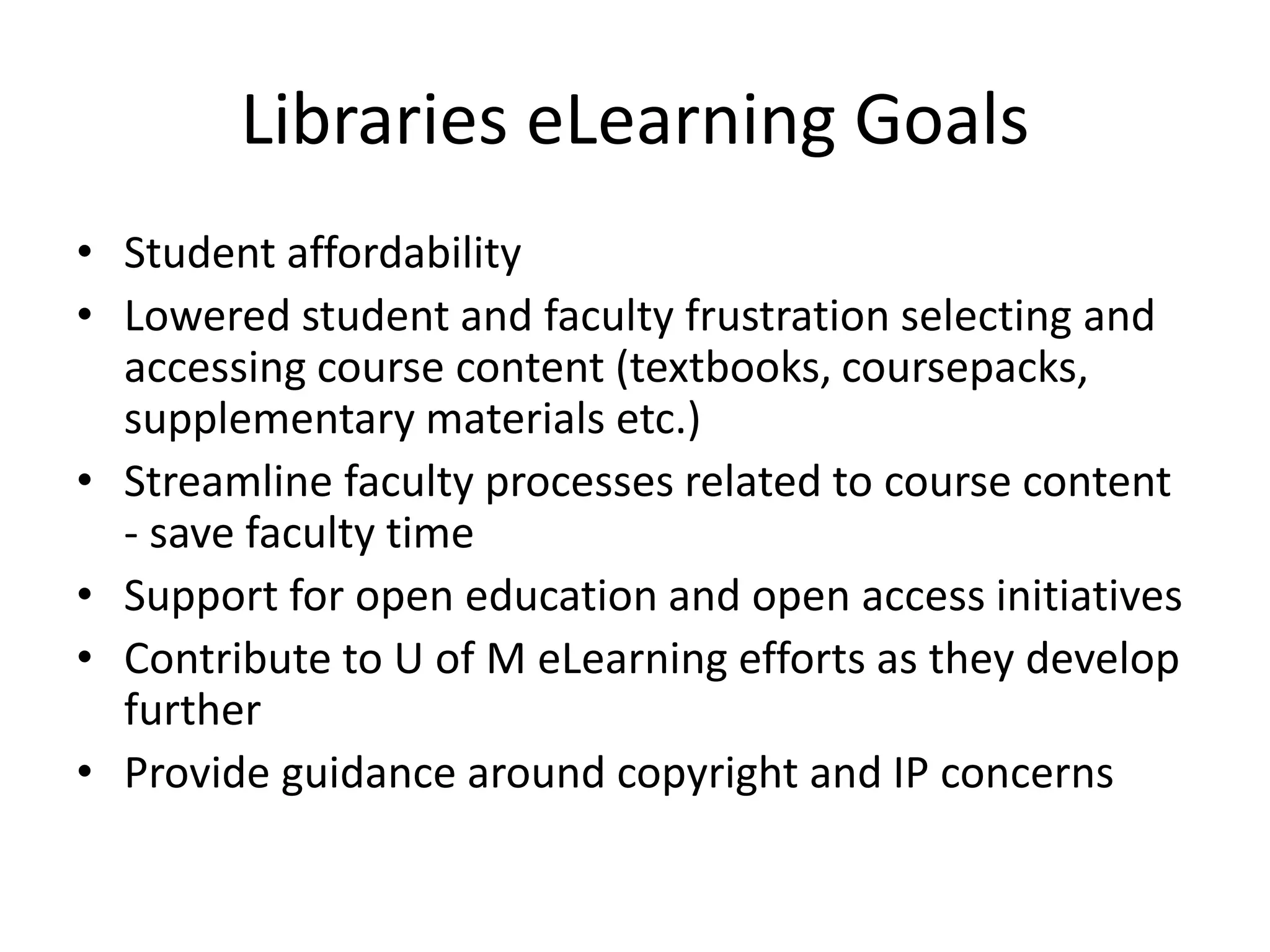
Libraries eLearning Goals
• Student affordability
• Lowered student and faculty frustration selecting and
accessing course content (textbooks, coursepacks,
supplementary materials etc.)
• Streamline faculty processes related to course content
- save faculty time
• Support for open education and open access initiatives
• Contribute to U of M eLearning efforts as they develop
further
• Provide guidance around copyright and IP concerns
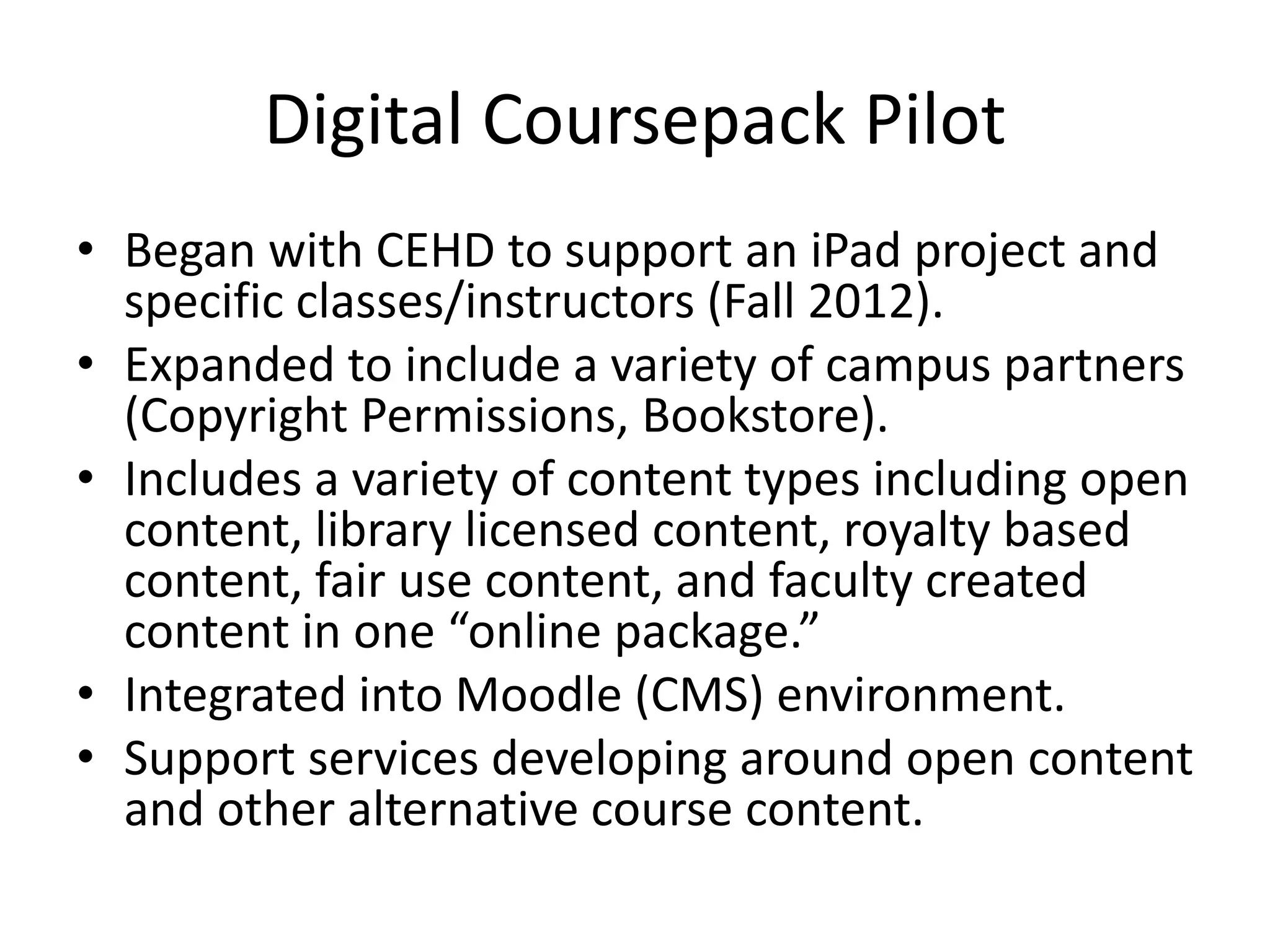
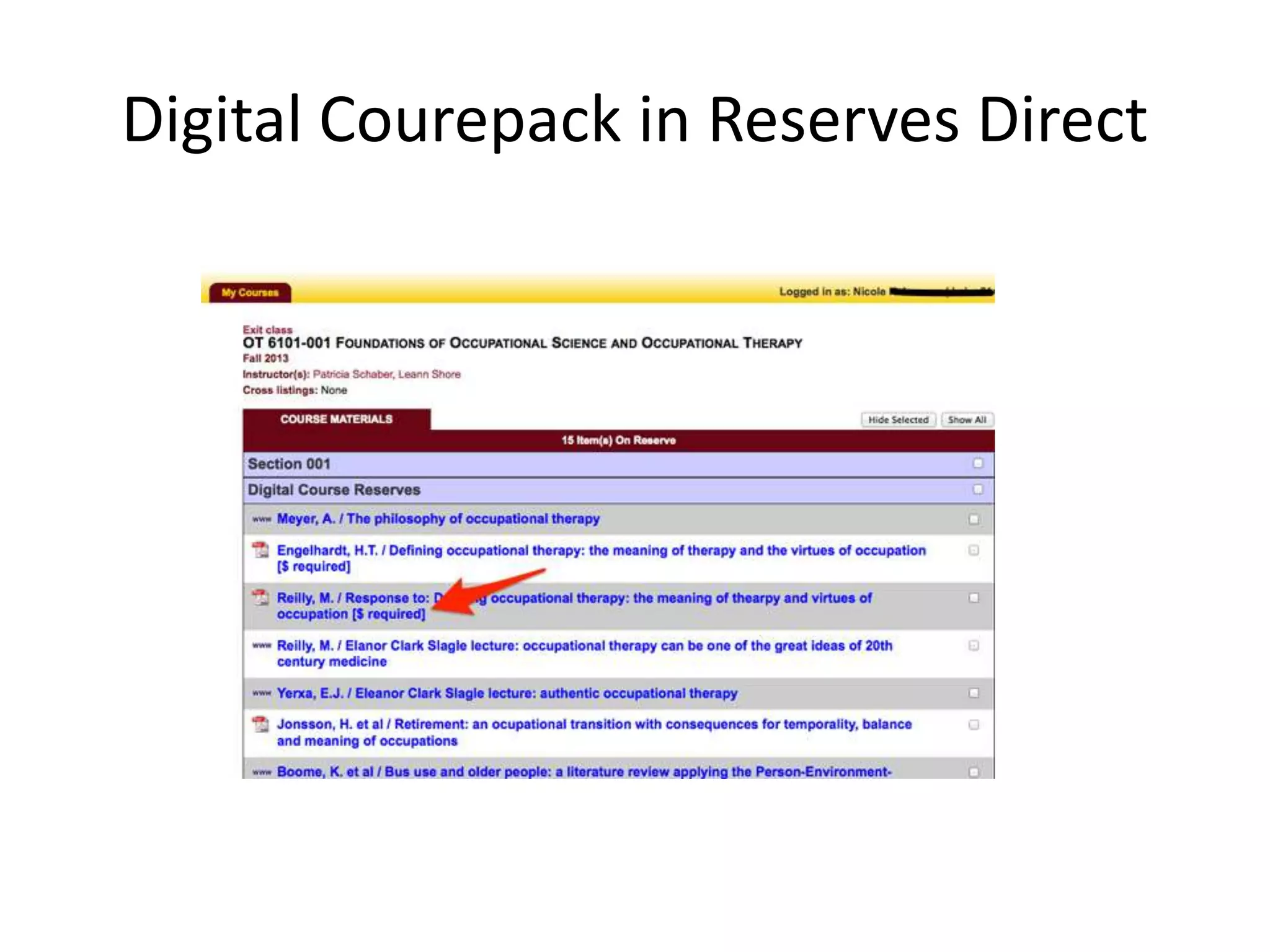
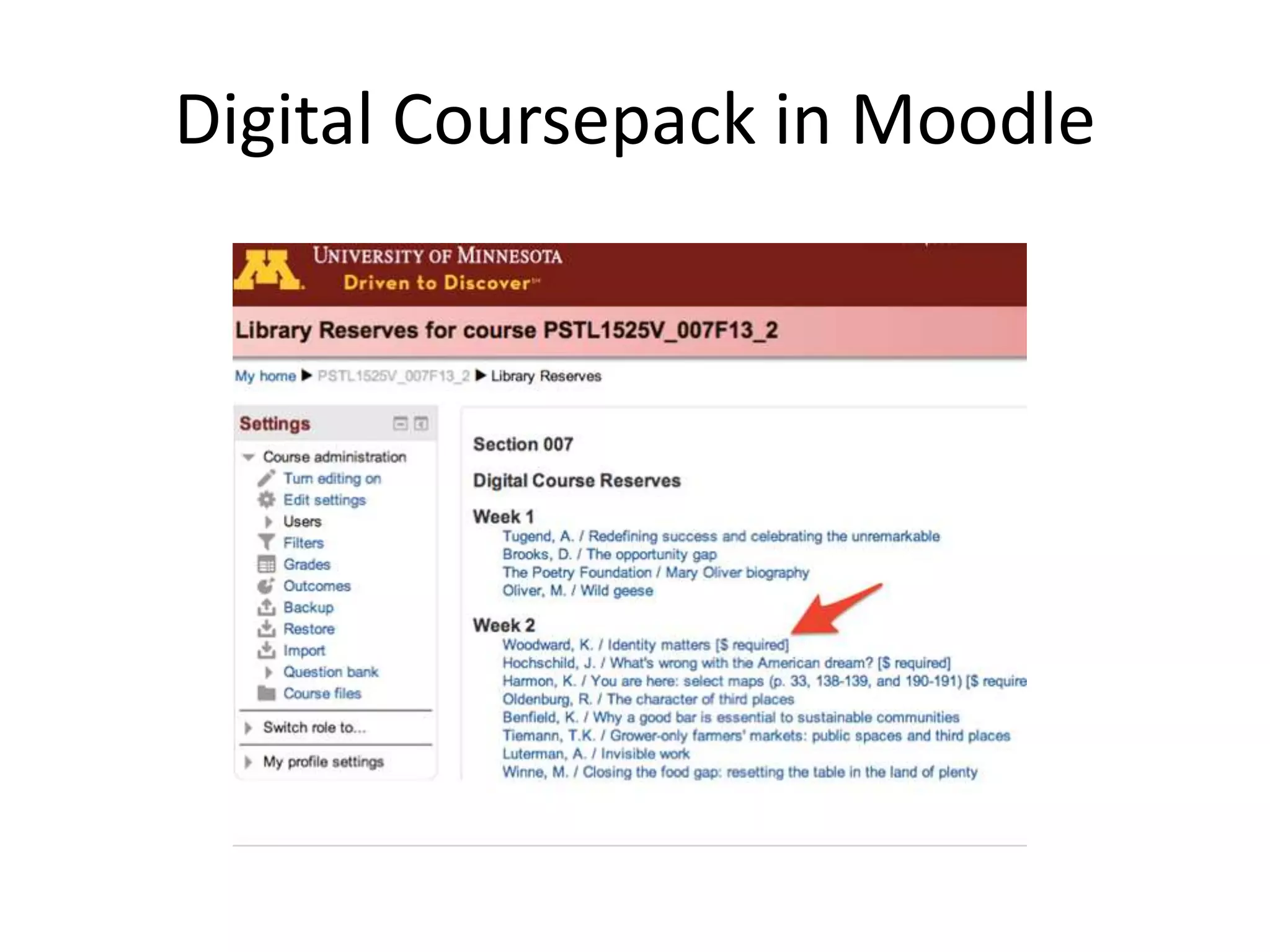
Digital Coursepack Pilot
• Began with CEHD to support an iPad project and
specific classes/instructors (Fall 2012).
• Expanded to include a variety of campus partners
(Copyright Permissions, Bookstore).
• Includes a variety of content types including open
content, library licensed content, royalty based
content, fair use content, and faculty created
content in one “online package.”
• Integrated into Moodle (CMS) environment.
• Support services developing around open content
and other alternative course content.
Digital Courepack in Reserves Direct
Digital Coursepack in Moodle
Why focus on Open Textbooks?
Informal Faculty Survey by the Libraries related to Course
Content in Fall 2013 indicates that:
• ~2/3 of Faculty surveyed still use a traditional textbook
• Over 2/3 of Faculty surveyed are willing to consider an
open textbook as an alternative to their current course
content – but many commented they need to learn more
about open textbooks – what they are, how to use them,
etc.
Open Textbooks and the CEHD Pilot
• Answering the question – What is keeping
faculty from adopting Open Textbooks?
• Identify barriers and develop tools and
strategies to address the barriers.
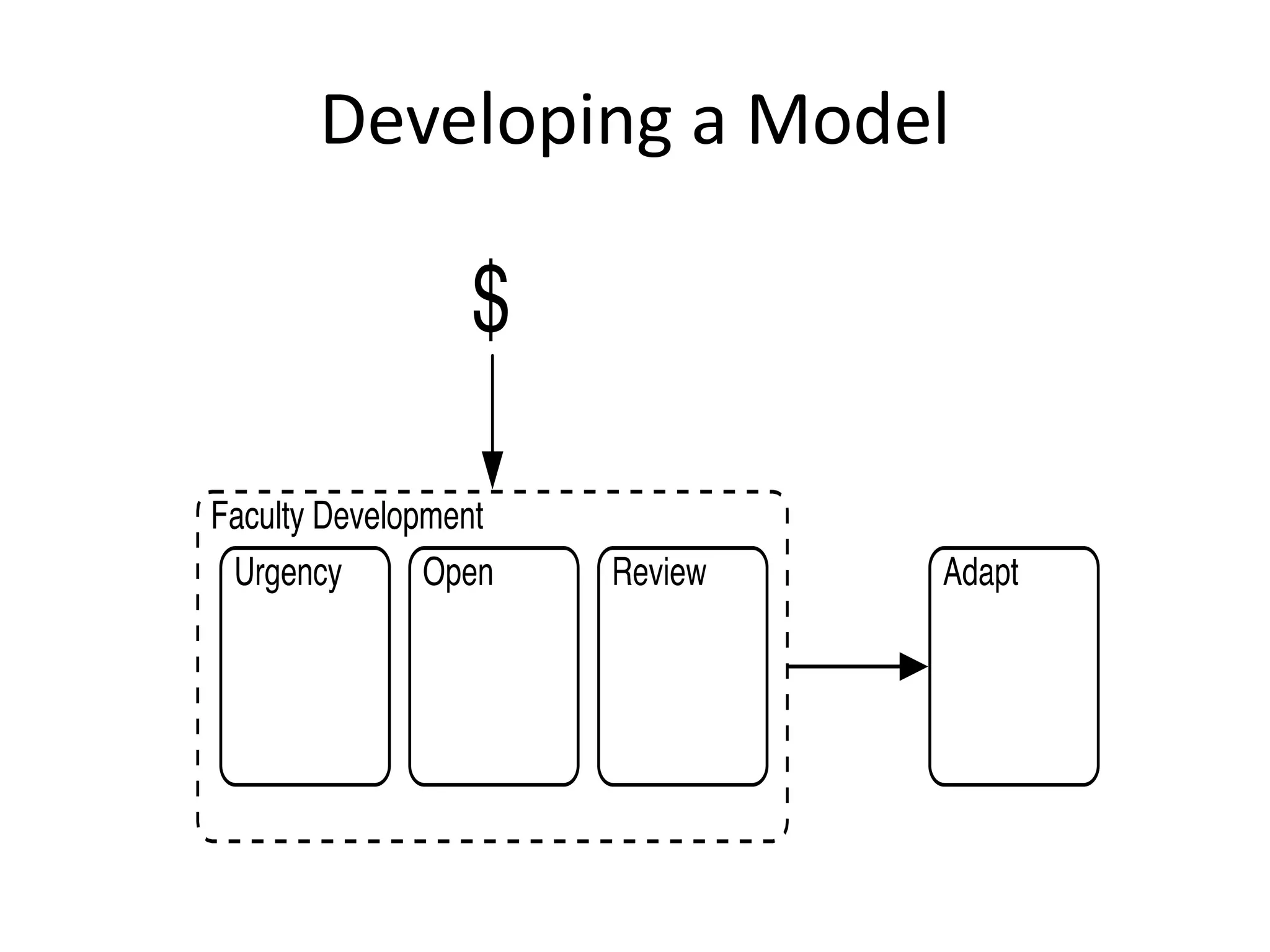
• Faculty don’t know:
– what open textbooks are
– how to find open textbooks
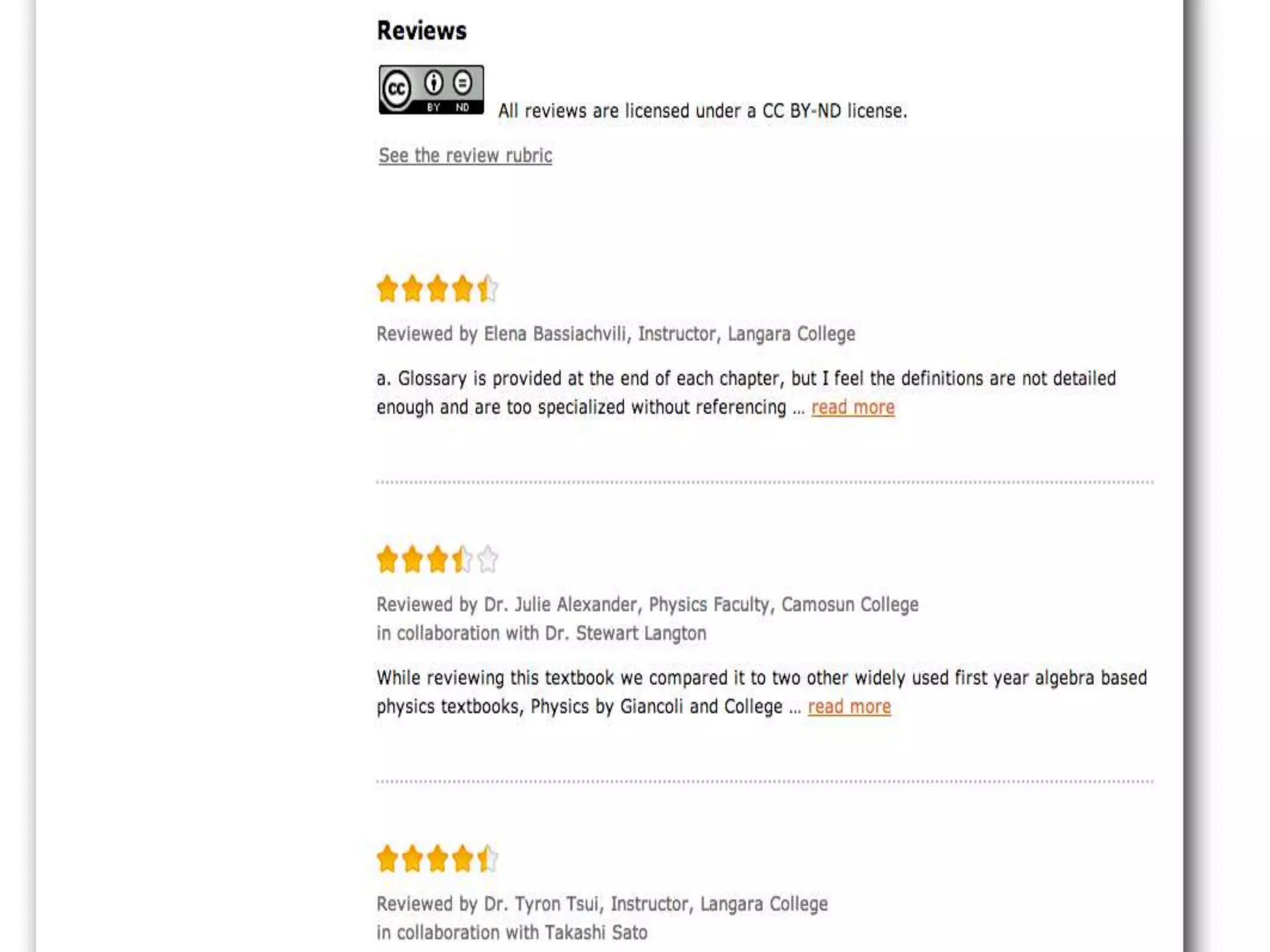
– the quality of open textbooks
– have little sense of urgency for change
What did we do?
• Develop resources to help faculty who might
be interested
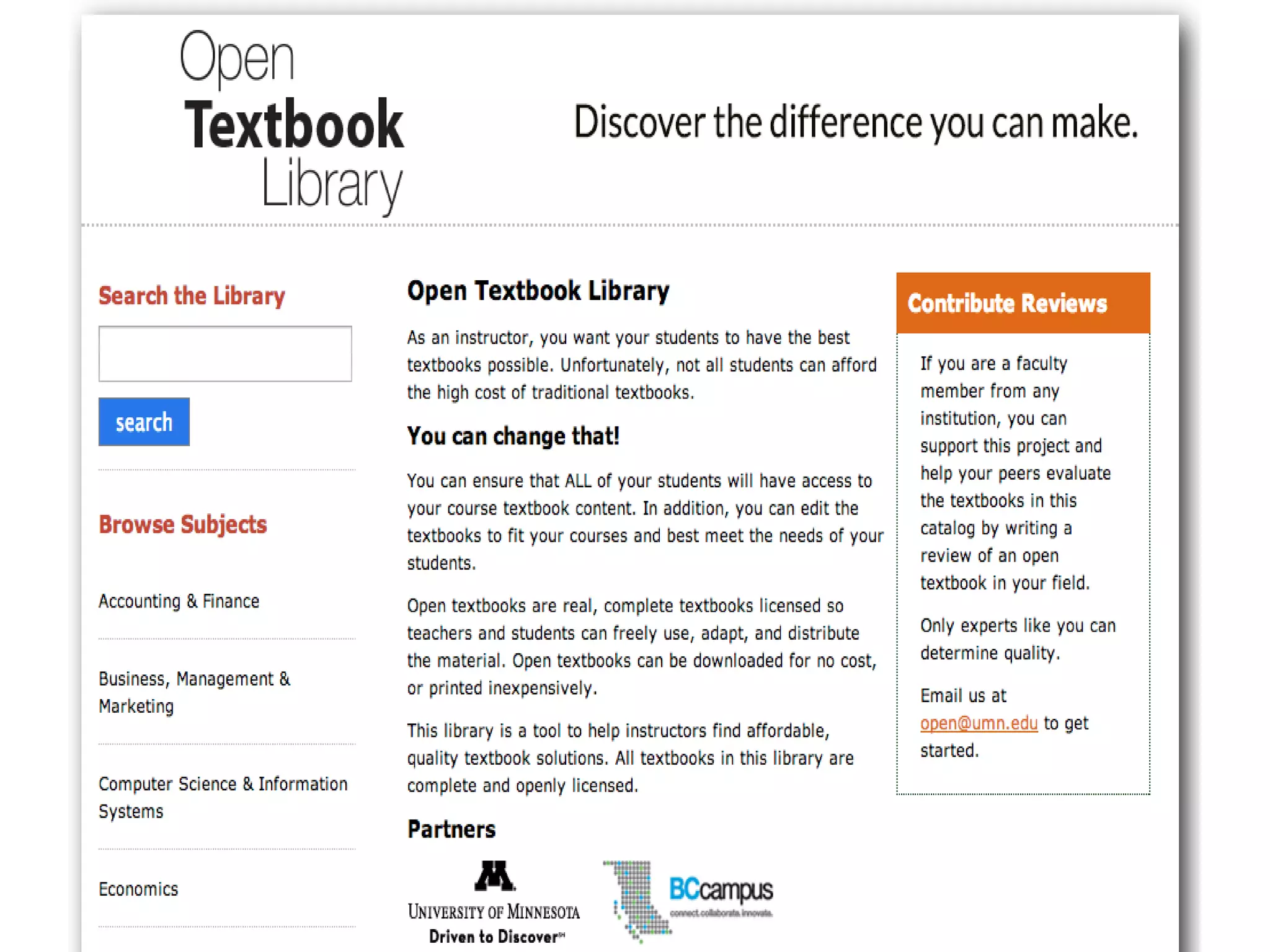
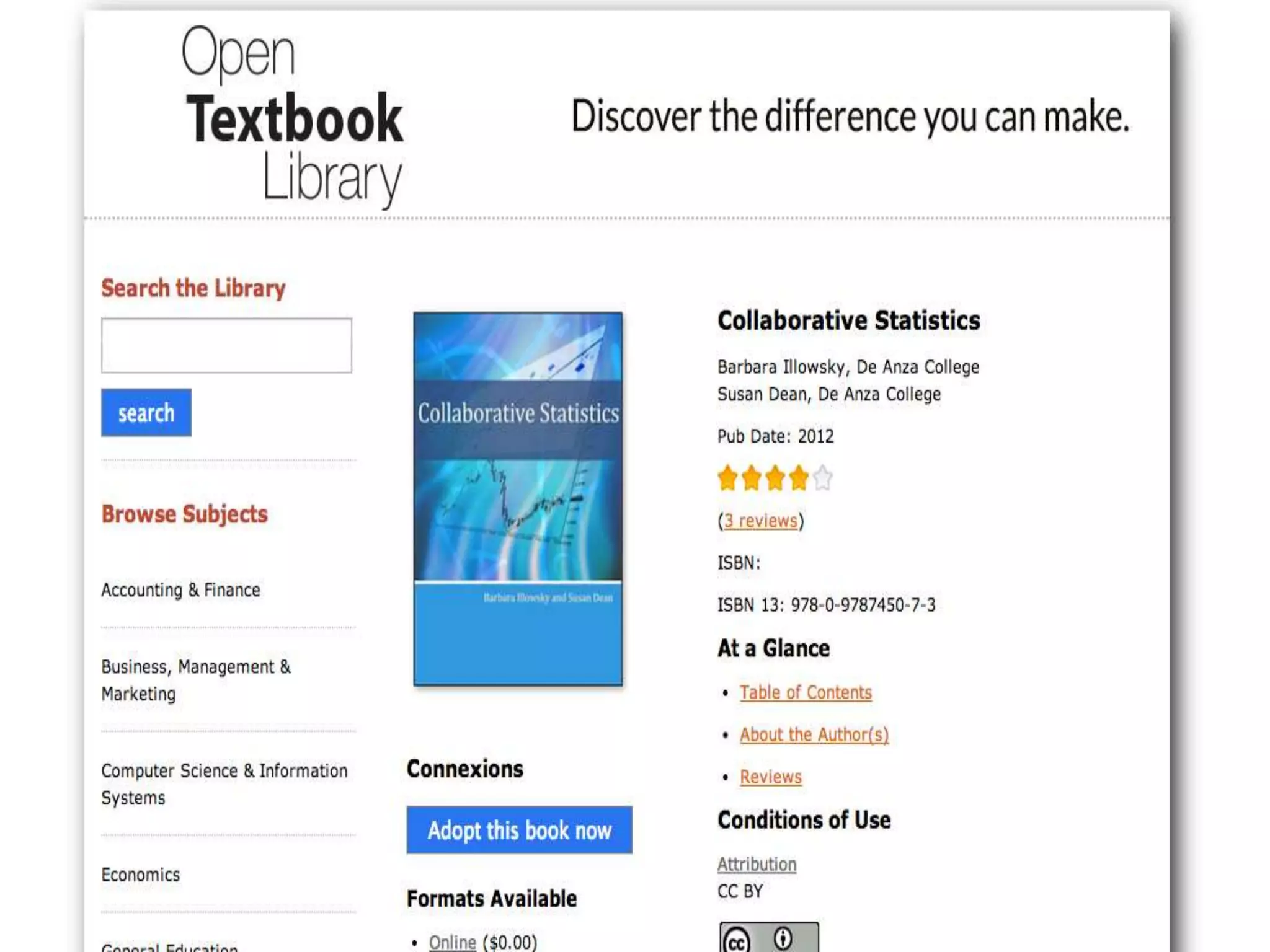
– Open Textbook Library (open.umn.edu)
– Faculty development program
– Engagement strategy
University of Minnesota
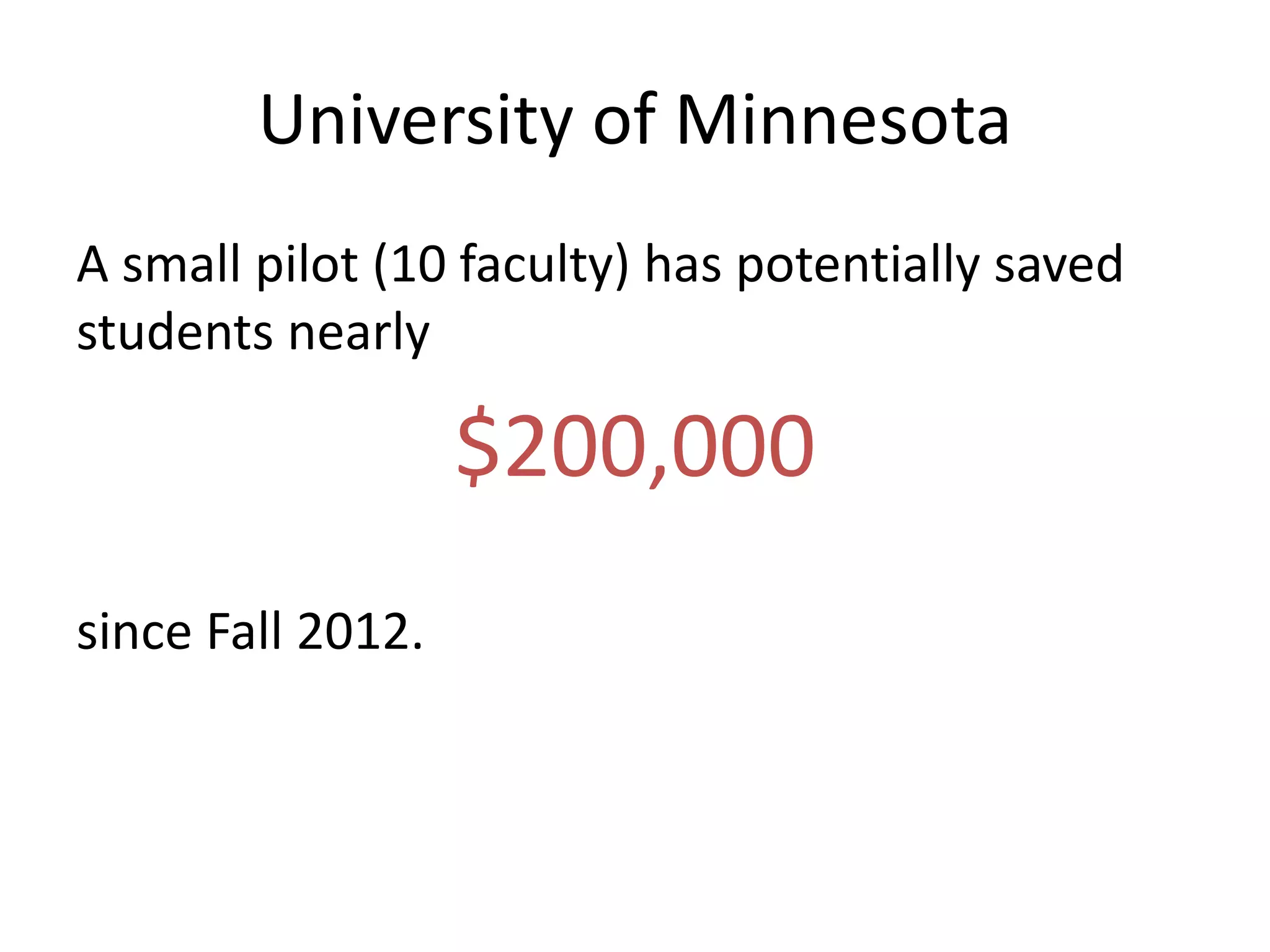
A small pilot (10 faculty) has potentially saved
students nearly
$200,000
since Fall 2012.
Developing a Model
Next Steps
• Held a workshop for Librarians, Academic
Technologists, Instructional Designers on
February 20th.
• Campus wide faculty workshop at University of
Minnesota on March 27th.
• Share strategies and lessons learned with others
– Hewlett Grant funds working at 7 other
institutions.
• Developing a toolkit of resources to support
others running Open Textbook programs.
What Can You Do?
• Educate your faculty about Open Textbooks
and Educational Resources.
• Advocate for the review of Open Textbooks by
faculty at your institution.
• Implement an Open Textbook Program at your
school or on your campus.
open.umn.edu
dernst@umn.edu
David Ernst
kjensen@umn.edu
Kristi Jensen
You can make a difference!
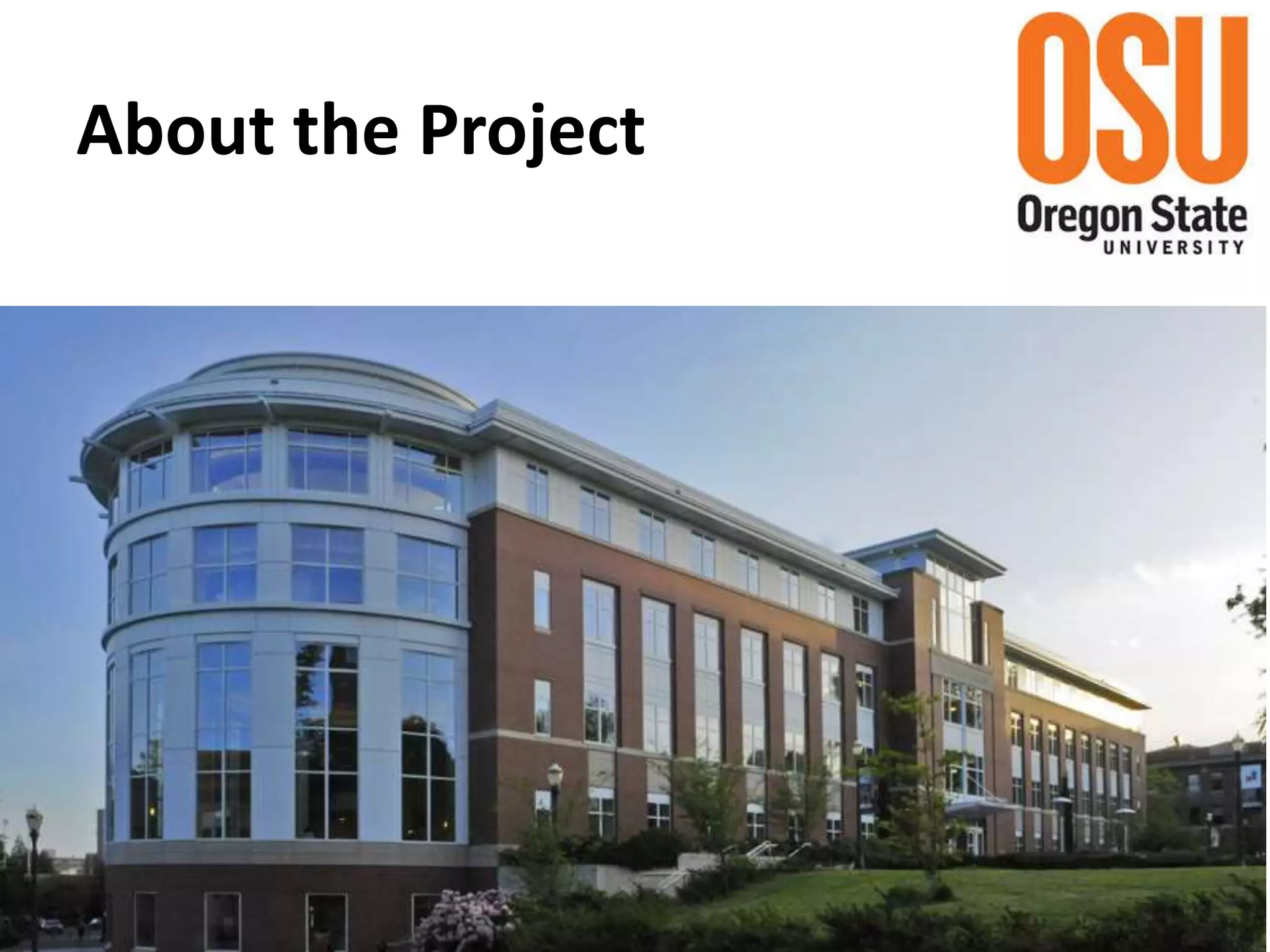
Oregon State University Open
Textbook Initiative
Shan Sutton
Associate University Librarian for Research
and Scholarly Communication
About the Project
About the Project
• Pilot program that facilitates the development
of open access textbooks at OSU
• Textbooks will be distributed free digitally
• Print-on-demand versions through OSU Press
About the Project
• Collaboration between OSU Libraries, OSU
Press and OSU Extended Campus
• OSU Press will provide editorial development,
coordinate peer review, and review by its
Editorial Board
• The Extended Campus Open Educational
Resources unit will provide technical support
for the development of multi-media and
interactive content
About the Project
• Primary author must be OSU faculty
• Authors will receive royalties on print-on-
demand sales and a $5,000-$15,000 budget
transfer
About the Project
• Textbooks may be original content or
compilations of openly licensed materials
• Preference for high-enrollment undergrad
courses in natural resources, geosciences,
forestry, marine biology, agricultural sciences
and environmental science
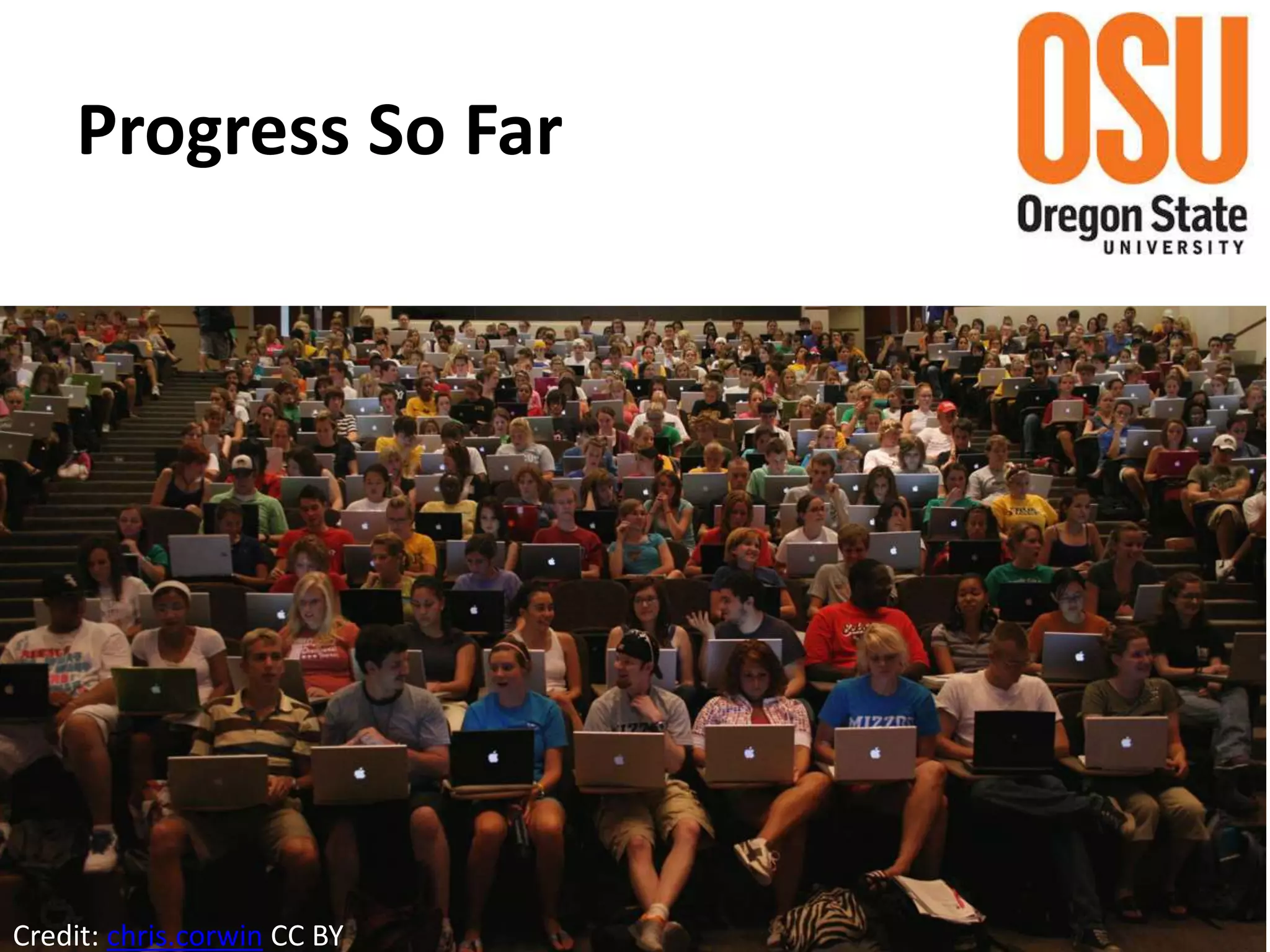
Progress So Far
Credit: chris.corwin CC BY
Progress So Far
• June 2013: RFP issued with Sept. deadline
• Feb. 2014: Winning proposals announced
1. Kevin Ahern and Indira Rajagopal, Dept. of Biochemistry
& Biophysics
2. Gita Cherain, Dept. of Animal & Rangeland Sciences
3. John Lambrinos, Dept. of Horticulture
4. One more TBD
Progress So Far
• Publication of the first four open textbooks
will take place in 2014-2015
• Each will be made available in four digital
formats - HTML, PDF, iBooks & ePub – as well
as print-on-demand
Progress So Far
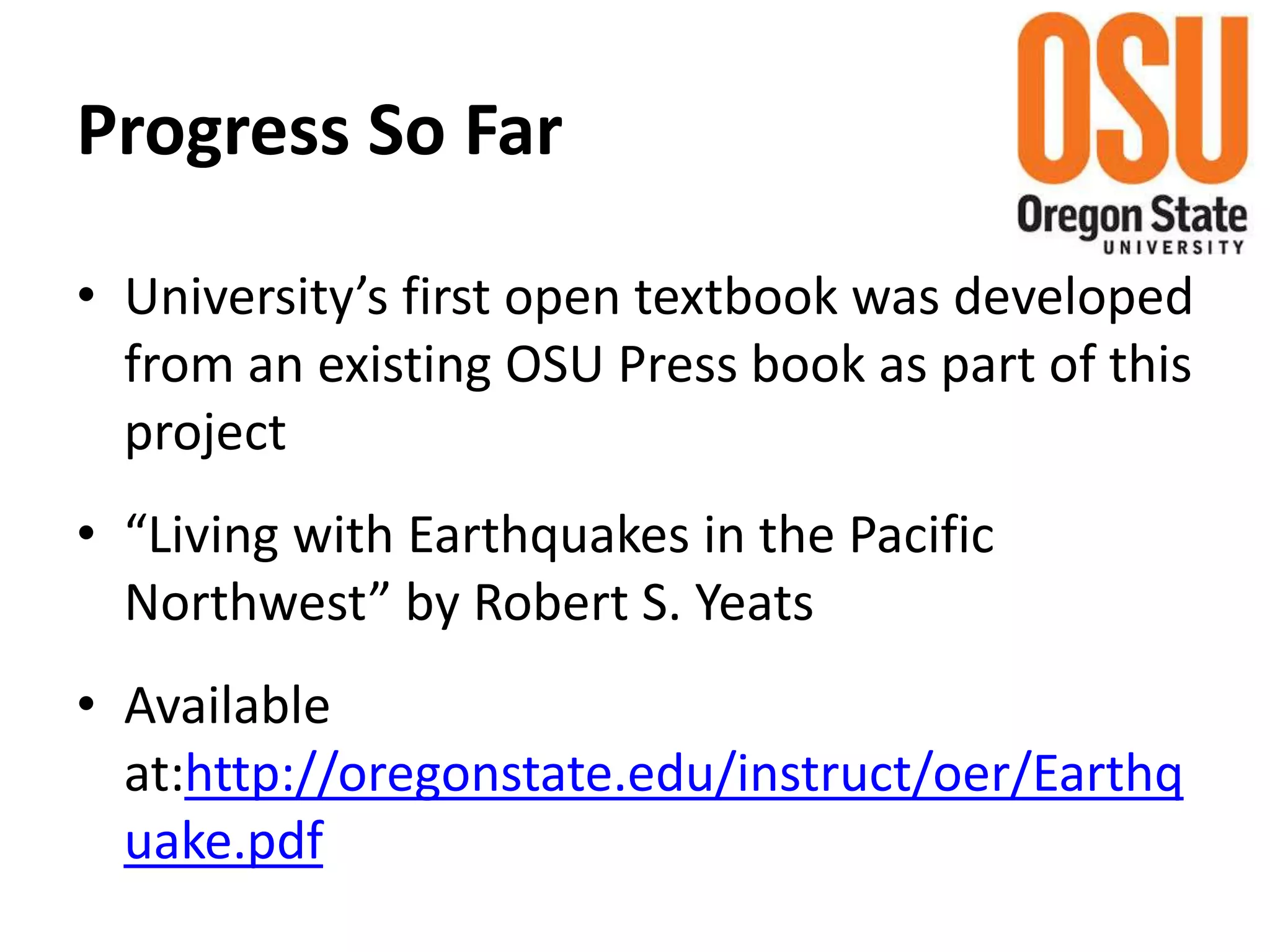
• University’s first open textbook was developed
from an existing OSU Press book as part of this
project
• “Living with Earthquakes in the Pacific
Northwest” by Robert S. Yeats
• Available
at:http://oregonstate.edu/instruct/oer/Earthq
uake.pdf
Progress So Far
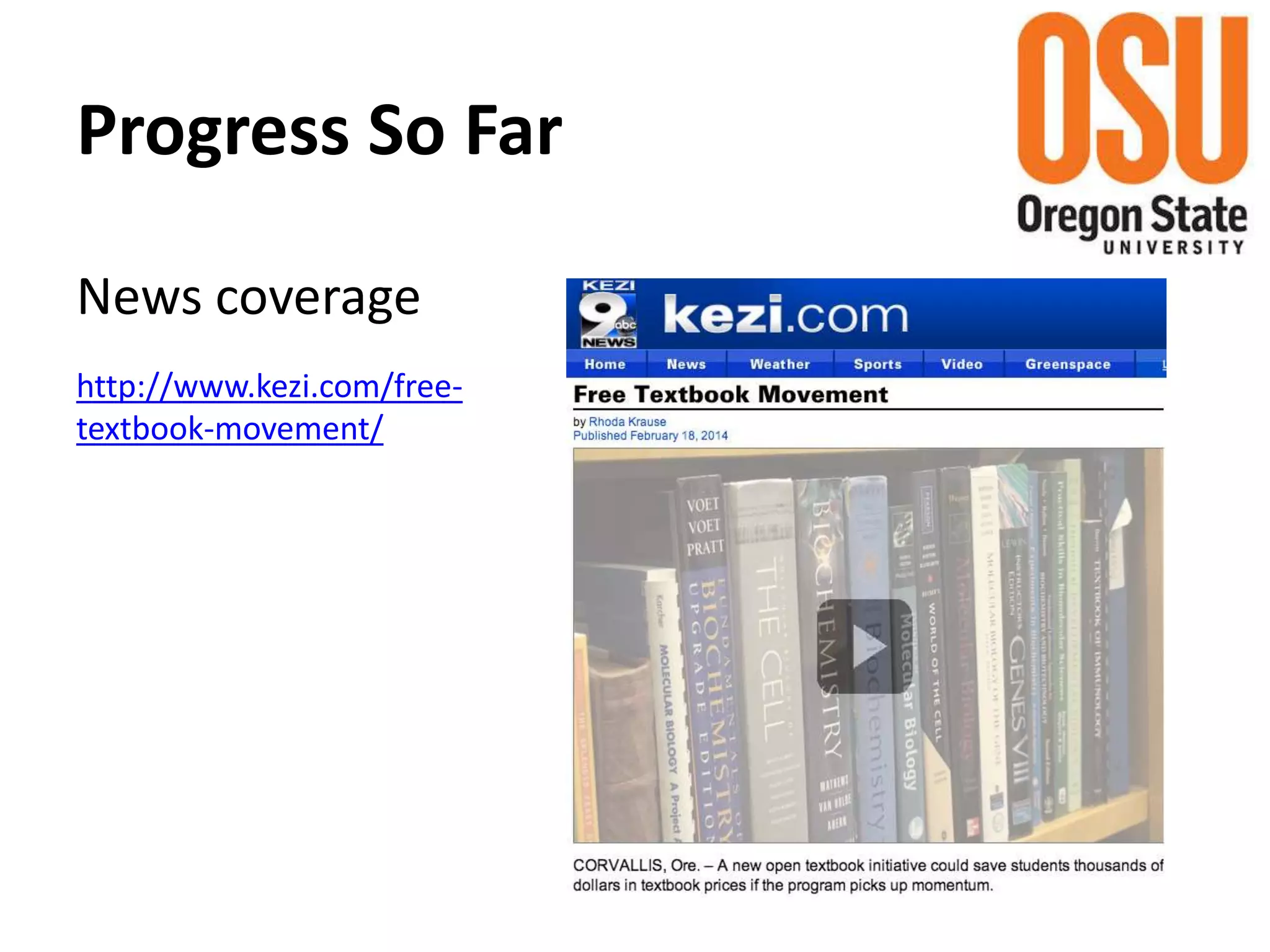
News coverage
http://www.kezi.com/free-
textbook-movement/
Next Steps
Credit: srharris CC BY NC
Tips & Advice
Credit: Xbxg32000 CC BY SA
Shan Sutton
Associate University Librarian for Research and Scholarly
Communication
Oregon State University Libraries and Press
shan.sutton@oregonstate.edu
@txtbks
Scholarly Publishing &
Academic Resources Coalition
www.sparc.arl.org
@SPARC_NA
#openeducationwk
#sparcOEW
Open Educational Resources
@txtbks
Scholarly Publishing &
Academic Resources Coalition
www.sparc.arl.org
@SPARC_NA
#openeducationwk
#sparcOEW
Libraries & OER Forum
Public discussion list intended for
academic and research librarians
interested in OER.
Sign up:
http://www.sparc.arl.org/resource/sparc-
libraries-oer-forum
@txtbks
Scholarly Publishing &
Academic Resources Coalition
www.sparc.arl.org
@SPARC_NA
#openeducationwk
#sparcOEW
OER Campus Project List
Resource describing library initiatives to
advance OER.
Add your campus:
http://www.sparc.arl.org/issues/oer/cam
pus-project-form
@txtbks
Scholarly Publishing &
Academic Resources Coalition
www.sparc.arl.org
@SPARC_NA
#openeducationwk
#sparcOEW
OER Campus Tour
SPARC staff will be traveling across the
country to educate librarians, students
and others about OER.
Interested?
nicole@sparc.arl.org
@txtbks
Scholarly Publishing &
Academic Resources Coalition
www.sparc.arl.org
@SPARC_NA
#openeducationwk
#sparcOEW
Open Education 2014
• Annual OER conference
• Nov 19-21, 2014, Washington, DC
• Track dedicated to Libraries & OER
Learn more:
http://www.openedconference.org
@txtbks
Scholarly Publishing &
Academic Resources Coalition
www.sparc.arl.org
@SPARC_NA
#openeducationwk
#sparcOEW
Other Resources
http://www.sparc.arl.org/resources
http://www.sparc.arl.org/membership
Nicole Allen
nicole@sparc.arl.org
401-484-8104
@txtbks
@txtbks
Scholarly Publishing &
Academic Resources Coalition
www.sparc.arl.org
@SPARC_NA
#openeducationwk
#sparcOEW
Questions
• Marilyn Billings Scholarly Communication & Special
Initiatives Librarian, University of Massachusetts Amherst
• Kristi Jensen Program Development Lead, eLearning
Support Initiative, University of Minnesota
• Shan Sutton Associate University Librarian for Research and
Scholarly Communication, Oregon State University Libraries
@txtbks
Scholarly Publishing &
Academic Resources Coalition
www.sparc.arl.org
@SPARC_NA
#openeducationwk
#sparcOEW
Libraries Leading
the Way on OER
A Free SPARC Webcast
March 13, 2014
Moderator: Nicole Allen (@txtbks), Director of Open Education for SPARC

SPARC Webcast: Libraries Leading the Way on Open Educational Resources

  • 1.
    @txtbks Scholarly Publishing & AcademicResources Coalition www.sparc.arl.org @SPARC_NA #openeducationwk #sparcOEW Libraries Leading the Way on OER A Free SPARC Webcast March 13, 2014 Moderator: Nicole Allen (@txtbks), Director of Open Education for SPARC
  • 2.
    @txtbks Scholarly Publishing & AcademicResources Coalition www.sparc.arl.org @SPARC_NA #openeducationwk #sparcOEW SPARC®, the Scholarly Publishing and Academic Resources Coalition, is an international alliance of academic and research libraries working to create a more open system of scholarly communication.
  • 3.
    @txtbks Scholarly Publishing & AcademicResources Coalition www.sparc.arl.org @SPARC_NA #openeducationwk #sparcOEW Open Educational Resources Textbooks and other academic materials that are published under a license permitting everyone to freely use, adapt and share the content.
  • 4.
    @txtbks Scholarly Publishing & AcademicResources Coalition www.sparc.arl.org @SPARC_NA #openeducationwk #sparcOEW (1) Free Immediate access for zero cost.
  • 5.
    @txtbks Scholarly Publishing & AcademicResources Coalition www.sparc.arl.org @SPARC_NA #openeducationwk #sparcOEW (2) Open Amends the default “All Rights Reserved” terms of © to “Some Rights Reserved,” granting blanket permission in advance to everyone to use the material
  • 6.
    @txtbks Scholarly Publishing & AcademicResources Coalition www.sparc.arl.org @SPARC_NA #openeducationwk #sparcOEW Open Access Open Education Open Data SPARC Open Access Meeting 2014
  • 7.
    @txtbks Scholarly Publishing & AcademicResources Coalition www.sparc.arl.org @SPARC_NA #openeducationwk #sparcOEW Webcast Goals • Showcase three SPARC member libraries that are leading the way on OER • Illustrate the impact these libraries’ work is having on campus • Provide guidance to other libraries on how to advance OER
  • 8.
    @txtbks Scholarly Publishing & AcademicResources Coalition www.sparc.arl.org @SPARC_NA #openeducationwk #sparcOEW Webcast Speakers • Marilyn Billings Scholarly Communication & Special Initiatives Librarian, University of Massachusetts Amherst • Kristi Jensen Program Development Lead, eLearning Support Initiative, University of Minnesota • Shan Sutton Associate University Librarian for Research and Scholarly Communication, Oregon State University Libraries
  • 9.
    Seeking Alternatives toHigh-cost Textbooks: A Case Study of the UMass Amherst Open Education Initiative SPARC Webinar March 13, 2014 Marilyn Billings Scholarly Communication Librarian University Libraries
  • 10.
    Outline  National andUMass context  Genesis of Open Education Initiative  Implementation of OEI  Preliminary assessment  Next steps
  • 11.
    Textbook Trends The highcost of commercial print textbooks is a major concern for parents, students, and even the federal government.
  • 12.
    UMass Amherst Profile Public Land-grant, Research Intensive University  Over 28,000 students, 1200 faculty  108 bachelor’s, 76 masters, 50 doctorates
  • 13.
    The UMass AmherstOpen Education Initiative: Part 1 February 2011: SPARC initiates topic with call about e-text project at Temple, Flat-world Knowledge model March 2011: Director of UMass Libraries and Provost establish a fund of $10,000 for open education initiative grants March 2011: The University Libraries Open Educational Resources LibGuide is created http://guides.library.umass.edu/oer March 2011: Workshops held for librarians and partners to learn about OERs April 2011: Round one of the Open Education Initiative begins. April 2011: Workshops, consultation sessions held for faculty.
  • 14.
    OEI Workshops /Consultations  Two one-hour workshops reviewing available Open Educational Resources and library licensed resources: 1) library, partners; 2) faculty  Individual consulting sessions for faculty with Scholarly Communication and subject liaison librarians, IT staff and others as needed  Topics covered: OER availability, copyright and licensing issues, Creative Commons licenses, accessibility concerns, creating a sustainable curriculum with OERs, managing resources in the LMS, assistance with creation of new content
  • 15.
    Faculty OEI Support FacultyAward Letter Liaison Assignment Peer-Review by IT Minor academic program faculty Consultation with partners prior to award
  • 16.
    April 23, 2012Living the Future Conference 1 6
  • 17.
    Faculty Proposal Development Basic course information  List current textbook(s) and cost, plus number of students  Narrative (500 words)  ID alternative sources - workshop, liaisons  Evaluation of course – outcomes, value of alternative resources, sustainability  Anticipated start date  Participation in follow-up assessment
  • 18.
    OEI Summary 2011-13,Rounds 1-3  Over 30 faculty participants, 44 courses • Humanities • Social Sciences • Sciences • Professional Schools  $46,000 invested, over $700,000 student savings for more than 5000 students  Demonstrated results!  We want more!!
  • 19.
    Why the AcademicLibrary?  Form a nexus of communication  Create strategic partnerships • Academic Computing, Center for Teaching and Faculty Development, Center for Educational Software Development, University Press and more  Promote Open Access initiatives  Curate digital materials  Provide expertise on metadata, author rights, fair use rights, copyright  Provide expertise on content, accessibility  Provide education and workshops
  • 20.
    Faculty Survey Results •My teaching needs were met by the Open Educational Resources implemented in the course. (4.27) • Student performance improved compared to past semesters when a traditional textbook was used. (4.36) • Student engagement increased compared to past semesters when a traditional textbook was used. (4.09) On a scale of 1 to 5, 5 being the highest
  • 21.
  • 22.
    Benefits  Convenience  Enhancedfunctionality, reuse, mixing • Full searching • Multimedia • Linking of references  Environmental sustainability  Timeliness  Pedagogical Implications • Increased control of course content • Opportunity to rethink/redesign course • More engaging for students • Potentially more collaborative
  • 23.
    Barriers  Time consumingto find high quality OER  Time consuming to create OER  May lack prepared tests/quizzes that commercial textbooks offer  Student preference for reading offline  Longevity of file formats  Lack of knowledge by faculty • Resources • Licenses, copyright • Support
  • 24.
    Best Practices  Libraryleadership  Partnerships  Peer review mechanism  Assessment tools  Marketing and Advocacy
  • 25.
    Next steps  Sustainablestaffing  Copyediting, proofing expertise  Assessment  Advocacy, Marketing, publicity  University-wide involvement • Registrar, Institutional Research
  • 26.
    Questions/Discussion Contact Information Marilyn Billings ScholarlyCommunication Librarian mbillings@library.umass.edu
  • 27.
    OER and theUniversity of Minnesota Libraries Kristi Jensen, MLS Program Development Lead eLearning Support Initiative U of M Libraries
  • 28.
    eLearning Team andPartners • Shane Nackerud, Technology Lead, eLearning Support Initiative • John Barneson, Web Developer • Nancy Sims, Copyright Program Librarian • Danika Stegman, Eelctronic Reserves Coordinator • David Ernst, CIO, College of Education and Human Development • Dale Mossestad, Copyright Permissions Center • Bob Crabb, Martha Hoppe, Neil Olness – U of M Bookstore • Treden Wagoner, College of Education and Human Development
  • 29.
    Libraries eLearning Goals •Student affordability • Lowered student and faculty frustration selecting and accessing course content (textbooks, coursepacks, supplementary materials etc.) • Streamline faculty processes related to course content - save faculty time • Support for open education and open access initiatives • Contribute to U of M eLearning efforts as they develop further • Provide guidance around copyright and IP concerns
  • 30.
    Digital Coursepack Pilot •Began with CEHD to support an iPad project and specific classes/instructors (Fall 2012). • Expanded to include a variety of campus partners (Copyright Permissions, Bookstore). • Includes a variety of content types including open content, library licensed content, royalty based content, fair use content, and faculty created content in one “online package.” • Integrated into Moodle (CMS) environment. • Support services developing around open content and other alternative course content.
  • 31.
    Digital Courepack inReserves Direct
  • 32.
  • 33.
    Why focus onOpen Textbooks? Informal Faculty Survey by the Libraries related to Course Content in Fall 2013 indicates that: • ~2/3 of Faculty surveyed still use a traditional textbook • Over 2/3 of Faculty surveyed are willing to consider an open textbook as an alternative to their current course content – but many commented they need to learn more about open textbooks – what they are, how to use them, etc.
  • 34.
    Open Textbooks andthe CEHD Pilot • Answering the question – What is keeping faculty from adopting Open Textbooks? • Identify barriers and develop tools and strategies to address the barriers. • Faculty don’t know: – what open textbooks are – how to find open textbooks – the quality of open textbooks – have little sense of urgency for change
  • 35.
    What did wedo? • Develop resources to help faculty who might be interested – Open Textbook Library (open.umn.edu) – Faculty development program – Engagement strategy
  • 39.
    University of Minnesota Asmall pilot (10 faculty) has potentially saved students nearly $200,000 since Fall 2012.
  • 40.
  • 41.
    Next Steps • Helda workshop for Librarians, Academic Technologists, Instructional Designers on February 20th. • Campus wide faculty workshop at University of Minnesota on March 27th. • Share strategies and lessons learned with others – Hewlett Grant funds working at 7 other institutions. • Developing a toolkit of resources to support others running Open Textbook programs.
  • 42.
    What Can YouDo? • Educate your faculty about Open Textbooks and Educational Resources. • Advocate for the review of Open Textbooks by faculty at your institution. • Implement an Open Textbook Program at your school or on your campus.
  • 43.
  • 44.
    Oregon State UniversityOpen Textbook Initiative Shan Sutton Associate University Librarian for Research and Scholarly Communication
  • 45.
  • 46.
    About the Project •Pilot program that facilitates the development of open access textbooks at OSU • Textbooks will be distributed free digitally • Print-on-demand versions through OSU Press
  • 47.
    About the Project •Collaboration between OSU Libraries, OSU Press and OSU Extended Campus • OSU Press will provide editorial development, coordinate peer review, and review by its Editorial Board • The Extended Campus Open Educational Resources unit will provide technical support for the development of multi-media and interactive content
  • 48.
    About the Project •Primary author must be OSU faculty • Authors will receive royalties on print-on- demand sales and a $5,000-$15,000 budget transfer
  • 49.
    About the Project •Textbooks may be original content or compilations of openly licensed materials • Preference for high-enrollment undergrad courses in natural resources, geosciences, forestry, marine biology, agricultural sciences and environmental science
  • 50.
    Progress So Far Credit:chris.corwin CC BY
  • 51.
    Progress So Far •June 2013: RFP issued with Sept. deadline • Feb. 2014: Winning proposals announced 1. Kevin Ahern and Indira Rajagopal, Dept. of Biochemistry & Biophysics 2. Gita Cherain, Dept. of Animal & Rangeland Sciences 3. John Lambrinos, Dept. of Horticulture 4. One more TBD
  • 52.
    Progress So Far •Publication of the first four open textbooks will take place in 2014-2015 • Each will be made available in four digital formats - HTML, PDF, iBooks & ePub – as well as print-on-demand
  • 53.
    Progress So Far •University’s first open textbook was developed from an existing OSU Press book as part of this project • “Living with Earthquakes in the Pacific Northwest” by Robert S. Yeats • Available at:http://oregonstate.edu/instruct/oer/Earthq uake.pdf
  • 54.
    Progress So Far Newscoverage http://www.kezi.com/free- textbook-movement/
  • 55.
  • 56.
    Tips & Advice Credit:Xbxg32000 CC BY SA
  • 57.
    Shan Sutton Associate UniversityLibrarian for Research and Scholarly Communication Oregon State University Libraries and Press shan.sutton@oregonstate.edu
  • 58.
    @txtbks Scholarly Publishing & AcademicResources Coalition www.sparc.arl.org @SPARC_NA #openeducationwk #sparcOEW Open Educational Resources
  • 59.
    @txtbks Scholarly Publishing & AcademicResources Coalition www.sparc.arl.org @SPARC_NA #openeducationwk #sparcOEW Libraries & OER Forum Public discussion list intended for academic and research librarians interested in OER. Sign up: http://www.sparc.arl.org/resource/sparc- libraries-oer-forum
  • 60.
    @txtbks Scholarly Publishing & AcademicResources Coalition www.sparc.arl.org @SPARC_NA #openeducationwk #sparcOEW OER Campus Project List Resource describing library initiatives to advance OER. Add your campus: http://www.sparc.arl.org/issues/oer/cam pus-project-form
  • 61.
    @txtbks Scholarly Publishing & AcademicResources Coalition www.sparc.arl.org @SPARC_NA #openeducationwk #sparcOEW OER Campus Tour SPARC staff will be traveling across the country to educate librarians, students and others about OER. Interested? nicole@sparc.arl.org
  • 62.
    @txtbks Scholarly Publishing & AcademicResources Coalition www.sparc.arl.org @SPARC_NA #openeducationwk #sparcOEW Open Education 2014 • Annual OER conference • Nov 19-21, 2014, Washington, DC • Track dedicated to Libraries & OER Learn more: http://www.openedconference.org
  • 63.
    @txtbks Scholarly Publishing & AcademicResources Coalition www.sparc.arl.org @SPARC_NA #openeducationwk #sparcOEW Other Resources http://www.sparc.arl.org/resources http://www.sparc.arl.org/membership Nicole Allen nicole@sparc.arl.org 401-484-8104 @txtbks
  • 64.
    @txtbks Scholarly Publishing & AcademicResources Coalition www.sparc.arl.org @SPARC_NA #openeducationwk #sparcOEW Questions • Marilyn Billings Scholarly Communication & Special Initiatives Librarian, University of Massachusetts Amherst • Kristi Jensen Program Development Lead, eLearning Support Initiative, University of Minnesota • Shan Sutton Associate University Librarian for Research and Scholarly Communication, Oregon State University Libraries
  • 65.
    @txtbks Scholarly Publishing & AcademicResources Coalition www.sparc.arl.org @SPARC_NA #openeducationwk #sparcOEW Libraries Leading the Way on OER A Free SPARC Webcast March 13, 2014 Moderator: Nicole Allen (@txtbks), Director of Open Education for SPARC