CONNECT OER
REPORT
2018-2019
Published September 2019
2	 Connect OER Report 2019
ABOUT CONNECT OER
Connect OER is SPARC’s platform to share and discover in-
formation about Open Educational Resources (OER) activi-
ties at campuses across North America. Through Connect
OER, academic libraries create and manage profiles about
their institution’s efforts on OER, producing valuable data
that we use to populate a searchable directory and produce
an annual report. SPARC launched Connect OER in 2017 in
response to demand from our community.
Join Connect OER: To search the Connect OER directory
or to join and create a profile for your institution, visit
connect.sparcopen.org.
Connect OER Report 2019	 3
ABOUT THIS REPORT
This report offers a snapshot of the state of OER activities
at participating institutions as of the end of the 2018-
2019 academic year. Our intent is that these insights will
help inform SPARC members, open education advocates,
and the library community at large about current trends,
best practices, and the collective impact being achieved
through OER at participating institutions.
The data underlying this report was collected through the
Connect OER platform between July 2017 and August
2019. Analysis was performed by the SPARC team. A full
open dataset with data tables is published at
connect.sparcopen.org.
*Data collected excluded the answer options “other” and “none”.
4	 Connect OER Report 2019
CLASSIFICATION STUDENT
POPULATION
COUNTRY
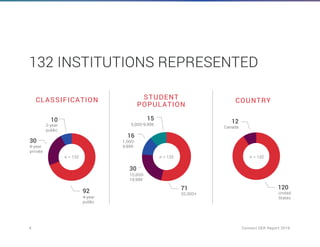
132 INSTITUTIONS REPRESENTED
United
States
Canada
120
12
4-year
public
2-year
public
4-year
private
92
30
10
20,000+
1,000-
4,999
5,000-9,999
10,000-
19,999
71
30
16
15
n = 132 n = 132 n = 132
Connect OER Report 2019	 5
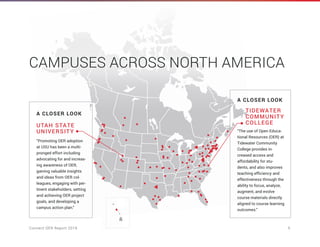
“The use of Open Educa-
tional Resources (OER) at
Tidewater Community
College provides in-
creased access and
affordability for stu-
dents, and also improves
teaching efficiency and
effectiveness through the
ability to focus, analyze,
augment, and evolve
course materials directly
aligned to course learning
outcomes.”
A CLOSER LOOK
TIDEWATER
COMMUNITY
COLLEGE
CAMPUSES ACROSS NORTH AMERICA
“Promoting OER adoption
at USU has been a multi-
pronged effort including
advocating for and increas-
ing awareness of OER,
gaining valuable insights
and ideas from OER col-
leagues, engaging with per-
tinent stakeholders, setting
and achieving OER project
goals, and developing a
campus action plan.”
A CLOSER LOOK
UTAH STATE
UNIVERSITY
6	 Connect OER Report 2019
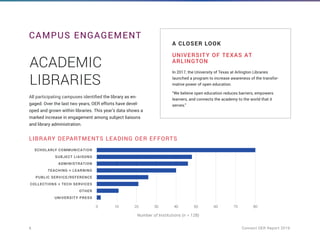
LIBRARY DEPARTMENTS LEADING OER EFFORTS
CAMPUS ENGAGEMENT
All participating campuses identified the library as en-
gaged. Over the last two years, OER efforts have devel-
oped and grown within libraries. This year’s data shows a
marked increase in engagement among subject liaisons
and library administration.
In 2017, the University of Texas at Arlington Libraries
launched a program to increase awareness of the transfor-
mative power of open education.
“We believe open education reduces barriers, empowers
learners, and connects the academy to the world that it
serves.”
A CLOSER LOOK
UNIVERSITY OF TEXAS AT
ARLINGTON
ACADEMIC
LIBRARIES
Number of Institutions (n = 128)
Connect OER Report 2019	 7
BEYOND LIBRARIES
CAMPUS ENGAGEMENT
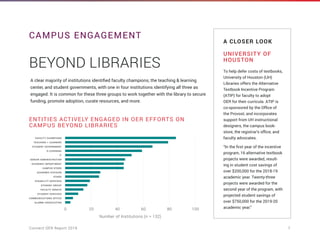
A clear majority of institutions identified faculty champions, the teaching & learning
center, and student governments, with one in four institutions identifying all three as
engaged. It is common for these three groups to work together with the library to secure
funding, promote adoption, curate resources, and more.
To help defer costs of textbooks,
University of Houston (UH)
Libraries offers the Alternative
Textbook Incentive Program
(ATIP) for faculty to adopt
OER for their curricula. ATIP is
co-sponsored by the Office of
the Provost, and incorporates
support from UH instructional
designers, the campus book-
store, the registrar’s office, and
faculty advocates.
“In the first year of the incentive
program, 16 alternative textbook
projects were awarded, result-
ing in student cost savings of
over $200,000 for the 2018-19
academic year. Twenty-three
projects were awarded for the
second year of the program, with
projected student savings of
over $750,000 for the 2019-20
academic year.”
A CLOSER LOOK
UNIVERSITY OF
HOUSTON
ENTITIES ACTIVELY ENGAGED IN OER EFFORTS ON
CAMPUS BEYOND LIBRARIES
Number of Institutions (n = 132)
8	 Connect OER Report 2019
2018-2019
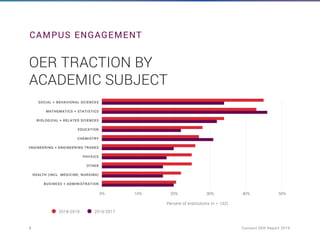
OER TRACTION BY
ACADEMIC SUBJECT
2016-2017
CAMPUS ENGAGEMENT
Percent of Institutions (n = 132)
Connect OER Report 2019	 9
OER FACULTY + STAFF POSITIONS
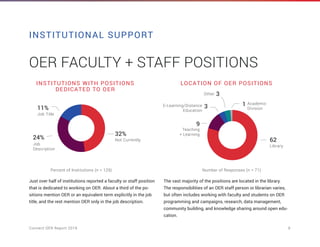
Just over half of institutions reported a faculty or staff position
that is dedicated to working on OER. About a third of the po-
sitions mention OER or an equivalent term explicitly in the job
title, and the rest mention OER only in the job description.
The vast majority of the positions are located in the library.
The responsibilities of an OER staff person or librarian varies,
but often includes working with faculty and students on OER
programming and campaigns, research, data management,
community building, and knowledge sharing around open edu-
cation.
INSTITUTIONS WITH POSITIONS
DEDICATED TO OER
LOCATION OF OER POSITIONS
Not Currently
Job Title
32%
11%
Job
Description
24%
Library
Academic
Division
E-Learning/Distance
Education
Other
62
3 1
3
Teaching
+ Learning
9
INSTITUTIONAL SUPPORT
Number of Responses (n = 71)Percent of Institutions (n = 129)
10	 Connect OER Report 2019
INSTITUTIONAL SUPPORT
OER TASK FORCES
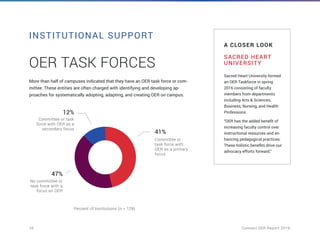
More than half of campuses indicated that they have an OER task force or com-
mittee. These entities are often charged with identifying and developing ap-
proaches for systematically adopting, adapting, and creating OER on campus.
Sacred Heart University formed
an OER Taskforce in spring
2016 consisting of faculty
members from departments
including Arts & Sciences,
Business, Nursing, and Health
Professions.
“OER has the added benefit of
increasing faculty control over
instructional resources and en-
hancing pedagogical practices.
These holistic benefits drive our
advocacy efforts forward.”
A CLOSER LOOK
SACRED HEART
UNIVERSITY
Committee or
task force with
OER as a primary
focus
41%
No committee or
task force with a
focus on OER
Committee or task
force with OER as a
secondary focus
47%
12%
Percent of Institutions (n = 129)
Connect OER Report 2019	 11
INSTITUTIONAL SUPPORT
COMMUNITY COLLEGESALL INSTITUTIONS
OER DEGREES
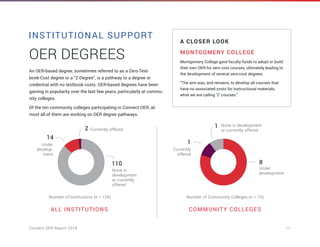
An OER-based degree, sometimes referred to as a Zero-Text-
book-Cost degree or a “Z-Degree”, is a pathway to a degree or
credential with no textbook costs. OER-based degrees have been
gaining in popularity over the last few years, particularly at commu-
nity colleges.
Of the ten community colleges participating in Connect OER, al-
most all of them are working on OER degree pathways.
Montgomery College gave faculty funds to adopt or build
their own OER for zero cost courses, ultimately leading to
the development of several zero-cost degrees.
“The aim was, and remains, to develop all courses that
have no associated costs for instructional materials,
what we are calling ‘Z’ courses.”
A CLOSER LOOK
MONTGOMERY COLLEGE
Under
development
None in development
or currently offered
Currently
offered
8
1
1
None in
development
or currently
offered
Currently offered
Under
develop-
ment
110
14
2
Number of Institutions (n = 126) Number of Community Colleges (n = 10)
12	 Connect OER Report 2019
INSTITUTIONAL SUPPORT
OER COURSE MARKINGS
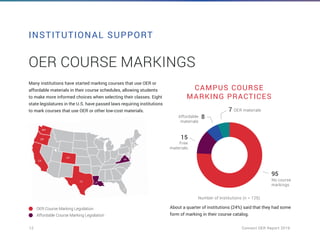
Many institutions have started marking courses that use OER or
affordable materials in their course schedules, allowing students
to make more informed choices when selecting their classes. Eight
state legislatures in the U.S. have passed laws requiring institutions
to mark courses that use OER or other low-cost materials.
About a quarter of institutions (24%) said that they had some
form of marking in their course catalog.
No course
markings
Affordable
materials
OER materials
Free
materials
95
15
8
7
OER Course Marking Legislation
Affordable Course Marking Legislation
CAMPUS COURSE
MARKING PRACTICES
Number of Institutions (n = 125)
Connect OER Report 2019	 13
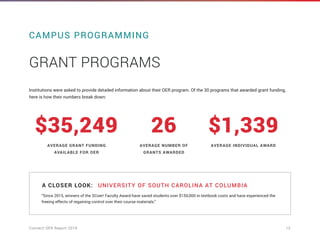
Institutions were asked to provide detailed information about their OER program. Of the 30 programs that awarded grant funding,
here is how their numbers break down:
AVERAGE GRANT FUNDING
AVAILABLE FOR OER
$35,249
AVERAGE NUMBER OF
GRANTS AWARDED
26
AVERAGE INDIVIDUAL AWARD
$1,339
GRANT PROGRAMS
“Since 2015, winners of the SCoer! Faculty Award have saved students over $150,000 in textbook costs and have experienced the
freeing effects of regaining control over their course materials.”
A CLOSER LOOK: UNIVERSITY OF SOUTH CAROLINA AT COLUMBIA
CAMPUS PROGRAMMING
14	 Connect OER Report 2019
CAMPUS PROGRAMMING
PROGRAM INCENTIVES
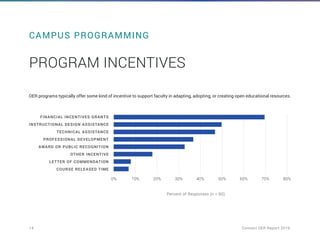
OER programs typically offer some kind of incentive to support faculty in adapting, adopting, or creating open educational resources.
Percent of Responses (n = 60)
Connect OER Report 2019	 15
CAMPUS PROGRAMMING
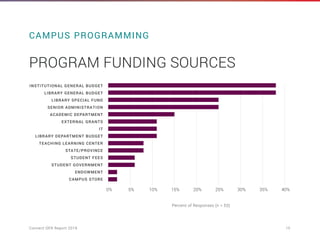
PROGRAM FUNDING SOURCES
Percent of Responses (n = 53)
16	 Connect OER Report 2019
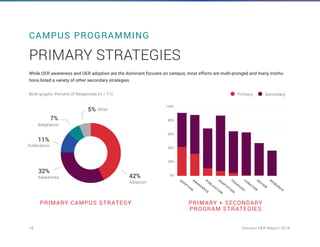
While OER awareness and OER adoption are the dominant focuses on campus, most efforts are multi-pronged and many institu-
tions listed a variety of other secondary strategies.
CAMPUS PROGRAMMING
PRIMARY CAMPUS STRATEGY PRIMARY + SECONDARY
PROGRAM STRATEGIES
PRIMARY STRATEGIES
Adoption
42%Awareness
Publication
Adaptation
Other
32%
11%
7%
5%
Primary SecondaryBoth graphs: Percent of Responses (n = 71)
Author:
Mo Nyamweya
Open Education Coordinator
mo@sparcopen.org
@MoNyamweya
21 Dupont Circle NW, Suite 800
Washington, DC, 20036 USA
www.sparcopen.org
Design by Kim Henze
This work by SPARC is licensed under a Creative Commons Attribution 4.0 International License.

Connect OER Annual Report, 2018-2019

  • 1.
  • 2.
    2 Connect OERReport 2019 ABOUT CONNECT OER Connect OER is SPARC’s platform to share and discover in- formation about Open Educational Resources (OER) activi- ties at campuses across North America. Through Connect OER, academic libraries create and manage profiles about their institution’s efforts on OER, producing valuable data that we use to populate a searchable directory and produce an annual report. SPARC launched Connect OER in 2017 in response to demand from our community. Join Connect OER: To search the Connect OER directory or to join and create a profile for your institution, visit connect.sparcopen.org.
  • 3.
    Connect OER Report2019 3 ABOUT THIS REPORT This report offers a snapshot of the state of OER activities at participating institutions as of the end of the 2018- 2019 academic year. Our intent is that these insights will help inform SPARC members, open education advocates, and the library community at large about current trends, best practices, and the collective impact being achieved through OER at participating institutions. The data underlying this report was collected through the Connect OER platform between July 2017 and August 2019. Analysis was performed by the SPARC team. A full open dataset with data tables is published at connect.sparcopen.org. *Data collected excluded the answer options “other” and “none”.
  • 4.
    4 Connect OERReport 2019 CLASSIFICATION STUDENT POPULATION COUNTRY 132 INSTITUTIONS REPRESENTED United States Canada 120 12 4-year public 2-year public 4-year private 92 30 10 20,000+ 1,000- 4,999 5,000-9,999 10,000- 19,999 71 30 16 15 n = 132 n = 132 n = 132
  • 5.
    Connect OER Report2019 5 “The use of Open Educa- tional Resources (OER) at Tidewater Community College provides in- creased access and affordability for stu- dents, and also improves teaching efficiency and effectiveness through the ability to focus, analyze, augment, and evolve course materials directly aligned to course learning outcomes.” A CLOSER LOOK TIDEWATER COMMUNITY COLLEGE CAMPUSES ACROSS NORTH AMERICA “Promoting OER adoption at USU has been a multi- pronged effort including advocating for and increas- ing awareness of OER, gaining valuable insights and ideas from OER col- leagues, engaging with per- tinent stakeholders, setting and achieving OER project goals, and developing a campus action plan.” A CLOSER LOOK UTAH STATE UNIVERSITY
  • 6.
    6 Connect OERReport 2019 LIBRARY DEPARTMENTS LEADING OER EFFORTS CAMPUS ENGAGEMENT All participating campuses identified the library as en- gaged. Over the last two years, OER efforts have devel- oped and grown within libraries. This year’s data shows a marked increase in engagement among subject liaisons and library administration. In 2017, the University of Texas at Arlington Libraries launched a program to increase awareness of the transfor- mative power of open education. “We believe open education reduces barriers, empowers learners, and connects the academy to the world that it serves.” A CLOSER LOOK UNIVERSITY OF TEXAS AT ARLINGTON ACADEMIC LIBRARIES Number of Institutions (n = 128)
  • 7.
    Connect OER Report2019 7 BEYOND LIBRARIES CAMPUS ENGAGEMENT A clear majority of institutions identified faculty champions, the teaching & learning center, and student governments, with one in four institutions identifying all three as engaged. It is common for these three groups to work together with the library to secure funding, promote adoption, curate resources, and more. To help defer costs of textbooks, University of Houston (UH) Libraries offers the Alternative Textbook Incentive Program (ATIP) for faculty to adopt OER for their curricula. ATIP is co-sponsored by the Office of the Provost, and incorporates support from UH instructional designers, the campus book- store, the registrar’s office, and faculty advocates. “In the first year of the incentive program, 16 alternative textbook projects were awarded, result- ing in student cost savings of over $200,000 for the 2018-19 academic year. Twenty-three projects were awarded for the second year of the program, with projected student savings of over $750,000 for the 2019-20 academic year.” A CLOSER LOOK UNIVERSITY OF HOUSTON ENTITIES ACTIVELY ENGAGED IN OER EFFORTS ON CAMPUS BEYOND LIBRARIES Number of Institutions (n = 132)
  • 8.
    8 Connect OERReport 2019 2018-2019 OER TRACTION BY ACADEMIC SUBJECT 2016-2017 CAMPUS ENGAGEMENT Percent of Institutions (n = 132)
  • 9.
    Connect OER Report2019 9 OER FACULTY + STAFF POSITIONS Just over half of institutions reported a faculty or staff position that is dedicated to working on OER. About a third of the po- sitions mention OER or an equivalent term explicitly in the job title, and the rest mention OER only in the job description. The vast majority of the positions are located in the library. The responsibilities of an OER staff person or librarian varies, but often includes working with faculty and students on OER programming and campaigns, research, data management, community building, and knowledge sharing around open edu- cation. INSTITUTIONS WITH POSITIONS DEDICATED TO OER LOCATION OF OER POSITIONS Not Currently Job Title 32% 11% Job Description 24% Library Academic Division E-Learning/Distance Education Other 62 3 1 3 Teaching + Learning 9 INSTITUTIONAL SUPPORT Number of Responses (n = 71)Percent of Institutions (n = 129)
  • 10.
    10 Connect OERReport 2019 INSTITUTIONAL SUPPORT OER TASK FORCES More than half of campuses indicated that they have an OER task force or com- mittee. These entities are often charged with identifying and developing ap- proaches for systematically adopting, adapting, and creating OER on campus. Sacred Heart University formed an OER Taskforce in spring 2016 consisting of faculty members from departments including Arts & Sciences, Business, Nursing, and Health Professions. “OER has the added benefit of increasing faculty control over instructional resources and en- hancing pedagogical practices. These holistic benefits drive our advocacy efforts forward.” A CLOSER LOOK SACRED HEART UNIVERSITY Committee or task force with OER as a primary focus 41% No committee or task force with a focus on OER Committee or task force with OER as a secondary focus 47% 12% Percent of Institutions (n = 129)
  • 11.
    Connect OER Report2019 11 INSTITUTIONAL SUPPORT COMMUNITY COLLEGESALL INSTITUTIONS OER DEGREES An OER-based degree, sometimes referred to as a Zero-Text- book-Cost degree or a “Z-Degree”, is a pathway to a degree or credential with no textbook costs. OER-based degrees have been gaining in popularity over the last few years, particularly at commu- nity colleges. Of the ten community colleges participating in Connect OER, al- most all of them are working on OER degree pathways. Montgomery College gave faculty funds to adopt or build their own OER for zero cost courses, ultimately leading to the development of several zero-cost degrees. “The aim was, and remains, to develop all courses that have no associated costs for instructional materials, what we are calling ‘Z’ courses.” A CLOSER LOOK MONTGOMERY COLLEGE Under development None in development or currently offered Currently offered 8 1 1 None in development or currently offered Currently offered Under develop- ment 110 14 2 Number of Institutions (n = 126) Number of Community Colleges (n = 10)
  • 12.
    12 Connect OERReport 2019 INSTITUTIONAL SUPPORT OER COURSE MARKINGS Many institutions have started marking courses that use OER or affordable materials in their course schedules, allowing students to make more informed choices when selecting their classes. Eight state legislatures in the U.S. have passed laws requiring institutions to mark courses that use OER or other low-cost materials. About a quarter of institutions (24%) said that they had some form of marking in their course catalog. No course markings Affordable materials OER materials Free materials 95 15 8 7 OER Course Marking Legislation Affordable Course Marking Legislation CAMPUS COURSE MARKING PRACTICES Number of Institutions (n = 125)
  • 13.
    Connect OER Report2019 13 Institutions were asked to provide detailed information about their OER program. Of the 30 programs that awarded grant funding, here is how their numbers break down: AVERAGE GRANT FUNDING AVAILABLE FOR OER $35,249 AVERAGE NUMBER OF GRANTS AWARDED 26 AVERAGE INDIVIDUAL AWARD $1,339 GRANT PROGRAMS “Since 2015, winners of the SCoer! Faculty Award have saved students over $150,000 in textbook costs and have experienced the freeing effects of regaining control over their course materials.” A CLOSER LOOK: UNIVERSITY OF SOUTH CAROLINA AT COLUMBIA CAMPUS PROGRAMMING
  • 14.
    14 Connect OERReport 2019 CAMPUS PROGRAMMING PROGRAM INCENTIVES OER programs typically offer some kind of incentive to support faculty in adapting, adopting, or creating open educational resources. Percent of Responses (n = 60)
  • 15.
    Connect OER Report2019 15 CAMPUS PROGRAMMING PROGRAM FUNDING SOURCES Percent of Responses (n = 53)
  • 16.
    16 Connect OERReport 2019 While OER awareness and OER adoption are the dominant focuses on campus, most efforts are multi-pronged and many institu- tions listed a variety of other secondary strategies. CAMPUS PROGRAMMING PRIMARY CAMPUS STRATEGY PRIMARY + SECONDARY PROGRAM STRATEGIES PRIMARY STRATEGIES Adoption 42%Awareness Publication Adaptation Other 32% 11% 7% 5% Primary SecondaryBoth graphs: Percent of Responses (n = 71)
  • 17.
    Author: Mo Nyamweya Open EducationCoordinator mo@sparcopen.org @MoNyamweya 21 Dupont Circle NW, Suite 800 Washington, DC, 20036 USA www.sparcopen.org Design by Kim Henze This work by SPARC is licensed under a Creative Commons Attribution 4.0 International License.