Swelling Properties
When textile fibres absorb water, they change in dimensionally (axially &
transversely). Swelling occursin the transverse direction (width-wise) and axial
direction (length-wise) of fibre. It may be expressed in terms of the increase
in diameter, area, length or volume of a fibre. The changes in dimension due to
absorbing moisture or water by any textile fibre are termed as swelling
properties.
Swelling phenomenon of textile fibres:
The molecular chains are laying roughly parallel to the fibre axis, as a
result fibre has lower space between the adjacent chains and swelling will be
lower. When the fibres are immersed into water, the water molecules enter
into the fibre and occupy the molecular space of fibre and thus push the fibre
chains. As a result, there will be a considerable increase in diameter of the
fibre but very little increases in length.
Importance/Effects of Swelling on textile material:
1. Swelling improves the absorption of dyes and chemicals in fibre, thus
fastness of dyed material is improved
2. Due to swelling the pores of closely interlaced woven fabric will be
completely blocked and thus it may act as water proof fabric.
3. Swelling changes the dimensional stability of fabric.
4. Swelling changes the tensile and electric properties of fibre i.e. static
electricity is reduced.
5. It has chemical consequences in the dimensional stability of the fabric, the
predominant transverse swelling results in shrinkage.
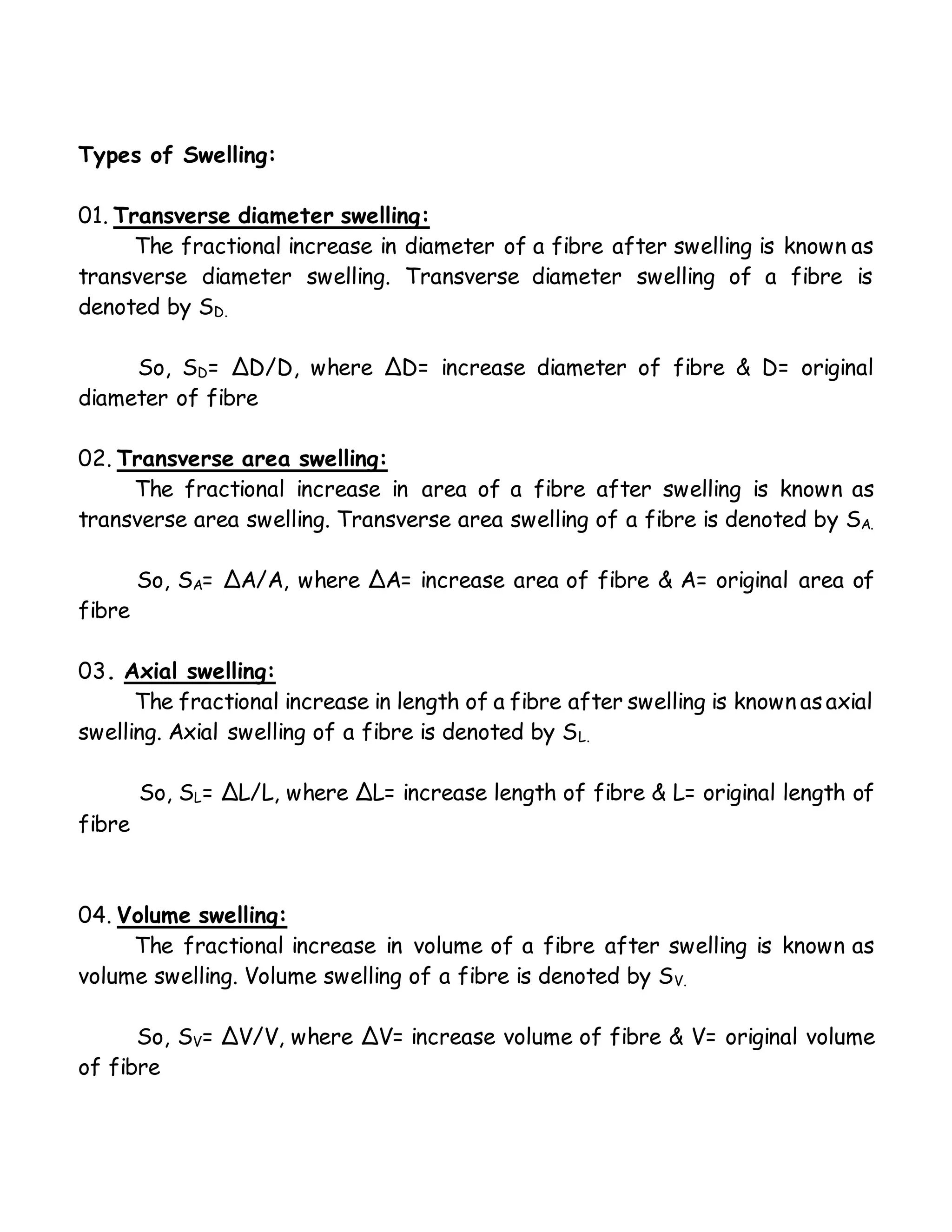
Types of Swelling:
01. Transverse diameter swelling:
The fractional increase in diameter of a fibre after swelling is known as
transverse diameter swelling. Transverse diameter swelling of a fibre is
denoted by SD.
So, SD= ΔD/D, where ΔD= increase diameter of fibre & D= original
diameter of fibre
02. Transverse area swelling:
The fractional increase in area of a fibre after swelling is known as
transverse area swelling. Transverse area swelling of a fibre is denoted by SA.
So, SA= ΔA/A, where ΔA= increase area of fibre & A= original area of
fibre
03. Axial swelling:
The fractional increase in length of a fibre after swelling is known asaxial
swelling. Axial swelling of a fibre is denoted by SL.
So, SL= ΔL/L, where ΔL= increase length of fibre & L= original length of
fibre
04. Volume swelling:
The fractional increase in volume of a fibre after swelling is known as
volume swelling. Volume swelling of a fibre is denoted by SV.
So, SV= ΔV/V, where ΔV= increase volume of fibre & V= original volume
of fibre
ΔL
Relationship among volume swelling (SV), transverse area swelling (SA) &
Axial swelling (SL): Sv = SA + SL + SA. SL
Relationship between transverse diameter swelling (SD) & transverse area
swelling (SA): SA = 2.SD + SD
2
[Ref: Physical Properties of Textile Fibres- by W.E. Morton
Chapter-11,Swelling]
Swelling (%) of different fibres:
Fibre
Transverse
dia.
swelling %
(SD)
Transverse
area swelling %
(SA)
Axial
swelling
% (SL)
Volume
swelling
% (SV)
Cotton 20 40 - -
Flax 20 47 0.1 -
Jute 20 40 - -
Viscose
rayon
35 67 3.7 119
Wool 14.8 25 - 37
Silk 16.5 19 1.6 30
Nylon 1.9 1.6 2.7 8.1
A
A+ΔA
D
L
D+ΔD
V V+ΔV
Swollen fibre
Original fibre
D+ΔD

Swelling Properties of Textile Fibers

  • 1.
    Swelling Properties When textilefibres absorb water, they change in dimensionally (axially & transversely). Swelling occursin the transverse direction (width-wise) and axial direction (length-wise) of fibre. It may be expressed in terms of the increase in diameter, area, length or volume of a fibre. The changes in dimension due to absorbing moisture or water by any textile fibre are termed as swelling properties. Swelling phenomenon of textile fibres: The molecular chains are laying roughly parallel to the fibre axis, as a result fibre has lower space between the adjacent chains and swelling will be lower. When the fibres are immersed into water, the water molecules enter into the fibre and occupy the molecular space of fibre and thus push the fibre chains. As a result, there will be a considerable increase in diameter of the fibre but very little increases in length. Importance/Effects of Swelling on textile material: 1. Swelling improves the absorption of dyes and chemicals in fibre, thus fastness of dyed material is improved 2. Due to swelling the pores of closely interlaced woven fabric will be completely blocked and thus it may act as water proof fabric. 3. Swelling changes the dimensional stability of fabric. 4. Swelling changes the tensile and electric properties of fibre i.e. static electricity is reduced. 5. It has chemical consequences in the dimensional stability of the fabric, the predominant transverse swelling results in shrinkage.
  • 2.
    Types of Swelling: 01.Transverse diameter swelling: The fractional increase in diameter of a fibre after swelling is known as transverse diameter swelling. Transverse diameter swelling of a fibre is denoted by SD. So, SD= ΔD/D, where ΔD= increase diameter of fibre & D= original diameter of fibre 02. Transverse area swelling: The fractional increase in area of a fibre after swelling is known as transverse area swelling. Transverse area swelling of a fibre is denoted by SA. So, SA= ΔA/A, where ΔA= increase area of fibre & A= original area of fibre 03. Axial swelling: The fractional increase in length of a fibre after swelling is known asaxial swelling. Axial swelling of a fibre is denoted by SL. So, SL= ΔL/L, where ΔL= increase length of fibre & L= original length of fibre 04. Volume swelling: The fractional increase in volume of a fibre after swelling is known as volume swelling. Volume swelling of a fibre is denoted by SV. So, SV= ΔV/V, where ΔV= increase volume of fibre & V= original volume of fibre
  • 3.
    ΔL Relationship among volumeswelling (SV), transverse area swelling (SA) & Axial swelling (SL): Sv = SA + SL + SA. SL Relationship between transverse diameter swelling (SD) & transverse area swelling (SA): SA = 2.SD + SD 2 [Ref: Physical Properties of Textile Fibres- by W.E. Morton Chapter-11,Swelling] Swelling (%) of different fibres: Fibre Transverse dia. swelling % (SD) Transverse area swelling % (SA) Axial swelling % (SL) Volume swelling % (SV) Cotton 20 40 - - Flax 20 47 0.1 - Jute 20 40 - - Viscose rayon 35 67 3.7 119 Wool 14.8 25 - 37 Silk 16.5 19 1.6 30 Nylon 1.9 1.6 2.7 8.1 A A+ΔA D L D+ΔD V V+ΔV Swollen fibre Original fibre D+ΔD