Space Elevator
Module Outcomes What is a space elevator, and  why would it be so useful?  What sort of material could we build a space elevator from? Why do different materials have different properties?  What are carbon nanotubes, and how can we learn about them? In this module we will address the following questions: Images: Benuzter:Scharm@wikipedia
Space Elevator Concept Artist Pat Rawlings concept of a space elevator viewed from the geostationary transfer station looking down along the length of the elevator toward Earth. Image: Courtesy Pat Rawlings
What If You Could Build A Stairway To The Moon? Image: © Dorling Kindersley
What If A Path To The Stars Was Paved In Carbon?  Image: © Dorling Kindersley
Houston, We Have A Problem… Image: © Dorling Kindersley On 20 May the toilet broke down on the International Space Station….. It wasn’t until 5 June that a shuttle arrived with the parts needed to repair the toilet. That’s a very long time to wait. Imagine if the astronauts and cosmonauts were running out of water, or air?  How could the repair parts be delivered to them in time?
Space Elevator: A New Way To Reach The Stars The Space Elevator is a cable-like tool which could connect the Earth with a fixed structure in outer space. - It would provide a permanent link between Earth and outer space. Image:  Courtesy The Enterprise Mission
Let’s Learn More About Space Elevators View the  Space Elevator animation  and then conduct research as guided by your teacher. Image: Courtesy Pat Rawlings
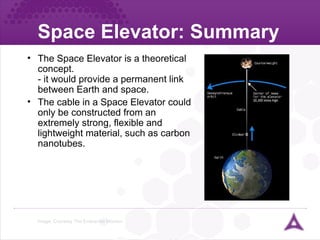
Space Elevator: Summary Image: Courtesy The Enterprise Mission The Space Elevator is a theoretical concept. - it would provide a permanent link between Earth and space. The cable in a Space Elevator could only be constructed from an  extremely strong, flexible and lightweight material, such as carbon nanotubes.
Activities Activity 1 – T-Chart Examine the Space Elevator concept further by using the T chart to compare current technologies with the Space Elevator Activity 2 – KWLH Start the process of researching the Space Elevator in preparation for a later performance activity using the KWLH chart
Properties Of Carbon Nanotubes Image:  [email_address] Strong –  200 times stronger than steel. –  the first synthetic material to have greater strength than spider silk. Light –  1 square kilometre = 30kg Flexible –  Compared to most materials. Heat resistant – resists burning like a metal.
Carbon Nanotubes? Image:  [email_address] How can we explain the properties of carbon nanotubes? What about other forms of carbon?
Experiment 1  Forms Of Carbon Use these molecular images to do the  Forms of Carbon  Experiment Image:  [email_address]
Forms Of Carbon: Nanotubes Images Top to Bottom:  Mstroeck@wikipedia, Pat Rawlings Properties:  strong, light, metal-like Molecular structure:  carbon atoms in regular, tubular structure Application:  space elevator cable
Forms Of Carbon: Buckyball Images Top to Bottom:  Mstroeck@wikipedia, compujeramy@flickr Properties:  light, semi-conductor or superconductor Molecular structure:  carbon atoms in regular, circular structure Application:  improved electronics
Forms Of Carbon: Diamond Images Clockwise:  betsssssy@flickr, swamibu@flickr, wikipedia Properties:  hard, clear, disperses light Molecular structure:  carbon atoms in crystal structure Application:  drill bits, jewellery
Forms Of Carbon: Graphite Images Clockwise:  Wikipedia ,  orangeacid@flickr,  compujeramey @flickr,  [email_address]   Properties:  light, super lubricating,  conductor Molecular structure:    sheets of carbon atoms in  regular, flat structure Application:  pencil, sport equipment,  electronics
Space Elevator: Performance Image: emeryjl@flickr Write and perform a 5-10 minute drama that will teach other students and adults about space elevators and carbon nanotubes. Groups of 5 Performance must include at least 10 scientific facts Be creative!
Could You Win? Image:  spaceward.org Currently The Spaceward Foundation is running two competitions to design the space elevator. A total of US$ 4 million is up for grabs. Design either the climber (the elevator unit) or the tether (the “string”)
Activity 3 - Performance Create a performance to teach others about the Space Elevator and Carbon Nanotubes.
Summary The Space Elevator is a new concept possible due to nanotechnology Carbon nanotubes are a form of carbon, and have unique properties which can be explained by understanding their molecular structure With proper referencing, the internet can be used as a first ‘port of call’ for new information and research
Revision Why do scientists want to design a space elevator? Carbon nanotubes would be an important construction material in the space elevator. Explain how and why they would be used. List as many different types of carbon that you can. What causes the types of carbon to have different properties?
 

Space Elevator Module

  • 1.
  • 2.
    Module Outcomes Whatis a space elevator, and why would it be so useful? What sort of material could we build a space elevator from? Why do different materials have different properties? What are carbon nanotubes, and how can we learn about them? In this module we will address the following questions: Images: Benuzter:Scharm@wikipedia
  • 3.
    Space Elevator ConceptArtist Pat Rawlings concept of a space elevator viewed from the geostationary transfer station looking down along the length of the elevator toward Earth. Image: Courtesy Pat Rawlings
  • 4.
    What If YouCould Build A Stairway To The Moon? Image: © Dorling Kindersley
  • 5.
    What If APath To The Stars Was Paved In Carbon? Image: © Dorling Kindersley
  • 6.
    Houston, We HaveA Problem… Image: © Dorling Kindersley On 20 May the toilet broke down on the International Space Station….. It wasn’t until 5 June that a shuttle arrived with the parts needed to repair the toilet. That’s a very long time to wait. Imagine if the astronauts and cosmonauts were running out of water, or air? How could the repair parts be delivered to them in time?
  • 7.
    Space Elevator: ANew Way To Reach The Stars The Space Elevator is a cable-like tool which could connect the Earth with a fixed structure in outer space. - It would provide a permanent link between Earth and outer space. Image: Courtesy The Enterprise Mission
  • 8.
    Let’s Learn MoreAbout Space Elevators View the Space Elevator animation and then conduct research as guided by your teacher. Image: Courtesy Pat Rawlings
  • 9.
    Space Elevator: SummaryImage: Courtesy The Enterprise Mission The Space Elevator is a theoretical concept. - it would provide a permanent link between Earth and space. The cable in a Space Elevator could only be constructed from an extremely strong, flexible and lightweight material, such as carbon nanotubes.
  • 10.
    Activities Activity 1– T-Chart Examine the Space Elevator concept further by using the T chart to compare current technologies with the Space Elevator Activity 2 – KWLH Start the process of researching the Space Elevator in preparation for a later performance activity using the KWLH chart
  • 11.
    Properties Of CarbonNanotubes Image: [email_address] Strong – 200 times stronger than steel. – the first synthetic material to have greater strength than spider silk. Light – 1 square kilometre = 30kg Flexible – Compared to most materials. Heat resistant – resists burning like a metal.
  • 12.
    Carbon Nanotubes? Image: [email_address] How can we explain the properties of carbon nanotubes? What about other forms of carbon?
  • 13.
    Experiment 1 Forms Of Carbon Use these molecular images to do the Forms of Carbon Experiment Image: [email_address]
  • 14.
    Forms Of Carbon:Nanotubes Images Top to Bottom: Mstroeck@wikipedia, Pat Rawlings Properties: strong, light, metal-like Molecular structure: carbon atoms in regular, tubular structure Application: space elevator cable
  • 15.
    Forms Of Carbon:Buckyball Images Top to Bottom: Mstroeck@wikipedia, compujeramy@flickr Properties: light, semi-conductor or superconductor Molecular structure: carbon atoms in regular, circular structure Application: improved electronics
  • 16.
    Forms Of Carbon:Diamond Images Clockwise: betsssssy@flickr, swamibu@flickr, wikipedia Properties: hard, clear, disperses light Molecular structure: carbon atoms in crystal structure Application: drill bits, jewellery
  • 17.
    Forms Of Carbon:Graphite Images Clockwise: Wikipedia , orangeacid@flickr, compujeramey @flickr, [email_address] Properties: light, super lubricating, conductor Molecular structure: sheets of carbon atoms in regular, flat structure Application: pencil, sport equipment, electronics
  • 18.
    Space Elevator: PerformanceImage: emeryjl@flickr Write and perform a 5-10 minute drama that will teach other students and adults about space elevators and carbon nanotubes. Groups of 5 Performance must include at least 10 scientific facts Be creative!
  • 19.
    Could You Win?Image: spaceward.org Currently The Spaceward Foundation is running two competitions to design the space elevator. A total of US$ 4 million is up for grabs. Design either the climber (the elevator unit) or the tether (the “string”)
  • 20.
    Activity 3 -Performance Create a performance to teach others about the Space Elevator and Carbon Nanotubes.
  • 21.
    Summary The SpaceElevator is a new concept possible due to nanotechnology Carbon nanotubes are a form of carbon, and have unique properties which can be explained by understanding their molecular structure With proper referencing, the internet can be used as a first ‘port of call’ for new information and research
  • 22.
    Revision Why doscientists want to design a space elevator? Carbon nanotubes would be an important construction material in the space elevator. Explain how and why they would be used. List as many different types of carbon that you can. What causes the types of carbon to have different properties?
  • 23.

Editor's Notes

  • #2 Shape Memory Alloy module - Title Page
  • #3 Image from http://en.wikipedia.org/wiki/Image:Kohlenstoffnanoroehre_Animation.gif, GNU free documentation license by http://de.wikipedia.org/wiki/Benutzer:Schwarzm
  • #4 Artist Pat Rawling's ( http://www.patrawlings.com) concept of a space elevator viewed from the geostationary transfer station looking down along the length of the elevator toward Earth.
  • #5 http://www.dorlingkindersley-uk.co.uk/static/cs/uk/11/clipart/
  • #6 http://www.dorlingkindersley-uk.co.uk/static/cs/uk/11/clipart/
  • #7 Image thanks to Dorling Kindersley http://www.dorlingkindersley-uk.co.uk/
  • #8 http://www.enterprisemission.com/
  • #9 Research can be based on the questions how, what, when, where and why. Students should formulate these questions.
  • #10 http://www.enterprisemission.com/
  • #12 Nanotube image from http://en.wikipedia.org/wiki/Image:Eight_Allotropes_of_Carbon.png, GNU free documentation license, courtesy of Michael Strock http://en.wikipedia.org/wiki/User:Mstroeck Reference for weight info: K. Banerjee and N. Srivastava, "Are Carbon Nanotubes the future of VLSI Interconnections?", ACM Design Automation Conference, 2006, pp. 809-814.
  • #13 Image thanks to http://www.flickr.com/photos/erikcharlton/2303709058/ (creative commons license)
  • #14 Nanotube image from http://en.wikipedia.org/wiki/Image:Eight_Allotropes_of_Carbon.png, GNU free documentation license, courtesy of Michael Strock http://en.wikipedia.org/wiki/User:Mstroeck Teachers should emphasize awareness of the concept that molecular structure determines properties and therefore function Movable 3D models of carbon allotropes can be viewed here: http://www.creative-chemistry.org.uk/molecules/carbon.htm This website also very useful: http://mrsec.wisc.edu/Edetc/cineplex/nanotube/index.html
  • #15 Images: Nanotube image from http://en.wikipedia.org/wiki/Image:Eight_Allotropes_of_Carbon.png, GNU free documentation license, courtesy of Michael Strock http://en.wikipedia.org/wiki/User:Mstroeck http://inventorspot.com/articles/space_elevator_competition_shows_7648 Artist Pat Rawling's ( http://www.patrawlings.com) concept of a space elevator viewed from the geostationary transfer station looking down along the length of the elevator toward Earth.
  • #16 Images: Both structure images from http://en.wikipedia.org/wiki/Fullerene Phone image http://www.flickr.com/photos/compujeramey/168108824/ (creative commons license)
  • #17 Structure image from http://en.wikipedia.org/wiki/Image:Diamond_and_graphite.jpg Dentist image (http://www.flickr.com/photos/betsssssy/530507000/) and d iamond image http://www.flickr.com/photos/swamibu/1182138940/ (creative commons license)
  • #18 Structure image from http://en.wikipedia.org/wiki/Image:Diamond_and_graphite.jpg Tennis image thanks to http://www.flickr.com/photos/stuseeger/2419642327/ (creative commons license) Pencil image thanks to http://www.flickr.com/photos/orangeacid/204163563/ (creative commons license) Phone image http://www.flickr.com/photos/compujeramey/168108824/ (creative commons license)
  • #19 Image thanks to http://www.flickr.com/photos/emeryjl/511012252/ (creative commons license)
  • #20 Info and images from http://www.spaceward.org/elevator2010
  • #24 End title