Health & Medicine Nanogold
Module Outcomes Understand the importance of developing a rapid diagnostic test for meningitis Understand how nanotechnology can improve the sensitivity of medical diagnostics Be familiar with the characteristics of nanoparticulate gold Identify recent developments in nanotechnology and how they may benefit human health.
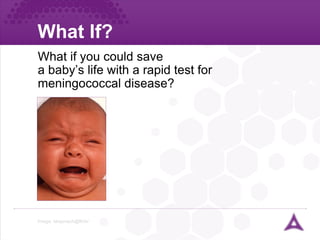
What If? Image: bbaunach@flickr What if you could save  a baby’s life with a rapid test for meningococcal disease?
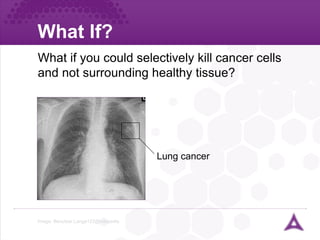
What If? Image: Benutzer:Lange123@wikipedia What if you could selectively kill cancer cells and not surrounding healthy tissue? Lung cancer
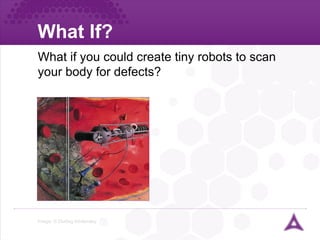
What If? Image: © Dorling Kindersley What if you could create tiny robots to scan your body for defects?
Activity 1 The following is a headline from ABC news online, August 13 2008: ‘ A 14 year-old boy has died from a suspected case of meningococcal disease on the New South Wales central coast .’ Perform the  Meningitis Activity  to learn more about this fatal disease.
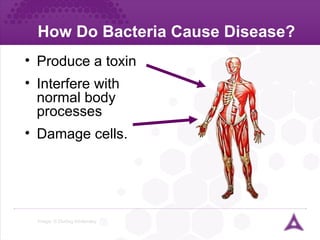
How Do Bacteria Cause Disease? Image: © Dorling Kindersley Produce a toxin Interfere with normal body processes Damage cells.
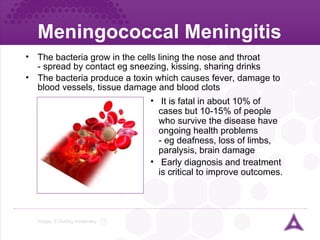
Meningococcal Meningitis Image: © Dorling Kindersley The bacteria grow in the cells lining the nose and throat - spread by contact eg sneezing, kissing, sharing drinks The bacteria produce a toxin which causes fever, damage to blood vessels, tissue damage and blood clots It is fatal in about 10% of cases but 10-15% of people who survive the disease have ongoing health problems - eg deafness, loss of limbs, paralysis, brain damage Early diagnosis and treatment is critical to improve outcomes.
Two Types Of Meningococcal Disease Meningitis - bacteria attack the meninges (lining around the brain)  - early symptom is a stiff, sore neck - meninges and brain swell, putting pressure on nerves - survivors often left deaf or with brain damage Sepsis - infection occurs throughout the bloodstream - affects the entire body - bacterial toxins rupture blood vessels and can rapidly shut down vital organs - survivors often left with permanent injuries and/or require amputations.
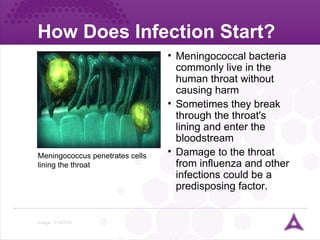
How Does Infection Start? Image: © NOVA Meningococcal bacteria commonly live in the human throat without causing harm  Sometimes they break through the throat's lining and enter the bloodstream  Damage to the throat from influenza and other infections could be a predisposing factor. Meningococcus penetrates cells lining the throat
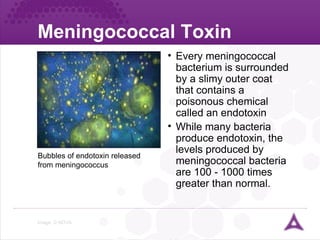
Meningococcal Toxin Image: © NOVA Every meningococcal bacterium is surrounded by a slimy outer coat that contains a poisonous chemical called an endotoxin  While many bacteria produce endotoxin, the levels produced by meningococcal bacteria are 100 - 1000 times greater than normal. Bubbles of endotoxin released from meningococcus
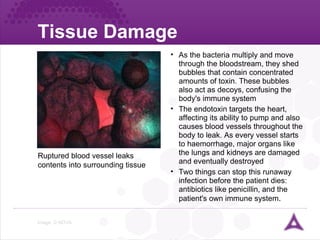
Tissue Damage Image: © NOVA Ruptured blood vessel leaks contents into surrounding tissue   As the bacteria multiply and move through the bloodstream, they shed bubbles that contain concentrated amounts of toxin. These bubbles also act as decoys, confusing the body's immune system The endotoxin targets the heart, affecting its ability to pump and also causes blood vessels throughout the body to leak. As every vessel starts to haemorrhage, major organs like the lungs and kidneys are damaged and eventually destroyed Two things can stop this runaway infection before the patient dies: antibiotics like penicillin, and the patient's own immune system .
Not All Bacteria Is Bad Image: Yakult.Honsah@wikipedia Very few bacteria are harmful, most bacteria have the following functions:  - Food production - Normally live on our bodies and stop pathogenic bacteria from growing - Help with digestion (hence dietary supplements) - Can be genetically altered to make the products we need in the laboratory e.g. vaccines, drugs.
Experiment 1  Observation Of Bacteria Perform the   Observation of Bacteria experiment   as instructed by your teacher.
How Can We Diagnose Meningitis? Current tests detect bacterial proteins in blood/other fluid - can only detect in the range of   micro)  mol (10 -6 ) to pico mol (10 -12 ) of protein concentration If we develop new tests using  gold nanoparticles  combined with DNA amplification we could detect molecule concentrations in the atto (10 -18 ) mol range  i.e. one million times more sensitive than current tests This would allow earlier detection and therefore faster medical interventions.
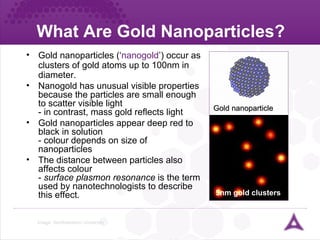
What Are Gold Nanoparticles? Image: Northwestern University Gold nanoparticles (‘ nanogold ’) occur as clusters of gold atoms up to 100nm in diameter. Nanogold has unusual visible properties because the particles are small enough to scatter visible light - in contrast, mass gold reflects light Gold nanoparticles appear deep red to black in solution - colour depends on size of nanoparticles The distance between particles also affects colour -  surface plasmon resonance  is the term used by nanotechnologists to describe this effect. 5nm gold clusters Gold nanoparticle
Experiment 2  Making Gold Nanoparticles Perform or watch a demonstration of the  Making Gold Nanoparticles Experiment  to see the differing chromic properties of nanoparticulate gold for yourself.
Animation View the  Nanoparticles Diagnostics Animation   to better understand how gold nanoparticles are used to detect bacterial meningitis  Complete a flow chart outlining the key steps in the nanoparticle diagnostic test.
Activity 2 Use the  Nick’s Test   PowerPoint presentation provided by your teacher to model the use of a nanoparticle diagnostic test in real-life Answer the questions on the last slide.
Rapid Diagnosis So nanogold can be used to rapidly diagnose meningitis… … what else can nanogold offer to  the world of medicine?
What If? Image: © Dorling Kindersley What if you could treat cancer without surgery? Imagine if you suffered from inoperable cancer. Imagine if your tumour grew in an important part of the brain.  Surgery could save your life but you would end up permanently and severely disabled. Now, imagine if there was an alternative…
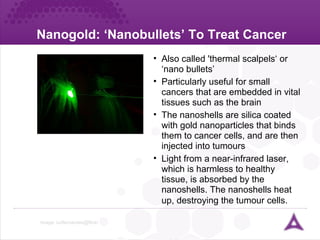
Nanogold: ‘Nanobullets’ To Treat Cancer Image: iurifernandes@flickr Also called 'thermal scalpels‘ or ‘nano bullets’ Particularly useful for small cancers that are embedded in vital tissues such as the brain The nanoshells are silica coated with gold nanoparticles that binds them to cancer cells, and are then injected into tumours Light from a near-infrared laser, which is harmless to healthy tissue, is absorbed by the nanoshells. The nanoshells heat up, destroying the tumour cells.
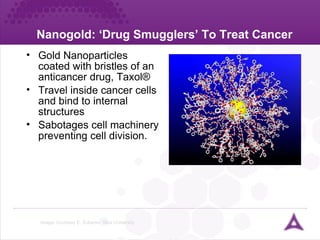
Nanogold: ‘Drug Smugglers’ To Treat Cancer Image: Courtesy E. Zubarev, Rice University Gold Nanoparticles coated with bristles of an anticancer drug, Taxol®  Travel inside cancer cells and bind to internal structures Sabotages cell machinery preventing cell division.
Activity 3 & Experiment 3 Perform the  Gold Nanobullets Activity  and the  Golden Cancer Treatment Experiment   to better understand the benefits of using nanogold to treat cancer .
But Wait! Nanogold can do more!
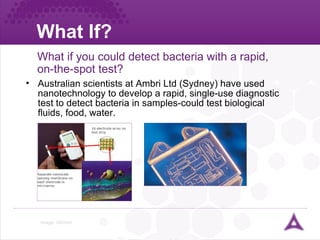
What If? Image: ©Ambri What if  you could detect bacteria with a rapid, on-the-spot test? Australian scientists at Ambri Ltd (Sydney) have used nanotechnology to develop a rapid, single-use diagnostic test to detect bacteria in samples-could test biological fluids, food, water.
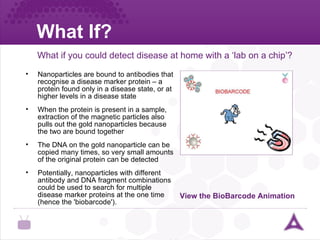
What If? What if  you could detect disease at home with a ‘lab on a chip’? Nanoparticles are bound to antibodies that recognise a disease marker protein – a protein found only in a disease state, or at higher levels in a disease state  When the protein is present in a sample, extraction of the magnetic particles also pulls out the gold nanoparticles because the two are bound together  The DNA on the gold nanoparticle can be copied many times, so very small amounts of the original protein can be detected Potentially, nanoparticles with different antibody and DNA fragment combinations could be used to search for multiple disease marker proteins at the one time (hence the 'biobarcode').  View the BioBarcode Animation
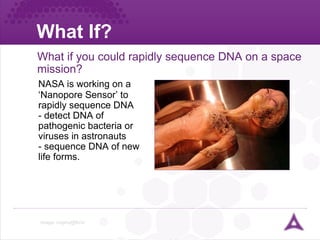
What If? What if  you could rapidly sequence DNA on a space mission? NASA is working on a ‘Nanopore Sensor’ to rapidly sequence DNA - detect DNA of pathogenic bacteria or viruses in astronauts - sequence DNA of new life forms. Image: mujitra@flickr
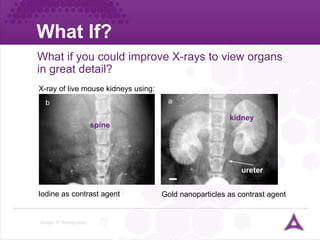
What If? What if you could improve X-rays to view organs in great detail? Image: © Nanoprobes X-ray of live mouse kidneys using: Iodine as contrast agent Gold nanoparticles as contrast agent kidney ureter spine
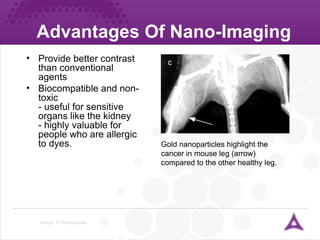
Advantages Of Nano-Imaging Image: © Nanoprobes ureter Provide better contrast than conventional agents Biocompatible and non-toxic - useful for sensitive organs like the kidney - highly valuable for people who are allergic to dyes. Gold nanoparticles highlight the cancer in mouse leg (arrow) compared to the other healthy leg.
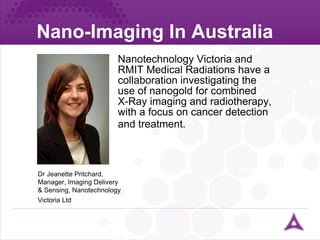
Nano-Imaging In Australia Nanotechnology Victoria and RMIT Medical Radiations have a collaboration investigating the use of nanogold for combined  X-Ray imaging and radiotherapy, with a focus on cancer detection and treatment.    ureter Dr Jeanette Pritchard,  Manager, Imaging Delivery  & Sensing, Nanotechnology  Victoria Ltd
Animation ureter View the  Nano-imaging Animation .
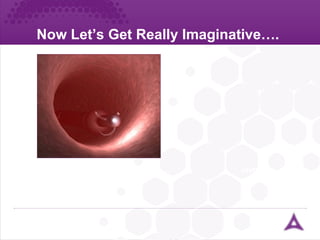
Now Let’s Get Really Imaginative…. ureter
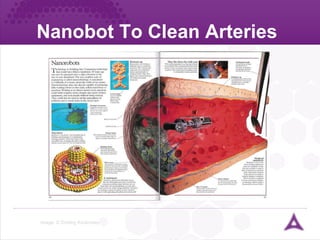
What If? ureter A ‘nanobot’ is a robot constructed from nanoscale components Nanobots could one day be injected into the body to treat diseases by delivering drugs or to perform surgery Nanobots could also perform a surveillance function where they check that the body is healthy and detect diseases very early.
Nanobot To Clean Arteries Image: © Dorling Kindersley ureter
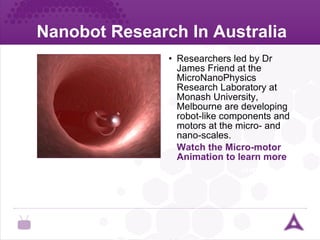
Nanobot Research In Australia Researchers led by Dr James Friend at the MicroNanoPhysics Research Laboratory at Monash University, Melbourne are developing robot-like components and motors at the micro- and nano-scales. Watch the Micro-motor Animation to learn more ureter
Activity 4 Perform the  Nanobots  and  Design Your Own Nanobot  activities to explore this concept further.
Quantum Problems ureter Play Duckboy in Nanoland! www.sciencemuseum.org.uk/antenna/nano/nanoland/nanoworld.asp MURKY MANSION STUCK WITH THE DUCK STRANGE ATTRACTIONS BROWNIAN BUMPERS FUNHOUSE   Answer the questions in the  Design Your Own Nanobot Activity  which relate to this game.
Summary ureter Meningococcal meningitis is a deadly bacterial disease for which rapid diagnosis can be critical to prevent death and permanent side effects Gold nanoparticles have been used by Australian scientists to develop a rapid and sensitive test for meningococcal meningitis  Gold nanoparticles are the focus of many health tools currently in development - targeted at prevention, diagnosis and treatment.
Revision What is bacterial meningitis and how do the bacteria cause the symptoms of the disease? Why have scientists developed a rapid diagnostic test for meningococcal infection? Describe one way that gold nanoparticles can be used to treat cancer. Do you believe that nanobots will one day be a reality?  What problems must nanobot designers overcome?
 

Health & Medicine Module - NanoGold

  • 1.
  • 2.
    Module Outcomes Understandthe importance of developing a rapid diagnostic test for meningitis Understand how nanotechnology can improve the sensitivity of medical diagnostics Be familiar with the characteristics of nanoparticulate gold Identify recent developments in nanotechnology and how they may benefit human health.
  • 3.
    What If? Image:bbaunach@flickr What if you could save a baby’s life with a rapid test for meningococcal disease?
  • 4.
    What If? Image:Benutzer:Lange123@wikipedia What if you could selectively kill cancer cells and not surrounding healthy tissue? Lung cancer
  • 5.
    What If? Image:© Dorling Kindersley What if you could create tiny robots to scan your body for defects?
  • 6.
    Activity 1 Thefollowing is a headline from ABC news online, August 13 2008: ‘ A 14 year-old boy has died from a suspected case of meningococcal disease on the New South Wales central coast .’ Perform the Meningitis Activity to learn more about this fatal disease.
  • 7.
    How Do BacteriaCause Disease? Image: © Dorling Kindersley Produce a toxin Interfere with normal body processes Damage cells.
  • 8.
    Meningococcal Meningitis Image:© Dorling Kindersley The bacteria grow in the cells lining the nose and throat - spread by contact eg sneezing, kissing, sharing drinks The bacteria produce a toxin which causes fever, damage to blood vessels, tissue damage and blood clots It is fatal in about 10% of cases but 10-15% of people who survive the disease have ongoing health problems - eg deafness, loss of limbs, paralysis, brain damage Early diagnosis and treatment is critical to improve outcomes.
  • 9.
    Two Types OfMeningococcal Disease Meningitis - bacteria attack the meninges (lining around the brain) - early symptom is a stiff, sore neck - meninges and brain swell, putting pressure on nerves - survivors often left deaf or with brain damage Sepsis - infection occurs throughout the bloodstream - affects the entire body - bacterial toxins rupture blood vessels and can rapidly shut down vital organs - survivors often left with permanent injuries and/or require amputations.
  • 10.
    How Does InfectionStart? Image: © NOVA Meningococcal bacteria commonly live in the human throat without causing harm Sometimes they break through the throat's lining and enter the bloodstream Damage to the throat from influenza and other infections could be a predisposing factor. Meningococcus penetrates cells lining the throat
  • 11.
    Meningococcal Toxin Image:© NOVA Every meningococcal bacterium is surrounded by a slimy outer coat that contains a poisonous chemical called an endotoxin While many bacteria produce endotoxin, the levels produced by meningococcal bacteria are 100 - 1000 times greater than normal. Bubbles of endotoxin released from meningococcus
  • 12.
    Tissue Damage Image:© NOVA Ruptured blood vessel leaks contents into surrounding tissue As the bacteria multiply and move through the bloodstream, they shed bubbles that contain concentrated amounts of toxin. These bubbles also act as decoys, confusing the body's immune system The endotoxin targets the heart, affecting its ability to pump and also causes blood vessels throughout the body to leak. As every vessel starts to haemorrhage, major organs like the lungs and kidneys are damaged and eventually destroyed Two things can stop this runaway infection before the patient dies: antibiotics like penicillin, and the patient's own immune system .
  • 13.
    Not All BacteriaIs Bad Image: Yakult.Honsah@wikipedia Very few bacteria are harmful, most bacteria have the following functions: - Food production - Normally live on our bodies and stop pathogenic bacteria from growing - Help with digestion (hence dietary supplements) - Can be genetically altered to make the products we need in the laboratory e.g. vaccines, drugs.
  • 14.
    Experiment 1 Observation Of Bacteria Perform the Observation of Bacteria experiment as instructed by your teacher.
  • 15.
    How Can WeDiagnose Meningitis? Current tests detect bacterial proteins in blood/other fluid - can only detect in the range of  micro)  mol (10 -6 ) to pico mol (10 -12 ) of protein concentration If we develop new tests using gold nanoparticles combined with DNA amplification we could detect molecule concentrations in the atto (10 -18 ) mol range i.e. one million times more sensitive than current tests This would allow earlier detection and therefore faster medical interventions.
  • 16.
    What Are GoldNanoparticles? Image: Northwestern University Gold nanoparticles (‘ nanogold ’) occur as clusters of gold atoms up to 100nm in diameter. Nanogold has unusual visible properties because the particles are small enough to scatter visible light - in contrast, mass gold reflects light Gold nanoparticles appear deep red to black in solution - colour depends on size of nanoparticles The distance between particles also affects colour - surface plasmon resonance is the term used by nanotechnologists to describe this effect. 5nm gold clusters Gold nanoparticle
  • 17.
    Experiment 2 Making Gold Nanoparticles Perform or watch a demonstration of the Making Gold Nanoparticles Experiment to see the differing chromic properties of nanoparticulate gold for yourself.
  • 18.
    Animation View the Nanoparticles Diagnostics Animation to better understand how gold nanoparticles are used to detect bacterial meningitis Complete a flow chart outlining the key steps in the nanoparticle diagnostic test.
  • 19.
    Activity 2 Usethe Nick’s Test PowerPoint presentation provided by your teacher to model the use of a nanoparticle diagnostic test in real-life Answer the questions on the last slide.
  • 20.
    Rapid Diagnosis Sonanogold can be used to rapidly diagnose meningitis… … what else can nanogold offer to the world of medicine?
  • 21.
    What If? Image:© Dorling Kindersley What if you could treat cancer without surgery? Imagine if you suffered from inoperable cancer. Imagine if your tumour grew in an important part of the brain. Surgery could save your life but you would end up permanently and severely disabled. Now, imagine if there was an alternative…
  • 22.
    Nanogold: ‘Nanobullets’ ToTreat Cancer Image: iurifernandes@flickr Also called 'thermal scalpels‘ or ‘nano bullets’ Particularly useful for small cancers that are embedded in vital tissues such as the brain The nanoshells are silica coated with gold nanoparticles that binds them to cancer cells, and are then injected into tumours Light from a near-infrared laser, which is harmless to healthy tissue, is absorbed by the nanoshells. The nanoshells heat up, destroying the tumour cells.
  • 23.
    Nanogold: ‘Drug Smugglers’To Treat Cancer Image: Courtesy E. Zubarev, Rice University Gold Nanoparticles coated with bristles of an anticancer drug, Taxol® Travel inside cancer cells and bind to internal structures Sabotages cell machinery preventing cell division.
  • 24.
    Activity 3 &Experiment 3 Perform the Gold Nanobullets Activity and the Golden Cancer Treatment Experiment to better understand the benefits of using nanogold to treat cancer .
  • 25.
    But Wait! Nanogoldcan do more!
  • 26.
    What If? Image:©Ambri What if you could detect bacteria with a rapid, on-the-spot test? Australian scientists at Ambri Ltd (Sydney) have used nanotechnology to develop a rapid, single-use diagnostic test to detect bacteria in samples-could test biological fluids, food, water.
  • 27.
    What If? Whatif you could detect disease at home with a ‘lab on a chip’? Nanoparticles are bound to antibodies that recognise a disease marker protein – a protein found only in a disease state, or at higher levels in a disease state When the protein is present in a sample, extraction of the magnetic particles also pulls out the gold nanoparticles because the two are bound together The DNA on the gold nanoparticle can be copied many times, so very small amounts of the original protein can be detected Potentially, nanoparticles with different antibody and DNA fragment combinations could be used to search for multiple disease marker proteins at the one time (hence the 'biobarcode'). View the BioBarcode Animation
  • 28.
    What If? Whatif you could rapidly sequence DNA on a space mission? NASA is working on a ‘Nanopore Sensor’ to rapidly sequence DNA - detect DNA of pathogenic bacteria or viruses in astronauts - sequence DNA of new life forms. Image: mujitra@flickr
  • 29.
    What If? Whatif you could improve X-rays to view organs in great detail? Image: © Nanoprobes X-ray of live mouse kidneys using: Iodine as contrast agent Gold nanoparticles as contrast agent kidney ureter spine
  • 30.
    Advantages Of Nano-ImagingImage: © Nanoprobes ureter Provide better contrast than conventional agents Biocompatible and non-toxic - useful for sensitive organs like the kidney - highly valuable for people who are allergic to dyes. Gold nanoparticles highlight the cancer in mouse leg (arrow) compared to the other healthy leg.
  • 31.
    Nano-Imaging In AustraliaNanotechnology Victoria and RMIT Medical Radiations have a collaboration investigating the use of nanogold for combined X-Ray imaging and radiotherapy, with a focus on cancer detection and treatment.   ureter Dr Jeanette Pritchard, Manager, Imaging Delivery & Sensing, Nanotechnology Victoria Ltd
  • 32.
    Animation ureter Viewthe Nano-imaging Animation .
  • 33.
    Now Let’s GetReally Imaginative…. ureter
  • 34.
    What If? ureterA ‘nanobot’ is a robot constructed from nanoscale components Nanobots could one day be injected into the body to treat diseases by delivering drugs or to perform surgery Nanobots could also perform a surveillance function where they check that the body is healthy and detect diseases very early.
  • 35.
    Nanobot To CleanArteries Image: © Dorling Kindersley ureter
  • 36.
    Nanobot Research InAustralia Researchers led by Dr James Friend at the MicroNanoPhysics Research Laboratory at Monash University, Melbourne are developing robot-like components and motors at the micro- and nano-scales. Watch the Micro-motor Animation to learn more ureter
  • 37.
    Activity 4 Performthe Nanobots and Design Your Own Nanobot activities to explore this concept further.
  • 38.
    Quantum Problems ureterPlay Duckboy in Nanoland! www.sciencemuseum.org.uk/antenna/nano/nanoland/nanoworld.asp MURKY MANSION STUCK WITH THE DUCK STRANGE ATTRACTIONS BROWNIAN BUMPERS FUNHOUSE Answer the questions in the Design Your Own Nanobot Activity which relate to this game.
  • 39.
    Summary ureter Meningococcalmeningitis is a deadly bacterial disease for which rapid diagnosis can be critical to prevent death and permanent side effects Gold nanoparticles have been used by Australian scientists to develop a rapid and sensitive test for meningococcal meningitis Gold nanoparticles are the focus of many health tools currently in development - targeted at prevention, diagnosis and treatment.
  • 40.
    Revision What isbacterial meningitis and how do the bacteria cause the symptoms of the disease? Why have scientists developed a rapid diagnostic test for meningococcal infection? Describe one way that gold nanoparticles can be used to treat cancer. Do you believe that nanobots will one day be a reality? What problems must nanobot designers overcome?
  • 41.

Editor's Notes

  • #2 Nanogold module - Title Page
  • #4 http://www.flickr.com/photos/bbaunach/1055569383/
  • #5 Image from http://en.wikipedia.org/wiki/Cancer, image uploaded by http://de.wikipedia.org/wiki/Benutzer:Lange123 Beschreibung: Konventionelles Röntgenbild des Thorax (der Lunge) mit rundlicher Verdichtung in der linken Lunge Quelle: selbst erstellt -- de:Benutzer:Lange123 17:18, 11. Nov. 2004 (CEST)
  • #6 http://www.dorlingkindersley-uk.co.uk
  • #7 http://www.abc.net.au/news/stories/2008/08/13/2334170.htm
  • #8 http://www.dorlingkindersley-uk.co.uk
  • #9 http://www.dorlingkindersley-uk.co.uk
  • #11 Infection stage. Slide shows the bacteria as yellow spheres. The blue indicates a mucosal surface in a human. The long hairy structures are called cilia which are part of cells that help move particles over their surface. Image: http://www.pbs.org/wgbh/nova/meningitis/bloodstream.html
  • #12 A toxin is a poison. Meningitis bacteria produce large amounts of poison. Image: http://www.pbs.org/wgbh/nova/meningitis/bloodstream.html
  • #13 How the poison causes damage to the infected person. The picture indicates a ruptured blood vessel. Image: http://www.pbs.org/wgbh/nova/meningitis/bloodstream.html
  • #14 Image of Japanese Yakult from http://en.wikipedia.org/wiki/Image:Yakult_(Yakult_Honsha).jpg
  • #16 The ultra-sensitive test mentioned in the slide is the biobarcode method for detecting DNA – see animation.
  • #22 http://www.dorlingkindersley-uk.co.uk Reminder of “what if” scenario. The following slides will discuss various nanoparticles that could be used as alternatives to surgery, particularly for invasive types of cancer that effects vital organs like the brain. Sometimes surgery may mean survival but a loss of function, e.g. paralysis. A person who has cancer in an organ is not eligible for organ donation. Therefore it cannot be removed and replaced with a new organ.
  • #23 http://www.flickr.com/photos/iurifernandes/2465538344/ Nano bullets. Use of coated gold nanoparticles that when heated preferentially kill cancer cells.
  • #24 Source:http://www.azonano.com/news.asp?newsID=4934
  • #27 Australian example info found at: http://www.dest.gov.au/sectors/science_innovation/science_agencies_committees/prime_ministers_science_engineering_innovation_council/meetings/thirteenth_meeting.htm
  • #28 The idea is to detect a protein that is only found in the disease state. Two different types of nanoparticle are used. The gold nanoparticle has antibodies on its surface that detect the disease protein. The gold nanoparticle also has DNA fragments on it. The second particle used is magnetic. It has antibodies to the disease protein on its surface. If the disease protein is present, both the gold nanoparticle and the magnetic nanoparticle will bind to it. This will create a sandwich effect.
  • #29 Image courtesy of http://www.flickr.com/photos/mujitra/2559450853/ (creative commons license)
  • #30 Photos and info sourced from nanoprobes, http://www.nanoprobes.com/
  • #31 Photos and info sourced from nanoprobes, http://www.nanoprobes.com/
  • #32 www.nanovic.com.au
  • #35 Introductory slide showing a “nanobot” the size of a red blood cell. Of course this would make the bot actually a microsized bot. Nevertheless the components inside the bot must be nanosized.

  • #42 End title