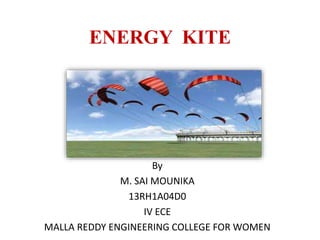
ENERGY KITE
By
M. SAI MOUNIKA
13RH1A04D0
IV ECE
MALLA REDDY ENGINEERING COLLEGE FOR WOMEN
CONTENTS
• INTRODUCTION
• KITE –GEN
• NEED FOR ENERGY KITE
• COMPONENTS
• KEY TECHNOLOGY
• LIFTING MECHANISM
• PRINCIPLE
• WORKING
• YO-YO CONFIGURATION
• WIND MILL v/s ENERGY KITES
• ADVANTAGES
• DISADVANTAGES
• FUTURE SCOPE
• CONCLUSION
2ENERGY KITE
ENERGY KITE 3
INTRODUCTION
• Developed in Italy that takes power from high altitude
winds.
• This was originally conceived by Italian researcher
Massimo Ippolitoe
•Kite-Gen organisation was developed in Italy for
adopting green energy concept.
•The simple idea of kite waving in the air lead to this
technology
•Kite – Gen initiated its first project called “LADDER
MILL” that could generate 50Kw of power.
ENERGY KITE 4
KITE- GEN
• The first design of KITEGEN is a small scale
prototype.
• The electric actuators which hold the kite lines are
fixed with respect to the ground
ENERGY KITE 5
NEED FOR ENERGY KITE
 Provides 80% of electricity
Environmental conservation
Renewable energy source
Abundantly Available
 Less Area required
ENERGY KITE 6
COMPONENTS IN ENERGY KITE
A. POWER RING
B. DYNEEMA
C. COMPASS
D. STEM
E. POWERED JOINTS
F. GROUND STRUCTURE
G. ROTATING ENGINE
H. POWER DRUM
I. CONTROL PULLEYS
J. ACTUATORS
ENERGY KITE 7
KEY TECHNOLOGY
The core is the system of automatic control of
the kite flight, called KSU (Kite Steering Unit):
ENERGY KITE 8
LIFTING MECHANISM
ENERGY KITE 9
PRINCIPLE
RE-TRACTION
PHASE
POWER
PHASE
TRACTION
PHASE
ENERGY KITE 10
WORKING
• The KSU is the unit that allows to automatically piloting a
power kite.
• The kite steering unit, which includes the electric drives, the
drums, and all of the hardware needed to control a single kite
•The KiteGen project has designed and simulated a small-scale
prototype ,The two kite lines are rolled around two drums and
linked to two electric drives, which are fixed to the ground.
•Energy is collected when the wind force on the kite unrolls the
lines, and the electric drives act as generators due to the
rotation of the drums.
ENERGY KITE 11
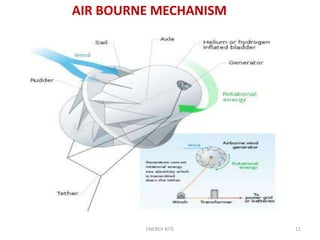
AIR BOURNE MECHANISM
ENERGY KITE 12
YO-YO CONFIGURATION
ENERGY KITE 13
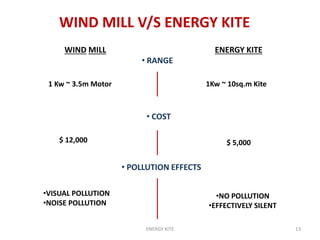
WIND MILL V/S ENERGY KITE
WIND MILL ENERGY KITE
• RANGE
1 Kw ~ 3.5m Motor 1Kw ~ 10sq.m Kite
• COST
$ 12,000 $ 5,000
• POLLUTION EFFECTS
•VISUAL POLLUTION
•NOISE POLLUTION
•NO POLLUTION
•EFFECTIVELY SILENT
ENERGY KITE 14
• ENVIRONMENTAL EFFECTS
• HEIGHT RANGE
MOST OF THE BIRDS GET
KILLED
LESS LIKELY TO KILL
LIMITED HEIGHT (100 ft) CAN FLY ABOVE 500 ft
ENERGY KITE 15
ADVANTAGES
• EASY TO INSTALL
• COST EFFECTIVE
• HIGH POWER WITH LOW INPUT
•ECO-FRIENDLY
• RENEWABLE ENERGY SOURCE
ENERGY KITE 16
DISADVANTAGES
• REQUIRES CONTINUOUS MONITRING
•DEPENDS ON WIND COMPLETELY
ENERGY KITE 17
CONCLUSION
• Wind Power from Kites is a potential
renewable energy technology
• High‐altitude wind power using tethered
wind turbine devices has the potential to
open up a new wind resource in areas that
are not served by conventional turbines.
ENERGY KITE 18
THANK YOU

Energy kite

  • 1.
    ENERGY KITE By M. SAIMOUNIKA 13RH1A04D0 IV ECE MALLA REDDY ENGINEERING COLLEGE FOR WOMEN
  • 2.
    CONTENTS • INTRODUCTION • KITE–GEN • NEED FOR ENERGY KITE • COMPONENTS • KEY TECHNOLOGY • LIFTING MECHANISM • PRINCIPLE • WORKING • YO-YO CONFIGURATION • WIND MILL v/s ENERGY KITES • ADVANTAGES • DISADVANTAGES • FUTURE SCOPE • CONCLUSION 2ENERGY KITE
  • 3.
    ENERGY KITE 3 INTRODUCTION •Developed in Italy that takes power from high altitude winds. • This was originally conceived by Italian researcher Massimo Ippolitoe •Kite-Gen organisation was developed in Italy for adopting green energy concept. •The simple idea of kite waving in the air lead to this technology •Kite – Gen initiated its first project called “LADDER MILL” that could generate 50Kw of power.
  • 4.
    ENERGY KITE 4 KITE-GEN • The first design of KITEGEN is a small scale prototype. • The electric actuators which hold the kite lines are fixed with respect to the ground
  • 5.
    ENERGY KITE 5 NEEDFOR ENERGY KITE  Provides 80% of electricity Environmental conservation Renewable energy source Abundantly Available  Less Area required
  • 6.
    ENERGY KITE 6 COMPONENTSIN ENERGY KITE A. POWER RING B. DYNEEMA C. COMPASS D. STEM E. POWERED JOINTS F. GROUND STRUCTURE G. ROTATING ENGINE H. POWER DRUM I. CONTROL PULLEYS J. ACTUATORS
  • 7.
    ENERGY KITE 7 KEYTECHNOLOGY The core is the system of automatic control of the kite flight, called KSU (Kite Steering Unit):
  • 8.
  • 9.
  • 10.
    ENERGY KITE 10 WORKING •The KSU is the unit that allows to automatically piloting a power kite. • The kite steering unit, which includes the electric drives, the drums, and all of the hardware needed to control a single kite •The KiteGen project has designed and simulated a small-scale prototype ,The two kite lines are rolled around two drums and linked to two electric drives, which are fixed to the ground. •Energy is collected when the wind force on the kite unrolls the lines, and the electric drives act as generators due to the rotation of the drums.
  • 11.
    ENERGY KITE 11 AIRBOURNE MECHANISM
  • 12.
    ENERGY KITE 12 YO-YOCONFIGURATION
  • 13.
    ENERGY KITE 13 WINDMILL V/S ENERGY KITE WIND MILL ENERGY KITE • RANGE 1 Kw ~ 3.5m Motor 1Kw ~ 10sq.m Kite • COST $ 12,000 $ 5,000 • POLLUTION EFFECTS •VISUAL POLLUTION •NOISE POLLUTION •NO POLLUTION •EFFECTIVELY SILENT
  • 14.
    ENERGY KITE 14 •ENVIRONMENTAL EFFECTS • HEIGHT RANGE MOST OF THE BIRDS GET KILLED LESS LIKELY TO KILL LIMITED HEIGHT (100 ft) CAN FLY ABOVE 500 ft
  • 15.
    ENERGY KITE 15 ADVANTAGES •EASY TO INSTALL • COST EFFECTIVE • HIGH POWER WITH LOW INPUT •ECO-FRIENDLY • RENEWABLE ENERGY SOURCE
  • 16.
    ENERGY KITE 16 DISADVANTAGES •REQUIRES CONTINUOUS MONITRING •DEPENDS ON WIND COMPLETELY
  • 17.
    ENERGY KITE 17 CONCLUSION •Wind Power from Kites is a potential renewable energy technology • High‐altitude wind power using tethered wind turbine devices has the potential to open up a new wind resource in areas that are not served by conventional turbines.
  • 18.