The Space Elevator 
Bradley C. Edwards, Ph.D. 
Eureka Scientific and HighLift Systems 
Funded by 
NASA Institute for Advanced Concepts 
For more information please see: www.niac.usra.edu or www.highliftsystems.com
Proposed System: 
Overview 
• What is a space elevator? 
• First, small elevator (20 ton 
capacity) 
• One week ascent time to GEO 
• Constructed with existing or 
near-term technology
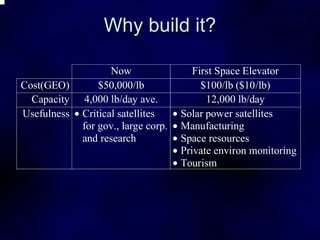
Why build it? 
Now First Space Elevator 
Cost(GEO) $50,000/lb $100/lb ($10/lb) 
Capacity 4,000 lb/day ave. 12,000 lb/day 
Usefulness • Critical satellites 
for gov., large corp. 
and research 
• Solar power satellites 
• Manufacturing 
• Space resources 
• Private environ monitoring 
• Tourism
The Original Problem: 
The Cable
Carbon Nanotubes 
• 100 times stronger than steel and 1/5 as heavy 
• Production at 1 and 2 tons per week available 
in 2003
5km continuous 1% CNT composite fiber 
Carbon Nanotubes Composites 
• Dispersion, functionalization, 
incorporation 
• Need 100GPa tensile strength 
(30 times steel) 
• 1 to 3 years development
Ribbon Design 
• Optimized strength to mass 
• Resistant to meteors 
• Easy to climb 
• Few square millimeters 
cross section
The Rest of the Problems: 
Deployment 
Climber 
Power 
Anchor 
etc.
Deployment Overview
Initial Spacecraft 
• Largest initial ribbon 
• Minimum launch mass 
• Minimal development
Climbers 
Motors 
CPU, power and 
speed control, etc. 
Initial 
cable 
Photo 
array 
Spooled 
cable to be 
added 
Added 
cable 
• Simple 
• Reliable 
• Efficient 
• Low mass to payload ratio
Power Beaming 
• Minimal mass on climber 
• High net power 
• Low recurring cost 
• Efficient
Anchor 
Sealaunch 
• Mobile 
• Ocean-going 
• Existing technology 
• Multi-purpose platform
Full Deployment
Operational Challenges
Lightning 
Ecuador 
Proposed Anchor 
zone 
Pacific 
Ocean 
Lightning rate: <10 km-2 year-1 
1000 km
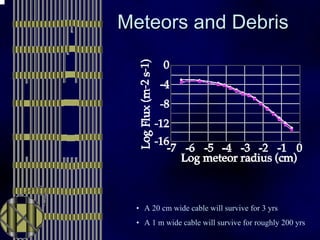
Meteors and Debris 
• A 20 cm wide cable will survive for 3 yrs 
• A 1 m wide cable will survive for roughly 200 yrs
Orbital Objects and Debris 
• 110,000 objects larger 
than 1 cm diameter 
• Active avoidance required
Wind Loading 
• Proposed cable should be able to survive 
windspeeds up to 159 mph or a Category 5 
hurricane 
• Anchor location avoids hurricanes, 
jetstreams and high winds
Murphy 
z Environmental Impact - 
Ionosphere 
z Malfunctioning climbers
Severed Cables 
• Infall scenario: break-up on re-entry 
• Mechanical damage: minimal 
• Lingering health risks: under investigation
Schedule and Cost
Schedule (Years 1-10) 
Cable Build-up 
Climber Const ruct ion 
Cable Const ruct ion 
Init ial SC Launch 
Init ial SC Const ruct . 
SC & Climber Design 
Power Beaming Fac. Const . 
Power Beaming Sys Design 
Tracking Facilit ies Const . 
Tracking Syst em Design 
Anchor Stat ion Const . 
Anchor Stat ion Design 
0 1 2 3 4 5 6 7 9 8 10 
Years 
1) 
2) 
3) 
4) 
5) 
6) 
7) 
8) 
9) 
10) 
11) 
12)
Budget (Technical Costs) 
Component Cost Estimate 
Launch costs to GEO $1.02B 
Cable production $390M 
Spacecraft $507M 
Climbers $367M 
Power beaming stations $1.5B 
Anchor station $120M 
Tracking facility $500M 
Other $430M 
Contingency (30%) $1.44B 
TOTAL ~$6.2B 
Recommend construction of a second cable for redundancy: $2B
The Bottom Line 
•Initial capital cost: $6.2B 
•Operations cost: <$100M/yr, <$250/kg 
•Ultimate operational costs: ~$10/kg 
•SE Lift rate: 5000 kg/day 
•Cost of additional cables or doubling the size of the first: $2B
The Next Step 
• Complete development effort: 
-CNT composites 
-Feasibility test 
-Engineering studies 
• Assemble management, 
engineering and construction 
teams
Applications
Summary 
For more information and details please see: 
www.niac.usra.edu or 
www.highliftsystems.com 
z The initial designs, construction and 
operational scenarios for the space 
elevator have been laid out. 
z Two years of supported development yet 
required 
z First space elevator (13,000 kg capacity, 
5000 kg/day, $250/kg) can be operational 
in 11 years at a cost of <$10B

Space elevatorjun02

  • 1.
    The Space Elevator Bradley C. Edwards, Ph.D. Eureka Scientific and HighLift Systems Funded by NASA Institute for Advanced Concepts For more information please see: www.niac.usra.edu or www.highliftsystems.com
  • 2.
    Proposed System: Overview • What is a space elevator? • First, small elevator (20 ton capacity) • One week ascent time to GEO • Constructed with existing or near-term technology
  • 3.
    Why build it? Now First Space Elevator Cost(GEO) $50,000/lb $100/lb ($10/lb) Capacity 4,000 lb/day ave. 12,000 lb/day Usefulness • Critical satellites for gov., large corp. and research • Solar power satellites • Manufacturing • Space resources • Private environ monitoring • Tourism
  • 4.
  • 5.
    Carbon Nanotubes •100 times stronger than steel and 1/5 as heavy • Production at 1 and 2 tons per week available in 2003
  • 6.
    5km continuous 1%CNT composite fiber Carbon Nanotubes Composites • Dispersion, functionalization, incorporation • Need 100GPa tensile strength (30 times steel) • 1 to 3 years development
  • 7.
    Ribbon Design •Optimized strength to mass • Resistant to meteors • Easy to climb • Few square millimeters cross section
  • 8.
    The Rest ofthe Problems: Deployment Climber Power Anchor etc.
  • 9.
  • 10.
    Initial Spacecraft •Largest initial ribbon • Minimum launch mass • Minimal development
  • 11.
    Climbers Motors CPU,power and speed control, etc. Initial cable Photo array Spooled cable to be added Added cable • Simple • Reliable • Efficient • Low mass to payload ratio
  • 12.
    Power Beaming •Minimal mass on climber • High net power • Low recurring cost • Efficient
  • 13.
    Anchor Sealaunch •Mobile • Ocean-going • Existing technology • Multi-purpose platform
  • 14.
  • 15.
  • 16.
    Lightning Ecuador ProposedAnchor zone Pacific Ocean Lightning rate: <10 km-2 year-1 1000 km
  • 17.
    Meteors and Debris • A 20 cm wide cable will survive for 3 yrs • A 1 m wide cable will survive for roughly 200 yrs
  • 18.
    Orbital Objects andDebris • 110,000 objects larger than 1 cm diameter • Active avoidance required
  • 19.
    Wind Loading •Proposed cable should be able to survive windspeeds up to 159 mph or a Category 5 hurricane • Anchor location avoids hurricanes, jetstreams and high winds
  • 20.
    Murphy z EnvironmentalImpact - Ionosphere z Malfunctioning climbers
  • 21.
    Severed Cables •Infall scenario: break-up on re-entry • Mechanical damage: minimal • Lingering health risks: under investigation
  • 22.
  • 23.
    Schedule (Years 1-10) Cable Build-up Climber Const ruct ion Cable Const ruct ion Init ial SC Launch Init ial SC Const ruct . SC & Climber Design Power Beaming Fac. Const . Power Beaming Sys Design Tracking Facilit ies Const . Tracking Syst em Design Anchor Stat ion Const . Anchor Stat ion Design 0 1 2 3 4 5 6 7 9 8 10 Years 1) 2) 3) 4) 5) 6) 7) 8) 9) 10) 11) 12)
  • 24.
    Budget (Technical Costs) Component Cost Estimate Launch costs to GEO $1.02B Cable production $390M Spacecraft $507M Climbers $367M Power beaming stations $1.5B Anchor station $120M Tracking facility $500M Other $430M Contingency (30%) $1.44B TOTAL ~$6.2B Recommend construction of a second cable for redundancy: $2B
  • 25.
    The Bottom Line •Initial capital cost: $6.2B •Operations cost: <$100M/yr, <$250/kg •Ultimate operational costs: ~$10/kg •SE Lift rate: 5000 kg/day •Cost of additional cables or doubling the size of the first: $2B
  • 26.
    The Next Step • Complete development effort: -CNT composites -Feasibility test -Engineering studies • Assemble management, engineering and construction teams
  • 27.
  • 28.
    Summary For moreinformation and details please see: www.niac.usra.edu or www.highliftsystems.com z The initial designs, construction and operational scenarios for the space elevator have been laid out. z Two years of supported development yet required z First space elevator (13,000 kg capacity, 5000 kg/day, $250/kg) can be operational in 11 years at a cost of <$10B