

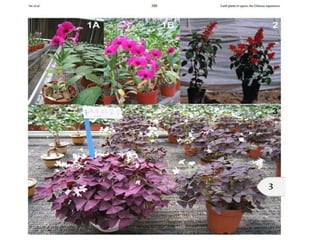

Space breeding….
 It is a cutting edge science that combines astronautics with
agricultural and forestry sciences.
It refers to the technique of sending seeds or
microorganisms into space(200-400km) on a recoverable
satellite or in other recoverable spacecraft.
Returning to earth , mutant seeds will be selected and
planted to breed strains with high desirable traits.
Main factors of space environment
affecting plant mutation
High-energy ion radiation
Microgravity
Space magnetic field
Ultra vacuum
 Other physical stresses
China – The Pioneers
 Jiang Xingcun, a scientist with the Chinese Academy of
Sciences, discovered that spaceflight can increase mutation
rates by hundreds of times that experienced on Earth.
12% of seeds sent to space in satellites manifested
mutations of some kind in such experiments.
Since then, China has sent more than 400 plant seed
species to space.
"Breeding seeds in space is expected to become a strong
driving force behind Chinese agriculture in the 21st century
since it can bring about high-yield and high-quality crops
that are hard for ordinary breeding methods to obtain."
Goals of this space Expedition
Scientists intend to produce :-
Higher Yield
Disease Resistant Plant Varieties
 Abiotic Stress Resistant Plant Varieties
Biotic Stress Resistant Plant varieties
Several other desirable traits
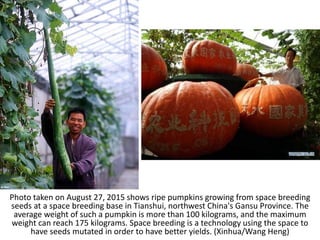
Photo taken on August 27, 2015 shows ripe pumpkins growing from space breeding
seeds at a space breeding base in Tianshui, northwest China's Gansu Province. The
average weight of such a pumpkin is more than 100 kilograms, and the maximum
weight can reach 175 kilograms. Space breeding is a technology using the space to
have seeds mutated in order to have better yields. (Xinhua/Wang Heng)
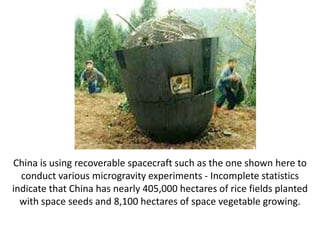
China is using recoverable spacecraft such as the one shown here to
conduct various microgravity experiments - Incomplete statistics
indicate that China has nearly 405,000 hectares of rice fields planted
with space seeds and 8,100 hectares of space vegetable growing.
Biological effects of space induced
factors on plant seeds
seed germination potential, germination
index, seedling height and seedling vigor index
of wheat, barley and triticale were all
significantly higher
japonica rice carried by a high altitude
balloon, all the 11 investigated characters which
were plant height, growth period duration, spike
length, grain husk color and light sensitivity, etc.
segregated greatly.
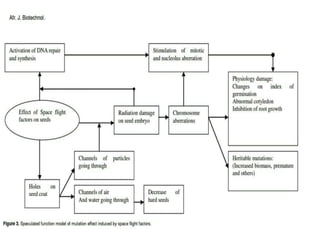
Mechanism of Space mutagenesis
•Space radiation
•HZE particles
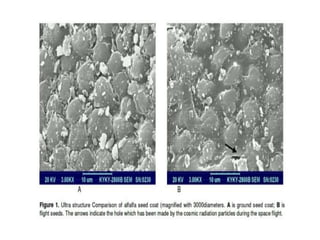
•Frequency rate more- root meristem and
hypotyle was hit.
• Higher duration- frequency rate increased.
•Both cosmic radiation and microgravity
combined.
•Strong vibration and blastforce at the time of
launch and landing- chromosomal aberrations.
Mutant Varieties developed by
space breeding
CROP VARIETIES
1) RICE Hangyu1, Huahang1,Eryouhang1, Teyouhang1,
Yuehang1, Zhe101, Yuyou1, Teyou175 and
Huaxiang7, etc.
2) WHEAT Taikong5,Taikong6, Longfumai15, Hangmai96,
Longfumai17 and Luyuan301
3)COTTON Zhongmiansuo42 and Zhongmiansuo52
4) SESAME Zhongzhi11 and Zhongzhi13
5) PEPPER Yujiao1, Yujiao2, Yujiao3, Yujiao4 and
Longjiao9
6) TOMATO Yufan1 and Yufan2
7) ALFALFA Longjing1
Screening of the mutant varieties
Numerous molecular markers, such as AFLP
and RAPD have been used to mark plant
materials, but simple sequence repeats
(SSRs),as a highly reproducible molecular
marker , has become one of the most effective
markers for population genetic analysis. Thus
SSRs are used in the study of space bred
mutant varieties.
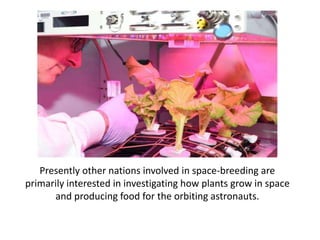
Presently other nations involved in space-breeding are
primarily interested in investigating how plants grow in space
and producing food for the orbiting astronauts.
CONCLUSION
Space-induced mutation technique is an effectively
new way not only to develop new crop variety, but
also possible to obtain rare mutants that may make
a great breakthrough in important economic
characters of crop, such as yield and quality, which
are difficult to get using the other breeding methods
on ground.
The research on applied basis of space-induced
mutation technique needs to be strengthened.
Because of the big investment and good
technological support, this method is limited but is
important to make ground simulation on space
environment factors
THANKYOU

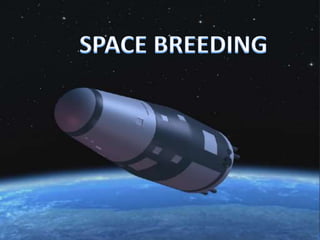
Space Breeding

  • 3.
    Space breeding….  Itis a cutting edge science that combines astronautics with agricultural and forestry sciences. It refers to the technique of sending seeds or microorganisms into space(200-400km) on a recoverable satellite or in other recoverable spacecraft. Returning to earth , mutant seeds will be selected and planted to breed strains with high desirable traits.
  • 4.
    Main factors ofspace environment affecting plant mutation High-energy ion radiation Microgravity Space magnetic field Ultra vacuum  Other physical stresses
  • 5.
    China – ThePioneers  Jiang Xingcun, a scientist with the Chinese Academy of Sciences, discovered that spaceflight can increase mutation rates by hundreds of times that experienced on Earth. 12% of seeds sent to space in satellites manifested mutations of some kind in such experiments. Since then, China has sent more than 400 plant seed species to space. "Breeding seeds in space is expected to become a strong driving force behind Chinese agriculture in the 21st century since it can bring about high-yield and high-quality crops that are hard for ordinary breeding methods to obtain."
  • 6.
    Goals of thisspace Expedition Scientists intend to produce :- Higher Yield Disease Resistant Plant Varieties  Abiotic Stress Resistant Plant Varieties Biotic Stress Resistant Plant varieties Several other desirable traits
  • 7.
    Photo taken onAugust 27, 2015 shows ripe pumpkins growing from space breeding seeds at a space breeding base in Tianshui, northwest China's Gansu Province. The average weight of such a pumpkin is more than 100 kilograms, and the maximum weight can reach 175 kilograms. Space breeding is a technology using the space to have seeds mutated in order to have better yields. (Xinhua/Wang Heng)
  • 9.
    China is usingrecoverable spacecraft such as the one shown here to conduct various microgravity experiments - Incomplete statistics indicate that China has nearly 405,000 hectares of rice fields planted with space seeds and 8,100 hectares of space vegetable growing.
  • 10.
    Biological effects ofspace induced factors on plant seeds seed germination potential, germination index, seedling height and seedling vigor index of wheat, barley and triticale were all significantly higher japonica rice carried by a high altitude balloon, all the 11 investigated characters which were plant height, growth period duration, spike length, grain husk color and light sensitivity, etc. segregated greatly.
  • 11.
    Mechanism of Spacemutagenesis •Space radiation •HZE particles •Frequency rate more- root meristem and hypotyle was hit. • Higher duration- frequency rate increased. •Both cosmic radiation and microgravity combined. •Strong vibration and blastforce at the time of launch and landing- chromosomal aberrations.
  • 12.
    Mutant Varieties developedby space breeding CROP VARIETIES 1) RICE Hangyu1, Huahang1,Eryouhang1, Teyouhang1, Yuehang1, Zhe101, Yuyou1, Teyou175 and Huaxiang7, etc. 2) WHEAT Taikong5,Taikong6, Longfumai15, Hangmai96, Longfumai17 and Luyuan301 3)COTTON Zhongmiansuo42 and Zhongmiansuo52 4) SESAME Zhongzhi11 and Zhongzhi13 5) PEPPER Yujiao1, Yujiao2, Yujiao3, Yujiao4 and Longjiao9 6) TOMATO Yufan1 and Yufan2 7) ALFALFA Longjing1
  • 17.
    Screening of themutant varieties Numerous molecular markers, such as AFLP and RAPD have been used to mark plant materials, but simple sequence repeats (SSRs),as a highly reproducible molecular marker , has become one of the most effective markers for population genetic analysis. Thus SSRs are used in the study of space bred mutant varieties.
  • 18.
    Presently other nationsinvolved in space-breeding are primarily interested in investigating how plants grow in space and producing food for the orbiting astronauts.
  • 19.
    CONCLUSION Space-induced mutation techniqueis an effectively new way not only to develop new crop variety, but also possible to obtain rare mutants that may make a great breakthrough in important economic characters of crop, such as yield and quality, which are difficult to get using the other breeding methods on ground. The research on applied basis of space-induced mutation technique needs to be strengthened. Because of the big investment and good technological support, this method is limited but is important to make ground simulation on space environment factors
  • 20.