Exploring Early
Enterprise 2.0 Methodologies


                                 Climbing the
                              Maturity Curve
                               of Process and
                                 Methods for
                             Enterprise Social
                                   Computing


          Dion Hinchcliffe
Introduction
Dion Hinchcliffe
 • ZDNet’s Enterprise Web 2.0
   • http://blogs.zdnet.com/Hinchcliffe
 • Social Computing Journal – Editor-in-Chief
   • http://socialcomputingjournal.com
 • Enterprise 2.0 TV Show
       •   http://e2tvshow.com 

   • •Hinchcliffe & Company
           http://hinchcliffeandco.com
       •   mailto:dion@hinchcliffeandco.com

   •   Web 2.0 University
       •   http://web20university.com
   •            : dhinchcliffe
Premise
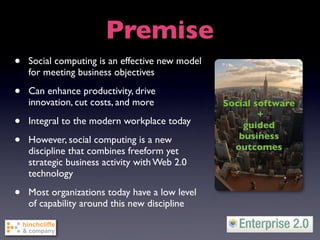
•   Social computing is an effective new model
    for meeting business objectives

•   Can enhance productivity, drive
    innovation, cut costs, and more              Social software
                                                         +
•   Integral to the modern workplace today           guided
•   However, social computing is a new              business
                                                   outcomes
    discipline that combines freeform yet
    strategic business activity with Web 2.0
    technology

•   Most organizations today have a low level
    of capability around this new discipline
The Questions
• How can we adopt Enterprise 2.0 most
  effectively?
• What have we learned so far?
• How do we get the upsides without
  potential downsides?
• Can we identify best practices or are
  organizations too different to do this?
How do we best
transform our work
   processes for
 the 21st century?
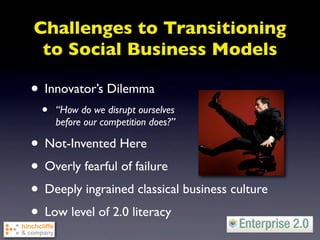
Challenges to Transitioning
 to Social Business Models

• Innovator’s Dilemma
  •   “How do we disrupt ourselves
      before our competition does?”

• Not-Invented Here
• Overly fearful of failure
• Deeply ingrained classical business culture
• Low level of 2.0 literacy
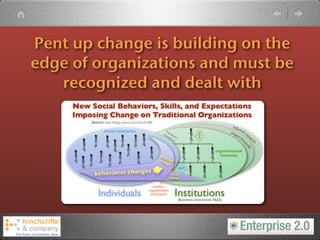
Pent up change is building on the
edge of organizations and must be
   recognized and dealt with
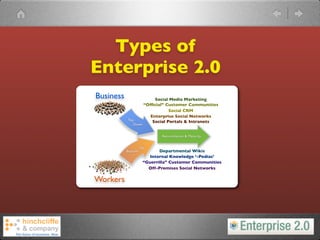
Types of
Enterprise 2.0
Business                  Social Media Marketing
                     “Official” Customer Communities
                                 Social CRM
                        Enterprise Social Networks
           Top           Social Portals & Intranets
              Down


                            Reconciliation & Maturity


                    Up
           Bottom           Departmental Wikis
                        Internal Knowledge ‘-Pedias’
                     “Guerrilla” Customer Communities
                       Off-Premises Social Networks

Workers
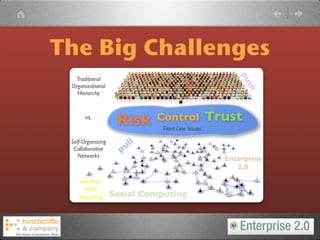
The Big Challenges


        The
Key area where traditional
process models often struggle

•   Don’t respond to change quickly enough

•   Poorly aligned with current business reality

•   Lack of focus on driving consumption (or network
    effects)

•   Too centralized and/or isolated

•   Expensive and resource-intensive

•   Overengineered in the wrong places. Excessively
    constraining.
At the Very Least, an
E2.0 Methodology Must:

 A) Address active business concerns (downsides)
 B) Focus on delivering business value
 C) Help an organization acquire social computing
 competency
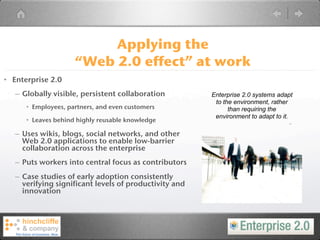
Applying the
                     “Web 2.0 effect” at work
• Enterprise 2.0
   – Globally visible, persistent collaboration         Enterprise 2.0 systems adapt
                                                         to the environment, rather
      • Employees, partners, and even customers               than requiring the
                                                         environment to adapt to it.
      • Leaves behind highly reusable knowledge

   – Uses wikis, blogs, social networks, and other
     Web 2.0 applications to enable low-barrier
     collaboration across the enterprise
   – Puts workers into central focus as contributors
   – Case studies of early adoption consistently
     verifying significant levels of productivity and
     innovation
Perceived Benefits Of Enterprise 2.0
• Increased knowledge retention
• More adoption and actual use of knowledge
  management tools
• Better solutions that fit local business problems
 (via emergent structure and processes)

• Increased transparency
• Less duplication of effort
• Higher levels of productivity
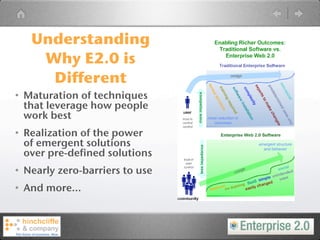
Understanding
    Why E2.0 is
     Different
• Maturation of techniques
  that leverage how people
  work best
• Realization of the power
  of emergent solutions
  over pre-defined solutions
• Nearly zero-barriers to use
• And more...
The Enterprise 2.0 Checklist
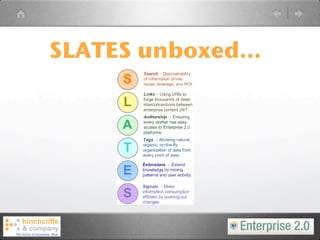
• SLATES
 – Search
 – Linking
 – Authorship
 – Tagging
 – Extensions
 – Signals
SLATES unboxed...
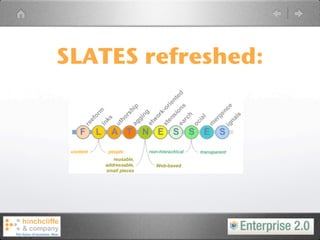
SLATES refreshed:
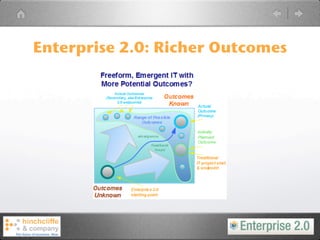
Enterprise 2.0: Richer Outcomes
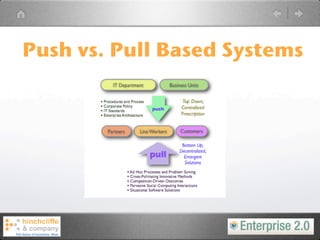
Push vs. Pull Based Systems
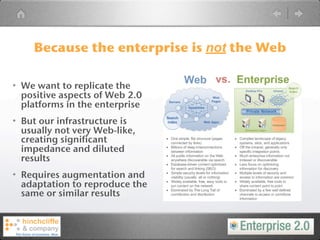
Because the enterprise is not the Web

• We want to replicate the
  positive aspects of Web 2.0
  platforms in the enterprise
• But our infrastructure is
  usually not very Web-like,
  creating significant
  impedance and diluted
  results
• Requires augmentation and
  adaptation to reproduce the
  same or similar results
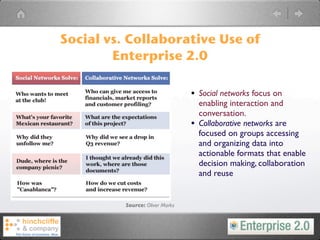
Social vs. Collaborative Use of
        Enterprise 2.0

                                 • Social networks focus on
                                     enabling interaction and
                                     conversation.
                                 •   Collaborative networks are
                                     focused on groups accessing
                                     and organizing data into
                                     actionable formats that enable
                                     decision making, collaboration
                                     and reuse


          Source: Oliver Marks
Adoption Strategies
• Gain and Enlist Top Down Support and
    Overcome Turf Issues In Advance
•   Align Enterprise 2.0 Strategy to Business
    Strategy (Find A Problem To Solve)
•   Align Enterprise 2.0 Applications to Key
    Business Goals and Processes
•   Develop a Simple, Clear Business Case
•   Provide Strong Leadership for the Enterprise
    2.0 Function(s)
•   Design Measures Aligned to Business Processes
Adoption Strategies Pt. 2
•   Listen to the Users, Involve Them in the
    Design
•   Simplify the Access and Production of
    Knowledge
•   Develop a Clear Communication Plan to
    Promote the Effort
•   Involve all the Key Stakeholders, Eventually
•   Integrate all forms of Communication and
    Documentation)
•   Develop a Clear Motivation Plan that Aligns
    with Current Incentive Plans
Community Management
• Guiding, administering, supporting, and
  mentoring social groups

• Helps organizations achieve specific
  objectives with Enterprise 2.0

• Has proven invaluable at organizations
  with significant success:

  • Stories: SAP, CIA Intellipedia
• Now believed to be “essential” to E2.0
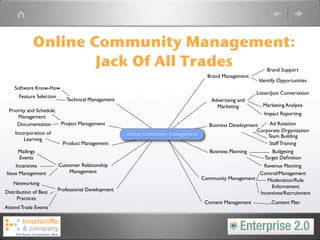
Online Community Management:
                     Jack Of All Trades                                                                       Brand Support
                                                                                     Brand Management
                                                                                                           Identify Opportunities
    Software Know-How
                                                                                                          Listen/Join Conversation
      Feature Selection
                             Technical Management                                      Advertising and
                                                                                         Marketing           Marketing Analysis
 Priority and Schedule
                                                                                                             Impact Reporting
     Management
     Documentation         Project Management                                         Business Development    Ad Rotation
    Incorporation of                                                                                     Corporate Organization
                                                     online community management                             Team Building
        Learning
                            Product Management                                                                Staff Training
      Mailings                                                                        Business Planning         Budgeting
      Events                                                                                                 Target Definition
    Incentives            Customer Relationship                                                           Revenue Planning
Issue Management              Management                                                                Control/Management
                                                                                   Community Management    Moderation/Rule
   Networking
                                                                                                             Enforcement
Distribution of Best      Professional Development
                                                                                                        Incentives/Recruitment
      Practices
                                                                                    Content Management          Content Plan
Attend Trade Events
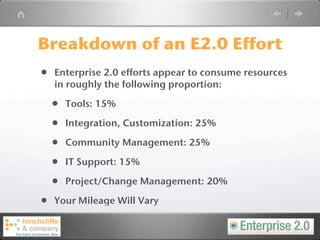
Breakdown of an E2.0 Effort
•   Enterprise 2.0 efforts appear to consume resources
    in roughly the following proportion:

    •   Tools: 15%

    •   Integration, Customization: 25%

    •   Community Management: 25%

    •   IT Support: 15%

    •   Project/Change Management: 20%

•   Your Mileage Will Vary
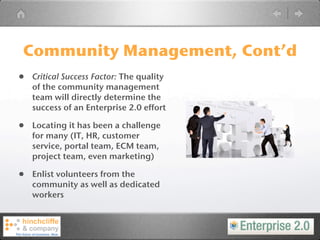
Community Management, Cont’d
•   Critical Success Factor: The quality
    of the community management
    team will directly determine the
    success of an Enterprise 2.0 effort

•   Locating it has been a challenge
    for many (IT, HR, customer
    service, portal team, ECM team,
    project team, even marketing)

•   Enlist volunteers from the
    community as well as dedicated
    workers
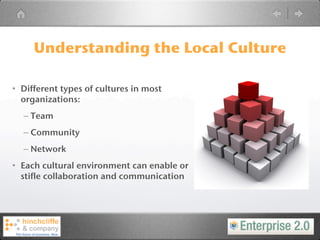
Understanding the Local Culture

• Different types of cultures in most
  organizations:
  – Team
  – Community
  – Network
• Each cultural environment can enable or
  stifle collaboration and communication
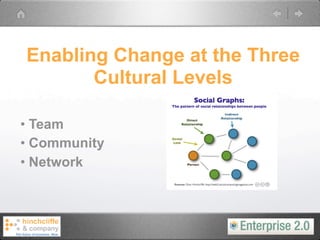
Enabling Change at the Three
       Cultural Levels

• Team
• Community
• Network
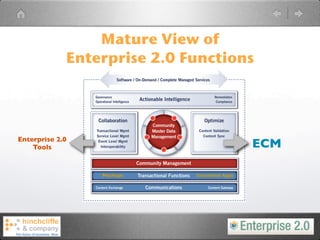
Mature View of
             Enterprise 2.0 Functions


Enterprise 2.0
    Tools                                       ECM

                 Mashups     Situational Apps
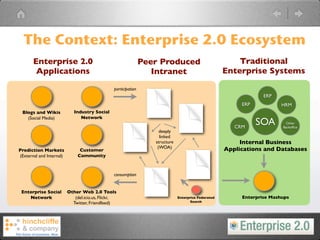
The Context: Enterprise 2.0 Ecosystem
       Enterprise 2.0                                           Peer Produced                             Traditional
        Applications                                               Intranet                           Enterprise Systems

                                                participation
                                                                                                                   ERP
                                                                                                           ERP            HRM
 Blogs and Wikis             Industry Social
   (Social Media)               Network

                                                                                                         CRM
                                                                                                                 SOA        Other
                                                                                                                          Backoffice
                                                                     deeply
                                                                     linked
                                                                   structure                               Internal Business
                                                                    (WOA)                             Applications and Databases
Prediction Markets              Customer
(External and Internal)        Community


                                                consumption


 Enterprise Social        Other Web 2.0 Tools
    Network                  (del.icio.us, Flickr,                             Enterprise Federated        Enterprise Mashups
                            Twitter, Friendfeed)                                      Search
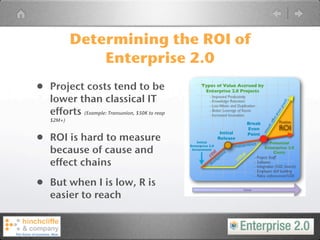
Determining the ROI of
                Enterprise 2.0
•   Project costs tend to be
    lower than classical IT
    efforts (Example: Transunion, $50K to reap
    $2M+)


•   ROI is hard to measure
    because of cause and
    effect chains

•   But when I is low, R is
    easier to reach
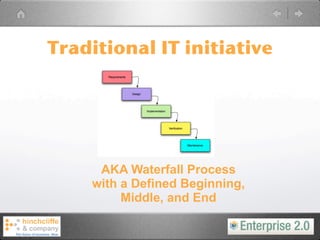
Traditional IT initiative


     AKA Waterfall Process
    with a Defined Beginning,
         Middle, and End
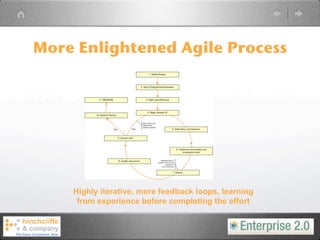
More Enlightened Agile Process


    Highly iterative, more feedback loops, learning
     from experience before completing the effort
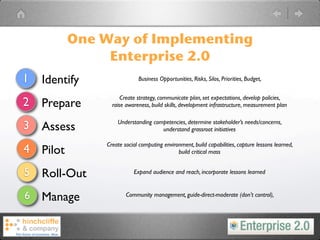
One Way of Implementing
               Enterprise 2.0
1   Identify                Business Opportunities, Risks, Silos, Priorities, Budget,


                     Create strategy, communicate plan, set expectations, develop policies,
2   Prepare      raise awareness, build skills, development infrastructure, measurement plan


3   Assess         Understanding competencies, determine stakeholder’s needs/concerns,
                                    understand grassroot initiatives

               Create social computing environment, build capabilities, capture lessons learned,
4 Pilot                                      build critical mass


5   Roll-Out              Expand audience and reach, incorporate lessons learned


6   Manage             Community management, guide-direct-moderate (don’t control),
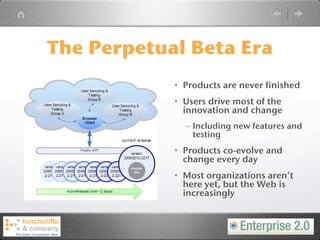
The Perpetual Beta Era
            • Products are never finished
            • Users drive most of the
              innovation and change
              – Including new features and
                testing
            • Products co-evolve and
              change every day
            • Most organizations aren’t
              here yet, but the Web is
              increasingly
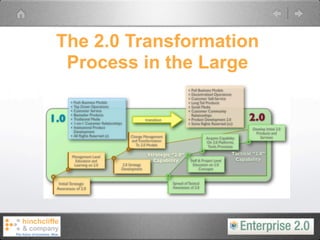
The 2.0 Transformation
 Process in the Large
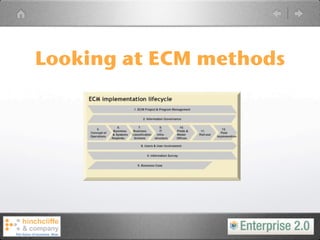
Looking at ECM methods
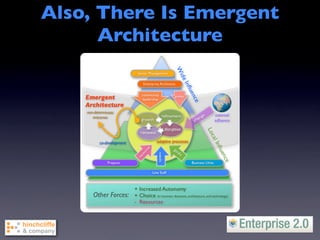
Also, There Is Emergent
      Architecture
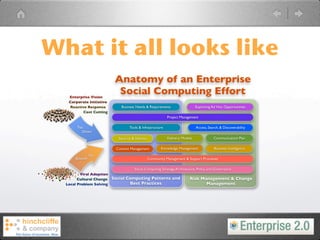
What it all looks like
                          Anatomy of an Enterprise
   Enterprise Vision
                           Social Computing Effort
   Corporate Initiative
   Reactive Response         Business Needs & Requirements                    Exploiting Ad Hoc Opportunities
          Cost Cutting
                                                            Project Management

       Top                        Tools & Infrastructure                      Access, Search, & Discoverability
          Down
                           Security & Identity              Delivery Models              Communication Plan

                          Content Management            Knowledge Management              Business Intelligence
               Up
      Bottom                                     Community Management & Support Processes

                                     Social Computing Strategy, Architecture, Policy, and Governance
         Viral Adoption
        Cultural Change Social Computing Patterns and                    Risk Management & Change
  Local Problem Solving         Best Practices                                  Management
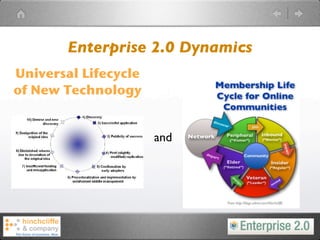
Enterprise 2.0 Dynamics
Universal Lifecycle
of New Technology


                      and
Enterprise 2.0
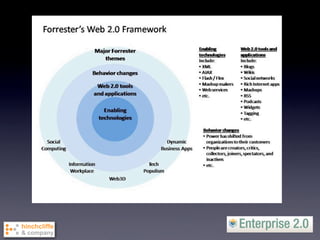
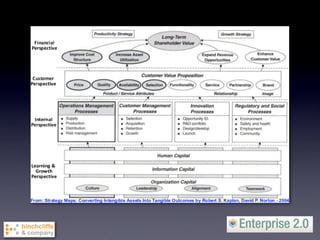
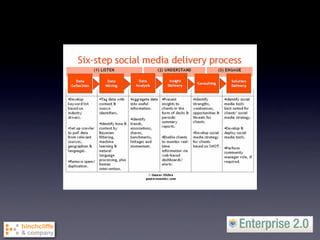
Frameworks &
Methods Survey
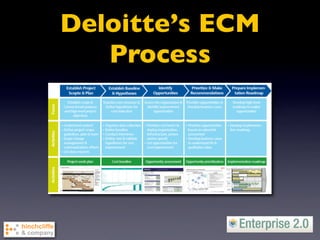
Deloitte’s ECM
   Process
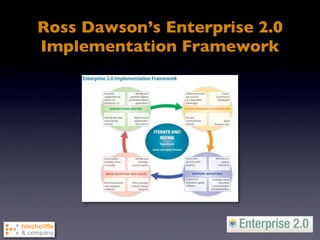
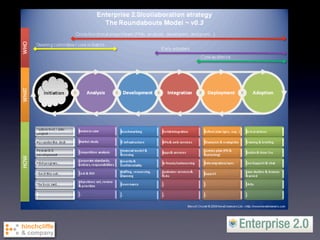
Ross Dawson’s Enterprise 2.0
Implementation Framework
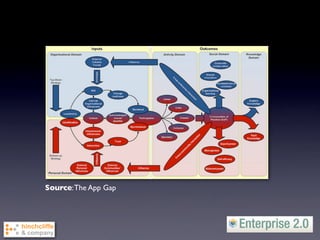
Source: The App Gap
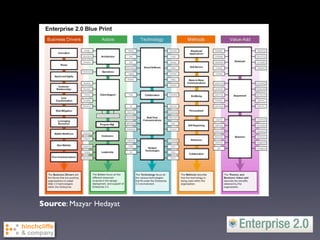
Source: Mazyar Hedayat
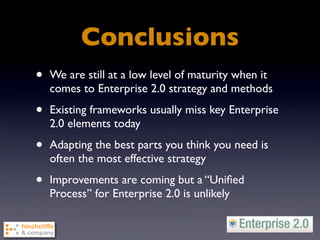
Conclusions
•   We are still at a low level of maturity when it
    comes to Enterprise 2.0 strategy and methods

•   Existing frameworks usually miss key Enterprise
    2.0 elements today

•   Adapting the best parts you think you need is
    often the most effective strategy

•   Improvements are coming but a “Unified
    Process” for Enterprise 2.0 is unlikely
Questions
         Slides:
info@hinchcliffeandco.com

Exploring Early Enterprise 2.0 Methodology

  • 1.
    Exploring Early Enterprise 2.0Methodologies Climbing the Maturity Curve of Process and Methods for Enterprise Social Computing Dion Hinchcliffe
  • 2.
    Introduction Dion Hinchcliffe •ZDNet’s Enterprise Web 2.0 • http://blogs.zdnet.com/Hinchcliffe • Social Computing Journal – Editor-in-Chief • http://socialcomputingjournal.com • Enterprise 2.0 TV Show • http://e2tvshow.com • •Hinchcliffe & Company http://hinchcliffeandco.com • mailto:dion@hinchcliffeandco.com • Web 2.0 University • http://web20university.com • : dhinchcliffe
  • 3.
    Premise • Social computing is an effective new model for meeting business objectives • Can enhance productivity, drive innovation, cut costs, and more Social software + • Integral to the modern workplace today guided • However, social computing is a new business outcomes discipline that combines freeform yet strategic business activity with Web 2.0 technology • Most organizations today have a low level of capability around this new discipline
  • 4.
    The Questions • Howcan we adopt Enterprise 2.0 most effectively? • What have we learned so far? • How do we get the upsides without potential downsides? • Can we identify best practices or are organizations too different to do this?
  • 5.
    How do webest transform our work processes for the 21st century?
  • 6.
    Challenges to Transitioning to Social Business Models • Innovator’s Dilemma • “How do we disrupt ourselves before our competition does?” • Not-Invented Here • Overly fearful of failure • Deeply ingrained classical business culture • Low level of 2.0 literacy
  • 7.
    Pent up changeis building on the edge of organizations and must be recognized and dealt with
  • 8.
    Types of Enterprise 2.0 Business Social Media Marketing “Official” Customer Communities Social CRM Enterprise Social Networks Top Social Portals & Intranets Down Reconciliation & Maturity Up Bottom Departmental Wikis Internal Knowledge ‘-Pedias’ “Guerrilla” Customer Communities Off-Premises Social Networks Workers
  • 9.
  • 10.
    Key area wheretraditional process models often struggle • Don’t respond to change quickly enough • Poorly aligned with current business reality • Lack of focus on driving consumption (or network effects) • Too centralized and/or isolated • Expensive and resource-intensive • Overengineered in the wrong places. Excessively constraining.
  • 11.
    At the VeryLeast, an E2.0 Methodology Must: A) Address active business concerns (downsides) B) Focus on delivering business value C) Help an organization acquire social computing competency
  • 12.
    Applying the “Web 2.0 effect” at work • Enterprise 2.0 – Globally visible, persistent collaboration Enterprise 2.0 systems adapt to the environment, rather • Employees, partners, and even customers than requiring the environment to adapt to it. • Leaves behind highly reusable knowledge – Uses wikis, blogs, social networks, and other Web 2.0 applications to enable low-barrier collaboration across the enterprise – Puts workers into central focus as contributors – Case studies of early adoption consistently verifying significant levels of productivity and innovation
  • 14.
    Perceived Benefits OfEnterprise 2.0 • Increased knowledge retention • More adoption and actual use of knowledge management tools • Better solutions that fit local business problems (via emergent structure and processes) • Increased transparency • Less duplication of effort • Higher levels of productivity
  • 15.
    Understanding Why E2.0 is Different • Maturation of techniques that leverage how people work best • Realization of the power of emergent solutions over pre-defined solutions • Nearly zero-barriers to use • And more...
  • 16.
    The Enterprise 2.0Checklist • SLATES – Search – Linking – Authorship – Tagging – Extensions – Signals
  • 17.
  • 18.
  • 19.
  • 20.
    Push vs. PullBased Systems
  • 21.
    Because the enterpriseis not the Web • We want to replicate the positive aspects of Web 2.0 platforms in the enterprise • But our infrastructure is usually not very Web-like, creating significant impedance and diluted results • Requires augmentation and adaptation to reproduce the same or similar results
  • 22.
    Social vs. CollaborativeUse of Enterprise 2.0 • Social networks focus on enabling interaction and conversation. • Collaborative networks are focused on groups accessing and organizing data into actionable formats that enable decision making, collaboration and reuse Source: Oliver Marks
  • 23.
    Adoption Strategies • Gainand Enlist Top Down Support and Overcome Turf Issues In Advance • Align Enterprise 2.0 Strategy to Business Strategy (Find A Problem To Solve) • Align Enterprise 2.0 Applications to Key Business Goals and Processes • Develop a Simple, Clear Business Case • Provide Strong Leadership for the Enterprise 2.0 Function(s) • Design Measures Aligned to Business Processes
  • 24.
    Adoption Strategies Pt.2 • Listen to the Users, Involve Them in the Design • Simplify the Access and Production of Knowledge • Develop a Clear Communication Plan to Promote the Effort • Involve all the Key Stakeholders, Eventually • Integrate all forms of Communication and Documentation) • Develop a Clear Motivation Plan that Aligns with Current Incentive Plans
  • 25.
    Community Management • Guiding,administering, supporting, and mentoring social groups • Helps organizations achieve specific objectives with Enterprise 2.0 • Has proven invaluable at organizations with significant success: • Stories: SAP, CIA Intellipedia • Now believed to be “essential” to E2.0
  • 26.
    Online Community Management: Jack Of All Trades Brand Support Brand Management Identify Opportunities Software Know-How Listen/Join Conversation Feature Selection Technical Management Advertising and Marketing Marketing Analysis Priority and Schedule Impact Reporting Management Documentation Project Management Business Development Ad Rotation Incorporation of Corporate Organization online community management Team Building Learning Product Management Staff Training Mailings Business Planning Budgeting Events Target Definition Incentives Customer Relationship Revenue Planning Issue Management Management Control/Management Community Management Moderation/Rule Networking Enforcement Distribution of Best Professional Development Incentives/Recruitment Practices Content Management Content Plan Attend Trade Events
  • 27.
    Breakdown of anE2.0 Effort • Enterprise 2.0 efforts appear to consume resources in roughly the following proportion: • Tools: 15% • Integration, Customization: 25% • Community Management: 25% • IT Support: 15% • Project/Change Management: 20% • Your Mileage Will Vary
  • 28.
    Community Management, Cont’d • Critical Success Factor: The quality of the community management team will directly determine the success of an Enterprise 2.0 effort • Locating it has been a challenge for many (IT, HR, customer service, portal team, ECM team, project team, even marketing) • Enlist volunteers from the community as well as dedicated workers
  • 29.
    Understanding the LocalCulture • Different types of cultures in most organizations: – Team – Community – Network • Each cultural environment can enable or stifle collaboration and communication
  • 30.
    Enabling Change atthe Three Cultural Levels • Team • Community • Network
  • 31.
    Mature View of Enterprise 2.0 Functions Enterprise 2.0 Tools ECM Mashups Situational Apps
  • 32.
    The Context: Enterprise2.0 Ecosystem Enterprise 2.0 Peer Produced Traditional Applications Intranet Enterprise Systems participation ERP ERP HRM Blogs and Wikis Industry Social (Social Media) Network CRM SOA Other Backoffice deeply linked structure Internal Business (WOA) Applications and Databases Prediction Markets Customer (External and Internal) Community consumption Enterprise Social Other Web 2.0 Tools Network (del.icio.us, Flickr, Enterprise Federated Enterprise Mashups Twitter, Friendfeed) Search
  • 33.
    Determining the ROIof Enterprise 2.0 • Project costs tend to be lower than classical IT efforts (Example: Transunion, $50K to reap $2M+) • ROI is hard to measure because of cause and effect chains • But when I is low, R is easier to reach
  • 34.
    Traditional IT initiative AKA Waterfall Process with a Defined Beginning, Middle, and End
  • 35.
    More Enlightened AgileProcess Highly iterative, more feedback loops, learning from experience before completing the effort
  • 36.
    One Way ofImplementing Enterprise 2.0 1 Identify Business Opportunities, Risks, Silos, Priorities, Budget, Create strategy, communicate plan, set expectations, develop policies, 2 Prepare raise awareness, build skills, development infrastructure, measurement plan 3 Assess Understanding competencies, determine stakeholder’s needs/concerns, understand grassroot initiatives Create social computing environment, build capabilities, capture lessons learned, 4 Pilot build critical mass 5 Roll-Out Expand audience and reach, incorporate lessons learned 6 Manage Community management, guide-direct-moderate (don’t control),
  • 37.
    The Perpetual BetaEra • Products are never finished • Users drive most of the innovation and change – Including new features and testing • Products co-evolve and change every day • Most organizations aren’t here yet, but the Web is increasingly
  • 38.
    The 2.0 Transformation Process in the Large
  • 39.
  • 40.
    Also, There IsEmergent Architecture
  • 41.
    What it alllooks like Anatomy of an Enterprise Enterprise Vision Social Computing Effort Corporate Initiative Reactive Response Business Needs & Requirements Exploiting Ad Hoc Opportunities Cost Cutting Project Management Top Tools & Infrastructure Access, Search, & Discoverability Down Security & Identity Delivery Models Communication Plan Content Management Knowledge Management Business Intelligence Up Bottom Community Management & Support Processes Social Computing Strategy, Architecture, Policy, and Governance Viral Adoption Cultural Change Social Computing Patterns and Risk Management & Change Local Problem Solving Best Practices Management
  • 42.
    Enterprise 2.0 Dynamics UniversalLifecycle of New Technology and
  • 43.
  • 44.
  • 45.
    Ross Dawson’s Enterprise2.0 Implementation Framework
  • 50.
  • 51.
  • 52.
    Conclusions • We are still at a low level of maturity when it comes to Enterprise 2.0 strategy and methods • Existing frameworks usually miss key Enterprise 2.0 elements today • Adapting the best parts you think you need is often the most effective strategy • Improvements are coming but a “Unified Process” for Enterprise 2.0 is unlikely
  • 53.
    Questions Slides: info@hinchcliffeandco.com