
Emerging Social Business
  Strategies in 2010


    What Works And Why
          Dion Hinchcliffe
Introduction
Dion Hinchcliffe
 • ZDNet’s Enterprise Web 2.0
   • http://blogs.zdnet.com/Hinchcliffe
 • Social Computing Journal – Editor-in-Chief
   • http://socialcomputingjournal.com
 • ebizQ’s Next-Generation Enterprises
       •
      http://www.ebizq.net/blogs/enterprise

   •    Hinchcliffe & Company
       • http://hinchcliffeandco.com
       • mailto:dion@hinchcliffeandco.com
   •   Web 2.0 University
       •   http://web20university.com
   •            : @dhinchcliffe
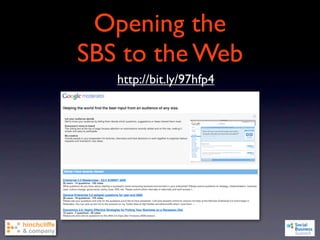
Opening the
SBS to the Web
   http://bit.ly/97hfp4
The vision
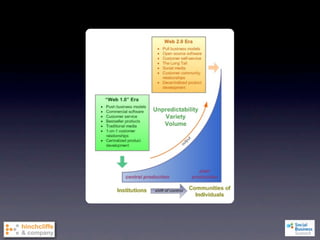
•   How we run our businesses is changing more quickly
    than ever before

•   New technology and expectations have led to results not
    possible -- or expected -- before

•   New economic, social, governmental, and cultural models
    emerging globally

    •   Largely driven by the Web, but changes in us too

•   A pragmatic exploration of how they promote resilient,
    sustainable new business models

•   Using what’s happened recently as a guide, what will this
    transformation look like?
The network is a
    big place today
• All your customers
• All your competitors
• All the ideas and
  innovation
• Only a few proven
  strategies for long-term
  competitive advantage
The major shifts
 • In who creates value (the network does)
 • How much control we have over our
   businesses
 • How intellectual property works
 • Great increases in transparency and
   openness
  • Open supply chains, community-based
     processes and relationships
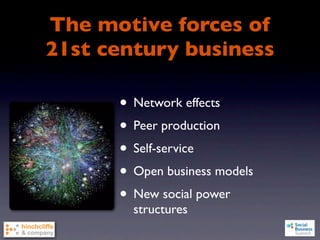
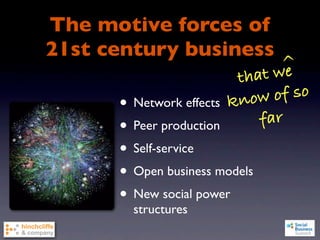
The motive forces of
21st century business

      • Network effects
      • Peer production
      • Self-service
      • Open business models
      • New social power
        structures
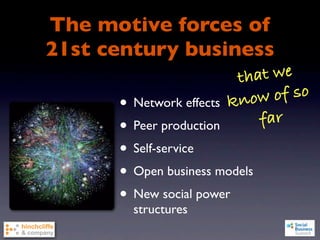
The motive forces of
21st century business
                        tha t we
                         now  of so
      • Network effectsk
      • Peer production    far
      • Self-service
      • Open business models
      • New social power
        structures
The motive forces of
21st century business
                               ^
                        tha t we
                         now  of so
      • Network effectsk
      • Peer production    far
      • Self-service
      • Open business models
      • New social power
        structures
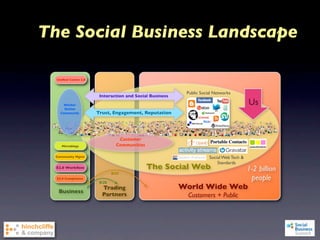
The Social Business Landscape

  Unified Comm 2.0


                                                         Public Social Networks
                     Interaction and Social Business

     Worker                                                                             Us
     Online
   Community        Trust, Engagement, Reputation


                             Customer
    Microblogs              Communities

 Community Mgmt                                                     Social Web Tech &
                                                                        Standards
  E2.0 Workflow                            The Social Web             1-2 billion
                           B2C
  E2.0 Compliance
                     B2B
                                                                      people
                      Trading                          World Wide Web
   Business
                      Partners                           Customers + Public
The Big Questions
•   How do we build and sustain a
    connection with a fundamentally new
    marketplace?
•   What are the rules for success?
•   What do social businesses look like?
•   Are we starting to understand best
    practices?
•   Where is this going? Is it part of a
    larger story?
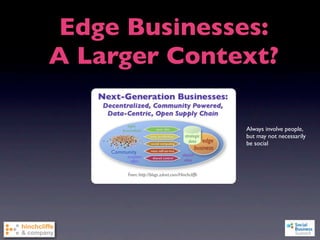
Edge Businesses:
A Larger Context?

              Always involve people,
              but may not necessarily
              be social
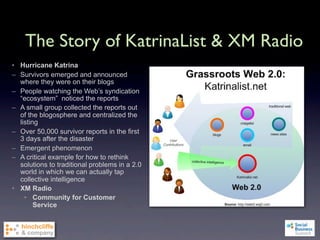
The Story of KatrinaList & XM Radio
• Hurricane Katrina
– Survivors emerged and announced
  where they were on their blogs
– People watching the Web’s syndication
  “ecosystem” noticed the reports
– A small group collected the reports out
  of the blogosphere and centralized the
  listing
– Over 50,000 survivor reports in the first
  3 days after the disaster
– Emergent phenomenon
– A critical example for how to rethink
  solutions to traditional problems in a 2.0
  world in which we can actually tap
  collective intelligence
• XM Radio
    • Community for Customer
        Service
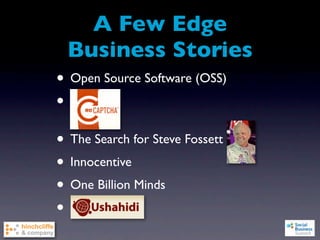
A Few Edge
  Business Stories
• Open Source Software (OSS)
•
• The Search for Steve Fossett
• Innocentive
• One Billion Minds
•
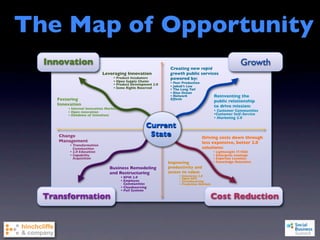
The Map of Opportunity
  Innovation                                                                                           Growth
                                                               Creating new rapid
                              Leveraging Innovation            growth public services
                                  • Product Incubators         powered by:
                                  • Open Supply Chains         • Peer Production
                                  • Product Development 2.0    • Jakob’s Law
                                  • Some Rights Reserved       • The Long Tail
                                                               • Blue Ocean
                                                               • Network           Reinventing the
     Fostering                                                 Effects
                                                                                   public relationship
     Innovation                                                                    to drive mission:
          • Internal Innovation Markets                                                   • Customer Communities
          • Open innovation                                                               •Customer Self-Service
          • Database of Intentions
                                                                                          • Marketing 2.0
                                                    Current
     Change                                          State                       Driving costs down through
     Management                                                                  less expensive, better 2.0
         • Transformation
           Communities                                                           solutions:
         • 2.0 Education                                                               • Lightweight IT/SOA
         • Capability                                                                  • Enterprise mashups
             Acquisition                                                               • Expertise Location
                                                              Improving                • Knowledge Retention
                                  Business Remodeling         productivity and
                                  and Restructuring           access to value:
                                       • BPM 2.0                   • Enterprise 2.0
                                                                   • Open APIs
                                       • Employee                  • Crowdsourcing
                                         Communities               • Prediction Markets
                                       • Cloudsourcing
                                       • Pull Systems
  Transformation                                                                      Cost Reduction
The challenges
• Cultural “chasms”
• Disruption
• Cost
• Risk
• Difficulty (“Digital DNA”)
• Repeatability
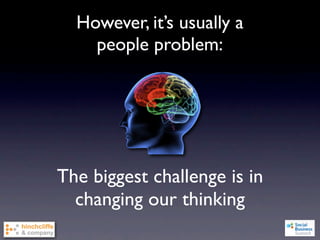
However, it’s usually a
    people problem:


The biggest challenge is in
  changing our thinking
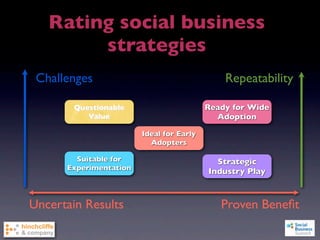
Rating social business
        strategies
 Challenges                                   Repeatability

        Questionable                      Ready for Wide
           Value                            Adoption

                        Ideal for Early
                          Adopters

        Suitable for                        Strategic
      Experimentation                     Industry Play


Uncertain Results                            Proven Benefit
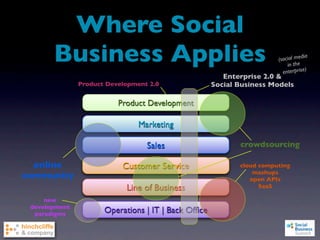
Where Social
       Business Applies                                                (social me
                                                                           in the
                                                                                  dia

                                                                         enterprise
                                                                                    )
                                                        Enterprise 2.0 &
               Product Development 2.0               Social Business Models

                          Product Development

                                Marketing

                                  Sales                     crowdsourcing

  online                   Customer Service                 cloud computing
                                                                mashups
community                                                      open APIs
                            Line of Business                      SaaS

     new
 development
  paradigms
                      Operations | IT | Back Office
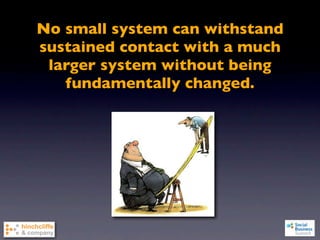
No small system can withstand
sustained contact with a much
 larger system without being
   fundamentally changed.
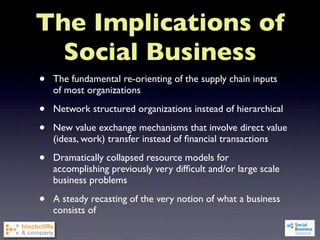
The Implications of
  Social Business
•   The fundamental re-orienting of the supply chain inputs
    of most organizations

•   Network structured organizations instead of hierarchical

•   New value exchange mechanisms that involve direct value
    (ideas, work) transfer instead of financial transactions

•   Dramatically collapsed resource models for
    accomplishing previously very difficult and/or large scale
    business problems

•   A steady recasting of the very notion of what a business
    consists of
Social Business
 For Collaboration
(aka Enterprise 2.0)
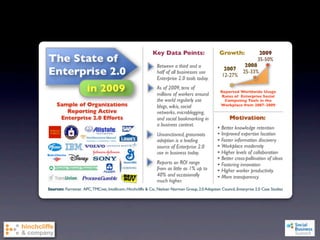
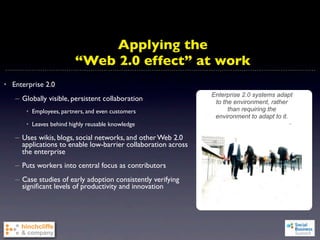
Applying the
                         “Web 2.0 effect” at work
• Enterprise 2.0
                                                               Enterprise 2.0 systems adapt
   – Globally visible, persistent collaboration                 to the environment, rather
       • Employees, partners, and even customers                     than requiring the
                                                                environment to adapt to it.
       • Leaves behind highly reusable knowledge

   – Uses wikis, blogs, social networks, and other Web 2.0
     applications to enable low-barrier collaboration across
     the enterprise
   – Puts workers into central focus as contributors
   – Case studies of early adoption consistently verifying
     significant levels of productivity and innovation
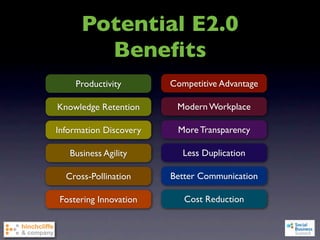
Potential E2.0
        Benefits
    Productivity        Competitive Advantage

Knowledge Retention      Modern Workplace

Information Discovery    More Transparency

   Business Agility        Less Duplication

  Cross-Pollination     Better Communication

Fostering Innovation       Cost Reduction
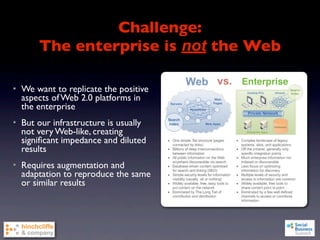
Challenge:
      The enterprise is not the Web

                                      Enterprise
• We want to replicate the positive
  aspects of Web 2.0 platforms in
  the enterprise
• But our infrastructure is usually
  not very Web-like, creating
  significant impedance and diluted
  results
• Requires augmentation and
  adaptation to reproduce the same
  or similar results
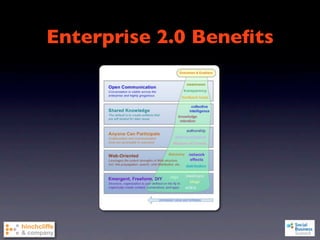
Enterprise 2.0 Benefits
Enterprise 2.0:
 The bottom line
• Repeatable
• Low Risk
• Proven Benefit                       Ready for Wide
                                        Adoption

• Rapid ROI
 •   Transunion Enterprise 2.0 case
     study: $3.5M recoup in 5
     months with $50K
     investment: http://bit.ly/O74W
Open Supply Chains
  & Open Data
Open Supply Chains
  & Open Data
          al so kn own
              as APIs
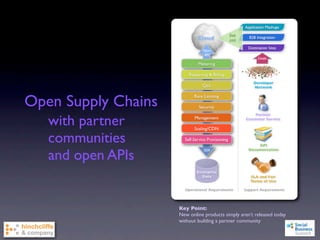
Open Supply Chains
   with partner
   communities
   and open APIs


                     Key Point:
                     New online products simply aren’t released today
                     without building a partner community
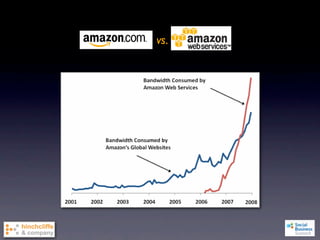
vs.             :
The Platform Overtakes the Web Site
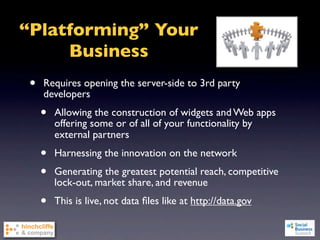
“Platforming” Your
     Business
 •   Requires opening the server-side to 3rd party
     developers
     •   Allowing the construction of widgets and Web apps
         offering some or of all of your functionality by
         external partners
     •   Harnessing the innovation on the network
     •   Generating the greatest potential reach, competitive
         lock-out, market share, and revenue
     •   This is live, not data files like at http://data.gov
Open Supply Chains:
 The bottom line

• Good repeatability
• Can be costly          Strategic

• Unproven in          Industry Play

  certain industries
• Proven ROI
Online Community
What do online
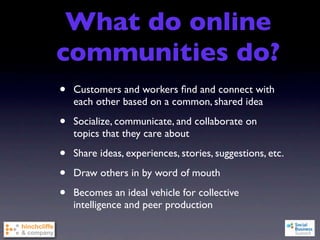
communities do?
•   Customers and workers find and connect with
    each other based on a common, shared idea

•   Socialize, communicate, and collaborate on
    topics that they care about

•   Share ideas, experiences, stories, suggestions, etc.

•   Draw others in by word of mouth

•   Becomes an ideal vehicle for collective
    intelligence and peer production
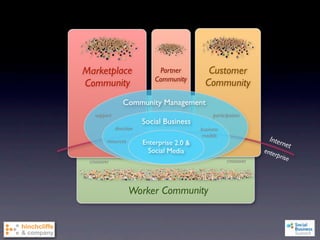
Marketplace                   Partner          Customer
                             Community
Community                                     Community
                 Community Management
   support                                       participation
                         Social Business
             direction                      business
                                            models
         resources       Enterprise 2.0 &                            Inter
                                                                          n et
                           Social Media                            ente
                                                                        rprise
 crossover                                             crossover


                     Worker Community
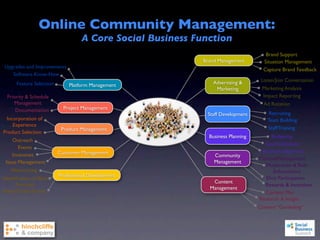
Online Community Management:
                                   A Core Social Business Function
                                                                                     Brand Support
                                                            Brand Management        Situation Management
Upgrades and Improvements
                                                                                    Capture Brand Feedback
   Software Know-How
                                                               Advertising &       Listen/Join Conversation
      Feature Selection       Platform Management
                                                                Marketing          Marketing Analysis
  Priority & Schedule                                                              Impact Reporting
     Management                                                                     Ad Rotation
      Documentation         Project Management
                                                             Staff Development         Recruiting
 Incorporation of                                                                     Team Building
    Experience
                           Product Management                                         Staff Training
Product Selection
                                                              Business Planning        Budgeting
    Outreach
                                                                                    Goal Definition
       Events
                          Customer Management                                      Business Alignment
    Incentives                                                  Community
                                                                                  Control/Management
 Issue Management                                               Management
                                                                                     Moderation & Rule
   Networking                                                                           Enforcement
                          Professional Development                                  Elicit Participation
Identification of Best
                                                               Content
      Practices                                                                     Rewards & Incentives
                                                              Management
Attend Trade Events                                                                 Content Plan
                                                                                  Research & Insight
                                                                                  Content “Gardening”
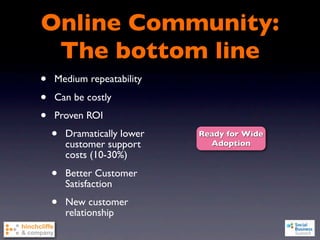
Online Community:
 The bottom line
•   Medium repeatability

•   Can be costly

•   Proven ROI

    •   Dramatically lower
        customer support
                             Ready for Wide
                               Adoption
        costs (10-30%)

    •   Better Customer
        Satisfaction

    •   New customer
        relationship
Open Business
   Models
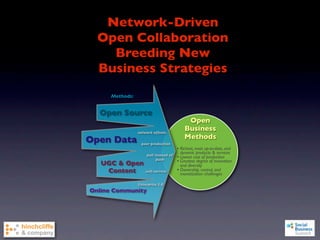
Network-Driven
  Open Collaboration
    Breeding New
  Business Strategies
     Methods:


  Open Source
                                           Open
                network effects
                                          Business
                                          Methods
Open Data        peer production
                                      • Richest, most up-to-date, and
                                        dynamic products & services
                    pull instead of
                          push
                                      • Lowest cost of production
   UGC & Open                         • Greatest degree of innovation
                                        and diversity
    Content         self-service      • Ownership, control, and
                                       monetization challenges

                Enterprise 2.0
Online Community
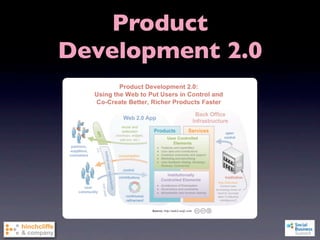
Product
Development 2.0
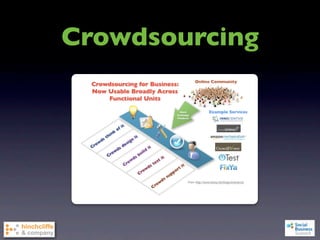
Crowdsourcing

      Text
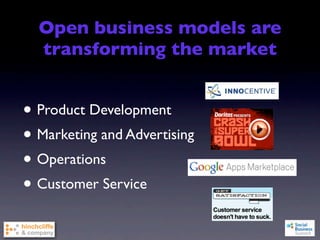
Open business models are
  transforming the market


• Product Development
• Marketing and Advertising
• Operations
• Customer Service
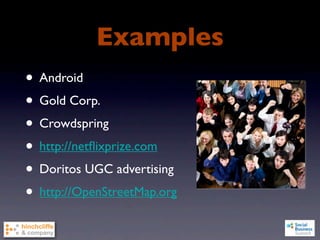
Examples
• Android
• Gold Corp.
• Crowdspring
• http://netflixprize.com
• Doritos UGC advertising
• http://OpenStreetMap.org
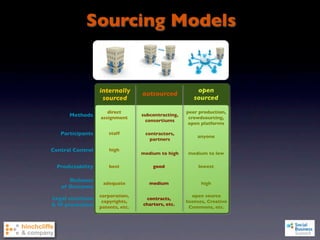
Sourcing Models


                   internally                            open
                                   outsourced
                    sourced                             sourced

                      direct                         peer production,
      Methods      assignment
                                   subcontracting,
                                                      crowdsourcing,
                                    consortiums
                                                      open platforms

   Participants        staff        contractors,
                                                          anyone
                                      partners

Central Control        high
                                   medium to high     medium to low

  Predictability       best            good               lowest


      Richness
                    adequate          medium               high
   of Outcome
                   corporation,                         open source
Legal structure                     contracts,
                    copyrights,                      licenses, Creative
& IP protection                    charters, etc.
                   patents, etc.                       Commons, etc.
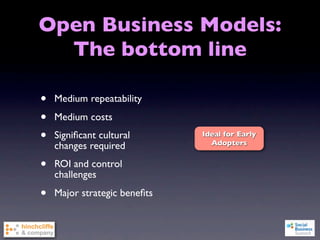
Open Business Models:
  The bottom line

•   Medium repeatability

•   Medium costs

•   Significant cultural
    changes required
                              Ideal for Early
                                Adopters


•   ROI and control
    challenges

•   Major strategic benefits
How do we
 re-imagine our
organizations for
the 21st century?
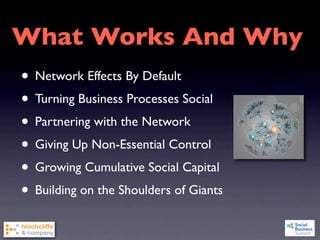
What Works And Why
• Network Effects By Default
• Turning Business Processes Social
• Partnering with the Network
• Giving Up Non-Essential Control
• Growing Cumulative Social Capital
• Building on the Shoulders of Giants
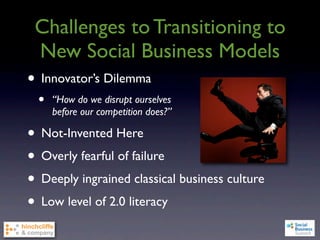
Challenges to Transitioning to
 New Social Business Models
• Innovator’s Dilemma
  •   “How do we disrupt ourselves
      before our competition does?”

• Not-Invented Here
• Overly fearful of failure
• Deeply ingrained classical business culture
• Low level of 2.0 literacy
Key Lesson:
      We now have a
  fundamentally new and
better set of lenses through
 which to look at creating
      business value...
It’s time to change
      our DNA
• Moving from the 20th century towards
  21st century businesses
• Deeply understanding the network and its
  profound potential for creating growth and
  building value
• Putting 2.0 into the core of our modern
  government design
The rewards are
   considerable
• A business world that is sustainable
• Successful transition to a rapid evolving
  new business landscape
• Attaining of better and new type
  relationships with citizens and workers
• Resilience to future change and ongoing
  evolution of business, culture, and society
Discussion
         Slides:
dion@hinchcliffeandco.com

Dion Hinchcliffe at SBS2010

  • 1.
    Emerging Social Business Strategies in 2010 What Works And Why Dion Hinchcliffe
  • 2.
    Introduction Dion Hinchcliffe •ZDNet’s Enterprise Web 2.0 • http://blogs.zdnet.com/Hinchcliffe • Social Computing Journal – Editor-in-Chief • http://socialcomputingjournal.com • ebizQ’s Next-Generation Enterprises • http://www.ebizq.net/blogs/enterprise • Hinchcliffe & Company • http://hinchcliffeandco.com • mailto:dion@hinchcliffeandco.com • Web 2.0 University • http://web20university.com • : @dhinchcliffe
  • 3.
    Opening the SBS tothe Web http://bit.ly/97hfp4
  • 4.
    The vision • How we run our businesses is changing more quickly than ever before • New technology and expectations have led to results not possible -- or expected -- before • New economic, social, governmental, and cultural models emerging globally • Largely driven by the Web, but changes in us too • A pragmatic exploration of how they promote resilient, sustainable new business models • Using what’s happened recently as a guide, what will this transformation look like?
  • 5.
    The network isa big place today • All your customers • All your competitors • All the ideas and innovation • Only a few proven strategies for long-term competitive advantage
  • 6.
    The major shifts • In who creates value (the network does) • How much control we have over our businesses • How intellectual property works • Great increases in transparency and openness • Open supply chains, community-based processes and relationships
  • 7.
    The motive forcesof 21st century business • Network effects • Peer production • Self-service • Open business models • New social power structures
  • 8.
    The motive forcesof 21st century business tha t we now of so • Network effectsk • Peer production far • Self-service • Open business models • New social power structures
  • 9.
    The motive forcesof 21st century business ^ tha t we now of so • Network effectsk • Peer production far • Self-service • Open business models • New social power structures
  • 10.
    The Social BusinessLandscape Unified Comm 2.0 Public Social Networks Interaction and Social Business Worker Us Online Community Trust, Engagement, Reputation Customer Microblogs Communities Community Mgmt Social Web Tech & Standards E2.0 Workflow The Social Web 1-2 billion B2C E2.0 Compliance B2B people Trading World Wide Web Business Partners Customers + Public
  • 11.
    The Big Questions • How do we build and sustain a connection with a fundamentally new marketplace? • What are the rules for success? • What do social businesses look like? • Are we starting to understand best practices? • Where is this going? Is it part of a larger story?
  • 12.
    Edge Businesses: A LargerContext? Always involve people, but may not necessarily be social
  • 13.
    The Story ofKatrinaList & XM Radio • Hurricane Katrina – Survivors emerged and announced where they were on their blogs – People watching the Web’s syndication “ecosystem” noticed the reports – A small group collected the reports out of the blogosphere and centralized the listing – Over 50,000 survivor reports in the first 3 days after the disaster – Emergent phenomenon – A critical example for how to rethink solutions to traditional problems in a 2.0 world in which we can actually tap collective intelligence • XM Radio • Community for Customer Service
  • 14.
    A Few Edge Business Stories • Open Source Software (OSS) • • The Search for Steve Fossett • Innocentive • One Billion Minds •
  • 15.
    The Map ofOpportunity Innovation Growth Creating new rapid Leveraging Innovation growth public services • Product Incubators powered by: • Open Supply Chains • Peer Production • Product Development 2.0 • Jakob’s Law • Some Rights Reserved • The Long Tail • Blue Ocean • Network Reinventing the Fostering Effects public relationship Innovation to drive mission: • Internal Innovation Markets • Customer Communities • Open innovation •Customer Self-Service • Database of Intentions • Marketing 2.0 Current Change State Driving costs down through Management less expensive, better 2.0 • Transformation Communities solutions: • 2.0 Education • Lightweight IT/SOA • Capability • Enterprise mashups Acquisition • Expertise Location Improving • Knowledge Retention Business Remodeling productivity and and Restructuring access to value: • BPM 2.0 • Enterprise 2.0 • Open APIs • Employee • Crowdsourcing Communities • Prediction Markets • Cloudsourcing • Pull Systems Transformation Cost Reduction
  • 16.
    The challenges • Cultural“chasms” • Disruption • Cost • Risk • Difficulty (“Digital DNA”) • Repeatability
  • 17.
    However, it’s usuallya people problem: The biggest challenge is in changing our thinking
  • 18.
    Rating social business strategies Challenges Repeatability Questionable Ready for Wide Value Adoption Ideal for Early Adopters Suitable for Strategic Experimentation Industry Play Uncertain Results Proven Benefit
  • 19.
    Where Social Business Applies (social me in the dia enterprise ) Enterprise 2.0 & Product Development 2.0 Social Business Models Product Development Marketing Sales crowdsourcing online Customer Service cloud computing mashups community open APIs Line of Business SaaS new development paradigms Operations | IT | Back Office
  • 20.
    No small systemcan withstand sustained contact with a much larger system without being fundamentally changed.
  • 22.
    The Implications of Social Business • The fundamental re-orienting of the supply chain inputs of most organizations • Network structured organizations instead of hierarchical • New value exchange mechanisms that involve direct value (ideas, work) transfer instead of financial transactions • Dramatically collapsed resource models for accomplishing previously very difficult and/or large scale business problems • A steady recasting of the very notion of what a business consists of
  • 23.
    Social Business ForCollaboration (aka Enterprise 2.0)
  • 25.
    Applying the “Web 2.0 effect” at work • Enterprise 2.0 Enterprise 2.0 systems adapt – Globally visible, persistent collaboration to the environment, rather • Employees, partners, and even customers than requiring the environment to adapt to it. • Leaves behind highly reusable knowledge – Uses wikis, blogs, social networks, and other Web 2.0 applications to enable low-barrier collaboration across the enterprise – Puts workers into central focus as contributors – Case studies of early adoption consistently verifying significant levels of productivity and innovation
  • 26.
    Potential E2.0 Benefits Productivity Competitive Advantage Knowledge Retention Modern Workplace Information Discovery More Transparency Business Agility Less Duplication Cross-Pollination Better Communication Fostering Innovation Cost Reduction
  • 27.
    Challenge: The enterprise is not the Web Enterprise • We want to replicate the positive aspects of Web 2.0 platforms in the enterprise • But our infrastructure is usually not very Web-like, creating significant impedance and diluted results • Requires augmentation and adaptation to reproduce the same or similar results
  • 28.
  • 29.
    Enterprise 2.0: Thebottom line • Repeatable • Low Risk • Proven Benefit Ready for Wide Adoption • Rapid ROI • Transunion Enterprise 2.0 case study: $3.5M recoup in 5 months with $50K investment: http://bit.ly/O74W
  • 30.
  • 31.
    Open Supply Chains & Open Data al so kn own as APIs
  • 32.
    Open Supply Chains with partner communities and open APIs Key Point: New online products simply aren’t released today without building a partner community
  • 33.
    vs. : The Platform Overtakes the Web Site
  • 34.
    “Platforming” Your Business • Requires opening the server-side to 3rd party developers • Allowing the construction of widgets and Web apps offering some or of all of your functionality by external partners • Harnessing the innovation on the network • Generating the greatest potential reach, competitive lock-out, market share, and revenue • This is live, not data files like at http://data.gov
  • 35.
    Open Supply Chains: The bottom line • Good repeatability • Can be costly Strategic • Unproven in Industry Play certain industries • Proven ROI
  • 36.
  • 38.
    What do online communitiesdo? • Customers and workers find and connect with each other based on a common, shared idea • Socialize, communicate, and collaborate on topics that they care about • Share ideas, experiences, stories, suggestions, etc. • Draw others in by word of mouth • Becomes an ideal vehicle for collective intelligence and peer production
  • 39.
    Marketplace Partner Customer Community Community Community Community Management support participation Social Business direction business models resources Enterprise 2.0 & Inter n et Social Media ente rprise crossover crossover Worker Community
  • 40.
    Online Community Management: A Core Social Business Function Brand Support Brand Management Situation Management Upgrades and Improvements Capture Brand Feedback Software Know-How Advertising & Listen/Join Conversation Feature Selection Platform Management Marketing Marketing Analysis Priority & Schedule Impact Reporting Management Ad Rotation Documentation Project Management Staff Development Recruiting Incorporation of Team Building Experience Product Management Staff Training Product Selection Business Planning Budgeting Outreach Goal Definition Events Customer Management Business Alignment Incentives Community Control/Management Issue Management Management Moderation & Rule Networking Enforcement Professional Development Elicit Participation Identification of Best Content Practices Rewards & Incentives Management Attend Trade Events Content Plan Research & Insight Content “Gardening”
  • 41.
    Online Community: Thebottom line • Medium repeatability • Can be costly • Proven ROI • Dramatically lower customer support Ready for Wide Adoption costs (10-30%) • Better Customer Satisfaction • New customer relationship
  • 42.
  • 43.
    Network-Driven OpenCollaboration Breeding New Business Strategies Methods: Open Source Open network effects Business Methods Open Data peer production • Richest, most up-to-date, and dynamic products & services pull instead of push • Lowest cost of production UGC & Open • Greatest degree of innovation and diversity Content self-service • Ownership, control, and monetization challenges Enterprise 2.0 Online Community
  • 44.
  • 45.
  • 46.
    Open business modelsare transforming the market • Product Development • Marketing and Advertising • Operations • Customer Service
  • 47.
    Examples • Android • GoldCorp. • Crowdspring • http://netflixprize.com • Doritos UGC advertising • http://OpenStreetMap.org
  • 48.
    Sourcing Models internally open outsourced sourced sourced direct peer production, Methods assignment subcontracting, crowdsourcing, consortiums open platforms Participants staff contractors, anyone partners Central Control high medium to high medium to low Predictability best good lowest Richness adequate medium high of Outcome corporation, open source Legal structure contracts, copyrights, licenses, Creative & IP protection charters, etc. patents, etc. Commons, etc.
  • 49.
    Open Business Models: The bottom line • Medium repeatability • Medium costs • Significant cultural changes required Ideal for Early Adopters • ROI and control challenges • Major strategic benefits
  • 50.
    How do we re-imagine our organizations for the 21st century?
  • 51.
    What Works AndWhy • Network Effects By Default • Turning Business Processes Social • Partnering with the Network • Giving Up Non-Essential Control • Growing Cumulative Social Capital • Building on the Shoulders of Giants
  • 52.
    Challenges to Transitioningto New Social Business Models • Innovator’s Dilemma • “How do we disrupt ourselves before our competition does?” • Not-Invented Here • Overly fearful of failure • Deeply ingrained classical business culture • Low level of 2.0 literacy
  • 53.
    Key Lesson: We now have a fundamentally new and better set of lenses through which to look at creating business value...
  • 54.
    It’s time tochange our DNA • Moving from the 20th century towards 21st century businesses • Deeply understanding the network and its profound potential for creating growth and building value • Putting 2.0 into the core of our modern government design
  • 55.
    The rewards are considerable • A business world that is sustainable • Successful transition to a rapid evolving new business landscape • Attaining of better and new type relationships with citizens and workers • Resilience to future change and ongoing evolution of business, culture, and society
  • 56.
    Discussion Slides: dion@hinchcliffeandco.com