Agroforestry Program in South Asia

   V.P. Singh, Regional Coordinator for
                South Asia
             New Delhi, India
South Asia Program context
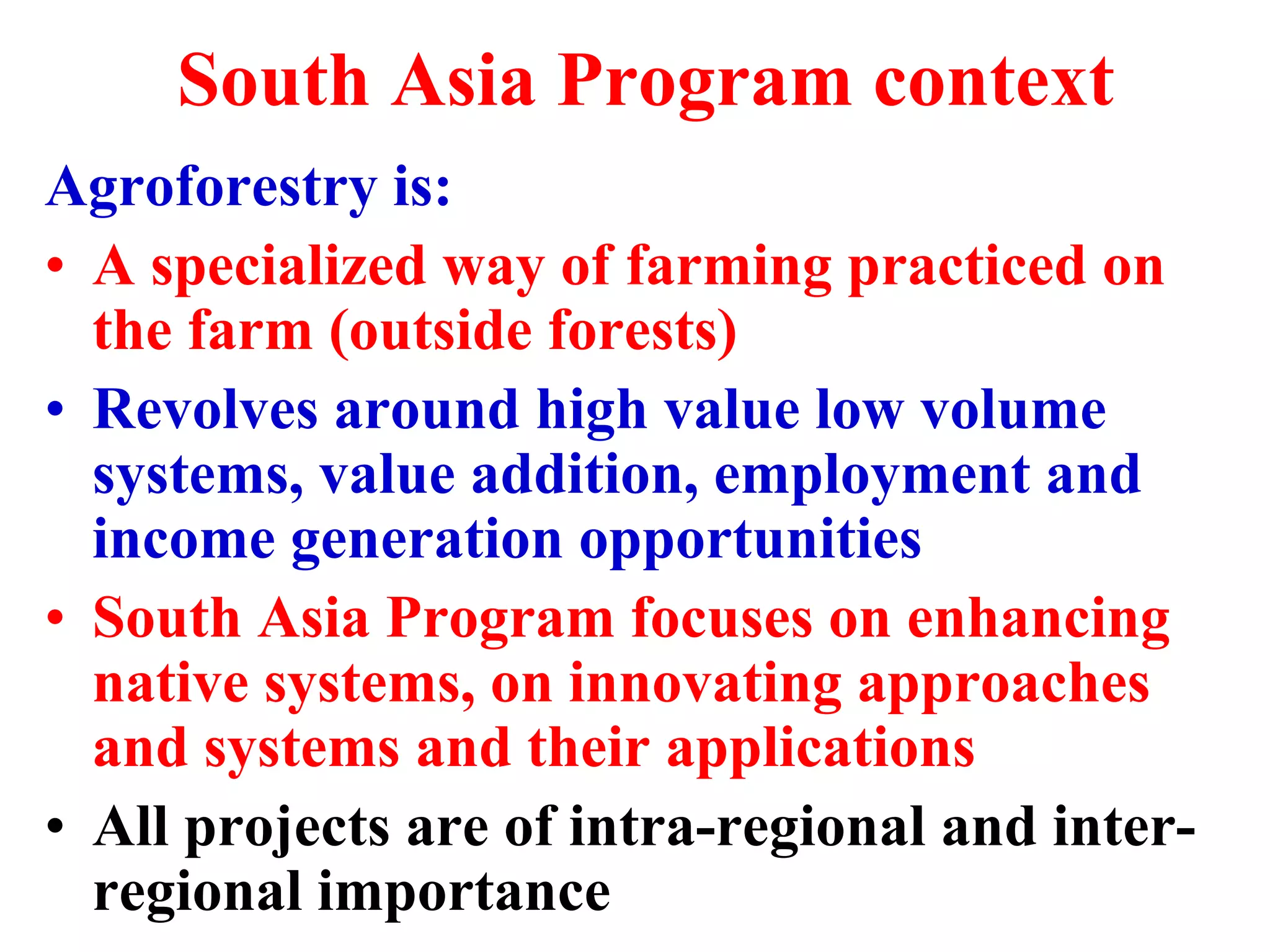
Agroforestry is:
• A specialized way of farming practiced on
  the farm (outside forests)
• Revolves around high value low volume
  systems, value addition, employment and
  income generation opportunities
• South Asia Program focuses on enhancing
  native systems, on innovating approaches
  and systems and their applications
• All projects are of intra-regional and inter-
  regional importance
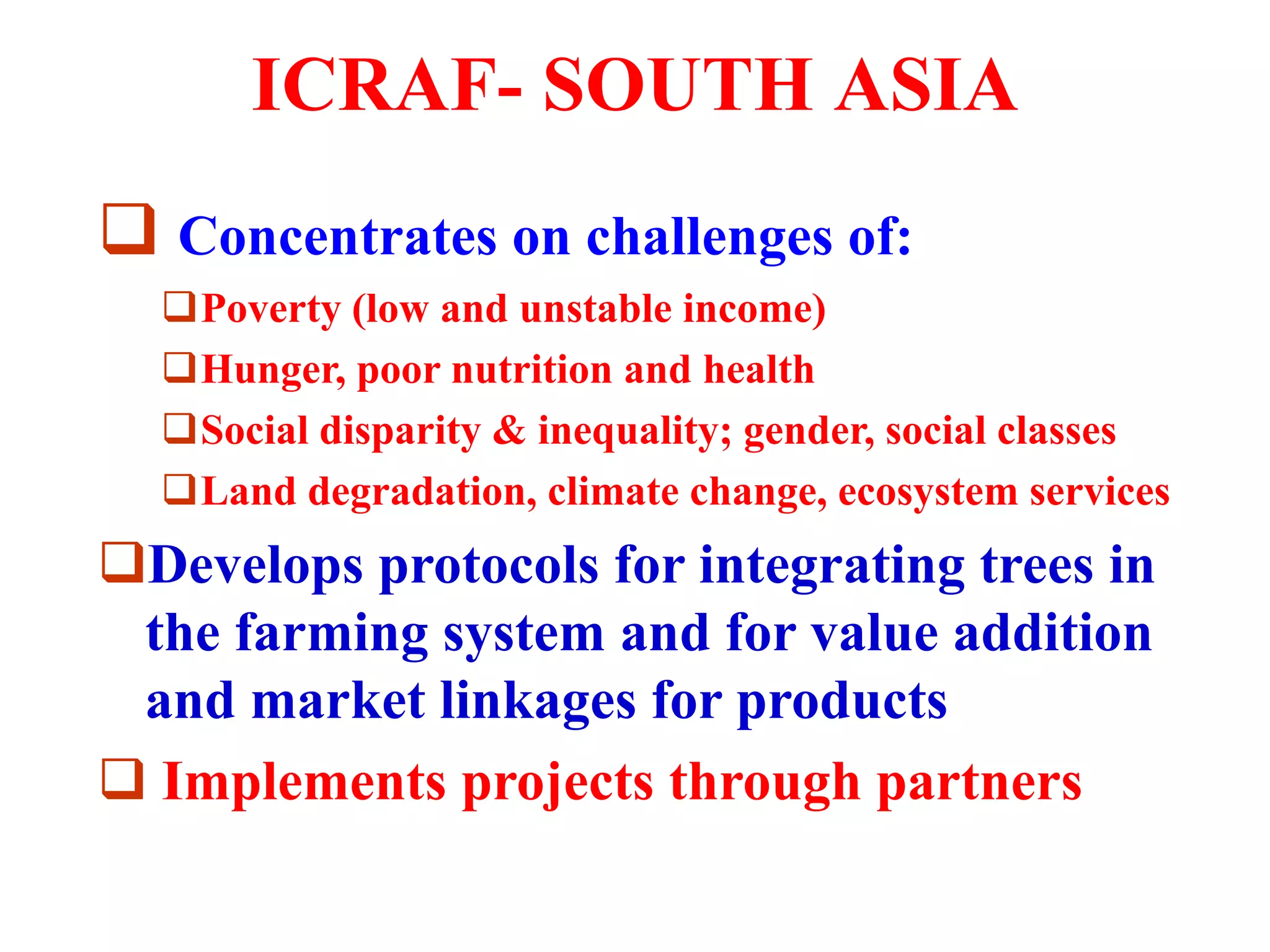
ICRAF- SOUTH ASIA
 Concentrates on challenges of:
  Poverty (low and unstable income)
  Hunger, poor nutrition and health
  Social disparity & inequality; gender, social classes
  Land degradation, climate change, ecosystem services
Develops protocols for integrating trees in
the farming system and for value addition
and market linkages for products
 Implements projects through partners
South Asia operates through
• Multiple partnerships
• National agriculture / forestry R&D systems
• Ecology/ commodity / product based
  coordinated projects and networks
• Focusing on national capacity building
• Accessing national capacity strengths
• Resource and credit sharing
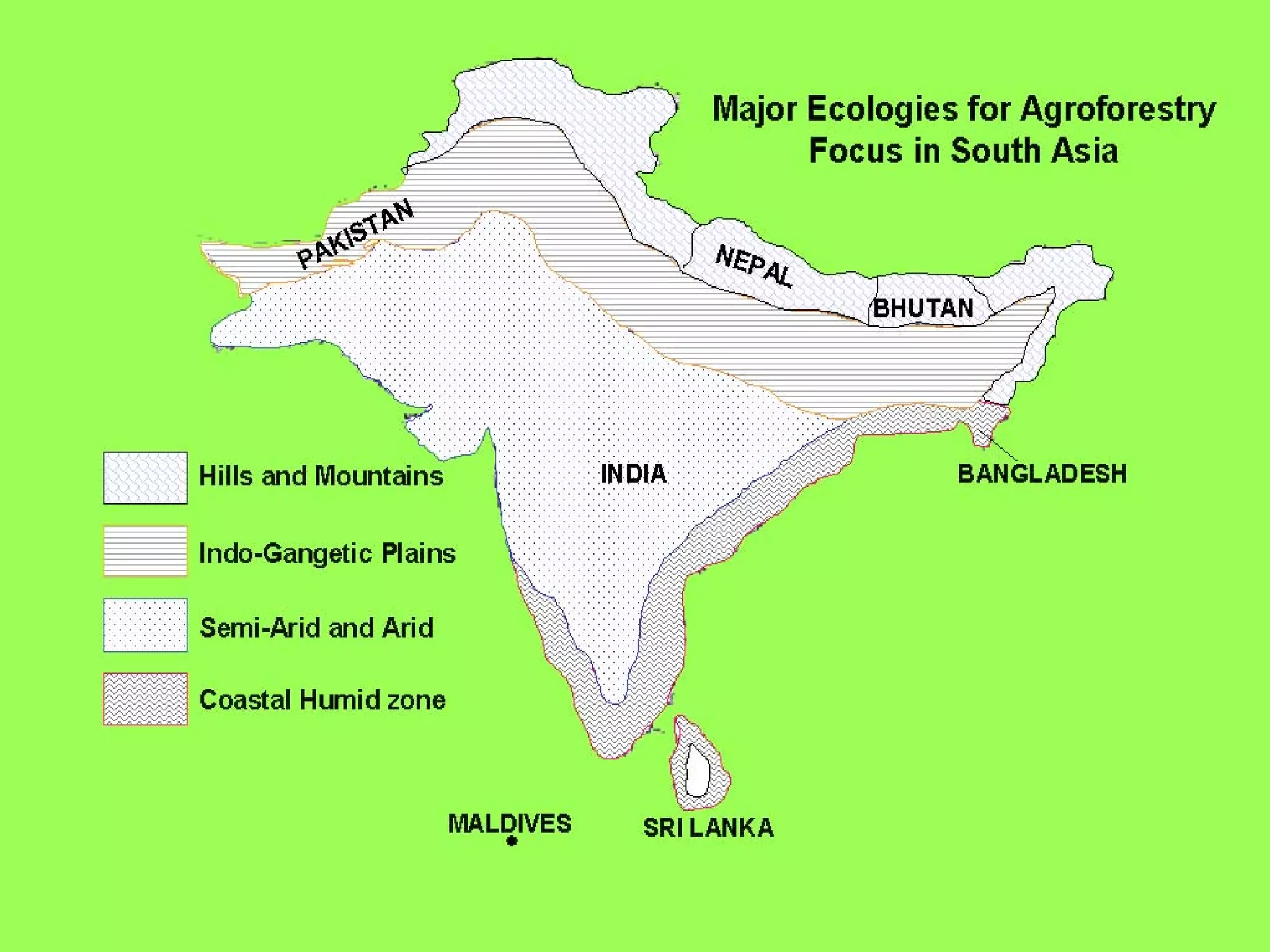
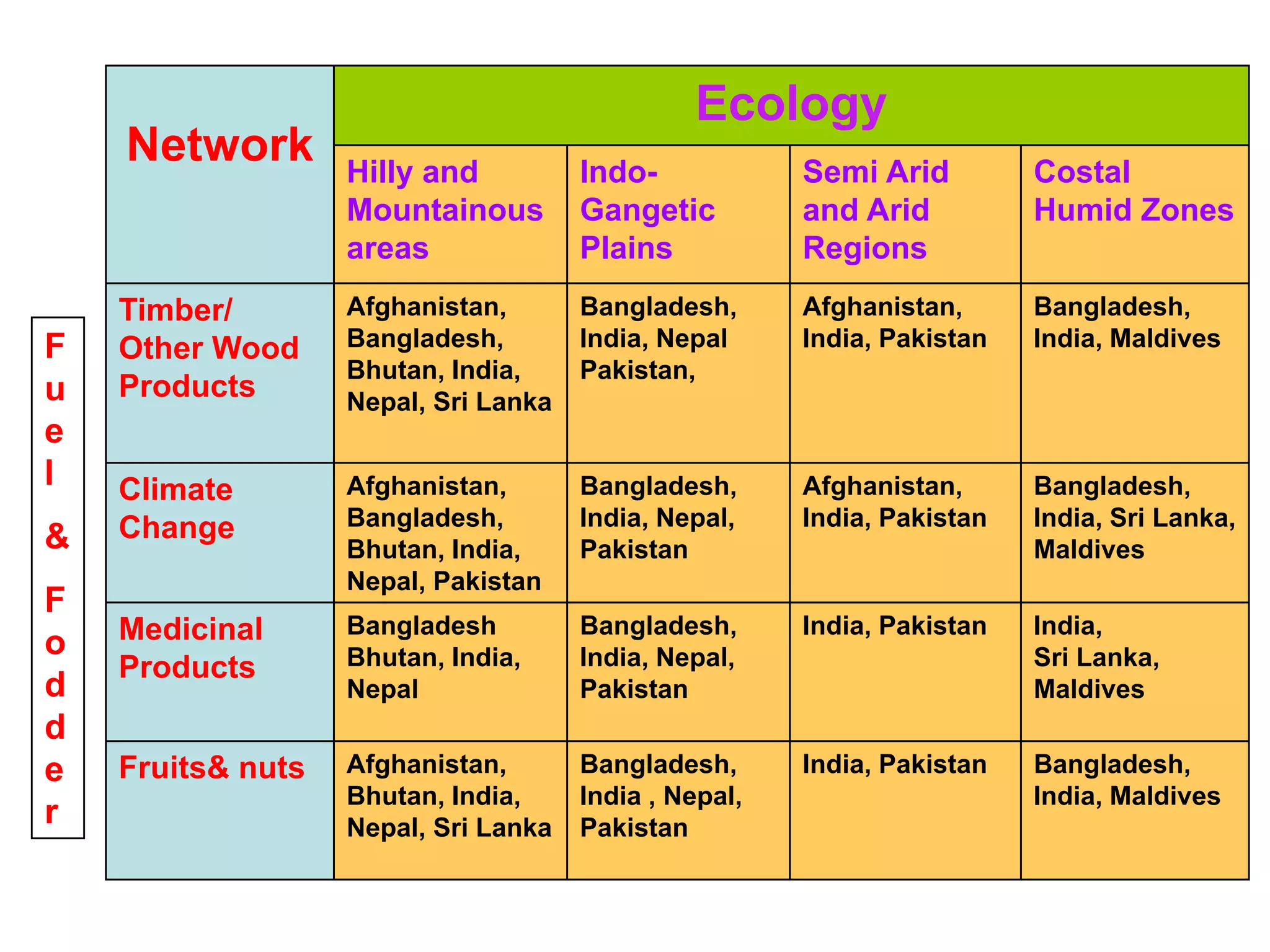
Ecology
    Network        Hilly and          Indo-            Semi Arid         Costal
                   Mountainous        Gangetic         and Arid          Humid Zones
                   areas              Plains           Regions
    Timber/        Afghanistan,       Bangladesh,      Afghanistan,      Bangladesh,
F   Other Wood     Bangladesh,        India, Nepal     India, Pakistan   India, Maldives
                   Bhutan, India,     Pakistan,
u   Products       Nepal, Sri Lanka
e
l   Climate        Afghanistan,       Bangladesh,      Afghanistan,      Bangladesh,
    Change         Bangladesh,        India, Nepal,    India, Pakistan   India, Sri Lanka,
&                  Bhutan, India,     Pakistan                           Maldives
                   Nepal, Pakistan
F
    Medicinal      Bangladesh         Bangladesh,      India, Pakistan   India,
o                  Bhutan, India,     India, Nepal,                      Sri Lanka,
    Products
d                  Nepal              Pakistan                           Maldives
d
e   Fruits& nuts   Afghanistan,       Bangladesh,      India, Pakistan   Bangladesh,
                   Bhutan, India,     India , Nepal,                     India, Maldives
r                  Nepal, Sri Lanka   Pakistan
South Asia Priorities and Focus
•   Improved germplasm and high quality
    planting material supply systems

•   Agroforestry intensification and
    diversification

•   Agroforestry product demand, market
    and value chain analysis

•   Impact assessment and value tagging of
    major agroforestry systems
South Asia priorities and focus---
•    Land degradation assessment and
     rehabilitation of degraded lands

•    Climate change mitigation and
     adaptation, carbon finance

•    Bioenergy / bio-fuels policy, technical
     advancements and practical solutions

•    Inter-regional partnerships
Sustainable tree seed and seedling
supply systems---

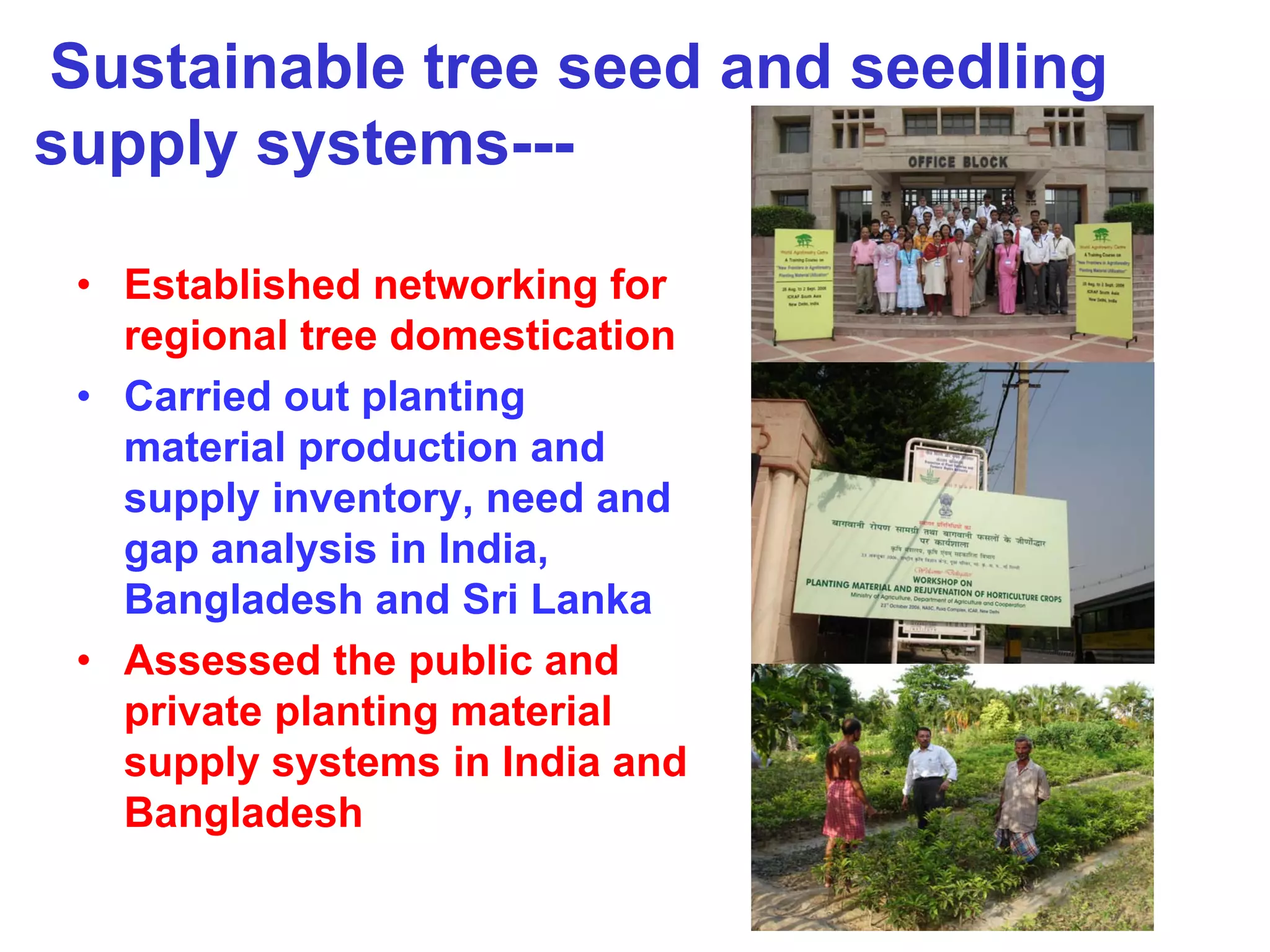
 • Established networking for
   regional tree domestication
 • Carried out planting
   material production and
   supply inventory, need and
   gap analysis in India,
   Bangladesh and Sri Lanka
 • Assessed the public and
   private planting material
   supply systems in India and
   Bangladesh
Sustainable tree seed and Seedling
          supply systems---

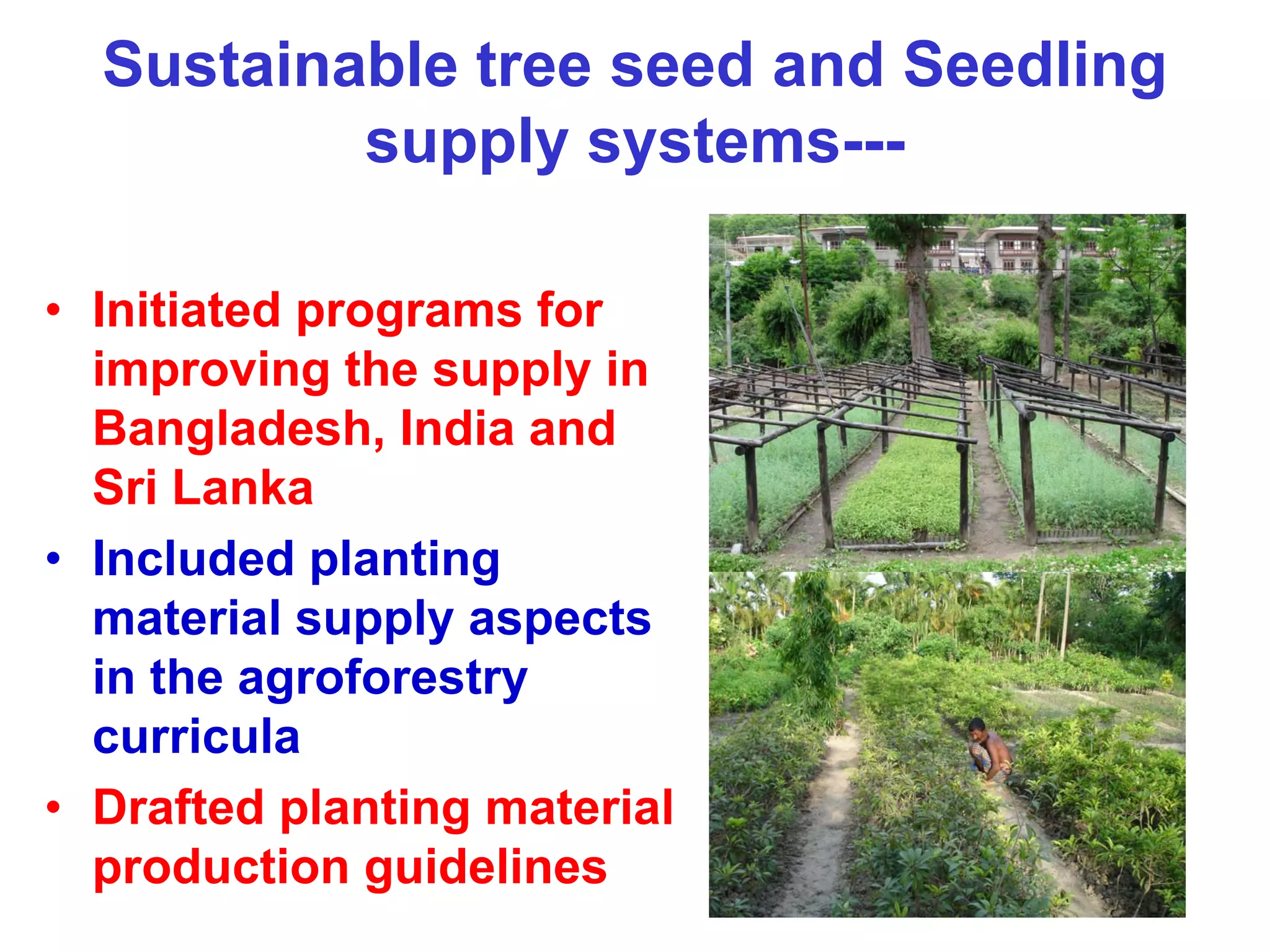
• Initiated programs for
  improving the supply in
  Bangladesh, India and
  Sri Lanka
• Included planting
  material supply aspects
  in the agroforestry
  curricula
• Drafted planting material
  production guidelines
Improved on-farm productivity of trees and
agroforestry systems
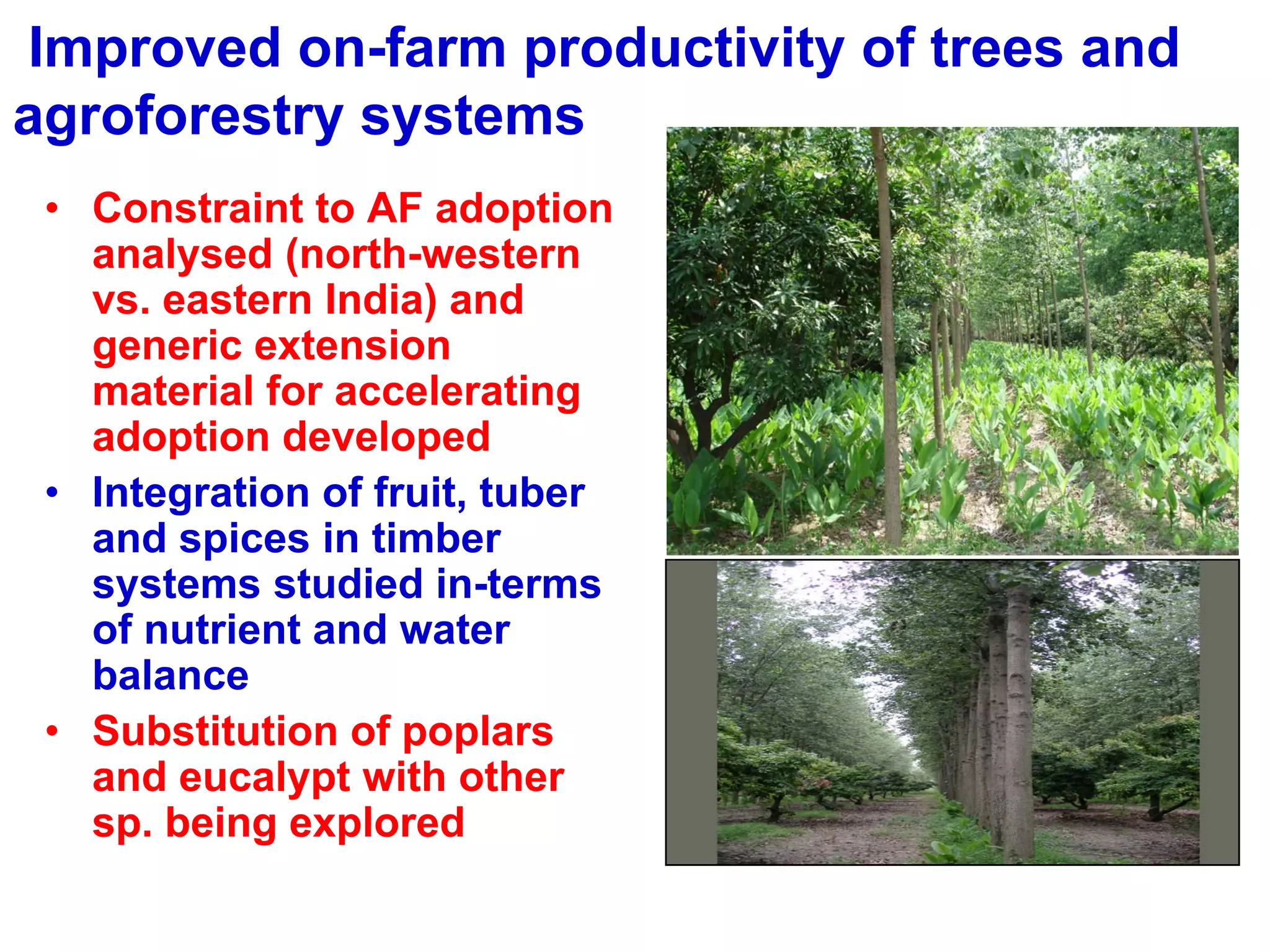
 • Constraint to AF adoption
   analysed (north-western
   vs. eastern India) and
   generic extension
   material for accelerating
   adoption developed
 • Integration of fruit, tuber
   and spices in timber
   systems studied in-terms
   of nutrient and water
   balance
 • Substitution of poplars
   and eucalypt with other
   sp. being explored
Improved on-farm productivity of trees and
          agroforestry systems
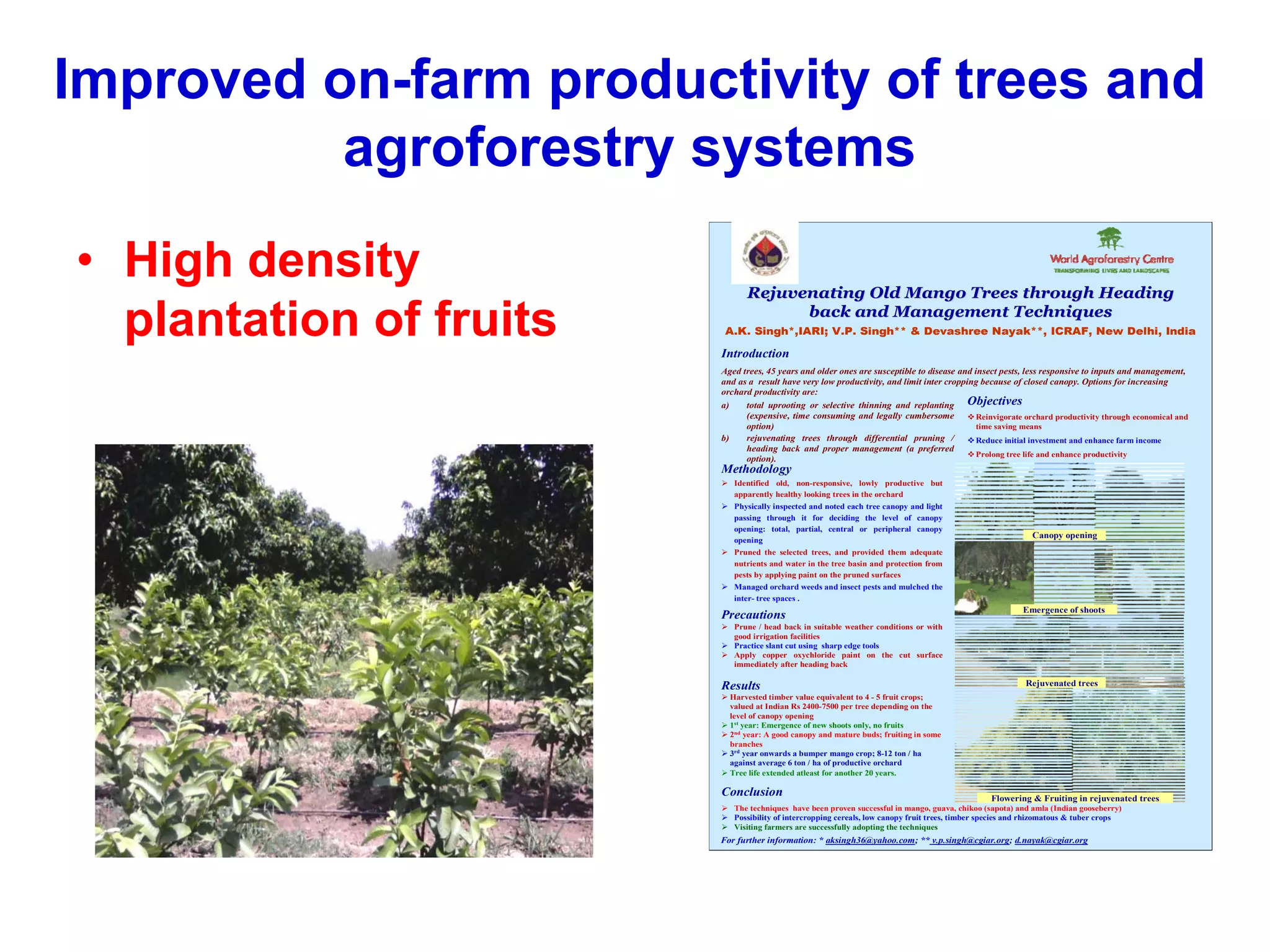
• High density                    Rejuvenating Old Mango Trees through Heading

  plantation of fruits                  back and Management Techniques
                          A.K. Singh*,IARI; V.P. Singh** & Devashree Nayak**, ICRAF, New Delhi, India

                         Introduction
                         Aged trees, 45 years and older ones are susceptible to disease and insect pests, less responsive to inputs and management,
                         and as a result have very low productivity, and limit inter cropping because of closed canopy. Options for increasing
                         orchard productivity are:
                         a)       total uprooting or selective thinning and replanting        Objectives
                                  (expensive, time consuming and legally cumbersome              Reinvigorate orchard productivity through economical and
                                  option)                                                        time saving means
                         b)       rejuvenating trees through differential pruning /              Reduce initial investment and enhance farm income
                                  heading back and proper management (a preferred
                                                                                                 Prolong tree life and enhance productivity
                                  option).
                         Methodology
                               Identified old, non-responsive, lowly productive but
                               apparently healthy looking trees in the orchard
                               Physically inspected and noted each tree canopy and light
                               passing through it for deciding the level of canopy
                               opening: total, partial, central or peripheral canopy
                                                                                                                Canopy opening
                               opening
                               Pruned the selected trees, and provided them adequate
                               nutrients and water in the tree basin and protection from
                               pests by applying paint on the pruned surfaces
                               Managed orchard weeds and insect pests and mulched the
                               inter- tree spaces .
                                                                                                              Emergence of shoots
                         Precautions
                               Prune / head back in suitable weather conditions or with
                               good irrigation facilities
                               Practice slant cut using sharp edge tools
                               Apply copper oxychloride paint on the cut surface
                               immediately after heading back

                         Results                                                                              Rejuvenated trees
                              Harvested timber value equivalent to 4 - 5 fruit crops;
                              valued at Indian Rs 2400-7500 per tree depending on the
                              level of canopy opening
                              1st year: Emergence of new shoots only, no fruits
                              2nd year: A good canopy and mature buds; fruiting in some
                              branches
                              3rd year onwards a bumper mango crop; 8-12 ton / ha
                              against average 6 ton / ha of productive orchard
                              Tree life extended atleast for another 20 years.

                         Conclusion                                                                  Flowering & Fruiting in rejuvenated trees
                               The techniques have been proven successful in mango, guava, chikoo (sapota) and amla (Indian gooseberry)
                               Possibility of intercropping cereals, low canopy fruit trees, timber species and rhizomatous & tuber crops
                               Visiting farmers are successfully adopting the techniques
                         For further information: * aksingh36@yahoo.com; ** v.p.singh@cgiar.org; d.nayak@cgiar.org
Impact assessment of major agroforestry systems


 • Ongoing in the following areas:
 -- Timber based (poplar and eucalypt) in north-
    western India
 -- Fruit based systems:
 • Mango in Uttar Pradesh, West Bengal and
    Karnataka,
 • Guava in Uttar Pradesh,
 • Pomegranate in Maharashtra, and
 • Custard apple in Rajasthan
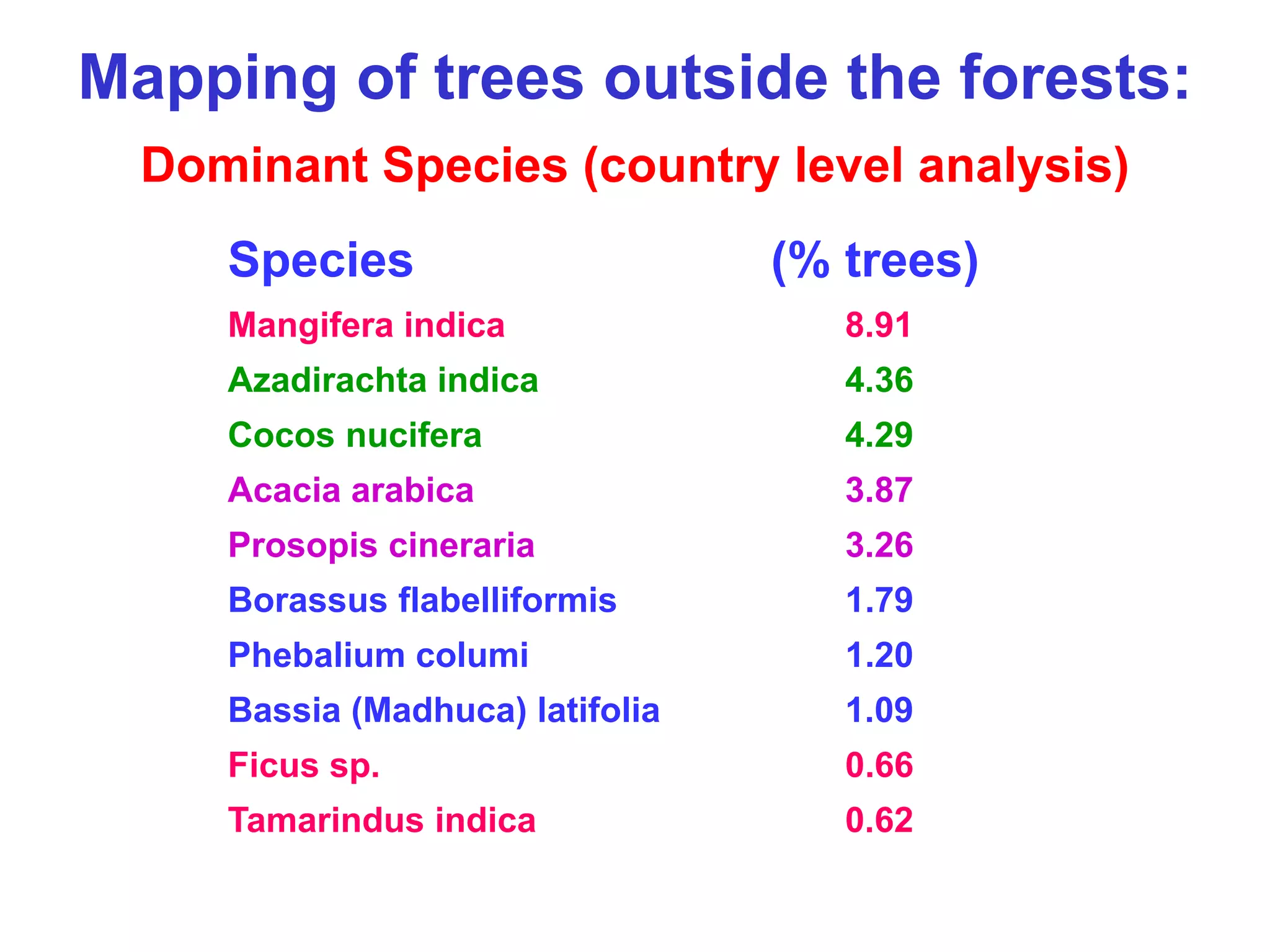
Mapping of trees outside the forests:
  Dominant Species (country level analysis)
     Species                      (% trees)
     Mangifera indica                8.91
     Azadirachta indica              4.36
     Cocos nucifera                  4.29
     Acacia arabica                  3.87
     Prosopis cineraria              3.26
     Borassus flabelliformis         1.79
     Phebalium columi                1.20
     Bassia (Madhuca) latifolia      1.09
     Ficus sp.                       0.66
     Tamarindus indica               0.62
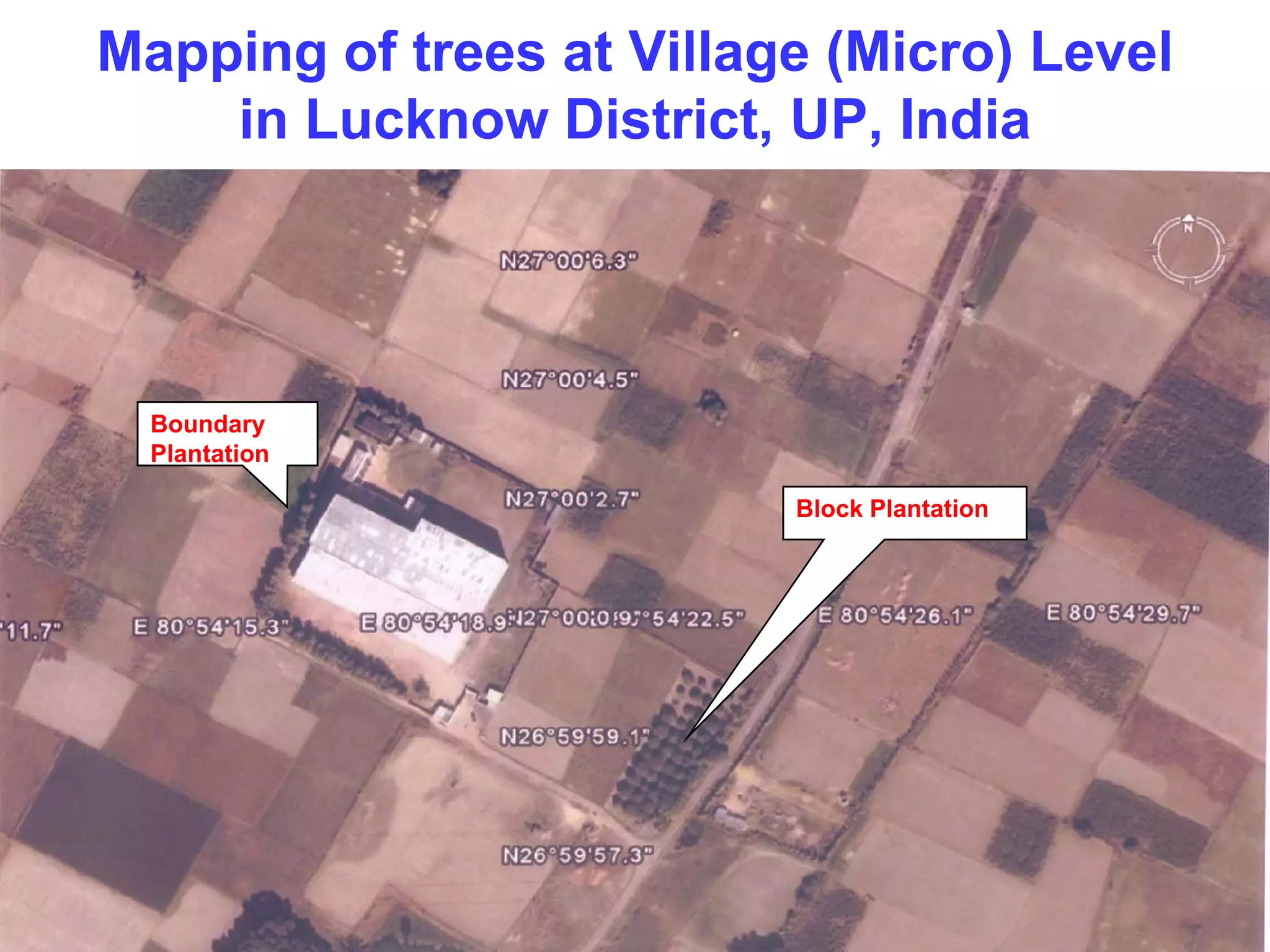
Mapping of trees at Village (Micro) Level
    in Lucknow District, UP, India


  Boundary
  Plantation

                          Block Plantation
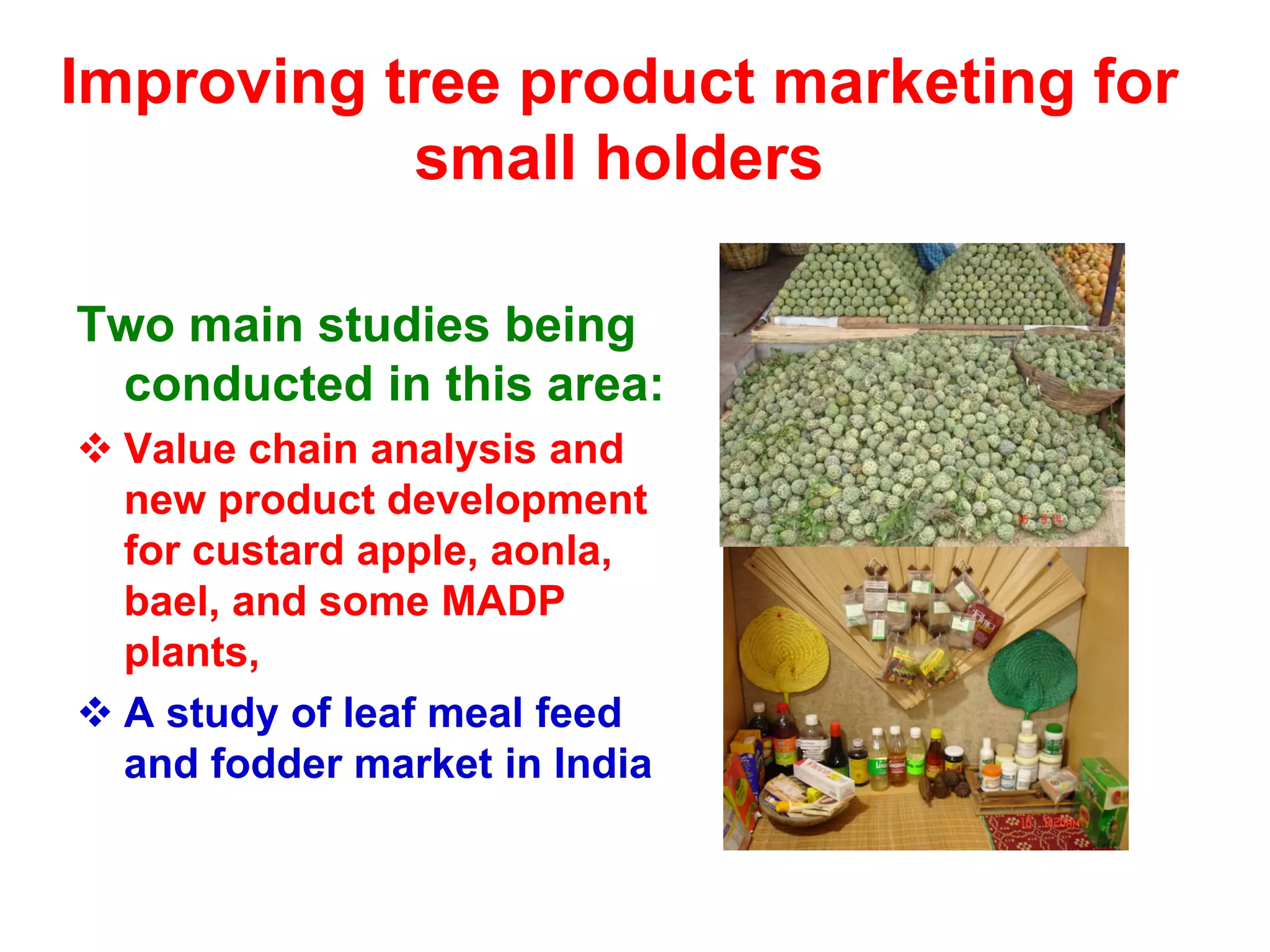
Improving tree product marketing for
           small holders

Two main studies being
 conducted in this area:
  Value chain analysis and
  new product development
  for custard apple, aonla,
  bael, and some MADP
  plants,
  A study of leaf meal feed
  and fodder market in India
Reducing land health risk and rehabilitation of
   degraded lands through agroforestry

 • Extent of eroded (Rajasthan), surface mined (UP), mine
   tailing (Orissa) and sand deposits (Assam) monitored,

 • Soils analyzed and calibrated with the spectral
   signatures for large scale soil loss assessment,

 • Public and private rehabilitation efforts of degraded
   lands through agroforestry being compiled,

 • Rehabilitation of degraded lands through agroforestry
   being studied
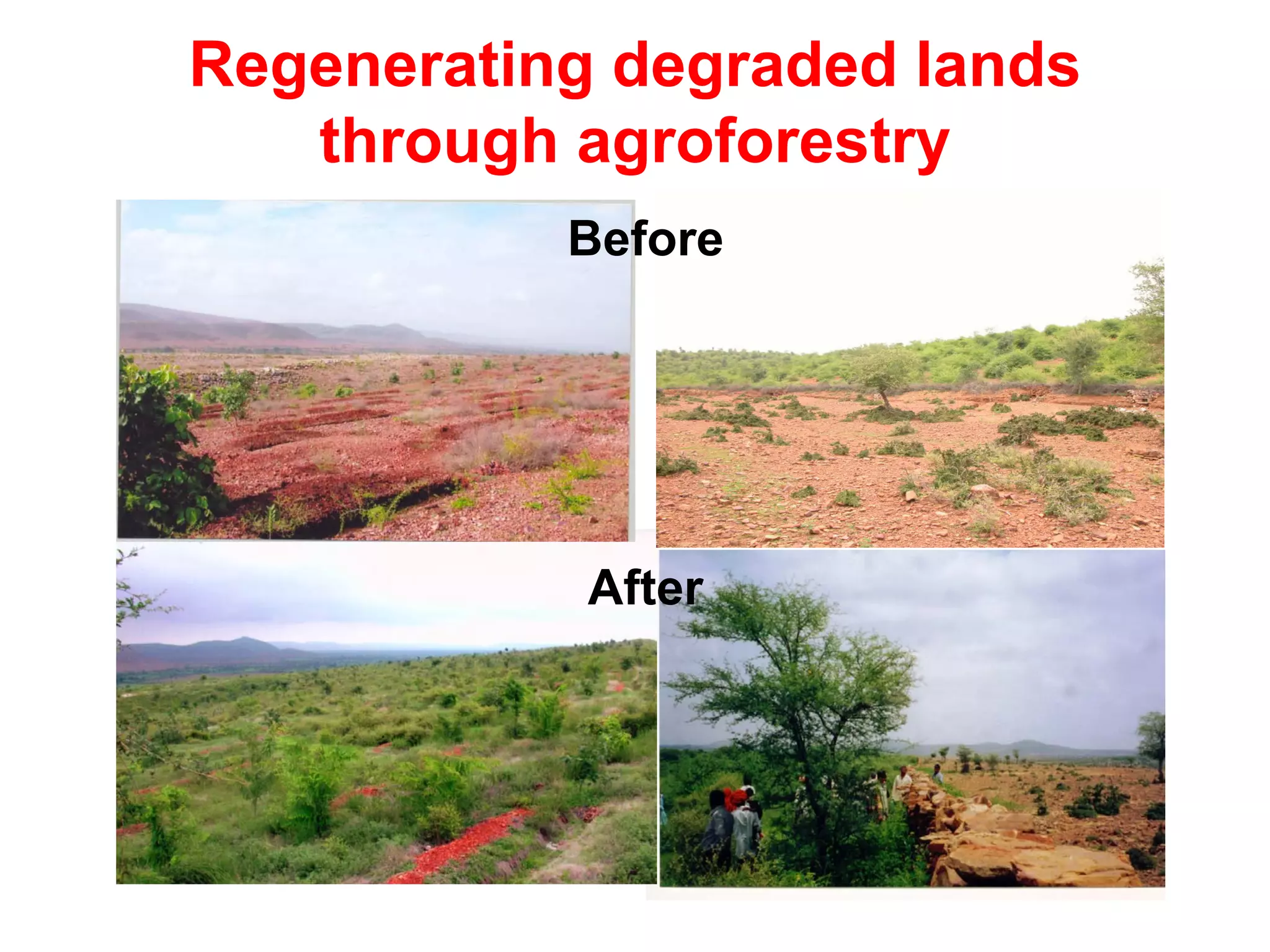
Regenerating degraded lands
   through agroforestry
           Before


            After
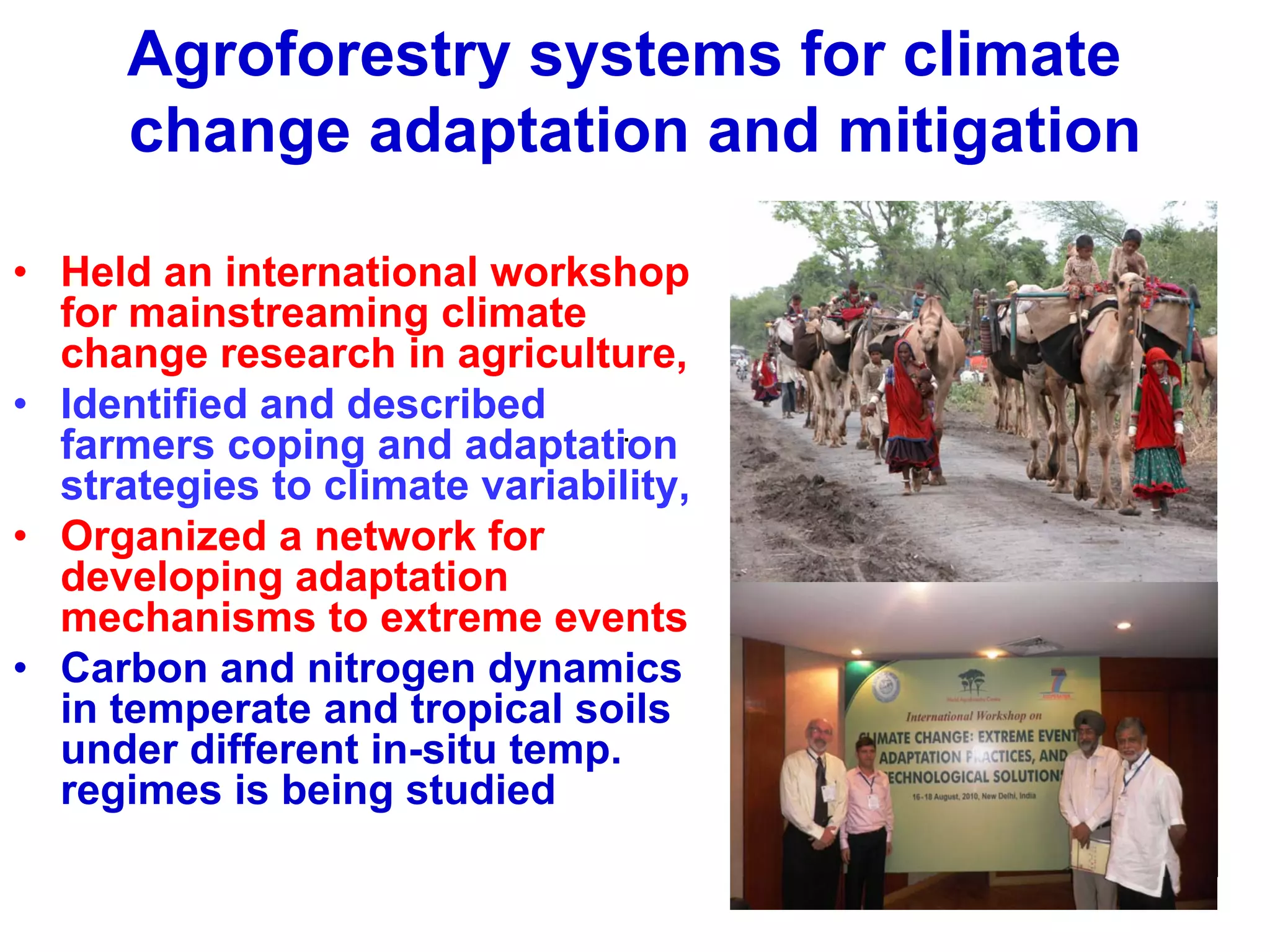
Agroforestry systems for climate
      change adaptation and mitigation

• Held an international workshop
  for mainstreaming climate
  change research in agriculture,
• Identified and described
                               .
  farmers coping and adaptation
  strategies to climate variability,
• Organized a network for
  developing adaptation
  mechanisms to extreme events
• Carbon and nitrogen dynamics
  in temperate and tropical soils
  under different in-situ temp.
  regimes is being studied
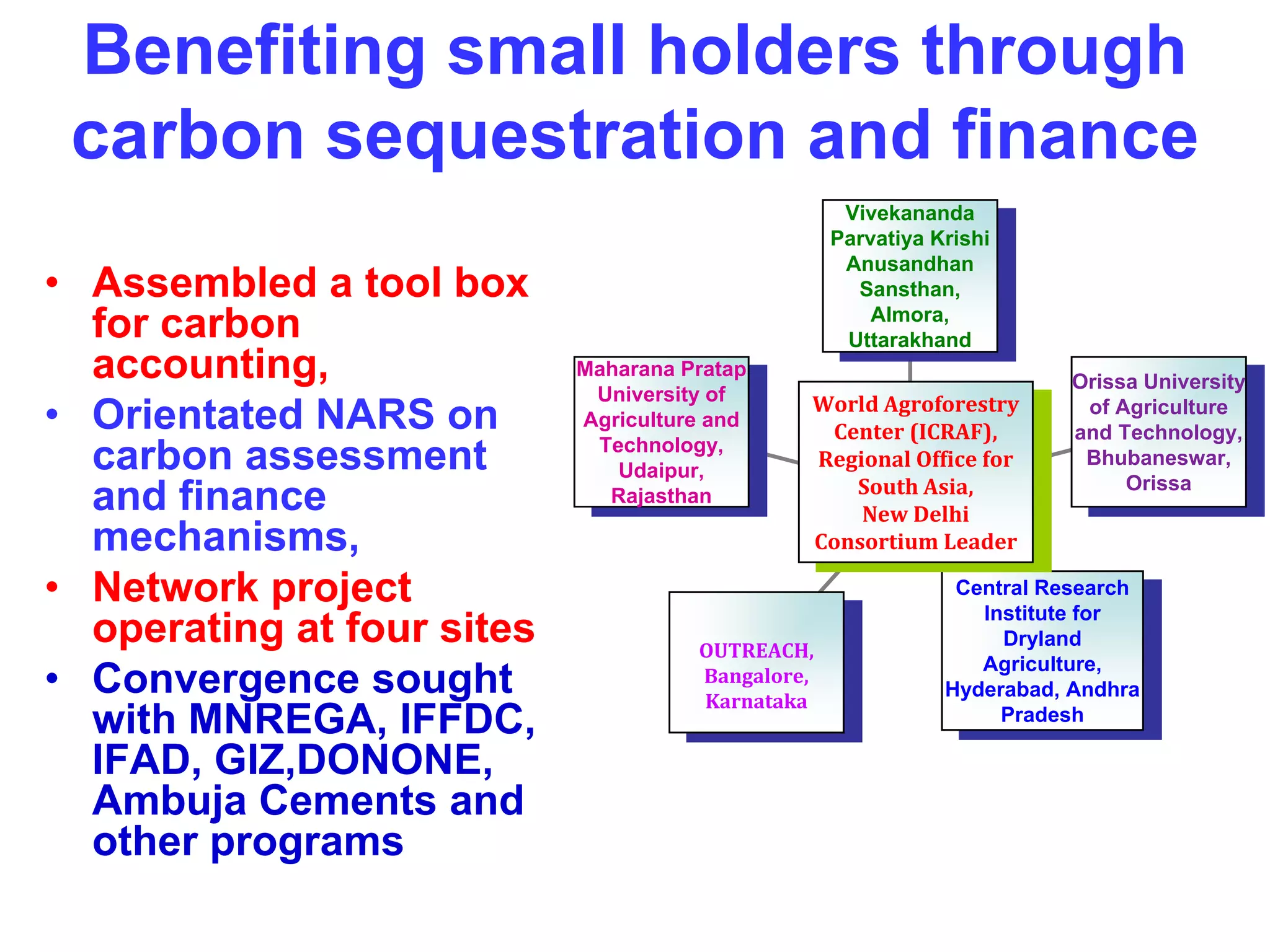
Benefiting small holders through
 carbon sequestration and finance
                                                     Vivekananda
                                                    Parvatiya Krishi
                                                     Anusandhan
• Assembled a tool box                                Sansthan,
                                                        Almora,
  for carbon                                         Uttarakhand
  accounting,               Maharana Pratap
                                                                          Orissa University
                             University of
• Orientated NARS on        Agriculture and
                               .
                                                World Agroforestry 
                                                 Center (ICRAF),
                                                                           of Agriculture
                                                                          and Technology,
                             Technology,
  carbon assessment            Udaipur,
                                                Regional Office for        Bhubaneswar,
                                                                               Orissa
                                                   South Asia, 
  and finance                 Rajasthan
                                                    New Delhi
  mechanisms,                                   Consortium Leader

• Network project                                               Central Research
                                                                  Institute for
  operating at four sites             OUTREACH, 
                                                                    Dryland

• Convergence sought
                                                                  Agriculture,
                                      Bangalore, 
                                                               Hyderabad, Andhra
                                      Karnataka
  with MNREGA, IFFDC,                                               Pradesh

  IFAD, GIZ,DONONE,
  Ambuja Cements and
  other programs
Bioenergy / bio-fuels policy, technical
advancements and practical solutions

• Conducted a complete life cycle analysis of
  producing bio- diesel from jatropha and
  compared it with other sources,
• Published a number of journal papers and a
  booklet, and guided one Ph. D and two M S
  students,
• Prepared a national level bio-fuel policy
  document through lead economists, and plan to
  organize a national / regional debate on this
  issue
Developing policies and incentives for
            agroforestry
Agroforestry Policy:
--- StateAgroforestry Policy for Chhatishgarh, India
   drafted and the National Agroforestry Policy for Sri
   Lanka being done,
--- Contributing to the development of an International
   Agroforestry Policy,

Modification of state legislature:
---Tree felling, transit and selling regulations,
   Chhatishgarh, India
--- State Agroforestry Authority established in
   Chhatishgarh, India
Staffing
• Four full time new staff: Dr. C. Ravikumar
  (carbon finance), Dr. Kabita Bhardwaj (fruits),
  Dr. Babita Bohra (fodder); one position is
  being arranged for interviews
• Two part time staff: Dr. Giashuddin Miah
  (Liaison for Bangladesh), Dr. Buddhi
  Marambe (home gardens mgt, Sri Lanka)
• Two consultants: Dr. Dinesh Marothia
  (impact assessment), Dr. S.S. Baghel
  (planting materials production and
  certification protocols and guidelines)
Recently realized and New opportunities:
Realized:
• Core support from ICAR, $150 K
• US $ 1.5 m on Livelihoods and carbon finance, NAIP/ World
  Bank, India
• Bangladesh Taka 16 m on Climate change and livelihoods,
  NATP / World Bank, Bangladesh
• Sri Lankan Rupees 1.6 m on Bio-fuels, Science Foundation
In Principle approved projects:
• Euros 300 k on Sand Dune Stabilization, GIZ, India
• Can $ 1.2 m on Alleviation of poverty and malnutrition in
  agro-biodiversity hot spots with MSSRF and Uni. Alberta
  from IDRC / CIDA
• US $ 2.0 on Water Augmentation with MSSRF and Uni.
  Nebraska from Indo-USA S&T Forum
Realized and New opportunities----
 New projects and programs:

 •   Climate Resilient Agri., Climate Change Fund, India, $1.5-2.0
     (CN submitted)
 •   Climate change and carbon sequestration, India, $1.9 m, World
     Bank, India (CN approved, first draft being developed)
 •   Bio-energy, IFAD, $ 1.5- 3.0 (has been submitted)
 •   Negotiations in progress with DANONE, Ambuja Cements and
     J.K. Industries for buying carbon credits under their CSR

 •   Established program in Bangladesh, August, 2010
 •   New MoU signed with Sri Lanka, March, 2011
 •   Launching of the Asian Network on Evergreen Agriculture
     scheduled on 14 May, 2011.
Recently realized and New opportunities:
● Africa- India bridge started:
   44 Scholarships for MS and Ph. D in 2010; 125 for 2011
  100 post- doc fellowships in 2010; 17 in Agri.
  Six soil & tissue analysis lab.
  Germplasm exchange got moving
  Training and skills enhancement of ICRAF staff to be
  sponsored by ICAR
• Hosting arrangements for the next World Agroforestry
  Congress (Feb. 2014) started
● South-East Asia bridge approved, and potential areas,
  including agroforestry, climate change and watershed
  management tentatively identified with ICAR
Thank
 you

South asia program focus

  • 1.
    Agroforestry Program inSouth Asia V.P. Singh, Regional Coordinator for South Asia New Delhi, India
  • 3.
    South Asia Programcontext Agroforestry is: • A specialized way of farming practiced on the farm (outside forests) • Revolves around high value low volume systems, value addition, employment and income generation opportunities • South Asia Program focuses on enhancing native systems, on innovating approaches and systems and their applications • All projects are of intra-regional and inter- regional importance
  • 4.
    ICRAF- SOUTH ASIA Concentrates on challenges of: Poverty (low and unstable income) Hunger, poor nutrition and health Social disparity & inequality; gender, social classes Land degradation, climate change, ecosystem services Develops protocols for integrating trees in the farming system and for value addition and market linkages for products Implements projects through partners
  • 5.
    South Asia operatesthrough • Multiple partnerships • National agriculture / forestry R&D systems • Ecology/ commodity / product based coordinated projects and networks • Focusing on national capacity building • Accessing national capacity strengths • Resource and credit sharing
  • 6.
    Ecology Network Hilly and Indo- Semi Arid Costal Mountainous Gangetic and Arid Humid Zones areas Plains Regions Timber/ Afghanistan, Bangladesh, Afghanistan, Bangladesh, F Other Wood Bangladesh, India, Nepal India, Pakistan India, Maldives Bhutan, India, Pakistan, u Products Nepal, Sri Lanka e l Climate Afghanistan, Bangladesh, Afghanistan, Bangladesh, Change Bangladesh, India, Nepal, India, Pakistan India, Sri Lanka, & Bhutan, India, Pakistan Maldives Nepal, Pakistan F Medicinal Bangladesh Bangladesh, India, Pakistan India, o Bhutan, India, India, Nepal, Sri Lanka, Products d Nepal Pakistan Maldives d e Fruits& nuts Afghanistan, Bangladesh, India, Pakistan Bangladesh, Bhutan, India, India , Nepal, India, Maldives r Nepal, Sri Lanka Pakistan
  • 7.
    South Asia Prioritiesand Focus • Improved germplasm and high quality planting material supply systems • Agroforestry intensification and diversification • Agroforestry product demand, market and value chain analysis • Impact assessment and value tagging of major agroforestry systems
  • 8.
    South Asia prioritiesand focus--- • Land degradation assessment and rehabilitation of degraded lands • Climate change mitigation and adaptation, carbon finance • Bioenergy / bio-fuels policy, technical advancements and practical solutions • Inter-regional partnerships
  • 9.
    Sustainable tree seedand seedling supply systems--- • Established networking for regional tree domestication • Carried out planting material production and supply inventory, need and gap analysis in India, Bangladesh and Sri Lanka • Assessed the public and private planting material supply systems in India and Bangladesh
  • 10.
    Sustainable tree seedand Seedling supply systems--- • Initiated programs for improving the supply in Bangladesh, India and Sri Lanka • Included planting material supply aspects in the agroforestry curricula • Drafted planting material production guidelines
  • 11.
    Improved on-farm productivityof trees and agroforestry systems • Constraint to AF adoption analysed (north-western vs. eastern India) and generic extension material for accelerating adoption developed • Integration of fruit, tuber and spices in timber systems studied in-terms of nutrient and water balance • Substitution of poplars and eucalypt with other sp. being explored
  • 12.
    Improved on-farm productivityof trees and agroforestry systems • High density Rejuvenating Old Mango Trees through Heading plantation of fruits back and Management Techniques A.K. Singh*,IARI; V.P. Singh** & Devashree Nayak**, ICRAF, New Delhi, India Introduction Aged trees, 45 years and older ones are susceptible to disease and insect pests, less responsive to inputs and management, and as a result have very low productivity, and limit inter cropping because of closed canopy. Options for increasing orchard productivity are: a) total uprooting or selective thinning and replanting Objectives (expensive, time consuming and legally cumbersome Reinvigorate orchard productivity through economical and option) time saving means b) rejuvenating trees through differential pruning / Reduce initial investment and enhance farm income heading back and proper management (a preferred Prolong tree life and enhance productivity option). Methodology Identified old, non-responsive, lowly productive but apparently healthy looking trees in the orchard Physically inspected and noted each tree canopy and light passing through it for deciding the level of canopy opening: total, partial, central or peripheral canopy Canopy opening opening Pruned the selected trees, and provided them adequate nutrients and water in the tree basin and protection from pests by applying paint on the pruned surfaces Managed orchard weeds and insect pests and mulched the inter- tree spaces . Emergence of shoots Precautions Prune / head back in suitable weather conditions or with good irrigation facilities Practice slant cut using sharp edge tools Apply copper oxychloride paint on the cut surface immediately after heading back Results Rejuvenated trees Harvested timber value equivalent to 4 - 5 fruit crops; valued at Indian Rs 2400-7500 per tree depending on the level of canopy opening 1st year: Emergence of new shoots only, no fruits 2nd year: A good canopy and mature buds; fruiting in some branches 3rd year onwards a bumper mango crop; 8-12 ton / ha against average 6 ton / ha of productive orchard Tree life extended atleast for another 20 years. Conclusion Flowering & Fruiting in rejuvenated trees The techniques have been proven successful in mango, guava, chikoo (sapota) and amla (Indian gooseberry) Possibility of intercropping cereals, low canopy fruit trees, timber species and rhizomatous & tuber crops Visiting farmers are successfully adopting the techniques For further information: * aksingh36@yahoo.com; ** v.p.singh@cgiar.org; d.nayak@cgiar.org
  • 13.
    Impact assessment ofmajor agroforestry systems • Ongoing in the following areas: -- Timber based (poplar and eucalypt) in north- western India -- Fruit based systems: • Mango in Uttar Pradesh, West Bengal and Karnataka, • Guava in Uttar Pradesh, • Pomegranate in Maharashtra, and • Custard apple in Rajasthan
  • 14.
    Mapping of treesoutside the forests: Dominant Species (country level analysis) Species (% trees) Mangifera indica 8.91 Azadirachta indica 4.36 Cocos nucifera 4.29 Acacia arabica 3.87 Prosopis cineraria 3.26 Borassus flabelliformis 1.79 Phebalium columi 1.20 Bassia (Madhuca) latifolia 1.09 Ficus sp. 0.66 Tamarindus indica 0.62
  • 15.
    Mapping of treesat Village (Micro) Level in Lucknow District, UP, India Boundary Plantation Block Plantation
  • 16.
    Improving tree productmarketing for small holders Two main studies being conducted in this area: Value chain analysis and new product development for custard apple, aonla, bael, and some MADP plants, A study of leaf meal feed and fodder market in India
  • 17.
    Reducing land healthrisk and rehabilitation of degraded lands through agroforestry • Extent of eroded (Rajasthan), surface mined (UP), mine tailing (Orissa) and sand deposits (Assam) monitored, • Soils analyzed and calibrated with the spectral signatures for large scale soil loss assessment, • Public and private rehabilitation efforts of degraded lands through agroforestry being compiled, • Rehabilitation of degraded lands through agroforestry being studied
  • 18.
    Regenerating degraded lands through agroforestry Before After
  • 19.
    Agroforestry systems forclimate change adaptation and mitigation • Held an international workshop for mainstreaming climate change research in agriculture, • Identified and described . farmers coping and adaptation strategies to climate variability, • Organized a network for developing adaptation mechanisms to extreme events • Carbon and nitrogen dynamics in temperate and tropical soils under different in-situ temp. regimes is being studied
  • 20.
    Benefiting small holdersthrough carbon sequestration and finance Vivekananda Parvatiya Krishi Anusandhan • Assembled a tool box Sansthan, Almora, for carbon Uttarakhand accounting, Maharana Pratap Orissa University University of • Orientated NARS on Agriculture and . World Agroforestry  Center (ICRAF), of Agriculture and Technology, Technology, carbon assessment Udaipur, Regional Office for  Bhubaneswar, Orissa South Asia,  and finance Rajasthan New Delhi mechanisms, Consortium Leader • Network project Central Research Institute for operating at four sites OUTREACH,  Dryland • Convergence sought Agriculture, Bangalore,  Hyderabad, Andhra Karnataka with MNREGA, IFFDC, Pradesh IFAD, GIZ,DONONE, Ambuja Cements and other programs
  • 21.
    Bioenergy / bio-fuelspolicy, technical advancements and practical solutions • Conducted a complete life cycle analysis of producing bio- diesel from jatropha and compared it with other sources, • Published a number of journal papers and a booklet, and guided one Ph. D and two M S students, • Prepared a national level bio-fuel policy document through lead economists, and plan to organize a national / regional debate on this issue
  • 22.
    Developing policies andincentives for agroforestry Agroforestry Policy: --- StateAgroforestry Policy for Chhatishgarh, India drafted and the National Agroforestry Policy for Sri Lanka being done, --- Contributing to the development of an International Agroforestry Policy, Modification of state legislature: ---Tree felling, transit and selling regulations, Chhatishgarh, India --- State Agroforestry Authority established in Chhatishgarh, India
  • 23.
    Staffing • Four fulltime new staff: Dr. C. Ravikumar (carbon finance), Dr. Kabita Bhardwaj (fruits), Dr. Babita Bohra (fodder); one position is being arranged for interviews • Two part time staff: Dr. Giashuddin Miah (Liaison for Bangladesh), Dr. Buddhi Marambe (home gardens mgt, Sri Lanka) • Two consultants: Dr. Dinesh Marothia (impact assessment), Dr. S.S. Baghel (planting materials production and certification protocols and guidelines)
  • 24.
    Recently realized andNew opportunities: Realized: • Core support from ICAR, $150 K • US $ 1.5 m on Livelihoods and carbon finance, NAIP/ World Bank, India • Bangladesh Taka 16 m on Climate change and livelihoods, NATP / World Bank, Bangladesh • Sri Lankan Rupees 1.6 m on Bio-fuels, Science Foundation In Principle approved projects: • Euros 300 k on Sand Dune Stabilization, GIZ, India • Can $ 1.2 m on Alleviation of poverty and malnutrition in agro-biodiversity hot spots with MSSRF and Uni. Alberta from IDRC / CIDA • US $ 2.0 on Water Augmentation with MSSRF and Uni. Nebraska from Indo-USA S&T Forum
  • 25.
    Realized and Newopportunities---- New projects and programs: • Climate Resilient Agri., Climate Change Fund, India, $1.5-2.0 (CN submitted) • Climate change and carbon sequestration, India, $1.9 m, World Bank, India (CN approved, first draft being developed) • Bio-energy, IFAD, $ 1.5- 3.0 (has been submitted) • Negotiations in progress with DANONE, Ambuja Cements and J.K. Industries for buying carbon credits under their CSR • Established program in Bangladesh, August, 2010 • New MoU signed with Sri Lanka, March, 2011 • Launching of the Asian Network on Evergreen Agriculture scheduled on 14 May, 2011.
  • 26.
    Recently realized andNew opportunities: ● Africa- India bridge started: 44 Scholarships for MS and Ph. D in 2010; 125 for 2011 100 post- doc fellowships in 2010; 17 in Agri. Six soil & tissue analysis lab. Germplasm exchange got moving Training and skills enhancement of ICRAF staff to be sponsored by ICAR • Hosting arrangements for the next World Agroforestry Congress (Feb. 2014) started ● South-East Asia bridge approved, and potential areas, including agroforestry, climate change and watershed management tentatively identified with ICAR
  • 27.