Agroforestry 
International Symposium on Agroecology for Food Security and Nutrition 
Ravi Prabhu et al., ICRAF 
A knowledge system for synergy?
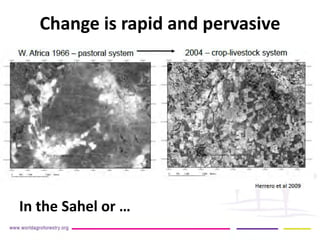
Change is rapid and pervasive 
In the Sahel or …
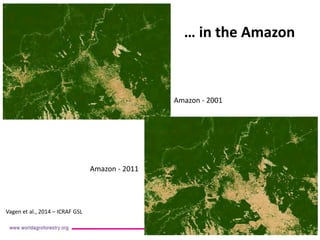
Amazon - 2001 
Amazon - 2011 
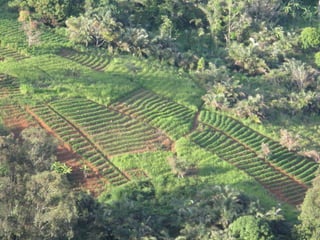
… in the Amazon 
Vagen et al., 2014 – ICRAF GSL
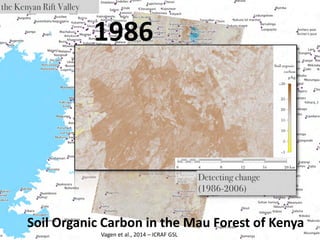
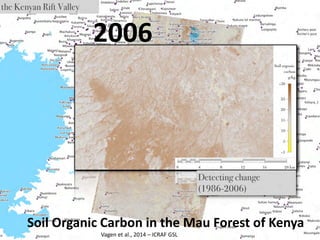
Soil Organic Carbon in the Mau Forest of Kenya 
1986 
Vagen et al., 2014 – ICRAF GSL
2006 
Soil Organic Carbon in the Mau Forest of Kenya 
Vagen et al., 2014 – ICRAF GSL
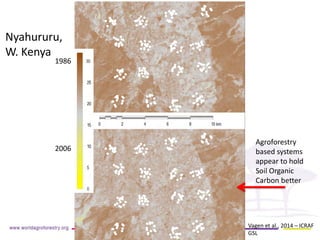
Nyahururu, 
W. Kenya 
2006 
1986 
Vagen et al., 2014 – ICRAF GSL 
Agroforestry based systems appear to hold Soil Organic Carbon better
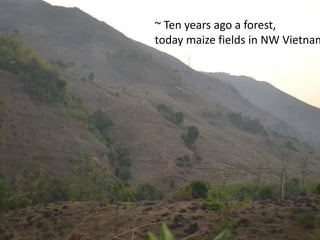
~ Ten years ago a forest, 
today maize fields in NW Vietnam
A lot of the change is negative
By 2050, we know we need to: 
• 
Produce 60% more food on ~ the same amount of land 
• 
Improve the nutrition of about 2 billion people who go to bed hungry every night 
• 
Massively reduce GHG emissions from land use. 
• 
Make farms, fields and landscapes more resistant to extreme weather 
3
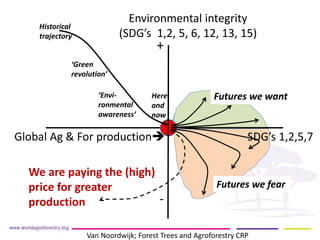
Environmental integrity (SDG’s 1,2, 5, 6, 12, 13, 15) 
Global Ag & For production SDG’s 1,2,5,7 
+ 
- 
Futures we want 
Historical trajectory 
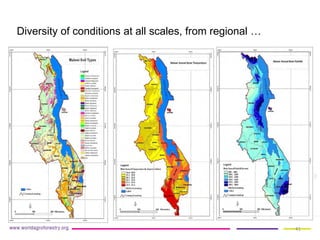
‘Green revolution’ 
‘Envi- ronmental awareness’ 
Here and now 
Sparing + Sharing strategies combined 
Futures we fear 
Van Noordwijk; Forest Trees and Agroforestry CRP 
We are paying the (high) price for greater production
Can Agroforestry help at all? 
Can we reach scale in time?
What is agroforestry? 
A dynamic, ecologically based, natural resource management system that, through 
integration of trees on farms and in the agricultural landscape, 
diversifies and sustains production and builds social institutions.
Take home messages 
1. 
Optimise the contribution of trees to agricultural systems at nested scales to deliver multiple benefits to people and the planet 
2. 
Fine scale variation & diversity (species, systems, life- forms, contexts and options) are assets 
3. 
It is possible to go to scale (we have tools, evidence, partnerships), but challenges remain
Outline 
• 
A few minutes on principles 
• 
Case studies on nutrition and plantation crops (to help make my point) 
• 
Conclusions on the way forward 
• 
Landscape perspective, but other scales nested 
• 
In the interest of time, not going to mention the ‘usual suspects’ such as fertilizer trees!
Remember, we are dealing with complex systems that are: 
• 
Nested, and scale-hierarchic in structure 
• 
Scale-dependent 
– 
which is potentially confounding as choice of each scale will affect what is revealed of reality and what remains hidden 
• 
boundaries are neither innate nor natural 
– 
they have more than one useful boundary
Nested scales of agroforestry 
Farm: A set of specific practices sensitive to fine- scale variation that combine trees, crops and/or livestock for multiple benefits 
Landscape: Purposeful interactions of trees, crops, livestock and human-beings to support emergence of multifunctional landscapes for sustainable (human) development 
Region or larger: Efforts to influence the emergent properties of the interactions of the underlying complex system, consisting of nested agro-forestry systems and components, for the achievement of planetary goals
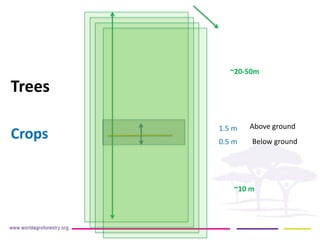
Above ground 
Below ground 
1.5 m 
0.5 m 
Crops 
Trees 
~20-50m 
~10 m
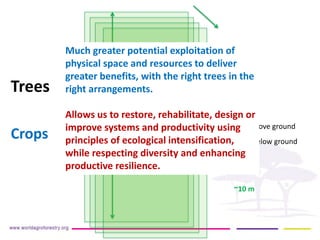
Above ground 
Below ground 
1.5 m 
0.5 m 
Crops 
Trees 
~20-50m 
~10 m 
Much greater potential exploitation of physical space and resources to deliver greater benefits, with the right trees in the right arrangements. 
Allows us to restore, rehabilitate, design or improve systems and productivity using principles of ecological intensification, while respecting diversity and enhancing productive resilience.
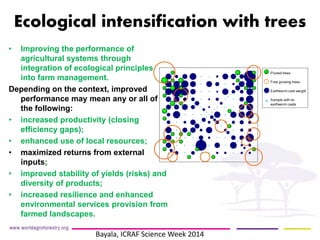
Ecological intensification with trees 
• 
Improving the performance of agricultural systems through integration of ecological principles into farm management. 
Depending on the context, improved performance may mean any or all of the following: 
• 
increased productivity (closing efficiency gaps); 
• 
enhanced use of local resources; 
• 
maximized returns from external inputs; 
• 
improved stability of yields (risks) and diversity of products; 
• 
increased resilience and enhanced environmental services provision from farmed landscapes. 
Bayala, ICRAF Science Week 2014
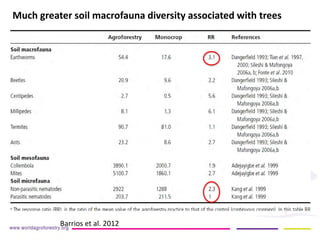
Much greater soil macrofauna diversity associated with trees 
Barrios et al. 2012
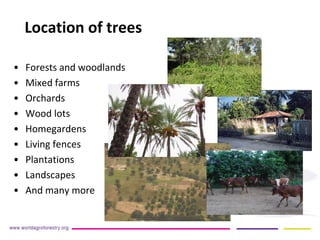
Where? 
• 
Forests and woodlands 
• 
Mixed farms 
• 
Orchards 
• 
Wood lots 
• 
Homegardens 
• 
Living fences 
• 
Plantations 
• 
Landscapes 
• 
And many more 
Location of trees
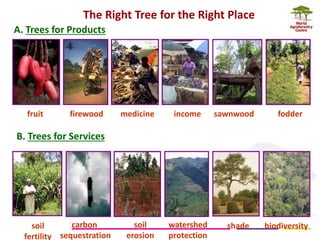
The Right Tree for the Right Place 
A. Trees for Products 
B. Trees for Services 
fruit 
firewood 
medicine 
income 
sawnwood 
fodder 
soil fertility 
carbon sequestration 
soil 
erosion 
watershed protection 
shade 
biodiversity
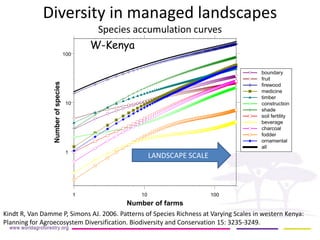
110100Number of farms110100 Number of species boundaryfruitfirewoodmedicinetimberconstructionshadesoil fertilitybeveragecharcoalfodderornamentalall 
W-Kenya 
Diversity in managed landscapes Species accumulation curves 
Kindt R, Van Damme P, Simons AJ. 2006. Patterns of Species Richness at Varying Scales in western Kenya: Planning for Agroecosystem Diversification. Biodiversity and Conservation 15: 3235-3249. 
LANDSCAPE SCALE
So what? 
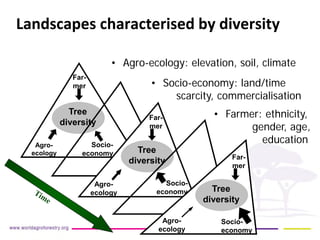
Landscapes characterised by diversity 
Agro- ecology 
Far- mer 
Socio- economy 
Tree diversity 
Agro- ecology 
Far- mer 
Socio- economy 
Tree diversity 
Agro- ecology 
Far- mer 
Socio- economy 
Tree diversity 
• 
Agro-ecology: elevation, soil, climate 
• 
Farmer: ethnicity, gender, age, education 
• 
Socio-economy: land/time scarcity, commercialisation
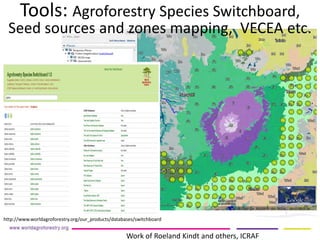
Tools: Agroforestry Species Switchboard, Seed sources and zones mapping, VECEA etc. 
http://www.worldagroforestry.org/our_products/databases/switchboard 
Work of Roeland Kindt and others, ICRAF
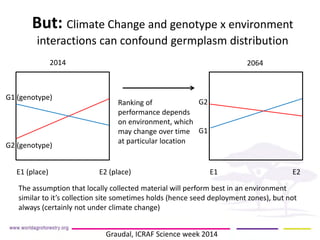
But: Climate Change and genotype x environment interactions can confound germplasm distribution 
E1 (place) 
E2 (place) 
2014 
2064 
Ranking of performance depends on environment, which may change over time at particular location 
E1 
E2 
G1 (genotype) 
G2 (genotype) 
G2 G1 
The assumption that locally collected material will perform best in an environment similar to it’s collection site sometimes holds (hence seed deployment zones), but not always (certainly not under climate change) 
Graudal, ICRAF Science week 2014
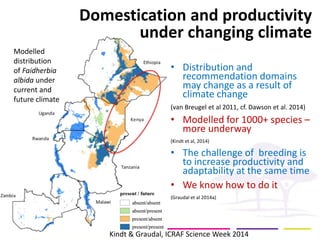
Domestication and productivity under changing climate 
• 
Distribution and recommendation domains may change as a result of climate change 
(van Breugel et al 2011, cf. Dawson et al. 2014) 
• 
Modelled for 1000+ species – more underway 
(Kindt et al, 2014) 
• 
The challenge of breeding is to increase productivity and adaptability at the same time 
• 
We know how to do it 
(Graudal et al 2014a) 
Modelled distribution of Faidherbia albida under current and future climate 
Kindt & Graudal, ICRAF Science Week 2014
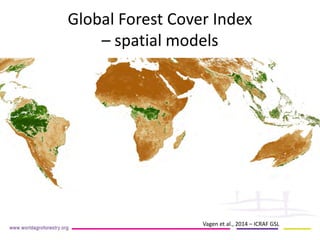
Global Forest Cover Index – spatial models 
Vagen et al., 2014 – ICRAF GSL
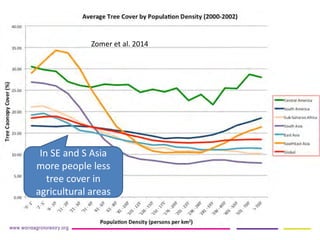
Zomer et al. 2014 
In SE and S Asia more people less tree cover in agricultural areas
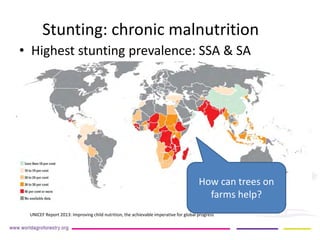
Stunting: chronic malnutrition 
• 
Highest stunting prevalence: SSA & SA 
UNICEF Report 2013: Improving child nutrition, the achievable imperative for global progress 
How can trees on farms help?
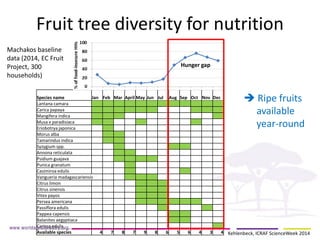
Fruit tree diversity for nutrition 
Species name 
Jan 
Feb 
Mar 
April 
May 
Jun 
Jul 
Aug 
Sep 
Oct 
Nov 
Dec 
Lantana camara 
Carica papaya 
Mangifera indica 
Musa x paradisiaca 
Eriobotrya japonica 
Morus alba 
Tamarindus indica 
Syzygium spp. 
Annona reticulata 
Psidium guajava 
Punica granatum 
Casimiroa edulis 
Vangueria madagascariensis 
Citrus limon 
Citrus sinensis 
Vitex payos 
Persea americana 
Passiflora edulis 
Pappea capensis 
Balanites aegyptiaca 
Carissa edulis 
Available species 
4 
7 
8 
7 
9 
8 
6 
5 
6 
4 
3 
4 
Hunger gap 
 Ripe fruits available year-round 
Machakos baseline data (2014, EC Fruit Project, 300 households) 
Kehlenbeck, ICRAF ScienceWeek 2014
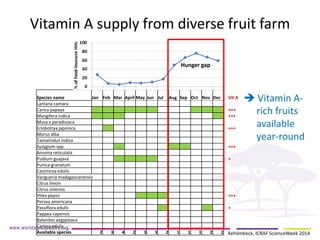
Vitamin A supply from diverse fruit farm 
Species name 
Jan 
Feb 
Mar 
April 
May 
Jun 
Jul 
Aug 
Sep 
Oct 
Nov 
Dec 
Vit A 
Lantana camara 
Carica papaya 
+++ 
Mangifera indica 
+++ 
Musa x paradisiaca 
Eriobotrya japonica 
+++ 
Morus alba 
Tamarindus indica 
Syzygium spp. 
+++ 
Annona reticulata 
Psidium guajava 
+ 
Punica granatum 
Casimiroa edulis 
Vangueria madagascariensis 
Citrus limon 
Citrus sinensis 
Vitex payos 
+++ 
Persea americana 
Passiflora edulis 
+ 
Pappea capensis 
Balanites aegyptiaca 
Carissa edulis 
Available species 
2 
3 
4 
2 
3 
3 
2 
1 
1 
1 
2 
2 
Hunger gap 
 Vitamin A- rich fruits available year-round 
Kehlenbeck, ICRAF ScienceWeek 2014
Species name 
Jan 
Feb 
Mar 
April 
May 
Jun 
Jul 
Aug 
Sep 
Oct 
Nov 
Dec 
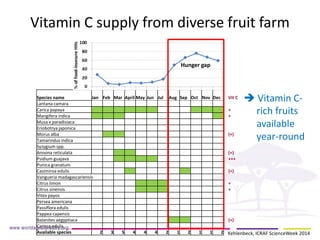
Vit C 
Lantana camara 
Carica papaya 
+ 
Mangifera indica 
+ 
Musa x paradisiaca 
Eriobotrya japonica 
Morus alba 
(+) 
Tamarindus indica 
Syzygium spp. 
Annona reticulata 
(+) 
Psidium guajava 
+++ 
Punica granatum 
Casimiroa edulis 
(+) 
Vangueria madagascariensis 
Citrus limon 
+ 
Citrus sinensis 
+ 
Vitex payos 
Persea americana 
Passiflora edulis 
Pappea capensis 
Balanites aegyptiaca 
(+) 
Carissa edulis 
Available species 
2 
3 
5 
4 
4 
4 
2 
1 
2 
1 
1 
2 
Hunger gap 
Vitamin C supply from diverse fruit farm 
 Vitamin C- rich fruits available year-round 
Kehlenbeck, ICRAF ScienceWeek 2014
Species name 
Jan 
Feb 
Mar 
April 
May 
Jun 
Jul 
Aug 
Sep 
Oct 
Nov 
Dec 
Vit C 
Vit A 
Lantana camara 
Carica papaya 
+ 
+++ 
Mangifera indica 
+ 
+++ 
Musa x paradisiaca 
Eriobotrya japonica 
+++ 
Morus alba 
(+) 
Tamarindus indica 
Syzygium spp. 
+++ 
Annona reticulata 
(+) 
Psidium guajava 
+++ 
+ 
Punica granatum 
Casimiroa edulis 
(+) 
Vangueria madagascariensis 
Citrus limon 
+ 
Citrus sinensis 
+ 
Vitex payos 
+++ 
Persea americana 
Passiflora edulis 
+ 
Pappea capensis 
Balanites aegyptiaca 
(+) 
Carissa edulis 
Available species 
2 
4 
6 
4 
4 
5 
4 
2 
3 
1 
2 
2 
Hunger gap 
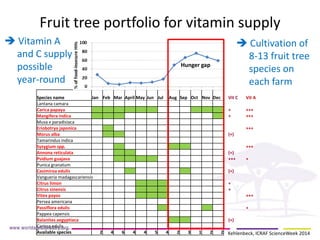
Fruit tree portfolio for vitamin supply 
 Vitamin A and C supply possible year-round 
 Cultivation of 8-13 fruit tree species on each farm 
Kehlenbeck, ICRAF ScienceWeek 2014
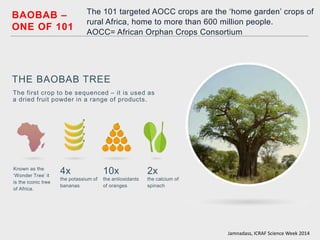
BAOBAB – ONE OF 101 
Known as the ‘Wonder Tree’ it is the iconic tree of Africa. 
4x 
the potassium of bananas 
10x 
the antioxidants of oranges 
2x 
the calcium of spinach 
THE BAOBAB TREE 
The first crop to be sequenced – it is used as a dried fruit powder in a range of products. 
The 101 targeted AOCC crops are the ‘home garden’ crops of rural Africa, home to more than 600 million people. AOCC= African Orphan Crops Consortium 
Jamnadass, ICRAF Science Week 2014
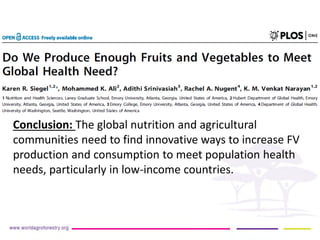
Conclusion: The global nutrition and agricultural communities need to find innovative ways to increase FV production and consumption to meet population health needs, particularly in low-income countries.
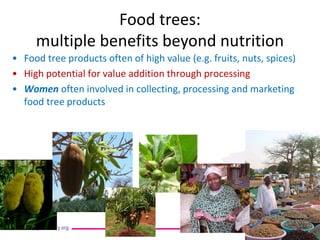
How are trees used? 
• 
Food tree products often of high value (e.g. fruits, nuts, spices) 
• 
High potential for value addition through processing 
• 
Women often involved in collecting, processing and marketing food tree products 
Food trees: multiple benefits beyond nutrition
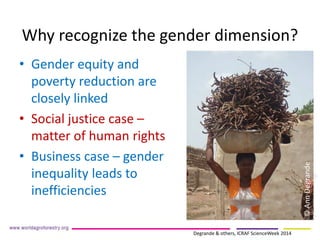
Why recognize the gender dimension? 
• 
Gender equity and poverty reduction are closely linked 
• 
Social justice case – matter of human rights 
• 
Business case – gender inequality leads to inefficiencies 
© Ann Degrande 
Degrande & others, ICRAF ScienceWeek 2014
Let’s take a look at dealing with diverse contexts and fine scale variation as determinants of the nature of agroforestry …
Diversity of conditions at all scales, from regional … 
41
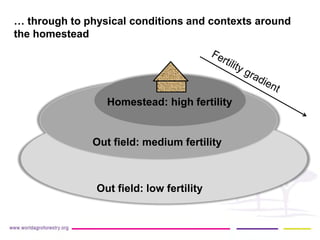
… through to physical conditions and contexts around the homestead 
Homestead: high fertility 
Out field: low fertility 
Out field: medium fertility
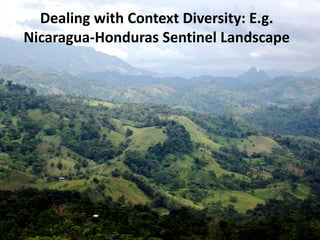
Dealing with Context Diversity: E.g. Nicaragua-Honduras Sentinel Landscape
A partial evaluation of the context in each Sentinel Landscape using standard methodologies 
• 
IFRI +Stages of Poverty (Krishna) 
• 
Land Degradation Surveillance Framework 
• 
Household survey 
– 
Livelihood 
– 
Food security 
– 
Social network 
Ordonez, Vagen, Gassner, Beer and others ICRAF Science Week 2014
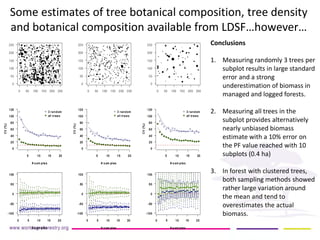
Some estimates of tree botanical composition, tree density and botanical composition available from LDSF…however… 
Conclusions 
1.Measuring randomly 3 trees per subplot results in large standard error and a strong underestimation of biomass in managed and logged forests. 
2.Measuring all trees in the subplot provides alternatively nearly unbiased biomass estimate with a 10% error on the PF value reached with 10 subplots (0.4 ha) 
3.In forest with clustered trees, both sampling methods showed rather large variation around the mean and tend to overestimates the actual biomass.
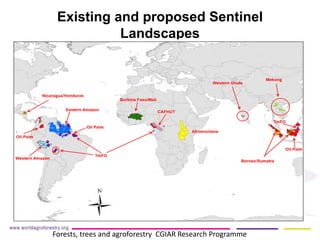
Existing and proposed Sentinel Landscapes 
Forests, trees and agroforestry CGIAR Research Programme
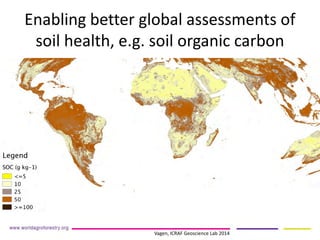
Enabling better global assessments of soil health, e.g. soil organic carbon 
Vagen, ICRAF Geoscience Lab 2014
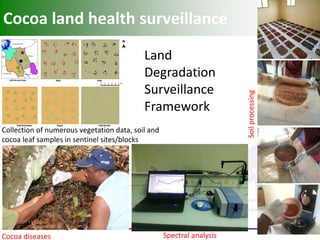
Cocoa land health surveillance 
Cocoa diseases 
Collection of numerous vegetation data, soil and cocoa leaf samples in sentinel sites/blocks 
Spectral analysis 
Soil processing 
Land 
Degradation 
Surveillance 
Framework
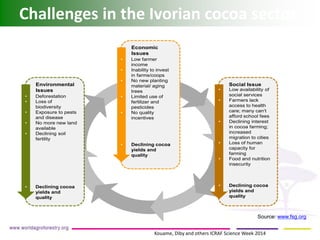
Challenges in the Ivorian cocoa sector 
Economic Issues•Low farmer income•Inability to invest in farms/coops•No new planting material/ aging trees•Limited use of fertilizer and pesticides•No quality incentives•Declining cocoa yields and qualityEnvironmental Issues•Deforestation•Loss of biodiversity•Exposure to pests and disease•No more new land available•Declining soil fertility•Declining cocoa yields and quality Social Issue•Low availability of social services•Farmers lack access to health care; many can’t afford school fees•Declining interest in cocoa farming; increased migration to cities•Loss of human capacity for farming•Food and nutrition insecurity•Declining cocoa yields and quality 
Source: www.fsg.org 
Kouame, Diby and others ICRAF Science Week 2014
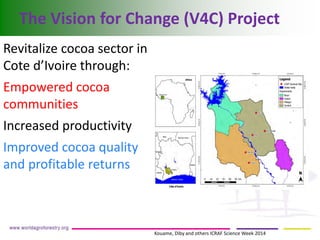
The Vision for Change (V4C) Project 
Revitalize cocoa sector in Cote d’Ivoire through: 
Empowered cocoa communities 
Increased productivity 
Improved cocoa quality and profitable returns 
Kouame, Diby and others ICRAF Science Week 2014
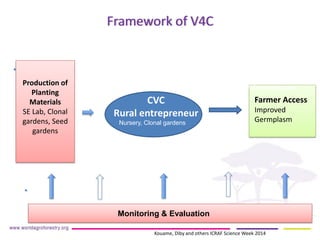
Framework of V4C 
CVC 
Rural entrepreneur 
Production of Planting Materials 
SE Lab, Clonal gardens, Seed gardens 
Farmer Access 
Improved Germplasm 
CVC 
Rural entrepreneur 
Monitoring & Evaluation 
Nursery, Clonal gardens 
Kouame, Diby and others ICRAF Science Week 2014
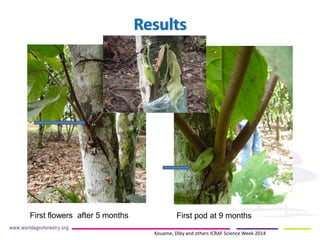
Results 
First flowers after 5 months 
First pod at 9 months 
Kouame, Diby and others ICRAF Science Week 2014
Results …2 
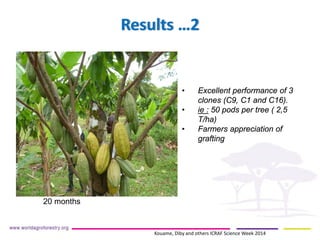
20 months 
• 
Excellent performance of 3 clones (C9, C1 and C16). 
• 
ie : 50 pods per tree ( 2,5 T/ha) 
• 
Farmers appreciation of grafting 
Kouame, Diby and others ICRAF Science Week 2014
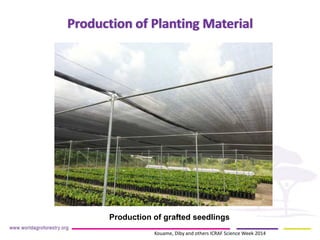
Production of Planting Material 
Production of grafted seedlings 
Kouame, Diby and others ICRAF Science Week 2014
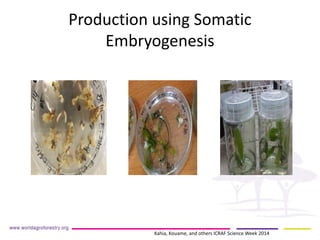
Production using Somatic Embryogenesis 
Kahia, Kouame, and others ICRAF Science Week 2014
Conclusions from Cocoa/V4C 
• 
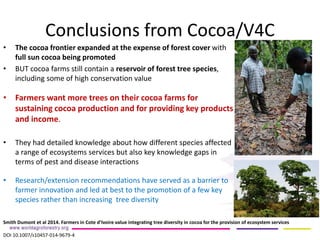
The cocoa frontier expanded at the expense of forest cover with full sun cocoa being promoted 
• 
BUT cocoa farms still contain a reservoir of forest tree species, including some of high conservation value 
• 
Farmers want more trees on their cocoa farms for sustaining cocoa production and for providing key products and income. 
• 
They had detailed knowledge about how different species affected a range of ecosystems services but also key knowledge gaps in terms of pest and disease interactions 
• 
Research/extension recommendations have served as a barrier to farmer innovation and led at best to the promotion of a few key species rather than increasing tree diversity 
Smith Dumont et al 2014. Farmers in Cote d’Ivoire value integrating tree diversity in cocoa for the provision of ecosystem services DOI 10.1007/s10457-014-9679-4
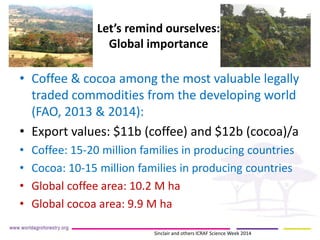
Let’s remind ourselves: Global importance 
• 
Coffee & cocoa among the most valuable legally traded commodities from the developing world (FAO, 2013 & 2014): 
• 
Export values: $11b (coffee) and $12b (cocoa)/a 
• 
Coffee: 15-20 million families in producing countries 
• 
Cocoa: 10-15 million families in producing countries 
• 
Global coffee area: 10.2 M ha 
• 
Global cocoa area: 9.9 M ha 
Sinclair and others ICRAF Science Week 2014
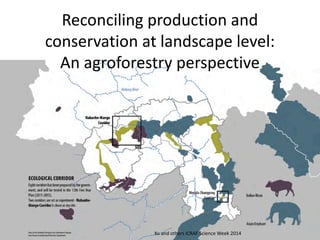
Reconciling production and conservation at landscape level: An agroforestry perspective 
Xu and others ICRAF Science Week 2014
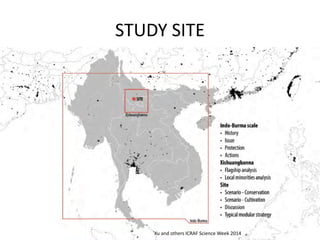
STUDY SITE 
Xu and others ICRAF Science Week 2014
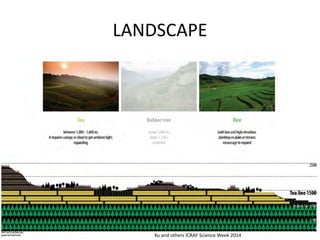
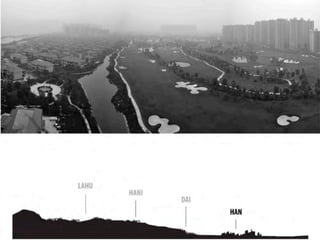
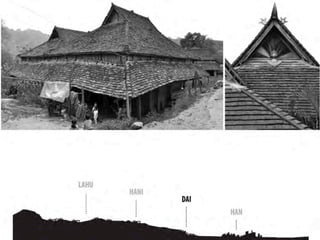
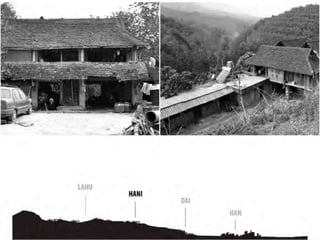
LANDSCAPE 
Xu and others ICRAF Science Week 2014
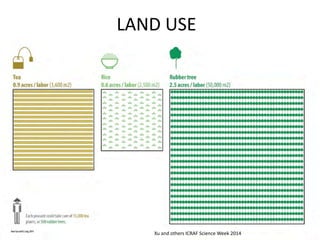
LAND USE 
Xu and others ICRAF Science Week 2014
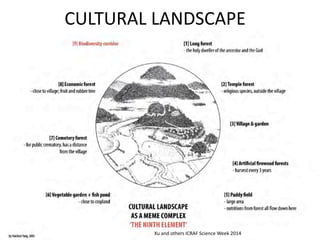
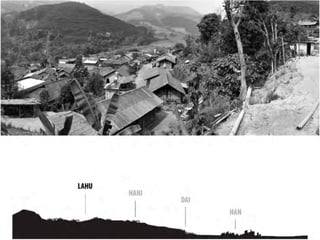
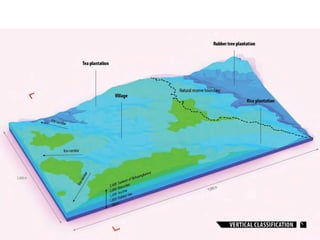
CULTURAL LANDSCAPE 
Xu and others ICRAF Science Week 2014
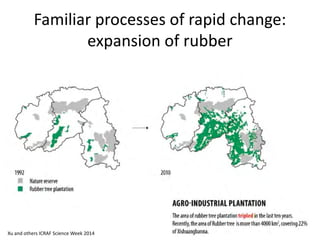
Familiar processes of rapid change: expansion of rubber 
Xu and others ICRAF Science Week 2014
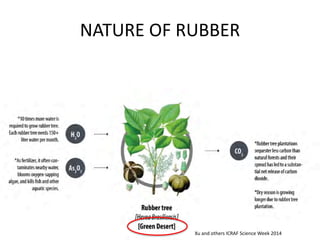
NATURE OF RUBBER 
Xu and others ICRAF Science Week 2014
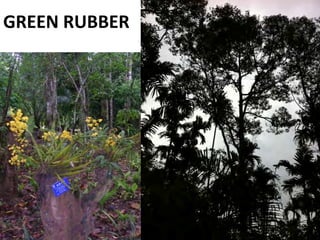
GREEN RUBBER
To conclude: Some possible next steps 
– 
Recognition that agroforestry is a scalable option for improving food and nutrition security 
– 
Promotion of investments in agroforestry as part of an approach to sustainable landscape management, building on stakeholder participation and integration of local indigenous knowledge. 
– 
Development of strategies for increased adaptation to climate risks through grater income and/ or reduced exposure to climate hazards by vulnerable people at local scales. 
– 
Development of relevant metrics of increased resilience, adaptive capacity and institutional or governance strength and strategies that support governance and market reforms, value chain development and technical capacity which provides a vision beyond subsistence farming with trees. 
– 
Policy reform, e.g. India’s new National Agroforestry Policy; innovative partnerships, including with the private sector
Challenges remain 
– 
Shortage of quality germplasm and distribution systems 
– 
Dissemination and capacity strengthening approaches and services for relatively knowledge intensive systems 
– 
Quantification of contribution of agroforestry systems to impacts on ecosystem services such as land and water resources at scale. 
– 
Overly sectoral approaches to land management
Acknowledgements 
This presentation drew heavily on the work of several people, including: 
• 
Anja Gassner, Anne Degrande, Cheikh Mbow, Christophe Kouame, Dennis Garrity, Edmundo Barrios, Emilie Smith-Dumont, Jenny Ordonez, Jianchu Xu, John Beer, Jules Bayala, Katja Kehlenbeck, Keith Shepherd, Lars Graudal, Lucien Diby, Meine van Noordwijk, Ramni Jamnadass, Rhett Harrison, Roeland Kindt, Sileshi Weldesmayat, Tony Simons, Tor Vagen
Thank you! 
r.prabhu@cgiar.org
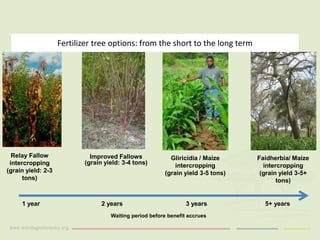
Fertilizer tree options: from the short to the long term 
Relay Fallow intercropping (grain yield: 2-3 tons) 
Improved Fallows (grain yield: 3-4 tons) 
Faidherbia/ Maize intercropping (grain yield 3-5+ tons) 
Waiting period before benefit accrues 
1 year 
2 years 
3 years 
5+ years 
Gliricidia / Maize intercropping (grain yield 3-5 tons)
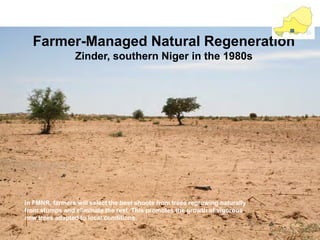
Farmer-Managed Natural Regeneration 
Zinder, southern Niger in the 1980s 
In FMNR, farmers will select the best shoots from trees regrowing naturally from stumps and eliminate the rest. This promotes the growth of vigorous new trees adapted to local conditions.
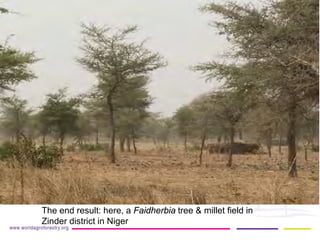
The end result: here, a Faidherbia tree & millet field in Zinder district in Niger
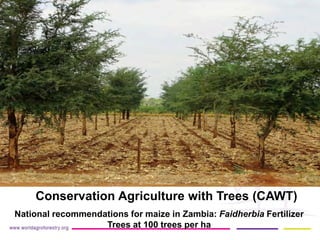
Conservation Agriculture with Trees (CAWT) National recommendations for maize in Zambia: Faidherbia Fertilizer Trees at 100 trees per ha

Agroecology – a knowledge system for synergy?

  • 1.
    Agroforestry International Symposiumon Agroecology for Food Security and Nutrition Ravi Prabhu et al., ICRAF A knowledge system for synergy?
  • 2.
    Change is rapidand pervasive In the Sahel or …
  • 3.
    Amazon - 2001 Amazon - 2011 … in the Amazon Vagen et al., 2014 – ICRAF GSL
  • 4.
    Soil Organic Carbonin the Mau Forest of Kenya 1986 Vagen et al., 2014 – ICRAF GSL
  • 5.
    2006 Soil OrganicCarbon in the Mau Forest of Kenya Vagen et al., 2014 – ICRAF GSL
  • 6.
    Nyahururu, W. Kenya 2006 1986 Vagen et al., 2014 – ICRAF GSL Agroforestry based systems appear to hold Soil Organic Carbon better
  • 7.
    ~ Ten yearsago a forest, today maize fields in NW Vietnam
  • 8.
    A lot ofthe change is negative
  • 9.
    By 2050, weknow we need to: • Produce 60% more food on ~ the same amount of land • Improve the nutrition of about 2 billion people who go to bed hungry every night • Massively reduce GHG emissions from land use. • Make farms, fields and landscapes more resistant to extreme weather 3
  • 10.
    Environmental integrity (SDG’s1,2, 5, 6, 12, 13, 15) Global Ag & For production SDG’s 1,2,5,7 + - Futures we want Historical trajectory ‘Green revolution’ ‘Envi- ronmental awareness’ Here and now Sparing + Sharing strategies combined Futures we fear Van Noordwijk; Forest Trees and Agroforestry CRP We are paying the (high) price for greater production
  • 11.
    Can Agroforestry helpat all? Can we reach scale in time?
  • 12.
    What is agroforestry? A dynamic, ecologically based, natural resource management system that, through integration of trees on farms and in the agricultural landscape, diversifies and sustains production and builds social institutions.
  • 13.
    Take home messages 1. Optimise the contribution of trees to agricultural systems at nested scales to deliver multiple benefits to people and the planet 2. Fine scale variation & diversity (species, systems, life- forms, contexts and options) are assets 3. It is possible to go to scale (we have tools, evidence, partnerships), but challenges remain
  • 14.
    Outline • Afew minutes on principles • Case studies on nutrition and plantation crops (to help make my point) • Conclusions on the way forward • Landscape perspective, but other scales nested • In the interest of time, not going to mention the ‘usual suspects’ such as fertilizer trees!
  • 15.
    Remember, we aredealing with complex systems that are: • Nested, and scale-hierarchic in structure • Scale-dependent – which is potentially confounding as choice of each scale will affect what is revealed of reality and what remains hidden • boundaries are neither innate nor natural – they have more than one useful boundary
  • 16.
    Nested scales ofagroforestry Farm: A set of specific practices sensitive to fine- scale variation that combine trees, crops and/or livestock for multiple benefits Landscape: Purposeful interactions of trees, crops, livestock and human-beings to support emergence of multifunctional landscapes for sustainable (human) development Region or larger: Efforts to influence the emergent properties of the interactions of the underlying complex system, consisting of nested agro-forestry systems and components, for the achievement of planetary goals
  • 17.
    Above ground Belowground 1.5 m 0.5 m Crops Trees ~20-50m ~10 m
  • 18.
    Above ground Belowground 1.5 m 0.5 m Crops Trees ~20-50m ~10 m Much greater potential exploitation of physical space and resources to deliver greater benefits, with the right trees in the right arrangements. Allows us to restore, rehabilitate, design or improve systems and productivity using principles of ecological intensification, while respecting diversity and enhancing productive resilience.
  • 19.
    Ecological intensification withtrees • Improving the performance of agricultural systems through integration of ecological principles into farm management. Depending on the context, improved performance may mean any or all of the following: • increased productivity (closing efficiency gaps); • enhanced use of local resources; • maximized returns from external inputs; • improved stability of yields (risks) and diversity of products; • increased resilience and enhanced environmental services provision from farmed landscapes. Bayala, ICRAF Science Week 2014
  • 20.
    Much greater soilmacrofauna diversity associated with trees Barrios et al. 2012
  • 21.
    Where? • Forestsand woodlands • Mixed farms • Orchards • Wood lots • Homegardens • Living fences • Plantations • Landscapes • And many more Location of trees
  • 22.
    The Right Treefor the Right Place A. Trees for Products B. Trees for Services fruit firewood medicine income sawnwood fodder soil fertility carbon sequestration soil erosion watershed protection shade biodiversity
  • 23.
    110100Number of farms110100Number of species boundaryfruitfirewoodmedicinetimberconstructionshadesoil fertilitybeveragecharcoalfodderornamentalall W-Kenya Diversity in managed landscapes Species accumulation curves Kindt R, Van Damme P, Simons AJ. 2006. Patterns of Species Richness at Varying Scales in western Kenya: Planning for Agroecosystem Diversification. Biodiversity and Conservation 15: 3235-3249. LANDSCAPE SCALE
  • 24.
    So what? Landscapescharacterised by diversity Agro- ecology Far- mer Socio- economy Tree diversity Agro- ecology Far- mer Socio- economy Tree diversity Agro- ecology Far- mer Socio- economy Tree diversity • Agro-ecology: elevation, soil, climate • Farmer: ethnicity, gender, age, education • Socio-economy: land/time scarcity, commercialisation
  • 25.
    Tools: Agroforestry SpeciesSwitchboard, Seed sources and zones mapping, VECEA etc. http://www.worldagroforestry.org/our_products/databases/switchboard Work of Roeland Kindt and others, ICRAF
  • 26.
    But: Climate Changeand genotype x environment interactions can confound germplasm distribution E1 (place) E2 (place) 2014 2064 Ranking of performance depends on environment, which may change over time at particular location E1 E2 G1 (genotype) G2 (genotype) G2 G1 The assumption that locally collected material will perform best in an environment similar to it’s collection site sometimes holds (hence seed deployment zones), but not always (certainly not under climate change) Graudal, ICRAF Science week 2014
  • 27.
    Domestication and productivityunder changing climate • Distribution and recommendation domains may change as a result of climate change (van Breugel et al 2011, cf. Dawson et al. 2014) • Modelled for 1000+ species – more underway (Kindt et al, 2014) • The challenge of breeding is to increase productivity and adaptability at the same time • We know how to do it (Graudal et al 2014a) Modelled distribution of Faidherbia albida under current and future climate Kindt & Graudal, ICRAF Science Week 2014
  • 28.
    Global Forest CoverIndex – spatial models Vagen et al., 2014 – ICRAF GSL
  • 29.
    Zomer et al.2014 In SE and S Asia more people less tree cover in agricultural areas
  • 30.
    Stunting: chronic malnutrition • Highest stunting prevalence: SSA & SA UNICEF Report 2013: Improving child nutrition, the achievable imperative for global progress How can trees on farms help?
  • 31.
    Fruit tree diversityfor nutrition Species name Jan Feb Mar April May Jun Jul Aug Sep Oct Nov Dec Lantana camara Carica papaya Mangifera indica Musa x paradisiaca Eriobotrya japonica Morus alba Tamarindus indica Syzygium spp. Annona reticulata Psidium guajava Punica granatum Casimiroa edulis Vangueria madagascariensis Citrus limon Citrus sinensis Vitex payos Persea americana Passiflora edulis Pappea capensis Balanites aegyptiaca Carissa edulis Available species 4 7 8 7 9 8 6 5 6 4 3 4 Hunger gap  Ripe fruits available year-round Machakos baseline data (2014, EC Fruit Project, 300 households) Kehlenbeck, ICRAF ScienceWeek 2014
  • 32.
    Vitamin A supplyfrom diverse fruit farm Species name Jan Feb Mar April May Jun Jul Aug Sep Oct Nov Dec Vit A Lantana camara Carica papaya +++ Mangifera indica +++ Musa x paradisiaca Eriobotrya japonica +++ Morus alba Tamarindus indica Syzygium spp. +++ Annona reticulata Psidium guajava + Punica granatum Casimiroa edulis Vangueria madagascariensis Citrus limon Citrus sinensis Vitex payos +++ Persea americana Passiflora edulis + Pappea capensis Balanites aegyptiaca Carissa edulis Available species 2 3 4 2 3 3 2 1 1 1 2 2 Hunger gap  Vitamin A- rich fruits available year-round Kehlenbeck, ICRAF ScienceWeek 2014
  • 33.
    Species name Jan Feb Mar April May Jun Jul Aug Sep Oct Nov Dec Vit C Lantana camara Carica papaya + Mangifera indica + Musa x paradisiaca Eriobotrya japonica Morus alba (+) Tamarindus indica Syzygium spp. Annona reticulata (+) Psidium guajava +++ Punica granatum Casimiroa edulis (+) Vangueria madagascariensis Citrus limon + Citrus sinensis + Vitex payos Persea americana Passiflora edulis Pappea capensis Balanites aegyptiaca (+) Carissa edulis Available species 2 3 5 4 4 4 2 1 2 1 1 2 Hunger gap Vitamin C supply from diverse fruit farm  Vitamin C- rich fruits available year-round Kehlenbeck, ICRAF ScienceWeek 2014
  • 34.
    Species name Jan Feb Mar April May Jun Jul Aug Sep Oct Nov Dec Vit C Vit A Lantana camara Carica papaya + +++ Mangifera indica + +++ Musa x paradisiaca Eriobotrya japonica +++ Morus alba (+) Tamarindus indica Syzygium spp. +++ Annona reticulata (+) Psidium guajava +++ + Punica granatum Casimiroa edulis (+) Vangueria madagascariensis Citrus limon + Citrus sinensis + Vitex payos +++ Persea americana Passiflora edulis + Pappea capensis Balanites aegyptiaca (+) Carissa edulis Available species 2 4 6 4 4 5 4 2 3 1 2 2 Hunger gap Fruit tree portfolio for vitamin supply  Vitamin A and C supply possible year-round  Cultivation of 8-13 fruit tree species on each farm Kehlenbeck, ICRAF ScienceWeek 2014
  • 36.
    BAOBAB – ONEOF 101 Known as the ‘Wonder Tree’ it is the iconic tree of Africa. 4x the potassium of bananas 10x the antioxidants of oranges 2x the calcium of spinach THE BAOBAB TREE The first crop to be sequenced – it is used as a dried fruit powder in a range of products. The 101 targeted AOCC crops are the ‘home garden’ crops of rural Africa, home to more than 600 million people. AOCC= African Orphan Crops Consortium Jamnadass, ICRAF Science Week 2014
  • 37.
    Conclusion: The globalnutrition and agricultural communities need to find innovative ways to increase FV production and consumption to meet population health needs, particularly in low-income countries.
  • 38.
    How are treesused? • Food tree products often of high value (e.g. fruits, nuts, spices) • High potential for value addition through processing • Women often involved in collecting, processing and marketing food tree products Food trees: multiple benefits beyond nutrition
  • 39.
    Why recognize thegender dimension? • Gender equity and poverty reduction are closely linked • Social justice case – matter of human rights • Business case – gender inequality leads to inefficiencies © Ann Degrande Degrande & others, ICRAF ScienceWeek 2014
  • 40.
    Let’s take alook at dealing with diverse contexts and fine scale variation as determinants of the nature of agroforestry …
  • 41.
    Diversity of conditionsat all scales, from regional … 41
  • 42.
    … through tophysical conditions and contexts around the homestead Homestead: high fertility Out field: low fertility Out field: medium fertility
  • 43.
    Dealing with ContextDiversity: E.g. Nicaragua-Honduras Sentinel Landscape
  • 44.
    A partial evaluationof the context in each Sentinel Landscape using standard methodologies • IFRI +Stages of Poverty (Krishna) • Land Degradation Surveillance Framework • Household survey – Livelihood – Food security – Social network Ordonez, Vagen, Gassner, Beer and others ICRAF Science Week 2014
  • 45.
    Some estimates oftree botanical composition, tree density and botanical composition available from LDSF…however… Conclusions 1.Measuring randomly 3 trees per subplot results in large standard error and a strong underestimation of biomass in managed and logged forests. 2.Measuring all trees in the subplot provides alternatively nearly unbiased biomass estimate with a 10% error on the PF value reached with 10 subplots (0.4 ha) 3.In forest with clustered trees, both sampling methods showed rather large variation around the mean and tend to overestimates the actual biomass.
  • 46.
    Existing and proposedSentinel Landscapes Forests, trees and agroforestry CGIAR Research Programme
  • 47.
    Enabling better globalassessments of soil health, e.g. soil organic carbon Vagen, ICRAF Geoscience Lab 2014
  • 48.
    Cocoa land healthsurveillance Cocoa diseases Collection of numerous vegetation data, soil and cocoa leaf samples in sentinel sites/blocks Spectral analysis Soil processing Land Degradation Surveillance Framework
  • 49.
    Challenges in theIvorian cocoa sector Economic Issues•Low farmer income•Inability to invest in farms/coops•No new planting material/ aging trees•Limited use of fertilizer and pesticides•No quality incentives•Declining cocoa yields and qualityEnvironmental Issues•Deforestation•Loss of biodiversity•Exposure to pests and disease•No more new land available•Declining soil fertility•Declining cocoa yields and quality Social Issue•Low availability of social services•Farmers lack access to health care; many can’t afford school fees•Declining interest in cocoa farming; increased migration to cities•Loss of human capacity for farming•Food and nutrition insecurity•Declining cocoa yields and quality Source: www.fsg.org Kouame, Diby and others ICRAF Science Week 2014
  • 50.
    The Vision forChange (V4C) Project Revitalize cocoa sector in Cote d’Ivoire through: Empowered cocoa communities Increased productivity Improved cocoa quality and profitable returns Kouame, Diby and others ICRAF Science Week 2014
  • 51.
    Framework of V4C CVC Rural entrepreneur Production of Planting Materials SE Lab, Clonal gardens, Seed gardens Farmer Access Improved Germplasm CVC Rural entrepreneur Monitoring & Evaluation Nursery, Clonal gardens Kouame, Diby and others ICRAF Science Week 2014
  • 52.
    Results First flowersafter 5 months First pod at 9 months Kouame, Diby and others ICRAF Science Week 2014
  • 53.
    Results …2 20months • Excellent performance of 3 clones (C9, C1 and C16). • ie : 50 pods per tree ( 2,5 T/ha) • Farmers appreciation of grafting Kouame, Diby and others ICRAF Science Week 2014
  • 54.
    Production of PlantingMaterial Production of grafted seedlings Kouame, Diby and others ICRAF Science Week 2014
  • 55.
    Production using SomaticEmbryogenesis Kahia, Kouame, and others ICRAF Science Week 2014
  • 56.
    Conclusions from Cocoa/V4C • The cocoa frontier expanded at the expense of forest cover with full sun cocoa being promoted • BUT cocoa farms still contain a reservoir of forest tree species, including some of high conservation value • Farmers want more trees on their cocoa farms for sustaining cocoa production and for providing key products and income. • They had detailed knowledge about how different species affected a range of ecosystems services but also key knowledge gaps in terms of pest and disease interactions • Research/extension recommendations have served as a barrier to farmer innovation and led at best to the promotion of a few key species rather than increasing tree diversity Smith Dumont et al 2014. Farmers in Cote d’Ivoire value integrating tree diversity in cocoa for the provision of ecosystem services DOI 10.1007/s10457-014-9679-4
  • 57.
    Let’s remind ourselves:Global importance • Coffee & cocoa among the most valuable legally traded commodities from the developing world (FAO, 2013 & 2014): • Export values: $11b (coffee) and $12b (cocoa)/a • Coffee: 15-20 million families in producing countries • Cocoa: 10-15 million families in producing countries • Global coffee area: 10.2 M ha • Global cocoa area: 9.9 M ha Sinclair and others ICRAF Science Week 2014
  • 58.
    Reconciling production andconservation at landscape level: An agroforestry perspective Xu and others ICRAF Science Week 2014
  • 59.
    STUDY SITE Xuand others ICRAF Science Week 2014
  • 60.
    LANDSCAPE Xu andothers ICRAF Science Week 2014
  • 61.
    LAND USE Xuand others ICRAF Science Week 2014
  • 62.
    CULTURAL LANDSCAPE Xuand others ICRAF Science Week 2014
  • 67.
    Familiar processes ofrapid change: expansion of rubber Xu and others ICRAF Science Week 2014
  • 68.
    NATURE OF RUBBER Xu and others ICRAF Science Week 2014
  • 70.
  • 71.
    To conclude: Somepossible next steps – Recognition that agroforestry is a scalable option for improving food and nutrition security – Promotion of investments in agroforestry as part of an approach to sustainable landscape management, building on stakeholder participation and integration of local indigenous knowledge. – Development of strategies for increased adaptation to climate risks through grater income and/ or reduced exposure to climate hazards by vulnerable people at local scales. – Development of relevant metrics of increased resilience, adaptive capacity and institutional or governance strength and strategies that support governance and market reforms, value chain development and technical capacity which provides a vision beyond subsistence farming with trees. – Policy reform, e.g. India’s new National Agroforestry Policy; innovative partnerships, including with the private sector
  • 72.
    Challenges remain – Shortage of quality germplasm and distribution systems – Dissemination and capacity strengthening approaches and services for relatively knowledge intensive systems – Quantification of contribution of agroforestry systems to impacts on ecosystem services such as land and water resources at scale. – Overly sectoral approaches to land management
  • 74.
    Acknowledgements This presentationdrew heavily on the work of several people, including: • Anja Gassner, Anne Degrande, Cheikh Mbow, Christophe Kouame, Dennis Garrity, Edmundo Barrios, Emilie Smith-Dumont, Jenny Ordonez, Jianchu Xu, John Beer, Jules Bayala, Katja Kehlenbeck, Keith Shepherd, Lars Graudal, Lucien Diby, Meine van Noordwijk, Ramni Jamnadass, Rhett Harrison, Roeland Kindt, Sileshi Weldesmayat, Tony Simons, Tor Vagen
  • 75.
  • 76.
    Fertilizer tree options:from the short to the long term Relay Fallow intercropping (grain yield: 2-3 tons) Improved Fallows (grain yield: 3-4 tons) Faidherbia/ Maize intercropping (grain yield 3-5+ tons) Waiting period before benefit accrues 1 year 2 years 3 years 5+ years Gliricidia / Maize intercropping (grain yield 3-5 tons)
  • 77.
    Farmer-Managed Natural Regeneration Zinder, southern Niger in the 1980s In FMNR, farmers will select the best shoots from trees regrowing naturally from stumps and eliminate the rest. This promotes the growth of vigorous new trees adapted to local conditions.
  • 78.
    The end result:here, a Faidherbia tree & millet field in Zinder district in Niger
  • 79.
    Conservation Agriculture withTrees (CAWT) National recommendations for maize in Zambia: Faidherbia Fertilizer Trees at 100 trees per ha