Sourcing and
Purchasing
Management
Overview


           www.Tools4management.com
Buy the slides at

www.tools4management.com


                           2
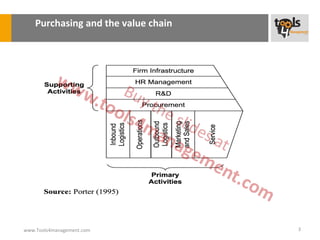
Purchasing and the value chain


www.Tools4management.com             3
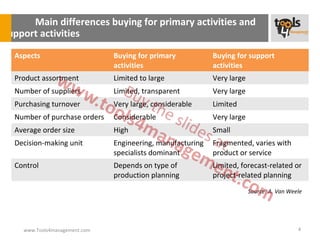
Main differences buying for primary activities and
support activities

  Aspects                      Buying for primary           Buying for support
                               activities                   activities
  Product assortment           Limited to large             Very large
  Number of suppliers          Limited, transparent         Very large
  Purchasing turnover          Very large, considerable     Limited
  Number of purchase orders    Considerable                 Very large
  Average order size           High                         Small
  Decision-making unit         Engineering, manufacturing   Fragmented, varies with
                               specialists dominant         product or service
  Control                      Depends on type of           Limited, forecast-related or
                               production planning          project-related planning
                                                                         Source: A. Van Weele


    www.Tools4management.com                                                               4
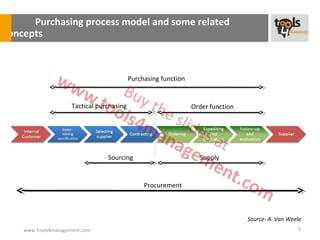
Purchasing process model and some related
concepts


                                           Purchasing function


                     Tactical purchasing                         Order function


                                 Sourcing                          Supply


                                                Procurement


                                                                                  Source: A. Van Weele
    www.Tools4management.com                                                                        5
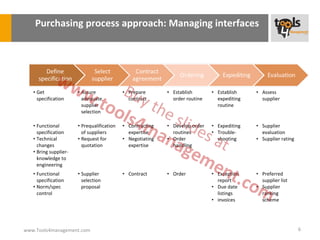
Purchasing process approach: Managing interfaces


   • Get               • Assure             • Prepare       • Establish       • Establish    • Assess
     specification       adequate             contract        order routine     expediting     supplier
                         supplier                                               routine
                         selection

   • Functional        • Prequalification   • Contracting   • Develop order   • Expediting   • Supplier
     specification       of suppliers         expertise       routines        • Trouble-       evaluation
   • Technical         • Request for        • Negotiating   • Order             shooting     • Supplier rating
     changes             quotation            expertise       handling
   • Bring supplier-
     knowledge to
     engineering
   • Functional        • Supplier           • Contract      • Order           • Exception    • Preferred
     specification       selection                                              report         supplier list
   • Norm/spec           proposal                                             • Due date     • Supplier
     control                                                                    listings       ranking
                                                                              • invoices       scheme


www.Tools4management.com                                                                                         6
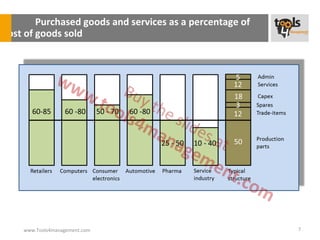
Purchased goods and services as a percentage of
cost of goods sold


    www.Tools4management.com                              7
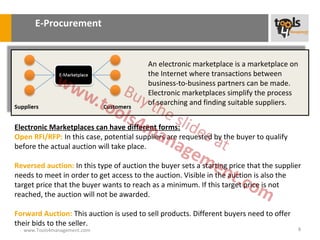
E-Procurement


                                          An electronic marketplace is a marketplace on
                                          the Internet where transactions between
                                          business-to-business partners can be made.
                                          Electronic marketplaces simplify the process
                                          of searching and finding suitable suppliers.


Electronic Marketplaces can have different forms:
Open RFI/RFP: In this case, potential suppliers are requested by the buyer to qualify
before the actual auction will take place.

Reversed auction: In this type of auction the buyer sets a starting price that the supplier
needs to meet in order to get access to the auction. Visible in the auction is also the
target price that the buyer wants to reach as a minimum. If this target price is not
reached, the auction will not be awarded.

Forward Auction: This auction is used to sell products. Different buyers need to offer
their bids to the seller.
  www.Tools4management.com                                                                8
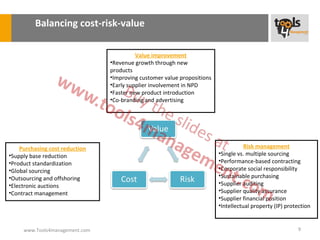
Balancing cost-risk-value

                                          Value improvement
                                •Revenue growth through new
                                products
                                •Improving customer value propositions
                                •Early supplier involvement in NPD
                                •Faster new product introduction
                                •Co-branding and advertising


    Purchasing cost reduction                                                       Risk management
•Supply base reduction                                                   •Single vs. multiple sourcing
•Product standardization                                                 •Performance-based contracting
•Global sourcing                                                         •Corporate social responsibility
•Outsourcing and offshoring                                              •Sustainable purchasing
•Electronic auctions                                                     •Supplier auditing
•Contract management                                                     •Supplier quality assurance
                                                                         •Supplier financial position
                                                                         •Intellectual property (IP) protection


     www.Tools4management.com                                                                            9
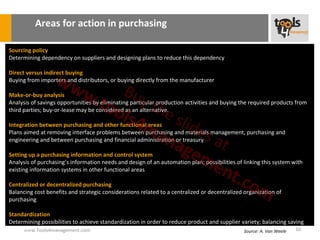
Areas for action in purchasing

Sourcing policy
Determining dependency on suppliers and designing plans to reduce this dependency

Direct versus indirect buying
Buying from importers and distributors, or buying directly from the manufacturer

Make-or-buy analysis
Analysis of savings opportunities by eliminating particular production activities and buying the required products from
third parties; buy-or-lease may be considered as an alternative.

Integration between purchasing and other functional areas
Plans aimed at removing interface problems between purchasing and materials management, purchasing and
engineering and between purchasing and financial administration or treasury

Setting up a purchasing information and control system
Analysis of purchasing’s information needs and design of an automation plan; possibilities of linking this system with
existing information systems in other functional areas

Centralized or decentralized purchasing
Balancing cost benefits and strategic considerations related to a centralized or decentralized organization of
purchasing

Standardization
Determining possibilities to achieve standardization in order to reduce product and supplier variety; balancing saving
and risks.
      www.Tools4management.com                                                                Source: A. Van Weele 10
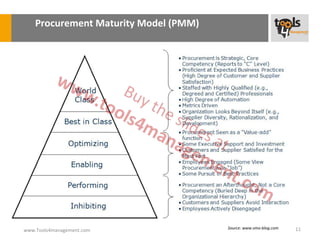
Procurement Maturity Model (PMM)


                                       Source: www.vmo-blog.com   11
www.Tools4management.com
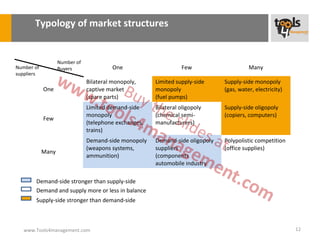
Typology of market structures


                   Number of
Number of          Buyers                One                     Few                     Many
suppliers
                               Bilateral monopoly,     Limited supply-side     Supply-side monopoly
            One                captive market          monopoly                (gas, water, electricity)
                               (spare parts)           (fuel pumps)
                               Limited demand-side     Bilateral oligopoly     Supply-side oligopoly
                               monopoly                (chemical semi-         (copiers, computers)
            Few
                               (telephone exchanges,   manufacturers)
                               trains)
                               Demand-side monopoly    Demand-side oligopoly   Polypolistic competition
                               (weapons systems,       suppliers               (office supplies)
            Many
                               ammunition)             (components
                                                       automobile industry

       Demand-side stronger than supply-side
       Demand and supply more or less in balance
       Supply-side stronger than demand-side


   www.Tools4management.com                                                                                12
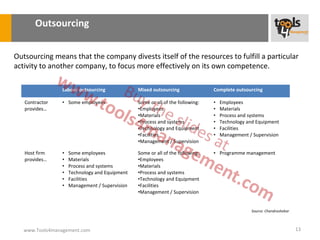
Outsourcing


Outsourcing means that the company divests itself of the resources to fulfill a particular
activity to another company, to focus more effectively on its own competence.

                Labour outsourcing             Mixed outsourcing               Complete outsourcing

   Contractor   • Some employees               Some or all of the following:   •   Employees
   provides…                                   •Employees                      •   Materials
                                               •Materials                      •   Process and systems
                                               •Process and systems            •   Technology and Equipment
                                               •Technology and Equipment       •   Facilities
                                               •Facilities                     •   Management / Supervision
                                               •Management / Supervision

   Host firm    •   Some employees             Some or all of the following:   • Programme management
   provides…    •   Materials                  •Employees
                •   Process and systems        •Materials
                •   Technology and Equipment   •Process and systems
                •   Facilities                 •Technology and Equipment
                •   Management / Supervision   •Facilities
                                               •Management / Supervision


                                                                                               Source: Chandrashekar


   www.Tools4management.com                                                                                            13
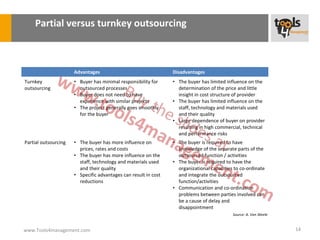
Partial versus turnkey outsourcing


                      Advantages                                 Disadvantages
Turnkey               • Buyer has minimal responsibility for     • The buyer has limited influence on the
outsourcing             outsourced processes                       determination of the price and little
                      • Buyer does not need to have                insight in cost structure of provider
                        experience with similar projects         • The buyer has limited influence on the
                      • The project generally goes smoothly        staff, technology and materials used
                        for the buyer                              and their quality
                                                                 • Large dependence of buyer on provider
                                                                   resulting in high commercial, technical
                                                                   and performance risks
Partial outsourcing   • The buyer has more influence on          • The buyer is required to have
                        prices, rates and costs                    knowledge of the separate parts of the
                      • The buyer has more influence on the        outsourced function / activities
                        staff, technology and materials used     • The buyer is required to have the
                        and their quality                          organizational capacities to co-ordinate
                      • Specific advantages can result in cost     and integrate the outsourced
                        reductions                                 function/activities
                                                                 • Communication and co-ordination
                                                                   problems between parties involved can
                                                                   be a cause of delay and
                                                                   disappointment
                                                                                            Source: A. Van Weele


www.Tools4management.com                                                                                           14
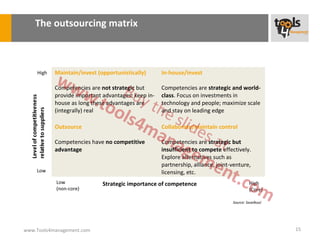
The outsourcing matrix


    High   Maintain/invest (opportunistically)      In-house/invest

           Competencies are not strategic but       Competencies are strategic and world-
           provide important advantages; keep in-   class. Focus on investments in
           house as long these advantages are       technology and people; maximize scale
           (integrally) real                        and stay on leading edge

           Outsource                                Collaborate/maintain control

           Competencies have no competitive         Competencies are strategic but
           advantage                                insufficient to compete effectively.
                                                    Explore alternatives such as
                                                    partnership, alliance, joint-venture,
    Low                                             licensing, etc.
           Low               Strategic importance of competence                           High
           (non-core)                                                                     (Core)

                                                                                 Source: Savelkoul


www.Tools4management.com                                                                             15
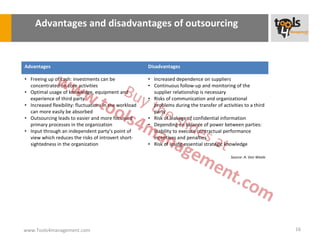
Advantages and disadvantages of outsourcing


Advantages                                              Disadvantages

• Freeing up of cash: investments can be                • Increased dependence on suppliers
  concentrated on core activities                       • Continuous follow-up and monitoring of the
• Optimal usage of knowledge, equipment and               supplier relationship is necessary
  experience of third party                             • Risks of communication and organizational
• Increased flexibility: fluctuations in the workload     problems during the transfer of activities to a third
  can more easily be absorbed                             party
• Outsourcing leads to easier and more focussed         • Risk of leakage of confidential information
  primary processes in the organization                 • Depending on balance of power between parties:
• Input through an independent party’s point of           inability to execute contractual performance
  view which reduces the risks of introvert short-        incentives and penalties
  sightedness in the organization                       • Risk of losing essential strategic knowledge

                                                                                               Source: A. Van Weele


www.Tools4management.com                                                                                              16
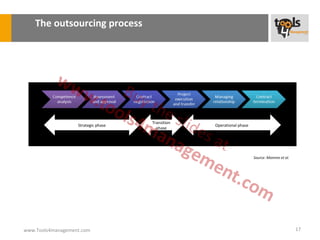
The outsourcing process


                                     Transition
                   Strategic phase                Operational phase
                                       phase


                                                                      Source: Momme et al.


www.Tools4management.com                                                                     17
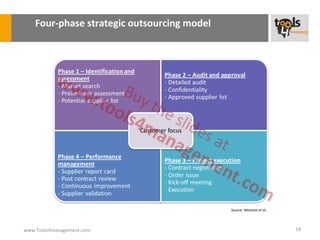
Four-phase strategic outsourcing model


                                             Source: Momme et al.


www.Tools4management.com                                            18
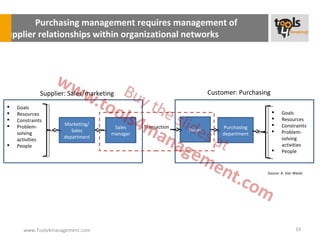
Purchasing management requires management of
supplier relationships within organizational networks


              Supplier: Sales/marketing                               Customer: Purchasing
   Goals
   Resources                                                                                   Goals
   Constraints                                                                                 Resources
    Problem-          Marketing/                                                                Constraints
                                      Sales    Transaction               Purchasing
                         Sales                                Buyer                             Problem-
    solving                           manager                             department
                      department                                                                 solving
    activities
   People                                                                                       activities
                                                                                                People


                                                                                         Source: A. Van Weele


      www.Tools4management.com                                                                          19
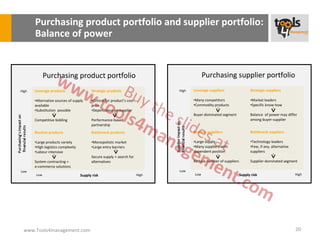
Purchasing product portfolio and supplier portfolio:
       Balance of power


             Purchasing product portfolio                                                    Purchasing supplier portfolio
High   Leverage products                  Strategic products                    High   Leverage suppliers                 Strategic suppliers

       •Alternative sources of supply     •Critical for product’s cost                 •Many competitors                  •Market leaders
       available                          price                                        •Commodity products                •Specific know-how
       •Substitution possible             •Dependence on supplier
                                                                                       Buyer dominated segment            Balance of power may differ
       Competitive bidding                Performance-based                                                               among buyer-supplier
                                          partnership
       Routine products                   Bottleneck products                          Routine suppliers                  Bottleneck suppliers

       •Large products variety            •Monopolistic market                         •Large supply                      •Technology leaders
       •High logistics complexity         •Large entry barriers                        •Many suppliers with               •Few, if any, alternative
       •Labour intensive                                                               dependent position                 suppliers
                                          Secure supply + search for
       System contracting +               alternatives                                 Reduce number of suppliers         Supplier-dominated segment
       e-commerce solutions
Low                                                                             Low
       Low                          Supply risk                          High          Low                          Supply risk                       High


 www.Tools4management.com                                                                                                                             20
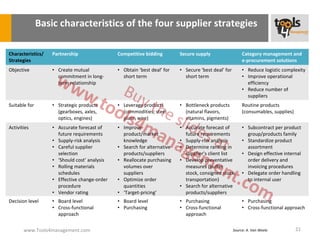
Basic characteristics of the four supplier strategies

Characteristics/   Partnership                Competitive bidding        Secure supply                   Category management and
Strategies                                                                                               e-procurement solutions
Objective          • Create mutual            • Obtain ‘best deal’ for   • Secure ‘best deal’ for        • Reduce logistic complexity
                     commitment in long-        short term                 short term                    • Improve operational
                     term relationship                                                                     efficiency
                                                                                                         • Reduce number of
                                                                                                           suppliers
Suitable for       • Strategic products       • Leverage products        • Bottleneck products           Routine products
                     (gearboxes, axles,         (commodities, steel        (natural flavors,             (consumables, supplies)
                     optics, engines)           plate, wire)               vitamins, pigments)
Activities         • Accurate forecast of     • Improve                  • Accurate forecast of          • Subcontract per product
                     future requirements        product/market             future requirements             group/products family
                   • Supply-risk analysis       knowledge                • Supply-risk analysis          • Standardize product
                   • Careful supplier         • Search for alternative   • Determine ranking in            assortment
                     selection                  products/suppliers         supplier’s client list        • Design effective internal
                   • ‘Should cost’ analysis   • Reallocate purchasing    • Develop preventative            order delivery and
                   • Rolling materials          volumes over               measures (buffer                invoicing procedures
                     schedules                  suppliers                  stock, consigned stock,       • Delegate order handling
                   • Effective change-order   • Optimize order             transportation)                 to internal user
                     procedure                  quantities               • Search for alternative
                   • Vendor rating            • ‘Target-pricing’           products/suppliers
Decision level     • Board level              • Board level              • Purchasing                    • Purchasing
                   • Cross-functional         • Purchasing               • Cross-functional              • Cross-functional approach
                     approach                                              approach


       www.Tools4management.com                                                                     Source: A. Van Weele           21
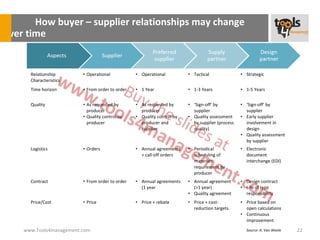
How buyer – supplier relationships may change
over time


      Relationship       • Operational           • Operational          • Tactical               • Strategic
      Characteristics
      Time horizon       • From order to order   • 1 Year               • 1-3 Years              • 1-5 Years


      Quality            • As requested by       • As requested by      • ‘Sign-off’ by          • ‘Sign-off’ by
                           producer                producer               supplier                 supplier
                         • Quality control by    • Quality control by   • Quality assessment     • Early supplier
                           producer                producer and           by supplier (process     involvement in
                                                   supplier               quality)                 design
                                                                                                 • Quality assessment
                                                                                                   by supplier
      Logistics          • Orders                • Annual agreements    • Periodical             • Electronic
                                                   + call-off orders      scheduling of            document
                                                                          materials                interchange (EDI)
                                                                          requirement by
                                                                          producer
      Contract           • From order to order   • Annual agreements    • Annual agreement       • Design contract
                                                   (1 year                (>1 year)              • Life of type
                                                                        • Quality agreement        responsibility
      Price/Cost         • Price                 • Price + rebate       • Price + cost-          • Price based on
                                                                          reduction targets        open calculations
                                                                                                 • Continuous
                                                                                                   improvement

    www.Tools4management.com                                                                       Source: A. Van Weele   22
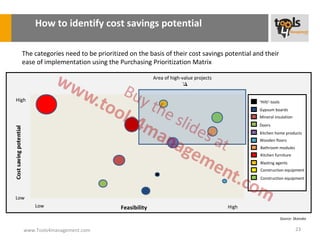
How to identify cost savings potential

  The categories need to be prioritized on the basis of their cost savings potential and their
  ease of implementation using the Purchasing Prioritization Matrix

                                                   Area of high-value projects


High                                                                                    ‘Hilti’-tools
                                                                                        Gypsum boards
                                                                                        Mineral insulation
                                                                                        Doors
                                                                                        Kitchen home products
                                                                                        Wooden floors
                                                                                        Bathroom modules
                                                                                        Kitchen furniture
                                                                                        Blasting agents
                                                                                        Construction equipment
                                                                                        Construction equipment


Low
       Low                           Feasibility                                 High

                                                                                                        Source: Skanska


   www.Tools4management.com                                                                                     23
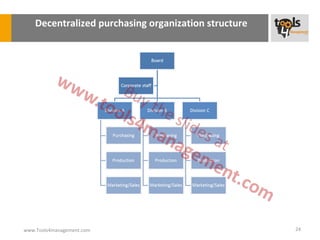
Decentralized purchasing organization structure


www.Tools4management.com                              24
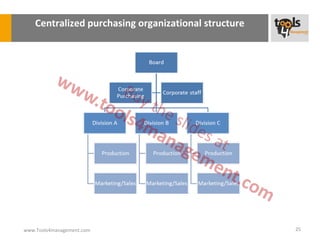
Centralized purchasing organizational structure


www.Tools4management.com                              25
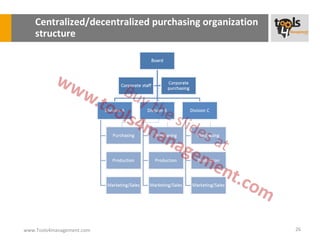
Centralized/decentralized purchasing organization
    structure


www.Tools4management.com                                26
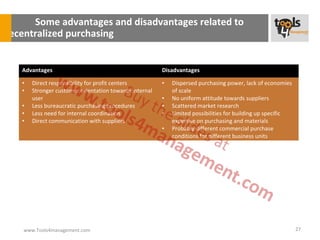
Some advantages and disadvantages related to
decentralized purchasing


   Advantages                                           Disadvantages

   •   Direct responsibility for profit centers         •   Dispersed purchasing power, lack of economies
   •   Stronger customer orientation towards internal       of scale
       user                                             •   No uniform attitude towards suppliers
   •   Less bureaucratic purchasing procedures          •   Scattered market research
   •   Less need for internal coordination              •   Limited possibilities for building up specific
   •   Direct communication with suppliers                  expertise on purchasing and materials
                                                        •   Probably different commercial purchase
                                                            conditions for different business units


    www.Tools4management.com                                                                                 27
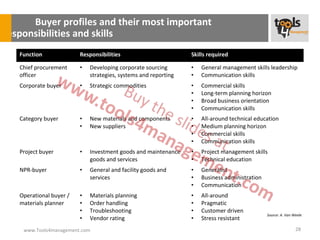
Buyer profiles and their most important
responsibilities and skills
   Function              Responsibilities                        Skills required

   Chief procurement     •   Developing corporate sourcing       •   General management skills leadership
   officer                   strategies, systems and reporting   •   Communication skills
   Corporate buyer       •   Strategic commodities               •   Commercial skills
                                                                 •   Long-term planning horizon
                                                                 •   Broad business orientation
                                                                 •   Communication skills
   Category buyer        •   New materials and components        •   All-around technical education
                         •   New suppliers                       •   Medium planning horizon
                                                                 •   Commercial skills
                                                                 •   Communication skills
   Project buyer         •   Investment goods and maintenance    •   Project management skills
                             goods and services                  •   Technical education
   NPR-buyer             •   General and facility goods and      •   Generalist
                             services                            •   Business administration
                                                                 •   Communication
   Operational buyer /   •   Materials planning                  •   All-around
   materials planner     •   Order handling                      •   Pragmatic
                         •   Troubleshooting                     •   Customer driven
                                                                                               Source: A. Van Weele
                         •   Vendor rating                       •   Stress resistant
    www.Tools4management.com                                                                                   28
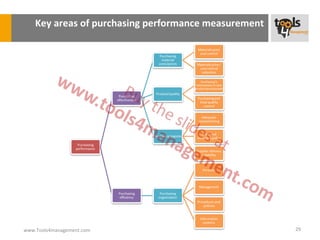
Key areas of purchasing performance measurement


www.Tools4management.com                              29
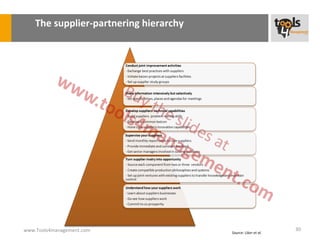
The supplier-partnering hierarchy


www.Tools4management.com                                       30
                                        Source: Liker et al.
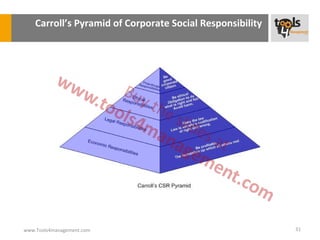
Carroll’s Pyramid of Corporate Social Responsibility


www.Tools4management.com                                   31
Buy the slides at

www.tools4management.com


                           32

Sourcing and purchasing management overview

  • 1.
  • 2.
    Buy the slidesat www.tools4management.com 2
  • 3.
    Purchasing and thevalue chain www.Tools4management.com 3
  • 4.
    Main differences buyingfor primary activities and support activities Aspects Buying for primary Buying for support activities activities Product assortment Limited to large Very large Number of suppliers Limited, transparent Very large Purchasing turnover Very large, considerable Limited Number of purchase orders Considerable Very large Average order size High Small Decision-making unit Engineering, manufacturing Fragmented, varies with specialists dominant product or service Control Depends on type of Limited, forecast-related or production planning project-related planning Source: A. Van Weele www.Tools4management.com 4
  • 5.
    Purchasing process modeland some related concepts Purchasing function Tactical purchasing Order function Sourcing Supply Procurement Source: A. Van Weele www.Tools4management.com 5
  • 6.
    Purchasing process approach:Managing interfaces • Get • Assure • Prepare • Establish • Establish • Assess specification adequate contract order routine expediting supplier supplier routine selection • Functional • Prequalification • Contracting • Develop order • Expediting • Supplier specification of suppliers expertise routines • Trouble- evaluation • Technical • Request for • Negotiating • Order shooting • Supplier rating changes quotation expertise handling • Bring supplier- knowledge to engineering • Functional • Supplier • Contract • Order • Exception • Preferred specification selection report supplier list • Norm/spec proposal • Due date • Supplier control listings ranking • invoices scheme www.Tools4management.com 6
  • 7.
    Purchased goods andservices as a percentage of cost of goods sold www.Tools4management.com 7
  • 8.
    E-Procurement An electronic marketplace is a marketplace on the Internet where transactions between business-to-business partners can be made. Electronic marketplaces simplify the process of searching and finding suitable suppliers. Electronic Marketplaces can have different forms: Open RFI/RFP: In this case, potential suppliers are requested by the buyer to qualify before the actual auction will take place. Reversed auction: In this type of auction the buyer sets a starting price that the supplier needs to meet in order to get access to the auction. Visible in the auction is also the target price that the buyer wants to reach as a minimum. If this target price is not reached, the auction will not be awarded. Forward Auction: This auction is used to sell products. Different buyers need to offer their bids to the seller. www.Tools4management.com 8
  • 9.
    Balancing cost-risk-value Value improvement •Revenue growth through new products •Improving customer value propositions •Early supplier involvement in NPD •Faster new product introduction •Co-branding and advertising Purchasing cost reduction Risk management •Supply base reduction •Single vs. multiple sourcing •Product standardization •Performance-based contracting •Global sourcing •Corporate social responsibility •Outsourcing and offshoring •Sustainable purchasing •Electronic auctions •Supplier auditing •Contract management •Supplier quality assurance •Supplier financial position •Intellectual property (IP) protection www.Tools4management.com 9
  • 10.
    Areas for actionin purchasing Sourcing policy Determining dependency on suppliers and designing plans to reduce this dependency Direct versus indirect buying Buying from importers and distributors, or buying directly from the manufacturer Make-or-buy analysis Analysis of savings opportunities by eliminating particular production activities and buying the required products from third parties; buy-or-lease may be considered as an alternative. Integration between purchasing and other functional areas Plans aimed at removing interface problems between purchasing and materials management, purchasing and engineering and between purchasing and financial administration or treasury Setting up a purchasing information and control system Analysis of purchasing’s information needs and design of an automation plan; possibilities of linking this system with existing information systems in other functional areas Centralized or decentralized purchasing Balancing cost benefits and strategic considerations related to a centralized or decentralized organization of purchasing Standardization Determining possibilities to achieve standardization in order to reduce product and supplier variety; balancing saving and risks. www.Tools4management.com Source: A. Van Weele 10
  • 11.
    Procurement Maturity Model(PMM) Source: www.vmo-blog.com 11 www.Tools4management.com
  • 12.
    Typology of marketstructures Number of Number of Buyers One Few Many suppliers Bilateral monopoly, Limited supply-side Supply-side monopoly One captive market monopoly (gas, water, electricity) (spare parts) (fuel pumps) Limited demand-side Bilateral oligopoly Supply-side oligopoly monopoly (chemical semi- (copiers, computers) Few (telephone exchanges, manufacturers) trains) Demand-side monopoly Demand-side oligopoly Polypolistic competition (weapons systems, suppliers (office supplies) Many ammunition) (components automobile industry Demand-side stronger than supply-side Demand and supply more or less in balance Supply-side stronger than demand-side www.Tools4management.com 12
  • 13.
    Outsourcing Outsourcing means thatthe company divests itself of the resources to fulfill a particular activity to another company, to focus more effectively on its own competence. Labour outsourcing Mixed outsourcing Complete outsourcing Contractor • Some employees Some or all of the following: • Employees provides… •Employees • Materials •Materials • Process and systems •Process and systems • Technology and Equipment •Technology and Equipment • Facilities •Facilities • Management / Supervision •Management / Supervision Host firm • Some employees Some or all of the following: • Programme management provides… • Materials •Employees • Process and systems •Materials • Technology and Equipment •Process and systems • Facilities •Technology and Equipment • Management / Supervision •Facilities •Management / Supervision Source: Chandrashekar www.Tools4management.com 13
  • 14.
    Partial versus turnkeyoutsourcing Advantages Disadvantages Turnkey • Buyer has minimal responsibility for • The buyer has limited influence on the outsourcing outsourced processes determination of the price and little • Buyer does not need to have insight in cost structure of provider experience with similar projects • The buyer has limited influence on the • The project generally goes smoothly staff, technology and materials used for the buyer and their quality • Large dependence of buyer on provider resulting in high commercial, technical and performance risks Partial outsourcing • The buyer has more influence on • The buyer is required to have prices, rates and costs knowledge of the separate parts of the • The buyer has more influence on the outsourced function / activities staff, technology and materials used • The buyer is required to have the and their quality organizational capacities to co-ordinate • Specific advantages can result in cost and integrate the outsourced reductions function/activities • Communication and co-ordination problems between parties involved can be a cause of delay and disappointment Source: A. Van Weele www.Tools4management.com 14
  • 15.
    The outsourcing matrix High Maintain/invest (opportunistically) In-house/invest Competencies are not strategic but Competencies are strategic and world- provide important advantages; keep in- class. Focus on investments in house as long these advantages are technology and people; maximize scale (integrally) real and stay on leading edge Outsource Collaborate/maintain control Competencies have no competitive Competencies are strategic but advantage insufficient to compete effectively. Explore alternatives such as partnership, alliance, joint-venture, Low licensing, etc. Low Strategic importance of competence High (non-core) (Core) Source: Savelkoul www.Tools4management.com 15
  • 16.
    Advantages and disadvantagesof outsourcing Advantages Disadvantages • Freeing up of cash: investments can be • Increased dependence on suppliers concentrated on core activities • Continuous follow-up and monitoring of the • Optimal usage of knowledge, equipment and supplier relationship is necessary experience of third party • Risks of communication and organizational • Increased flexibility: fluctuations in the workload problems during the transfer of activities to a third can more easily be absorbed party • Outsourcing leads to easier and more focussed • Risk of leakage of confidential information primary processes in the organization • Depending on balance of power between parties: • Input through an independent party’s point of inability to execute contractual performance view which reduces the risks of introvert short- incentives and penalties sightedness in the organization • Risk of losing essential strategic knowledge Source: A. Van Weele www.Tools4management.com 16
  • 17.
    The outsourcing process Transition Strategic phase Operational phase phase Source: Momme et al. www.Tools4management.com 17
  • 18.
    Four-phase strategic outsourcingmodel Source: Momme et al. www.Tools4management.com 18
  • 19.
    Purchasing management requiresmanagement of supplier relationships within organizational networks Supplier: Sales/marketing Customer: Purchasing  Goals  Resources  Goals  Constraints  Resources Problem- Marketing/  Constraints  Sales Transaction Purchasing Sales Buyer  Problem- solving manager department department solving activities  People activities  People Source: A. Van Weele www.Tools4management.com 19
  • 20.
    Purchasing product portfolioand supplier portfolio: Balance of power Purchasing product portfolio Purchasing supplier portfolio High Leverage products Strategic products High Leverage suppliers Strategic suppliers •Alternative sources of supply •Critical for product’s cost •Many competitors •Market leaders available price •Commodity products •Specific know-how •Substitution possible •Dependence on supplier Buyer dominated segment Balance of power may differ Competitive bidding Performance-based among buyer-supplier partnership Routine products Bottleneck products Routine suppliers Bottleneck suppliers •Large products variety •Monopolistic market •Large supply •Technology leaders •High logistics complexity •Large entry barriers •Many suppliers with •Few, if any, alternative •Labour intensive dependent position suppliers Secure supply + search for System contracting + alternatives Reduce number of suppliers Supplier-dominated segment e-commerce solutions Low Low Low Supply risk High Low Supply risk High www.Tools4management.com 20
  • 21.
    Basic characteristics ofthe four supplier strategies Characteristics/ Partnership Competitive bidding Secure supply Category management and Strategies e-procurement solutions Objective • Create mutual • Obtain ‘best deal’ for • Secure ‘best deal’ for • Reduce logistic complexity commitment in long- short term short term • Improve operational term relationship efficiency • Reduce number of suppliers Suitable for • Strategic products • Leverage products • Bottleneck products Routine products (gearboxes, axles, (commodities, steel (natural flavors, (consumables, supplies) optics, engines) plate, wire) vitamins, pigments) Activities • Accurate forecast of • Improve • Accurate forecast of • Subcontract per product future requirements product/market future requirements group/products family • Supply-risk analysis knowledge • Supply-risk analysis • Standardize product • Careful supplier • Search for alternative • Determine ranking in assortment selection products/suppliers supplier’s client list • Design effective internal • ‘Should cost’ analysis • Reallocate purchasing • Develop preventative order delivery and • Rolling materials volumes over measures (buffer invoicing procedures schedules suppliers stock, consigned stock, • Delegate order handling • Effective change-order • Optimize order transportation) to internal user procedure quantities • Search for alternative • Vendor rating • ‘Target-pricing’ products/suppliers Decision level • Board level • Board level • Purchasing • Purchasing • Cross-functional • Purchasing • Cross-functional • Cross-functional approach approach approach www.Tools4management.com Source: A. Van Weele 21
  • 22.
    How buyer –supplier relationships may change over time Relationship • Operational • Operational • Tactical • Strategic Characteristics Time horizon • From order to order • 1 Year • 1-3 Years • 1-5 Years Quality • As requested by • As requested by • ‘Sign-off’ by • ‘Sign-off’ by producer producer supplier supplier • Quality control by • Quality control by • Quality assessment • Early supplier producer producer and by supplier (process involvement in supplier quality) design • Quality assessment by supplier Logistics • Orders • Annual agreements • Periodical • Electronic + call-off orders scheduling of document materials interchange (EDI) requirement by producer Contract • From order to order • Annual agreements • Annual agreement • Design contract (1 year (>1 year) • Life of type • Quality agreement responsibility Price/Cost • Price • Price + rebate • Price + cost- • Price based on reduction targets open calculations • Continuous improvement www.Tools4management.com Source: A. Van Weele 22
  • 23.
    How to identifycost savings potential The categories need to be prioritized on the basis of their cost savings potential and their ease of implementation using the Purchasing Prioritization Matrix Area of high-value projects High ‘Hilti’-tools Gypsum boards Mineral insulation Doors Kitchen home products Wooden floors Bathroom modules Kitchen furniture Blasting agents Construction equipment Construction equipment Low Low Feasibility High Source: Skanska www.Tools4management.com 23
  • 24.
    Decentralized purchasing organizationstructure www.Tools4management.com 24
  • 25.
    Centralized purchasing organizationalstructure www.Tools4management.com 25
  • 26.
    Centralized/decentralized purchasing organization structure www.Tools4management.com 26
  • 27.
    Some advantages anddisadvantages related to decentralized purchasing Advantages Disadvantages • Direct responsibility for profit centers • Dispersed purchasing power, lack of economies • Stronger customer orientation towards internal of scale user • No uniform attitude towards suppliers • Less bureaucratic purchasing procedures • Scattered market research • Less need for internal coordination • Limited possibilities for building up specific • Direct communication with suppliers expertise on purchasing and materials • Probably different commercial purchase conditions for different business units www.Tools4management.com 27
  • 28.
    Buyer profiles andtheir most important responsibilities and skills Function Responsibilities Skills required Chief procurement • Developing corporate sourcing • General management skills leadership officer strategies, systems and reporting • Communication skills Corporate buyer • Strategic commodities • Commercial skills • Long-term planning horizon • Broad business orientation • Communication skills Category buyer • New materials and components • All-around technical education • New suppliers • Medium planning horizon • Commercial skills • Communication skills Project buyer • Investment goods and maintenance • Project management skills goods and services • Technical education NPR-buyer • General and facility goods and • Generalist services • Business administration • Communication Operational buyer / • Materials planning • All-around materials planner • Order handling • Pragmatic • Troubleshooting • Customer driven Source: A. Van Weele • Vendor rating • Stress resistant www.Tools4management.com 28
  • 29.
    Key areas ofpurchasing performance measurement www.Tools4management.com 29
  • 30.
  • 31.
    Carroll’s Pyramid ofCorporate Social Responsibility www.Tools4management.com 31
  • 32.
    Buy the slidesat www.tools4management.com 32