ARSALAN GULZAR
IMDAD
FARHAN
RAHEEL
GROUP MEMBERS
Supply Chain Management
“The process of planning, organizing, and controlling
the flow of materials, services, and information
from supplier to end user/customer.”
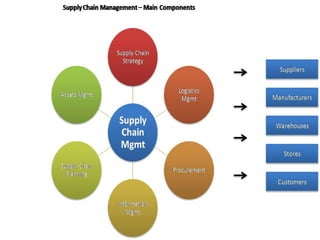
This integrated approach incorporate suppliers,
supply management, integrated logistics, and
operations .
FARHAN
Procurement and Sourcing
Strategies
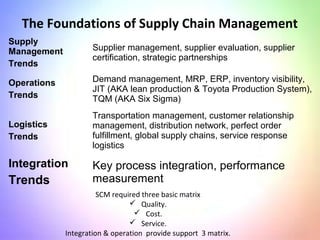
The Foundations of Supply Chain Management
Supply
Management
Trends
Supplier management, supplier evaluation, supplier
certification, strategic partnerships
Operations
Trends
Demand management, MRP, ERP, inventory visibility,
JIT (AKA lean production & Toyota Production System),
TQM (AKA Six Sigma)
Logistics
Trends
Transportation management, customer relationship
management, distribution network, perfect order
fulfillment, global supply chains, service response
logistics
Integration
Trends
Key process integration, performance
measurement
SCM required three basic matrix
 Quality.
 Cost.
 Service.
Integration & operation provide support 3 matrix.
Advantages of Special Department
• Easier to standardize
• Allows room for application of electronic supply systems.
• Development of specialization and expertise.
• Essential for strategic Supply Chain Management
Purchasing
The process of buying; learning the need, locating ad
selecting a supplier, negotiating price and other
pertinent terms, and following up to ensure delivery.
• Procurement
• Not limited, but also includes the storage, traffic,
receiving, incoming inspection, and salvage.
Material Management
the integration of related materials functions to provide cost
–effective delivery of materials and services to the
organization, includes a number of separate groups, such as
material planning and control, material and purchasing
research, purchasing, inbound traffic, incoming quality
control, inventory control, production scheduling, receiving,
stores, in-plant materials movement, and scrap and surplus
disposal.
Others names used for materials management, Integrated
Logistic and Supply Chain Management.
IMDAD
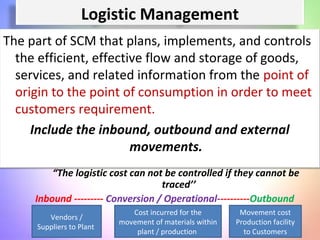
Logistic Management
The part of SCM that plans, implements, and controls
the efficient, effective flow and storage of goods,
services, and related information from the point of
origin to the point of consumption in order to meet
customers requirement.
Include the inbound, outbound and external
movements.
“The logistic cost can not be controlled if they cannot be
traced’’
Inbound --------- Conversion / Operational----------Outbound
Vendors /
Suppliers to Plant
Cost incurred for the
movement of materials within
plant / production
Movement cost
Production facility
to Customers
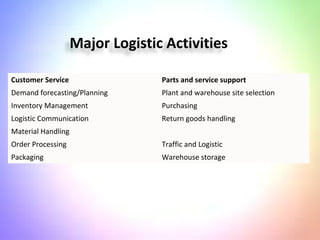
Customer Service Parts and service support
Demand forecasting/Planning Plant and warehouse site selection
Inventory Management Purchasing
Logistic Communication Return goods handling
Material Handling
Order Processing Traffic and Logistic
Packaging Warehouse storage
Major Logistic Activities
Importance of Decision Making in the Purchasing /
Supply Management
The following decision will have a major impact on the
organizational goal, final customer, profitability, return on assets,
etc
•Make or Buy
•Price
•Where shall be order place
•Maximum or Minimum Order Size
•Best alternative in case of any emergency
•Transportation mode and Cost considering quality and timely delivery
•Dispose of surplus material
•Reactive and Proactive – Wait or Act now?
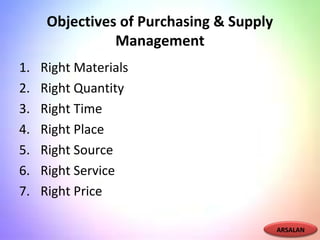
Objectives of Purchasing & Supply
Management
1. Right Materials
2. Right Quantity
3. Right Time
4. Right Place
5. Right Source
6. Right Service
7. Right Price
ARSALAN
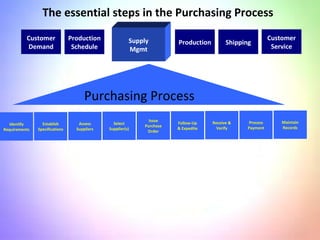
The essential steps in the Purchasing Process
Supply
Mgmt
Production
Customer
Service
Shipping
Identify
Requirements
Establish
Specifications
Assess
Suppliers
Select
Supplier(s)
Issue
Purchase
Order
Follow-Up
& Expedite
Receive &
Verify
Process
Payment
Maintain
Records
Purchasing Process
Customer
Demand
Production
Schedule
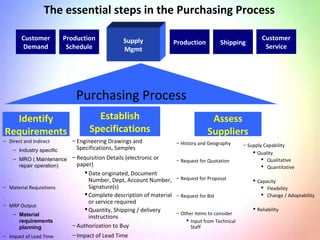
The essential steps in the Purchasing Process
Supply
Mgmt
Production
Customer
Service
Shipping
Identify
Requirements
Establish
Specifications
Assess
Suppliers
Purchasing Process
Customer
Demand
Production
Schedule
– Direct and Indirect
– Industry specific
– MRO ( Maintenance
repair operation)
.
– Material Requisitions
.
– MRP Output
– Material
requirements
planning
– Impact of Lead Time
– Engineering Drawings and
Specifications, Samples
– Requisition Details (electronic or
paper)
Date originated, Document
Number, Dept, Account Number,
Signature(s)
Complete description of material
or service required
Quantity, Shipping / delivery
instructions
– Authorization to Buy
– Impact of Lead Time
– History and Geography
– Request for Quotation
– Request for Proposal
– Request for Bid
– Other items to consider
 Input from Technical
Staff
– Supply Capability
 Quality
 Qualitative
 Quantitative
 Capacity
 Flexibility
 Change / Adoptability
 Reliability
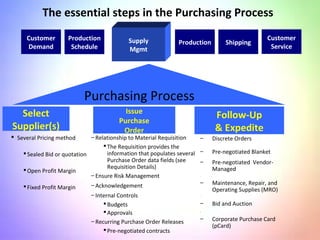
The essential steps in the Purchasing Process
Supply
Mgmt
Production
Customer
Service
Shipping
Select
Supplier(s)
Issue
Purchase
Order
Follow-Up
& Expedite
Purchasing Process
Customer
Demand
Production
Schedule
 Several Pricing method
Sealed Bid or quotation
Open Profit Margin
Fixed Profit Margin
– Relationship to Material Requisition
The Requisition provides the
information that populates several
Purchase Order data fields (see
Requisition Details)
– Ensure Risk Management
– Acknowledgement
– Internal Controls
Budgets
Approvals
– Recurring Purchase Order Releases
Pre-negotiated contracts
– Discrete Orders
.
– Pre-negotiated Blanket.
– Pre-negotiated Vendor-
Managed
.
– Maintenance, Repair, and
Operating Supplies (MRO)
.
– Bid and Auction
.
– Corporate Purchase Card
(pCard)
The essential steps in the Purchasing Process
Supply
Mgmt
Production
Customer
Service
Shipping
Receive &
Verify
Process
Payment
Purchasing Process
Customer
Demand
Production
Schedule
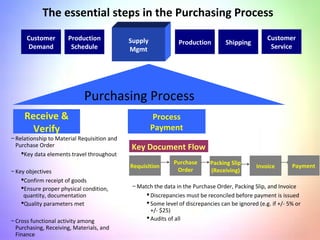
– Relationship to Material Requisition and
Purchase Order
Key data elements travel throughout
– Key objectives
Confirm receipt of goods
Ensure proper physical condition,
quantity, documentation
Quality parameters met
– Cross functional activity among
Purchasing, Receiving, Materials, and
Finance
Key Document Flow
Requisition
Purchase
Order
Packing Slip
(Receiving)
Invoice Payment
– Match the data in the Purchase Order, Packing Slip, and Invoice
Discrepancies must be reconciled before payment is issued
Some level of discrepancies can be ignored (e.g. if +/- 5% or
+/- $25)
Audits of all
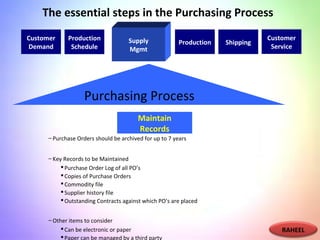
– Purchase Orders should be archived for up to 7 years
– Key Records to be Maintained
Purchase Order Log of all PO’s
Copies of Purchase Orders
Commodity file
Supplier history file
Outstanding Contracts against which PO’s are placed
– Other items to consider
Can be electronic or paper
Paper can be managed by a third party
The essential steps in the Purchasing Process
Supply
Mgmt
Production
Customer
Service
Shipping
Maintain
Records
Purchasing Process
Customer
Demand
Production
Schedule
RAHEEL
Information System & Purchasing
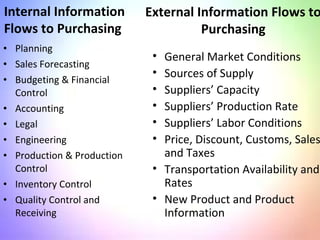
• Planning
• Sales Forecasting
• Budgeting & Financial
Control
• Accounting
• Legal
• Engineering
• Production & Production
Control
• Inventory Control
• Quality Control and
Receiving
Internal Information
Flows to Purchasing
External Information Flows to
Purchasing
• General Market Conditions
• Sources of Supply
• Suppliers’ Capacity
• Suppliers’ Production Rate
• Suppliers’ Labor Conditions
• Price, Discount, Customs, Sales
and Taxes
• Transportation Availability and
Rates
• New Product and Product
Information
Information flows from Purchasing to
Organization
• General Management
• Engineering
• Product Development
• Marketing
• Production
• Legal
• Finance and Accounting
• Stores
IMPORTANCE OF SCM
• In any type of business it play very crucial role.
• In SCM process heavy investment is invested.
• 75% revenue Company generate by this process.
• By properly managing SCM ensure the better &
smooth running of a Company.
ARSALAN
THANK
YOU
Waste it
GOOD THOUGHTS.
“LIFE” is like an ICE-CREAM
Its up to you
You taste
it
oR

Arsalan supply chain management 1

  • 3.
  • 4.
    Supply Chain Management “Theprocess of planning, organizing, and controlling the flow of materials, services, and information from supplier to end user/customer.” This integrated approach incorporate suppliers, supply management, integrated logistics, and operations . FARHAN
  • 6.
  • 7.
    The Foundations ofSupply Chain Management Supply Management Trends Supplier management, supplier evaluation, supplier certification, strategic partnerships Operations Trends Demand management, MRP, ERP, inventory visibility, JIT (AKA lean production & Toyota Production System), TQM (AKA Six Sigma) Logistics Trends Transportation management, customer relationship management, distribution network, perfect order fulfillment, global supply chains, service response logistics Integration Trends Key process integration, performance measurement SCM required three basic matrix  Quality.  Cost.  Service. Integration & operation provide support 3 matrix.
  • 8.
    Advantages of SpecialDepartment • Easier to standardize • Allows room for application of electronic supply systems. • Development of specialization and expertise. • Essential for strategic Supply Chain Management
  • 9.
    Purchasing The process ofbuying; learning the need, locating ad selecting a supplier, negotiating price and other pertinent terms, and following up to ensure delivery. • Procurement • Not limited, but also includes the storage, traffic, receiving, incoming inspection, and salvage.
  • 10.
    Material Management the integrationof related materials functions to provide cost –effective delivery of materials and services to the organization, includes a number of separate groups, such as material planning and control, material and purchasing research, purchasing, inbound traffic, incoming quality control, inventory control, production scheduling, receiving, stores, in-plant materials movement, and scrap and surplus disposal. Others names used for materials management, Integrated Logistic and Supply Chain Management. IMDAD
  • 11.
    Logistic Management The partof SCM that plans, implements, and controls the efficient, effective flow and storage of goods, services, and related information from the point of origin to the point of consumption in order to meet customers requirement. Include the inbound, outbound and external movements. “The logistic cost can not be controlled if they cannot be traced’’ Inbound --------- Conversion / Operational----------Outbound Vendors / Suppliers to Plant Cost incurred for the movement of materials within plant / production Movement cost Production facility to Customers
  • 12.
    Customer Service Partsand service support Demand forecasting/Planning Plant and warehouse site selection Inventory Management Purchasing Logistic Communication Return goods handling Material Handling Order Processing Traffic and Logistic Packaging Warehouse storage Major Logistic Activities
  • 13.
    Importance of DecisionMaking in the Purchasing / Supply Management The following decision will have a major impact on the organizational goal, final customer, profitability, return on assets, etc •Make or Buy •Price •Where shall be order place •Maximum or Minimum Order Size •Best alternative in case of any emergency •Transportation mode and Cost considering quality and timely delivery •Dispose of surplus material •Reactive and Proactive – Wait or Act now?
  • 14.
    Objectives of Purchasing& Supply Management 1. Right Materials 2. Right Quantity 3. Right Time 4. Right Place 5. Right Source 6. Right Service 7. Right Price ARSALAN
  • 15.
    The essential stepsin the Purchasing Process Supply Mgmt Production Customer Service Shipping Identify Requirements Establish Specifications Assess Suppliers Select Supplier(s) Issue Purchase Order Follow-Up & Expedite Receive & Verify Process Payment Maintain Records Purchasing Process Customer Demand Production Schedule
  • 16.
    The essential stepsin the Purchasing Process Supply Mgmt Production Customer Service Shipping Identify Requirements Establish Specifications Assess Suppliers Purchasing Process Customer Demand Production Schedule – Direct and Indirect – Industry specific – MRO ( Maintenance repair operation) . – Material Requisitions . – MRP Output – Material requirements planning – Impact of Lead Time – Engineering Drawings and Specifications, Samples – Requisition Details (electronic or paper) Date originated, Document Number, Dept, Account Number, Signature(s) Complete description of material or service required Quantity, Shipping / delivery instructions – Authorization to Buy – Impact of Lead Time – History and Geography – Request for Quotation – Request for Proposal – Request for Bid – Other items to consider  Input from Technical Staff – Supply Capability  Quality  Qualitative  Quantitative  Capacity  Flexibility  Change / Adoptability  Reliability
  • 17.
    The essential stepsin the Purchasing Process Supply Mgmt Production Customer Service Shipping Select Supplier(s) Issue Purchase Order Follow-Up & Expedite Purchasing Process Customer Demand Production Schedule  Several Pricing method Sealed Bid or quotation Open Profit Margin Fixed Profit Margin – Relationship to Material Requisition The Requisition provides the information that populates several Purchase Order data fields (see Requisition Details) – Ensure Risk Management – Acknowledgement – Internal Controls Budgets Approvals – Recurring Purchase Order Releases Pre-negotiated contracts – Discrete Orders . – Pre-negotiated Blanket. – Pre-negotiated Vendor- Managed . – Maintenance, Repair, and Operating Supplies (MRO) . – Bid and Auction . – Corporate Purchase Card (pCard)
  • 18.
    The essential stepsin the Purchasing Process Supply Mgmt Production Customer Service Shipping Receive & Verify Process Payment Purchasing Process Customer Demand Production Schedule – Relationship to Material Requisition and Purchase Order Key data elements travel throughout – Key objectives Confirm receipt of goods Ensure proper physical condition, quantity, documentation Quality parameters met – Cross functional activity among Purchasing, Receiving, Materials, and Finance Key Document Flow Requisition Purchase Order Packing Slip (Receiving) Invoice Payment – Match the data in the Purchase Order, Packing Slip, and Invoice Discrepancies must be reconciled before payment is issued Some level of discrepancies can be ignored (e.g. if +/- 5% or +/- $25) Audits of all
  • 19.
    – Purchase Ordersshould be archived for up to 7 years – Key Records to be Maintained Purchase Order Log of all PO’s Copies of Purchase Orders Commodity file Supplier history file Outstanding Contracts against which PO’s are placed – Other items to consider Can be electronic or paper Paper can be managed by a third party The essential steps in the Purchasing Process Supply Mgmt Production Customer Service Shipping Maintain Records Purchasing Process Customer Demand Production Schedule RAHEEL
  • 20.
  • 21.
    • Planning • SalesForecasting • Budgeting & Financial Control • Accounting • Legal • Engineering • Production & Production Control • Inventory Control • Quality Control and Receiving Internal Information Flows to Purchasing External Information Flows to Purchasing • General Market Conditions • Sources of Supply • Suppliers’ Capacity • Suppliers’ Production Rate • Suppliers’ Labor Conditions • Price, Discount, Customs, Sales and Taxes • Transportation Availability and Rates • New Product and Product Information
  • 22.
    Information flows fromPurchasing to Organization • General Management • Engineering • Product Development • Marketing • Production • Legal • Finance and Accounting • Stores
  • 23.
    IMPORTANCE OF SCM •In any type of business it play very crucial role. • In SCM process heavy investment is invested. • 75% revenue Company generate by this process. • By properly managing SCM ensure the better & smooth running of a Company. ARSALAN
  • 25.
  • 26.
    Waste it GOOD THOUGHTS. “LIFE”is like an ICE-CREAM Its up to you You taste it oR