Model based Strategic Sourcing
Laleh Rafati & Geert Poels
1
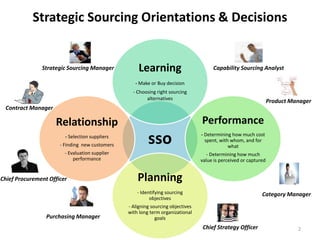
Strategic Sourcing Orientations & Decisions
sso
Learning
- Make or Buy decision
- Choosing right sourcing
alternatives
Performance
- Determining how much cost
spent, with whom, and for
what
- Determining how much
value is perceived or captured
Planning
- Identifying sourcing
objectives
- Aligning sourcing objectives
with long term organizational
goals
Relationship
- Selection suppliers
- Finding new customers
- Evaluation supplier
performance
Purchasing Manager
Contract Manager
Capability Sourcing Analyst
Category Manager
Product Manager
Chief Procurement Officer
Chief Strategy Officer
Strategic Sourcing Manager
2
Spend
Management
Sourcing
Management
Supplier
Selection
Contract
Management
Relational
Management
SAP
Accounts Payable
ERP
Purchasing Cards
eProcurement
eSourcing
GL account
Online RFx
e-Auctions
Spend Data
Sourcing Data Contract Data
Supplier Data Performance Data
Fact based Decision Making
Application
Layer
Process
Layer
Data
Layer
Analytics
Layer
Decision
Layer
Spend analysis
Market analysis
Demand analysis Risk analysis Value chain analysis
Descriptive Diagnostic Predictive Prescriptive
Data
(Acquiring)
Insights
(Analyzing )
Act
(Acting )
Chief Procurement Officer (CPO)
Performance analysisCapability analysis
3
Spend
Management
Sourcing
Management
Supplier
Selection
Contract
Management
Relational
Management
SAP
Accounts Payable
ERP
Purchasing Cards
eProcurement
eSourcing
GL account
Online RFx
e-Auctions
Spend Data
Sourcing Data Contract Data
Supplier Data Performance Data
Fact based Decision Making
Application
Layer
Process
Layer
Data
Layer
Analytics
Layer
Decision
Layer
Spend analysis
Market analysis Risk analysis
Value chain analysisDemand analysis
Descriptive Diagnostic Predictive Prescriptive
Chief Procurement Officer (CPO)
disparate nature of
systems and data
sources
Non-automated
Processes
lack of data
centralization,
integration,
standardization
lack of advanced
techniques,
softwares, skills
lack of visualization
techniques
4
Research Objectives
5
Objective 1: a holistic view on strategic sourcing
Objective 2: a conceptual basis for centralization of procurement
data
Objective 3: a conceptual basis for systemic exploration of strategic
sourcing alternatives
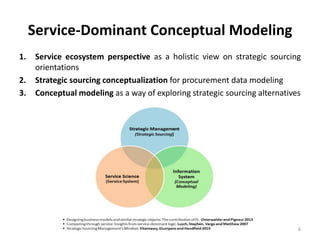
Service-Dominant Conceptual Modeling
1. Service ecosystem perspective as a holistic view on strategic sourcing
orientations
2. Strategic sourcing conceptualization for procurement data modeling
3. Conceptual modeling as a way of exploring strategic sourcing alternatives
6
Solution Approach
Seligmann et al., 1989
Analyzing the structure of IS methodologies, an alternative approach
Way of Thinking
Way of Modeling Way of Working
Way of Supporting
7
principles
viewpoints & conceptualization model-based exploration
model-based analytical techniques and tools
Way of Thinking: Service ecoSystem
8
Capability
Resource Competency
Competitiveness or Surviving Profitability or Viability
Supply Network Members
Way of Modeling: Conceptualization & Viewpoints
What the actor Can do
Who is the Actor
What the actor Has
What the actor Does
9
C.A.R.S
Way of Working: Model based Exploration
10
Value Creation View
11
Capability Sourcing View
12
Supply Base View
13
Resource Based View
14
Way of Supporting:
model based analytical tools
• e.g. Business Architecture (BA) software tools
15
to manage
16
Thanks for your attention
17

Model based strategic sourcing

  • 1.
    Model based StrategicSourcing Laleh Rafati & Geert Poels 1
  • 2.
    Strategic Sourcing Orientations& Decisions sso Learning - Make or Buy decision - Choosing right sourcing alternatives Performance - Determining how much cost spent, with whom, and for what - Determining how much value is perceived or captured Planning - Identifying sourcing objectives - Aligning sourcing objectives with long term organizational goals Relationship - Selection suppliers - Finding new customers - Evaluation supplier performance Purchasing Manager Contract Manager Capability Sourcing Analyst Category Manager Product Manager Chief Procurement Officer Chief Strategy Officer Strategic Sourcing Manager 2
  • 3.
    Spend Management Sourcing Management Supplier Selection Contract Management Relational Management SAP Accounts Payable ERP Purchasing Cards eProcurement eSourcing GLaccount Online RFx e-Auctions Spend Data Sourcing Data Contract Data Supplier Data Performance Data Fact based Decision Making Application Layer Process Layer Data Layer Analytics Layer Decision Layer Spend analysis Market analysis Demand analysis Risk analysis Value chain analysis Descriptive Diagnostic Predictive Prescriptive Data (Acquiring) Insights (Analyzing ) Act (Acting ) Chief Procurement Officer (CPO) Performance analysisCapability analysis 3
  • 4.
    Spend Management Sourcing Management Supplier Selection Contract Management Relational Management SAP Accounts Payable ERP Purchasing Cards eProcurement eSourcing GLaccount Online RFx e-Auctions Spend Data Sourcing Data Contract Data Supplier Data Performance Data Fact based Decision Making Application Layer Process Layer Data Layer Analytics Layer Decision Layer Spend analysis Market analysis Risk analysis Value chain analysisDemand analysis Descriptive Diagnostic Predictive Prescriptive Chief Procurement Officer (CPO) disparate nature of systems and data sources Non-automated Processes lack of data centralization, integration, standardization lack of advanced techniques, softwares, skills lack of visualization techniques 4
  • 5.
    Research Objectives 5 Objective 1:a holistic view on strategic sourcing Objective 2: a conceptual basis for centralization of procurement data Objective 3: a conceptual basis for systemic exploration of strategic sourcing alternatives
  • 6.
    Service-Dominant Conceptual Modeling 1.Service ecosystem perspective as a holistic view on strategic sourcing orientations 2. Strategic sourcing conceptualization for procurement data modeling 3. Conceptual modeling as a way of exploring strategic sourcing alternatives 6
  • 7.
    Solution Approach Seligmann etal., 1989 Analyzing the structure of IS methodologies, an alternative approach Way of Thinking Way of Modeling Way of Working Way of Supporting 7 principles viewpoints & conceptualization model-based exploration model-based analytical techniques and tools
  • 8.
    Way of Thinking:Service ecoSystem 8 Capability Resource Competency Competitiveness or Surviving Profitability or Viability Supply Network Members
  • 9.
    Way of Modeling:Conceptualization & Viewpoints What the actor Can do Who is the Actor What the actor Has What the actor Does 9 C.A.R.S
  • 10.
    Way of Working:Model based Exploration 10
  • 11.
  • 12.
  • 13.
  • 14.
  • 15.
    Way of Supporting: modelbased analytical tools • e.g. Business Architecture (BA) software tools 15
  • 16.
  • 17.
    Thanks for yourattention 17

Editor's Notes

  • #2 I prepared a short presentation about my research as ….
  • #3 “Strategic sourcing (SS) is a process that directs all sourcing activities toward opportunities that enable the firm to achieve its long-term operational and organizational performance goals”. Strategic sourcing as a multidimensional phenomenon with four potential orientations: Learning orientation focus on exploiting opportunities for new ideas and processes; sourcing process and capability process Performance orientation focus on exploiting opportunities for value creation and cost saving; spend analysis (Cost-Benefit Analysis) and value chain analysis Planing orientation focus on defining (operational and organizational) objectives; long term and short term; strategic planning Relation orientation focus on exploiting opportunities for improving supplier relationship and customer relationship; SRM and CRM We define sourcing decisions based on four orientations. Sourcing decisions are important for sourcing decision makers at management level … Tha main problem is lack of a holestic view for exploring alternatives ….
  • #4 Acquire: Source and manage data Analyze: Focus on analyzing the data and identifying the insights most likely to create a positive business impact Act: Use the insights derived from data to create value for the organization. Chief Procurement Officer (CPO) for right strategic sourcing decision making need to manage data, analyzing the data and identifying the insights (systemic use of data) to drive decisions, Use the insights to create value Procurement analytics uses procurement data systematically through applied analytical disciplines (e.g. statistical, contextual, quantitative, predictive, cognitive, other emerging models) to drive strategic sourcing decision-making for planning, management, measurement and learning
  • #5 Requirement: Application layer: the disparate nature of systems and data sources Process layer: need to integrate analytics into the business process to enable accurate and quick action; procurement processes are not automated, which means that data is not available in electronic form for analysis; need to embed analytics in procurement processes; Data layer: a platform that consolidates all sources of information and enables creative discovery; integration for collaboration; standardization for a common language; a shared operational data store accelerating the ability to ingest and analyze data Analytics layer: lack of advanced analytics techniques; skills and softwares; Decision layer: lack of visualization techniques to quickly understand and act on data
  • #8 The solution approach is described in the rest of the chapter according to the four different perspectives proposed by Seligmann et al. (1989) [17]: as a way of thinking (i.e. principles for a systemic view of strategic sourcing) which addresses the first research objective, as a way of modeling (i.e. conceptualization of strategic sourcing) which addresses (partially) the second research objective, as a way of working (model-based exploration of strategic sourcing alternatives) which addresses the second and third research objectives, and as a way of supporting (model-based analytical techniques and tools) which we present as future research to further address the third research objective.
  • #9 The strategic sourcing design process needs a systemic view on complex sourcing interactions (e.g. resource integration, capability configuration, service exchange, value creation, value capture, competitive advantage, innovation, relationship management) to generate strategic sourcing alternatives in the learning, planning, performance and relationship management orientations. This challenge is addressed by applying a service ecosystem perspective as a systemic view on strategic sourcing interactions at micro levels (e.g., dyadic exchange encounter), meso levels (e.g., local), and macro levels (e.g., global). A service ecosystem is defined as a system of service system entities connected (internally and externally) by mutual value co-creation interactions realized through service exchanges. We define sourcing as a strategic process for organizing and fine-tuning the focal firm’s capabilities and resources internally and externally through A2A interactions (e.g. resource integration, capability configuration and service exchange) with suppliers, buyers, internal and external customers, at the different sourcing levels (e.g. local, international and global) to achieve (sustainable) competitive advantage or survivability, which in turn results in value as superior profit or long-term viability.
  • #10 We introduce a conceptualization to formalize core concets and four viewpoints to model alternatives. Value Creation Viewpoint : This viewpoint focuses on the firm’s profitability and viability that is derived by the participation of its network members to co-create value Capability Sourcing Viewpoint : This viewpoint focuses on the firm’s or its supplier’s ability (strategic dimension) to configure its resource base and competencies internally and externally to achieve competitive advantage and surviving in rapidly changing environment Supply Base Viewpoint : This viewpoint focuses the firm’s relationships in supply network as provider-customer and supplier-buyer relationship to manage for long term and short term partnership. Resource Based Viewpoint : This viewpoint focuses on the firm-specific strengths (superior resources and core competencies) that are capable of creating value and allow a firm to gain competitive advantage.
  • #11 To illustrate the way of working we chose a sourcing scenarion in healthcare; Healthcare costs are increasing and hospitals are facing fierce competition to provide high quality services; What is the design domain? Clinical Equipment Management in healthcare Our design domain restrict to clinical equipment management capability and its sub capalities such as IT management, training & education management, R&D management, capital equimpent management to provide services like installation, reparing, training , monitoring , maintenance for patient and clinical staff members safety
  • #12 How much is being spent? What is value preceived by beneficiary actor? How much? What is value proposed by service provider? How much profit captured by hospital/ focal firm? Descriptive Model: What HAS happened? It is a descriptive model about what has happend in performance
  • #13 What is the hospital’s capacity - to leverage the existing resource base to learn for a new capability to reconfiguration the existing resource base to integrate to innovate to develop new products to absorb the external resource base to adapt to take advantage of market opportunities 2. What is the hospital’s ability to achieve competitive advantage 3. What is the existing hospital‘s asset 4. What is right sourcing model of capability It is a descriptive model about what is the hospital’s capacity, ability and asset for IT management to achieve competitive advantage It is a predective model about what could be right sourcing model for IT management
  • #14 What is the service provider’ s performance ( operational metrics) What is the service provider’ s capability (strategic metrics) Who is the best candudate for long time partnership Who is the candidate for pruning - Descriptive Model: What HAS happened? - Predictive Model: What COULD happen? - It is a descriptive model about what is the service provider’ s performance and capabilities. - It is a predictive model about who could be a candidate for long-term or short-term partnership
  • #15 Hospital Information System Management should able to measure and analyze the entire data (patient data, financial data,  medical, administrative and legal data) The ability to create, absorb, acquire and integrate information through internal and external networks Prescriptive Model: What SHOULD happen? It is a Prescriptive Model about what should be the hospital’s resource base to have a core IT management capability to achieve sustainable competitive advantage
  • #17 Conseptualization: Data Management Capability: the ability to address data architecture, extraction, transformation, movement, storage, integration, and governance; ability to integrate information across functional and business silos; developing a common architecture for integration, portability and storage. getting the data in the right form for analysis A language as a carrier for the analytics modeling: descriptive and predictive models As a carrier for data visualization to quickly understand and act on data To integrate business process To integrate information flow as a carrier for integration analytics in business process; using analytics to automate, drive or inform key business processes Totally enabling the organization to extract the most from its data assets to deliver outcomes that matter.