Tests of Hearing
Loud sounds and
hearing loss
Intense sounds can cause
- hair cell death
- nerve fiber degeneration
Hearing testing is a
means of evaluating an
individual's overall hearing
function.
What is Hearing Testing?
Hearing can be impaired due to lesions in the
external ear canal, the middle ear, or the inner ear.
The purpose of hearing testing is to evaluate hearing
function and, if it is impaired, to attempt to localize
the site of lesion.
• Nerve deafness – impairment of the
cochlea or impairment of the auditory
nerve
• Conduction Deafness – impairment of
the physical structures that conduct
the sound into the cochlea
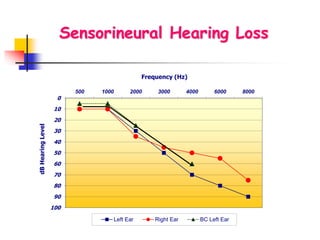
Types of Deafness
destruction of the cochlear or
the auditory nerve
Nerve Deafness
the person becomes
permanently deaf
destruction of tympanum-
ossicular system
Conduction Deafness
sound can still be heard via bone
(ossicular) conduction
Three different sized tuning forks. The
higher pitched forks (such as the 512 Hz fork)
are more appropriate for hearing testing.
Bedside Testing of Hearing
The single most common office
test is a tuning fork test called the
Rinne, named after Adolf Rinne,
who described this test in 1855.
Rinne’s Test
In the Rinne test, a comparison
is made between hearing elicited by
placing the base of a tuning fork
applied to the mastoid area (bone),
and then after the sound is no
longer appreciated, the vibrating top
is placed one inch from the external
ear canal (air).
Rinne’s Test
Normal Hears vibration in air after
bone conduction is over
Conduction deafness
of one ear
Vibration in air is not heard
after bone conduction is over
Partial nerve deaf-
ness of one ear
Vibration in air is heard
after bone conduction is over
Complete nerve deaf-
ness of one ear
Vibration is not heard on the
affected side
Rinne’s Test
In the Weber test, a 512 Hz tuning
fork is placed on the patient's forehead.
If the sound lateralizes (is louder on one
side than the other), the patient may have
either an ipsilateral conductive hearing loss
or a contralateral sensorineural hearing
loss.
Weber’s Test
Normal Hears equally on both
sides
Conduction deafness of
one ear
Sound louder in the
diseased ear
Partial nerve deaf-
ness of one ear
Sound louder in the normal
ear
Complete nerve deaf-
ness of one ear
Sound heard only in the
normal ear
Weber’s Test
Audiometry
Audiometry is the term used to
describe formal measurement of
hearing. The measurement is usually
performed using an "audiometer" by an
"audiologist".
In audiometry, hearing is measured
at frequencies varying from low pitches
(250 Hz) to high pitches (8000 Hz).
Produces pure tones of different
frequencies. Is used to determine the
nature of hearing disabilities.
The audiometer is calibrated so that
zero intensity level of sound at each
frequency is the loudness that can barely
be heard by the normal person (0 db).
Audiometer
Audiometry provides a more precise
measurement of hearing. Air conduction
is tested by having the subject wear
earphones attached to the audiometer.
Audiometry
Audiometry
Pure tones of controlled
intensity are delivered to one ear at
a time. The subject is asked to raise
a hand, press a button, or otherwise
indicate when he/she hears a sound.
An attachment called a bone
oscillator is placed against the bone
behind each ear (mastoid bone) to
test bone conduction.
Audiogram
Frequency
Hearing
level
(dbs)
normal
-10
+10
100
The minimum intensity (volume)
required to hear each tone is graphed,
and the results are called an audiogram.
The hearing level is quantified
relative to "normal" hearing in
decibels (DB), with higher numbers
of DB indicating worse hearing.
Audiometry
The DB score is not really percent
loss, but neverthless 100 dB hearing loss
is nearly equivalent to complete deafness
for that particular frequency.
A score of 0 is normal. It is
possible to have scores less than 0,
which indicate better than average
hearing.
Audiometry
Audiogram for a Patient
with Normal Hearing
When there is a hearing loss,
the next step is to try and
determine whether the loss is caused
by a sensory problem (sensorineural
hearing loss) or a mechanical problem
(conductive hearing loss).
Audiometry
This distinction is made by using
a bone vibrator, which bypasses the
mechanical parts of the middle ear.
If hearing is better using bone
than air, this suggests a conductive
hearing loss.
Audiometry
Audiogram
Conductive Hearing Loss
0
10
20
30
40
50
60
70
80
90
100
500 1000 2000 3000 4000 6000 8000
dBHearingLevel
Frequency (Hz)
Left Ear Right Ear BC Left Ear
0
10
20
30
40
50
60
70
80
90
100
500 1000 2000 3000 4000 6000 8000
dBHearingLevel
Frequency (Hz)
Left Ear Right Ear BC Left Ear
Sensorineural Hearing Loss

Sound practical

  • 1.
  • 2.
    Loud sounds and hearingloss Intense sounds can cause - hair cell death - nerve fiber degeneration
  • 3.
    Hearing testing isa means of evaluating an individual's overall hearing function. What is Hearing Testing?
  • 4.
    Hearing can beimpaired due to lesions in the external ear canal, the middle ear, or the inner ear. The purpose of hearing testing is to evaluate hearing function and, if it is impaired, to attempt to localize the site of lesion.
  • 5.
    • Nerve deafness– impairment of the cochlea or impairment of the auditory nerve • Conduction Deafness – impairment of the physical structures that conduct the sound into the cochlea Types of Deafness
  • 6.
    destruction of thecochlear or the auditory nerve Nerve Deafness the person becomes permanently deaf
  • 7.
    destruction of tympanum- ossicularsystem Conduction Deafness sound can still be heard via bone (ossicular) conduction
  • 8.
    Three different sizedtuning forks. The higher pitched forks (such as the 512 Hz fork) are more appropriate for hearing testing. Bedside Testing of Hearing
  • 9.
    The single mostcommon office test is a tuning fork test called the Rinne, named after Adolf Rinne, who described this test in 1855. Rinne’s Test
  • 10.
    In the Rinnetest, a comparison is made between hearing elicited by placing the base of a tuning fork applied to the mastoid area (bone), and then after the sound is no longer appreciated, the vibrating top is placed one inch from the external ear canal (air). Rinne’s Test
  • 11.
    Normal Hears vibrationin air after bone conduction is over Conduction deafness of one ear Vibration in air is not heard after bone conduction is over Partial nerve deaf- ness of one ear Vibration in air is heard after bone conduction is over Complete nerve deaf- ness of one ear Vibration is not heard on the affected side Rinne’s Test
  • 12.
    In the Webertest, a 512 Hz tuning fork is placed on the patient's forehead. If the sound lateralizes (is louder on one side than the other), the patient may have either an ipsilateral conductive hearing loss or a contralateral sensorineural hearing loss. Weber’s Test
  • 13.
    Normal Hears equallyon both sides Conduction deafness of one ear Sound louder in the diseased ear Partial nerve deaf- ness of one ear Sound louder in the normal ear Complete nerve deaf- ness of one ear Sound heard only in the normal ear Weber’s Test
  • 14.
    Audiometry Audiometry is theterm used to describe formal measurement of hearing. The measurement is usually performed using an "audiometer" by an "audiologist". In audiometry, hearing is measured at frequencies varying from low pitches (250 Hz) to high pitches (8000 Hz).
  • 15.
    Produces pure tonesof different frequencies. Is used to determine the nature of hearing disabilities. The audiometer is calibrated so that zero intensity level of sound at each frequency is the loudness that can barely be heard by the normal person (0 db). Audiometer
  • 16.
    Audiometry provides amore precise measurement of hearing. Air conduction is tested by having the subject wear earphones attached to the audiometer. Audiometry
  • 17.
    Audiometry Pure tones ofcontrolled intensity are delivered to one ear at a time. The subject is asked to raise a hand, press a button, or otherwise indicate when he/she hears a sound. An attachment called a bone oscillator is placed against the bone behind each ear (mastoid bone) to test bone conduction.
  • 18.
    Audiogram Frequency Hearing level (dbs) normal -10 +10 100 The minimum intensity(volume) required to hear each tone is graphed, and the results are called an audiogram.
  • 19.
    The hearing levelis quantified relative to "normal" hearing in decibels (DB), with higher numbers of DB indicating worse hearing. Audiometry
  • 20.
    The DB scoreis not really percent loss, but neverthless 100 dB hearing loss is nearly equivalent to complete deafness for that particular frequency. A score of 0 is normal. It is possible to have scores less than 0, which indicate better than average hearing. Audiometry
  • 21.
    Audiogram for aPatient with Normal Hearing
  • 22.
    When there isa hearing loss, the next step is to try and determine whether the loss is caused by a sensory problem (sensorineural hearing loss) or a mechanical problem (conductive hearing loss). Audiometry
  • 23.
    This distinction ismade by using a bone vibrator, which bypasses the mechanical parts of the middle ear. If hearing is better using bone than air, this suggests a conductive hearing loss. Audiometry
  • 24.
  • 25.
    Conductive Hearing Loss 0 10 20 30 40 50 60 70 80 90 100 5001000 2000 3000 4000 6000 8000 dBHearingLevel Frequency (Hz) Left Ear Right Ear BC Left Ear
  • 26.
    0 10 20 30 40 50 60 70 80 90 100 500 1000 20003000 4000 6000 8000 dBHearingLevel Frequency (Hz) Left Ear Right Ear BC Left Ear Sensorineural Hearing Loss