 Presbycusis, or age-related hearing loss (ARHL),
is the loss of hearing that gradually occurs in most
people as they grow older.
 According to theWorld Health Organization,
approximately one third of people over 65 years of
age are affected by disabling hearing loss.
 In 2025, there will be 1.2 billion people over 60
years of age worldwide, with more than 500 million
individuals who will suffer significant impairment
from presbycusis
Age-related hearing loss according to the International Organization for
Standardization
 ARHL is a progressive, irreversible, and symmetrical
bilateral neuro-sensory hearing loss resulting either
from
• degeneration of the cochlea , or
• loss of auditory nerve fibers during cochlear aging
 associated with difficulty in speech discrimination, as
well as in sound detection and localization, particularly
in noise.
 Males are generally more severely affected than
females
 Untreated presbycusis can contribute to social
isolation, depression, and dementia
Increases with age.
25 – 30% of people aged 65 – 75 are
estimated to have impaired hearing.
 For people aged 75 or older incidence is
thought to be 40 – 50%
Presbycusis is a multifactorial condition
that represents the lifetime accumulation of
both intrinsic and extrinsic insults on the
inner ear, including the inner and outer hair
cells, stria vascularis, and afferent spiral
ganglion neurons
Four primary categories of risk factors for
presbycusis:
1. Cochlear aging,
2. Noise exposure,
3. Genetic predisposition, and
4. Health comorbidities
 Increasing Age
• strong, consistent association
• Increased mutations and deletions in mitochondrial DNA
 Noise
• Reactive oxygen species are believed to play a major role in
cochlear aging, and they are also generated in response to noise
exposure.
 Genetic Predisposition
• Male sex and race
• blacks consistently demonstrate 60% to 70% lower odds of
hearing loss compared with whites
• Presbycusis has been found to cluster strongly in families.
• more pronounced for the strial atrophy pattern of hearing loss (flat
audiogram) than the sensory phenotype (high-frequency loss)
• Proposed genes in recent studies include those that code for
glutathione peroxidase and superoxide dismutase, two
antioxidant enzymes active in the cochlea
 Health Comorbidities
• smoking and circulatory disorders such as hypertension,
cardiovascular and cerebrovascular disease, and diabetes
 Histologic changes associated with aging
occur throughout the auditory system from
the hair cells of the cochlea to the auditory
cortex in temporal lobe of the brain.
Elucidation of pathophysiology of
presbycusis is still incomplete.
 Studied histologic changes in cochlea of
human ears with presbycusis
 Identified 4 sites of aging in cochlea and
divided presbycusis into 4 types based on
these sites
Histologic changes correlated
approximately with symptoms and auditory
test results
 Epithelial atrophy with loss of sensory hair cells
as well as supporting cells in the organ of corti.
 Originates in basal turn of cochlea and slowly
progress towards the apex. Affects first few
millimeters of basal turn.
 Sharp drop in high frequency threshold, begins
after
middle age.
 Abrupt downward slope of audiogram begins
above
speech frequency, speech discrimination is
preserved.
 Histologically atrophy
may be limited to only
the first few millimetres
of basal end of cochlea
 Process is slowly
progressive over time
 Due to accumulation
of lipofuscin pigment
granules at the basal
end of cochlea
 Most common type.
 Atrophy of the spiral ganglion and nerves of
osseous spiral lamina in the basal turn
 Organ of Corti is largely intact
 Schuknecht estimated that 2100/35000
neurons are lost every decade. Loss begins
early in life and may be genetically
predetermined.
 Effects not noticeable until old age because
PTA not affected until 90% of neurons are
gone.
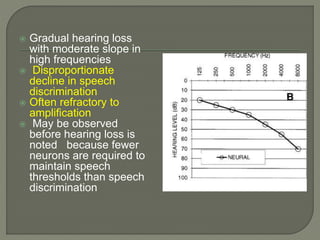
 Gradual hearing loss
with moderate slope in
high frequencies
 Disproportionate
decline in speech
discrimination
 Often refractory to
amplification
 May be observed
before hearing loss is
noted because fewer
neurons are required to
maintain speech
thresholds than speech
discrimination
 Results as atrophy of stria
vascularis.
 Normally maintains the chemical
and bioelectrical balance and
metabolic health of cochlea
 Hearing is represented by a flat
hearing curve because entire
cochlea is affected
 Speech discrimination is
preserved
 Affects younger population (30 –
60 years) with slow progression
and may be familial
 Atrophy of the spiral ligament
 Primarily affects the apical
turn
 Cystic degeneration may
cause detachment of the
organ of Corti from the lateral
cochlear wall
 Bilateral symmetric loss with
upward slope in high
frequencies
 Preserved speech
discrimination
 Change in characteristics of the cochlear duct that
are
not evident on light microscopy but alter function
at
sub microscopic level.
 Changes in intracellular organalles involved in cell
metabolism,decrease in synapse numbers and
changes
in endolymph composition have all been
implicated in
this category.
Some combination of other five.
 Presentation varies
 Physological -Old patient at least in their
fifties.
 H/O :Slow and insidious hearing problem
 Description involves loss of clarity rather than
loss of volume.
 Difficulty in hearing conversation particularly
in presence of background noise.
 Sometimes tinnitus may be the only
presenting
feature.
Otological examination will be normal.
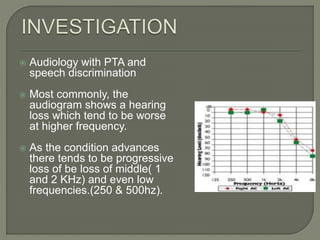
 Audiology with PTA and
speech discrimination
 Most commonly, the
audiogram shows a hearing
loss which tend to be worse
at higher frequency.
 As the condition advances
there tends to be progressive
loss of be loss of middle( 1
and 2 KHz) and even low
frequencies.(250 & 500hz).
 Age >60yrs.
Normal examination finding.
 Symmetrical
High frequency hearing loss.
NON SPECIFIC:
• PSYCHOLOGICAL AND
• PRACTICAL MEASURES.
 SPECIFIC
Binaural hearing aids.
Tinnitus management.
• Tinnnitus retraining therapy
• Cognitive directive counselling.
• Sound therapy
 recent emphasis has been placed on personal
sound amplification products (PSAPs) and low-
cost, community-based hearing interventions for
older adults.
 Aside from amplification, correction of health
factors that may impact age-related hearing
loss—such as smoking, hypertension, and
cholesterol levels—should also be considered.
 Cochlear implantation may play a role in treating
older adults with severe to profound sensorineural
deafness.
Thank You ....

4. Presbycusis.pptx

  • 2.
     Presbycusis, orage-related hearing loss (ARHL), is the loss of hearing that gradually occurs in most people as they grow older.  According to theWorld Health Organization, approximately one third of people over 65 years of age are affected by disabling hearing loss.  In 2025, there will be 1.2 billion people over 60 years of age worldwide, with more than 500 million individuals who will suffer significant impairment from presbycusis
  • 4.
    Age-related hearing lossaccording to the International Organization for Standardization
  • 5.
     ARHL isa progressive, irreversible, and symmetrical bilateral neuro-sensory hearing loss resulting either from • degeneration of the cochlea , or • loss of auditory nerve fibers during cochlear aging  associated with difficulty in speech discrimination, as well as in sound detection and localization, particularly in noise.  Males are generally more severely affected than females  Untreated presbycusis can contribute to social isolation, depression, and dementia
  • 6.
    Increases with age. 25– 30% of people aged 65 – 75 are estimated to have impaired hearing.  For people aged 75 or older incidence is thought to be 40 – 50%
  • 7.
    Presbycusis is amultifactorial condition that represents the lifetime accumulation of both intrinsic and extrinsic insults on the inner ear, including the inner and outer hair cells, stria vascularis, and afferent spiral ganglion neurons
  • 8.
    Four primary categoriesof risk factors for presbycusis: 1. Cochlear aging, 2. Noise exposure, 3. Genetic predisposition, and 4. Health comorbidities
  • 9.
     Increasing Age •strong, consistent association • Increased mutations and deletions in mitochondrial DNA  Noise • Reactive oxygen species are believed to play a major role in cochlear aging, and they are also generated in response to noise exposure.  Genetic Predisposition • Male sex and race • blacks consistently demonstrate 60% to 70% lower odds of hearing loss compared with whites • Presbycusis has been found to cluster strongly in families. • more pronounced for the strial atrophy pattern of hearing loss (flat audiogram) than the sensory phenotype (high-frequency loss) • Proposed genes in recent studies include those that code for glutathione peroxidase and superoxide dismutase, two antioxidant enzymes active in the cochlea  Health Comorbidities • smoking and circulatory disorders such as hypertension, cardiovascular and cerebrovascular disease, and diabetes
  • 10.
     Histologic changesassociated with aging occur throughout the auditory system from the hair cells of the cochlea to the auditory cortex in temporal lobe of the brain. Elucidation of pathophysiology of presbycusis is still incomplete.
  • 11.
     Studied histologicchanges in cochlea of human ears with presbycusis  Identified 4 sites of aging in cochlea and divided presbycusis into 4 types based on these sites Histologic changes correlated approximately with symptoms and auditory test results
  • 12.
     Epithelial atrophywith loss of sensory hair cells as well as supporting cells in the organ of corti.  Originates in basal turn of cochlea and slowly progress towards the apex. Affects first few millimeters of basal turn.  Sharp drop in high frequency threshold, begins after middle age.  Abrupt downward slope of audiogram begins above speech frequency, speech discrimination is preserved.
  • 13.
     Histologically atrophy maybe limited to only the first few millimetres of basal end of cochlea  Process is slowly progressive over time  Due to accumulation of lipofuscin pigment granules at the basal end of cochlea
  • 14.
     Most commontype.  Atrophy of the spiral ganglion and nerves of osseous spiral lamina in the basal turn  Organ of Corti is largely intact  Schuknecht estimated that 2100/35000 neurons are lost every decade. Loss begins early in life and may be genetically predetermined.  Effects not noticeable until old age because PTA not affected until 90% of neurons are gone.
  • 15.
     Gradual hearingloss with moderate slope in high frequencies  Disproportionate decline in speech discrimination  Often refractory to amplification  May be observed before hearing loss is noted because fewer neurons are required to maintain speech thresholds than speech discrimination
  • 16.
     Results asatrophy of stria vascularis.  Normally maintains the chemical and bioelectrical balance and metabolic health of cochlea  Hearing is represented by a flat hearing curve because entire cochlea is affected  Speech discrimination is preserved  Affects younger population (30 – 60 years) with slow progression and may be familial
  • 17.
     Atrophy ofthe spiral ligament  Primarily affects the apical turn  Cystic degeneration may cause detachment of the organ of Corti from the lateral cochlear wall  Bilateral symmetric loss with upward slope in high frequencies  Preserved speech discrimination
  • 18.
     Change incharacteristics of the cochlear duct that are not evident on light microscopy but alter function at sub microscopic level.  Changes in intracellular organalles involved in cell metabolism,decrease in synapse numbers and changes in endolymph composition have all been implicated in this category.
  • 19.
  • 20.
     Presentation varies Physological -Old patient at least in their fifties.  H/O :Slow and insidious hearing problem  Description involves loss of clarity rather than loss of volume.  Difficulty in hearing conversation particularly in presence of background noise.  Sometimes tinnitus may be the only presenting feature.
  • 21.
  • 22.
     Audiology withPTA and speech discrimination  Most commonly, the audiogram shows a hearing loss which tend to be worse at higher frequency.  As the condition advances there tends to be progressive loss of be loss of middle( 1 and 2 KHz) and even low frequencies.(250 & 500hz).
  • 23.
     Age >60yrs. Normalexamination finding.  Symmetrical High frequency hearing loss.
  • 24.
    NON SPECIFIC: • PSYCHOLOGICALAND • PRACTICAL MEASURES.  SPECIFIC
  • 26.
    Binaural hearing aids. Tinnitusmanagement. • Tinnnitus retraining therapy • Cognitive directive counselling. • Sound therapy
  • 27.
     recent emphasishas been placed on personal sound amplification products (PSAPs) and low- cost, community-based hearing interventions for older adults.  Aside from amplification, correction of health factors that may impact age-related hearing loss—such as smoking, hypertension, and cholesterol levels—should also be considered.  Cochlear implantation may play a role in treating older adults with severe to profound sensorineural deafness.
  • 28.