Sound
Daniella Everett
What you need to create a PA-Personal/public
address system:
• Speakers
• cables
• Sound desk
• Sound source
Speakers
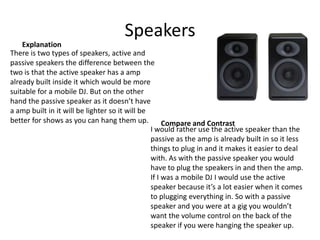
There is two types of speakers, active and
passive speakers the difference between the
two is that the active speaker has a amp
already built inside it which would be more
suitable for a mobile DJ. But on the other
hand the passive speaker as it doesn’t have
a amp built in it will be lighter so it will be
better for shows as you can hang them up.
I would rather use the active speaker than the
passive as the amp is already built in so it less
things to plug in and it makes it easier to deal
with. As with the passive speaker you would
have to plug the speakers in and then the amp.
If I was a mobile DJ I would use the active
speaker because it’s a lot easier when it comes
to plugging everything in. So with a passive
speaker and you were at a gig you wouldn’t
want the volume control on the back of the
speaker if you were hanging the speaker up.
Explanation
Compare and Contrast
Sound desk
• The sound desk is the desk that controls
everything that’s going from just playing a
track to adjusting someone’s microphone. You
have input and output channels. The output
goes to speakers, the input channels have
mono and stereo. The mono is a single sound
and only needs one plug. The stereo is the left
and right. The sound desk has a lot of dials.
There are 24 input channels.
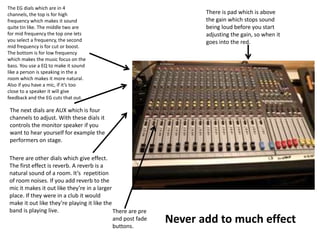
There is pad which is above
the gain which stops sound
being loud before you start
adjusting the gain, so when it
goes into the red.
The EG dials which are in 4
channels, the top is for high
frequency which makes it sound
quite tin like. The middle two are
for mid frequency the top one lets
you select a frequency, the second
mid frequency is for cut or boost.
The bottom is for low frequency
which makes the music focus on the
bass. You use a EQ to make it sound
like a person is speaking in the a
room which makes it more natural.
Also if you have a mic, if it’s too
close to a speaker it will give
feedback and the EG cuts that out.
The next dials are AUX which is four
channels to adjust. With these dials it
controls the monitor speaker if you
want to hear yourself for example the
performers on stage.
There are other dials which give effect.
The first effect is reverb. A reverb is a
natural sound of a room. It’s repetition
of room noises. If you add reverb to the
mic it makes it out like they’re in a larger
place. If they were in a club it would
make it out like they’re playing it like the
band is playing live.
Never add to much effect
There are pre
and post fade
buttons.
Compare and contrast
In a situation of a musical and someone was
singing in a cave you would change the reverb to
add an echo and an eary sound. The sound with
a cathedral as it echo's normally to give that
effect that you’re there you’d add reverb. But if
you were already in a church or cathedral you
wouldn’t need to change the reverb as it’s more
natural as it echo’s itself.
Compare and contrast
A pre fade button is the amount of effect, it is already set and
you can’t change it regardless of how much you fade it.
Post fade is the amount of effect goes along with the fader
itself.
So if you were to have four mics and you need them all to
sound the same effect wise you can still have the volumes
different for example wanting the lead singer in a show to
have the louder microphone. That is in a pre fade situation.
For post fade if you were to have 4 mics again and 2 people
were in a cave you can change them 2 people to have the
effect of the echo and the other two just normal.
Cables
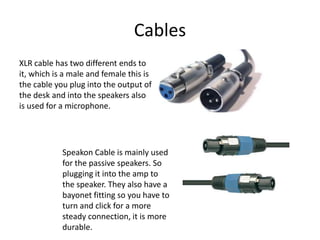
XLR cable has two different ends to
it, which is a male and female this is
the cable you plug into the output of
the desk and into the speakers also
is used for a microphone.
Speakon Cable is mainly used
for the passive speakers. So
plugging it into the amp to
the speaker. They also have a
bayonet fitting so you have to
turn and click for a more
steady connection, it is more
durable.
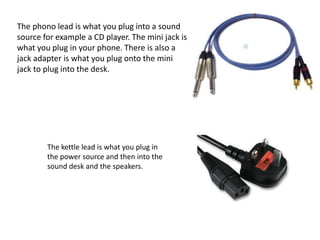
The phono lead is what you plug into a sound
source for example a CD player. The mini jack is
what you plug in your phone. There is also a
jack adapter is what you plug onto the mini
jack to plug into the desk.
The kettle lead is what you plug in
the power source and then into the
sound desk and the speakers.

Sound

  • 1.
  • 2.
    What you needto create a PA-Personal/public address system: • Speakers • cables • Sound desk • Sound source
  • 3.
    Speakers There is twotypes of speakers, active and passive speakers the difference between the two is that the active speaker has a amp already built inside it which would be more suitable for a mobile DJ. But on the other hand the passive speaker as it doesn’t have a amp built in it will be lighter so it will be better for shows as you can hang them up. I would rather use the active speaker than the passive as the amp is already built in so it less things to plug in and it makes it easier to deal with. As with the passive speaker you would have to plug the speakers in and then the amp. If I was a mobile DJ I would use the active speaker because it’s a lot easier when it comes to plugging everything in. So with a passive speaker and you were at a gig you wouldn’t want the volume control on the back of the speaker if you were hanging the speaker up. Explanation Compare and Contrast
  • 4.
    Sound desk • Thesound desk is the desk that controls everything that’s going from just playing a track to adjusting someone’s microphone. You have input and output channels. The output goes to speakers, the input channels have mono and stereo. The mono is a single sound and only needs one plug. The stereo is the left and right. The sound desk has a lot of dials. There are 24 input channels.
  • 5.
    There is padwhich is above the gain which stops sound being loud before you start adjusting the gain, so when it goes into the red. The EG dials which are in 4 channels, the top is for high frequency which makes it sound quite tin like. The middle two are for mid frequency the top one lets you select a frequency, the second mid frequency is for cut or boost. The bottom is for low frequency which makes the music focus on the bass. You use a EQ to make it sound like a person is speaking in the a room which makes it more natural. Also if you have a mic, if it’s too close to a speaker it will give feedback and the EG cuts that out. The next dials are AUX which is four channels to adjust. With these dials it controls the monitor speaker if you want to hear yourself for example the performers on stage. There are other dials which give effect. The first effect is reverb. A reverb is a natural sound of a room. It’s repetition of room noises. If you add reverb to the mic it makes it out like they’re in a larger place. If they were in a club it would make it out like they’re playing it like the band is playing live. Never add to much effect There are pre and post fade buttons.
  • 6.
    Compare and contrast Ina situation of a musical and someone was singing in a cave you would change the reverb to add an echo and an eary sound. The sound with a cathedral as it echo's normally to give that effect that you’re there you’d add reverb. But if you were already in a church or cathedral you wouldn’t need to change the reverb as it’s more natural as it echo’s itself.
  • 7.
    Compare and contrast Apre fade button is the amount of effect, it is already set and you can’t change it regardless of how much you fade it. Post fade is the amount of effect goes along with the fader itself. So if you were to have four mics and you need them all to sound the same effect wise you can still have the volumes different for example wanting the lead singer in a show to have the louder microphone. That is in a pre fade situation. For post fade if you were to have 4 mics again and 2 people were in a cave you can change them 2 people to have the effect of the echo and the other two just normal.
  • 8.
    Cables XLR cable hastwo different ends to it, which is a male and female this is the cable you plug into the output of the desk and into the speakers also is used for a microphone. Speakon Cable is mainly used for the passive speakers. So plugging it into the amp to the speaker. They also have a bayonet fitting so you have to turn and click for a more steady connection, it is more durable.
  • 9.
    The phono leadis what you plug into a sound source for example a CD player. The mini jack is what you plug in your phone. There is also a jack adapter is what you plug onto the mini jack to plug into the desk. The kettle lead is what you plug in the power source and then into the sound desk and the speakers.