Kazim Pardhan
What is a PA system?
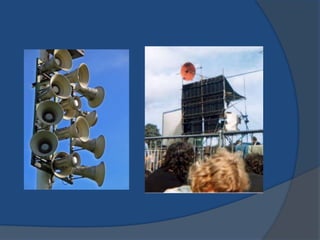
   An electronic amplification system used
    as a communication system in public
    areas

   http://wordnetweb.princeton.edu/perl/webwn?s=pa%20system
How do PA systems work?
   Microphones

   The goal of a PA system is to provide "public address", or
    a way to transmit audio communication to a group. This
    transmission can begin with a microphone, which is a
    device that can assist in magnifying an audio source's
    volume. A microphone is classified as a device that
    transforms sound into an electrical signal. Microphones
    used in PA systems are usually dynamic or condensers.
    Dynamic microphones are more rugged than condensers
    and are able to withstand the elements a little better.
    Condenser microphones utilize their own power source
    and produce better-quality audio signals, but can
    sometimes be so sensitive that they also receive
    background noises.

                                   Paul Bright. How Do PA Systems Work?. Available:
                                   http://www.ehow.com/how-does_4964034_pa-systems-work.html. Last
                                   accessed 04/03/2013.
   Mixers

   If a microphone or another audio source is
    used in a PA system, it is plugged into a mixer.
    The mixer allows for multiple channels of
    sound to be broadcast at different levels. This
    can help prevent feedback if a PA system will
    involve multiple microphones, instruments, or
    other audio sources. For example, someone
    may use a PA system to sing along with a pre-
    recorded CD. The CD track could be plugged
    into one channel, while the singer's voice
    would be broadcast through another.
                              Paul Bright. How Do PA Systems Work?. Available:
                              http://www.ehow.com/how-does_4964034_pa-systems-work.html. Last
                              accessed 04/03/2013.
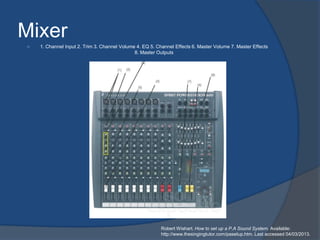
Mixer
   1. Channel Input 2. Trim 3. Channel Volume 4. EQ 5. Channel Effects 6. Master Volume 7. Master Effects
                                              8. Master Outputs


                                                          Robert Wishart. How to set up a P.A Sound System. Available:
                                                          http://www.thesingingtutor.com/pasetup.htm. Last accessed 04/03/2013.
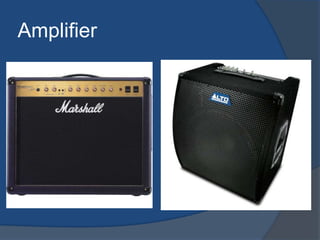
   Amplifier

   The amplifier is usually side by side or
    incorporated with the mixer. The amplifier's job
    is to magnify the audio signal by manipulating
    its varying frequency qualities. Gain in an
    amplifier refers to the decibel level of the
    sound coming out of the speakers. Another
    quality, Output Dynamic Range, refers to the
    loud and soft levels of a specific channel's
    sound. Too low of an output could result in
    just broadcasting noise; too high of an output
    can lead to distortion.
                              Paul Bright. How Do PA Systems Work?. Available:
                              http://www.ehow.com/how-does_4964034_pa-systems-work.html. Last
                              accessed 04/03/2013.
Amplifier
   Loudspeakers

   The loudspeaker is the output end of the PA
    system, transforming the electrical signal back into
    sound that a group can hear. A good loudspeaker
    system will separate the differing sound frequencies
    and broadcast them through different sound
    channels for better quality output. Parts of a
    loudspeaker system include a
    woofer, which broadcasts low frequency sounds; and
    tweeters, the drivers of high frequency output. Some
    speakers also contain crossover systems that are
    responsible for separating these
    frequencies, reducing the electrical noise that can
    sometimes accompany a PA system broadcast.
                                Paul Bright. How Do PA Systems Work?. Available:
                                http://www.ehow.com/how-does_4964034_pa-systems-work.html. Last
                                accessed 04/03/2013.
   The Drivers
   Drivers are the components that produce the sounds. They are
    generally comprised of a coil of wire sitting within a magnetic field. As
    electric current flows through the coil of wire it moves within the
    magnetic field. By attaching a diaphram to the coil, we can make a
    volume of air move at the same time and produce sound waves.
   A single driver can be capable of producing the full range of audible
    sounds. In practice, however, multiple drivers are more common in a
    loudspeaker for efficiency reasons. A two-way system would have a
    low-to-mid range frequency driver and a high-frequency driver too. One
    of the reasons for separating these out is that high frequencies are
    more directional. High frequency drivers are normally mounted along
    with a horn in order to control the direction. If you take a look at the
    specification for a loudspeaker, you should find a Dispersion property.
    This indicates the angle at which the high frequencies leave the
    loudspeaker. Narrower dispersion angles (30° - 60°) are more suited to
    long-throw speaker applications whereas wider angles (90° - 100°) are
    better for short-throw.


                                          Public Address (PA) Basics. Available: http://www.livesystems.co.uk/pa-
                                          basics.html. Last accessed 04/03/2013.
   Crossovers
   When a loudspeaker has more than one driver we need a way to split
    the frequencies so that the low frequencies go to the low frequency
    driver and the high frequencies to the high frequency driver, etc. This is
    done using a Crossover.
   A crossover splits an incoming audio signal into its component
    frequency bands. Most two-way or three-way loudspeakers have an
    inbuilt crossover network that does this job. This is known as a Passive
    Crossover. More advanced systems use an external crossover known
    as an Active Crossover. This works slightly differently as it is inserted
    before the amplifier. In this case, you will require additional amplifier
    channels to run each individual driver. This technique is referred to
    as Bi-Amping. Such systems tend to sound cleaner, more detailed and
    controlled with each driver being run by its own dedicated amplifier
    channel. The down side is the expense as more amplifiers are required
    as well as the active-crossover itself.


                                          Public Address (PA) Basics. Available: http://www.livesystems.co.uk/pa-
                                          basics.html. Last accessed 04/03/2013.
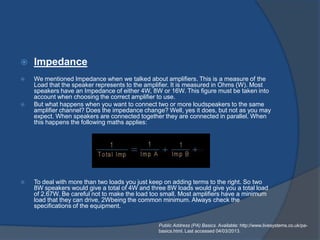
   Impedance
   We mentioned Impedance when we talked about amplifiers. This is a measure of the
    Load that the speaker represents to the amplifier. It is measured in Ohms (W). Most
    speakers have an Impedance of either 4W, 8W or 16W. This figure must be taken into
    account when choosing the correct amplifier to use.
   But what happens when you want to connect two or more loudspeakers to the same
    amplifier channel? Does the impedance change? Well, yes it does, but not as you may
    expect. When speakers are connected together they are connected in parallel. When
    this happens the following maths applies:


   To deal with more than two loads you just keep on adding terms to the right. So two
    8W speakers would give a total of 4W and three 8W loads would give you a total load
    of 2.67W. Be careful not to make the load too small. Most amplifiers have a minimum
    load that they can drive, 2Wbeing the common minimum. Always check the
    specifications of the equipment.


                                                Public Address (PA) Basics. Available: http://www.livesystems.co.uk/pa-
                                                basics.html. Last accessed 04/03/2013.
   Cables & Connections


   Cables, although among the cheapest
    items in a PA, are very important. These
    carry the audio signals between
    components and should therefore be
    chosen carefully in order to minimise
    losses and interference which could
    degrade the resulting sound.
                           Public Address (PA) Basics. Available: http://www.livesystems.co.uk/pa-
                           basics.html. Last accessed 04/03/2013.

Tech2003 systems

  • 1.
  • 2.
    What is aPA system?  An electronic amplification system used as a communication system in public areas  http://wordnetweb.princeton.edu/perl/webwn?s=pa%20system
  • 4.
    How do PAsystems work?  Microphones  The goal of a PA system is to provide "public address", or a way to transmit audio communication to a group. This transmission can begin with a microphone, which is a device that can assist in magnifying an audio source's volume. A microphone is classified as a device that transforms sound into an electrical signal. Microphones used in PA systems are usually dynamic or condensers. Dynamic microphones are more rugged than condensers and are able to withstand the elements a little better. Condenser microphones utilize their own power source and produce better-quality audio signals, but can sometimes be so sensitive that they also receive background noises. Paul Bright. How Do PA Systems Work?. Available: http://www.ehow.com/how-does_4964034_pa-systems-work.html. Last accessed 04/03/2013.
  • 5.
    Mixers  If a microphone or another audio source is used in a PA system, it is plugged into a mixer. The mixer allows for multiple channels of sound to be broadcast at different levels. This can help prevent feedback if a PA system will involve multiple microphones, instruments, or other audio sources. For example, someone may use a PA system to sing along with a pre- recorded CD. The CD track could be plugged into one channel, while the singer's voice would be broadcast through another. Paul Bright. How Do PA Systems Work?. Available: http://www.ehow.com/how-does_4964034_pa-systems-work.html. Last accessed 04/03/2013.
  • 6.
    Mixer  1. Channel Input 2. Trim 3. Channel Volume 4. EQ 5. Channel Effects 6. Master Volume 7. Master Effects 8. Master Outputs Robert Wishart. How to set up a P.A Sound System. Available: http://www.thesingingtutor.com/pasetup.htm. Last accessed 04/03/2013.
  • 7.
    Amplifier  The amplifier is usually side by side or incorporated with the mixer. The amplifier's job is to magnify the audio signal by manipulating its varying frequency qualities. Gain in an amplifier refers to the decibel level of the sound coming out of the speakers. Another quality, Output Dynamic Range, refers to the loud and soft levels of a specific channel's sound. Too low of an output could result in just broadcasting noise; too high of an output can lead to distortion. Paul Bright. How Do PA Systems Work?. Available: http://www.ehow.com/how-does_4964034_pa-systems-work.html. Last accessed 04/03/2013.
  • 8.
  • 9.
    Loudspeakers  The loudspeaker is the output end of the PA system, transforming the electrical signal back into sound that a group can hear. A good loudspeaker system will separate the differing sound frequencies and broadcast them through different sound channels for better quality output. Parts of a loudspeaker system include a woofer, which broadcasts low frequency sounds; and tweeters, the drivers of high frequency output. Some speakers also contain crossover systems that are responsible for separating these frequencies, reducing the electrical noise that can sometimes accompany a PA system broadcast. Paul Bright. How Do PA Systems Work?. Available: http://www.ehow.com/how-does_4964034_pa-systems-work.html. Last accessed 04/03/2013.
  • 10.
    The Drivers  Drivers are the components that produce the sounds. They are generally comprised of a coil of wire sitting within a magnetic field. As electric current flows through the coil of wire it moves within the magnetic field. By attaching a diaphram to the coil, we can make a volume of air move at the same time and produce sound waves.  A single driver can be capable of producing the full range of audible sounds. In practice, however, multiple drivers are more common in a loudspeaker for efficiency reasons. A two-way system would have a low-to-mid range frequency driver and a high-frequency driver too. One of the reasons for separating these out is that high frequencies are more directional. High frequency drivers are normally mounted along with a horn in order to control the direction. If you take a look at the specification for a loudspeaker, you should find a Dispersion property. This indicates the angle at which the high frequencies leave the loudspeaker. Narrower dispersion angles (30° - 60°) are more suited to long-throw speaker applications whereas wider angles (90° - 100°) are better for short-throw. Public Address (PA) Basics. Available: http://www.livesystems.co.uk/pa- basics.html. Last accessed 04/03/2013.
  • 11.
    Crossovers  When a loudspeaker has more than one driver we need a way to split the frequencies so that the low frequencies go to the low frequency driver and the high frequencies to the high frequency driver, etc. This is done using a Crossover.  A crossover splits an incoming audio signal into its component frequency bands. Most two-way or three-way loudspeakers have an inbuilt crossover network that does this job. This is known as a Passive Crossover. More advanced systems use an external crossover known as an Active Crossover. This works slightly differently as it is inserted before the amplifier. In this case, you will require additional amplifier channels to run each individual driver. This technique is referred to as Bi-Amping. Such systems tend to sound cleaner, more detailed and controlled with each driver being run by its own dedicated amplifier channel. The down side is the expense as more amplifiers are required as well as the active-crossover itself. Public Address (PA) Basics. Available: http://www.livesystems.co.uk/pa- basics.html. Last accessed 04/03/2013.
  • 12.
    Impedance  We mentioned Impedance when we talked about amplifiers. This is a measure of the Load that the speaker represents to the amplifier. It is measured in Ohms (W). Most speakers have an Impedance of either 4W, 8W or 16W. This figure must be taken into account when choosing the correct amplifier to use.  But what happens when you want to connect two or more loudspeakers to the same amplifier channel? Does the impedance change? Well, yes it does, but not as you may expect. When speakers are connected together they are connected in parallel. When this happens the following maths applies:  To deal with more than two loads you just keep on adding terms to the right. So two 8W speakers would give a total of 4W and three 8W loads would give you a total load of 2.67W. Be careful not to make the load too small. Most amplifiers have a minimum load that they can drive, 2Wbeing the common minimum. Always check the specifications of the equipment. Public Address (PA) Basics. Available: http://www.livesystems.co.uk/pa- basics.html. Last accessed 04/03/2013.
  • 13.
    Cables & Connections  Cables, although among the cheapest items in a PA, are very important. These carry the audio signals between components and should therefore be chosen carefully in order to minimise losses and interference which could degrade the resulting sound. Public Address (PA) Basics. Available: http://www.livesystems.co.uk/pa- basics.html. Last accessed 04/03/2013.