JAI HIND
Virendra Kumar Maurya
Assistant Professor
CAEHS COLLEGE, MEERUT
SOUND OF PHYSICS
Index
• Sound
• Nature and propagation of sound wave
• Characteristics of sound
• Speed of sound in a material medium
• Intensity of sound
• The decibel
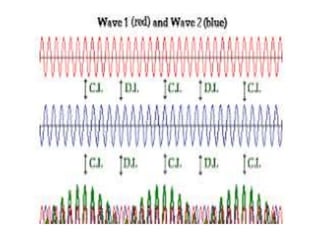
• Interference of sound waves
• Beats
• Diffractions
• Wave theory
• Doppler ,s effect
sound
• Sound is a form of energy that can be heard
and travels in waves.
• When matter vibrates or moves back and forth
very quickly, a sound is made.
• Sound waves can travel through solids, liquids,
or gases.
• Example: When a school bell rings, parts
of the bell will vibrate creating sound.
Sound in human
• We use our vocal cords to make
sounds in our throat.
• When we speak, our vocal cords
vibrate.
• Place your hand on your throat
when you talk, and you can feel
the vocal cords vibrate.
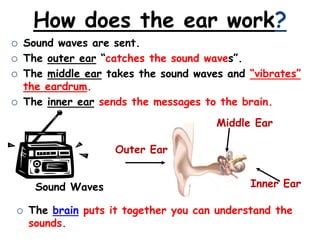
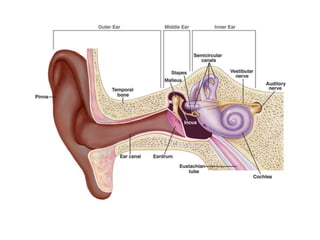
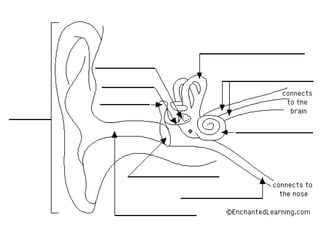
How does the ear work?
Sound Waves
 Sound waves are sent.
 The outer ear “catches the sound waves”.
 The middle ear takes the sound waves and “vibrates”
the eardrum.
 The inner ear sends the messages to the brain.
Middle Ear
Inner Ear
 The brain puts it together you can understand the
sounds.
Outer Ear
Nature and propagation of sound wave
• Sound is a sequence of waves of pressure
which propagates through compressible
media such as air or water. (Sound can
propagate through solids as well, but there are
additional modes of propagation). During
their propagation, waves can be reflected,
refracted, or attentuated by the medium.
• The purpose of this experiment is to examine what effect
the characteristics of the medium have on sound. All media
have three properties which affect the behavior of sound
propagation:
 A relationship between density and pressure. This
relationship, affected by temperature, determines the
speed of sound within the medium.
 The motion of the medium itself, e.g., wind. Independent of
the motion of sound through the medium, if the medium is
moving, the sound is further transported.
 The viscosity of the medium. This determines the rate at
which sound is attenuated. For many media, such as air or
water, attenuation due to viscosity is negligible.
Characteristics of sound waves
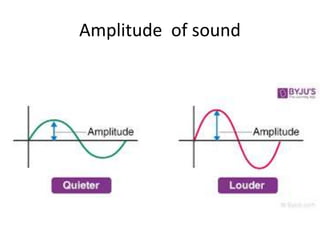
 Amplitude - The strength or level of sound pressure is
called amplitude.
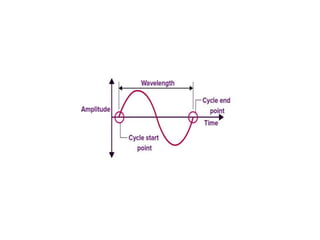
 Wavelength - The physical gap between two consecutive
maxima of an acoustic source is called the wavelength
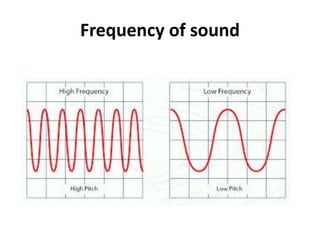
 Frequency - The number of periodicals compressing and
rarefaction cycles that occur a single second when the
beam is transmitted across the medium is called frequency.
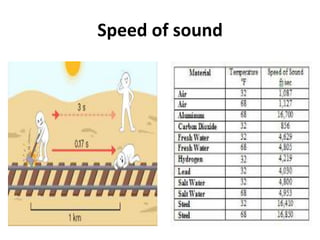
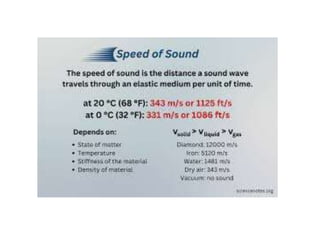
 Speed - The rate during which waves move through a
medium is called sound speed.
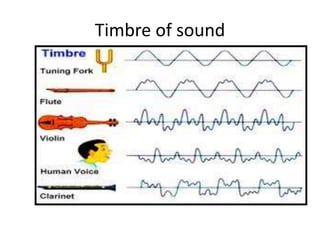
 Timbre - The quality that allows sounds of identical
frequency to be distinguished is called timbre.(Timbre, also
known as tone color or tone quality)
Amplitude of sound
Frequency of sound
Speed of sound
Timbre of sound
Speed of sound
Intensity of sound
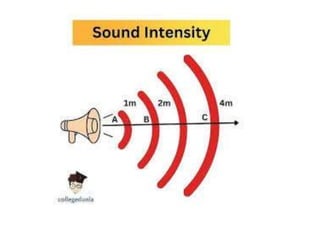
• Sound intensity, also known as acoustic
intensity, is defined as the power carried by
sound waves per unit area in a direction
perpendicular to that area. The SI unit of
intensity, which includes sound intensity, is
the watt per square meter (W/m2).
Decibel
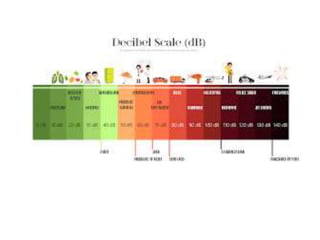
Decibel is the unit of sound. Its symbol is 'dB'. We can
define decibel as.
Named after the inventor Alexander Graham Bell,
a decibel (dBA) is the unit used to express the intensity
of sound.
It is normally measured using the “A” scale, which
approximates the human ear’s response to a wide
range of frequencies.
A decibel is a logarithmic value to the base 10.
Readings are given as dB(A) or dBA. Therefore, if the
decibel value is increased by 10, the noise exposure
has doubled.
A normal conversation takes place at about 60
decibels.
A woodshop noise level is about 100 decibels,
and a chainsaw noise measures about 110
decibels.
 Prolonged exposure to noise above 85
decibels can cause hearing loss.
difference between decibels and hertz
• Decibels (dB) and hertz (Hz) are both units of measurement for
sound, but they measure different aspects of sound:
• Decibels
• Measure the loudness or intensity of sound. The more decibels a
sound has, the louder it is. The decibel scale is logarithmic and uses
the human hearing threshold of 20 µPa as a reference level.
• Hertz
• Measure the frequency of sound, or the number of vibrations per
second. A higher frequency corresponds to a higher-pitched
sound. Hertz are also used to measure the frequency of
electromagnetic radiation, such as the 60 hertz frequency of the US
household electrical supply. Hertz are also commonly used to
describe periodic waveforms and musical tones, as well as the clock
speeds of computers and other electronics.
2ND CLASS
Interference of sound waves
When two or more sound waves from
different sources are present at the same
time, they interact with each other to produce
a new wave.
The new wave is the sum of all the different
waves. Wave interaction is called interference.
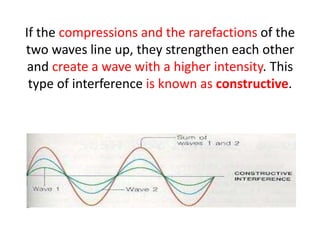
If the compressions and the rarefactions of the
two waves line up, they strengthen each other
and create a wave with a higher intensity. This
type of interference is known as constructive.
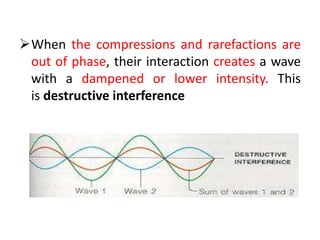
When the compressions and rarefactions are
out of phase, their interaction creates a wave
with a dampened or lower intensity. This
is destructive interference
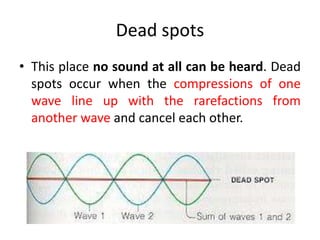
Dead spots
• This place no sound at all can be heard. Dead
spots occur when the compressions of one
wave line up with the rarefactions from
another wave and cancel each other.
Beats
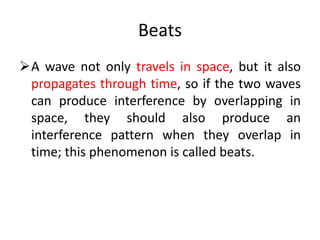
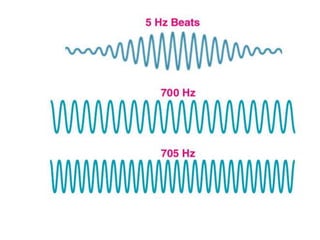
A wave not only travels in space, but it also
propagates through time, so if the two waves
can produce interference by overlapping in
space, they should also produce an
interference pattern when they overlap in
time; this phenomenon is called beats.
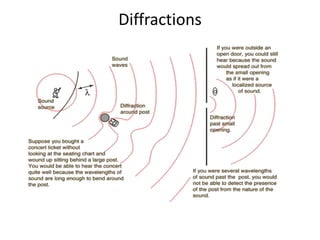
Diffraction
• the bending of waves around small* obstacles
and the spreading out of waves beyond small*
openings.
• the spreading of waves around obstacles.
Diffraction takes place with sound; with
electromagnetic radiation, such as light, X-
rays, and gamma rays; and with very small
moving particles such as atoms, neutrons, and
electrons, which show wavelike properties.
Diffractions
WAVE THEORY
• In the late 17th century, scientists were embroiled in a
debate about the fundamental nature of light –
whether it was a wave or a particle.
• Sir Isaac Newton strongly advocated the particle nature
of light.
• But, the Dutch physicist Christiaan Huygens believed
that light was made up of waves vibrating up and down
perpendicular to the direction of the wave propagation
and therefore formulated a way of visualizing wave
propagation.
• This became known as ‘Huygens’ Principle‘.
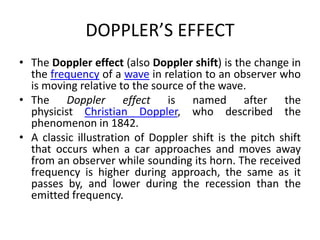
• The wave theory of light proposed by Christian
Huygens has stood the test of time, and today,
it is considered the backbones of optics. Here,
in the article, let us discuss the wave theory of
light in detail.
• Historical Context
• Christiaan Huygens: Proposed the wave theory of
light in the 17th century, suggesting that light
behaves as a wave.
• Thomas Young: Demonstrated the wave nature
of light through his double-slit experiment in the
early 19th century.
• Augustin-Jean Fresnel: Developed a
mathematical basis for wave optics, explaining
diffraction and interference.
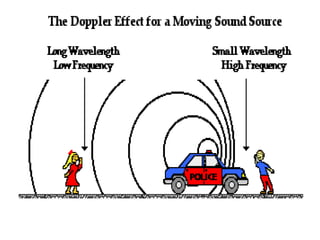
DOPPLER’S EFFECT
• The Doppler effect (also Doppler shift) is the change in
the frequency of a wave in relation to an observer who
is moving relative to the source of the wave.
• The Doppler effect is named after the
physicist Christian Doppler, who described the
phenomenon in 1842.
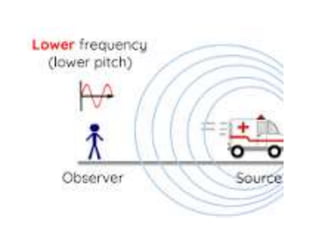
• A classic illustration of Doppler shift is the pitch shift
that occurs when a car approaches and moves away
from an observer while sounding its horn. The received
frequency is higher during approach, the same as it
passes by, and lower during the recession than the
emitted frequency.
References
1. Wcpss.net. 2024 [cited 2024
Jul15].Availablefrom:https://www.wcpss.net/cms/lib/NC01911451/Centricity/Domain/3868/Sound%20waves.ppt
2. https://www.nidcd.nih.gov/news/multimedia/medical-illustration-parts-ear
3. The Propagation of sound [Internet]. pages.jh.edu. Available from:
https://pages.jh.edu/virtlab/ray/acoustic.htm#:~:text=The%20Propagation%20of%20sound&text=Sound%20is%
20a%20sequence%20of
4. What are the characteristics of sound waves? [Internet]. byjus.com. [cited 2024 Jul 16]. Available from:
https://byjus.com/question-answer/what-are-the-characteristics-of-sound-waves/
5. https://www.quora.com/How-does-amplitude-affect-the-loudness-of-a-sound
6. https://www.quora.com/What-makes-the-timbre-of-one-instrument-sound-different-from-another
7. https://en.wikipedia.org/wiki/Decibel
8. https://www.sciencedirect.com/topics/engineering/decibel#:~:text=Named%20after%20the%20inventor%20Al
exander,value%20to%20the%20base%2010.
9. https://www.ndeed.org/Physics/Sound/interference.xhtml#:~:text=When%20two%20or%20more%20sound,Wa
ve%20interaction%20is%20called%20interference.
10. https://www.nde-ed.org/Physics/Sound/acousticimpedance.xhtml
11. GOOGLE
12. SLIDESHARE
13. https://en.wikipedia.org/wiki/Doppler_effect
14. https://www.google.com/search?q=example+of+doppler+effect&rlz=1C1CHBD
•

sound 2 Sem basic physics INCLUDING RADIOLOGICAL PHYSICS

  • 1.
    JAI HIND Virendra KumarMaurya Assistant Professor CAEHS COLLEGE, MEERUT SOUND OF PHYSICS
  • 2.
    Index • Sound • Natureand propagation of sound wave • Characteristics of sound • Speed of sound in a material medium • Intensity of sound • The decibel • Interference of sound waves • Beats • Diffractions • Wave theory • Doppler ,s effect
  • 3.
    sound • Sound isa form of energy that can be heard and travels in waves. • When matter vibrates or moves back and forth very quickly, a sound is made. • Sound waves can travel through solids, liquids, or gases. • Example: When a school bell rings, parts of the bell will vibrate creating sound.
  • 4.
    Sound in human •We use our vocal cords to make sounds in our throat. • When we speak, our vocal cords vibrate. • Place your hand on your throat when you talk, and you can feel the vocal cords vibrate.
  • 5.
    How does theear work? Sound Waves  Sound waves are sent.  The outer ear “catches the sound waves”.  The middle ear takes the sound waves and “vibrates” the eardrum.  The inner ear sends the messages to the brain. Middle Ear Inner Ear  The brain puts it together you can understand the sounds. Outer Ear
  • 8.
    Nature and propagationof sound wave • Sound is a sequence of waves of pressure which propagates through compressible media such as air or water. (Sound can propagate through solids as well, but there are additional modes of propagation). During their propagation, waves can be reflected, refracted, or attentuated by the medium.
  • 9.
    • The purposeof this experiment is to examine what effect the characteristics of the medium have on sound. All media have three properties which affect the behavior of sound propagation:  A relationship between density and pressure. This relationship, affected by temperature, determines the speed of sound within the medium.  The motion of the medium itself, e.g., wind. Independent of the motion of sound through the medium, if the medium is moving, the sound is further transported.  The viscosity of the medium. This determines the rate at which sound is attenuated. For many media, such as air or water, attenuation due to viscosity is negligible.
  • 10.
    Characteristics of soundwaves  Amplitude - The strength or level of sound pressure is called amplitude.  Wavelength - The physical gap between two consecutive maxima of an acoustic source is called the wavelength  Frequency - The number of periodicals compressing and rarefaction cycles that occur a single second when the beam is transmitted across the medium is called frequency.  Speed - The rate during which waves move through a medium is called sound speed.  Timbre - The quality that allows sounds of identical frequency to be distinguished is called timbre.(Timbre, also known as tone color or tone quality)
  • 11.
  • 13.
  • 14.
  • 16.
  • 17.
  • 18.
    Intensity of sound •Sound intensity, also known as acoustic intensity, is defined as the power carried by sound waves per unit area in a direction perpendicular to that area. The SI unit of intensity, which includes sound intensity, is the watt per square meter (W/m2).
  • 20.
    Decibel Decibel is theunit of sound. Its symbol is 'dB'. We can define decibel as. Named after the inventor Alexander Graham Bell, a decibel (dBA) is the unit used to express the intensity of sound. It is normally measured using the “A” scale, which approximates the human ear’s response to a wide range of frequencies. A decibel is a logarithmic value to the base 10. Readings are given as dB(A) or dBA. Therefore, if the decibel value is increased by 10, the noise exposure has doubled.
  • 21.
    A normal conversationtakes place at about 60 decibels. A woodshop noise level is about 100 decibels, and a chainsaw noise measures about 110 decibels.  Prolonged exposure to noise above 85 decibels can cause hearing loss.
  • 23.
    difference between decibelsand hertz • Decibels (dB) and hertz (Hz) are both units of measurement for sound, but they measure different aspects of sound: • Decibels • Measure the loudness or intensity of sound. The more decibels a sound has, the louder it is. The decibel scale is logarithmic and uses the human hearing threshold of 20 µPa as a reference level. • Hertz • Measure the frequency of sound, or the number of vibrations per second. A higher frequency corresponds to a higher-pitched sound. Hertz are also used to measure the frequency of electromagnetic radiation, such as the 60 hertz frequency of the US household electrical supply. Hertz are also commonly used to describe periodic waveforms and musical tones, as well as the clock speeds of computers and other electronics.
  • 24.
  • 25.
    Interference of soundwaves When two or more sound waves from different sources are present at the same time, they interact with each other to produce a new wave. The new wave is the sum of all the different waves. Wave interaction is called interference.
  • 26.
    If the compressionsand the rarefactions of the two waves line up, they strengthen each other and create a wave with a higher intensity. This type of interference is known as constructive.
  • 27.
    When the compressionsand rarefactions are out of phase, their interaction creates a wave with a dampened or lower intensity. This is destructive interference
  • 28.
    Dead spots • Thisplace no sound at all can be heard. Dead spots occur when the compressions of one wave line up with the rarefactions from another wave and cancel each other.
  • 29.
    Beats A wave notonly travels in space, but it also propagates through time, so if the two waves can produce interference by overlapping in space, they should also produce an interference pattern when they overlap in time; this phenomenon is called beats.
  • 32.
    Diffraction • the bendingof waves around small* obstacles and the spreading out of waves beyond small* openings. • the spreading of waves around obstacles. Diffraction takes place with sound; with electromagnetic radiation, such as light, X- rays, and gamma rays; and with very small moving particles such as atoms, neutrons, and electrons, which show wavelike properties.
  • 33.
  • 34.
    WAVE THEORY • Inthe late 17th century, scientists were embroiled in a debate about the fundamental nature of light – whether it was a wave or a particle. • Sir Isaac Newton strongly advocated the particle nature of light. • But, the Dutch physicist Christiaan Huygens believed that light was made up of waves vibrating up and down perpendicular to the direction of the wave propagation and therefore formulated a way of visualizing wave propagation. • This became known as ‘Huygens’ Principle‘.
  • 35.
    • The wavetheory of light proposed by Christian Huygens has stood the test of time, and today, it is considered the backbones of optics. Here, in the article, let us discuss the wave theory of light in detail.
  • 36.
    • Historical Context •Christiaan Huygens: Proposed the wave theory of light in the 17th century, suggesting that light behaves as a wave. • Thomas Young: Demonstrated the wave nature of light through his double-slit experiment in the early 19th century. • Augustin-Jean Fresnel: Developed a mathematical basis for wave optics, explaining diffraction and interference.
  • 37.
    DOPPLER’S EFFECT • TheDoppler effect (also Doppler shift) is the change in the frequency of a wave in relation to an observer who is moving relative to the source of the wave. • The Doppler effect is named after the physicist Christian Doppler, who described the phenomenon in 1842. • A classic illustration of Doppler shift is the pitch shift that occurs when a car approaches and moves away from an observer while sounding its horn. The received frequency is higher during approach, the same as it passes by, and lower during the recession than the emitted frequency.
  • 41.
    References 1. Wcpss.net. 2024[cited 2024 Jul15].Availablefrom:https://www.wcpss.net/cms/lib/NC01911451/Centricity/Domain/3868/Sound%20waves.ppt 2. https://www.nidcd.nih.gov/news/multimedia/medical-illustration-parts-ear 3. The Propagation of sound [Internet]. pages.jh.edu. Available from: https://pages.jh.edu/virtlab/ray/acoustic.htm#:~:text=The%20Propagation%20of%20sound&text=Sound%20is% 20a%20sequence%20of 4. What are the characteristics of sound waves? [Internet]. byjus.com. [cited 2024 Jul 16]. Available from: https://byjus.com/question-answer/what-are-the-characteristics-of-sound-waves/ 5. https://www.quora.com/How-does-amplitude-affect-the-loudness-of-a-sound 6. https://www.quora.com/What-makes-the-timbre-of-one-instrument-sound-different-from-another 7. https://en.wikipedia.org/wiki/Decibel 8. https://www.sciencedirect.com/topics/engineering/decibel#:~:text=Named%20after%20the%20inventor%20Al exander,value%20to%20the%20base%2010. 9. https://www.ndeed.org/Physics/Sound/interference.xhtml#:~:text=When%20two%20or%20more%20sound,Wa ve%20interaction%20is%20called%20interference. 10. https://www.nde-ed.org/Physics/Sound/acousticimpedance.xhtml 11. GOOGLE 12. SLIDESHARE 13. https://en.wikipedia.org/wiki/Doppler_effect 14. https://www.google.com/search?q=example+of+doppler+effect&rlz=1C1CHBD •