
SEM For Startups
Soso Sazesh
^
Who Am I?
• Founder of Growth Pilots
• Helped 50+ companies with paid acquisition
What is SEM?
Paying for search engine traffic in hopes that you
make more in revenue than you spend…
• Can be very profitable and scalable
• Can also be very unprofitable and not at all
scalable
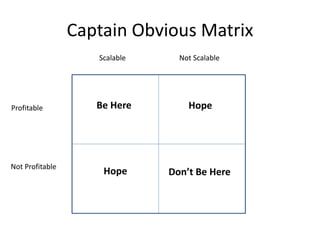
Captain Obvious Matrix
Profitable
Not Profitable
Scalable Not Scalable
Be Here Hope
Hope Don’t Be Here
SEM 101
• Customer intent shown by keyword search
– “best online payroll software”
• You choose how much you are willing to pay
to get traffic from each keyword
• Finite amount of search volume for a given
keyword
• The goal is finding as many keywords as
possible that are profitable
SEM Variables That Matter
Three variables:
• Cost to acquire a customer (CPA or CAC)
• Lifetime revenue generated by a customer
(LTV)
• Market size (Volume)
• LTV > CPA with Volume is what matters
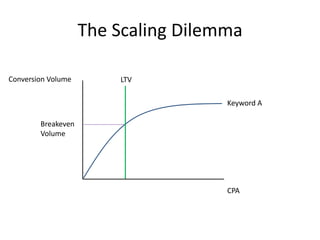
The Scaling Dilemma
CPA
Conversion Volume
Keyword A
LTV
Breakeven
Volume
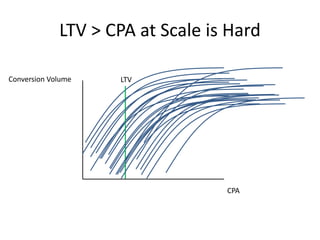
LTV > CPA at Scale is Hard
LTV
v
Conversion Volume
CPA
Challenges for Startups
• Unproven LTVs
• Niche/emerging markets with low search
volume
• Lack the time and expertise to do it right
• Competing against irrational advertisers
The Ingredients of SEM
• Things you can’t control
– Your market size
– Your competition
– Your LTV
• Things you can control and optimize
– Keyword selection
– CPA (bids)
– Ad copy
– Landing pages
Keyword Selection
• Two approaches depending on your goals
– Start broad and narrow down
– Start narrow and expand gradually
• Use a combination of intuition and Google
Keyword Planner to generate relevant
keywords
Keyword Match Types
• Broad: payroll services
• Broad modified: +payroll +services
• Phrase: “payroll services”
• Exact: [payroll services]
Negative Keywords
• Negatives prevent unwanted clicks
• Very underutilized but very important
• If you sell children’s toys you probably don’t
want to appear next to people looking for sex
toys
Search Term Report
• Tells you what people are actually searching
for
• Usually lots of surprises in here
• Critical resource for keyword expansion and
exclusion
Quality Score
• Each keyword is given a 1-10 score based on
– The relevancy of the ad triggered by the keyword
– The expected clickthrough rate of the ad triggered
by the keyword
– The landing page experience of the ad triggered
by the keyword
• Quality Score affects ad position and amount
you pay per click
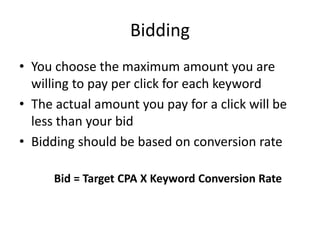
Bidding
• You choose the maximum amount you are
willing to pay per click for each keyword
• The actual amount you pay for a click will be
less than your bid
• Bidding should be based on conversion rate
Bid = Target CPA X Keyword Conversion Rate
The AdWords Auction
• Ad position
– Position is determined by your bid and your
quality score
• Cost Per Click
– Cost per click is determined by the bid and quality
score of your next best competitor
Ad Optimization
• One of the most under-rated aspects of SEM
• Ad copy should match the keyword it’s paired
with
• Know the limits of testing (diminishing
returns)
Landing Page Optimization
• Landing page optimization can have a
dramatic effect on conversion rate and quality
score
• Diminishing returns apply here as well
Takeaways
• 4 main things to focus on
– Keyword Optimization
– Bid Optimization
– Ad Optimization
– Landing Page Optimization
Tracking
• If you don’t have the proper tracking in place,
you will not be able to measure LTV or CPA
• Recommended Tools
– AdWords conversion tracking for keyword-level
tracking
– KISSmetrics or Mixpanel for customer-level
tracking
Put A Plan Together
• Get tracking in place
• Determine budget and CPA goals
• Keyword research
• Map out account structure
• Build campaigns and write initial ads
• Optimize the big 4 frequently and intelligently
Questions?
Soso Sazesh
soso@growthpilots.com

Soso--SEM

  • 1.
  • 2.
    Who Am I? •Founder of Growth Pilots • Helped 50+ companies with paid acquisition
  • 3.
    What is SEM? Payingfor search engine traffic in hopes that you make more in revenue than you spend… • Can be very profitable and scalable • Can also be very unprofitable and not at all scalable
  • 4.
    Captain Obvious Matrix Profitable NotProfitable Scalable Not Scalable Be Here Hope Hope Don’t Be Here
  • 5.
    SEM 101 • Customerintent shown by keyword search – “best online payroll software” • You choose how much you are willing to pay to get traffic from each keyword • Finite amount of search volume for a given keyword • The goal is finding as many keywords as possible that are profitable
  • 6.
    SEM Variables ThatMatter Three variables: • Cost to acquire a customer (CPA or CAC) • Lifetime revenue generated by a customer (LTV) • Market size (Volume) • LTV > CPA with Volume is what matters
  • 7.
    The Scaling Dilemma CPA ConversionVolume Keyword A LTV Breakeven Volume
  • 8.
    LTV > CPAat Scale is Hard LTV v Conversion Volume CPA
  • 9.
    Challenges for Startups •Unproven LTVs • Niche/emerging markets with low search volume • Lack the time and expertise to do it right • Competing against irrational advertisers
  • 10.
    The Ingredients ofSEM • Things you can’t control – Your market size – Your competition – Your LTV • Things you can control and optimize – Keyword selection – CPA (bids) – Ad copy – Landing pages
  • 11.
    Keyword Selection • Twoapproaches depending on your goals – Start broad and narrow down – Start narrow and expand gradually • Use a combination of intuition and Google Keyword Planner to generate relevant keywords
  • 12.
    Keyword Match Types •Broad: payroll services • Broad modified: +payroll +services • Phrase: “payroll services” • Exact: [payroll services]
  • 13.
    Negative Keywords • Negativesprevent unwanted clicks • Very underutilized but very important • If you sell children’s toys you probably don’t want to appear next to people looking for sex toys
  • 14.
    Search Term Report •Tells you what people are actually searching for • Usually lots of surprises in here • Critical resource for keyword expansion and exclusion
  • 15.
    Quality Score • Eachkeyword is given a 1-10 score based on – The relevancy of the ad triggered by the keyword – The expected clickthrough rate of the ad triggered by the keyword – The landing page experience of the ad triggered by the keyword • Quality Score affects ad position and amount you pay per click
  • 16.
    Bidding • You choosethe maximum amount you are willing to pay per click for each keyword • The actual amount you pay for a click will be less than your bid • Bidding should be based on conversion rate Bid = Target CPA X Keyword Conversion Rate
  • 17.
    The AdWords Auction •Ad position – Position is determined by your bid and your quality score • Cost Per Click – Cost per click is determined by the bid and quality score of your next best competitor
  • 18.
    Ad Optimization • Oneof the most under-rated aspects of SEM • Ad copy should match the keyword it’s paired with • Know the limits of testing (diminishing returns)
  • 19.
    Landing Page Optimization •Landing page optimization can have a dramatic effect on conversion rate and quality score • Diminishing returns apply here as well
  • 20.
    Takeaways • 4 mainthings to focus on – Keyword Optimization – Bid Optimization – Ad Optimization – Landing Page Optimization
  • 21.
    Tracking • If youdon’t have the proper tracking in place, you will not be able to measure LTV or CPA • Recommended Tools – AdWords conversion tracking for keyword-level tracking – KISSmetrics or Mixpanel for customer-level tracking
  • 22.
    Put A PlanTogether • Get tracking in place • Determine budget and CPA goals • Keyword research • Map out account structure • Build campaigns and write initial ads • Optimize the big 4 frequently and intelligently
  • 23.

Editor's Notes