SEO for
small business websites
Sandra Wendland
6th Feb 2018
1
Questions
• Do you maintain your own business website?
• Do you outsource technical website tasks?
• Do you write your own web content?
2
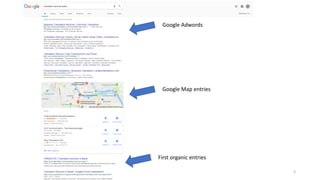
First organic entries
Google Map entries
Google Adwords
3
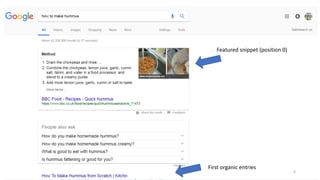
Featured snippet (position 0)
First organic entries
4
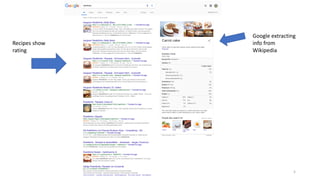
Google extracting
info from
Wikipedia
Recipes show
rating
5
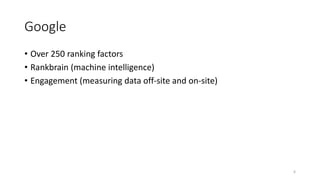
Google
• Over 250 ranking factors
• Rankbrain (machine intelligence)
• Engagement (measuring data off-site and on-site)
6
• SEO is dead
• SEO is evolving
7
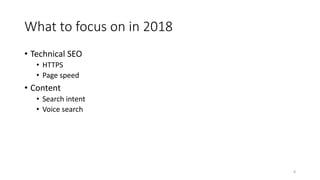
What to focus on in 2018
• Technical SEO
• HTTPS
• Page speed
• Content
• Search intent
• Voice search
8
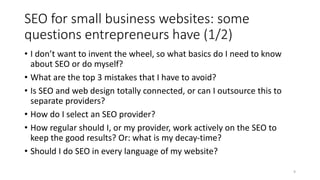
SEO for small business websites: some
questions entrepreneurs have (1/2)
• I don’t want to invent the wheel, so what basics do I need to know
about SEO or do myself?
• What are the top 3 mistakes that I have to avoid?
• Is SEO and web design totally connected, or can I outsource this to
separate providers?
• How do I select an SEO provider?
• How regular should I, or my provider, work actively on the SEO to
keep the good results? Or: what is my decay-time?
• Should I do SEO in every language of my website?
9
SEO for small business websites: some
questions entrepreneurs have (2/2)
• Is SEO scalable? Meaning: if I have set up my SEO properly, that with every
added search word, I have proportionally more results? Or do I have
diminishing returns, every time I add a search word, or content
improvement? Where do I reach the optimum in money and effect?
• How do I measure success with SEO? Proof that it works!
• What are the content activities I should do that help with better SEO
results? Like: weekly blog publication, news items, reposting other people’s
content… etc?
• Wie kann man sicherstellen, dass man als Firma von den Zielkunden
gefunden wird (und nicht von den «Falschen»)?
• Kann man Adwords durch gutes SEO ersetzen? Wie macht man das am
effizientesten?
• SEO inhouse or extern ?
10
Small business owner: What to do?
• Limited time
• Limited resources
• Outsource or DIY?
11
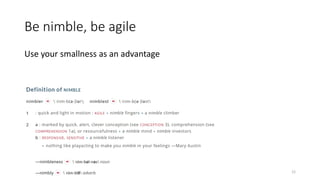
Be nimble, be agile
Use your smallness as an advantage
12
Do your marketing homework
• What market segment are you trying to reach?
• Who is your potential client?
• What is your core message?
• How would you present your services/products in a telephone call/face-to-
face meeting?
• What kind of words does your potential client use when referring to your
services/products?
• Customer questions and feedback are extremely useful for content
development and keyword research
• See: http://chiperoni.ch/wordpress/2017/11/seo-for-b2b-services-and-
products-how-to-get-started/
13
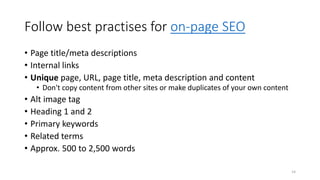
Follow best practises for on-page SEO
• Page title/meta descriptions
• Internal links
• Unique page, URL, page title, meta description and content
• Don't copy content from other sites or make duplicates of your own content
• Alt image tag
• Heading 1 and 2
• Primary keywords
• Related terms
• Approx. 500 to 2,500 words
14
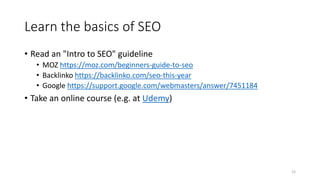
Learn the basics of SEO
• Read an "Intro to SEO" guideline
• MOZ https://moz.com/beginners-guide-to-seo
• Backlinko https://backlinko.com/seo-this-year
• Google https://support.google.com/webmasters/answer/7451184
• Take an online course (e.g. at Udemy)
15
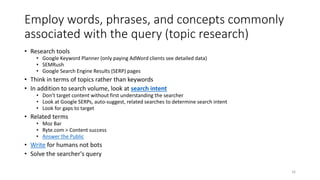
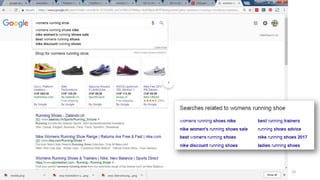
Employ words, phrases, and concepts commonly
associated with the query (topic research)
• Research tools
• Google Keyword Planner (only paying AdWord clients see detailed data)
• SEMRush
• Google Search Engine Results (SERP) pages
• Think in terms of topics rather than keywords
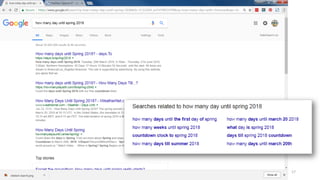
• In addition to search volume, look at search intent
• Don’t target content without first understanding the searcher
• Look at Google SERPs, auto-suggest, related searches to determine search intent
• Look for gaps to target
• Related terms
• Moz Bar
• Ryte.com > Content success
• Answer the Public
• Write for humans not bots
• Solve the searcher's query
16
17
18
Usability matters
• Text fonts and page layout are important
• Use Heading 2s, bullet lists, images
• Add videos, slides, podcasts to increase engagement
• Use plain language, write conversationally
• Use clear messaging for call-to-action buttons
"On an average web page, users read 20% of the words.“
• Test your web pages (e.g. using Nielsen’s Think Aloud method, or A/B
testing)
19
Check
• Does your site match the intended purpose?
• Does it answer your client's questions?
• Mobile first: Check your site looks good on your smartphone
20
Plan your content
• Set up an editorial calendar with deadlines
• If you have a business blog, write a blog at regular intervals
• Freshness is (still) a ranking factor.
• Blogging helps you to find out what works or what doesn’t
21
Promote your site
• Send out regular email updates/newsletter
• Point to new content
• Content amplification/share on social media
• A social media link isn't a ranking factor but it helps with getting attention; getting indexed by
Google bot; building a community
• Network online and offline
• Present at barcamps, meetups, business conferences
• Engage on social media
• Buy some online paid ads at Linkedin, Facebook and Google Adwords
• Integrate your offline and online sales activities
• It is all digital today!
• Earn backlinks from relevant sites
• Your topics must be related; don’t buy backlinks
22
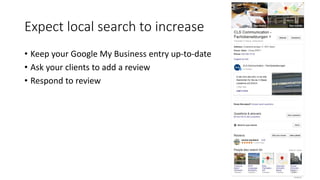
Expect local search to increase
• Keep your Google My Business entry up-to-date
• Ask your clients to add a review
• Respond to review
23
Fix your technical SEO
• Fast web hosting
• Page speed
• Get rid of bloat in your CMS (e.g. test your WordPress themes/plugins for speed)
• Google Page Speed Insights
• Lighthouse web developer tool for Chrome
• Make sure your web pages get indexed
• Google Search Console is your friend
• Minimum of crawl errors
• Get rid of duplicate page titles, meta descriptions, broken links
• Get HTTPS
• Add structured data to your web pages
• Schema
24
Measure. Add improvements. Repeat
• A page isn't getting any traffic?
• Why? Go back and try and figure out why.
• Thin content?
• Improving Low Quality Content is Better Than Deleting It
• How to improve:
• Show the page to 3 to 5 people and ask them for feedback
• Add an additional paragraph, improve the text and layout, add visuals
25
Resources
• https://searchengineland.com/5-ways-seo-experts-say-optimize-rankbrain-273458
• https://www.searchenginejournal.com/google-algorithm-history/rankbrain/
• https://varvy.com/matching-user-intent.html
• https://www.bdc.ca/en/blog/pages/seo-basics-entrepreneurs-easy-tips-optimizing-website.aspx
• https://searchengineland.com/small-business-seo-questions-answered-276500
• https://moz.com/blog/rank-in-2018-seo-checklist
• https://moz.com/blog/how-google-gives-us-insight-into-searcher-intent-through-the-results-whiteboard-friday
• https://searchengineland.com/rank-position-0-3-simple-steps-featured-snippets-primer-275941
• http://chiperoni.ch/wordpress/2017/11/seo-for-b2b-services-and-products-how-to-get-started/
• https://www.nngroup.com/articles/plain-language-experts/
• https://searchengineland.com/add-schema-markup-site-using-google-tag-manager-272516
• https://www.facebook.com/netnode.ch/videos/1703065746381150/
• http://www.sem-deutschland.de/semantische-seo/
• http://www.sem-deutschland.de/welche-bedeutung-hat-machine-learning-fuer-seo-2/
• https://www.seokratie.de/holistik-seo/
• https://www.crazyegg.com/blog/everything-about-semantic-search/
• https://www.netnode.ch/blog/alle-textsorten-fuer-blogs
• https://moz.com/blog/write-for-seo-2018
26
Tools
• Google Analytics/Google Search Console/Google My Business/Google
Keyword Planner/Google Tag Manager/Google Page Speed
Insight/Lighthouse
• Ryte
• SEMRush
• Linkdex
• Brightedge
• Buzzsumo
• MOZ
27
Connect
https://www.linkedin.com/in/sandrawendland/
Private blog
28

SEO for small business websites

  • 1.
    SEO for small businesswebsites Sandra Wendland 6th Feb 2018 1
  • 2.
    Questions • Do youmaintain your own business website? • Do you outsource technical website tasks? • Do you write your own web content? 2
  • 3.
    First organic entries GoogleMap entries Google Adwords 3
  • 4.
    Featured snippet (position0) First organic entries 4
  • 5.
  • 6.
    Google • Over 250ranking factors • Rankbrain (machine intelligence) • Engagement (measuring data off-site and on-site) 6
  • 7.
    • SEO isdead • SEO is evolving 7
  • 8.
    What to focuson in 2018 • Technical SEO • HTTPS • Page speed • Content • Search intent • Voice search 8
  • 9.
    SEO for smallbusiness websites: some questions entrepreneurs have (1/2) • I don’t want to invent the wheel, so what basics do I need to know about SEO or do myself? • What are the top 3 mistakes that I have to avoid? • Is SEO and web design totally connected, or can I outsource this to separate providers? • How do I select an SEO provider? • How regular should I, or my provider, work actively on the SEO to keep the good results? Or: what is my decay-time? • Should I do SEO in every language of my website? 9
  • 10.
    SEO for smallbusiness websites: some questions entrepreneurs have (2/2) • Is SEO scalable? Meaning: if I have set up my SEO properly, that with every added search word, I have proportionally more results? Or do I have diminishing returns, every time I add a search word, or content improvement? Where do I reach the optimum in money and effect? • How do I measure success with SEO? Proof that it works! • What are the content activities I should do that help with better SEO results? Like: weekly blog publication, news items, reposting other people’s content… etc? • Wie kann man sicherstellen, dass man als Firma von den Zielkunden gefunden wird (und nicht von den «Falschen»)? • Kann man Adwords durch gutes SEO ersetzen? Wie macht man das am effizientesten? • SEO inhouse or extern ? 10
  • 11.
    Small business owner:What to do? • Limited time • Limited resources • Outsource or DIY? 11
  • 12.
    Be nimble, beagile Use your smallness as an advantage 12
  • 13.
    Do your marketinghomework • What market segment are you trying to reach? • Who is your potential client? • What is your core message? • How would you present your services/products in a telephone call/face-to- face meeting? • What kind of words does your potential client use when referring to your services/products? • Customer questions and feedback are extremely useful for content development and keyword research • See: http://chiperoni.ch/wordpress/2017/11/seo-for-b2b-services-and- products-how-to-get-started/ 13
  • 14.
    Follow best practisesfor on-page SEO • Page title/meta descriptions • Internal links • Unique page, URL, page title, meta description and content • Don't copy content from other sites or make duplicates of your own content • Alt image tag • Heading 1 and 2 • Primary keywords • Related terms • Approx. 500 to 2,500 words 14
  • 15.
    Learn the basicsof SEO • Read an "Intro to SEO" guideline • MOZ https://moz.com/beginners-guide-to-seo • Backlinko https://backlinko.com/seo-this-year • Google https://support.google.com/webmasters/answer/7451184 • Take an online course (e.g. at Udemy) 15
  • 16.
    Employ words, phrases,and concepts commonly associated with the query (topic research) • Research tools • Google Keyword Planner (only paying AdWord clients see detailed data) • SEMRush • Google Search Engine Results (SERP) pages • Think in terms of topics rather than keywords • In addition to search volume, look at search intent • Don’t target content without first understanding the searcher • Look at Google SERPs, auto-suggest, related searches to determine search intent • Look for gaps to target • Related terms • Moz Bar • Ryte.com > Content success • Answer the Public • Write for humans not bots • Solve the searcher's query 16
  • 17.
  • 18.
  • 19.
    Usability matters • Textfonts and page layout are important • Use Heading 2s, bullet lists, images • Add videos, slides, podcasts to increase engagement • Use plain language, write conversationally • Use clear messaging for call-to-action buttons "On an average web page, users read 20% of the words.“ • Test your web pages (e.g. using Nielsen’s Think Aloud method, or A/B testing) 19
  • 20.
    Check • Does yoursite match the intended purpose? • Does it answer your client's questions? • Mobile first: Check your site looks good on your smartphone 20
  • 21.
    Plan your content •Set up an editorial calendar with deadlines • If you have a business blog, write a blog at regular intervals • Freshness is (still) a ranking factor. • Blogging helps you to find out what works or what doesn’t 21
  • 22.
    Promote your site •Send out regular email updates/newsletter • Point to new content • Content amplification/share on social media • A social media link isn't a ranking factor but it helps with getting attention; getting indexed by Google bot; building a community • Network online and offline • Present at barcamps, meetups, business conferences • Engage on social media • Buy some online paid ads at Linkedin, Facebook and Google Adwords • Integrate your offline and online sales activities • It is all digital today! • Earn backlinks from relevant sites • Your topics must be related; don’t buy backlinks 22
  • 23.
    Expect local searchto increase • Keep your Google My Business entry up-to-date • Ask your clients to add a review • Respond to review 23
  • 24.
    Fix your technicalSEO • Fast web hosting • Page speed • Get rid of bloat in your CMS (e.g. test your WordPress themes/plugins for speed) • Google Page Speed Insights • Lighthouse web developer tool for Chrome • Make sure your web pages get indexed • Google Search Console is your friend • Minimum of crawl errors • Get rid of duplicate page titles, meta descriptions, broken links • Get HTTPS • Add structured data to your web pages • Schema 24
  • 25.
    Measure. Add improvements.Repeat • A page isn't getting any traffic? • Why? Go back and try and figure out why. • Thin content? • Improving Low Quality Content is Better Than Deleting It • How to improve: • Show the page to 3 to 5 people and ask them for feedback • Add an additional paragraph, improve the text and layout, add visuals 25
  • 26.
    Resources • https://searchengineland.com/5-ways-seo-experts-say-optimize-rankbrain-273458 • https://www.searchenginejournal.com/google-algorithm-history/rankbrain/ •https://varvy.com/matching-user-intent.html • https://www.bdc.ca/en/blog/pages/seo-basics-entrepreneurs-easy-tips-optimizing-website.aspx • https://searchengineland.com/small-business-seo-questions-answered-276500 • https://moz.com/blog/rank-in-2018-seo-checklist • https://moz.com/blog/how-google-gives-us-insight-into-searcher-intent-through-the-results-whiteboard-friday • https://searchengineland.com/rank-position-0-3-simple-steps-featured-snippets-primer-275941 • http://chiperoni.ch/wordpress/2017/11/seo-for-b2b-services-and-products-how-to-get-started/ • https://www.nngroup.com/articles/plain-language-experts/ • https://searchengineland.com/add-schema-markup-site-using-google-tag-manager-272516 • https://www.facebook.com/netnode.ch/videos/1703065746381150/ • http://www.sem-deutschland.de/semantische-seo/ • http://www.sem-deutschland.de/welche-bedeutung-hat-machine-learning-fuer-seo-2/ • https://www.seokratie.de/holistik-seo/ • https://www.crazyegg.com/blog/everything-about-semantic-search/ • https://www.netnode.ch/blog/alle-textsorten-fuer-blogs • https://moz.com/blog/write-for-seo-2018 26
  • 27.
    Tools • Google Analytics/GoogleSearch Console/Google My Business/Google Keyword Planner/Google Tag Manager/Google Page Speed Insight/Lighthouse • Ryte • SEMRush • Linkdex • Brightedge • Buzzsumo • MOZ 27
  • 28.