BLACK BOX 
TESTING 
By Arun pandey
What is Black-box Testing? 
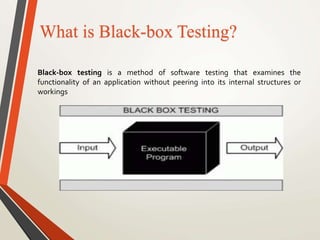
Black-box testing is a method of software testing that examines the 
functionality of an application without peering into its internal structures or 
workings
This method of attempts to find errors 
in the following categories 
• Incorrect or missing functions 
• Interface errors 
• Errors in data structures or external database access 
• Behavior or performance errors 
• Initialization and termination errors
LEVELS APPLICABLE TO 
Black Box Testing method is applicable to all levels of the software 
testing process: 
• Unit Testing 
• Integration Testing 
• System Testing 
• Acceptance Testing 
• The higher the level, and hence the bigger and more complex the box, the 
more black box testing method comes into use.
BLACK BOX TESTING 
ADVANTAGES 
• Tests are done from a user’s point of view and will help in exposing 
discrepancies in the specifications 
• Tester need not know programming languages or how the software has been 
implemented 
• Tests can be conducted by a body independent from the developers, allowing 
for an objective perspective and the avoidance of developer-bias 
• Test cases can be designed as soon as the specifications are complete
BLACK BOX TESTING 
DISADVANTAGES 
• Only a small number of possible inputs can be tested and many program paths 
will be left untested 
• Without clear specifications, which is the situation in many projects, test cases 
will be difficult to design 
• Tests can be redundant if the software designer/ developer has already run a 
test case. 
• Ever wondered why a soothsayer closes the eyes when foretelling events? So 
is almost the case in Black Box Testing.
STRUCTRURAL TESTING
What is Structural Testing? 
• Method of testing the application at the level of the source code. 
• known as white-box testing, clear box testing, glass box testing, 
transparent box testing, and structural testing 
• programming skills, are used to design test cases. 
• applied at the unit, integration and system levels of the software testing 
process. 
• These different techniques exercise every visible path of the source code to 
minimize errors and create an error-free environment. 
• knowledge of the internal implementations of the code.
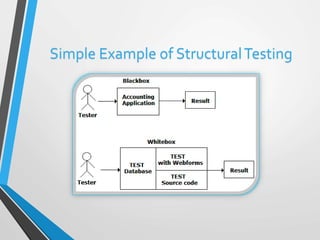
Simple Example of Structural Testing
Uses of Structural Testing 
• tests internal structures of software. 
• To find how the software is implemented, and how it works. 
• To create an error free environment by examining any fragile code 
• to prevent any hidden errors. 
• Prevent Logical error. 
• Typographical errors and syntax checking.
Advantages of Structural Testing 
• The tester can identify objects pro grammatically. This can be useful when 
the GUI is frequently changing. 
• It can improve stability and re usability of test cases . 
• By testing each path completely it is possible for a tester to achieve 
thoroughness.
Disadvantage of Structural Testing 
• High degree of complexity 
• Requires highly skilled people to develop the test cases.
EQUIVALENCE PARTITIONING
What is Equivalence Partitioning? 
• Equivalence Partitioning is a software test design technique that involves 
dividing input values into valid and invalid partitions and selecting 
representative values from each partition as test data. 
• Equivalence partitioning (also called Equivalence Class Partitioning or 
ECP) is a software testing technique that divides the input data of a software 
unit into partitions of equivalent data from which test cases can be derived
Equivalence Partitioning 
• The input data and number of program can be divided into number of classes. 
These class most have a common characteristics. 
• One system approach to defect testing is based on identifying all equivalence 
partition which must be handled by a program. 
• Once you have identify a set of partition, you then choose test cases from each 
of these partition.
Equivalence Partitioning 
• In principle, test cases are designed to cover each partition at least once. 
This technique tries to define test cases that uncover classes of errors, 
thereby reducing the total number of test cases that must be developed. 
• An advantage of this approach is reduction in the time required for testing 
a software due to lesser number of test cases. 
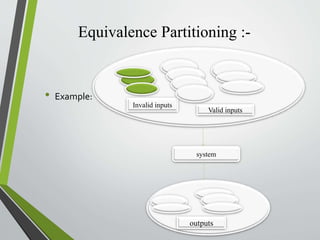
• In general an input has certain ranges which are valid and other ranges 
which are invalid.
Equivalence Partitioning :- 
• Example: 
Invalid inputs 
Valid inputs 
system 
outputs
Path Testing
What is Path Testing ? 
 
Typical white box testing but nowadays also used in black box tests. 
 
Is a structural testing method that involves using the source code of a program 
to attempt to find every possible executable path. 
 
Aims to derive a logical complexity measure of a procedural design and use 
this as a guide for defining a basic set of execution paths.
Path Testing(cont..) 
 
The objective of path testing is to ensure that the set of test cases is such that 
each path through the program is executed at least once. 
 
The starting point for path testing is a program flow graph that shows nodes 
representing program decisions and arcs representing the flow of control. 
 
Statements with conditions are therefore nodes in the flow graph.
Benefits of path testing 
 
Defines the number of independent paths thus the number of test cases needed to 
ensure: 
♦ Every statement will be executed at least one time 
♦ Every condition will be executed on its true & false sides 
 
Focuses attention on program logic 
 
Facilitates analytical versus arbitrary test case design.
Sorfware engineering presentation (software testing)

Sorfware engineering presentation (software testing)

  • 1.
    BLACK BOX TESTING By Arun pandey
  • 2.
    What is Black-boxTesting? Black-box testing is a method of software testing that examines the functionality of an application without peering into its internal structures or workings
  • 3.
    This method ofattempts to find errors in the following categories • Incorrect or missing functions • Interface errors • Errors in data structures or external database access • Behavior or performance errors • Initialization and termination errors
  • 4.
    LEVELS APPLICABLE TO Black Box Testing method is applicable to all levels of the software testing process: • Unit Testing • Integration Testing • System Testing • Acceptance Testing • The higher the level, and hence the bigger and more complex the box, the more black box testing method comes into use.
  • 5.
    BLACK BOX TESTING ADVANTAGES • Tests are done from a user’s point of view and will help in exposing discrepancies in the specifications • Tester need not know programming languages or how the software has been implemented • Tests can be conducted by a body independent from the developers, allowing for an objective perspective and the avoidance of developer-bias • Test cases can be designed as soon as the specifications are complete
  • 6.
    BLACK BOX TESTING DISADVANTAGES • Only a small number of possible inputs can be tested and many program paths will be left untested • Without clear specifications, which is the situation in many projects, test cases will be difficult to design • Tests can be redundant if the software designer/ developer has already run a test case. • Ever wondered why a soothsayer closes the eyes when foretelling events? So is almost the case in Black Box Testing.
  • 7.
  • 8.
    What is StructuralTesting? • Method of testing the application at the level of the source code. • known as white-box testing, clear box testing, glass box testing, transparent box testing, and structural testing • programming skills, are used to design test cases. • applied at the unit, integration and system levels of the software testing process. • These different techniques exercise every visible path of the source code to minimize errors and create an error-free environment. • knowledge of the internal implementations of the code.
  • 9.
    Simple Example ofStructural Testing
  • 10.
    Uses of StructuralTesting • tests internal structures of software. • To find how the software is implemented, and how it works. • To create an error free environment by examining any fragile code • to prevent any hidden errors. • Prevent Logical error. • Typographical errors and syntax checking.
  • 11.
    Advantages of StructuralTesting • The tester can identify objects pro grammatically. This can be useful when the GUI is frequently changing. • It can improve stability and re usability of test cases . • By testing each path completely it is possible for a tester to achieve thoroughness.
  • 12.
    Disadvantage of StructuralTesting • High degree of complexity • Requires highly skilled people to develop the test cases.
  • 13.
  • 14.
    What is EquivalencePartitioning? • Equivalence Partitioning is a software test design technique that involves dividing input values into valid and invalid partitions and selecting representative values from each partition as test data. • Equivalence partitioning (also called Equivalence Class Partitioning or ECP) is a software testing technique that divides the input data of a software unit into partitions of equivalent data from which test cases can be derived
  • 15.
    Equivalence Partitioning •The input data and number of program can be divided into number of classes. These class most have a common characteristics. • One system approach to defect testing is based on identifying all equivalence partition which must be handled by a program. • Once you have identify a set of partition, you then choose test cases from each of these partition.
  • 16.
    Equivalence Partitioning •In principle, test cases are designed to cover each partition at least once. This technique tries to define test cases that uncover classes of errors, thereby reducing the total number of test cases that must be developed. • An advantage of this approach is reduction in the time required for testing a software due to lesser number of test cases. • In general an input has certain ranges which are valid and other ranges which are invalid.
  • 17.
    Equivalence Partitioning :- • Example: Invalid inputs Valid inputs system outputs
  • 18.
  • 19.
    What is PathTesting ?  Typical white box testing but nowadays also used in black box tests.  Is a structural testing method that involves using the source code of a program to attempt to find every possible executable path.  Aims to derive a logical complexity measure of a procedural design and use this as a guide for defining a basic set of execution paths.
  • 20.
    Path Testing(cont..)  The objective of path testing is to ensure that the set of test cases is such that each path through the program is executed at least once.  The starting point for path testing is a program flow graph that shows nodes representing program decisions and arcs representing the flow of control.  Statements with conditions are therefore nodes in the flow graph.
  • 21.
    Benefits of pathtesting  Defines the number of independent paths thus the number of test cases needed to ensure: ♦ Every statement will be executed at least one time ♦ Every condition will be executed on its true & false sides  Focuses attention on program logic  Facilitates analytical versus arbitrary test case design.